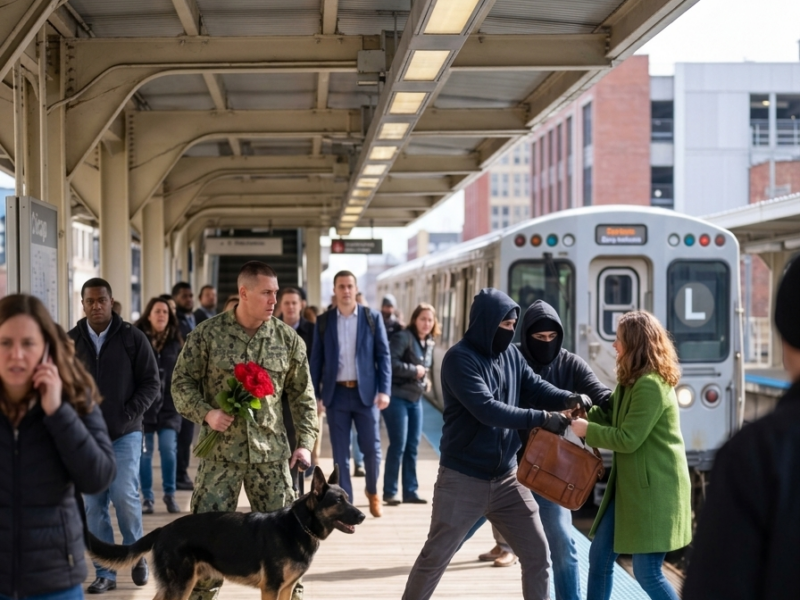
The last train pulled into Chicago’s Union Station as I stood there with my service dog, Atlas, holding flowers for a woman who never came
The midnight train from Milwaukee rolled into Chicago’s Union Station with a low, metallic groan that echoed through the vast, vaulted concourse. Steam hissed against the damp, chilly platform, obscuring the flickering fluorescent lights above. I stood near column fourteen, shifting my weight from one foot to the other, holding a bouquet of yellow roses that felt heavier with every passing second. Beside me, Atlas, my Belgian Malinois service dog, sat perfectly still, his dark eyes scanning the sparse late-night crowd.
I had been waiting forty minutes, checking my phone so often the screen felt burned into my hand. My date, Claire, had promised she would be on that train. We had been talking online for three months—long nights spent sharing late-night conversations after my night terrors kept me awake. She knew about my time in the Navy SEALs, my medically honorable discharge, and the quiet, solitary life I led in the suburbs of Chicago. Tonight was supposed to be our first real meeting.
Then Atlas suddenly stiffened.
His ears lifted, his muscles coiled, and he pulled hard against his leash toward the far end of the platform.
“Easy, buddy,” I muttered, adjusting my grip on his harness.
He ignored me—a rare occurrence for a dog trained to respond to my subtle heart-rate changes. Across the platform, beneath the dim shadow of an inactive train car, a woman in a mud-splattered gray coat was sitting alone on the cold concrete, her hands trembling violently. She looked so pale she seemed on the verge of fading into the concrete beneath her. Commuters walked past her, pulling their coats tighter, averting their eyes. One man glanced down, winced slightly, and hurried toward the exit.
I knew that look. It was the look people gave when someone’s pain made them uncomfortable—a silent decision that another human being’s crisis was none of their business.
Atlas pulled again, his tail rigid, his nose high in the air. This time, I followed him.
“Ma’am, are you okay?” I asked, dropping my flowers onto a nearby bench and crouching beside her.
She flinched violently, pulling her collar up, her dark eyes wide with unadulterated panic. When she looked at me, then down at Atlas, her chest heaved. “Please don’t call anyone,” she whispered, her voice barely audible over the hum of the station’s ventilation system.
That stopped me. “Why?”
Her eyes filled with tears, reflecting the orange tint of the overhead emergency lights. “Because if you call them, they’ll find me.”
Every survival instinct I had developed during eight years in special operations flared to life. This wasn’t the confusion of someone disoriented by cold or alcohol; this was pure, calculated terror. The kind of fear that had a specific face and a specific name. As she adjusted her coat, I caught a glimpse of deep violet bruising around her wrist and a fresh, swollen cut just beneath her jawline.
“Who are you running from?” I asked softly, keeping my posture non-threatening.
She stared at me for several excruciating seconds, weighing whether I was a threat. “My husband,” she finally breathed.
At that exact second, my phone vibrated in my palm. A text from Claire. I opened it expecting an apology for her delay, or perhaps an explanation that she had missed the train.
Instead, the screen read: Don’t come looking for me.
I stared at the six words, a sudden coldness settling in the pit of my stomach. The woman beside me caught a glimpse of the illuminated screen and went completely still. Her head snapped up, her eyes darting between the phone screen and my face.
“You know her?” she whispered, her voice trembling.
I nodded slowly, my mind racing. “She’s… she’s the woman I was supposed to meet here.”
The woman’s face drained of what little color it had left. “Then you need to leave right now.”
“Why?”
She swallowed hard, her knuckles white as she gripped her elbows. “Because Claire isn’t who you think she is. She isn’t a date, Noah. She’s a scout.”
Before I could process her words or ask how she knew my name, Atlas let out a low, chest-vibrating growl facing the central concourse doors.
A tall man in a dark tactical jacket stepped through the entrance. He didn’t look like a late-night traveler; he had no luggage, his gait was precise, and his eyes swept the platform with practiced efficiency. The moment his gaze locked onto us, he reached inside his jacket toward his left armpit.
Instinct overrode confusion. I stepped directly between him and the woman, placing my body as a shield. “Stay behind me,” I ordered.
The stranger stopped fifteen yards away. He slowly withdrew his hand from his coat, holding a small silver object, and smiled. It wasn’t a nervous smile—it was the cold, clinical expression of a predator that had tracked its prey to a dead end.
“You have no idea what you’ve stepped back into, Miller,” he said smoothly.
Distance sirens suddenly began to echo from the street level above, their high-pitched wails bouncing off the marble walls of the terminal. The man’s smile vanished. He took a step back, turned smoothly, and sprinted back toward the concourse stairs.
I took three fast strides to pursue him, but a sharp, terrified scream from the woman pulled me back.
She was staring down at my phone, which was still resting on the bench beside my discarded flowers. A second text message had illuminated the screen.
Ask her why she has your military records.
I turned back to the woman. Her shaking hands were reaching inside the deep inner pocket of her gray coat. She pulled out a thick, moisture-damaged manila envelope and held it out to me with trembling fingers. My name—NOAH MILLER, CPO, USN—was stamped clearly across the seal in red ink.
I tore the envelope open. Inside was a single, glossy photograph taken eight years ago in the Helmand Province of Afghanistan. I was standing beside my team leader, Master Chief Marcus Vance—the man whose body I had searched for after an ambush destroyed our outpost, the man whose military funeral I had attended in Virginia, the man I had blamed myself for losing for nearly a decade.
I turned the photograph over. Written in faded black marker were four short words:
He’s alive, and he’s coming.
Atlas suddenly stood up, barking aggressively toward the pitch-black mouth of the train tunnel behind us. Deep beneath the heavy iron tracks, somewhere in the labyrinthine service corridors under the city, a heavy metal door slammed shut with a deafening reverberation.
The woman lunged forward, her hand clamping onto my forearm with surprising strength. “He’s here,” she gasped.
I stared into the blackness of the subway tunnel, my mind shattering into a thousand pieces. The woman I came to meet was a lie, the stranger on the platform was a hunter, and the ghost I had carried in my heart for eight years was walking beneath the streets of Chicago.
“We can’t stay here,” I said, my tactical instincts overriding the shock paralyzing my brain. “If he’s in the lower service levels, he controls the egress points to the main hall.”
The woman struggled to stand, her legs buckling beneath her. I caught her by the upper arm, hauling her to her feet while Atlas circled us, his hair raised along his spine, his sensory focus locked on the tunnel.
“What is your name?” I demanded, dragging her toward the heavy maintenance doors marked EMPLOYEE ACCESS ONLY near the platform edge.
“Sarah,” she gasped, wincing as her injured leg took her weight. “Sarah Vance.”
The name hit me like a physical blow. Vance. Marcus Vance’s widow. I had sent her letters after the deployment—letters her lawyers had returned unopened. I had sent flowers to a home address in North Carolina that was eventually listed as abandoned. The last report I had received from Navy Casualty Assistance was that Sarah Vance had moved away and cut all ties with the military community.
“Marcus’s wife?” I asked, shoving open the heavy steel door and pulling her into a dimly lit concrete corridor that smelled of ozone, old water, and damp dust. Atlas slipped through first, clearing the hallway ahead of us.
“He’s not the man you served with, Noah,” Sarah said, leaning heavily against the concrete wall as the door heavy-latched shut behind us, cutting off the echoing sirens from the platform outside. “The man who died in Afghanistan… he should have stayed dead. Whatever came back eight months ago isn’t my husband.”
“I buried him, Sarah,” I said, pulling a compact flashlight from my pocket—a habit from my service days that I had never managed to break. The thin beam of light sliced through the darkness, revealing a long corridor lined with high-voltage conduits and rusting copper pipes. “I identified his dog tags. The brass confirmed the DNA from the wreckage of the command post.”
“They identified what he wanted them to identify!” Sarah’s voice cracked with hysteria. She pulled up the sleeve of her coat, showing me a series of circular scars on her forearm—thermal burns that had healed into jagged white tissue. “He staged the blast. He walked out of the valley while your unit took the blame for the compromised intelligence. He worked for a private military contractor out of Dubai for six years, and when he came back to the States three months ago, he tracked me down. He didn’t come back for love, Noah. He came back for his ledger.”
The air in the corridor grew colder. I looked down at the photograph in my hand. “What ledger?”
“The operational files from Operation Red Fall,” Sarah said, her breath forming small white clouds in the damp air. “The names of every officer who authorized the black-budget transfers in Kabul. He thinks you have the key to the encrypted drive he left behind in your kit when you were evacuated.”
My mind flashed back to the day I was medevaced out of the combat zone. My rucksack had been returned to me weeks later at Walter Reed Hospital. Among my personal belongings was a small, unmarked brass key on a leather cord—a souvenir I had assumed belonged to a trunk in our barracks. I had kept it in a lockbox at my apartment in Evanston for eight years.
Suddenly, Atlas dropped low to the ground, issuing a low, vibrating growl from his throat. He was facing the emergency stairs at the end of the corridor.
Clang.
The sound of iron boot-heels echoing against metal stairs echoed up from the level below.
“He’s cut off the exit to the street,” I whispered, reaching into my jacket and pulling out my folding tactical knife—the only weapon I carried legally in the city. “Sarah, listen to me. Who is Claire?”
“Claire is his operative,” Sarah said, backing away from the stairwell door. “She was hired to profile you. To see if you still suffered from PTSD, to see if you were weak enough to be manipulated into giving up the location of your storage unit. She wasn’t late tonight, Noah. She was waiting for Marcus to clear the perimeter.”
My phone vibrated again in my pocket. I pulled it out with my thumb over the speaker.
An audio file had been sent from an unknown number. I pressed play.
A voice I hadn’t heard in nearly a decade filled the tight concrete corridor—deeper now, raspy, damaged by fire, but unmistakably the voice of Master Chief Marcus Vance.
“You always were a loyal dog, Miller,” the recording said, accompanied by the static of a low-frequency radio. “You stood in the cold for forty minutes holding yellow roses for a woman who was reading your medical files in the van across the street. Give Sarah what she took from my safe, or I’ll make sure the CPD finds both of your bodies in the river before sunrise.”
The audio file ended.
Above us, the lights in the corridor began to flicker, then sputtered out entirely, plunging us into total darkness. The only light left was the thin, brilliant beam of my flashlight cutting through the settling dust.
From the stairwell, the heavy steel door clicked open.
“Atlas, heel,” I commanded softly. The dog pressed himself against my left knee, every muscle in his seventy-pound frame taut as a spring.
Out of the darkness at the end of the hallway stepped two men. Neither was Marcus Vance. They wore dark tactical gear without insignia, carrying silenced submachine guns held at low-ready positions.
“Noah Miller?” one of them called out, his voice echoing off the damp concrete. “Drop the light and step away from the woman. The Master Chief wants to speak with you privately.”
I raised the flashlight, blinding the lead man directly in the eyes.
“Atlas, strike!” I roared.
The Malinois exploded into motion, a dark blur tearing through the narrow space. The lead man fired a burst—the suppressed thwack-thwack-thwack of bullets biting into the concrete wall behind us—before Atlas hit his chest, taking him to the floor in a brutal tangle of limbs and tactical armor.
I lunged forward, closing the distance before the second man could bring his weapon to bear. I grabbed the barrel of his submachine gun, driving my hip into his midsection and stripping the weapon from his hands using a technique burned into my muscle memory. I struck him in the throat with the butt of the weapon, dropping him to his knees, then swept his legs from under him.
The hallway fell silent again, save for the heavy panting of my dog and the groans of the two men on the floor.
I picked up the dropped weapon, pulled the magazine to check the rounds, and slammed it back into place. I looked back at Sarah, who was leaning against the wall, staring at me in shock.
“You’re not a civilian anymore, are you?” she whispered.
“I never was,” I replied, grabbing her arm and pulling her toward the service ladder that led to the upper access hatches. “We’re going to my apartment. We’re getting that key, and then we’re going to put an end to a dead man’s ghost.”
The rain began to fall as we emerged from a storm grate three blocks away from Union Station, pulling ourselves up into a dark alley off Canal Street. The chill wind off Lake Michigan whipped through the alley, carrying the smell of wet asphalt and lake water. Atlas emerged last, shaking the damp street grime from his coat before taking his position at my right side, his eyes scanning the mouths of the alleyway.
Sarah was shivering uncontrollably, her face pale under the amber glow of the streetlights. I pulled off my heavy canvas coat and draped it over her shoulders.
“We can’t take the highways,” I said, guiding her toward my pickup truck parked in a secure garage two blocks away. “If Vance has resources, he’s monitoring the traffic cameras along the Kennedy Expressway. We take the side streets through Humboldt Park to Evanston.”
“He has more than traffic cameras, Noah,” Sarah said, clutching my coat around her chest as we walked quickly beneath the shadows of the elevated train tracks. “He has access to the city’s private surveillance network. The company he works for—Aegis Global—contracted with the city last year for smart-grid camera integration. They can run facial recognition on every public camera between here and the Wisconsin border.”
I unlocked the truck remotely, pushing Sarah into the passenger seat and loading Atlas into the back cabin. As I slid behind the wheel, I checked my rearview mirrors, watching the mouth of the parking garage. Nothing moved except the falling rain.
I pulled out onto the wet street, keeping my speed precisely at the posted limit. “Tell me everything, Sarah. From the beginning. How did you find out he was alive?”
Sarah stared out the passenger window, her reflection distorted by the rain running down the glass. “Eight months ago, I received an anonymous wire transfer into my bank account—fifty thousand dollars from an offshore account in the Cayman Islands. A week later, a man showed up at my house in Charlotte. He didn’t knock. He just walked into my kitchen in the middle of the night.”
She swallowed hard, her hand trembling as she touched the faint scar beneath her jaw. “I thought I was seeing a ghost. He looked older, his face scarred, his eyes… empty. He didn’t hug me. He didn’t ask how I had survived the last eight years. He just demanded to know where his old military trunk was—the one the Navy shipped back after the attack.”
“What was in that trunk?”
“A hard drive,” Sarah said softly. “A hardened, military-grade drive he had stolen from the forward operating base before the ambush. It contained the complete operational records of a black-site interrogation program in Afghanistan called Operation Winterfall. The men who funded that program are now high-ranking officials in the Department of Defense and private defense contractors. If those files are published, dozens of powerful men will spend the rest of their lives in federal prison.”
“And Marcus wanted to expose them?” I asked.
Sarah let out a bitter, lifeless laugh. “Expose them? No, Noah. Marcus wanted to blackmail them. He wanted fifty million dollars to hand over the master key. But when he opened his trunk in my house, the drive was missing. He thought I had taken it. That’s when he… that’s when he hurt me.”
My knuckles turned white against the leather of the steering wheel. Marcus Vance had been my mentor. He was the man who had pulled me out of a burning Humvee in Ramadi during my first deployment, the man who had taught me how to stay alive when everything around us was collapsing. To hear that he had turned into a monster who tortured his own wife was like learning the sun was cold.
“The drive wasn’t in his trunk,” I said slowly, connecting the pieces in my head. “Because he never put it there.”
“He left it with you,” Sarah said, turning to look at me. “The day before the final ambush, when your unit was preparing to patrol the valley. He gave you his secondary survival kit and told you to keep it safe. You thought it was just extra ammunition and rations, didn’t you?”
Memory flooded back to me—a hot, dusty afternoon in the Shahi-Kot Valley. Marcus tossing a heavy, waterproof nylon pouch into my rucksack. Hold onto this, Miller. Don’t open it unless I don’t make it back.
Two hours later, the valley exploded into mortars and small-arms fire. I had been hit by shrapnel, dragged to a medevac chopper under heavy fire, and spent the next three months in intensive care. I had forgotten about the pouch entirely until my belongings were delivered to my room at Walter Reed. I had taken the contents—a small brass key and a heavy black steel box—and put them away, unable to look at anything that reminded me of that day.
“The black box,” I whispered. “It’s been in my gun safe in Evanston for eight years.”
“And Claire was sent to find it,” Sarah added. “She spent three months creating a fake profile, targeting you on veteran support forums, learning your routines, learning where you lived. Tonight was supposed to be the night they broke into your apartment while you were waiting for her at the station.”
A cold wave of adrenaline spiked through my veins. I slammed my foot on the accelerator, the truck’s engine roaring as we surged forward through a yellow light onto Ridge Avenue.
“What’s wrong?” Sarah gasped, grabbing the dashboard.
“My gun safe doesn’t just hold the box,” I said, my voice dripping with lethal cold. “It holds my secondary security system feed. If someone enters my apartment, my phone gets an silent alert.”
I tapped my dashboard screen, bringing up the remote security app for my Evanston residence.
The screen blinked red.
ALERT: MOTION DETECTED – LIVING ROOM – 01:42 AM
ALERT: DOOR SENSOR BREACHED – MASTER BEDROOM – 01:44 AM
I flipped to the live video feed. The camera showed the interior of my small, neat living room. Two figures in civilian clothes were methodical tearing the place apart—ripping couch cushions, overturning bookcases, dragging my desk into the center of the room.
Standing in the center of the frame, facing away from the camera, was a large man wearing a dark trench coat. He turned slowly toward the hidden lens, as if he knew he was being watched.
His face was heavy, crossed by a jagged silver scar that ran from his ear down to his collarbone. His eyes were cold, dead gray.
Marcus Vance looked directly into the camera lens, raised his right hand, and made a slow cut across his throat.
The camera feed went black.
Ten minutes later, I pulled the truck into the dark alleyway behind my apartment building in Evanston. Rain was coming down in sheets now, washing down the brick walls and filling the storm drains with roaring water.
“Stay in the vehicle,” I told Sarah, putting the truck in park and pulling the tactical knife and the captured submachine gun from under my coat.
“Noah, no,” Sarah pleaded, grabbing my wrist. “He’s waiting for you! It’s a trap!”
“He’s in my home, Sarah,” I said, looking her dead in the eye. “He brought a war that ended eight years ago into my personal life. If I don’t face him here, he will hunt us down until there’s nowhere left to run.”
I turned to the back seat. “Atlas, stay with her. Guard.”
The Malinois whined softly, but settled into the passenger footwell, his head resting on Sarah’s knee, his eyes fixed on the alley exit.
I stepped out into the pouring rain, pulling my hood up as I slipped through the rear service door of the three-story brick building. The interior stairwell was quiet, smelling of clean laundry and old wood. I took the stairs two at a time, moving silently on the balls of my feet, keeping the submachine gun pointed up toward the third-floor landing.
My apartment was at the end of the hall—Door 3B.
The heavy oak door was slightly ajar, the lock shattered by a silent hydraulic tool. Light leaked out into the dark hallway, casting long, distorted shadows against the wallpaper.
I approached the door, backed against the wall, and listened.
Inside, I could hear the sound of wood splintering and metal grinding against metal. They were attempting to force open the heavy floor safe hidden in my bedroom closet.
“It’s reinforced with quarter-inch manganese steel, Master Chief,” a voice called out from inside—a younger man, sounding frustrated. “We need a plasma cutter to get through this faceplate.”
“We don’t have time for a cutter,” a voice replied—the deep, rough gravel of Marcus Vance. “Miller is already on his way. He wouldn’t leave his dog and his civilian friend at the station for long.”
I kicked the door open with a thunderous crack, stepping into the living room with the submachine gun raised to my shoulder.
“Hands!” I shouted, sweeping the room.
The younger man in the living room—a contractor in tactical pants—lunged for his sidearm resting on the dining table. I fired a two-round burst into his thigh, dropping him instantly to the hardwood floor, screaming in agony.
From the bedroom doorway, Marcus Vance stepped out slowly, his hands held at chest height, palms open.
Seeing him in person was like looking at a ghost reconstructed from nightmarish memories. He was heavier than he had been in Afghanistan, his hair streaked with silver, his face mapped with the brutal history of eight years spent in the shadows of illegal operations.
“Put the weapon down, Noah,” Vance said quietly, his voice unnervingly calm. “You always were good with a rifle, but you don’t have the stomach to shoot your commander.”
“You stopped being my commander the moment you let our team get slaughtered in the valley so you could walk away with fifty million dollars in dirty money,” I said, my finger tight against the trigger.
Vance chuckled—a dry, humorless sound. “Is that what Sarah told you? That I set up the ambush?”
“She showed me her arm, Vance. She showed me what you did to her.”
Vance’s gray eyes darkened, a flash of genuine pain crossing his scarred features before being replaced by cold detachment. “Sarah doesn’t know the whole story. She thinks she’s running from a monster. She doesn’t realize she’s carrying the very thing that’s going to get us all killed.”
“What are you talking about?” I demanded, keeping the gun leveled at his chest.
“The drive isn’t in your safe, Miller,” Vance said, taking a slow step forward. “The key you have doesn’t open a box. It opens a safety deposit box at the Federal Reserve in downtown Chicago. And the information on that drive doesn’t just name corrupt generals—it names Sarah’s father.”
I froze, my mind struggling to process the revelation. “Her father?”
“General Thomas Vance,” Marcus said, his voice dropping to an intense whisper. “The man who authorized the drone strikes that wiped out two civilian villages to cover up the missing funds. He’s the one who sent Claire. He’s the one who sent the team to Union Station tonight. I didn’t come to kill you, Noah. I came to get that key before her father’s men kill Sarah and erase every piece of evidence linking him to Red Fall!”
Before I could answer, the glass balcony doors behind me shattered into a storm of lethal shards.
A flashbang grenade bounced across the hardwood floor, rolling beneath the coffee table.
“Cover!” Vance roared, tackling me to the floor just as the flashbang detonated in a blinding white explosion of light and ear-splitting noise.
The world erupted into white light and high-pitched ringing. The concussive shockwave blew out the remaining windows, sending rain and freezing wind howling through the apartment.
I rolled across the floor, blinded and disoriented, my tactical instincts taking over as I reached for my fallen submachine gun. A heavy hand grabbed my collar, hauling me backward into the hallway just as a hail of automatic gunfire tore through the apartment walls, turning the drywall and furniture into splintered dust.
Marcus pulled me into the stairwell, slamming the heavy fire door shut behind us.
“Mercenaries!” Vance spat, wiping blood from a cut on his forehead. “General Vance’s private security detail! They tracked your truck from the station!”
My hearing slowly returned, replaced by the sound of boots pounding up the lower stairs. We were trapped between the hit squad coming through the apartment windows and the team pushing up from the street.
“Sarah!” I gasped, grabbing Vance by his coat. “She’s in the truck in the alley!”
“Then we go down!” Vance barked, drawing a heavy semi-automatic pistol from his belt. “Move!”
We sprinted down the concrete stairs, Vance taking the lead and firing three rapid shots through the central stairwell well at the men advancing from the second floor. Groans and falling gear echoed up the concrete shaft. We hit the ground floor service exit, bursting out into the alleyway into the driving rain.
Two armed men in dark raincoats were standing near my truck, weapons raised toward the driver’s side window.
Before they could pull their triggers, a dark streak lunged from the shadow beneath the truck’s chassis. Atlas sank his teeth into the lead shooter’s forearm, dragging him violently to the pavement. Vance raised his pistol and fired two precise shots, neutralizing the second gunman before he could bring his weapon around.
“Sarah! Get out!” I yelled, throwing open the passenger door.
Sarah scrambled out of the cab, trembling, her eyes wide with terror as she saw Marcus standing beside me, his face dripping with rain and blood.
“Stay away from me!” she screamed, backing away into the brick wall of the alley.
“Sarah, listen to me!” Vance shouted over the roar of the rain. “Your father sent them! The man you’ve been calling every week for help—he’s the one who leaked our position in Afghanistan! He’s the one who gave Claire your location!”
Sarah froze, her face turning as white as ash. “My… my father?”
“He couldn’t risk the Red Fall files coming to light,” Vance said, stepping forward, dropping his weapon to the wet asphalt to prove his intent. “He used me to cover his tracks eight years ago, and when I survived, he used you to bait me out into the open. The message you received tonight wasn’t from Claire—it was sent through your father’s private server!”
Sarah looked at me, her chest heaving, tears streaming down her cheeks, washing away the dirt and blood. “Noah… is he telling the truth?”
I looked down at the envelope in my hand, then at the photo of my old team, then into the eyes of the man I had mourned for nearly a decade. The pieces finally fell into place with terrifying clarity—the missing reports, the sudden closure of the investigation, the anonymous funds sent to Sarah’s account. It hadn’t been a husband hunting his wife; it had been a soldier trying to keep his family alive against a enemy that wore a four-star uniform.
“He’s telling the truth,” I said softly.
Headlights suddenly flashed at the entrance of the alleyway. A heavy black SUV slammed into reverse, blocking the exit, while two more tactical vehicles pulled up to block the street behind us. Armed men stepped out into the rain, forming a fatal perimeter.
From the front passenger seat of the lead SUV, an older man in a tailored trench coat stepped out, holding a large black umbrella. General Thomas Vance looked at his daughter, then at Marcus, and finally at me.
“You should have stayed in the grave, Marcus,” the General said, his voice amplified by a megaphone. “And you, Sergeant Miller… you should have stayed out of family matters.”
“He’s not leaving any witnesses,” I muttered to Marcus, stepping in front of Sarah while Atlas leaned heavily against my leg, growling into the storm.
“No,” Marcus said, a cold, dark smile spreading across his scarred face as he reached into his tactical vest and pulled out a small, heavy silver detonator. “He’s not. But he forgot who taught me how to lay an ambush.”
Marcus looked at me, his gray eyes clear for the first time in eight years. “Take Sarah and the dog. Run down the storm drain at the end of the alley. It connects to the main city sewer system—it leads two miles south to the river.”
“Marcus, no!” Sarah cried out.
“I died eight years ago in Helmand, Sarah,” Marcus said softly, without looking back. “It’s time I finished the mission.”
He pressed the red button on the detonator.
A series of deafening explosions rocked the alleyway as charge blocks Marcus had planted along the fire escapes detonate simultaneously, bringing tons of brick, iron, and masonry crashing down onto the mercenary vehicles, crushing the SUVs and blocking the street in a roaring wall of fire, dust, and twisted steel.
“GO!” Vance roared, turning toward the remaining survivors with his pistol raised, firing into the smoke as the alleyway collapsed into utter chaos.
I grabbed Sarah’s waist, lifting her off her feet, and hauled her toward the open storm grate at the rear wall. “Atlas, down!” I shouted.
The dog leaped into the dark, wet opening without hesitation. I lowered Sarah down into the rushing water below, then took one last look back through the billowing smoke and flames.
Marcus Vance was standing tall against the burning wreckage, holding the line, a solitary ghost standing between his past and his redemption.
I dropped down into the dark, cool water beneath the city, the heavy iron grate slamming shut above us, sealing out the noise of the battle, the burning city, and the shadows of a dead man’s war.
The end,









