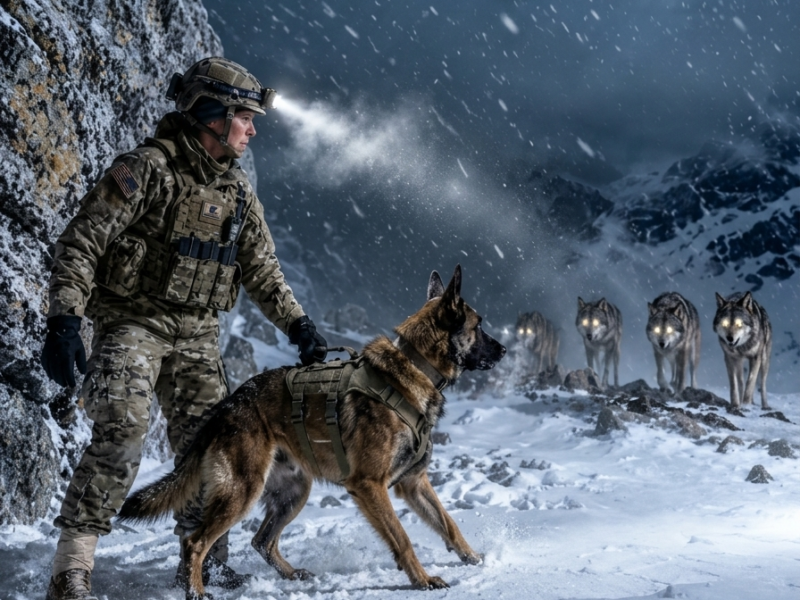
The last thing I remember seeing before the Colorado whiteout swallowed us was Sergeant Mason pointing his rifle at me and shouting, “Stay back,”
The Colorado whiteout didn’t just blind you; it erased your sense of existence. Standing at eleven thousand feet near Independence Pass, the world was reduced to the screaming roar of eighty-mile-an-hour winds and a wall of pure, suffocating white. Every breath felt like inhaling ground glass. My boots had long since lost all traction on the slick, wind-scoured ice, and my hands, locked inside frozen leather gloves, were numb blocks of useless meat.
The last clear image burned into my retina before the storm completely swallowed us was Sergeant Mason. He was fifty feet ahead of me, framed against the swirling vortex, his posture rigid and frantic. He raised his M4 rifle, pointing the barrel straight at my chest, his face contorted in a silent scream against the deafening gale.
“Stay back!” his voice tore through the storm, fractured and distorted by the wind.
Between us stood Ranger. The Belgian Malinois was a lean, muscle-bound shadow against the snow, his short mahogany coat dusted in frost. A distinct, pale scar ran above his left eye—a souvenir from an explosive ordnance disposal run in Afghanistan two years prior. Ranger’s ears were pinned flat against his skull, his body strained in a rigid arch. He wasn’t barking at the wind or the freezing air. He was positioned deliberately between Mason and me, his massive head turned toward the dark abyss of the ravine behind us. He pressed his heavy skull against my left knee—his instinctual, ironclad habit whenever he sensed the cold hand of terror gripping my spine.
That night, Ranger knew what was coming long before either of us did.
We had been dispatched six hours earlier on what was supposed to be a routine search-and-recovery mission. A four-person civilian rescue team had gone dark near the lower slopes of Independence Pass just as an unexpected arctic front surged down from the northern corridor. Command had assured us the storm was still hours away, but mountain weather acknowledges no forecasts. Within twenty minutes, the sky had collapsed from a clear twilight into an absolute, apocalyptic blackout.
“Turn around!” I had screamed at Mason just moments before he raised his rifle. I had stepped toward him, intending to grab his tactical vest and drag him back toward the treeline where we had a fraction of shelter.
Mason had shaken his head violently, his eyes wild and bloodshot behind his frozen goggles. “Two more minutes!” he yelled back. “Command said they were right here!”
Those two minutes didn’t save anyone. They became a sixty-three-hour descent into hell.
The avalanche didn’t start with a roar; it started with a sickening, sub-audible vibration beneath our boots—a deep, tearing groan as a massive slab of wind-packed snow detached from the upper ridge. Before I could process the shift in gravity, the mountain gave way. The force struck like a freight train, tearing our satellite radio from my harness, snapping pine trees like dry toothpicks, and hurling Mason sideways into a jagged wall of blue glacial ice.
I was swept fifty yards down the slope, tumbling in a disorienting washing machine of ice and debris until I slammed into a snowdrift. When the violent motion finally ceased, the silence was instant and deafening.
I clawed my way to the surface, gasping for air that felt like liquid nitrogen in my lungs. “Mason!” I croaked, my voice instantly stolen by the returning wind. “Ranger!”
Ranger found Mason first. Through the thick curtain of falling snow, I saw the dog digging wildly at a mound of ice. His front paws were a blur of frantic motion, throwing frozen chunks behind him until the skin on his pads was raw and dripping crimson onto the snow. He didn’t stop until he uncovered Mason’s torso. The Sergeant was bleeding profusely from a deep laceration on his forehead, his eyes rolled back, his breaths shallow and rattling. Without hesitation, Ranger dragged his body across Mason’s chest, curling his powerful frame over the wounded man to seal in what little body heat remained.
I dragged myself over, every joint in my body screaming in protest. I pulled our emergency orange tarp from my pack, my frozen fingers struggling with the grommets, and tried to anchor it against the rock face using ice screws. But the wind was merciless. Every few minutes, a powerful gust would rip under the edges, shredding the plastic and forcing me to lean my entire body over Mason and Ranger to keep us from being buried alive.
Every thirty minutes, I reached for my vest, blindly pressing the talk button on my primary radio. Nothing. Just the dry, static hiss of a dead signal. The temperature plunged far below zero. The fluid in my hydration bladder froze solid, rendering our water supply useless. My fingers lost all sensation, turning a waxy, translucent white.
Yet, for thirty-six brutal hours, Ranger never broke his watch. He lay glued to Mason, his warm breath fanning across the Sergeant’s pale face, his chest rising and falling in sync with the dying man’s pulse.
On the second night, as the darkness settled over us like a shroud, I pulled my face close to the dog’s frosted snout. “We’re going home, buddy,” I whispered, my lips so cracked they bled. “Just hold on. We’re going home.”
Ranger lifted his head. His dark eyes caught the faint reflection of the storm light. He didn’t relax. Instead, his body went rigid, and a low, guttural growl began deep in his chest.
I froze. “Ranger? What is it?”
At first, I thought he was reacting to the phantom sounds of the blizzard—the wind howling through the crevasses like wailing ghosts. But then, in a momentary lull between gusts, I heard it too.
A sound that shouldn’t have existed at eleven thousand feet in the middle of a killer storm. A sound beneath the ice.
It was a faint, rhythmically muted thumping, followed by a raspy, sobbing gasp of air coming from beneath a collapsed snow-shelf ten yards to our left.
We dug. With no shovels left, I used my combat knife to hack at the packed ice while Ranger tore through the crust with his bleeding paws. For nearly an hour, we fought the mountain until the ice gave way, revealing a narrow crawlspace beneath a fallen pine.
Trapped inside was a young woman in a torn military parka. Her name badge read Specialist Alvarez—a medic from a unit that shouldn’t have been within fifty miles of our grid. She was shivering violently, her skin blue, her eyes glassy with severe hypothermia.
Ranger immediately crawled into the cramped hollow beside her, wrapping his body around her frozen torso while I used my remaining strength to haul her up into our crude tarp shelter.
As I dragged Alvarez beside Mason, I saw the Sergeant’s eyelids flutter open. His gaze was hollow, unfocused, but he turned his head slowly toward me.
“How… long?” Mason rasped, his voice barely a whisper against the storm.
I checked the face of my mechanical watch, wiping away the frost crusting the glass. “Thirty-one hours,” I said. “We’ve been down thirty-one hours.”
Mason closed his eyes, his breathing heavy and strained. He reached out a trembling, gloved hand and touched Ranger’s flank. “Ranger… knows the way,” he muttered incoherently. “He knows…”
“Knows the way where?” I asked, leaning closer. “Mason, where are we?”
He didn’t answer. He slipped back into unconsciousness.
I didn’t understand what Mason meant. Not then. Not until the break of the third morning.
As the sun began to rise behind an impenetrable layer of grey clouds, the violent winds suddenly died down to a bitter, whispering draft. The whiteout thinned just enough to grant us fifty yards of visibility.
Ranger stood up. He didn’t stretch; he didn’t look for food or water. He stood facing south-southeast, staring directly toward a narrow, jagged pass carved between two sheer walls of black granite—a path that was completely unmarked on any standard military topographical map. It was a route that led deeper into the wilderness, away from the established search-and-rescue corridors.
Ranger walked ten deliberate steps toward the pass. He stopped, turned his head, and locked his dark eyes on mine. He gave a single, low bark.
Then he walked again.
“He’s taking us out,” I murmured to Alvarez, who was barely conscious, leaning heavily against my shoulder.
For six agonizing hours, we followed the dog. Ranger moved like a ghost through a labyrinth of frozen ravines, unmapped ice bridges, and perilous snow-ledges. He never hesitated. He never checked a scent on the ground; he walked with his nose pointed straight ahead, as if following a invisible highway laid out in the air.
At 1400 hours, the faint, thump-thump-thump of heavy rotor blades vibrated through the canyon walls. Two Blackhawk helicopters broke through the cloud ceiling, their searchlights sweeping the slope. They spotted us at the edge of a high plateau.
Rescuers dropped from the sky. Medics swarmed Mason and Alvarez, hooking them up to IVs and loading them into litter baskets.
Mason survived. Alvarez survived. I survived with second-degree frostbite on my feet and fingers.
But Ranger collapsed the moment the second rescue harness touched the snow. His legs simply gave out. His heart was hammering against his ribs at a terrifying speed, his paws shredded to the muscle, his body temperature dangerously low. They carried him into the belly of the aircraft on a canvas stretcher, wrapping his bleeding limbs in sterile bandages.
Three days later, I was sitting in a stark, windowless briefing room at Fort Carson, my hands wrapped in heavy white gauze. An intelligence officer I had never seen before—a Colonel wearing a suit with no rank insignia—walked into the room and slid a thick paper folder across the metal table.
“Read it,” the Colonel said coldly.
I flipped open the folder with my bandaged thumbs. It was the official military after-action report of our rescue. My stomach plummeted as my eyes scanned the typed lines.
The report stated that I had abandoned my assigned post during the initial onset of the storm, panicking and fleeing down the mountain. It claimed Sergeant Mason had been found alone near the primary ridge, having secured Specialist Alvarez by his own efforts. Most egregiously, the document noted that Ranger had been severely injured in the initial avalanche and had played no operational or navigational role in the survival or rescue of the team.
I stared at the paper until the words blurred into meaningless black ink.
“Who wrote this?” I whispered, my voice trembling with rising fury. “This is a lie. I was with Mason the entire time. Ranger led us for six miles through an unmapped gorge! He saved Alvarez! He saved us!”
The Colonel didn’t answer. He didn’t even meet my eyes. Instead, he reached into his breast pocket, pulled out a smaller, single sheet of yellowed paper, and slid it quietly across the steel surface.
It was the raw digital telemetry printout from Ranger’s tactical GPS harness—the backup hardware that logged satellite coordinates directly to a hardened internal drive, independent of our radio comms.
I looked at the map trace. A bright red line showed our path up the mountain. Then, at the moment of the avalanche, the line abruptly stopped.
The final six hours of data—the exact route Ranger had taken to guide us to the rescue plateau—had been manually deleted from the digital record. The coordinates were blacked out with heavy ink.
And sitting right beneath the missing block of coordinates was a single, handwritten note written in shaky, frantic pencil. I recognized the handwriting instantly. It belonged to Sergeant Mason.
He didn’t lead us home, the note read. He led us to something.
My breath caught in my throat. I slowly turned my head toward the reinforced glass window at the end of the corridor. Down in the courtyard below, sitting alone in the falling snow outside the military veterinary clinic, was Ranger. He was wrapped in a thermal jacket, his paws neatly bandaged.
He wasn’t sleeping. He was sitting completely upright, staring fixedly toward the snow-capped peak of Independence Pass miles in the distance.
And for the first time, a cold terror settled into my chest as I realized the terrible truth: Ranger hadn’t been searching for a way off that mountain. He had been tracking something that was already up there.
The silence of the military hospital at Fort Carson was louder than the storm on Independence Pass. It was a sterile, suffocating quiet, broken only by the hum of fluorescent lights and the rhythmic beep of heart monitors down the hall.
I left the briefing room without signing the Colonel’s fraudulent report. They didn’t stop me. The silence from the officers felt like an ambush waiting to happen. My immediate priority wasn’t clearing my name; it was finding Sergeant Mason.
I snuck into the intensive care unit during the shift change at 0200 hours. The corridors were dimly lit, smelling of antiseptic and ozone. I found Mason’s room at the end of the hall, guarded not by standard military police, but by two private security contractors in tactical gear without unit patches. They didn’t recognize me in my civilian clothes, my hands hidden in my jacket pockets. I waited until one went to grab coffee and the other stepped away to answer a secure radio call, then I slipped through the heavy door.
Mason lay in the center of the dark room, hooked to a maze of clear plastic tubes and a ventilator. His head was wrapped in thick surgical dressing, his face bruised a violent shade of purple. His eyes fluttered open as the door clicked shut behind me.
“Mason,” I whispered, stepping close to his bed. “It’s me. Vance.”
He didn’t speak at first. His dry, cracked lips moved soundlessly. He reached out with a hand bruised dark green from IV lines, his fingers clutching my sleeve with surprising strength.
“They… they took the logs, Vance,” he rasped, his voice sounding like dry leaves blowing across pavement. “The Colonel… they cleared the grid.”
“I saw the report,” I said, leaning over his bed. “They said I ran. They said Ranger was useless. They erased the last six hours of the GPS data, Mason. What happened up there? What did Ranger find?”
Mason’s eyes shifted frantically toward the window, as if expecting someone to crash through the glass. “It wasn’t a civilian rescue team we were sent for,” he whispered, his chest heaving against the ventilator monitor. “Command lied to us from the start. It was a crash recovery.”
“A crash?”
“Not a plane, Vance,” Mason gritted his teeth, a tremor running through his jaw. “Something came down three nights before the whiteout. Department of Defense locked down the airspace over the pass. Specialist Alvarez… she wasn’t a medic. She was a bio-containment specialist attached to a black-budget task force out of Groom Lake. Her team was sent in to lock down the site before the storm hit. They didn’t count on the avalanche.”
My mind raced. Alvarez. The woman we found buried under the snow shelf. She hadn’t been trapped by accident; she was fleeing the very site Ranger had led us toward.
“When Ranger took the lead on the third morning,” Mason continued, his breath rattling in his throat, “he wasn’t following a path to safety. He was following a high-frequency tracking signal built into his tactical collar—a signal meant to auto-homing on emergency beacons. But he didn’t home on our beacon, Vance. He homed on theirs.”
“The site,” I realized, the blood running cold in my veins. “Ranger took us through the black gorge because it was the shortest path to the impact crater.”
“And what was down there…” Mason choked, tears cutting clear tracks through the grime on his bruised cheeks. “Vance, when I woke up for those few seconds in the ravine… before the Blackhawks arrived… I looked over the edge of the ice shelf where Ranger stopped. It wasn’t rock down there. It was metal. Black, seamless metal sticking out of the glacier like a broken tooth. And the air around it… the air was warm. The snow was melting before it touched the hull.”
Before I could ask him another question, the latch on the hospital door clicked.
I ducked behind the heavy privacy curtain just as the door swung open. Heavy boots stepped into the room.
“Sergeant Mason,” a cold, smooth voice spoke. It was the Colonel from the briefing room. “You should be resting. Your vitals are spiking.”
“Where is my dog?” Mason’s voice was suddenly hard, stripped of the terror he had just shown me.
“The K9 asset has been reassigned,” the Colonel replied calmly. “Given his physical trauma and exposure to extreme conditions, he is being transferred to a specialized recovery facility in San Antonio. He leaves at 0600.”
“He’s not an asset, Colonel,” Mason growled. “He’s a member of this team.”
“He is property of the United States Government, Sergeant,” the Colonel’s voice was absolute ice. “And as of two hours ago, your team no longer exists. You will be medically discharged with full benefits. Specialist Vance will face a court-martial for desertion unless he signs the non-disclosure agreement currently sitting on his desk. I suggest you advise your buddy to sign. The mountain is closed. Permanently.”
I held my breath behind the curtain, my knuckles white against my thighs. I heard the Colonel turn and walk out, the door closing with a firm, definitive click.
I stepped out from behind the curtain. Mason was looking at me, his eyes filled with a desperate, unspoken plea.
“They’re going to put Ranger down, Vance,” Mason whispered. “They aren’t taking him to San Antonio. They’re taking him to a lab to run tests on what he was exposed to at the crash site. You saw his paws. You saw how he acted. He inhaled whatever leaked out of that hull. If they get him to San Antonio, he never comes out.”
“I won’t let them take him,” I said.
“You can’t fight them here, Vance. They have the whole base locked down.” Mason reached under his pillow, pulling out a small, metallic keycard attached to a braided lanyard—his master access pass for the K9 motor pool. “Take my truck. It’s parked behind the supply depot. Ranger is being held in Bay 4 of the veterinary transport complex. Get him out before 0600.”
“What about you?” I asked.
“I can’t run,” Mason looked down at his shattered legs. “But you can. Get Ranger. Find out what Alvarez knows. She was transferred to the secure medical wing at Peterson Space Force Base yesterday. She’s the only one who has the telemetry files they tried to delete.”
“And if they come after us?”
Mason looked up, his eyes hard as flint. “Then don’t let them catch you.”
I left the room through the secondary service exit, slipping through the darkened corridors of the hospital like a shadow. The temperature outside had dropped into the low teens, light flakes of fresh snow falling over the base.
I made my way to the K9 veterinary complex on the far side of the post. The facility was surrounded by a ten-foot chain-link fence topped with razor wire. A single security transport van was idling near Bay 4, its exhaust plumes thick and white in the freeze. Two armed handlers in unmarked grey fatigues were standing near the rear doors, holding clipboard documents.
Inside the bay, behind the reinforced wire mesh of a transport crate, I could see Ranger.
He was sitting perfectly still. His head was raised, his nose pointed toward the open door, his body tense. He knew I was there. Even fifty yards away through the falling snow and the diesel exhaust, the dog knew.
I pulled my watch face into the dim light of a streetlamp. 0515 hours. Forty-five minutes before the transport left.
I reached inside my jacket and felt the weight of Mason’s keycard. If I stepped across that fence line, my career, my freedom, and my life as I knew it were over. I would be a fugitive, wanted for treason and theft of government property.
Then I remembered Ranger lying across Mason’s freezing chest on the ridge. I remembered his bloody paws tearing through the ice to pull Specialist Alvarez from her grave. He hadn’t abandoned us on that mountain.
I wasn’t about to abandon him now.
I pulled my beanie low over my ears, gripped the keycard, and stepped out into the blinding white snow.
The lock on the perimeter gate clicked with a sharp, metallic snap as Mason’s keycard registered green. I slipped through the narrow gap, keeping my boots low in the fresh powder to minimize the sound of crunching snow.
The two handlers near the transport van were arguing in hushed, tense tones over a clipboard.
“Command wants the blood samples processed before we cross the state line,” the tall one said, checking his watch. “The radio-bio reads from the dog’s coat came back off the charts. We shouldn’t even be handling him without Level 4 suits.”
“Just load the crate,” the shorter handler snapped, thumbing the safety on his sidearm holster. “The sooner this dog is at the Nevada test site, the sooner this isn’t our problem.”
Nevada. Not San Antonio. Mason was right; they were taking Ranger to a classified weapons testing facility.
I didn’t have a weapon. I had a tactical flashlight, a roll of heavy-duty duct tape from my gear bag, and six years of close-quarters combat training from my time in the Infantry. It had to be enough.
I rounded the rear of the transport van, using the roaring idling engine to mask my footfalls. I struck the shorter handler first, bringing the heavy steel casing of the tactical flashlight down sharply behind his ear. He went down without a sound, collapsing into the snow drift.
Before the second handler could turn, I lunged forward, wrapping my forearm around his neck in a sleeper hold, slamming his body against the side of the van. He thrashed, reaching for his pistol, but I tightened my grip, cutting off the blood flow to his brain. Within eight seconds, his eyes rolled back and he went limp in my arms.
I dragged both men behind a row of stacked equipment pallets, bound their wrists with duct tape, and retrieved the master key ring from the taller handler’s belt.
I turned toward the transport crate inside Bay 4.
Ranger was standing up, his nose pressed hard against the iron bars of the crate door. His tail gave a single, hesitant thump against the plastic floor.
“Quiet, buddy,” I whispered, unlocking the crate latch.
The moment the door swung open, Ranger didn’t leap out with frantic excitement. He stepped out deliberately, his movements slow and calculated. His paws were neatly wrapped in fresh medical bandages, but he didn’t limp. He immediately walked up to me and pressed his broad, warm head firmly against my knee.
A surge of relief washed through me, but there was no time to celebrate. “Come on,” I muttered, grabbing his tactical harness from the equipment bench. I strapped it around his chest, clipping his lead to my belt.
We moved fast. I took the keys to the handlers’ unmarked grey SUV, loaded Ranger into the back seat, and smashed the gate mechanism with a crowbar on our way out to delay pursuit.
By 0600 hours, we were on Highway 115, heading north toward Colorado Springs. The storm from Independence Pass had pushed eastward, leaving the highway blanketed in a thick, eerie fog that reduced visibility to thirty feet.
As I drove, Ranger sat upright in the passenger seat beside summer-worn upholstery, his dark eyes staring fixatedly through the windshield. He wasn’t watching the road or the passing cars. He was watching the air—his nostrils flaring, his ears twitching at frequencies I couldn’t hear.
“Where are we going, Ranger?” I murmured, my hands tight on the steering wheel.
My destination was Peterson Space Force Base, twenty miles north. If Specialist Alvarez was being held there, she was my only chance at understanding what happened on the mountain and obtaining the raw telemetry files that could clear my name and protect Ranger.
Using Mason’s credentials and an old emergency access pass from my time with the joint task force, I managed to clear the outer perimeter check-point at Peterson just as the sun began to break through the fog. The base was on high alert; security patrols were doubled, and armored vehicles were parked near the central communications tower.
I parked the SUV behind the base medical research wing—a low, windowless concrete bunker surrounded by satellite dishes.
“Stay,” I told Ranger, pulling the key from the ignition.
Ranger didn’t stay. The moment I opened the driver’s side door, he pushed past me, slipping out into the cold morning air. He didn’t run away. He began trotting directly toward the rear service entrance of the bio-research facility, his head held low, sniffing the asphalt.
“Ranger, heel!” I hissed.
He ignored the command—something he had never done in five years of service. He reached the heavy metal service door, put his paws against the latch, and let out a low, persistent whine.
I ran up to him. The service door was cracked open an inch. A thin line of black electrical tape had been placed over the magnetic lock striker to keep it from engaging.
Someone inside had left it open for us. Or for someone else.
I pulled the door open, slipping inside with Ranger close at my heels. The corridor inside was brightly lit, white tiled, and dead silent. The air smelled strongly of bleach and something else—a sharp, metallic smell that tasted like copper on the back of my tongue.
Ranger moved down the hall with absolute purpose, his nails clicking softly on the linoleum. He stopped outside Room 108. The sign beside the door read: SPECIMEN ANALYSIS – ISOLATION UNIT 3.
I pushed the door open.
Sitting at a steel desk in the middle of a room filled with computer servers and bio-hazard containment units was Specialist Alvarez. She wasn’t in a hospital gown. She was dressed in full civilian clothes, a heavy tactical hard drive connected to a laptop on the desk in front of her.
She swung around, pulling a silenced 9mm pistol from beneath the desk, aiming it straight at my chest.
“Don’t move,” she said, her voice shaking violently.
“Alvarez,” I raised my hands, stepping in front of Ranger. “It’s Vance. Sergeant Vance from the pass. We dug you out.”
Alvarez lowered the gun slowly, her chest heaving as she recognized me. Her face was deathly pale, dark circles hollowed beneath her eyes. “Vance? How… how did you get in here?”
“Ranger brought me,” I said, pointing down at the dog.
Alvarez looked at Ranger, and to my horror, a look of profound, unadulterated terror crossed her face. She took a step back, hitting the edge of the metal desk.
“You shouldn’t have brought him here,” she whispered, her voice trembling. “You shouldn’t have brought him anywhere near this facility.”
“Why?” I demanded, taking a step forward. “What is going on, Alvarez? What was on that mountain? Mason said it was a crash. The Colonel erased six hours of GPS tracking data. What did Ranger find down in that gorge?”
Alvarez looked at the laptop screen, where lines of encrypted code were downloading onto a flash drive.
“It wasn’t a crash, Vance,” she said, her voice dropping to an absolute whisper. “It was an extraction. What we brought back from Independence Pass wasn’t an aircraft. It was a containment vault buried in the ice since 1962.”
She turned the laptop screen toward me.
On the monitor was a high-resolution thermal scan of the mountain ridge where Ranger had led us. Deep beneath the ice shelf, sixty feet below where we had dug Alvarez out, was a massive, perfectly spherical metal structure. And radiating outward from the sphere was a massive, pulsating ring of thermal energy.
“The whiteout wasn’t weather,” Alvarez said, her eyes wide with dread. “The whiteout was caused by the vault cracking open when the geological fault shifted last week. It breached containment. It released an ultra-high-frequency electromagnetic pulse that froze the moisture in the atmosphere for thirty miles around.”
I stared at the screen, my mind struggling to process the words. “And Ranger? Why did he take us there?”
Alvarez looked down at the dog, who was now standing perfectly still in the middle of the room, staring at the hard drive plugged into the computer.
“Because Ranger wasn’t following a GPS signal, Vance,” Alvarez whispered, her voice breaking. “The vault… it uses a biological pulse frequency to signal its location. It’s designed to interact with the nervous systems of living organisms. Ranger didn’t lead you away from the mountain. He was being summoned.”
Before I could reply, the emergency sirens inside the facility began to blare—a deafening, rhythmic scream that filled the room with flashing red light.
The heavy steel security door at the end of the hallway slammed shut with an iron clang.
“They found us,” Alvarez shouted over the noise, grabbing the flash drive from the laptop. “The Colonel locked down the floor!”
Suddenly, Ranger let out a sound I had never heard a K9 make in my entire life. It wasn’t a bark or a growl. It was a high-pitched, metallic whine that vibrated through the floorboards, causing the glass monitors on the desks to rattle.
The lights in the room flickered, burned bright blinding white, and then violently exploded into shower of sparks.
Darkness slammed into the isolation room, illuminated only by the strobing red pulse of the emergency backup lighting. Sparks showered from the overhead light fixtures, showering the steel desks in brilliant orange light.
The air instantly grew bitter cold. The moisture from our breath condensed into thick white clouds, and frost began to bloom across the surface of the computer monitors like crystalline ivy.
“What is happening?!” Alvarez screamed, clutching the flash drive to her chest, her gun raised toward the door.
“It’s the same effect from the mountain,” I shouted over the blaring siren. I reached down, grabbing Ranger’s harness. His body was rigid as iron, his coat standing on end as static electricity crackled through his fur. His dark eyes were locked on the metallic hard drive Alvarez held in her hand.
The heavy steel security door at the end of the hall shuddered. A deep, mechanical tearing sound echoed through the concrete walls as if something massive was pushing against the structural reinforced frame from the outside.
“They’re burning through the lock!” Alvarez yelled, moving behind the server racks. “The Colonel’s strike team—they aren’t here to arrest us, Vance! They’re sweeping the building! No witnesses!”
“Give me the drive!” I demanded, holding my hand out. “If they breach this room, they’ll destroy everything!”
“You don’t understand what’s on here!” she cried back, her voice laced with panic. “It’s not just telemetry! It’s the frequency logs! The object in the mountain… it’s not dead! It’s transmitting!”
Before she could finish her sentence, a loud CHARLIE charge detonated on the hinges of the heavy security door. The explosion blew the reinforced steel off its frame, sending it skittering across the linoleum floor in a cloud of smoke and fire.
Tactical flashlights cut through the smoke. Four heavily armed operators in black, unmarked body armor surged into the room, their suppressed rifles raised.
“Target acquired!” one screamed. “Open fire!”
I threw my weight into Alvarez, tackling her behind a heavy steel server cabinet just as a hail of submachine gun fire chewed through the drywall where she had been standing. Sparks exploded overhead as bullets shattered the server racks, sending torrents of hot coolant liquid spraying across the floor.
Ranger didn’t hide.
The Belgian Malinois moved with terrifying, lightning speed. He didn’t attack like a standard military working dog trained to bite and hold an arm. He vaulted over a fallen desk, using the flying debris as cover, and slammed his heavy body straight into the chest of the lead operator.
The man went down hard, his rifle clattering across the floor. But instead of tearing at the shooter’s neck, Ranger seized the operator’s tactical vest in his jaw, dragging the fully equipped two-hundred-pound man sideways into the path of the second shooter’s line of fire.
The second shooter checked his fire in confusion—and that fraction of a second was all I needed.
I lunged out from behind the server rack, grabbing the fallen rifle, sweeping the butt of the weapon upward into the second operator’s jaw. He crumpled to the floor. I pivoted, bringing the stock down across the neck of the third man who was attempting to raise his sidearm.
The fourth operator backed toward the door, raising his rifle toward Ranger.
“Ranger, down!” I roared.
The dog dropped flat to the floor a split second before I pulled the trigger. The burst struck the operator’s body armor, throwing him backward out into the hallway.
Silence returned to the room, broken only by the crackle of burning wiring and the steady, rhythmic pulsing of the red emergency lights.
Alvarez was shaking violently against the wall, her hands covered in cold sweat. “They were going to kill us,” she whispered, her eyes wide with realization. “They weren’t even going to ask questions.”
“They’re hiding a black site operation,” I said, breathing heavily as I stripped the ammunition magazines from the fallen operators’ vests. “Where does this hallway lead?”
“To the underground utility tunnels,” Alvarez said, pointing toward a heavy grate at the rear of the room. “It connects to the base drainage system. It leads out past the main security gates into the drainage canals.”
I ran to the grate, using the butt of the rifle to shatter the heavy padlock securing the latch. I pulled the iron bars back, exposing a dark, narrow concrete shaft sloping downward into the gloom.
“Go!” I told Alvarez. “Get through the tunnel!”
She didn’t hesitate. She scrambled into the shaft, her flashlight beam cutting through the damp darkness.
I turned to Ranger. “Come on, boy. Moving out.”
Ranger didn’t move toward the tunnel. He was standing near the central control console where Alvarez’s laptop had been destroyed in the firefight. The drive had been knocked to the floor, lying in a pool of blue coolant liquid.
The drive was glowing.
A faint, blue luminescence was pulsing from within its aluminum casing, matching the exact rhythm of Ranger’s heartbeat. The dog stepped closer, lowering his nose until his snout was inches from the metal drive.
Then, he let out a low, smooth whine—a sound of recognition.
“Ranger,” I said softly, my voice tight with sudden dread. “What is that thing?”
The dog turned his head slowly and looked at me. His eyes were clear, but the scar above his left eye was throbbing with a faint, unnatural heat—a pale red line glowing under his skin.
He picked up the burning hot metallic drive in his jaw, holding it gently between his teeth. He turned and trotted into the concrete shaft after Alvarez.
I followed him into the pitch-black tunnel, sealing the iron grate behind us.
We crawled through two hundred yards of icy drainage pipes, the water sloshing around our knees, until the shaft emptied into a dry storm canal two miles outside the Peterson security perimeter.
The storm had fully cleared. The sky above Colorado was an endless, crystalline blue, the distant peaks of the Rocky Mountains standing out like jagged teeth against the horizon.
Independence Pass was visible forty miles to the west—a blinding white spire crowning the continent.
Alvarez collapsed against the concrete wall of the canal, catching her breath, her face smeared with soot and grease. I sat beside her, inspecting Ranger’s paws. The bandages were soaked through with tunnel water, but the wounds beneath were healed. Not scabbed—healed. The skin on his pads was completely smooth, as if the severe frostbite and tearing from three days ago had never happened.
“Look at his paws, Alvarez,” I said, my voice barely a whisper.
She leaned over, her flashlight beam focusing on the dog’s feet. She touched the smooth, fresh skin, her hand trembling.
“It’s accelerating his cellular regeneration,” she breathed, her voice filled with awe and terror. “The bio-magnetic field from the vault… it didn’t just affect his nervous system. It rewritten his cellular structure while he was near it.”
“Why him?” I asked, looking at Ranger. “Why didn’t it happen to Mason? Or me? Or you?”
Alvarez slowly pulled a folded document from her inner jacket pocket—a document she had pulled from the classified files before the lockdown.
“Because Ranger was born at the base facility in 2018,” she said, reading the typed lines. “His mother was part of a military experimental unit deployed near an old underground testing site in Nevada. He was exposed in the womb, Vance. He didn’t find the vault on Independence Pass by accident.”
She looked up at me, her eyes filled with terrifying clarity.
“He was trying to go home.”
The old cabin sat four miles off the unpaved forest road, hidden deep within the dense pine forests of the Pike National Forest. It belonged to my late grandfather—a place with no electricity, no running water, and no cell service. A place that didn’t exist on any modern digital map.
It was our only refuge.
By nightfall, the news was broadcasting our faces across every national network. We were listed as armed and dangerous fugitives, wanted for high treason, terrorism, and the theft of top-secret military hardware. They claimed I was suffering from severe post-traumatic stress and had murdered two security guards during my escape from Peterson Space Force Base.
They didn’t mention Sergeant Mason. They didn’t mention Alvarez. And above all, they didn’t mention Ranger.
Inside the cabin, a single kerosene lamp cast long, dancing shadows across the log walls. Alvarez was sitting at the wooden table, her portable field scanner wired directly into the hard drive Ranger had retrieved from the lab. The blue luminescence on the drive’s casing had dimmed, but it still emitted a faint, warmth that kept the chill out of the small room.
“I’ve bypassed the encryption,” Alvarez said, her fingers flying across her keyboard. “These are the raw coordinates from the vault’s transmission.”
I leaned over her shoulder. The screen displayed a global map grid overlaid with complex wave patterns. A solid red line originated from Independence Pass, stretching outward across the globe. But there was a second line—a counter-signal—responding from three distinct locations across the world: one in the deep trench of the Mariana Trench, one beneath the ice sheet of Antarctica, and one buried deep within the Siberian tundra.
“They’re networks,” I realized, the horrific scale of it unfolding in my mind. “Independence Pass wasn’t an isolated artifact. It’s an activation beacon.”
“When the fault line shifted and cracked the vault,” Alvarez explained, staring at the telemetry, “the primary beacon went live. The military thought they were recovering an old nuclear satellite or a crashed foreign prototype. They had no idea what they were digging up. When they brought in heavy mining gear to force the hull open, they didn’t breach it—they triggered it.”
“And the six hours Ranger led us through the pass?” I asked.
“He wasn’t guiding you away from the storm, Vance,” Alvarez turned her head to look at me, her face pale in the yellow lamp light. “He was guiding you away from the blast radius. The vault emitted a localized thermal surge five minutes after you left the ridge. If you had stayed where Mason crashed, the secondary energy pulse would have vaporized your entire team.”
I turned to look at Ranger.
The Belgian Malinois was lying on an old wool blanket near the hearth. He wasn’t sleeping. His dark, intelligent eyes were fixed on the northern window, reflecting the cold light of the stars outside.
I walked over to him, kneeling on the rough floorboards. I ran my hand over his head, resting my palm over the pale scar above his left eye. The skin beneath my hand felt unnaturally warm, humming with a vibration so soft it felt like a second pulse.
“You saved us,” I whispered to him. “Every step of the way, you were saving us.”
Ranger turned his head, pressing his heavy skull firmly against my knee—his familiar, solid gesture. But this time, I didn’t feel the cold hand of fear. I felt an overwhelming sense of clarity.
“They’re coming for us, aren’t they?” Alvarez asked softly from the table. “The Colonel. The Department of Defense. They won’t stop until they have the drive and Ranger.”
“They’re already on their way,” I said quietly, looking out the frost-covered window toward the dark forest canopy.
“How do you know?”
“Look at Ranger.”
The dog had stood up. His body was perfectly motionless, his tail horizontal, his ears cupped forward. A deep, low rumble began in his chest—not a growl of anger, but a sound of total, absolute readiness.
Far in the distance, through the miles of black timber and snow-laden pines, the faint, rhythmic thumping of heavy rotor blades cut through the mountain air. Three blacked-out transport helicopters were moving low over the tree line, their searchlights completely dark, tracking the silent signal emitted by the drive.
They thought they were hunting a rogue soldier and a fugitive scientist. They thought they were coming to collect a piece of military property.
I stood up, pulling the tactical rifle from the table, checking the magazine, and chambering a round. Alvarez reached into her jacket, pulling her pistol, her hands steady now, her fear replaced by a cold, hardened resolve.
I looked down at Ranger. He looked up at me, his dark eyes fierce and clear, his scar glowing softly in the dark cabin.
“We aren’t running anymore, buddy,” I said softly.
Ranger gave a single, deep bark—a sound that echoed through the small cabin, ringing out into the vast, frozen wilderness.
I unlatched the heavy wooden door and threw it open to the winter night. The cold wind rushed in, carrying the scent of pine, diesel exhaust, and the oncoming storm.
We stepped out into the snow together—the soldier, the scientist, and the dog—standing on the edge of the mountain slope, ready to meet whatever was coming down from the sky.
The end









