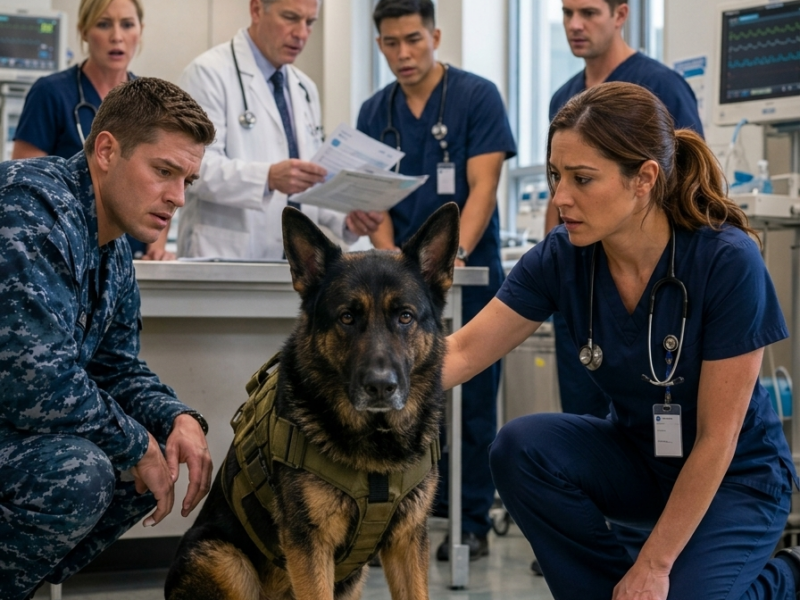
The K9 Was Getting Weaker Every Day — Until One Nurse Checked His Diet
The fluorescent lights of the Fort Campbell Veterinary Treatment Facility buzzed with a dull, persistent hum that vibrated through the soles of my shoes.
“His kidney panels are completely wrecked, Sergeant. Creatinine is through the roof, and his red blood cell count is plummeting by the day,” Dr. Miller said, keeping his voice level as he clipped another set of digital X-rays to the light board. “At eleven years old, after three combat deployments in the Helmand Province, a working Belgian Malinois’s body just breaks down. It’s systemic failure. It’s old age.”
“It’s not just old age!” Staff Sergeant Daniel Brooks slammed a calloused fist onto the stainless steel examination table. The loud CLANG echoed off the tiled walls, making a junior specialist by the door flinch. “Three weeks ago, Rex was cleared for light physical training! He was running two miles with me every morning! You don’t go from clearing four-foot obstacles to dying of kidney failure in twenty-one days!”
“Organ failure in senior military working dogs can be precipitously rapid,” Dr. Miller replied, his tone infuriatingly clinical as he adjusted his wire-rimmed glasses. “We’ve given him fluid therapy, broad-spectrum antibiotics, and steroid boosters. He’s refusing his feed, Daniel. His body is simply giving up. The most humane option…”
“Don’t you say it,” Daniel hissed, stepping into the veterinarian’s space. His voice dropped into a raspy, terrifying register. “Don’t you dare say that word to me.”
I stood quietly in the shadow of the doorway, holding a metal clipboard jammed with therapy dog intake logs. As a civilian pediatric nurse assigned to the base’s animal-assisted rehabilitation program, I wasn’t supposed to voice an opinion during MWD—Military Working Dog—medical reviews. But I couldn’t pull my eyes away from the dog laying on the rubber floor mat in the corner.
Rex had been a legend across the 101st Airborne. His black-and-tan coat, once thick and lustrous, now looked dull, dry, and coarse like dead grass. The deep chest that had once battered down doors in Kandahar caved inward, his ribs outlining his flank like the bands of a wooden barrel. Yet, despite the exhaustion clouding his brown eyes, he kept his snout rested firmly over Daniel’s left boot. He was watching his handler’s hands.
Daniel sat down heavily on the floor beside Rex, his knees cracking. His uniform was worn, the rank insignia on his chest slightly frayed. He reached into his pocket, pulled out a metal bowl, and opened a Tupperware container filled with premium, high-calorie kibble mixed with a thick greyish-white nutritional powder.
“Come on, buddy,” Daniel whispered, his rough voice fracturing down the middle as he held the bowl near Rex’s snout. “Just a few bites. You can’t leave me, too. Not after everything.”
What happened next was what made my blood run cold.
If Rex were simply dying of terminal organ failure, he would have displayed an intrinsic, passive anorexia—the dull indifference of an animal whose digestive system had shut down. I had seen it in pediatric oncology patients and aging therapy animals alike. They simply closed their eyes and turned away from the smell of nourishment.
Rex didn’t do that.
The moment Daniel brought the bowl within six inches of the dog’s nose, Rex’s nostrils flared. His ears flattened backward against his skull in stark terror. A high, pathetic whine bubbled up from his throat, and he violently recoiled, dragging his weakened hind legs backward until his spine slammed against the cold brick wall of the examination room. He tucked his tail between his legs and began to tremble violently.
He wasn’t sickened by the food. He was terrified of it.
“He’s just too weak to eat, Clara,” Daniel said quietly, staring at the floor, misinterpreting the dog’s movement as a seizure of weakness. “He can’t even hold his head up.”
“Sergeant,” I spoke up, stepping into the room.
Dr. Miller sighed, crossing his arms. “Clara, please. This is an active military veterinary review—”
“Quiet, Doctor,” I cut him off, my voice firmer than I had ever dared use on a military installation. I reached into my canvas tote bag and pulled out my lunch container—a piece of unseasoned, plain boiled chicken breast I had prepared for myself that morning.
I knelt three feet away from Rex, keeping my posture non-threatening, eyes lowered. I shredded a small piece of the chicken and held it out on the flat palm of my hand.
“Clara, he’s not going to—” Daniel started.
Rex’s head snapped up. His black nose twitched frantically. Without a second of hesitation, the dying K9 crawled forward on his elbows, stretched his neck out, and gently lifted the chicken off my palm with his front teeth. He swallowed it in a single gulp, his tail giving a weak, single thump against the linoleum. He looked at my hands, whining softly, begging for more.
Dr. Miller blinked, staring at the dog. “What… he hasn’t taken solid food in four days.”
“He’s starving,” I said, my heart hammering against my ribs. I looked directly at Daniel. “Sergeant, he isn’t losing his appetite. He’s refusing that bowl.”
Daniel frowned, looking down at the premium kibble. “That’s impossible. This is the canine performance mix from Base Supply. He’s been eating it for five years.”
“May I see the supplement package?” I asked, pointing to the plastic tub of greyish-white powder Daniel used to top off the kibble.
Daniel handed me the tub. It was a standard industrial-sized container of Canine Vitality MAX, a high-protein supplement issued to working dogs undergoing intensive recovery or senior maintenance. But as I turned the plastic tub in my hands, my thumb caught on a raised edge near the back.
Layered over the manufacturer’s original label was a second, glossier adhesive sticker. It covered the batch code, the expiration date, and the ingredient breakdown. I used my thumb to peel back the top sticker. Beneath it, the original print had been intentionally scraped away with what looked like a razor blade, leaving only jagged silver scratches over the manufacturing details.
“Where did this specific tub come from, Sergeant?” I asked, my fingers trembling slightly.
“Supply delivered a six-month crate to our unit’s kennel two months ago,” Daniel said, his brow furrowing. “Direct from the central quartermaster depot. Why?”
“Dr. Miller,” I said, holding the tub out to the vet. “When was the last time you ran an independent toxicological screen on the nutritional supplements coming out of the central supply depot?”
Dr. Miller looked offended. “We don’t screen sealed, SEAL-approved supply shipments! They come from vetted defense contractors!”
“Run it,” Daniel commanded. The tremor was gone from his voice, replaced by the lethal, quiet tone of an infantry officer. “Run a full chemical spectrum analysis on this powder right now, Doctor. Or I swear to God I will call the Provost Marshal’s office and have Criminal Investigation Division seal this clinic as a crime scene.”
Dr. Miller took the tub without another word and walked swiftly toward the lab room at the back of the facility.
For two hours, Daniel and I sat on the floor of the exam room. I fed Rex tiny pieces of my boiled chicken while Daniel held the dog’s head in his lap. Rex didn’t tremble anymore. He lay there, licking Daniel’s palm, his breathing steadying for the first time in weeks.
When the lab door finally swung open, Dr. Miller looked like he had seen a ghost. His face was drained of color, his fingers shaking as he held a printed laboratory printout.
“It’s not a manufacturing defect,” Miller whispered, locking the exam room door behind him. “The powder is laced with a concentrated organophosphate compound—a heavy industrial pesticide. In tiny daily doses, it doesn’t kill instantly. It causes progressive renal vascular necrosis. It mimics end-stage kidney disease.”
Daniel stood up so fast his chair flipped backward, slamming against the wall. “Someone is poisoning my dog?!”
“We need to find out how this batch entered the supply chain,” Miller said frantically, trying to calm him down. “I’ll submit a report to the garrison commander—”
“No,” I said, pointing at the lab paper. “Look at the batch distribution on the supply manifest.”
Dr. Miller handed me the printout. I scanned down the military supply tracking codes. The shipment had contained twenty tubs of the supplement. Seventeen of them—distributed to the MP K9 units, the search-and-rescue dogs, and the explosive detection teams across the base—were completely clean.
Only three tubs were laced with the pesticide.
And according to the quartermaster’s digital sign-out log, all three contaminated tubs had been hand-delivered directly to a single kennel: Bin 104, Assigned to K9 Rex.
Daniel stared at the document, his breath coming in ragged, violent gasps. “This wasn’t a supply chain accident,” he whispered, his eyes wide with horror. “Someone targeted Rex. Someone wanted him dead before the end of the month.”
Before Dr. Miller could respond, heavy footsteps echoed outside in the hallway. A young Military Police officer opened the door, carrying a clear plastic evidence bag.
“Sir,” the MP said, looking confused. “A private on perimeter patrol found this sitting right outside Sergeant Brooks’s unit kennel twenty minutes ago. It was sitting on his gear trunk.”
Inside the clear bag was a fresh, sealed tub of the exact same supplement.
Scratched deeply into the heavy plastic lid with the blade of a tactical knife were five words written in block capital letters:
STOP ASKING, OR HE DIES.
Daniel didn’t move for three full seconds. Then, his hand dropped instinctively to his right hip—where his sidearm would have been if we weren’t inside a medical facility.
“Who dropped this off?” Daniel demanded, advancing on the young MP officer. “Did you check the perimeter cameras near the 4th Brigade kennels?”
“The… the camera for Quad B went offline for maintenance at 0400 hours, Sergeant,” the MP stammered, backing up a step. “The shift log says it was an authorized system update.”
“An authorized update,” Daniel repeated, his voice dangerously low. He turned toward Dr. Miller. “Lock this clinic. You put Rex in an unlisted isolation bay under a private alias. If anyone asks—anyone from Supply, anyone from Command, anyone from my own unit—you tell them Rex died of kidney failure an hour ago.”
“Sergeant, falsifying an MWD casualty record is a major infraction—” Dr. Miller began.
“Someone inside my unit just left a death threat on my locker!” Daniel roared, pulling the evidence bag from the MP’s hands. “You want to explain to the Pentagon why an award-winning combat K9 was murdered inside a high-security military installation? Do it, or do what I tell you!”
Dr. Miller swallowed hard, looking at Rex, who was sleeping peacefully on the mat after eating the rest of my chicken. “Bay 4 in the basement. It’s a secure research isolation ward. No windows, separate air filtration, keycard access only. I’ll enter his status as deceased in the primary database at midnight.”
“Thank you,” Daniel said grimly. He turned to me. “Clara, I need you.”
“I’m a civilian nurse, Daniel,” I whispered, though my heart was already pounding with a mixture of terror and determination. “I can’t skirt military law.”
“You saw the detail everyone else missed,” Daniel said, looking me dead in the eye. His eyes were bloodshot, rimmed with dark circles, but behind them burned an unyielding fire. “You saved his life today. The people doing this know the base layout, they know the camera blind spots, and they have access to security override codes. I can’t trust anyone wearing a uniform right now. I need someone on the outside who can help me figure out why.”
“Why would anyone want to kill a retired search dog?” I asked, looking at Rex.
“Because of what he found six months ago,” Daniel said quietly.
He motioned for me to follow him into the small breakroom down the hall. He locked the door, pulled down the window blinds, and leaned against the counter, rubbing his face with both hands.
“Six months ago, right before Rex was processed for medical retirement, our unit was called to sweep an abandoned ammunition storage bunker on the southern edge of the post,” Daniel explained, his voice hushed. “It was supposed to be a routine inventory audit. But Rex picked up a scent behind a false drywall panel in Storage Vault 7.”
“What was behind it?”
“Three wooden crates stamped with stolen DIA markings,” Daniel said. “Inside were forty night-vision monoculars, dozen suppressed assault rifles, and four military-grade tactical encryption drives—all gear that had been officially logged as ‘destroyed in action’ during our last deployment in Syria.”
My breath hitched. “Someone on base was trafficking stolen military hardware.”
“It was an illegal arms ring operating right out of Fort Campbell,” Daniel said. “The Military Police opened a classified internal investigation. CID came in, seized the crates, and interviewed my team. But two weeks later, the lead CID investigator on the case, Captain Thomas, was killed in an off-base car accident. The investigation stalled. They called it an isolated incident of supply theft by unknown contractors.”
“And Rex?”
“Rex was the only dog who sniffed out that vault,” Daniel said, his jaw clenching. “He was trained on a specific synthetic lubricant used exclusively on classified Special Operations weapons. If whoever was hiding those crates is still operating on this base, they knew Rex’s nose was a ticking clock. If another audit happened, or if Rex was brought near the logistics yard…”
“…He could point out the buyers,” I finished the thought, terror cold in my belly. “It wasn’t revenge. It was evidence elimination.”
Daniel pulled a small black notebook from his pocket and flipped through the pages. “The supply Tub came from the 526th Brigade Support Battalion. The sign-out log was signed by a Chief Warrant Officer named Eric Vance.”
I stared at the name. “Vance? Isn’t he the chief of logistics for the entire division?”
“Yeah,” Daniel said grimly. “And he was Captain Thomas’s primary contact during the stolen weapons investigation before Thomas died.”
“We need to check those original inventory logs,” I said, my nurse’s mind kicking into high gear, connecting clinical data to logical paths. “If Vance forged the food inspection records, he had to use his personal digital signature on the logistics network. That signature leaves a permanent timestamp on the base intranet server.”
“The logistics server terminal is in the basement of the Command Administration Building,” Daniel said, shaking his head. “It’s guarded 24/7. I’m a Sergeant; I can’t just walk into the central server room and start digging through Chief Warrant Officer Vance’s personal sign-out logs without alerting him.”
I looked down at my badge pinned to my scrubs.
Clara Reynolds, RN — Civilian Medical Contractor — Access Level: All Facilities (Medical & Support).
“You can’t,” I said, a slow smile touching my lips. “But every Tuesday night at 2000 hours, I conduct environmental sanitation audits for the therapy animal access corridors in the Command Administration Building. Including the basement utility vaults.”
Daniel stared at me, astonished. “Clara, if you get caught digging into classified logistics files, you won’t just lose your job. You could be prosecuted under the Espionage Act.”
“They tried to poison a dog who saved four human lives, Daniel,” I said softly, thinking of Rex’s gentle snout resting against my palm. “And they left a death threat in a plastic bag. I’m not letting them win.”
Daniel reached into his pocket and pulled out a small USB thumb drive encased in a heavy rubber shell.
“This is an automated data-scraping tool,” he said, pressing it into my hand. “My brother was a signal corps specialist; he showed me how to use it. You plug this into the back of any terminal connected to the base intranet. It bypasses local passwords and downloads the last thirty days of quartermaster digital signatures onto the drive in under two minutes.”
“Two minutes,” I repeated, closing my fingers around the drive.
“I’ll be waiting in the parking lot behind the building in an unmarked civilian sedan,” Daniel said, grabbing my shoulders. “If anything—anything—looks wrong, you drop the drive and walk out. Understand?”
“I understand,” I whispered.
Three hours later, the sun had set behind the rolling hills of Kentucky, dipping Fort Campbell into a quiet, shadowed darkness. Rain began to patter against the windshield of my sedan as I pulled up to the security gate of the Command Administration Building.
I swiped my badge at the side door. The green light blinked, and the heavy magnetic lock disengaged with a loud CLICK.
The interior of the building was silent, lit only by emergency red wall sconces. My sneakers squeaked softly against the pristine marble floors as I navigated down the stairs toward the sub-basement.
The air grew cooler, smelling of ozone, concrete, and cold metal.
At the end of the corridor stood the heavy oak door marked LOGISTICS & QUARTERMASTER DATA RELAY.
I took a deep breath, pulled my cleaning trolley up to the door to act as a physical wedge, swiped my badge, and stepped inside.
The server room was freezing, dominated by three tall metal racks of blinking blue and green routers. In the center of the room sat a single terminal workstation, its monitor glowing with a blue standby screen.
My hands shook as I reached behind the central processing unit, feeling for an open USB port. My fingers found the slot. I slid the rubber thumb drive inside.
The monitor instantly flickered. A line of green text scrolled rapidly down the blue screen:
EXTRACTING LOGISTICS SIGN-OUT MANIFESTS… BATCH 409-B… AUTHORIZATION KEY ACCEPTED.
30 seconds…
60 seconds…
I kept my eyes fixed on the door, listening past the hum of the cooling fans.
90 seconds…
PROGRESS: 98%… COMPLETE.
A soft beep rang out in the quiet room. I reached behind the computer and yanked the USB drive out, shoving it deep into my pocket.
I turned around to leave—and stopped dead in my tracks.
Standing in the doorway, blocking my only exit, was a tall man in a crisp dress uniform. His silver bar glittered under the fluorescent light. He had a scarred jawline, cold grey eyes, and a silenced 9mm pistol held firmly in his right hand.
Chief Warrant Officer Eric Vance smiled, his voice smooth and cold as liquid nitrogen.
“Nurse Reynolds,” he said softly. “I believe you have something that belongs to my department.”
I backed up until my spine slammed against the sharp metal corner of the server rack. The cold aluminum bit into my back through my scrubs.
“Chief Vance,” I said, forcing my nurse’s voice into a flat, professional tone, though my heart was thrashing inside my ribs like a trapped bird. “I’m conducting a routine sanitary audit of the basement utility corridors. You’re pointing a weapon at a civilian medical contractor.”
“Save it, Clara,” Vance said, stepping slowly into the room. He reached back with his left hand and closed the heavy door behind him, locking the deadbolt with a sickening CLACK. “You think I don’t know who you’ve been talking to? You think I didn’t see you playing hero in the clinic this morning?”
He raised the silenced pistol, aligning the front sight directly between my eyes.
“Where is Staff Sergeant Brooks?” Vance demanded.
“He’s at the clinic,” I lied smoothly, keeping my hands visible near my chest. “He’s burying his dog.”
Vance let out a short, dry laugh. “Nice try. But Dr. Miller’s digital death certificate for Rex didn’t process through the system until twenty minutes ago. And yet, ten minutes ago, someone tried to access the base armory inventory logs using Sergeant Brooks’s old clearance code.”
He took another step closer. The smell of his cologne—expensive, sharp, overriding the cold ozone of the server room—flooded my nose.
“Give me the drive, Clara,” Vance said softly. “Hand it over, and maybe you walk out of this building with a transfer order to another base instead of a bullet in your spine.”
I reached slowly into my scrub pocket. My fingers wrapped around the rubber casing of the thumb drive.
If I give it to him, he kills me anyway, my mind screamed. Witnesses don’t get transfer orders.
“It’s right here,” I whispered, slowly pulling my hand out.
Instead of handing him the drive, I swung my arm with all the strength in my body, hurling the heavy rubber flash drive directly at his face.
Vance ducked instinctively, his arm flinching upward.
PFFT!
The silenced pistol coughed—a soft, dry sound like a compressed air hose snapping. The bullet slammed into the server rack inches from my ear, showering my face with tiny sparks and hot plastic shrapnel.
I didn’t wait. I grabbed a heavy metal fire extinguisher mounted on the wall beside the rack, pulled the safety pin with a violent yank, and slammed the nozzle control down.
A dense, blinding cloud of white chemical foam exploded straight into Vance’s face.
“ARRGH! SHIT!” Vance roared, coughing wildly as the toxic white powder blinded his eyes and filled his lungs.
He fired twice more into the fog—PFFT! PFFT!—the bullets ricocheting off the concrete walls with sharp metallic whines.
I dove under his outstretched arm, my shoulder slamming against his hip, sending him staggering back against the door frame. I grabbed my cleaning trolley, violently shoved it into his knees, and yanked the door open.
I sprinted down the corridor, my sneakers slipping on the slick floorboards.
“GUARDS!” Vance’s voice echoed down the concrete hallway behind me, muffled by coughing fits. “LOCKDOWN THE SUB-BASEMENT! CODE RED IN ARCHIVES!”
Red emergency lights began to flash along the ceiling, accompanied by the deafening, pulsing shriek of the building’s internal alarm.
I scrambled up the stairs, taking them three at a time, my lungs burning with ice-cold air. I burst through the rear exit door into the torrential Virginia rainstorm, tumbling down the concrete steps into the mud.
“Clara!” a voice barked from the dark.
A black civilian sedan screeched around the corner of the loading dock, its tires spraying water across the pavement. The passenger door swung wide open.
“Get in!” Daniel screamed over the roar of the engine.
I threw myself onto the passenger seat, slamming the door shut just as three armed security guards burst out of the building behind us, their flashlights cutting through the driving rain.
THUMP! THUMP!
Two rounds slammed into the rear bumper of the sedan as Daniel stomped on the accelerator. The tires squealed, caught traction on the wet asphalt, and propelled us out of the parking lot into the dark, rain-soaked streets of Fort Campbell.
“Are you hit?” Daniel yelled, his eyes darting between the rearview mirror and the road ahead. “Clara! Look at me! Are you shot?”
“I’m… I’m okay!” I gasped, clutching my chest, coughing up the acrid taste of the fire extinguisher foam. “It was Vance! He was waiting for me!”
“Did you get the files?”
I reached into my pocket, my heart dropping into my throat.
It was empty.
“I… I threw it at him,” I sobbed, terror breaking through my adrenaline. “I threw the drive at his head to escape! Daniel, I lost it!”
“Hey, hey, look at me!” Daniel reached over, grabbing my hand, his grip solid and warm. “You survived. You walked out of a room with a crooked officer holding a silenced gun. That’s a win.”
“No, you don’t understand!” I pulled my left hand out of my scrub pocket. Tucked inside the wrist cuff of my medical sleeve was a tiny, rectangular SD card—the micro-storage chip I had popped out of the rubber thumb drive right before Vance cornered me. “I threw the empty shell! I kept the memory card!”
Daniel stared at the tiny black chip in my palm, then let out a wild, victorious shout that echoed off the roof of the car. “You brilliant, incredible woman!”
Ten minutes later, we pulled into the gravel driveway of an off-base safe location—an old, weathered cabin tucked deep inside the timber reserves three miles south of the post perimeter. The cabin belonged to Daniel’s late grandfather, surrounded by thick pine trees that blocked the rain and screened us from overhead light.
Inside, the cabin was cold and dark. Daniel quickly pulled the heavy blackout curtains closed, lit a single oil lamp on the kitchen table, and booted up a ruggedized, military-grade laptop that wasn’t connected to any network.
He slid the micro SD card into an adapter and inserted it into the drive slot.
Lines of encrypted text flashed across the screen, resolving into a massive spreadsheet of logistics manifests, serial numbers, and sign-out approvals spanning six months.
I leaned over his shoulder, my wet hair dripping onto his jacket as I pointed at the screen. “Filter by batch code 409-B. The poisoned supplement tubs.”
Daniel typed rapidly. The list narrowed down to three entries.
My jaw dropped.
The sign-out for the three contaminated tubs hadn’t been authorized by Chief Vance.
The digital signature belonged to someone else. Someone whose name made Daniel’s blood drain completely from his face.
AUTHORIZATION USER: DR. ARTHUR MILLER, CHIEF VETERINARY OFFICER.
“Miller?” I gasped, holding onto the edge of the table. “Dr. Miller poisoned Rex?!”
“No,” Daniel whispered, his voice shaking with a terrifying realization. He pointed his finger at the timestamp on the screen. “Look at the time of the signature. 03:00 AM on August 14th.”
“What about it?”
“On August 14th at 03:00 AM, Dr. Miller was in surgery in Bay 1 saving the life of a search dog hit by a car on Highway 41,” Daniel said. “I was standing right beside him in the operating room for four straight hours. He didn’t sign this.”
“Someone stole his digital key,” I said.
“Not just his key,” Daniel said, scrolling down to the secondary override column. “To use a medical officer’s digital signature without triggering a system red flag, you need a physical biometrics master card. Only three people on Fort Campbell hold a master biometrics card.”
He looked up at me, his eyes dark as pitch.
“The Garrison Commander. The Chief of Logistics…” Daniel swallowed hard. “…And the base Chief of Staff, Colonel Marcus Vance. Chief Warrant Officer Vance’s older brother.”
Before I could digest the horrifying revelation, a sudden, low metallic rumble vibrated through the floorboards of the cabin.
Outside, in the dark timber, the rain stopped echoing against the roof—replaced by the distinctive, heavy chop of a military helicopter hovering low over the treeline.
THUD-THUD-THUD-THUD.
A blinding white searchlight cut straight through the gaps in the blackout curtains, illuminating the interior of the cabin like mid-day.
A loud, mechanical voice boomed from a loudspeaker overhead:
“Staff Sergeant Daniel Brooks! Clara Reynolds! You are harboring stolen military intelligence and are suspected of high treason! Step out of the cabin with your hands on your heads!”
Daniel looked at me, grabbed his laptop, and pulled a heavy tactical shotgun from beneath the kitchen bench.
“They didn’t come to arrest us, Clara,” Daniel said, racking a shell into the chamber with a lethal CLACK. “They came to finish what they started at the clinic.”
“Out the back cellar hatch!” Daniel yelled over the deafening roar of the helicopter blades.
He grabbed the laptop, shoved the micro SD card into his bulletproof vest pocket, and kicked open a small trapdoor hidden beneath the rug in the kitchen.
A stream of freezing air blew up from the earth below.
“Go! Move!” Daniel pushed me toward the ladder.
I didn’t argue. I dropped into the dark storm cellar, my feet hitting the dirt floor five feet below. Daniel dropped down right behind me, slamming the thick oak trapdoor shut and jamming a steel pry bar through the iron handles to lock it.
BOOM!
Above us, the cabin’s front door was blown off its hinges with a breaching charge. Heavy, tactical boots slammed onto the wooden floorboards right over our heads.
“Clear the main room! Check the bedrooms!” a voice barked through the floor. “The director wants that laptop destroyed! If they resist, free fire!”
“This cellar connects to an old drainage culvert that empties into the creekbed two hundred yards downhill,” Daniel whispered, grabbing my hand in the dark. “Keep low. Don’t make a sound.”
We crouched low, ducking our heads as we navigated the narrow, dirt-walled tunnel. The smell of wet earth, copper, and decaying pine needles was overwhelming. Behind us, we heard the timber floor of the cabin groan as heavy men searched the rooms, followed by curses when they discovered the trapdoor.
“They’re taking the hatch!” a voice shouted from above.
BANG! BANG! BANG!
Heavy rounds began punching through the wooden cellar door, sending splinters of oak raining down into the dirt behind us.
“Run!” Daniel barked.
We sprinted through the darkness, our feet splashing through ankle-deep groundwater inside the concrete culvert. We burst out of the open pipe into the torrential rain at the bottom of the ravine, surrounded by towering pine trees.
The night was alive with searchlights. Two dark, unmarked tactical SUVs were parked along the fire road at the top of the ridge, their spotlights sweeping back and forth across the forest floor.
“We can’t reach my car,” Daniel said, wiping rain from his eyes as we crouched behind a massive fallen oak tree. “They’ve got the perimeter blocked.”
“Where is the nearest safe place?” I asked, shivering violently, my wet scrubs sticking to my frozen skin.
“There are no safe places on this base anymore,” Daniel said grimly. “Colonel Vance controls the Garrison Military Police. He controls the perimeter gates. If we try to leave the post, they’ll stop us at the checkpoint and end it right there.”
“Then we don’t leave,” I said, a sudden realization washing over me. “Where is the one place on this base Colonel Vance can’t enter without a federal warrant?”
Daniel looked at me, frowning. “The CID Regional Field Office. It’s federal jurisdiction. But it’s on the main parade grounds—two miles across open ground.”
“It’s covered by cameras,” I said. “Unless…”
“Unless we have someone who knows how to move through the camera dead-zones,” Daniel finished my sentence, a sudden, fierce hope lighting up his eyes. “Someone who was trained to bypass visual surveillance in enemy territory.”
“Rex,” I whispered.
“Rex is locked in Bay 4 at the clinic,” Daniel said. “If Miller signed his death certificate, Vance’s men will be monitoring the clinic main entrance.”
“They’re monitoring the front entrance,” I corrected him. “Not the underground animal delivery chute in the back loading bay.”
Daniel pulled his radio from his belt. “I’m calling Miller.”
He switched the frequency to a secure tactical channel he had used during his days with the MWD unit. “Dr. Miller, this is Brooks. Do not name me over the air. Are you alone?”
A static-filled voice came through the speaker. “Daniel?! God, where are you?! Vance’s security team was just here! They demanded access to the records!”
“Is Rex safe?”
“He’s in Bay 4. They didn’t find him. But Daniel, Colonel Vance himself just issued an installation-wide arrest warrant for you and Nurse Reynolds! They’re claiming you stole classified medical narcotics!”
“Listen to me, Doctor,” Daniel said, his voice flat and authoritative. “I need you to bring Rex to the rear loading dock delivery chute in ten minutes. Put him in a tactical transport harness. Do not let anyone see you.”
“Daniel, he’s too weak—”
“He ate solid food today, Doctor,” I shouted into the radio. “He’s stronger than you think! Bring him!”
There was a long pause on the line. “Ten minutes,” Miller whispered, and the line went dead.
We moved through the forest like ghosts, using the shadow of the ridge line to avoid the hovering helicopter’s searchlights. Daniel’s tactical training guided us through every ditch, every drainage pipe, and every patch of thick brush, keeping us completely invisible from the road.
Ten minutes later, we slipped behind the brick wall of the veterinary facility’s rear loading bay.
The rain was slowing down to a steady drizzle. A single yellow safety light illuminated the metal delivery chute used for heavy dog food crates.
The heavy steel door of the chute slid open.
Dr. Miller appeared in the shadow, holding a leather leash. Beside him, standing on his own four feet, wearing his black tactical harness with his service medals pinned to the chest strap, was Rex.
The dog’s ears perked up instantly. He let out a low, breathless whine, his tail thumping against the concrete wall as he recognized Daniel’s scent.
“Good boy,” Daniel sobbed quietly, dropping to his knees and burying his face in the dog’s thick neck. “Good boy, Rex.”
Rex licked Daniel’s ear, his tail wagging furiously. He looked thinner, his ribs still visible beneath his coat, but his eyes were bright, clear, and filled with an fierce, unbroken energy.
“I gave him a high-potency B-complex injection and an intravenous glucose drip,” Dr. Miller whispered, handing Daniel a tactical chest rig containing Rex’s tracking harness. “His blood toxicity levels are dropping. He’s stable, Daniel.”
“Thank you, Doctor,” Daniel said. He looked down at Rex. “Buddy, we have one last mission. We need to reach the CID office. Can you lead us?”
Rex let out a short, muffled bark, turning his head toward the dark treeline bordering the parade grounds. He lowered his snout to the damp ground, sniffed deeply once, twice, and then looked back at Daniel, his ears forward, his posture locked into full working mode.
He knew the path. He had walked these perimeter routes for eight years.
“Clara, hold his lead,” Daniel instructed, handing me the leather strap. “If we hit a patrol, you follow Rex. He knows every drain, every blind spot, and every dead zone between here and the parade grounds.”
We stepped out from behind the loading dock into the vast, dark expanse of Fort Campbell.
The sky was clearing, revealing a sliver of pale moonlight above the clouds. Down on the main road, the flashing red lights of three MP cruisers sped past, their sirens wailing into the night.
Rex didn’t look at the cruisers. He moved with silent, fluid grace, keeping low to the grass, leading us along the edge of an old drainage ditch that ran parallel to the main thoroughfare, completely hidden from the street cameras above.
Every fifty yards, Rex would stop, raise his head, test the wind, and gently press his body against my legs—signaling us to halt as an MP spotlight swept across the grass fifty yards ahead.
He was a ghost navigating through an enemy field, protecting his team just as he had done in the valleys of Afghanistan.
Twenty minutes later, the dark red-brick facade of the UNITED STATES ARMY CRIMINAL INVESTIGATION DIVISION building loomed through the trees ahead of us.
The building was brightly lit, surrounded by a high chain-link fence topped with barbed wire.
“There it is,” I whispered, relief washing over me. “We made it.”
“Wait,” Daniel grabbed my shoulder, pulling me back into the shadows of a large pine tree.
Parked directly outside the CID building’s main gate was a black SUV with dark tinted windows.
Standing beside the gate, speaking quietly to two armed CID sentries, was Colonel Marcus Vance—dressed in his full service uniform, holding a thick leather folder in his hand.
He wasn’t just investigating us. He was setting up a trap at the finish line.
“He’s closing the door,” Daniel hissed through his teeth. “He’s convincing the CID duty officer that we’re dangerous felons before we even step foot on the property.”
Rex let out a low, chest-heaving growl, his upper lip curling back over his teeth.
He didn’t just smell the wet grass or the rain. He smelled the man standing at the gate.
And as I watched the dog’s eyes lock onto Colonel Vance, I noticed a tiny detail pinned to Vance’s left lapel—a small, silver unit insignia featuring a tactical dagger surrounded by oak leaves.
It was the exact same insignia etched into the brass buckle of Rex’s old combat collar.
The man standing at the gate wasn’t just a corrupt administrator selling stolen military hardware.
He was the commander who had sent Daniel’s unit into an ambush four years ago—and Rex remembered his scent.
“He was there,” Daniel whispered, his voice shaking so violently the shotgun trembled in his grip. “Colonel Vance was the theater commander in Kandahar when my squad was ambushed.”
“Daniel, look at Rex,” I said gently, touching his arm.
Rex was crouched low to the wet grass, his broad chest vibrating with a deep, silent growl. His eyes weren’t fixed on the sentries or the guard shack. They were fixed entirely on Colonel Vance’s left hand—where the colonel was holding a black leather briefcase.
“The briefcase,” I realized suddenly. “The master biometrics card… the hard drives from the stolen weapons audit. He’s taking them out of the building before CID opens an investigation.”
“He’s destroying the physical evidence,” Daniel said. “If he leaves that gate with that briefcase, it’s over. It’s his word against ours, and he has a chest full of medals and a colonel’s eagles.”
“Then we don’t let him leave,” I said.
I looked down at Rex. I dropped to my knees, holding his broad face in both of my hands, looking directly into his intelligent brown eyes.
“Rex,” I whispered, pointing my finger through the chain-link fence at the briefcase in Vance’s hand. “Track. Fetch.”
The dog’s ears snapped forward. The tiredness, the poison, the years of pain vanished from his posture in a single heartbeat. He was no longer an eleven-year-old retired MWD dying in a cage. He was a war dog back on the line.
“Daniel, cover the guards,” I commanded, pulling the gate latch lever down.
“Clara, wait!” Daniel shouted.
I threw the chain-link gate open. “Rex! TAKE!”
Rex exploded out of the shadows like a round fired from a cannon.
His powerful black-and-tan body cut through the dark grass, flying across the thirty yards of open parade ground with lethal, terrifying speed.
“WHAT THE—” Colonel Vance turned his head just as a hundred pounds of muscle, teeth, and iron determination slammed directly into his chest.
CRASH!
Vance screamed as he went down hard on the wet concrete driveway, the black leather briefcase flying from his hand and bouncing across the pavement.
“GET THIS ANIMAL OFF ME!” Vance shrieked, flailing his arms as Rex stood over his chest, his broad jaws pinned around the colonel’s uniform collar, his teeth inches from the man’s throat, letting out a roar that shook the windows of the guard house.
“DON’T MOVE!” the two CID sentries screamed, drawing their sidearms, rushing out of the guard house.
“WEAPONS DOWN! FEDERAL EVIDENCE!” Daniel roars, stepping through the gate with his shotgun raised at the sky, racking the slide with a deafening CLACK. “CID DUTY OFFICER! CODE NINE! SECURE THAT BRIEFCASE!”
Four senior CID special agents burst out of the main doors of the building, weapons drawn, taking in the scene in a fraction of a second: Staff Sergeant Brooks standing in the light, a civilian nurse holding a medical record file, a full colonel pinned to the ground by a decorated combat K9, and a black briefcase popped open on the pavement, spilling dozen encrypted flash drives and forged supply manifests across the wet concrete.
“Nobody shoot!” the lead CID Special Agent, a sharp-eyed woman with silver hair, commanded. “Sergeant Brooks! Stand down!”
“Agent Carter!” Daniel shouted, holding his left hand high in the air while keeping his right hand on the shotgun stock. “Check the flash drives in that briefcase! Check the digital signatures on batch 409-B! Colonel Vance and his brother have been trafficking stolen military hardware out of Vault 7 and poisoning MWDs to cover their trail!”
Colonel Vance, his uniform torn at the shoulder, pale as a corpse beneath Rex’s dripping jaws, looked up at Agent Carter. “Agent… arrest this man! He’s insane! He’s… he’s armed!”
Agent Carter walked slowly over to the spilled briefcase. She picked up one of the thumb drives, looking at the silver DIA serial number etched into its side. Then, she pulled out a secure tablet, scanned the drive’s internal chip, and watched as lines of encrypted logistics transfers—signed with Colonel Vance’s master biometrics card—filled her screen.
Her eyes turned to ice.
She looked down at Colonel Vance. “Colonel… you have the right to remain silent.”
“What?!” Vance roared. “I am the base Chief of Staff!”
“And you just tried to walk off a federal installation with three dozen classified DIA encryption drives in your personal vehicle,” Agent Carter said, nodding to her agents. “Handcuff him. Call the Provost Marshal. Tell them the commander is in custody.”
Two CID agents stepped forward, pulling Vance off the ground and snapping heavy steel cuffs around his wrists.
Rex slowly stepped back, his chest heaving, his mouth open in a long, triumphant pant. He looked up at Agent Carter, then turned his head toward Daniel, his tail giving a slow, steady thump against the pavement.
“Off, boy,” Daniel whispered, his eyes overflowing with tears as he lowered his shotgun to the ground. “Easy, sweetheart. Good boy…”
Rex trotted over to Daniel, sitting down heavily beside his knee, pressing his wet snout against Daniel’s hand.
I sank to my knees on the wet pavement beside them, wrapping my arms around Rex’s thick neck, burying my face in his damp fur as the sirens of arriving federal officers echoed across the parade grounds.
Three months later.
The morning sun was warm and golden, washing over the rolling green hills of the Fort Campbell MWD Retirement Sanctuary. The air smelled of sweet clover, cedar, and fresh earth.
On the front porch of the newly constructed rehabilitation center, Daniel sat on a wooden bench, wearing a crisp civilian jacket. Beside him sat Dr. Miller, reviewing a stack of clean, healthy blood-work panels.
“Kidney functions are completely back in the normal range,” Miller said with a bright smile, handing Daniel the file. “The organophosphate toxins are entirely cleared from his system. His weight is up twelve pounds.”
“Told you he was a fighter,” Daniel grinned, looking out across the open field.
Down in the grass, Rex was sprinting after a red rubber ball, his black-and-tan coat shining like polished mahogany under the sun. His leg muscles were thick, his stride smooth and powerful, completely devoid of the trembling that had nearly ended his life three months ago.
Beside him, two young therapy dogs from my pediatric program tumbled through the grass, yapping happily as Rex patiently trotted back, dropping the ball directly at my feet.
“Good boy, Rex,” I laughed, picking up the ball and scratching him right behind his ears.
Colonel Marcus Vance and Chief Warrant Officer Eric Vance were currently awaiting court-martial at the United States Disciplinary Barracks in Leavenworth, facing charges of grand larceny, treason, attempted murder, and falsification of official military records. The stolen arms ring had been completely dismantled, and every military working dog on Fort Campbell was now protected by an independent, civilian-audited food supply system.
I threw the ball across the green field.
Rex took off like a shot, his dark ears catching the wind, his powerful body moving with the grace and authority of a true champion.
Daniel walked down the porch steps, coming to stand beside me, resting his hand gently on my shoulder as we watched the legendary K9 leap high into the air, catching the ball effortlessly before turning back toward us with his head held high.
He wasn’t just a survivor of war anymore. He was free.
The end.









