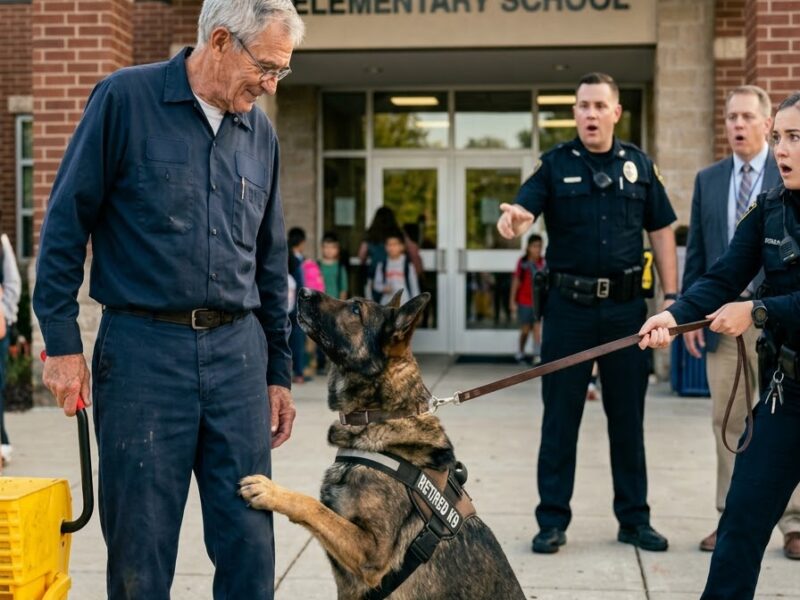
The K9 suddenly dropped beside me in the middle of the Lincoln High School hallway, refusing every command from its handler
The yellow plastic cleaning cart had a squeaky front wheel that hummed a rhythmic, grating tune against the polished linoleum of Lincoln High School. Every morning at 6:00 AM, I pushed that cart down the hallway of trophies, where dusty glass cabinets showcased basketball championships from 1984 and silver track ribbons from decades long gone. To the six hundred students, thirty teachers, and administrative staff who bustled through those doors every day, I was simply “Arthur”—the old janitor with graying hair, worn work boots, and a permanent scent of pine cleaner and stale coffee.
I preferred it that way. Invisibility was a gift I had earned through blood, silence, and fifteen long years of deliberate obscurity. When you spend two decades living in the shadows of global conflict, there is a distinct comfort in being utterly unremarkable.
It was a chilly Tuesday morning in mid-October when the silence broke.
I was wiping down the glass of the main display case, the smell of ammonia sharp in the crisp autumn air, when the heavy double doors at the front entrance swung open. Officer Mason, the school’s assigned resource officer, walked in. At his side was Ranger, a massive, two-year-old German Shepherd imported from Germany and trained specifically for high-level security, scent tracking, and patrol. Ranger was a magnificent beast—coal-black saddle, deep tan legs, eyes sharp and hyper-focused. He was an impressive display of disciplined force, normally moving with precise, robotic obedience to Mason’s every verbal cue.
Then the dog caught my scent.
Ranger froze in the middle of the foyer. His ears shot up, pointing straight forward like radar dishes. His tail, which usually swung in a slow, rhythmic sway, went rigid.
“Ranger, heel,” Officer Mason said, his voice carrying the firm, practiced authority of a veteran cop.
The dog did not move. He ignored the handler entirely. Slowly, with an intensity that made the hair on the back of my neck stand up, Ranger turned his broad head toward me.
“Ranger, sit!” Mason’s voice sharpened, a tone of mild embarrassment creeping in as a few early-arriving students paused near their lockers to watch.
Instead of sitting, Ranger broke formation. He didn’t charge, nor did he display aggression. He walked toward me with a slow, heavy, deliberate stride. Every step was measured, his body low to the ground.
“Ranger! Hold!” Mason commanded, reaching for the tactical lead, but the shepherd pushed right past his hand.
The dog stopped three inches from my work boots. I held my breath, keeping my arms loose at my sides, my palms open—an old instinct that never quite dies. Ranger raised his massive head, looked directly into my eyes, and then did something that stunned everyone in the hallway. He dropped his front quarters down, pressed his chest flat against the polished floor, and buried his wet muzzle against the side of my right boot. He began to tremble—a deep, violent shivering that rattled his tactical harness.
A heavy, suffocating silence fell over the hallway. A group of freshmen standing by the drinking fountain stopped talking. A phone camera chimed as someone pulled it out to record.
“Sir, what did you do to that dog?”
The voice was sharp, nasal, and dripping with immediate suspicion. Mr. Harris, the principal, stepped out of his office, his necktie slightly crooked, his eyes narrowed behind rimless spectacles. He looked at me the way he always looked at me—as an inconvenient utility, a man whose only value lay in mop buckets and trash bags.
“Nothing, Mr. Harris,” I said quietly, keeping my voice low and flat. “I was just wiping the glass.”
“Then step away from him,” Harris ordered, pointing a finger toward the gymnasium. “You’re making a scene, Arthur. Step back.”
I took two steps backward, dragging my boots softly against the floor.
Ranger immediately stood up, ignored Mason’s frantic leash tugs, and moved forward, matching my distance precisely before dropping back to his knees and pressing against my legs again.
“Ranger, what the hell is wrong with you?” Mason muttered, his face turning red with frustration as he tugged on the leash. But the dog was anchored to me as if held by an invisible chain.
“Look at his eyes, Mason,” I said, my voice slipping out before I could stop myself. It wasn’t the voice of a janitor asking permission. It was the low, gravelly tone of an operator making a tactical assessment.
Harris blinked, taken aback by the shift in my cadence. “What did you say?”
“He’s not aggressive, and he’s not broken,” I murmured, staring down into the shepherd’s dark brown eyes. “He’s remembering.”
Years ago, on a pitch-black, rain-slicked runway in Bagram, I had looked into the eyes of another military working dog named Ares. Ares had lost his handler to a roadside charge forty minutes prior, and he had sat beside my boots in the exact same manner, shivering from the shock of adrenaline and grief.
“Get this dog under control, Officer,” Harris snapped, trying to regain his authority. “And Arthur, finish the trophy cases and clear out of the main hall before the morning bell rings.”
Mason hauled Ranger backward with both hands, using his full body weight to pull the shepherd away. Ranger let out a single, high-pitched, agonized whine—a sound of profound loss—as he was forced toward the administrative office. He kept his head turned, his eyes locked on mine until the heavy door shut behind them.
I stood alone in the hallway, my chest tight. I reached down unconsciously and rubbed my right forearm beneath the sleeve of my gray janitor shirt. Underneath the heavy cotton lay a jagged, four-inch white scar—a permanent souvenir from a night in the mountains of the Hindu Kush that officially, according to the United States government, never happened.
That night, I couldn’t stay in my small, rented apartment across town. The walls felt too close, the silence too loud. At 11:00 PM, I unlocked the basement maintenance door of the high school and sat on a wooden stool in the dark, surrounded by spare fluorescent tubes, industrial mop buckets, and bags of rock salt.
I stared at the scar on my arm. For fifteen years, I had deliberately built a wall between who I was and who I am. I didn’t join the VFW. I didn’t wear tactical hats. I didn’t talk about the past. Because when you spend twenty-two years in the dark corners of the world doing things that keep normal people sleeping safely in their beds, you learn that memories have mass. If you give them names, if you speak them aloud, they become too heavy to carry.
A soft scratching at the basement door broke the silence.
I stood up, stepping quietly across the concrete floor. I unlatched the heavy steel door. Standing in the dim moonlight of the alleyway was Ranger. His leash was missing, a ragged piece of frayed nylon dangling from his collar where he had chewed himself free. Behind him, looking pale and bewildered in the beam of a tactical flashlight, was Officer Mason.
“He ran three miles from my house,” Mason whispered, his voice trembling slightly as he looked at me. “He broke through my back screen door, crossed the highway, and came straight to this door. He wouldn’t stop barking until I unlocked the outer perimeter gate.”
Mason lowered the flashlight, pointing it directly at my chest. The light illuminated my posture—upright, balanced, perfectly anchored.
“Who the hell are you, Arthur?” Mason asked softly. “I checked the school employee records tonight. Your file says you’re a retired factory worker from Ohio. But a tier-one war dog doesn’t submit to a factory worker like that. Were you military?”
I looked down at Ranger, who sat silently at my side, his heavy head resting against my knee.
“Yes,” I said.
“How long?”
“Twenty-two years.”
Mason took a breath. “What unit?”
I hesitated. The silence of fifteen years weighed heavily on my tongue. But looking into the eyes of the young officer and the dog who knew my secret, I finally spoke the truth.
“DEVGRU,” I said softly. “SEAL Team Six.”
Before Mason could process the words, a small voice echoed down the concrete hallway leading to the boiler room.
“Excuse me?”
We both turned instantly. Standing at the top of the concrete stairs was a skinny, dark-haired seventh-grade boy. He was wearing an oversized hoodie, his hands jammed deep into his pockets. It was Tyler Vance—a quiet kid who usually sat alone at lunch and spent his study halls staring out the window.
“Tyler?” Mason said, adjusting his belt. “What are you doing inside the school at this hour? The doors are locked.”
“I took the spare key from my mom’s purse,” Tyler said, his voice barely above a whisper. He wasn’t looking at Mason. He was looking straight at me. “I heard what you said. About Team Six.”
“Son, you need to go home,” Mason started, stepping forward.
“My dad was a SEAL,” Tyler interrupted. His voice trembled, but his eyes were fierce. “He died when I was a baby.”
My chest contracted, a sudden, cold panic seizing my heart. “What was his name, kid?”
“Daniel,” Tyler whispered. “Daniel Vance. Call sign ‘Gideon’.”
The basement seemed to tilt. The ambient noise of the hum from the water heater vanished. Daniel Vance. My point man. My brother. The man who had taken a bullet meant for me on a icy ridge in the Shah-i-Kot Valley thirteen years ago. The man whose blood had soaked into my uniform while I tried desperately to seal his chest wound in the back of an MH-47 Chinook.
“You’re Dan’s boy…” I breathed, stepping toward him, my hands shaking uncontrollably. “You’re Little Ty.”
Tyler reached into his hoodie pocket and pulled out a worn, faded ziplock bag. Inside was a black-and-white photograph, slightly creased at the edges. He walked down the stairs and handed it to me.
I pulled the photograph out with trembling fingers. There we were—thirteen years younger, standing on a dusty tarmac beside a modified Blackhawk helicopter. Daniel was on the left, his arm thrown over my shoulder, both of us grinning wildly like we were invincible, like the world could never touch us.
I flipped the photo over. Written on the yellowed back in faded black Sharpie was Daniel’s handwriting:
If I don’t come home, give this to my friend Arthur. He’ll know what it means.
My throat locked up. But as I held the photo up to the dim basement light, I noticed something else. Indented into the thick paper beneath the faded ink was a second line of text, written hastily, as if carved in a panic with a ballpoint pen just moments before a mission:
I never told him what really happened. The threat wasn’t in the valley. It was in the command tent.
Before I could read it again, a deep, guttural growl vibrated from Ranger’s chest. The shepherd was standing rigid, facing the locked maintenance storage room at the far back of the basement—a room that had been padlocked shut since I started working at the school.
The dog wasn’t growling at the door. He was growling at the heavy brass lock, which was fresh, clean, and entirely free of dust.
Someone had opened it tonight.
The low rumble in Ranger’s throat sent an adrenaline shock straight into my nervous system. Fifteen years of quiet janitorial work dissolved in a single second. My muscle memory took over; my body lowered into a tactical stance, my weight balanced on the balls of my feet, my left hand sweeping Tyler behind me while my right reached instinctively for a weapon that wasn’t there.
Officer Mason drew his sidearm, stepping up beside me. “Arthur, what’s in that room?”
“Supplies,” I said, my voice dropping an octave into pure operational calm. “Or at least, that’s what’s supposed to be in there. But that lock was changed recently. That’s a high-security Yale lock. The district doesn’t issue those to high school maintenance staff.”
“Tyler,” I whispered without looking back at the boy. “Get behind the steel desk. Stay down, no matter what you hear.”
The boy obeyed immediately, his eyes wide with a mix of terror and awe. He slid behind the heavy metal office desk tucked against the concrete wall.
Ranger moved forward, his hackles raised, a fierce ridge of black fur standing straight up along his spine. He stopped a foot from the metal door of the storage room, his nose twitching frantically at the gap beneath the frame. He didn’t bark—this was a silent alert.
“Mason,” I murmured. “Cover the right side of the frame. If someone comes out, don’t hesitate.”
Mason looked at me, nodding nervously. Sweat glistened on his forehead. “You think someone’s in there?”
I didn’t answer. I reached for a heavy iron pipe wrench resting on the top shelf of my cleaning cart. The cold steel felt familiar in my grip. I stepped up to the door, placed my hand on the brass knob, and found it unlocked.
I kicked the door open, swinging my body clear of the entrance in a smooth, fluid movement.
The room was pitch black. Mason swept his weapon’s mounted light across the interior.
It was empty.
No gunman, no intruder. But as the beam of light illuminated the far wall, my stomach dropped. The storage room wasn’t being used for mops or salt. Suspended from the concrete wall was a state-of-the-art surveillance array. Four high-definition monitors glowed silently in the dark, displaying live feeds from every corner of Lincoln High School—the hallways, the administrative offices, the parking lot, and specifically, the main entrance where I had been standing with Ranger earlier that morning.
On the desk beneath the monitors lay an open leather binder, a directional microphone, and a military-grade encryption radio unit—the exact type used by private security contractors and high-level government agencies.
“What the hell is this?” Mason breathed, stepping into the room with his flashlight raised. “Is the principal spying on teachers?”
“This isn’t school district gear,” I said, walking toward the desk. I picked up a sheaf of papers resting beside the encryption radio. The top page was a printout of my own mugshot from my military service file, stamped with a red watermark: SUBJECT UNDER ACTIVE SURVEILLANCE – DO NOT INTERCEPT.
Below my photo were dozens of candid photographs taken over the past five years. Me emptying trash cans. Me eating a sandwich on the bleachers. Me walking to my car after dark.
And beneath my file was another folder. Marked with a bright red tab: TYLER VANCE – TARGET OF INTEREST.
“They aren’t watching the school,” I said, the cold truth settling over me like a sheet of ice. “They’re watching me. And they’re waiting for him.”
I turned around to face Tyler. The boy was peeking out from behind the steel desk, clutching the ziplock bag with the old photograph.
“Tyler,” I said softly, stepping back out into the main basement area. “Why did you bring this photo to me tonight? Who told you I worked here?”
Tyler swallowed hard, his hands trembling. “Nobody told me. A man came to our house two days ago. He said he was from the Veterans Affairs department. He asked my mom a lot of questions about my dad’s old military belongings. He asked if my dad ever left behind any notebooks, thumb drives, or letters.”
“What did your mom say?”
“She told him we didn’t have anything,” Tyler said. “But after the man left, I saw him standing near his car on the street. He was on the phone, and he said, ‘The kid doesn’t know anything, but the old man at the school might have the key.’ Then he drove away. I went into my dad’s old footlocker in the attic—the one my mom told me never to open. I found that picture tucked inside his old bible. On the back, it had your name and this school’s address written in pencil on the margin.”
I closed my eyes as the pieces of a thirteen-year-old puzzle began to fit together in a horrifying picture.
Thirteen years ago, Operation Red Fall had gone terribly wrong. My six-man SEAL element had been sent into a remote valley in Operation Anaconda’s footprint to target a high-value commander. But when we hit the compound, it was empty. It was a trap. We were ambushed by over fifty heavily armed insurgents who knew our exact coordinates, our insertion vector, and our call signs.
Daniel had taken a bullet through his side while pushing me out of the line of heavy machine-gun fire. We fought our way out through a hail of lead, barely surviving until the extraction bird arrived. Before Daniel lost consciousness on the floor of that helicopter, he had reached into his vest, pulling out an encrypted tactical hard drive he had retrieved from a satellite comms kit at the compound.
He had squeezed my hand and whispered, “They knew we were coming, Artie. It came from top floor.”
I had assumed he meant Taliban intelligence. I thought he meant local informants. I had taken that drive, hidden it in a secure location, and surrendered my commission six months later, utterly broken by the loss of my best friend and disgusted by the bloody mess of war. I had spent fifteen years hiding from the world, thinking I was just a tired old man who wanted to be left alone.
I hadn’t realized that the hard drive I had buried beneath six feet of dirt near my old cabin was the only thing keeping me alive—and the moment I was identified, the clock started ticking.
“Arthur,” Mason said, his voice tense as he pointed to one of the live monitor screens. “Look.”
I stepped back into the covert surveillance room. On Screen 3, which covered the front parking lot of the school, two dark SUV sedans with tinted windows pulled up to the curb. Their headlights were turned off. Four men dressed in dark, unbadged tactical jackets stepped out, moving with the practiced, precise spread of professional mercenaries.
One of them carried a heavy glass-cutting tool and a thermal imaging device.
“They’re coming in,” Mason said, unholsterying his weapon and reaching for his radio. “I’m calling state police.”
I reached out and slammed my hand down on his radio unit, cutting off the transmission.
“No,” I said coldly. “If you call local dispatch on an open channel, they’ll intercept it. They’ll kill you, they’ll kill me, and they will take Tyler. Look at how they move, Mason. Those aren’t amateur criminals. Those are private military contractors—former Special Activity Center or Tier-One guys.”
“Then what the hell do we do?” Mason asked, his voice cracking with panic. “There are four of them and two of us! And you have a pipe wrench!”
I looked down at Ranger, who was standing beside my leg, his eyes gleaming in the dim light of the monitors, his tail stiff, ready for command.
“We have three,” I corrected him. “And this is my school.”
I turned to Tyler. “Son, I need you to trust me. I knew your father better than anyone in this world. He was the bravest man I ever met. Today, you’re going to see why they called him ‘Gideon’.”
I reached down into my cleaning cart, pulled out a heavy steel pry bar, two cans of industrial aerosol floor wax, and a high-powered halogen work light.
“Mason,” I said, my voice dropping into the absolute command tone of a Team Leader. “Take the boy into the boiler room. Lock the steel door from the inside. Do not open it for anyone unless you hear my voice give the passphrase ‘Red Fall’.”
“What are you going to do?” Mason asked, his hands shaking as he took Tyler by the shoulder.
I looked at the monitor as the four men breached the north side entrance, their silent footsteps carrying them into the darkened hallway of trophies.
“I’m going to clean the floors,” I said.
The high school at night was a maze of shadows, echo chambers, and narrow choke points. To an outsider, it was an educational facility. To me, after seven years of sweeping its floors every night, it was a tactical kill box that I knew better than the lines on my own hand.
I knew which floorboards in the library squeaked under fifty pounds of pressure. I knew that the double doors near the cafeteria took three seconds to swing fully shut. I knew that the main breaker box for the eastern wing had a loose fuse that, if flipped, would plunge the main concourse into total, absolute darkness while leaving the secondary emergency exit lights flicking like strobe lights.
I stood at the end of the long hallway near the science wing, holding the heavy iron pipe wrench in my right hand and a halogen work lamp in my left. Ranger sat silently at my left heel, his breathing shallow, his body coiled like a steel spring.
Down the hall, forty yards away, four flashlight beams swept across the rows of lockers. The contractors moved in an inverted V-formation—classic close-quarters combat doctrine. They wore night-vision goggles flipped up on their helmets, relying for now on tactical weapon lights to avoid halo distortion from the school’s ambient exit signs.
“Contractor One,” a low, metallic voice echoed down the hall—comm radio audio Bleeding into the quiet. “Target’s vehicle is in the driveway. He’s inside. Find the boy and the old man. Clean search. No witnesses.”
“Copy that, Lead,” came a reply.
I didn’t wait for them to reach the intersection. I turned the knob on the main electrical box behind me and pulled the primary breaker.
SNAP.
The overhead fluorescent lights died instantly. The long hallway was plunged into pitch darkness, save for the sickly green glow of the emergency exit signs at the far end.
“Go blind! Goggles down!” the team leader shouted.
The sound of four pairs of NVGs snapping down into place echoed off the lockers. They thought the dark was their advantage. They thought high-tech optical gear gave them the upper hand.
They were wrong.
In a enclosed, polished environment, night-vision goggles give you a two-dimensional depth perception and a narrow field of view. And more importantly, they are extremely vulnerable to sudden, intense bursts of lumen light.
I didn’t use a gun. I triggered the 10,000-lumen industrial halogen work lamp directly down the narrow corridor.
A blinding, sun-bright wall of white light exploded down the hallway.
Through standard eyes, it was blinding. Through third-generation thermal and image-intensifier goggles amplifiying light ten thousand times, it was like having a flashbang detonated directly inside their eyeballs.
“AHHH! MY EYES! BREACH LIGHT!” one of the contractors screamed, ripping his NVGs upward in sheer agony as his retinas burned from the sudden overload.
“Ranger, FETCH!” I barked.
The German Shepherd didn’t bark. He exploded forward like a cannonball. A hundred pounds of muscle, canine teeth, and relentless fury tearing down the polished linoleum.
Before the lead contractor could clear his eyes, Ranger hit him high in the chest, sending him crashing backward into a row of metal lockers with a deafening CLANG. The man’s rifle clattered onto the floor. Ranger instantly set his jaws onto the tactical vest shoulder strap, thrashing violently, keeping the man pinned and completely disoriented.
I charged behind the light beam, low and fast.
The second contractor was trying to raise his sidearm, his eyes watering, his vision swarming with green spots. I closed the distance in two seconds, bringing the heavy iron pipe wrench down in a swift, devastating arc that shattered his wrist, sending his handgun flying across the floor. Before he could recover, I drove a hard left elbow into his solar plexus, followed by a sweeping low kick that swept his legs out from under him. He hit the floor hard, his head bouncing off the tile, unconscious before he could bleed.
“CONTACT! CONTACT IN THE HALLWAY!” the third contractor yelled, backing away while firing off three round bursts toward the light source.
The gunshots were deafening in the enclosed space—TAK-TAK-TAK—sparks flying as the 5.56 rounds tore through the trophy display cases, shattering glass and punching holes through silver track ribbons and brass plaques.
I rolled behind a heavy oak display desk, feeling the bite of flying glass against my face.
“Flank him!” the team leader shouted, recovering from the dog attack and drawing a combat knife to slash at Ranger.
“Ranger, OUT!” I shouted.
The shepherd released his grip instantly, obeying the emergency disengage command, and retreated behind the desk with me, panting heavily but uninjured.
“He’s just an old janitor!” the third operator yelled, his voice laced with adrenaline and confusion as he reloaded his rifle. “How the hell is he moving like that?”
“That’s not a janitor, you idiot!” the team leader roared, clutching his bruised ribs as he pulled his secondary sidearm. “That’s Miller! The Ghost of Takur Ghar! Watch the corners!”
I sat behind the oak desk, my heart pounding in my ears. The name hit me like a physical blow. The Ghost of Takur Ghar. That was the call sign given to me by Iraqi and Afghan intelligence over a decade ago. A name I had buried deep beneath fifteen years of mopping floors and emptying trash cans.
“Miller!” the team leader called out into the dark hallway, his voice echoing off the shattered glass. “You’re fighting for a dead man’s secret! Daniel Vance died thirteen years ago! Give us the kid and the hard drive, and you walk away! You’re an old man! You can’t win this!”
I took a deep breath, reaching down to unbuckle the tactical utility belt from the unconscious contractor lying near my feet. I pulled his sidearm—a Sig Sauer P226—checked the magazine, racked the slide with a crisp CLACK, and stepped out from behind the desk into the dim glow of the exit light.
“I spent fifteen years being an old man,” I said, my voice echoing down the hallway with terrifying, icy clarity. “And I was getting pretty tired of it.”
I raised the handgun and fired two precise rounds into the ceiling’s main sprinkler system valve directly above their heads.
The high-pressure brass valve shattered. Thousands of gallons of cold, stagnant, pressurized water erupted from the pipes, raining down in a torrential deluge over the remaining two contractors, flooding their optics, slicking the floor, and drowning their tactical radios in a deafening roar of falling water.
“Move!” I ordered Ranger.
We pushed forward into the storm.
The torrent of water turned the polished linoleum hallway into a slippery, chaotic death trap. The third contractor lost his footing on the slick tile, his boots skidding out as he tried to raise his weapon. I closed the distance before he could regain his balance, stepping inside his guard, grabbing the barrel of his rifle, and driving my heel hard into his knee joint.
A sharp snap echoed through the corridor, accompanied by a scream of pain as he collapsed onto the wet floor. I swept the rifle from his grip, cleared the chamber, and tossed it down the hall.
That left the team leader.
He was a tall, heavily built man with a thick scar across his jaw, wearing a dark tactical jacket stripped of all military insignia. He stepped back into the doorway of the library, holding a secondary sidearm leveled at my chest, his hands steady despite the water streaming down his face.
“Stay right there, Miller,” he growled, wiping water from his eyes with his left sleeve. “Don’t test me. I’ll put a bullet in your chest before that dog can take two steps.”
Ranger stood at my knee, low to the ground, a continuous, vibration-like growl echoing from his chest, but he stayed in position, waiting for my command.
“Who hired you?” I asked, my voice flat, my own sidearm pointed directly at his forehead. “Who sent you after a thirteen-year-old boy?”
The team leader let out a cold, bitter laugh. “You really don’t know, do you? You thought you were hiding out here in the middle of nowhere, sweeping floors, living like a monk. You thought the past just evaporated.”
“Name a name,” I said, taking half a step forward.
“Director Harris,” the man said.
The name hit the quiet hallway like a thunderclap.
“Harris?” I repeated, my mind racing back to the rimless spectacles, the crooked tie, the man who spent his mornings complaining about dirty glass and unbrushed entryway mats. “The principal?”
“Not just a principal, you idiot,” the team leader spat. “Before he was playing high school administrator, Harold Harris was Deputy Chief of Logistics for Special Operations Command in Kabul. He was the one who leaked your flight plan at Takur Ghar. He was selling flight corridors and mission routes to private security firms and foreign buyers for millions.”
The air left my lungs. The face of the man I had taken orders from for seven years—the man who reprimanded me for using too much floor cleaner—suddenly warped into the face of the traitor who had killed my team.
“Daniel Vance figured it out,” the team leader continued, his eyes darting toward the hallway exit, calculating his odds. “Vance found the financial trails on that satellite comms drive during the raid. He brought it off the mountain, but he got hit before he could upload it to JAG. He hid the drive, sent the coordinates to his family, and died thinking someone would finish the job. But you didn’t finish it, Miller. You quit. You hid.”
“Because I didn’t know,” I whispered, the weight of thirteen years of grief crushing down on my chest. “Daniel never told me… he was trying to protect me.”
“And now Harris is wrapping up loose ends,” the leader sneered. “He saw the boy’s name on the school registration list three months ago. He realized Vance’s kid was right here in his school. He watched you every day on those security cameras, waiting to see if you or the boy would make a move toward the drive. Today, when that damn war dog recognized you, Harris knew the clock had run out.”
“Where is Harris now?” I asked, my finger tightening on the trigger.
“He’s not in his office, old man,” a sharp, familiar voice called out from the darkness of the main administrative foyer behind us.
I turned slowly, keeping my weapon trained on the team leader while using my peripheral vision to cover the foyer.
Standing near the main exit, holding a small silver revolver and wearing a dark raincoat, was Mr. Harris. Beside him, clutching his arm in terror, was Tyler. Harris had his left arm wrapped tightly around the boy’s neck, the small revolver pressed directly against Tyler’s temple.
Behind them, bleeding from a cut on his forehead, Officer Mason lay groaning on the floor near the trophy cases, having been caught off guard at the boiler room entrance.
“Drop the gun, Arthur,” Harris said, his voice stripped of all its usual soft, bureaucratic whining. Now it was hard, cold, and calculated—the voice of a man who had spent decades managing human life as collateral cost. “Drop it, or I end Daniel Vance’s line right here on this floor.”
“Harris,” I said, my voice dropping into a register so low it sounded like grinding stones. “Put the boy down.”
“You were always so reliable, Arthur,” Harris said, a sickening, pathetic smile touching his lips. “The quiet veteran who never asked questions. You swept my floors, cleaned my bathrooms, took my reprimands without a single word of complaint. I almost respected you. But you should have stayed in the shadows. You should have let the dead stay dead.”
Tyler looked at me through the dim light, tears streaming down his face, but he didn’t cry out. He held my gaze, his eyes reflecting the exact same fierce courage I had seen in his father’s eyes on that helicopter thirteen years ago.
“Don’t do it, Artie,” Tyler whispered, his voice trembling but clear. “My dad wouldn’t want you to give up.”
“Shut up, kid!” Harris barked, pressing the barrel harder into Tyler’s skin. “Arthur, handgun on the floor! Now! Or he dies!”
I looked at Harris. I looked at the boy. And then, slowly, deliberately, I lowered my hands. But I didn’t drop the gun.
“You’re right about one thing, Harris,” I said softly. “I was a janitor for fifteen years. I cleaned up dirt. I washed away stains. I cleared out trash.”
I took a deep, steady breath, my eyes locking onto Harris’s right shoulder.
“And tonight… I’m finishing the job.”
The hallway fell into an absolute, terrifying freeze. The only sound was the steady, rhythmic drip-drip-drip of the shattered sprinkler system leaking onto the linoleum fifty feet away.
Harris’s hand trembled slightly on the trigger of the silver revolver. “Don’t bluff me, Miller! I’ll pull this trigger!”
“You won’t,” I said, taking one slow, deliberate step forward. “Because if you pull that trigger, the boy dies, but you stay in this hallway with me. And you know what I am. You read my file before you hired those men. You know what DEVGRU operators do when there’s no camera, no audience, and no protocol left.”
“Stay back!” Harris screamed, his composure completely shattering. The calm, bureaucratic traitor was gone, replaced by a terrified, middle-aged coward realizing he was standing in a closed room with a apex predator.
“Ranger,” I whispered, so low that only the dog beside my leg could hear the frequency. “Sight.”
The shepherd’s ears shifted. He didn’t move his body, but his muscles tightened until he was a trembling coil of pure kinetic energy.
“You spent seven years watching me mop these floors, Harris,” I said, taking another step. “You thought I was broken. You thought I was weak. But the truth is, I was just waiting. Every day I spent in this building, I learned every exit, every angle, every blind spot.”
I raised my left hand slowly, holding up the old, creased photograph Tyler had given me.
“Daniel wrote a message on the back of this photo,” I said. “He said he never told me what happened because he wanted to protect me. But he left the coordinates. He buried that hard drive under the floorboards of his father’s cabin in Maine. He knew one day, someone would come to finish the job.”
Harris’s eyes flicked for a fraction of a second toward the photograph in my hand—a micro-second of distraction, a classic human instinct to focus on the object of desire.
That fraction of a second was all I needed.
“ATTACK!” I roared.
Ranger didn’t target Harris’s chest. He didn’t go for the arm holding the gun. He had been trained for tactical hostage resolution. He launched himself horizontally across the slick linoleum floor, hitting Harris directly in his knees from the side like a low-flying missile.
The impact was brutal. Harris’s legs were swept out from under him with a sickening crack. As he fell backward, his arm instinctively flew wide to catch his balance, pulling the revolver away from Tyler’s head.
BANG!
The revolver discharged harmlessly into the ceiling plaster as Harris went down.
Before Harris hit the floor, I closed the fifteen-foot gap in two blinding strides. I grabbed Tyler by his collar, yanked him hard behind my body, and slammed my boot down directly onto Harris’s right wrist.
The brass revolver skidded across the wet floor, disappearing into the darkness of the administrative office.
Harris shrieked in agony as my boot crushed his wrist against the concrete floor beneath the tile. Ranger was on his chest in an instant, his jaws pinned to the collar of Harris’s raincoat, his deep, terrifying growl vibrating against the traitor’s throat.
“OFF! GET HIM OFF ME! ARTHUR, PLEASE!” Harris sobbed, his face pale, blood trickling from a cut on his brow where he had struck the floor. “PLEASE! I CAN PAY YOU! I HAVE MILLIONS IN AN OFFSHORE ACCOUNT! WE CAN SHARE IT!”
I knelt beside him, leaning down until my face was three inches from his. The smell of fear and cheap cologne rose off him.
“Fifteen years ago,” I said, my voice barely a whisper, cold enough to freeze blood. “You sold out six men for a wire transfer. You left Daniel Vance to bleed out on a cold mountain ridge so you could buy a nice house and play principal in a small town.”
“I… I had no choice! They threatened my family!” Harris whimpered, tears pouring down his cheeks.
“You always have a choice,” I said.
I reached down, pulled the heavy plastic zip-ties from Officer Mason’s discarded belt, and bound Harris’s hands behind his back with absolute, unyielding precision. Then I pulled him up by his collar and shoved him hard against the trophy display case.
The glass cracked behind his head. The silver trophies—the ones I had wiped dust off every morning for seven years—reflected his terrified, pathetic expression.
Officer Mason limped out from the hallway, wiping blood from his forehead, his weapon drawn. He looked at the four unconscious contractors lying scattered across the flooded hallway, then at Harris bound against the glass, and finally at me.
“Arthur…” Mason panted, his breath coming in ragged gasps. “State police tactical units are two minutes out. I managed to hit the silent alarm panel in the boiler room.”
I nodded slowly, letting out a long, heavy breath that seemed to carry fifteen years of accumulated dust and pain out of my chest.
“Good,” I said. “Tell them to bring federal agents. Tell them to call the Department of Justice Inspector General. Tell them the Takur Ghar file is finally open.”
I turned away from Harris and walked over to Tyler. The boy was standing by my yellow cleaning cart, holding his father’s photograph close to his chest. He was trembling, but when he looked up at me, his eyes were clear and steady.
I knelt down in front of him, reaching out to gently touch his shoulder.
“Your dad was a hero, Tyler,” I said, my voice thick with emotion. “He saved my life. And tonight… you saved mine.”
Tyler wiped a tear from his cheek and looked down at Ranger, who walked over and gently rested his heavy head in the boy’s lap. Tyler wrapped his arms around the shepherd’s neck, burying his face in the dog’s thick fur.
“Are you going to leave now, Mr. Arthur?” Tyler asked softly. “Now that they know who you are?”
I looked down the long, flooded hallway of Lincoln High School. I looked at the broken glass, the water-stained floors, and the squeaky yellow cleaning cart sitting beside the front doors.
Then I looked at the boy and the dog who had brought me back from the shadows.
“No, kid,” I said, a soft, genuine smile touching my lips for the first time in fifteen years. “I think I’m going to stay awhile. This place still needs a lot of cleaning up.”
Ten minutes later, the flashing red and blue lights of fifty law enforcement vehicles illuminated the front glass doors of the school. Federal agents, state troopers, and tactical teams poured into the building, taking custody of Harris and his mercenaries.
As the agents led Harris out in handcuffs in front of local news cameras, I stood on the front steps in my gray janitor shirt, holding Ranger’s lead in one hand and keeping my arm around Tyler’s shoulder with the other.
The sun was just beginning to peak over the horizon, casting a warm, golden light across the school grounds. The long, cold night was finally over. The Ghost was gone.
And for the first time in my life, I was just Arthur—and that was more than enough.
The end.









