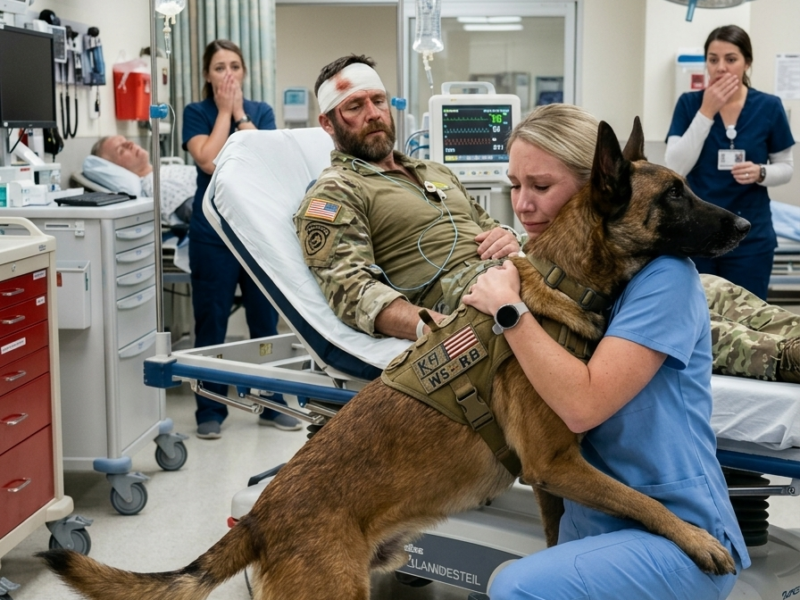
The K9 slammed a Navy doctor into the hospital doors and refused to let anyone touch the unconscious SEAL captain, while the furious commander ordered the dog removed
The fluorescent lights of Ward 4 at Naval Medical Center Portsmouth hummed with a cold, sterile energy that did nothing to warm the midnight chill. I had worked the night shift in the intensive care unit for six years, tending to burn victims, amputees, and traumatized sailors fresh off deployments. I was used to high-speed gurneys, frantic surgical teams, and the raw smell of antiseptic mixed with blood.
But I had never seen a military working dog behave with such absolute, terrifying desperation.
The German Shepherd—a broad-chested Belgian Malinois cross weighing at least eighty pounds—was locked in a rigid, lethal stance. He had slammed Dr. Julian Vance, the duty attending physician, back against the double glass doors of the trauma suite with enough force to crack the safety frame. His lips were pulled back over glistening white teeth, a low, guttural growl vibrating deep in his chest.
The target of his protective rage lay motionless on the central gurney: Captain Daniel Mercer, a legendary Navy SEAL commander assigned to Special Warfare Development Group. Mercer had been medevaced in under classified status three hours ago, unconscious, soaked in seawater, and bearing severe blast trauma that his official operational manifest dismissed as a “routine training accident.”
“Get that damn animal out of my ICU!” Commander Harris shouted from the doorway. As the hospital’s chief of administrative medicine, Harris was a man who measured life in regulatory compliance and clean paperwork. His face was red, his fists clenched at the sides of his crisp khakis. “The captain’s core temperature is dropping! He’s going into neurogenic shock! If we don’t get an IV line into his neck, he’s going to die on that table!”
The Malinois didn’t even flinch at the yelling. He growled louder, the dark fur along his spine standing up in a fierce ridge.
Two armed Master-at-Arms security officers stepped forward, unholstering their heavy electroshock batons. “Move aside, nurse,” one of them warned me, his hand hovering over his belt. “We’re taking the dog down.”
“Wait!” I yelled, stepping into the narrow gap between the guards and the snarling animal. “Don’t shoot him!”
“Lieutenant Miller, step back!” Harris ordered, his voice echoing off the tiled walls. “That animal is compromised! It’s a hazard to medical staff!”
They didn’t see what I saw. To Harris and the doctors, the dog was a broken piece of military equipment—a shell-shocked war dog gone rabid. But I had spent six years watching the subtle, unspoken language of dying men and the creatures that guarded them.
The dog wasn’t watching the medical team’s faces or their weapons. His dark, intelligent eyes were fixed entirely on Captain Mercer’s right hand.
Mercer’s right hand was tightly clenched into a strange, rigid fist—thumb tucked underneath the fingers, index finger slightly extended. It was a tactical hand signal, frozen in muscle contraction. Every time Dr. Vance or the security guards tried to step toward the gurney, Mercer’s heart monitor spiked dangerously into systemic tachycardia, his blood pressure soaring into the red zone. The moment the dog pressed his broad, warm head against Mercer’s bare shoulder, the heart monitor’s frantic beep slowed down into a steady, rhythmic cadence.
The dog wasn’t attacking us out of wild aggression. He was acting as an emotional life-support system for a man whose brain was still fighting a war in the dark.
My stomach churned. Earlier that evening, while cutting away Mercer’s salt-encrusted flight suit to place chest leads, I had noticed something the intake surgeons had missed in their rush. Underneath the tactical watch band on Mercer’s left wrist was a small, faded tattoo—inked hastily with a single needle, the skin around it scarred by fire.
Three simple words: Bring them home.
I took a deep, shaky breath, pushing past the security guards.
“Lieutenant Miller! Stand down!” Commander Harris barked. “You are a staff nurse, not a K9 handler!”
“I know what I am, sir,” I said softly, keeping my voice low, dropping my pitch to avoid triggering the dog’s acoustic reflexes. “But if you hit that dog with a taser, Captain Mercer’s cardiac rhythm will collapse. Look at the telemetry.”
Harris glanced at the monitor. The green wave of Mercer’s arterial line was violently spiking.
I turned back to the Malinois. The dog’s ears twitched forward. For the first time, his amber eyes shifted away from Mercer’s chest and met mine. There was no wildness in his gaze—only an overwhelming, crushing weight of grief and duty.
I took one slow step forward, reaching back into the darkest, most painful corner of my memory. Four years ago, my younger brother, Lieutenant Noah Miller, had vanished during a covert insertion flight over the Black Sea. His MH-60 Black Hawk had gone down in deep water. The Navy had recovered no bodies, held a swift, closed-door inquiry, and declared Noah and his entire crew dead.
The last thing Noah had ever left me was a twelve-second voicemail, recorded on a crackling satellite phone thirty minutes before his helicopter took off into the fog. In that recording, through the whine of rotor blades, Noah had whispered two words—a phrase he told me to hold onto if the Navy ever came to my door with a folded flag.
I looked the trembling Malinois dead in the eye.
“Blue Lantern,” I whispered.
The dog went completely, impossibly still.
The low growl in his throat died instantly. His bared teeth vanished as his jaw relaxed. The ridge of fur along his back smoothed down. He stared at me for a fraction of a second in absolute silence, then lowered his massive head, pressed his wet nose firmly into Captain Mercer’s palm, and let out a long, broken whimper that sounded uncannily like a human sob.
The entire trauma room fell into a dead, suffocating silence.
Dr. Vance lowered his hands. The security officers slowly re-holstered their batons.
Commander Harris stepped forward, his face draining of every drop of color until he looked like a walking corpse. His eyes darted from me to the dog, and then to the silent monitor.
“Where did you hear that code?” Harris’s voice was no longer arrogant. It was thin, sharp, and laced with sudden, dangerous panic. “Answer me, Lieutenant. Who gave you that phrase?”
I couldn’t answer. My tongue felt like lead in my mouth.
Blue Lantern was never a dog command. It was the classified call-sign of a covert Joint Special Operations task force—the exact unit my brother had been flying for when his chopper vanished from military radar. And according to the scrubbed flight manifests I had illegally accessed three years ago, the last officer recorded flying in the lead assault craft beside Noah’s bird was Captain Daniel Mercer.
Before Harris could speak again, a raspy, agonizing sound came from the gurney.
“Don’t… don’t let them… take the dog…”
I whipped around. Captain Mercer’s eyelids were fluttering open. His eyes were bloodshot, pupils dilated, but as they focused, they locked onto my face with desperate intensity. His trembling hand reached out, his fingers catching the sleeve of my medical scrubs.
“Captain!” I leaned over him immediately, placing my fingers against his carotid pulse. “Don’t try to move. You’re at Naval Medical Center Portsmouth. You’re safe.”
“Not… safe…” Mercer rasped, his throat dry and torn. He coughed, a droplet of blood appearing on his lip. His grip on my arm tightened with terrifying strength. “They told you… your brother died…”
My heart stopped beating. The air was sucked completely out of my lungs.
“What?” I choked out, tears instantly filling my eyes. “What did you say about Noah?”
Mercer leaned his head up off the pillow, his voice dropping into a fragile, lethal whisper that barely carried over the hum of the monitors.
“He didn’t.”
Behind me, before I could scream or demand an answer, a heavy metallic CLANG echoed through the suite.
The automatic emergency fire doors at the entrance of Ward 4 slammed shut. The magnetic locks engaged with a deep, authoritative thud, sealing the room off from the rest of the hospital.
Commander Harris stepped back toward the wall console, his hand slowly retracting from the manual lock override button. He pulled a secure tactical radio from his belt, his eyes cold and devoid of any human empathy.
Beside the gurney, the Malinois rose silently to his feet. He didn’t growl this time. He simply stepped in front of me and the wounded captain, placing his body squarely between us and Commander Harris.
The silence inside the sealed trauma suite was so thick I could hear the slow, rhythmic dripping of Mercer’s IV saline bag. The glass windows facing the main hallway had automatically frosted over as the security lock engaged, cutting off the view of the nurses’ station outside.
“Commander, what are you doing?” Dr. Vance demanded, taking a nervous step away from Harris. “This is an active ICU suite! You can’t lock down a critical care bay!”
“Doctor, you and your team are being relieved of this patient,” Harris said, his voice flat and mechanical. He spoke into his tactical radio without taking his eyes off me. “Security Team Bravo, report to Ward 4 rear corridor. Initiate Protocol Blackout. No external transmissions, no network logging.”
“Harris, he’s in septic shock!” Vance yelled, pointing at the monitors. “If we don’t clear his abdominal bleed, he’ll be dead in an hour!”
“The captain’s medical care is now under the jurisdiction of Naval Special Warfare Intelligence,” Harris replied coldly. He set the radio back on his belt and turned his full attention to me. “Lieutenant Miller. I am going to ask you one last time. Who gave you the phrase Blue Lantern?”
My mind was spinning, frantic thoughts colliding like broken glass. My brother was alive. For four years, I had accepted the folded flag, the empty casket, the silent grief that had destroyed my mother’s health and turned my own life into a grey routine of night shifts and lonely apartments. I had believed the Navy’s official story: Engine failure over deep sea. No wreckage recovered.
“My brother gave it to me,” I said, my voice shaking, but my eyes holding Harris’s cold glare. “In a voicemail. The night he took off from Sigonella.”
Harris didn’t flinch. “That voicemail was supposed to be scrubbed by the Naval Cyber Warfare Development Group four years ago.”
“It wasn’t,” I spat. “And you just admitted my brother was part of something you covered up!”
Mercer groaned on the gurney, his body shuddering as a wave of pain racked his frame. The Malinois immediately turned his head, pressing his nose against Mercer’s face, letting out a soft, rhythmic huffing sound that seemed to anchor the drifting captain back to reality.
“Claire…” Mercer’s voice was stronger now, cleared slightly by the adrenaline surging through his system. “The dog… his name is… Knox. He was… Noah’s dog.”
I gasped, looking down at the massive German Shepherd. “Noah’s?”
“Noah was… the lead pilot,” Mercer panted, his chest heaving under the monitor leads. “Knox was the tactical search-and-rescue canine… assigned to his bird. Four years ago… we weren’t shot down over the Black Sea. We were… betrayed.”
“Shut him up!” Harris ordered, stepping forward and reaching for a pre-filled syringe of midazolam on the crash cart—a heavy sedative that would render Mercer unconscious within seconds. “Doctor, administer this sedative now, or I will have you court-martialed for treason!”
“Don’t touch that cart!” I screamed, slamming my hand down on the syringe tray, sending glass vials shattering across the tiled deck.
Knox exploded into motion. With lightning speed, the dog lunged across the small gap between the gurney and the crash cart, his heavy jaws snapping shut inches from Harris’s throat. Harris shrieked, stumbling backward into the stainless steel cabinet, dropping his radio.
Knox didn’t bite him. He stood over the fallen commander, his chest expanding, a deep, earth-shaking snarl rumbling through his jaw.
“Vance!” I looked at the duty doctor, whose face was pale with terror. “You took an oath! Look at Captain Mercer! Look at his pupils! He’s not delirious! If they sedate him, they are going to let him die!”
Dr. Vance looked at Harris cowering on the floor beneath the snarling Malinois, then looked at Mercer’s chart. The oath of a physician fought against twelve years of military discipline in Vance’s eyes.
“What do you need, Claire?” Vance asked, his voice trembling.
“I need the portable ultrasound machine and a central line kit,” I said fast. “And I need you to stand at that door and tell me the second Harris’s security team tries to cut through those magnetic locks.”
Vance swallowed hard, then nodded. He grabbed the mobile ultrasound unit and rolled it over to the bedside, turning his back on the disgraced administrator on the floor.
I grabbed a sterile glove, snapped it onto my right hand, and leaned over Captain Mercer. “Daniel… listen to me. I need to know where my brother is. If he didn’t die in that crash, where have they been keeping him for four years?”
Mercer reached into the collar of his hospital gown. His fingers, covered in dried salt and blood, dragged out a small, metallic object hanging from a heavy Kevlar cord around his neck. It wasn’t a standard dog tag. It was a dark, thumb-sized encrypted drive, encased in a waterproof military shell.
“The accident… was staged,” Mercer whispered, his eyes locked onto mine with absolute, desperate clarity. “The task force found… a black-budget holding facility in the Crimean sector. American prisoners… men officially declared killed in action… being used for covert intelligence operations. Noah found out… his bird was sabotaged to keep him from reporting it.”
“Who sabotaged it?” I asked, tears streaming freely down my face.
Mercer didn’t speak. He simply raised one trembling finger and pointed directly at Commander Harris, who was sitting frozen against the wall, his eyes wild with fear as Knox stood over him.
“Harris… was the intelligence liaison for Task Force Blue… four years ago,” Mercer rasped. “He signed the death certificates. He signed… Noah’s empty casket clearance.”
A heavy, metallic thud echoed from the glass fire doors. The frosted glass shuddered as an electric saw began to bite into the steel frame from the outside hallway, sending bright showers of sparks cascading across the white floor.
“They’re cutting the lock!” Vance yelled from the door. “Claire, we have less than two minutes!”
Mercer shoved the encrypted drive into my hand, closing my fingers tightly around the cold metal.
“The drive… holds the location of the holding site… and the live transponder frequency for Noah’s team,” Mercer choked out, his hand sliding off mine as his blood pressure suddenly plummeted on the monitor. “Noah is still alive, Claire. But they’re closing the site tonight. If you don’t broadcast that drive to Fleet Command… they’re going to erase everyone in that facility.”
The electric saw shrieked as it sliced through the second magnetic deadbolt of the ICU suite doors. The smell of burning rubber and melting steel began to fill the sterile air of Ward 4.
“Claire, what do we do?” Dr. Vance panicked, pointing at the shuddering glass doors. “There’s a full tactical squad out there! We can’t fight them!”
I grabbed the encrypted drive Mercer had given me and jammed it deep into the pocket of my medical scrubs. I looked down at Mercer. His skin was turning a pale, waxy grey, his breathing becoming shallow and rapid. He was slipping into decompensated shock, his body unable to sustain the strain of his injuries any longer.
“We aren’t fighting them,” I said, my voice hardening as fear turned into absolute, ice-cold resolve. “We’re getting him out of this hospital.”
“Out? How?” Vance gasped. “He’s on full life support!”
“The utility elevator in the laundry chute,” I said, stepping over to the secondary wall behind the trauma bay. “It connects directly to the sub-basement maintenance tunnels beneath the naval base. It was built during the Cold War to transport burn victims straight to the subterranean hyperbaric chambers.”
“That elevator requires an administrative keycard!” Vance said.
I turned around and looked at Commander Harris, who was still pinned against the lower cabinet by Knox’s low, warning snarl.
I stepped over, reached down into Harris’s shirt pocket, and yanked out his master red-clearance keycard. Harris glared at me, his teeth gritted in fury.
“You’re committing high treason, Miller,” Harris hissed through his teeth. “You’ll spend the rest of your life in a military brig at Leavenworth.”
“If my brother is alive, Commander,” I said, leaning down until my face was inches from his, “you had better hope the military brig is where I end up. Because if I find out what you did to him, Leavenworth won’t be safe enough for you.”
I swiped the keycard across the hidden wall scanner behind the supply cabinet. A heavy section of the tiled wall hissed open, revealing a dark, concrete service elevator big enough to fit an ICU bed.
“Vance, help me push!” I ordered.
Together, Dr. Vance and I unlocked the heavy steel casters of Mercer’s gurney. We wheeled the entire mobile life-support unit—monitors, oxygen tanks, IV poles, and the unconscious captain—straight into the cramped, dimly lit elevator cage.
Knox bounded in right behind us, his wet nose pressing against my thigh, his body standing guard at the front of the gurney.
“Claire, I can’t go with you,” Vance said, his eyes filled with fear as he stood outside the elevator door. “I have a family. If I vanish with a high-value patient—”
“I know, Julian,” I said, touching his hand gently. “Lock the door behind us. Tell them I forced you at gunpoint.”
Vance gave me a grim, respectful nod. He hit the manual door close button from the outside panel. The steel doors slid shut, cutting off the blinding light of the ICU bay, plunging us into the flickering amber glow of the emergency service shaft.
The elevator shuddered, then began its slow, grinding descent into the depths of the hospital basement.
Inside the elevator, the only sounds were the rhythmic beep-beep-beep of Mercer’s cardiac monitor and Knox’s deep, steady breathing. I knelt beside Mercer, checking his IV line, opening a bag of plasma to replace his lost blood volume.
“Hold on, Daniel,” I whispered, pressing my fingers against his clammy cheek. “Just hold on.”
The elevator ground to a halt with a heavy mechanical groan. The steel doors pulled back, revealing the sub-basement utility corridor of Portsmouth Naval Hospital—a dark, humid cavern lined with massive steam pipes, thick bundle cables, and the dull, distant thrum of the building’s primary generators.
I took the gurney handles and pushed Mercer out onto the rough concrete floor. Knox trotted alongside us, his ears alert, turning his head at every hiss of steam from the overhead pipes.
“Where… are we going?” Mercer’s voice was faint, his eyes opening slightly as the cool, damp air of the basement hit his face.
“To the old ambulance bay near the pier,” I said, pushing the heavy gurney down the damp corridor. “My personal car is parked in the staff lot near the water. But I need to access a secure satellite terminal to upload this drive.”
“The… flight deck…” Mercer rasped, struggling to lift his arm. “The airfield… at NAS Norfolk… twenty miles north. The… task force radio station… has a direct link… to the Pentagon’s Inspector General.”
Before I could answer, a loud metallic crash echoed down the long tunnel behind us.
The primary access doors at the top of the basement stairs had been blown open. Heavy, tactical boot-steps began pounding down the metal staircase, accompanied by the distinct sound of assault rifles being racked into chambered positions.
“Target is in the maintenance sector!” a loud, synthesized voice shouted down the corridor. “Security Team Bravo, set up a perimeter at the pier exit! Lethal force is authorized!”
Knox stopped in his tracks. His head whipped back toward the dark tunnel behind us, a fierce, deep growl rising from his chest once more.
“Claire…” Mercer choked out, his fingers catching my wrist. “Leave me. Take the drive… take the dog… and go.”
I looked down at the injured SEAL, then at the encrypted drive in my pocket, and finally at my brother’s dog, who was standing ready to die for a man he had guarded through hell.
“I spent four years believing I was alone, Captain,” I said, my voice hardening into pure iron as I grabbed a heavy iron wrench from a nearby maintenance cart. “Nobody gets left behind tonight. Not you. Not Knox. And definitely not my brother.”
The damp sea air off the Elizabeth River hit my face like a cold towel as I shoved the heavy exit doors of the hospital’s lower service tunnel open. Rain was slanting down in dark, heavy sheets, blurring the distant lights of the naval shipyard across the water.
In the shadows of the loading dock, my twelve-year-old station wagon sat parked beneath a flickering security lamp.
With Dr. Vance’s emergency plasma bag still running into Mercer’s arm, I dragged the unconscious captain off the gurney and hauled his limp weight into the back seat of my car. Knox leaped in right beside him, curling his broad body around Mercer’s chest to keep him warm against the freezing rain.
I threw my medical kit into the front passenger seat, slammed the doors, and jammed my key into the ignition. The engine sputtered, caught, and roared to life.
I stomped on the gas pedal. The station wagon blasted out of the hospital parking lot, tires screaming against wet asphalt, just as three black, unmarked tactical SUVs rounded the main entrance curve, their high-beam headlights blinding in my rear-view mirror.
“Hold on back there!” I screamed over the sound of the rain.
I threw the car into a hard, sliding turn onto the interstate, heading north toward Naval Air Station Norfolk. Behind me, the black SUVs accelerated, their heavy bull-bars gleaming in the dark as they rapidly closed the distance.
Mercer groaned in the back, his hand blindly reaching up to grip Knox’s thick leather collar. “They… they won’t let us reach… the base gates…”
“They don’t know this road like I do!” I yelled, weaving through the late-night freight traffic on the rainy highway. For six years, I had driven this exact route between the hospital and the airfield, knowing every pothole, every maintenance turnoff, and every blind spot in the base security perimeter.
Two miles from the NAS Norfolk rear gate, the lead black SUV surged forward, slamming its heavy front bumper directly into my rear quarter panel. The station wagon fishtailed wildly across three lanes of slick asphalt, sparks flying from the crushed wheel well.
Knox let out a sharp bark, planting his heavy paws against the seat to brace Mercer’s body.
“Claire!” Mercer warned, looking out the back window. “He’s setting up… for a PIT maneuver!”
I looked ahead. Half a mile down the dark highway sat an abandoned weigh-station turnoff, blocked by a rusting chain-link gate leading directly to the outer perimeter fence of the airfield.
Instead of hitting the brakes, I jammed my foot all the way to the floorboard.
“Hold on!” I screamed.
The station wagon shot off the highway at seventy miles an hour, smashing straight through the rusting chain-link gate. Iron links snapped like twigs, showering the windshield with metal fragments. My car vaulted over a dirt embankment, landing hard on the perimeter service road inside NAS Norfolk, tires blowing out with a loud POP as we skidded to a halt in the mud just fifty yards from the base’s central communications tower.
The pursuing SUVs hit their brakes at the highway fence, unable to cross the deep ditch. Heavy tactical doors slammed open as armed operatives leapt out, raising their rifles toward my wrecked car.
“Out! Out!” I screamed, tearing my door open.
I threw Mercer’s arm over my shoulder, taking his full, heavy weight, dragging him out of the mud toward the steel reinforced access door of the satellite relay station. Knox bounded ahead of us, throwing his body against the door handle, barking frantically at the interior security camera.
Inside the relay station, a young Navy communications technician—a third-class petty officer holding a half-eaten sandwich—stared at us through the reinforced glass window in utter, speechless horror.
“Open the door!” I screamed, slamming my blood-stained medical badge against the window glass. “Emergency protocol! Code Blue Lantern!”
The young technician’s face turned bright white. He didn’t ask for a password. He didn’t consult a manual. The sheer terror in my voice, combined with the sight of a bleeding SEAL captain and a snarling military working dog, made him hit the emergency override release instantly.
The heavy steel door buzzed open. I hauled Mercer inside, collapsing onto the concrete floor of the server room as the heavy door slammed shut behind us, its pneumatic deadbolts sealing into place.
Outside, bullet rounds began to thud against the exterior blast walls—a soft, dull thump-thump-thump that couldn’t penetrate the military-grade concrete.
“What… what is happening out there?” the young technician stammered, dropping his sandwich, his hands shaking violently as he looked at the blood spreading across my scrubs.
“Petty Officer, what is your name?” I panted, wiping rain and mud from my eyes.
“P-Petty Officer Miller, ma’am! No relation!” he stuttered.
“Miller,” I said, reaching into my pocket and pulling out the thumb-sized encrypted drive Mercer had given me. “I need you to patch this drive directly into the primary satellite uplink array. Right now.”
“Ma’am, that array is locked under Joint Chiefs clearance!” the boy protested. “If I broadcast on that channel without written orders from Fleet Command, I’ll face a court-martial!”
I reached out, grabbed the collar of his uniform jacket, and pulled him down until his eyes were inches from Mercer’s bleeding face.
“That man on the floor is Captain Daniel Mercer, Commanding Officer of SEAL Team Six,” I hissed, my voice dropping into a lethal, terrifying growl. “And on this drive is the evidence that American sailors are being held in a black-site prison overseas while officers in Portsmouth take bribes to hide their names. If you don’t plug this drive into that console in ten seconds, I will let this dog tear your throat out.”
Knox let out a low, terrifying growl right on cue, his amber eyes locked onto the technician’s face.
The young petty officer swallowed hard, his knees knocking together. “Console… console four! Plug it into console four!”
The server room hummed with a deep, electric vibration as Petty Officer Miller’s fingers flew across the master communications console. The green lights on the satellite dish control board began to pulse rapidly as the encrypted drive was read by the station’s mainframe.
On the central monitoring screen, a complex series of military clearance codes began to unscramble, bypassing three layers of Pentagon security protocols.
“File unlocked,” the technician reported, his voice high and breathless. “It’s… it’s a master manifest, Lieutenant. Operations records, medical files, and… live transponder pings from a tactical facility in Eastern Europe.”
“Filter by officer name,” I ordered, leaning over his shoulder, holding a clean bandage against Mercer’s bleeding shoulder with one hand. “Search for Lieutenant Noah Miller.”
The boy hit the enter key.
The screen flickered. A single line of high-priority red text appeared across the top of the monitor:
SUBJECT: MILLER, NOAH J. — LT / USN
STATUS: ACTIVE / DETAINED — FACILITY BLACK-ZERO
TRANSPONDER BEACON: 448-DELTA-NOVEMBER (LIVE)
A sob erupted from my throat—a wild, uncontrolled sound that shook my entire body. Four years of dark, agonizing grief cracked open in a single second.
He was alive. He was really alive.
“Broadcast it,” Mercer rasped from the floor, his hand reaching up to grab the edge of the operator console. His voice was weak, but his eyes were blazing with victorious fury. “Broadcast that file… to the master network… Naval Inspector General… Pentagon Defense Command… and every flagship in the Atlantic Fleet.”
“Initiating fleet-wide emergency broadcast,” Petty Officer Miller said, pressing his thumb onto the main transmitter key.
On the monitor, a progress bar began to fill: UPLOAD 20%… 50%… 80%… UPLOAD COMPLETE.
Across the base outside, sirens suddenly began to blare—not the localized security alarms of the hospital, but the massive, thunderous horns of NAS Norfolk’s primary defense perimeter. Bright white floodlights lit up the sky as heavy tactical vehicles belonging to the base’s actual Marine Corps security force began rolling down the runway toward our building, surrounding the black SUVs that had pursued us.
Through the glass window of the server room, I saw the private operatives who had shot at us being forced to their knees at gunpoint by thirty fully armed US Marines.
The tactical radio on the console suddenly burst into life. A calm, authoritative voice filled the small server room—a voice that carried the absolute power of the Chief of Naval Operations in Washington.
“NAS Norfolk Communications, this is Fleet Command Alpha. We have received the data packet. All local security elements are now under direct orders from the Secretary of the Navy. Stand by for emergency authentication.”
Mercer reached up, taking the desk microphone from Petty Officer Miller’s hand. He pressed the transmitter button against his bloodied lip.
“Fleet Command Alpha, this is Captain Daniel Mercer, Special Warfare Development Group,” Mercer spoke into the mic, his voice echoing across the secure global military channel. “The operational file is verified. Commander Marcus Harris at Portsmouth Naval Hospital is compromised. I am requesting an immediate JSOC recovery strike on Facility Black-Zero to retrieve Lieutenant Noah Miller and six remaining American prisoners.”
A three-second pause stretched across the global radio circuit—a silence held by generals and admirals thousand of miles away in Washington.
Then, the voice came back, clear, sharp, and unquestionable:
“Copy, Captain Mercer. Task Force Red is already launching from Ramstein Air Base. God bless you, son. Hold your position. Medical teams are en route to your grid.”
Mercer let the microphone slip from his hand, leaning his head back against the concrete wall, letting out a long, shuddering sigh of pure relief.
Knox stepped over, resting his massive head directly in Mercer’s lap. The captain reached down, his scarred fingers gently stroking the dog’s soft ears.
“We did it, Knox,” Mercer whispered softly. “We brought them back into the light.”
I dropped to my knees beside them on the server room floor, pulling Knox’s broad body into my arms, burying my face in his thick fur as tears of relief flooded my eyes. The dog turned his head, licking the salt from my cheek, his tail thumping steadily against the cold floor in a rhythmic, comforting beat.
Outside, the rain began to clear, revealing a faint, pale streak of dawn breaking over the eastern horizon—a soft blue light cutting through the long, terrible night.
My brother was coming home.
And as I sat on that cold floor, holding Noah’s dog while the sirens faded into the morning air, I knew that the darkness that had held us all hostage for four long years was finally, irrevocably broken.
The end









