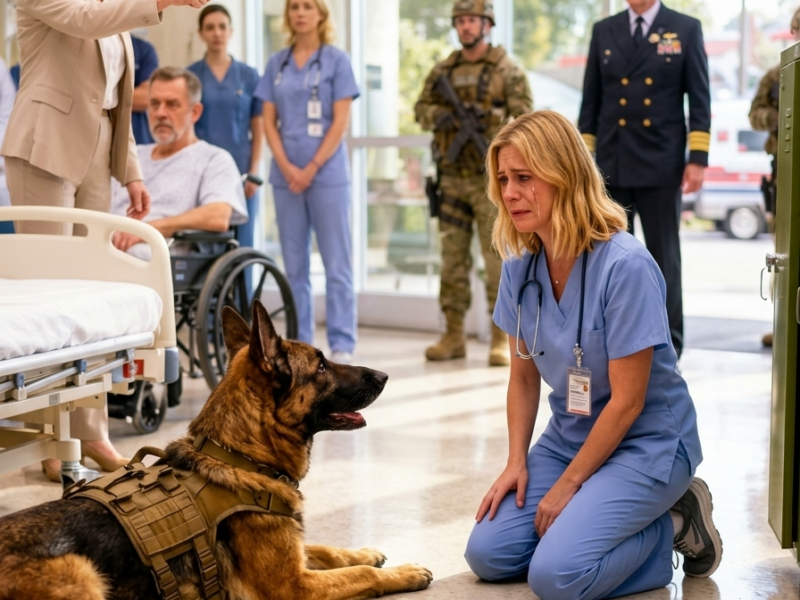
The K9 refused every meal beside the Navy SEAL’s flag-draped coffin, and when the grieving commander tried to drag him away from the funeral home
The rain had been falling over the Portsmouth Naval Annex in Virginia for three straight days, turning the grey concrete loading bays into slick mirrors of industrial light. Inside the quiet corridors of Saint Jude Military Auxiliary Hospital, the night shift moved with the slow, rhythmic cadence of fluorescent hums and the soft squeak of rubber soles against polished linoleum.
My name is Emily Miller. For seven years, I have worked as a trauma nurse on the late shift, attending to young men and women returning from deployments with broken bones, severe nerve damage, and minds haunted by sights they could never put into words. I thought I had seen every manifestation of grief, pain, and quiet trauma that the armed forces could produce.
I was wrong.
It began at two o’clock on a Tuesday morning when the escort team brought in Chief Petty Officer Daniel Hayes’s personal belongings, along with his military working dog, a eight-year-old Belgian Malinois named Ranger. Daniel had been a decorated Navy SEAL, attached to a specialized reconnaissance team operating out of Little Creek. Four days prior, his body had been brought back in a flag-draped casket, delivered straight to the base mortuary before being transferred to the local funeral home down the road.
The official military brief read like a hundred others I had filed in the hospital archives: Killed in action during a joint maritime counter-terrorism exercise in the Eastern Mediterranean. Vessel malfunction leading to catastrophic pressure explosion.
Yet, when Commander Arthur Vance—a tall, broad-shouldered man with ice-grey eyes and a rigid posture that seemed forged out of iron—brought Ranger through the double glass doors of our facility, the dog did not look like an animal mourning a tragic training accident.
Ranger’s coat was matted with rain and dust. His deep brown eyes were wide, alert, and burning with an unyielding, frantic intelligence. When Commander Vance attempted to drag the dog away from the funeral home transport unit parked near the rear bay, Ranger dug his claws into the rubber matting, locked his front legs, and let out a low, guttural growl that vibrated through the metal frame of the hallway. The dog wasn’t growling at the storm outside, nor was he whimpering in sorrow. He was staring directly at the sealed, flag-draped casket being loaded onto the transport vehicle, his lips pulled back over clean white fangs, his body trembling with a terrifying, directed fury.
“Get him up, Nurse,” Vance had snapped at me, his voice sharp and devoid of warmth. “The animal is becoming a disturbance. Put him in the holding kennel down in Storage B until the family claims him.”
“He hasn’t eaten in four days, Commander,” I replied, stepping forward and lowering myself to one knee, keeping my hands open and visible. “The escort officers said he refused water at the airfield. He’s severely dehydrated.”
“He’s a government asset undergoing behavioral stress,” Vance said coldly, tightening his grip on the heavy nylon leash. “He’ll eat when he’s hungry enough. Just clear the corridor.”
When Vance tried to haul the leash forward with force, Ranger did not yield. Instead, he snapped his jaw within an inch of the officer’s gloved wrist. Vance recoiled, his jaw tightening into a hard, dangerous line. He looked down at the dog not with sympathy, but with an intense, calculated irritation. Without another word, Vance dropped the leash into my hands and walked away, his polished dress shoes echoing down the empty hall.
For the next three nights, Ranger became my silent companion on the third-floor ward. He refused every bowl of wet food, every piece of seared beef I brought from the cafeteria, and every drop of freshwater I offered in stainless steel bowls. He would not sleep. He would not lie down.
Every night at precisely midnight, Ranger would stand up from the corner of my station, walk down the dimly lit hallway, and sit directly outside Room 112—an old, locked treatment room currently used to store decommissioned medical monitors and sealed tactical gear boxes left behind by Hayes’s unit.
Ranger would press his wet nose against the crack beneath the door, inhaling deeply, his tail completely motionless. He would remain there for hours, staring at the brass door handle as if expecting Daniel to step out at any second.
“He’s grieving, Emily,” Dr. Harrison, the senior night physician, told me on the third night as he reviewed patient charts. “A SEAL and his K9 share a neural bond deeper than most marriages. When the handler dies, the dog loses his anchor.”
“It’s not just grief, Doctor,” I said softly, watching Ranger through the open door of the nurses’ station. “Look at his posture. He isn’t waiting for a ghost. He’s guarding something.”
At three in the morning, while the hospital fell into its deepest lull, I walked down to Room 112. Ranger was sitting stiffly beside a pile of folded field gear that had belonged to Daniel—a salt-crusted tactical jacket, a pair of worn combat boots, and a heavy canvas rucksack that had not yet been returned to the family.
Ranger looked up as I approached. He did not growl at me. Over the past seventy-two hours, a quiet, unspoken trust had formed between us. I sat down on the cold floor beside him, crossing my legs.
“What is it, Ranger?” I whispered, stroking the coarse fur behind his ears. “What are you trying to tell us?”
Ranger let out a long, shuddering exhale. He turned toward Daniel’s salt-stained tactical jacket, shoved his long snout deep into the left breast pocket, and began scratching frantically at the inner lining with his front paws.
“Hey, easy boy,” I urged softly, placing a hand on his shoulder. “Easy…”
But Ranger was relentless. He bit down on the inner seam of the heavy canvas pocket and pulled back violently, tearing the reinforced stitching open with a sharp, crisp sound.
A small object fell onto the linoleum floor.
It was a folded, laminated photograph.
I picked it up. The image showed Daniel Hayes standing on a sun-drenched wooden pier, his arm draped over the shoulder of a young woman with dark hair and bright, intelligent eyes. They both looked happy, laughing into the camera with the Atlantic Ocean stretching out behind them.
I turned the photograph over. Written across the white back in dark, hasty black ink were four hand-lettered words:
She knows what happened.
My heart gave a sudden, violent thud against my ribs. The ink was fresh—not faded like an old keepsake, but crisp, smeared slightly at the edge as if written in a hurry under stressful conditions.
I took the photograph straight to Commander Vance’s administrative office on the main floor. The light was still on beneath his door. I knocked twice and pushed it open before he could answer.
Vance was standing behind a mahogany desk, looking over a stack of red-stamped casualty reports. He looked up, his brow furrowing instantly at my intrusion.
“Nurse Miller. Is there an emergency on the ward?”
“I found this,” I said, stepping forward and laying the photograph flat on his desk. “It was sewn into the lining of Chief CPO Hayes’s jacket.”
Vance did not pick up the photo immediately. He lowered his gaze to the image, his eyes scanning the woman’s face, then slowly flipping it over to read the four handwritten words. His expression did not soften into sadness. Instead, his jaw muscles clenched, and the ambient warmth seemed to drain completely from the room.
“Where did you get this?” Vance asked, his voice dangerously quiet.
“Ranger tore the lining open,” I replied, watching his eyes closely. “Who is the woman in the picture, Commander? If Daniel left this hidden in his gear, he wanted someone to find it.”
Vance slowly slid the photograph beneath a thick Manila folder on his desk. He leaned forward, resting both palms flat on the wood, locking his icy gaze onto mine.
“Chief Hayes died in the line of duty, Nurse Miller. His unit encountered a lethal equipment failure in international waters. What you are holding is a personal relic from a soldier whose mind was undoubtedly strained by operational fatigue.”
“That ink isn’t old, Commander,” I insisted, my voice rising slightly. “He wrote that right before he died.”
“Listen to me very carefully, Emily,” Vance said, leaning closer until I could smell the stale coffee and faint trace of tobacco on his breath. “You are a civilian contractor working in a naval medical facility. You do not understand tactical operations, nor do you understand the psychological deterioration of special operators under stress. You will leave this office, you will return to your desk, and you will forget you ever saw that photograph. For your own safety, and for the integrity of this hospital.”
The subtle threat hung heavy in the air, thick and suffused with unspoken danger. I stood my ground for three seconds before nodding curtly, turning on my heel, and exiting the office.
When I returned to the third floor, Ranger was gone.
Panic surged through my chest. The heavy steel door to the holding corridor was resting slightly ajar. I ran down the hallway, my heart hammering against my sternum.
“Ranger!” I called out in a hushed, urgent voice. “Ranger!”
I followed the trail of wet paw prints down the rear stairwell, down three flights of concrete stairs, leading straight to the hospital’s underground ambulance bay.
The heavy bay door was open just six inches to let in the cool night air. Outside, the rain was coming down in heavy sheets, splashing against the asphalt.
Ranger was standing outside in the downpour, his body tense, his nose lifted toward a unmarked grey van parked near the dark perimeter fence.
As I pushed the heavy metal door open and stepped into the cold rain, the driver’s side door of the van opened. A woman stepped out into the storm, wearing a dark trench coat with a hood pulled low over her face.
Ranger didn’t bark. He didn’t growl. He broke into a dead sprint, throwing his sixty-pound body through the rain straight toward her.
My breath hitched in my throat. “Ranger, no!”
But the dog didn’t attack. The moment he reached the woman, he dropped to his front knees, burying his head directly into her lap, letting out a high-pitched, agonizing whine that tore through the sound of the falling rain.
The woman fell to her knees in the wet gravel, wrapping her arms tightly around the dog’s neck, pulling his head into her chest. Tears mixed with the rain streaming down her face.
“Oh God,” she whispered, her voice shaking violently. “Oh God, Ranger… I’m so sorry, boy. I’m so sorry.”
I slowly walked toward them, my hands raised slightly in a non-threatening gesture, the rain soaking through my blue nursing scrubs within seconds.
She looked up at me. Beneath the dripping dark hood, I recognized the face immediately. It was the woman from the photograph.
“You’re the nurse,” she said, her voice trembling but clear. “The one working the night shift.”
“Who are you?” I asked, stopping five feet away. “How did you get past the perimeter gate?”
“Daniel told me you’d eventually find this if he didn’t come back,” she said, ignoring my question. She reached deep inside her wet coat and pulled out a small, thick yellow envelope. Across the front, written in the same dark black marker from the back of the photograph, was my name: Emily Miller.
My hands trembled violently as I reached out to take it. “I don’t understand. I never met Daniel outside his routine physicals at the clinic. Why would he leave something for me?”
“Because you were the only person in this facility who didn’t report to Commander Vance,” she said, her eyes searching my face with desperate intensity. “Inside that envelope is a letter Daniel wrote two weeks ago. He knew he wasn’t coming home.”
I opened the envelope with cold, numb fingers. Inside was a single piece of waterproof notebook paper:
Emily, if Ranger brings you to her, listen to what she has to say before they find you. Do not trust the official report. Do not trust Vance. Ranger knows who killed me.
I looked up from the paper, my blood running cold. “Who are you?”
“I’m Sarah Hayes,” she whispered, her voice cracking beneath the weight of her grief. “I’m Daniel’s sister.”
“His sister?” I repeated, my mind racing. “The military files… the brief said Daniel had no surviving immediate family.”
“Vance altered his personnel file three months ago,” Sarah said, wiping rain from her eyes as Ranger pressed his head against her hip. “Daniel discovered something monstrous happening inside his command structure before his last deployment. A black-budget smuggling operation involving decommissioned military ordinance being routed to private mercenary groups operating overseas.”
“He was killed in a training exercise…” I started, but Sarah cut me off, her hand gripping my wrist with terrifying strength.
“He wasn’t killed overseas, Emily,” she whispered, her voice barely audible over the roaring storm. “He was killed right here in Virginia. Three miles from this hospital. At an abandoned Navy storage facility near Pier 9.”
Ranger suddenly stiffened. His ears went flat against his skull, and a deep, terrifying growl rumbled deep within his chest.
Sarah and I both spun around.
At the far end of the covered ambulance corridor, standing motionless near the glass interior doors, was a man in a crisp khaki military service uniform. His face was hidden in the deep shadows of the overhead awning, but the silver rank insignia on his collar caught the dim light of the emergency fixtures.
It was Vance’s chief security officer, Captain Miller. He was holding a handheld radio in one hand, his eyes locked onto us. Without saying a word, he raised the radio to his mouth and pressed the button.
“He’s the one,” Sarah gasped, her grip on my wrist tightening. “He’s the man who was with Vance the night Daniel disappeared.”
Ranger pulled against his leash with such sudden, explosive power that I nearly lost my balance on the wet asphalt. He barked once—a booming, terrifying sound that echoed through the concrete loading bay like a gunshot.
“We have to go,” Sarah urged, grabbing Ranger’s collar. “If they take that envelope from you, neither of us will leave this base alive.”
“Wait!” I cried out as she began pulling Ranger toward the passenger side of the grey van. “What about Daniel’s gear? What was he trying to hide?”
Before Sarah could answer, Ranger suddenly broke free from her grasp, turned back, and sprinted back into the open rear entrance of the hospital. He ran straight into the small laundry alcove where Daniel’s torn tactical jacket was lying on the folding table.
I ran after him, sliding across the wet tiles of the service hallway.
Ranger didn’t tear at the cloth this time. He sat down beside the torn jacket, dipped his snout down, and gently lifted a small, metal object that had been sewn deep into the lining of the reinforced collar. He dropped it into my open palm.
It was a small, heavy brass key, covered in faint traces of motor grease.
Engraved along the side of the metal key were three distinct numbers:
Locker 317.
Before I could process what I was holding, the heavy fire doors at the top of the stairwell slammed open with a deafening crash. Heavy combat boots began descending the stairs at a rapid pace.
The metallic clatter of boots descending the concrete stairwell echoed down the narrow corridor like distant gunfire.
“Nurse Miller!” Captain Miller’s voice boomed from above, sharp, authoritative, and stripped of all professional courtesy. “Stand down and remain where you are! That entire area is a restricted crime scene!”
I didn’t think. Instinct took over, driven by the raw terror surging through my veins. I wrapped my fingers tightly around the brass key, shoved it deep into my scrub pants pocket, and grabbed Ranger by his heavy nylon harness.
“Come on, boy!” I hissed.
Ranger didn’t hesitate. Trained for tactical maneuvers in pitch-black environments, the dog turned seamlessly and led me down the service corridor toward the hospital’s sub-basement utility levels—a maze of unlit concrete pipes, steam valves, and forgotten storage bays built beneath the original 1940s structure.
We burst through the rear utility door into the blinding rain just as Sarah pulled the grey van around the corner of the boiler building, sliding the side door open.
“Get in!” she shouted over the roar of the wind.
I threw myself into the back of the van, and Ranger scrambled in behind me, his wet paws slamming against the steel floorboards. Sarah slammed the sliding door shut, hit the accelerator, and the vehicle lurched forward, tires screaming against the wet asphalt as we burst through the rear security gate just before the automated iron bars could lock into place.
Red emergency lights flashed behind us at the main guard shack, but within thirty seconds, the dark, tree-lined back roads of Portsmouth swallowed us whole.
I slumped against the metal wall of the van, gasping for air, my heart hammering like a trapped bird against my ribs. Ranger sat beside me, leaning his heavy, damp shoulder against my leg, his chest heaving in steady, rhythmic gasps.
“Are you alright?” Sarah called back from the driver’s seat, her eyes flicking to the rearview mirror as she navigated the winding coastal road without headlights.
“I think so,” I stammered, pulling the brass key from my pocket and holding it up in the dim amber glow of the dashboard lights. “Daniel hid this in the collar of his jacket. It’s marked Locker 317.”
Sarah glanced at the mirror, her hands tightening on the steering wheel until her knuckles turned white. “Locker 317… That’s not at the hospital. That’s at the old decommissioned armory building down near the Norfolk supply docks. Daniel had a private locker there from his early days in the TEAMS.”
“He knew they were going to kill him, didn’t he?” I asked, the terrible reality setting in.
Sarah was silent for a long moment. The only sound in the van was the heavy drumming of rain against the roof and the low, steady hum of the engine.
“Three weeks ago,” Sarah began, her voice heavy with grief, “Daniel called me from a burner phone. He sounded different—paranoid, exhausted. He said his unit had intercepted an unregistered shipment of high-grade tactical explosives at the port. When he reported the anomaly up the chain of command to Commander Vance, the inventory records vanished overnight. Two days later, Daniel’s closest teammate, Petty Officer Miller, died in a suspicious vehicle accident off Route 60.”
“They cleared the board,” I realized, terror chilling my spine.
“Daniel realized Vance wasn’t just turning a blind eye,” Sarah continued. “Vance was running the operation. He was using military transport flights to move weapons to private contractors operating in unregistered conflict zones. When Daniel threatened to go straight to the Naval Criminal Investigative Service, Vance had him detached from his team and brought to a private holding facility at Pier 9 under the guise of a classified briefing.”
“And the official story about the Mediterranean exercise?”
“A complete lie,” Sarah said bitterly. “They shot him in cold blood inside an empty warehouse, put his body in a sealed transport container, and staged the narrative. But they made one mistake. They didn’t count on Ranger.”
She looked back at the dog. Ranger lifted his head, his ears pricking up at the sound of his handler’s name.
“Ranger was in the transport vehicle when they brought Daniel’s body in,” Sarah said softly. “He bit through his restraint strap and attacked Captain Miller right there on the tarmac. That’s why Vance wanted the dog put down or locked away. Ranger isn’t just grieving, Emily. Ranger is the primary witness to a murder.”
Ten minutes later, the van pulled off the paved highway onto a rutted gravel road lined with rotting wooden piers and rusted shipping containers. The Norfolk Supply Annex looked abandoned—its high chain-link fences choked with dead ivy, its mercury-vapor security lights flickering ominously against the dark night sky.
We doused the engine and stepped out into the mud. Ranger immediately took the lead, his snout low to the ground, guiding us past stacks of rusting iron crates toward Building C—a sprawling, two-story brick warehouse with shattered windows and a sagging tin roof.
The padlock on the side entrance of Building C was heavily rusted, but the small brass key I held slipped into the keyhole with effortless precision. With a soft click, the heavy iron shackle released.
Inside, the warehouse smelled of stagnant saltwater, old engine grease, and damp concrete. A single row of locker bays stretched along the eastern wall, covered in decades of dust and grime.
We walked down the line until we reached the metal door painted with faded white stencils: 317.
My hand was shaking as I inserted the key into the locker mechanism. I turned it. The heavy latch lifted, and the rusted locker door creaked open.
Inside, sitting on a single wooden shelf, was a black, military-grade waterproof Pelican case. Next to it sat a small, battery-powered digital voice recorder and a set of blood-stained dog tags.
Sarah gasped, bringing her hands to her mouth as tears welled in her eyes once more.
I reached inside and picked up the digital recorder. My thumb hovered over the play button. I looked at Sarah, who gave a slow, somber nod.
I pressed play.
A static hissed from the tiny speaker, followed by the sound of heavy, labored breathing and the distant clatter of rainfall against metal. Then, Daniel Hayes’s voice echoed through the empty warehouse—deep, gravelly, and laced with absolute certainty.
“If you’re listening to this tape… it means Vance made sure I didn’t walk out of Pier 9 alive. To whoever found this—Nurse Miller, or my sister Sarah—what you hold in that black box is the complete digital ledger of Operation Black Veil. Names, offshore bank accounts, shipping manifests, and serial numbers for three hundred military-grade weapons systems sold illegally over the last eighteen months.”
Daniel paused on the recording, coughing violently before continuing.
“Vance thinks he cleaned his hands. He thinks my death will be buried under a folded flag and a polished lie. But Ranger knows the truth. The drive inside this box requires a two-factor encryption key that is hardwired into the base’s secure communications server at Fort Monroe. Take this data to the Inspector General before Vance realizes the locker key was missing from my uniform. God bless you both. Out.”
The recording clicked off into silence.
The heavy air in the warehouse felt suffocating. I reached into the locker to grab the black Pelican case, my hands trembling.
“We have it,” I whispered. “We have the proof.”
Before Sarah could respond, Ranger suddenly stood bolt upright. His throat tightened, releasing a low, vibrating growl that echoed through the hollow steel beams above us.
CLANG.
The heavy steel door at the far end of the warehouse slammed shut with a deafening, echoing thud.
The harsh, blinding beams of three high-intensity tactical spotlights suddenly burst through the darkness from the upper catwalks, pinning Sarah, Ranger, and me in an unforgiving circle of white light.
“Step away from the locker, Nurse Miller,” a voice boomed over the warehouse loudspeaker system.
Commander Vance stepped out onto the iron catwalk twenty feet above us, dressed in a black tactical coat. Beside him stood Captain Miller, holding a suppressed assault rifle pointed directly at my chest.
“You really should have followed my instructions, Emily,” Vance said, his voice dripping with smooth, ruthless calm. “You’re a good nurse. It’s a shame you have such a terrible sense of curiosity.”
Down in the shadows below the catwalk, four armed men wearing unmarked black gear stepped out from behind the shipping containers, their weapons raised, closing the circle around us.
The blinding tactical lights stung my eyes, turning the surrounding warehouse into a maze of harsh white light and pitch-black shadows.
Ranger moved instantly, placing his heavy body directly in front of Sarah and me, his back arched, his tail rigid, a fierce, terrifying snarl echoing from his chest.
“Commander Vance,” I said, my voice shaking despite my best efforts to project courage as I gripped the hard plastic handle of the Pelican case behind my back. “This is a military investigation now. The files are already archived. You can’t cover this up!”
Vance let out a dry, chilling laugh from the upper catwalk, leaning his forearm against the iron railing.
“Archived?” Vance sneered down at us. “Nurse Miller, you are standing in a decommissioned facility four miles outside your jurisdiction. No one knows you are here. No one knows Miss Hayes is alive. As far as the Pentagon is concerned, Chief CPO Hayes died a tragic hero, and his grieving sister tragically disappeared during a period of emotional instability.”
“You murdered my brother!” Sarah screamed, stepping out from behind me, her face pale with rage. “You shot him in cold blood!”
“Your brother was a foolish idealist who threatened the stability of a multi-million-dollar defense network,” Vance replied coldly, gesturing slightly with his left hand to the four armed men circling us on the ground. “Captain Miller… clean this up. Retrieve the case. Make sure the dog is disposed of this time.”
“Move!” Captain Miller commanded from the upper balcony.
The four armed operators surged forward simultaneously.
“Ranger, ATTACK!” Sarah shrieked.
The Belgian Malinois unleashed six years of elite special operations combat training in a single, explosive fraction of a second. He did not bark. He launched his entire body through the air, clearing six feet of concrete, slamming his chest directly into the lead operator’s throat. The man went down with a heavy crash, his assault rifle discharging into the tin ceiling with a deafening RAT-TAT-TAT-TAT.
“Run!” I screamed at Sarah.
In the ensuing chaos, I swung the heavy plastic Pelican case with all the strength in my arms, slamming it directly into the side of the second operator’s helmet. The man stumbled backward into a stack of empty oil drums, sending them crashing to the floor with a roaring metallic thunder.
“This way!” Sarah yelled, pulling open a rusted iron hatch marked Maintenance Access near the base of the locker wall.
Ranger disengaged from the downed guard, biting hard into the ankle of a third operator before turning and leaping through the narrow hatch right behind us. I threw myself inside last, slamming the heavy iron door shut and throwing the manual latch into place just as a hail of suppressed bullets slammed against the heavy metal exterior. THUD-THUD-THUD-THUD.
We were inside an ancient, narrow drainage tunnel that ran beneath the warehouse foundation toward the river basin. The air was ice-cold, foul-smelling, and thick with stagnant mud.
“Keep moving!” I panted, holding the Pelican case tight against my ribs as we stumbled through the pitch-black tunnel, guided only by the faint screen of my mobile phone.
Ranger ran ahead, his powerful senses navigating the slippery concrete pipe with absolute confidence. Behind us, the heavy iron hatch was already shuddering under the blows of a tactical breach sledgehammer.
BOOM. BOOM. BOOM.
We burst out of the drainage pipe into the freezing rain fifty yards away, scrambling up a muddy embankment into the dense pine woods that lined the edge of the industrial harbor.
“Where do we go?” Sarah gasped, her clothes completely soaked, her chest heaving as she leaned against an oak tree for support. “They have vehicles, thermal scopes, and the entire base communications array!”
“We need someone outside Vance’s chain of command who can verify the forensic physical evidence on this drive,” I said, my mind racing as adrenaline surged through my veins. “Dr. Harrison.”
Sarah stared at me in disbelief. “The hospital pathologist?”
“He’s the one who signed Daniel’s preliminary intake sheet,” I explained rapidly, pushing wet hair out of my face. “He told me tonight that something was wrong with the file. He’s a retired Navy Captain with thirty years of service. If Vance forced him to falsify an autopsy, Harrison will have kept his own private notes. He lives two miles from here in Cradock.”
Without waiting for an answer, Ranger barked once—a soft, low sound—and nudged my hand with his snout, pointing his head toward the tree line. He knew we had to keep moving.
We ran through the dark, muddy woods, staying off the main roads, using the heavy tree cover to shield us from potential aerial drones. Twenty minutes later, soaked, shivering, and exhausted, we reached a modest white-frame house set back in a secluded grove of pine trees at the end of a quiet residential street.
I ran up the porch stairs and pounded frantically on the front door.
“Dr. Harrison! Please, open up!”
A light flickered on in the second-floor window. Moments later, the heavy wooden door unlocked, and Dr. Harrison stood in the hallway wearing a flannel robe, holding a small revolver in his right hand.
“Emily?” he gasped, his eyes widening in shock as he looked at my mud-splattered scrubs, Sarah, and the massive, dripping war-dog standing on his porch. “What in God’s name is happening?”
“Doctor, please,” I begged, pushing gently past him into the warm living room. “Vance is trying to kill us. He killed Daniel Hayes, and he’s tracking us right now.”
Harrison’s face turned ashen. He closed the door quickly, threw the deadbolts, and pulled the heavy window drapes shut.
“I knew it,” the old doctor whispered, his hand shaking as he lowered his revolver onto the side table. “When they brought CPO Hayes into my morgue three days ago, Vance stood in the room with two armed escorts. The paperwork said explosion trauma… but the tissue entry wounds were unmistakable. Nine-millimeter sub-caliber rounds fired from point-blank range into his chest.”
Harrison walked over to a heavy steel safe in the corner of his study, dialed the combination with trembling fingers, and pulled out a thick yellow file folder containing high-resolution forensic photographs and toxicology slides.
“I was ordered to sign the official certificate under threat of a court-martial and the forfeiture of my medical license,” Harrison said, his voice breaking with deep shame. “I signed it because I was afraid. God help me, I was a coward.”
“You can fix it now, Doctor,” Sarah said, stepping forward. “We have Daniel’s drive from Locker 317. But we need your forensic report attached to the file to make it an airtight federal case.”
Dr. Harrison looked at the blood-stained dog tags lying on the table, then at Ranger, who was sitting quietly at his feet, looking up at him with those deep, mournful eyes.
“Give me the file,” Harrison said firmly, his eyes clearing with sudden resolve. “I’ll sign a sworn affidavit right now and attach my original autopsy photographs to your digital drive.”
For the first time in three hours, a sliver of hope cut through the darkness. Dr. Harrison sat down at his desk, pulled out his official medical seal, and began typing his formal deposition on an encrypted laptop terminal.
Ten minutes passed in absolute silence, save for the clicking of keys and the sound of rain against the roof.
Suddenly, the warm lamps in the living room flickered once, twice, and died completely.
The house was plunged into pitch-black darkness.
Ranger immediately sprang to his feet, a low, murderous snarl ripping from his throat as he faced the front bay windows.
Dot.
A tiny, brilliant red laser dot appeared on the wallpaper behind Dr. Harrison’s desk.
“DOWN!” I screamed, lunging across the desk to tackle the old doctor to the floor.
GLASS SHATTERED.
A sudden, deafening volley of automatic gunfire blew through the front windows of the house, shredding the curtains, shattering lamps, and tearing the wooden walls to splinters in a terrifying hail of lead.
The sound of shattering glass and tearing wood was absolute chaos. Splinters rained down over our heads as red laser beams crisscrossed the dark study like a deadly spiderweb.
“Is everyone down?” I screamed into the darkness, holding my hands over the back of Dr. Harrison’s neck as we lay flat on the hardwood floor behind the heavy oak desk.
“I’m hit!” Dr. Harrison groaned out, his voice choked with pain.
My heart plummeted. I crawled over to him in the dark, my nursing instincts instantly overriding my panic. I pressed my hands against his upper left shoulder, feeling the warm, sticky pulse of heavy arterial bleeding soaking through his flannel robe.
“Sarah! Hand me my scrub belt!” I shouted over the deafening sound of a second volley hitting the outer structure.
Sarah crawled through the broken glass on her hands and knees, tearing the cloth belt from her trench coat and pressing it into my hands. I wrapped it tightly around Harrison’s shoulder, applying a crude pressure dressing to stanch the wound.
“Hold this down, Doctor!” I commanded. “Keep firm pressure!”
Beside us, Ranger was crouched low to the floor, his ears pinned back, his eyes fixed on the shattered front entrance. Two tactical flashlights cut through the darkness from the front porch, casting long, menacing shadows across the ruined living room floor.
“Move in!” a voice commanded from outside. “Clear the house! Secure the laptop!”
“We have to get to the back door,” Sarah whispered, her face covered in plaster dust and tears. “There’s an access path into the swamp from his backyard!”
“We can’t leave the doctor!” I insisted.
“Go…” Dr. Harrison rasped, pressing his trembling hand firmly over his bloody wound. “My computer… is linked to… the base terminal at Fort Monroe. If you can get that drive… to the main relay tower… at the communications annex… you can trigger an automated Federal whistle-blower transmission…”
“Where is the relay tower?” I asked, grabbing his hand.
“Two miles north… off Highway 17,” Harrison gasped out. “The primary server node… is uncorrupted. Plug the Pelican drive into… the red Federal port. It bypasses… Vance’s local network…”
THUD.
The front door was kicked off its hinges.
“Ranger, COVER!” Sarah screamed.
Ranger didn’t hesitate. He launched himself toward the entryway like a dark bullet, knocking over a heavy antique floor lamp directly into the path of the entering operators. The lamp crashed against the lead guard’s tactical helmet, blinding him with a shower of sparks from the live wire, while Ranger bit down hard on the second guard’s tactical vest, dragging him backward into the rain.
“Go! GO!” Sarah yelled, grabbing the Pelican case and pulling me toward the kitchen.
We kicked open the wooden back door, bursting into the torrential rain once more. Ranger broke free from the porch struggle seconds later, sprinting past us into the pitch-black woods of the Dismal Swamp border, guiding us through the treacherous, mud-choked terrain.
The rain was turned into a blinding wall of water by the howling coastal wind. We waded through waist-deep swamp water, tripping over submerged cypress roots, our skin scratched by thorns, our bodies burning with raw exhaustion.
Behind us, red flares lit up the night sky as Vance’s men swept the perimeter with search helicopters, their powerful spotlights slicing through the storm clouds like giant blades of white light.
“Keep moving!” I pushed Sarah forward, my breath coming in painful, ragged wheezes. “We’re almost at Highway 17!”
Ranger moved through the dense brush like a ghost—never making a sound, turning back every fifty yards to check on us, his body acting as an invisible shield between the hunt and his fallen handler’s family.
After thirty grueling minutes of crawling through the freezing marsh, the tall, glowing iron structure of the Fort Monroe Auxiliary Communications Tower loomed out of the storm, rising two hundred feet into the dark sky behind a ten-foot security fence topped with razor wire.
The perimeter gate was locked with a heavy electronic keypad.
“We can’t get through!” Sarah cried, leaning against the cold chain-link fence in despair. “It’s a military security lock!”
Ranger stepped forward. He did not look at the lock. He ran ten feet to the left, where a fallen oak tree had crushed a section of the chain-link fence, creating a narrow, eighteen-inch gap near the muddy ground.
“Good boy!” I gasped.
We dug frantically at the mud with our bare hands, widening the gap until Sarah and I could drag ourselves through beneath the jagged wire.
We ran across the gravel courtyard toward the main server building—a windowless concrete bunker with a single reinforced steel door.
I grabbed the heavy handle. To my shock, the door clicked open. Dr. Harrison’s remote access signal had unlocked the automated emergency protocol from his study terminal before the attack.
We burst inside. The air inside the bunker was ice-cold, filled with the loud, deafening hum of bank after bank of glowing server racks processing millions of terabytes of military data.
In the center of the main terminal room sat a lit console with a prominent, glowing crimson interface slot labeled: FEDERAL IG DIRECT UPLINK – RESTRICTED AUTHORIZATION ONLY.
My hands shook violently as I set the Pelican case down on the metal desk. I unlatched the heavy plastic clasps, pulled out the encrypted high-capacity thumb drive, and inserted it into the crimson slot.
The main terminal screen instantly flashed yellow:
ENCRYPTED FILE DETECTED: OPERATION BLACK VEIL.
INPUT TWO-FACTOR AUTHENTICATION KEY TO INITIATE BROADCAST.
“The key…” I stammered, my heart stopping. “What’s the authentication key?”
Sarah pulled the brass key from her pocket, looking at the numbers stamped on the side. “Locker 317… Daniel’s team designator was Bravo-3-1-7!”
I quickly typed into the terminal keyboard: B-R-A-V-O – 3 – 1 – 7.
The terminal screen instantly turned bright green:
AUTHENTICATION ACCEPTED.
TRANSMITTING EVIDENCE TO NAVAL CRIMINAL INVESTIGATIVE SERVICE & PENTAGON INSPECTOR GENERAL…
PROGRESS: 12%… 24%… 38%…
“It’s working!” Sarah cried, tears of pure relief flooding her eyes. “It’s sending!”
CLANG-BANG.
The heavy reinforced steel entrance door of the server bunker was blown inward by a high-explosive breach charge, sending a deafening shockwave and a blinding cloud of gray smoke roaring through the room.
I was thrown against the server rack, my head slamming hard against the metal frame, vision swimming with bright stars.
Through the clearing smoke, Commander Vance stepped through the destroyed doorway, his face pale with cold, murderous rage. He was holding a black Sig Sauer 9mm sidearm in his right hand. Beside him stood Captain Miller, his rifle raised.
“Disconnect that drive!” Vance shouted to Miller, his voice trembling with furious panic.
“It’s a hardwired broadcast, Commander!” Miller yelled back, looking at the screen. “Once initiated, it can’t be aborted from this terminal! It’s going straight to the Federal Marshals!”
Vance looked at the terminal screen, where the progress bar hit 78%… 85%…
He turned his cold, dead eyes onto Sarah, then onto me. Slowly, deliberately, Vance raised his pistol, aiming the barrel straight at Sarah’s forehead.
“You ruined everything,” Vance whispered, his finger tightening on the trigger. “It ends right here.”
The world seemed to slow down into a series of jagged, frozen frames.
I saw Vance’s finger pressing hard against the steel trigger of his sidearm. I saw Sarah close her eyes, accepting her fate. I tried to scream, tried to lunge forward from the floor, but my concussed body refused to move fast enough.
BARK.
A dark, terrifying silhouette exploded from the smoke behind the server racks.
Ranger did not hesitate. He did not care about the weapon. He did not care about his own life. He launched his entire body straight at Commander Vance, a fury six years in the making concentrated into a single, unstoppable strike.
Ranger’s jaws locked onto Vance’s right forearm a microsecond before the hammer fell.
BANG!
The gunshot echoed deafeningly inside the concrete bunker, but the bullet tore wildly into the reinforced ceiling, showering us with concrete dust.
Vance screamed in agony as Ranger dragged him to the steel floor, his weight tearing through the officer’s tactical sleeve.
“Get him off me!” Vance shrieked, flailing helplessly on the floor. “Shoot him!”
Captain Miller spun his rifle toward the dog, but I mobilized every ounce of strength remaining in my body. I grabbed a heavy stainless-steel fire extinguisher mounted on the wall beside me and swung it with all my strength, slamming it straight into the side of Miller’s helmet.
Miller crumpled to the floor, his rifle clattering across the slick concrete floorboards.
Sarah rushed forward, kicking the rifle far out of reach, while Ranger held Vance pinned against the server base, his fangs sunk deep into the officer’s shoulder, pinning the traitor to the ground.
On the main terminal monitor behind us, a sharp, mechanical chime rang out:
TRANSMISSION 100% COMPLETE.
FEDERAL EMERGENCY ALERT DISTRIBUTED TO ALL REGIONAL NCIS FIELD OFFICES AND U.S. MARSHALS SERVICE.
Seconds later, the high-pitched, wailing sirens of multiple tactical law enforcement vehicles echoed outside the bunker, growing louder with every passing moment. Heavy searchlights illuminated the broken doorway, casting brilliant blue and red flashes across the smoke-filled room.
“FEDERAL AGENTS! DROP YOUR WEAPONS! COVER THE ENTRANCE!”
A dozen heavily armed NCIS Special Agents and Federal Marshals rushed through the breached door, tactical shields raised, laser sights painting the walls.
“SECURE THE ROOM!” the lead Federal Agent bellowed, his weapon aimed directly at Vance, who was weeping on the floor, bleeding from his torn shoulder.
“Stand down!” I gasped, raising my hands, tears finally breaking past my resolve. “The evidence is on that server terminal! He killed Chief Petty Officer Daniel Hayes! He’s the traitor!”
The Lead Agent looked at the glowing terminal screen displaying the fully uploaded military corruption dossier, then at the blood-stained evidence box, and finally down at Commander Vance lying in handcuffs on the cold floor.
“Arthur Vance,” the agent said, his voice cold as ice as he slapped steel cuffs onto the Commander’s wrists. “You are under arrest for high treason, conspiracy to commit murder, and the unlawful execution of a United States military officer.”
As the federal agents hauled Vance and Miller out into the flashing red lights of the storm, I dropped to my knees beside Ranger.
The dog was lying on his side on the cold floor, his chest rising and falling in shallow, labored gasps. A sharp piece of metallic shrapnel from the door breach had grazed his left flank, and blood was seeping through his thick dark coat.
“Ranger… oh God, Ranger,” I sobbed, pulling my trauma kit from my pocket with trembling fingers.
“Is he going to be okay?” Sarah asked, falling to her knees beside me, pressing her face against the dog’s soft neck.
“He’s going to make it,” I whispered, applying a sterile pressure bandage to his side, tears falling freely onto his coat. “He’s a warrior. He’s not going anywhere.”
Ranger lifted his head slowly. He looked up at Sarah, then at me. He didn’t growl. He didn’t whine. He let out a long, quiet sigh of absolute relief, leaning his heavy head softly into my lap, his body finally unclenching after four days of unimaginable trial.
The truth was out. The lie was dead. His duty was done.
Two months later, the morning sun broke over Arlington National Cemetery, painting the rolling green hills and neat rows of white marble headstones in a warm, golden light. The air was crisp, clean, and smelled of autumn oak leaves.
A massive crowd had gathered at the top of the hill overlooking the Potomac River—hundreds of Navy SEALs in dress blues, high-ranking military officials, civil servants, and dozens of citizens whose lives had been touched by the truth that had finally surfaced.
Commander Vance and his entire network had been dismantled by federal prosecutors, facing life sentences in maximum-security military prisons.
At the center of the gathering, resting on a polished mahogany caisson surrounded by crisp white lilies, was the casket of Chief Petty Officer Daniel Hayes.
This time, there were no false reports. No secret whispers in dark halls. No hidden horrors.
A six-man honor guard lifted the American flag above the casket, folding it into a tight, perfect triangle with meticulous, solemn reverence. The crisp sound of twenty-one rifles firing in unison echoed across the peaceful grounds, followed by the haunting, lonely notes of Taps drifting through the clear blue sky.
The Navy Chaplain stepped forward, presenting the folded flag to Sarah, who sat in the front row wearing a simple black dress, her eyes shining with quiet pride and healing grief.
Sitting right beside her, wearing a custom leather service harness adorned with a shiny gold star medal, was Ranger.
His fur was washed, brushed, and full once more. His wound had completely healed under my care. He sat with his head held high, his chest broad, his posture dignified and proud.
When the ceremony concluded and the crowd slowly began to disperse, Sarah and I walked up to the marble headstone engraved with Daniel’s name and rank.
Ranger walked between us, his steps slow and calm. He did not pull against his leash. He did not stare wildly into the distance looking for threats.
He walked up to the base of the headstone, sat down gracefully on the green grass, and rested his snout gently against the cold marble stone. He stayed there for a long moment, closing his eyes as a soft breeze rustled his ears.
I knelt beside him, resting my hand on his broad shoulder, looking up at the bright blue sky above Arlington.
“He knows,” Sarah whispered softly, stepping up beside me and taking my hand. “He knows Daniel is finally resting in peace.”
Ranger opened his eyes, turned his head toward us, and let out a soft, contented breath. For the first time since I had met him on that stormy night in the hospital corridor, the dark shadow of grief was gone from his eyes.
He had guarded his master’s secret. He had brought the traitors to justice. And now, at long last, the guardian was finally home.
The end.









