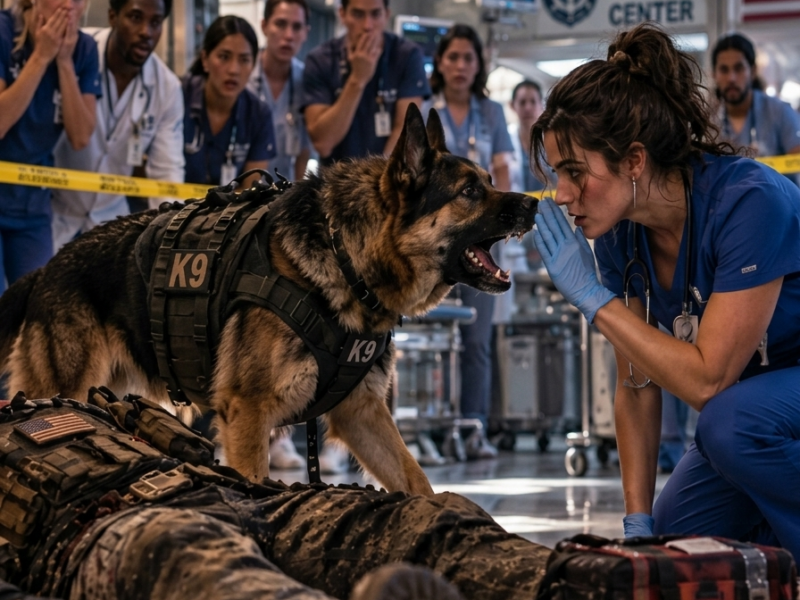
The K9 nearly tore through two corpsmen when they tried to reach the wounded SEAL on the stretcher
The fluorescent lights of Trauma Bay 3 at Naval Medical Center San Diego flickered in sync with the high-pitched shriek of an arterial monitor. The room smelled of fresh blood, ozone, and wet fur—a heavy, suffocating mix that instantly brought back the scent of copper and dust from a lifetime I thought I had buried.
“Clear the deck! Back up, dammit!”
Two navy corpsmen were pinned against the stainless-steel supply cart, their eyes wide with sheer terror. In front of them, blocking the chief trauma surgeon from reaching the gurney, was a eighty-pound Belgian Malinois. The dog’s dark coat was streaked with dirt and dried blood, his ears pinned flat against his skull. His heavy chest heaved as he let out a low, guttural snarl that shook the glass doors of the bay. Every time a corpsman made a move toward the stretcher, the Malinois lunged, his yellow teeth snapping inches from their gloved wrists.
“Where is his handler?!” Chief Surgeon Bradley yelled, shielding his face with a clipboard. “Get Security down here with a tranquilizer dart! The patient is in neurogenic shock, his pressure is dropping through the floor, and this damn dog is going to let him bleed out on my deck!”
“The handler was hit on the tarmac, sir!” a corpsman shouted back, his voice cracking. “The dog came off the Osprey with the bird! He won’t let anyone within three feet of the captain!”
I stood near the nursing station twenty feet away, a clipboard clamped in my hands. I had been finishing a chart for a routine appendectomy, eager to complete my twelve-hour shift and fade back into the quiet anonymity of my civilian life. But then I heard the name barked over the emergency comms system by the flight medic.
Captain Mason Cole. SEAL Team 7. Category Alpha trauma.
My fingers had locked around my pen so hard the plastic nearly snapped.
Mason Cole.
Nine years. It had been nine long, agonizing years since I had last heard that name spoken aloud. Nine years since a firestorm in the Kunar Province of Afghanistan shattered my world, erased my identity, and turned me into a ghost.
Slowly, as if moving through deep water, I set my clipboard on the desk and walked toward Trauma Bay 3.
“Nurse Vance, stay back!” Dr. Bradley snapped as I crossed the yellow boundary line painted on the tile floor. “That animal is wild! He nearly took off Miller’s hand!”
I ignored him. I didn’t see the hospital walls anymore. I didn’t hear the overhead announcements or the sirens outside. All I saw was the man on the gurney.
Mason’s face was almost unrecognizable under a thick crust of dried mud, soot, and dark blood. A massive shrapnel laceration split his right shoulder wide open, exposing dark red muscle tissue that was pooling blood onto the white sheets. His chest, crisscrossed with tactical gear straps that someone had partially cut away, rose in shallow, ragged gasps.
And standing over his lower legs, eyes wild and muscles tense as piano wire, was the Malinois. He wasn’t just defending his master; he was guarding a perimeter.
I stepped closer. The dog’s ears twitched. He turned his head toward me, his lips curling back over his gums, a vicious snarl rising in his throat.
I stopped two feet away. I didn’t look the dog in the eye—I knew better than that. Instead, I lowered my posture, dropped my hands to my sides where he could see them, and let out a soft, slow breath.
Then I leaned down and whispered a single word—a callsign that had been erased from official military registries nine years ago.
“Ghost.”
The barking stopped instantly.
The silence that fell over the trauma bay was so absolute that you could hear the steady drop of intravenous fluid dripping into a bag. The Malinois blinked. The ferocious tension in his spine melted away. His ears swiveled forward, and his tail gave one slow, hesitant thud against the metallic side of the gurney.
Dr. Bradley stared at me, his mouth open. The corpsmen slowly lowered their arms, looking between me and the massive war dog in sheer disbelief.
“How the hell did you do that?” a corpsman whispered. “How do you know that callsign? That’s not on his operational tag.”
“I knew his old team,” I said softly, my voice barely holding together.
It wasn’t a lie, but it was nowhere near the whole truth.
Nine years ago, I wasn’t Nurse Clara Vance. I was Lieutenant Maya Lin, an embedded surgical corpsman attached to a joint special operations task force in the mountains of eastern Afghanistan. Mason Cole had been my team leader—a brilliant, fiercely protective lieutenant who treated his unit like family.
We were sent into a remote village called Sangari after an intelligence leak exposed a suspected high-value target. But it was a trap. The moment our three-vehicle convoy entered the canyon, the hills erupted in mortar fire and heavy machine-gun rounds. Someone inside our own command structure had sold our exact coordinates to a private military contractor operating in the sector.
I was shot in the stomach during the opening volley. Mason had dragged my bleeding body behind the crumbling mud wall of an abandoned compound, pressing his own body over mine as RPGs rained down around us. Then, the roof collapsed under a heavy blast.
When I woke up three days later in an underground medical tent operated by an independent humanitarian aid network, I was told the truth: Task Force Jericho was gone. The official Department of Defense report declared the entire unit killed in action, their bodies consumed by an secondary ordnance explosion.
I was never listed as missing in action. I was simply erased. Dead. A casualty of a botched operation that the Pentagon swept under the rug to cover up the massive intelligence breach.
I knew then that if I returned to the military system, whoever had leaked our coordinates would finish the job. So I took the identity of a deceased civilian, faded into the background, put myself through nursing school, and swore I would never step foot near a military installation again.
Until Mason Cole was wheeled into my trauma bay bleeding to death.
The Malinois lowered his heavy head, pressing his cold, wet snout against the palm of my trembling hand. I stroked his thick fur, feeling the rhythmic rise and fall of his ribs.
As my hand moved down his neck, my fingers brushed against his heavy leather collar. Nailed to the thick leather was a scratched, brass identification tag. My heart stopped in my chest.
It wasn’t a standard military working dog tag. It was a custom-engraved dog tag carrying a fallen soldier’s name and service number: Special Warfare Operator 2nd Class David Lin.
My brother.
My breath hitched in my throat. David had been on that same mission in Sangari. He had died in the blast that destroyed the compound. Mason must have kept David’s tag all these years, fastening it to his working dog’s collar as a memorial.
I reached out, my fingers wrapping around the weathered brass. As I felt the edge of the tag, my thumb caught on a microscopic seam along its side. It wasn’t just a tag—it was a modified hollow capsule.
With a subtle flick of my fingernail, the back plate of the tag slid open. Inside lay a tiny, tightly rolled square of yellowed, waterproof paper.
I slid it out, cupping it in my palm so Dr. Bradley and the corpsmen couldn’t see. Using my thumb, I unrolled the tiny slip of paper. Written in dark, faded tactical ink were three words in my brother’s distinct, blocky handwriting:
She knows everything.
My blood ran cold. The room seemed to tilt beneath my feet. She knows everything. Who was “she”? Me? Or someone else?
A sudden, sharp rasping sound drew my attention back to the gurney.
Mason’s eyes snapped open.
They were clouded with pain and heavy sedatives, but the moment his gaze locked onto mine, his pupils dilated with absolute, raw shock. For several agonizing seconds, neither of us breathed. The noise of the hospital vanished. Nine years of grief, ghost stories, and buried trauma compressed into a single quiet space between us.
His lips parted, cracked and stained with dried blood. His voice was a barely audible whisper, scraped raw by smoke and intubation tubing.
“You’re… alive.”
Tears burned the backs of my eyes, but I forced them down, leaning over his chest as if adjusting his neck brace.
“So are you, Mason,” I whispered back, my voice shaking. “Stay still. You’re at Balboa. You’re safe.”
His gloved hand shot up with sudden, terrifying speed, his thick fingers wrapping around my wrist with a desperate, crushing grip. He pulled me down closer, until his mouth was inches from my ear.
“Don’t… trust them,” he hissed, his body trembling violently with the exertion. “The leak… it was never closed, Maya. They know…”
Before I could ask him what he meant, before I could ask who “they” were, every light in Trauma Bay 3 went black.
The abrupt failure of the hospital’s primary power grid plunged the entire emergency department into total darkness.
In an instant, the high-tech whir of medical equipment collapsed into eerie silence, replaced by the immediate panic of nurses and doctors shouting down the corridors.
“Generator backup! Why haven’t the emergency generators kicked in?!” Dr. Bradley roared from across the dark room.
“The whole wing just lost power!” a nurse called out from the doorway. “Main line’s down!”
Beside me, Ghost didn’t bark. He didn’t make a sound. Instead, the heavy Belgian Malinois stood bolt upright on the foot of the gurney, his shoulder muscles tightening into rigid iron blocks. A low, vibrating growl began deep within his chest—a warning sound not meant for the confused staff in the room, but aimed directly toward the glass doors facing the hallway.
Click.
With a harsh, yellow flicker, the low-voltage emergency backup lights buzzed to life along the baseboards, casting long, grotesque shadows across the blood-spattered tiles.
Mason’s hand tightened around my wrist like a vice. His eyes were wide, staring past me into the dimly lit corridor.
“They found you,” he rasped, his breath coming in shallow, ragged hitches. “Maya… run.”
“Mason, stop moving, you’re tearing your arterial repair!” I urged, trying to press him back down, but his gaze was fixed on the hallway.
I slowly turned my head, following his line of sight.
Standing at the far end of the darkened corridor, framed by the pale yellow glow of an emergency exit sign, was a tall man wearing a crisp Navy service dress blue uniform. He stood entirely still while doctors and nurses frantically ran past him in the darkness.
His posture was immaculate, his face carved from harsh, unforgiving angles. A thick, jagged scar ran from the edge of his jawline down into his collar.
My heart hammered against my ribs so hard I thought it would break them. I knew that face. I would have recognized that face in the depths of hell.
Commander Vance Sterling.
Nine years ago, Sterling had been the Executive Officer of our task force in Afghanistan. He was the man who had ordered Task Force Jericho into the Sangari canyon despite explicit warnings that our communications had been compromised. Two weeks after the massacre, a official Department of Defense press release stated that Commander Sterling had been killed in an insider attack at a forward operating base in Jalalabad. His body was never recovered. He had been buried with full military honors in an empty grave at Arlington.
Yet here he stood, alive, breathing, and looking straight through the glass partition of Trauma Bay 3.
In his gloved hand, held casually at his waist, was an old, faded 4×6 photograph. Even from twenty feet away, through the smudged glass, I recognized it. It was a candid shot taken at our staging base in Bagram—a photo of me in my tactical scrubs, laughing beside my brother David.
Sterling looked down at the photo, then raised his cold, grey eyes to lock onto mine. A slow, chilling smile touched the corners of his lips.
“Bradley, get out of here!” I shouted, dropping all pretense of being a civilian nurse. I shoved the chief surgeon behind the stainless steel cabinet as I grabbed a heavy brass retractor from the surgical tray. “Corpsman! Lock those doors!”
“Nurse Vance, what are you talking about?!” Bradley stammered, completely bewildered.
Before the corpsman could reach the sliding glass entrance, Commander Sterling took a step forward. But he didn’t draw a weapon. He simply raised his hand and made a brief, calculated signal toward the stairwell behind him.
Two men in dark, unmarked tactical fatigues stepped out of the shadows. They carried heavy suppressed sidearms and wore civilian contractor badges around their necks—the emblem of Apex Global Risk, a private military contracting firm that had secured multi-billion-dollar logistics contracts during the Afghan drawdown.
“Hospital security! Drop your weapons!” a young Navy Master-at-Arms shouted, running down the hall with his pistol drawn.
The lead contractor didn’t hesitate. He raised his suppressed pistol and fired twice.
Pfft. Pfft.
The sound was no louder than a couple of pneumatic air hoses snapping. The young guard collapsed to the floor, motionless.
Chaos erupted in the corridor. Medical staff began screaming, scattering into patient rooms and plunging behind nurses’ stations.
“In here! Now!” I yelled, slamming the manual locking bar on the heavy door of Trauma Bay 3.
“Maya…” Mason struggled to sit up, his face slick with cold sweat as dark red blood began to bloom anew through his chest dressings. “The file… behind David’s tag… it has the IP addresses… the bank accounts… Sterling sold the unit…”
“Save your energy, Mason!” I hissed, grabbing a bottle of sterile saline and a roll of heavy pressure gauze. I shoved the tiny, rolled-up slip of paper deep inside the inner pocket of my scrub top. “Can you walk?”
“No,” Mason grimaced, his teeth grinding together as he tried to swing his legs off the gurney. “Lacerated femoral branch… my left leg is dead meat right now.”
Bang!
The glass door of the trauma bay shuddered as a heavy boot slammed against the reinforced frame. Spiderweb cracks shattered across the glass panel, but the safety laminate held.
“Clara—or should I say, Lieutenant Lin?” Sterling’s voice echoed through the external speaker system of the bay, smooth, calm, and utterly devoid of emotion. “You’ve been dead a very long time, Maya. It’s a shame to spoil such a clean burial. Open the door. Let’s finish what we started in the canyon.”
Ghost let out a deafening bark, his front paws slamming against the cracked glass, his fangs bared in a terrifying display of rage.
“We need to move!” I looked frantically around the room. Trauma Bay 3 had no back door, but it shared a dirty-utility pass-through window with OR 4 next door—a small slide-hatch used for passing soiled linens and instruments.
It was narrow. Extremely narrow.
“Bradley! Help me move him onto the transport board!” I demanded, grabbing the heavy plastic backboard leaning against the wall.
Dr. Bradley was paralyzed with fear, staring at the body of the security guard lying in the hallway. “They… they just shot a guard… this is a federal hospital…”
I grabbed Bradley by his lapels and pulled his face inches from mine, my eyes blazing with the cold command of a battlefield corpsman. “If you don’t help me move this man right now, those men will put a bullet in your head just to keep this room quiet! Move!”
The surgeon snapped out of his trance. Together, we shoved the plastic backboard under Mason’s torso, lifting his heavy, muscular frame off the gurney. Mason groaned in agony, his fingers digging into my shoulder as his surgical incisions tore open.
Bang! Bang!
The glass door shattered inward as a contractor smashed the frame with a heavy crowbar. A black-gloved hand reached through the broken pane to locate the manual release latch.
“Ghost! Attack!” Mason spat through his teeth.
The Belgian Malinois didn’t hesitate. He launched his eighty-pound body straight through the shattered glass panel.
A terrible, agonizing scream echoed through the corridor as Ghost’s heavy jaws locked onto the contractor’s forearm. The man dropped his suppressed pistol, thrashing wildly as the massive war dog dragged him down onto the slick floor tile.
“Shoot the damn dog!” Sterling commanded from the hallway, his voice cold and precise.
“No!” I screamed.
I grabbed the heavy stainless-steel mayo stand beside the bed and hurled it through the broken glass door. The tray slammed into the second contractor just as he raised his sidearm toward Ghost, sending surgical instruments, scalpels, and glass vials crashing across the floor.
The distraction gave us three seconds.
“Bradley, take his legs!” I yelled, hoisting Mason’s upper torso toward the utility pass-through hatch.
The hatch was barely eighteen inches square. Mason was a broad-shouldered special operator weighing well over two hundred pounds, but with his body strapped flat to the plastic backboard, we shoved him head-first through the wall opening into Operating Room 4.
“Go! Go!” Mason gasped, sliding onto the sterile tile floor on the other side with a heavy thud.
“Doctor Bradley, get through!” I ordered.
The surgeon didn’t need to be told twice. He scrambled through the narrow square hatch like a terrified rabbit, disappearing into the dark operating room beyond.
I turned back to the broken door. The second contractor was pushing himself off the ground, his face covered in blood from a flying tray, his pistol rising again toward Ghost, who was currently pinning the first man to the deck.
“Ghost! Here!” I whistled—a short, dual-tone tactical recall sound my brother had taught me years ago.
The Malinois released the man’s mangled arm instantly, spun on his hind legs, and bounded back through the shattered glass of the door, clearing the metal frame in a single, fluid leap.
I grabbed the dog’s tactical harness, dragging him behind me as I dove head-first through the dirty-utility hatch into OR 4.
The moment my boots hit the floor of the dark operating room, I slammed the heavy lead-lined slide hatch shut and jammed a stainless-steel bone-retractor through the locking handle.
Pfft. Pfft. Pfft.
Suppressed rounds punched small, neat holes through the sheetrock wall above our heads, sending puffs of white plaster dust raining down onto our faces.
“Where does this exit lead?!” I demanded, crouching beside Mason on the floor as Ghost took up a defensive position by the main door of OR 4.
“It… it leads to the clean-utility corridor,” Dr. Bradley whimpered, clutching his arm where a stray piece of glass had cut him. “It connects directly to the basement service elevators and the loading dock.”
“Good. That’s our way out.” I looked down at Mason. His face was gray, his eyes unfocused, a thick puddle of arterial blood rapidly pooling beneath his backboard. His blood pressure was plummeting; if I didn’t get a tourniquet on that torn femoral branch within ninety seconds, he would die on this floor.
I grabbed a thick rubber tourniquet tube from a prep tray on the wall. “Mason, this is going to hurt.”
“Do it,” he rasped, clenching his jaw so hard his teeth squeaked.
I wrapped the rubber band high and tight around his upper left thigh, cranking it down until the arterial bleeding slowed to a dark, sluggish ooze. Mason let out a strangled groan, his fists digging into the tile floor until his knuckles turned white, but he didn’t scream.
“You’re a tough son of a bitch, Captain,” I muttered, grabbing a bottle of broad-spectrum antibiotic spray and dumping it straight into his open shoulder wound. “Now tell me what’s on that slip of paper. Why is Vance Sterling hunting you?”
Mason took a ragged, agonizing breath, his eyes locking onto mine through the gloom.
“Nine years ago… in Sangari,” Mason whispered, his voice trembling from blood loss. “It wasn’t just an intelligence leak, Maya. Sterling was working with Apex Global. They were staging incidents… ambushing American units… so Apex could secure a five-billion-dollar security contract from the Senate Appropriations Committee to ‘protect’ the sector.”
My stomach turned into a hard, cold knot. “They killed my brother… they slaughtered twelve men… for a private military contract?”
“Your brother… David… he figured it out before the convoy left the gate,” Mason said, a tear cutting a clean track through the dried blood on his cheek. “He transferred the financial routing numbers—the offshore accounts Sterling used to take the kickbacks—onto a encrypted drive. But when the RPG hit our building, David knew he wasn’t going to make it out.”
Mason reached up with a weak, trembling hand, pointing to the brass tag hanging from Ghost’s collar.
“He hid the decryption key inside that tag,” Mason rasped. “He told me… if anyone from Task Force Jericho survived… to find his sister. He said you were the only one who knew how to read the medical telemetry code he used to scramble the password.”
I stood frozen. She knows everything.
The three words written on that paper weren’t a warning about an enemy. They were my brother’s final testament of faith in me. David knew I was a corpsman; he knew I would understand the specialized sequence of medical heart-rate monitors he used as an encryption cipher for his personal files.
“I spent nine years searching for Sterling,” Mason whispered, his hand falling back to the floor. “I thought he was dead… until two weeks ago. I intercepted an Apex shipment in international waters off Baja. Sterling was on the manifest. He knew I had the tag… he tracked me here…”
BOOM!
The heavy double doors of OR 4 buckled inward as a breaching charge blew the lock off the frame. Acrid white smoke poured into the room, blinding us.
“Move!” I screamed, grabbing the handles of Mason’s backboard.
Dr. Bradley and I dragged the heavy plastic board across the floor, pushing through the rear service exit into the dimly lit clean-utility corridor just as the contractors poured into the operating room behind us, their sidearms raised.
Ghost stayed at my heel, his teeth bared, guarding our retreat as we plunged into the labyrinth of the hospital’s underground service tunnels.
The air in the basement tunnels beneath Naval Medical Center San Diego was thick with the humid heat of steam pipes and the oily scent of industrial generators.
The narrow concrete corridor stretched out before us, lit only by the sparse, amber glow of emergency bulkhead lanterns spaced fifty feet apart.
Dr. Bradley was sobbing hysterically as he helped me drag Mason’s backboard down the incline toward the main loading dock. “This is insane! They’re going to kill us! They’re going to kill all of us!”
“Shut up, Bradley!” I snapped, my eyes scanning the pipe-lined walls. “If you keep screaming, they won’t have to track us—they’ll just follow your voice!”
“We can’t go out the main loading dock!” Mason croaked from the board, his head slumping to the side. “Sterling… he’ll have men covering the perimeter gates… we’re boxed in…”
He was right. Vance Sterling was a master of tactical containment. He wouldn’t just breach the hospital; he would have a team covering every major vehicular exit from Balboa Park to ensure no one escaped with that decryption key.
“Where do the maintenance sub-tunnels lead?” I asked Bradley, kicking open a metal access door marked DANGER – HIGH VOLTAGE.
“They… they connect to the old municipal storm drainage system under Highway 163,” Bradley stammered, wiping sweat and blood from his forehead. “It runs all the way down toward the San Diego Bay, but it’s been sealed off for years!”
“Sealed off means no contractors,” I said.
I grabbed a heavy fire axe mounted on the wall cabinet, smashing the glass with my elbow. I pulled the heavy steel tool out, handing it to Bradley. “Use this to break the padlock on the drainage grate. Now!”
We hauled Mason into the high-voltage junction room, pulling his backboard behind a bank of massive grey transformers. Ghost immediately lay down beside Mason, pressing his body against the injured officer to keep him warm as shock set in.
I knelt beside Mason, tearing open a fresh bottle of IV saline from my scrub pocket and spiking his line to keep his blood pressure from collapsing completely. His skin was dangerously cold, his pulse thready and fast.
“Maya…” Mason whispered, reaching out with his blood-stained hand to catch my sleeve. “If I go under… take the tag… get to the federal courthouse downtown. Assistant US Attorney Vance… she’s the only one left… who isn’t on Apex’s payroll…”
“You’re not going under, Captain,” I said firmly, slapping his cheek gently to keep him conscious. “You survived a building collapsing on you in Afghanistan. You survived nine years in the dark. You are not dying in a basement room in San Diego.”
“I left you…” he choked out, a wave of profound, agonizing guilt breaking through his stoic tactical exterior. “In the canyon… I thought you were dead, Maya. I pulled your body out… there was no pulse… I had to fall back…”
“I know,” I said softly, brushing a lock of matted hair from his forehead. “I know, Mason. You didn’t abandon me. We were all betrayed.”
Thud. Thud. Thud.
Heavy tactical boots echoed down the concrete corridor outside the transformer room.
Ghost’s ears shot up. A low, barely audible rumble vibrated in his chest.
“They’re in the junction corridor,” I whispered to Bradley, who was trembling so violently he could barely hold the fire axe. “Give me the axe.”
I took the heavy iron tool from his hands, stepping quietly toward the metal door frame. Through the narrow gap in the door hinges, I saw three shadows moving cautiously down the amber-lit tunnel.
It wasn’t just the two contractors. Leading them, holding a suppressed Sig Sauer 9mm pistol in a relaxed, low-ready stance, was Vance Sterling.
His eyes were cold, methodical, searching the dark recesses of the pipe galleries.
“Maya!” Sterling called out, his voice echoing smoothly off the wet concrete. “You were always a brilliant corpsman. You saved a lot of good men in the Kunar Valley. Don’t throw your life away for a dead mission. Hand over the tag, and I’ll see to it that you get a full discharge, a new identity, and enough money to live comfortably anywhere in the world.”
I stayed silent, my fingers gripping the smooth wooden handle of the fire axe.
“You think you’re protecting honor?” Sterling laughed softly—a dry, humorless sound that sent chills down my spine. “Honor doesn’t pay for operations, Maya. It doesn’t pay for the weapons, the intel, or the sacrifices. Apex rebuilt the intelligence network in Sector 4 when the Pentagon pulled the plug. We did what had to be done. Your brother was a idealist who couldn’t see the bigger picture.”
“My brother was a soldier!” I screamed, stepping out into the open threshold of the doorway, raising the heavy fire axe over my shoulder. “And you are a traitor!”
Sterling turned his weapon toward me with terrifying speed.
Pfft!
A suppressed round slammed into the steel door frame inches from my head, sending sharp metal fragments showering into my face.
Before Sterling could press the trigger a second time, a dark, sixty-pound shape exploded out of the darkness behind me.
“Ghost! Kill!” Mason roared from the floor of the transformer room.
The Belgian Malinois didn’t go for the arm this time. He launched himself off the concrete floor like a missile, clearing ten feet of open space in a fraction of a second. His heavy jaws locked directly onto Vance Sterling’s throat.
Sterling let out a strangled, muffled scream as the weight of the massive war dog slammed him backward onto the hard concrete floor of the tunnel. His pistol clattered across the wet tile, spinning out of reach into the darkness.
“Shoot it! Shoot the dog!” the lead contractor yelled, raising his submachine gun.
“Bradley! Now!” I screamed.
Dr. Bradley, driven by a sudden, desperate surge of pure survival instinct, swung a heavy steel conduit pipe he had ripped from the wall, smashing it with all his strength into the side of the contractor’s knee.
The bone snapped with a sickening crunch. The contractor collapsed with a howl of agony, dropping his weapon.
I charged forward, bringing the flat side of the fire axe down across the second contractor’s jaw, knocking him senseless against the concrete wall.
On the floor, Sterling was thrashing wildly, his gloved hands clawing frantically at Ghost’s thick tactical collar, trying to break the dog’s lethal grip on his neck. Blood was pouring from deep lacerations along Sterling’s jawline, staining his pristine Navy uniform red.
“Ghost… heel!” I commanded, my voice echoing through the tight tunnel.
The Malinois didn’t release him immediately. He held Sterling down for two more agonizing seconds, his yellow eyes burning with wild, primal fury, before slowly stepping back, his chest heaving, a line of blood dripping from his jowls.
Sterling lay on the floor, gasping for air, his hands clutching his torn neck. He looked up at me, his eyes wide with fear, the arrogant, omnipotent facade completely shattered.
I stepped forward, my boots crushing the shattered glass of his fallen flashlight, and picked up his dropped Sig Sauer pistol from the floor. I racked the slide, chambering a round, and pointed the barrel directly between Vance Sterling’s eyes.
“Maya…” Sterling choked out, his voice a wet, rattling gasp. “Please… you’re… you’re a corpsman… you took an oath…”
“I took an oath to protect my team,” I said, my hand as steady as stone, the cold steel of the trigger smooth against my finger. “I took an oath to care for soldiers like my brother. You sold them out for offshore bank accounts.”
“Maya! No!”
Mason’s weak, rasping voice came from the doorway of the transformer room. He was dragging himself forward on his stomach, his elbows pulling his heavy, broken body across the concrete floor, leaving a dark trail of blood behind him.
“Don’t do it…” Mason gasped, reaching up to grab the hem of my scrub pants. “Don’t ruin… your life for this bastard… Let him face the court-martial… let him face the wall…”
I looked down at Mason. His face was pale, his eyes begging me not to cross the line that would turn me from a savior into a murderer.
Beside him, Ghost walked over and gently licked the blood from Mason’s cheek, sitting down like a silent sentinel over his fallen handler.
Slowly, agonizingly, I lowered the barrel of the pistol.
“Dr. Bradley,” I said, without taking my eyes off Sterling. “Take his radio. Call the Federal Bureau of Investigation and the Base MP Command. Tell them Commander Vance Sterling is alive, under arrest, and ready for transport.”
Three hours later, the morning sun was breaking over the blue waters of San Diego Bay, painting the sky in brilliant hues of gold and amber.
The emergency wing of Naval Medical Center San Diego was swarming with federal agents, military police, and naval investigators. Vance Sterling and his surviving contractors were in heavy iron restraints, being loaded into unmarked federal transport vans under the direct supervision of the United States Attorney’s Office.
The encrypted drive hidden behind my brother’s brass tag had been decrypted using the heart-rate telemetry code I provided. It revealed a web of corruption spanning nine years, forty-two offshore accounts, and the names of nineteen high-ranking officials who had profited from the blood of Task Force Jericho.
I stood on the helipad overlooking the ocean, a thick wool blanket wrapped around my shoulders. The cool morning breeze whipped my hair across my face, carrying the clean, salty scent of the sea.
The heavy double doors of the helipad opened, and a rolling bed was wheeled out into the sunlight.
Mason was lying on the gurney, hooked to an IV drip, his chest heavily bandaged, but the color was slowly returning to his face. Beside the bed, walking calmly with his head held high, was Ghost.
“They’re transferring me to Walter Reed for the vascular reconstruction,” Mason said softly, his voice much stronger than it had been in the dark tunnels beneath the hospital.
I walked over to the side of his bed, leaning down to adjust his blanket. “You’re going to make a full recovery, Captain. The surgeons said you’ll be back on two feet in six months.”
Mason reached out, his thick fingers wrapping around mine—not with the desperate, crushing grip of a dying man, but with the warm, steady strength of a brother-in-arms.
“What about you, Maya?” he asked, looking into my eyes. “The FBI cleared your record. Your identity as Lieutenant Maya Lin has been fully restored with full back pay and honor. You don’t have to hide as a ghost anymore.”
I looked out over the ocean, watching the naval ships glided silently across the harbor toward the open sea.
“I spent nine years running from the past, Mason,” I said softly, a genuine smile finally touching my lips for the first time in almost a decade. “I think it’s time I stopped running.”
Ghost nudged my hand with his cold snout, letting out a soft, contented sigh as I scratched him behind the ears.
“Where will you go?” Mason asked.
“Wherever you and Ghost are going,” I said, squeezing his hand tightly. “Task Force Jericho isn’t dead anymore. We’ve got a lot of catching up to do.”
Mason smiled—a rare, radiant look that completely transformed his scarred face. “Ready for duty, Lieutenant?”
I looked at the brass tag resting around Ghost’s neck, glittering like gold in the morning sun, and took a deep, clear breath of the sea air.
“Ready for duty, Captain.”
The end









