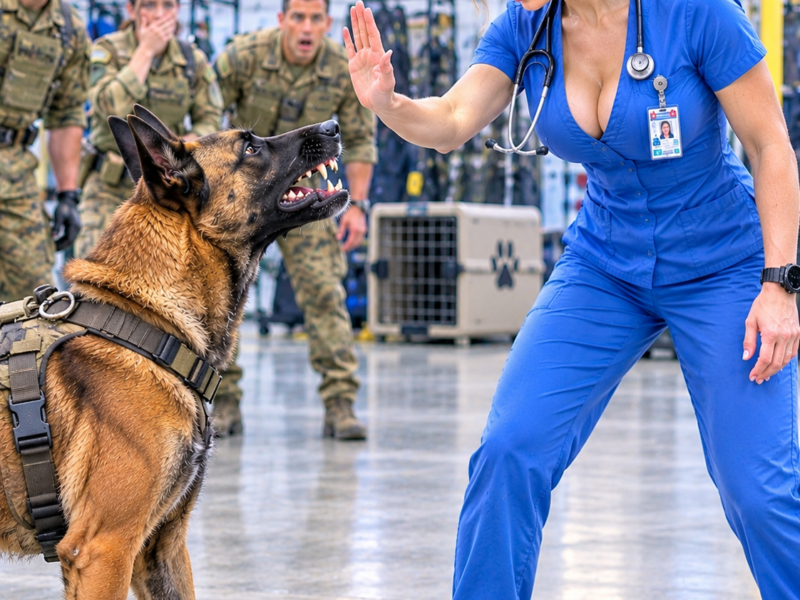
“The K9 lunged at its fourth handler in front of twenty armed military personnel, sending him crashing against a kennel gate
The commander didn’t answer my question immediately.
He looked at Rex through the kennel door, then at the photograph in his hand.
“Three years ago,” he said quietly, “your partner was assigned to a recovery operation that officially never happened.”
I felt my stomach tighten.
“Michael was a SEAL. He went missing during an operation. I was told his team never recovered his body.”
“That’s what the report says.”
“And you’re telling me the report was wrong?”
“I’m telling you that the man who signed it knew more than he put on paper.”
He turned the photograph toward me again.
I recognized Michael instantly.
He stood beside Rex, one hand resting on the dog’s neck, his expression serious but unmistakably alive.
Behind them stood a broad-shouldered officer in desert camouflage.
I knew that face, too.
“Colonel Vance,” I whispered.
“Lieutenant Colonel Vance at the time,” Commander Harris said. “He was the mission’s commanding officer. He signed the final casualty report.”
I stared at the picture.
“Why would he lie?”
“That’s what I’ve been trying to establish.”
Rex suddenly stood.
His ears pointed toward the photograph, and a low sound vibrated in his chest.
Not aggression.
Recognition.
I crouched beside the kennel.
“Easy, boy.”
His eyes moved from the photograph to mine.
“Home,” I whispered.
He lowered himself immediately, but his gaze stayed fixed on the image.
Commander Harris noticed.
“He only does that when someone mentions Dawson?”
“Not exactly.”
I reached through the kennel opening and rested my fingers against Rex’s shoulder.
“Michael taught him that word. It wasn’t just a command. It meant stop, breathe, and find the person you trust.”
“Then why did he attack four handlers?”
I looked at the old photograph.
“Because someone kept trying to take him away from the last place he felt safe.”
Harris studied me.
“You think he remembers what happened?”
“I think he remembers something that the rest of us were told to forget.”
The commander closed the folder.
“Come with me. There’s something you need to see.”
He led me to a small operations office at the end of the corridor.
A security officer stood outside.
Harris gave him a brief instruction, and the man unlocked the door.
Inside, a monitor displayed a video timeline.
“What is this?” I asked.
“Rex’s transfer footage. Every handler interaction. Every incident report.”
He pulled a chair toward the desk.
“Watch the first one.”
The video showed Rex inside a different kennel.
A young handler approached with a leash.
Rex remained still until the handler reached toward his collar.
Then the dog lunged.
The video ended with two security personnel separating them.
I watched the next recording.
Another handler.
Another approach.
Another attack.
Then the third.
The fourth.
The reports described the same behavior: sudden aggression, resistance to restraint, refusal to follow commands.
But I noticed something.
“Go back.”
Harris rewound the third recording.
“Right there,” I said.
The handler reached toward Rex’s collar.
Before the dog moved, his head turned sharply toward the man’s left hand.
“Zoom in.”
The image sharpened.
There was a small metal object hanging from the handler’s wrist.
A silver identification tag.
My pulse quickened.
“Do you have a close-up of the fourth incident?”
Harris opened another file.
The same thing.
A metal tag.
A distinctive shape.
I leaned closer.
It was a narrow rectangular tag with a small notch cut into one corner.
I had seen one before.
Michael used to carry something similar on his key ring.
But his wasn’t an identification tag.
It was a small metal marker he had brought home from an overseas deployment.
He called it a reminder.
A reminder of what, he never told me.
“Who are these handlers?” I asked.
“Contract personnel and temporary transfers. All qualified. None had previous disciplinary issues.”
“Did Rex react to anyone who didn’t wear one of these?”
Harris hesitated.
“We have one recording from a veterinary examination.”
He opened it.
A female veterinarian entered the kennel without a leash.
Rex stayed calm.
She examined his paws, checked his ears, and gave him a treat.
No attack.
No warning.
Then a technician entered carrying a medical tray.
Rex backed into the corner.
The technician reached for his collar.
The dog snapped.
I sat back.
“It isn’t the handlers themselves.”
“What is it?”
“The object. Or the smell on it. Something associated with it.”
Harris folded his arms.
“That’s what I thought, too.”
He opened a drawer and removed a clear evidence bag.
Inside was a silver tag.
My mouth went dry.
“Where did you get that?”
“It was found in Rex’s transport crate when he arrived here.”
I looked at it through the plastic.
The same notch.
The same worn edges.
And on the back, nearly hidden beneath scratches, were two engraved letters.
M.D.
Michael Dawson.
For a moment, the room seemed to lose all its air.
“That belonged to Michael.”
Harris nodded.
“We believe it was attached to his equipment during the final operation.”
I stared at the tag.
“Then why was it in Rex’s crate?”
“That’s the question.”
I turned toward him.
“Did you know Michael was handling Rex before the mission?”
“Yes. Rex was his working dog for fourteen months.”
“Then why wasn’t that in the transfer records?”
Harris didn’t answer.
I stood so quickly that the chair scraped across the floor.
“You knew.”
“I knew they had worked together. I didn’t know the full circumstances until I reviewed the original deployment file.”
“And you waited until now to tell me?”
“I needed to know whether Rex actually recognized you. I needed to know whether the connection was real.”
I looked at him in disbelief.
“You used me to test the dog.”
“I put you in a position where I could observe his response.”
“That’s the same thing.”
Harris accepted the accusation without defending himself.
Then he placed another photograph on the desk.
It showed Michael sitting on the ground beside Rex.
The dog was younger, his ears too large for his head.
Michael had one arm around him.
On the back, someone had written a date.
Three years and two months ago.
Two weeks before Michael disappeared.
I touched the edge of the photograph.
“He sent me a picture that day.”
Harris looked up.
“What picture?”
“Not this one. He was sitting beside a helicopter. He said he was going somewhere cold.”
“Did he tell you where?”
“No.”
“Did he mention Vance?”
I shook my head.
But then I remembered something.
A phone call.
Michael had called me late one evening, speaking so quietly I could barely hear him.
He had asked whether I still had the small emergency contact card he’d given me.
I told him it was in my medical bag.
He said, “Keep it there. Don’t give it to anyone unless I ask you myself.”
At the time, I thought he was being overly cautious.
Now I wondered whether he had been trying to warn me.
“Commander, I need to see the original mission file.”
Harris studied me.
“That file is restricted.”
“Then request authorization.”
“I already have.”
“And?”
“Denied.”
I stared at him.
“By whom?”
“Colonel Vance.”
The room went quiet.
I looked again at the silver tag.
“Then we know where to start.”
Harris shook his head.
“Not without evidence. Vance is now a senior officer. He has a clean record, a decorated career, and enough influence to bury an accusation before it reaches an investigator.”
“Then we don’t make an accusation.”
“What do we do?”
I held up the evidence bag.
“We find out why Rex is afraid of the people who carry this.”
Harris looked at me for a long moment.
Then he nodded.
“I have one more thing.”
He opened a secure folder on the monitor.
A document appeared.
It was a veterinary assessment dated six days after Michael’s disappearance.
The title read: CANINE RECOVERY AND BEHAVIORAL EVALUATION.
I read the first paragraph.
Rex had been recovered from an abandoned structure near the mission site.
He had suffered a deep laceration along his left flank and severe dehydration.
The report stated that he had been found alone.
But the next line made my hands go cold.
The animal repeatedly attempted to return to the western service tunnel despite physical exhaustion and handler intervention.
“Western service tunnel,” I repeated.
Harris nodded.
“The site was supposedly destroyed during the operation.”
“Supposedly?”
“The official report says a structural collapse made the area inaccessible.”
I looked at him.
“Was it searched?”
“Not according to the report.”
“Then how did they know there was no one inside?”
He looked away.
For the first time, I saw something like anger behind his calm expression.
“That’s what I want to know.”
I returned to Rex’s kennel that evening.
He was lying near the back wall.
When he saw me, he rose slowly and walked toward the door.
I held out my hand.
He sniffed my fingers, then pressed his muzzle against my palm.
“I found your tag,” I whispered.
His ears lifted.
“Michael’s tag.”
Rex made a small sound.
I swallowed.
“Did you leave him somewhere?”
His tail moved once.
Then he looked toward the corridor.
I followed his gaze.
A man had stopped outside the kennel.
He wore a dark uniform and carried a tablet.
I recognized him from the photograph.
Colonel Vance.
He looked older than he had three years earlier, but his expression was exactly the same.
Controlled.
Unhurried.
Certain that everyone in the room would do what he said.
“Commander Harris,” he called.
Harris appeared from the office.
“Colonel.”
“I hear we have a behavioral incident.”
“No incident, sir.”
Vance glanced at Rex.
“That’s not what the reports say.”
“The dog is responding well.”
“Then perhaps you can explain why a medical officer is spending so much time with an animal outside her assignment.”
His eyes moved to me.
I stood.
“I’m helping with the evaluation.”
“Your assignment is medical support, Lieutenant.”
“Medical officer,” I corrected.
His mouth tightened.
“Of course.”
He stepped closer to the kennel.
Rex immediately moved behind me.
The change was unmistakable.
His ears flattened.
His body stiffened.
A low growl began in his throat.
Vance stopped.
For a second, his expression changed.
Not surprise.
Recognition.
Then it disappeared.
“Still unstable,” he said.
Rex growled louder.
I placed one hand against the dog’s chest.
“Home.”
He lowered his head, but he didn’t relax.
Vance looked at me.
“Interesting command.”
“It’s an old one.”
“Where did you learn it?”
I met his eyes.
“From Michael Dawson.”
The corridor seemed to become colder.
Harris looked at me sharply.
Vance’s face remained composed, but his fingers tightened around his tablet.
“I see.”
“Did you know him?”
“I commanded his unit.”
“Then you know Rex belonged to him.”
“Many operators worked with that animal.”
“Not the way Michael did.”
Vance looked toward the kennel.
“Dawson died in the line of duty. I would suggest you leave his memory where it belongs.”
I felt my anger rising.
“I’d suggest you tell me why his identification tag was found in Rex’s transport crate.”
For the first time, Vance said nothing.
His gaze moved to Harris.
“Where did you get that information?”
Harris stepped forward.
“Colonel, I can explain.”
“No,” Vance interrupted. “You can report to my office tomorrow morning.”
Then he turned to me.
“And Lieutenant, you will discontinue your involvement with this animal effective immediately.”
He walked away.
Rex remained frozen until Vance disappeared around the corner.
Then the dog began to tremble.
I knelt beside him.
“It’s okay.”
He pushed his head beneath my hand.
I looked up at Harris.
“He recognized him.”
“Yes.”
“He was afraid of him.”
Harris stared down the corridor.
“I saw it.”
“Then we have more than a theory.”
“We have a reaction. We still need proof.”
I looked at Rex.
“Then we find it.”
That night, I couldn’t sleep.
I kept seeing Michael in the photograph.
His hand on Rex’s neck.
His eyes looking directly into the camera.
He had always had that expression when he was trying to reassure someone without telling them the truth.
I remembered our last conversation.
He had called from an unknown number.
I was exhausted after a long shift and irritated that he had woken me.
He laughed softly when I complained.
Then his voice changed.
“Sarah, if something happens, I need you to trust what you know.”
“What does that mean?”
“It means reports don’t always tell the whole story.”
“Michael, you’re scaring me.”
“I know.”
There had been a long silence.
Then he said something I hadn’t understood.
“Rex knows the way home.”
I asked him what he meant.
He told me he would explain when he returned.
He never did.
At 6:15 the next morning, Commander Harris called.
“Meet me at the training yard. Bring your medical kit.”
“Why?”
“Rex is being transferred.”
I was already getting dressed.
“By whose order?”
“Vance’s.”
I reached the kennel as two transport personnel approached with a reinforced lead.
Rex was pacing.
His breathing was fast.
One of the men held a restraint pole.
“Stop,” I said.
The nearest handler turned.
“Ma’am, we have transfer orders.”
“I know. Give me a minute.”
He looked at Harris.
The commander nodded.
I entered the kennel.
Rex backed away from the restraint pole.
I crouched.
“Home.”
His body lowered.
I touched the side of his neck.
“You’re not in trouble.”
His eyes searched my face.
Then he did something I had never seen him do.
He turned and walked to the rear corner of the kennel.
He began scratching at the floor.
Once.
Twice.
Then he looked back at me.
I moved closer.
The concrete beneath his paws had a small metal seam.
I knelt and ran my fingers over it.
A narrow maintenance panel.
“Commander.”
Harris came inside.
“What is it?”
“Help me move this.”
He crouched beside me.
The panel was secured with two small bolts.
We loosened them using a tool from my kit.
Beneath the metal cover was a shallow compartment.
Inside lay a folded piece of waterproof material.
I carefully pulled it out.
It was a strip of fabric.
Dark green.
Torn at one edge.
And stitched into the fabric was a small number.
17.
Harris stared at it.
“That’s not standard kennel equipment.”
I turned it over.
On the back, someone had written two words in faded black ink.
WEST TUNNEL.
My heart began pounding.
“Michael,” I whispered.
Rex pressed his nose against the fabric.
Then he let out a long, trembling whine.
Harris immediately radioed security.
“No one moves this dog. Suspend the transfer.”
The handlers stepped back.
I looked at him.
“Where did this come from?”
“I don’t know.”
“Then why was it hidden here?”
Harris looked at the dog.
“Someone wanted him to remember.”
We secured the fabric in an evidence bag.
Within an hour, a military investigator arrived.
His name was Special Agent Marcus Reed.
He was calm, middle-aged, and careful with every word.
He photographed the panel, documented the evidence, and interviewed everyone who had handled Rex since his arrival.
When I showed him the photograph of Michael, he paused.
“You knew Petty Officer Dawson?”
“He was my partner.”
“Personally?”
“Yes.”
He looked at me.
“Then I need you to understand something. If we reopen this case, there may be things in the original record you won’t want to hear.”
“I’ve spent three years hearing that he’s dead.”
“I understand.”
“No, you don’t. I need to know whether he died there.”
Reed closed his notebook.
“Then we’ll find out.”
He requested the original veterinary report.
He requested the transport logs.
He requested the names of every person who had handled Rex after the operation.
And most importantly, he requested the original photographs from the recovery site.
Two days later, he returned.
He asked Harris and me to join him in the conference room.
A large screen displayed a satellite image of an abandoned industrial compound overseas.
“Here’s the official recovery location,” Reed said.
He pointed to a collapsed building near the northern perimeter.
“Rex was reported here.”
Then he displayed a second image.
A western access road.
A narrow structure partly concealed beneath the remains of a loading platform.
“The western service tunnel,” I said.
Reed nodded.
“According to the original report, this tunnel was inaccessible due to structural damage.”
He changed the image.
A photograph appeared.
The tunnel entrance was intact.
The door was open.
And there were fresh tire tracks in the dirt.
“Those photographs were taken by a reconnaissance team forty-eight hours after the reported collapse,” he explained.
“Why weren’t they included in the report?”
“Because the reconnaissance team was told to submit their images through a separate intelligence channel.”
“Who told them?”
Reed looked directly at me.
“Colonel Vance.”
Harris leaned forward.
“What did the intelligence channel contain?”
“Most of the files were deleted or transferred. But we recovered one fragment from an archived server.”
He pressed a key.
A grainy video appeared.
The camera shook as someone moved through a dim corridor.
The date stamp matched the day after Michael’s disappearance.
A voice came through the recording.
“Dawson, keep moving.”
My breath stopped.
It was Michael.
Older footage, distorted audio, but unmistakably his voice.
Then another voice spoke.
“Leave the dog. We don’t have time.”
The camera turned.
A man in uniform appeared near a doorway.
I recognized the outline of his face.
Vance.
The video ended.
Nobody spoke.
I felt as if the floor had disappeared beneath me.
“He was alive,” I whispered.
Reed nodded.
“At least twenty-four hours after the reported casualty.”
Harris looked furious.
“Why was this never disclosed?”
“We don’t know yet.”
“Where did the footage come from?”
“A field recorder recovered during a later equipment audit.”
I stared at the frozen final frame.
“Can you enhance it?”
“We’re working on that.”
I looked at Reed.
“Is Michael still alive?”
He didn’t answer quickly.
“I can’t tell you that.”
It was honest.
And somehow, it hurt more than another empty reassurance.
For the next week, the investigation moved carefully.
I was removed from Rex’s official handling schedule to avoid compromising the inquiry.
But Reed allowed me to assist with the dog’s medical and behavioral assessments.
Rex improved.
He ate regularly.
He stopped lunging at unfamiliar handlers.
He even began sleeping through the night.
But whenever someone mentioned Vance, he went rigid.
The investigator also discovered something else.
The silver tag had not been recovered at the original site.
It had been listed as missing personal equipment.
Three weeks after Michael disappeared, it was signed out of a restricted evidence locker by an officer working directly under Vance.
That officer had since retired.
When Reed interviewed him, the man admitted that Vance had instructed him to place the tag in a sealed package.
He didn’t know where it went afterward.
The package had been marked for destruction.
But the destruction record was incomplete.
Someone had kept it.
Someone had placed it with Rex.
And someone had hidden the fabric in the kennel panel.
We still didn’t know who.
Then, on the eighth day of the investigation, Reed called me to his office.
He had a new photograph.
It showed a small coastal medical facility in another country.
The picture was taken months after Michael disappeared.
A man stood near the entrance.
His face was partly obscured by a medical mask.
But I recognized his posture.
The way he leaned slightly to one side.
The old injury in his left shoulder.
Michael.
My knees weakened.
“Where was this taken?”
“During an unrelated intelligence review. The location was never connected to the Dawson case.”
“Is he alive?”
“We believe the man in the image is Michael.”
I covered my mouth.
“Why didn’t anyone tell me?”
“We only confirmed the identity yesterday.”
“Where is he now?”
Reed hesitated.
“We don’t know.”
I stared at the picture.
There was something else in the background.
A sign above the doorway.
A medical emblem.
And a date printed on a notice.
The photograph was only eleven months old.
Eleven months.
Not three years.
He had been alive eleven months ago.
I sat down.
For the first time since his disappearance, I allowed myself to cry.
Not because I knew he was safe.
Because I finally knew I hadn’t been foolish for hoping.
Reed gave me a few minutes.
Then he placed another document on the desk.
“We also identified the person who submitted the original footage.”
I wiped my face.
“Who?”
“Sergeant Daniel Cole. He was assigned to Vance’s support team during the operation.”
“Where is he?”
“Retired. Lives in Arizona.”
“Can he tell us what happened?”
“He has agreed to speak with investigators.”
“When?”
“Tomorrow.”
The next morning, I joined Reed and Harris on a secure video call.
A tired-looking man appeared on the screen.
He had gray hair, a lined face, and eyes that seemed older than the rest of him.
“Sergeant Cole?” Reed asked.
“Yes.”
“We’re reviewing the Dawson operation.”
Cole looked down.
“I wondered when someone would finally do that.”
“Did you know Petty Officer Dawson?”
“I helped train with him. He was a good man.”
“Was he killed during the operation?”
Cole closed his eyes.
“No.”
My heart began pounding.
“Then what happened?”
Cole looked directly into the camera.
“Michael found evidence that the mission had been compromised before the team deployed.”
Reed leaned forward.
“What kind of evidence?”
“An informant had provided the location of a group holding several kidnapped civilians. The information was supposed to be verified through a secure channel. But Michael discovered that the channel had been accessed by someone outside the authorized team.”
“Vance?”
Cole nodded.
“He believed the breach came from a local contact. Michael wasn’t convinced.”
“What happened at the site?”
“Someone was waiting for them. The team came under fire. Michael and Rex were separated from the others when part of the structure collapsed.”
I gripped the edge of the table.
“Was Michael injured?”
“Badly. He had a head wound and a broken leg. Rex stayed with him.”
Cole swallowed.
“We heard the dog barking through the rubble. We tried to reach them, but Vance ordered us to pull back.”
“Why?”
“He said the structure was about to collapse again.”
“Was it?”
Cole shook his head.
“Not then.”
Silence filled the call.
“Vance knew Michael was alive,” Reed said.
“Yes.”
“Why did he report him dead?”
Cole looked away.
“Because Michael had found the breach.”
I felt sick.
“Was Vance involved in the compromise?”
“I can’t prove that. But he had been communicating with someone outside the operation. Michael confronted him before the mission.”
“Who was the other person?”
“I don’t know.”
Reed asked whether Cole had seen Michael after the team withdrew.
Cole nodded slowly.
“Two days later, I was assigned to a temporary medical transfer. We moved a wounded operator to a field facility under a different identity.”
“Was that Michael?”
“Yes.”
“Why didn’t you report it?”
Cole’s voice broke.
“Because Vance told us Michael had agreed to disappear while the investigation continued. He said it was necessary to protect the civilians and identify the person behind the leak.”
I stared at the screen.
“Did Michael agree?”
Cole was silent.
Then he said, “At first.”
“What does that mean?”
“He believed Vance was still trying to protect the team. But when he learned the official report listed him as dead, he wanted to contact you.”
My throat tightened.
“Why didn’t he?”
“Vance said your name had appeared in intercepted communications. He told Michael that anyone who contacted you could expose your location.”
I felt the blood drain from my face.
“Was that true?”
Cole looked at Reed.
“I don’t know. I never saw the communications.”
“Did Michael believe him?”
“For a while.”
“And then?”
Cole took a breath.
“Then Michael disappeared from the medical facility.”
“Where did he go?”
“We don’t know.”
I stared at the screen.
“He left?”
“His room was empty. His medical records were gone. But his personal effects were still there.”
“Did he have Rex?”
“No. The dog had already been transferred.”
I closed my eyes.
Michael had survived.
He had been injured.
He had tried to reach me.
And somewhere along the way, the truth had become another thing he couldn’t safely tell me.
Reed ended the call after several more questions.
The investigation now had enough evidence to formally question Vance.
But before that could happen, Vance requested a meeting with Harris.
He insisted I attend.
The meeting took place in a secure conference room.
Vance arrived with a legal adviser.
He looked at the evidence photographs spread across the table.
The kennel panel.
The fabric.
The silver tag.
The recovered video still.
“You’ve built an elaborate theory,” he said.
Reed remained calm.
“We have testimony, recovered footage, and evidence that contradicts your casualty report.”
“Sergeant Cole is unreliable.”
“He provided information that can be independently verified.”
“Then verify it.”
“We are.”
Vance looked at me.
“You should not be here.”
“I was Michael’s partner.”
“You were not assigned to the operation.”
“I was the person he tried to call before he disappeared.”
Vance’s jaw tightened.
“You don’t understand the circumstances.”
“Then explain them.”
He glanced at his adviser.
The man whispered something.
Vance ignored him.
“Dawson was involved in a classified investigation. His safety depended on remaining unidentified.”
“Then why did you declare him dead?”
“Because a public casualty record would have protected his family from further inquiries.”
I stared at him.
“You could have told me he was alive.”
“No.”
“Why?”
“Because you would have tried to find him.”
“Yes,” I said. “I would have.”
“And that would have put you at risk.”
“Did you ever ask me what risk I was willing to take?”
He didn’t answer.
Reed slid a document across the table.
“Colonel, did you authorize the removal of Dawson’s medical records?”
“No.”
“Did you order Sergeant Cole to transfer him under an alternate identity?”
“I don’t recall.”
“Did you instruct personnel to remove the western tunnel photographs from the official report?”
Vance’s expression hardened.
“I will not answer questions based on incomplete intelligence.”
Reed closed the folder.
“Then we’ll continue through the formal investigative process.”
Vance stood.
“You’re making a serious mistake.”
Reed remained seated.
“That’s for the evidence to determine.”
Vance left with his adviser.
For several seconds, nobody spoke.
Then Harris exhaled.
“He knows we’re close.”
I looked at the photographs.
“Close to what?”
“The truth.”
But the truth still had one missing piece.
Michael’s location.
And we had no idea whether he wanted to be found.
Three days later, Rex changed everything.
I was in the training yard when a delivery vehicle arrived.
The driver handed the security officer a small padded envelope.
There was no return address.
Only my name.
Inside was a photograph.
It showed Rex sitting beneath a tree.
His coat was clean.
His ears were upright.
And beside him, partly visible at the edge of the image, was a familiar hand resting on his back.
I turned the photograph over.
Four words were written in black ink.
“Tell him I’m coming home.”
My hands began shaking.
There was no signature.
There didn’t need to be.
I showed it to Reed.
He immediately secured the envelope and requested a forensic examination.
The photograph contained no useful fingerprints.
The paper had been purchased locally.
The delivery route led to a public mailbox.
But the message changed the investigation.
Michael knew Rex was alive.
He knew I was there.
And he was trying to reach us.
For the next two weeks, security monitored incoming messages.
Reed coordinated with the appropriate military and civilian authorities.
Harris arranged for Rex to remain at the facility.
I spent every available hour with him.
Sometimes we walked the training grounds.
Sometimes I sat beside his kennel and talked about Michael.
I told him about the hospital.
About the rain in San Diego.
About the terrible coffee Michael used to drink.
Rex listened.
He always seemed to recognize the stories.
Then, one quiet afternoon, the security officer called my name.
“Lieutenant Mitchell, there’s someone at the front gate.”
I looked up.
“Who?”
“He asked for you.”
My heart began to race.
“Did he give you a name?”
The officer hesitated.
“He said you would recognize him.”
I ran.
Harris was already moving toward the entrance.
Reed intercepted us near the security checkpoint.
“Don’t rush this,” he said.
“Agent, please.”
“I understand. But we need to verify his identity and make sure this is safe.”
I forced myself to stop.
Through the glass, I could see a man standing beside the gate.
He wore civilian clothes.
A dark jacket.
A faded shirt.
His hair was shorter than I remembered.
His face was thinner.
But the way he stood was unmistakable.
Michael.
He looked toward the building.
Then he saw me.
For one second, neither of us moved.
I had imagined this moment a thousand times.
In every version, I ran to him.
In every version, he smiled.
But now that he was standing in front of me, I couldn’t make my legs work.
He lifted one hand.
The same small gesture he used to make when he wanted me to know he was all right.
I covered my mouth.
“Michael.”
His eyes filled.
“Hey, Sarah.”
My knees nearly gave way.
Reed stepped forward and began the identity verification process.
Michael cooperated.
He provided the required identification details and answered questions about the operation that only the real Michael could have known.
The process felt endless.
But eventually, Reed nodded.
“It’s him.”
I didn’t wait.
I crossed the remaining distance.
Michael opened his arms.
I reached him and held on so tightly that he winced.
“I’m sorry,” he whispered.
I pulled back.
“Don’t.”
“Sarah—”
“Don’t say you’re sorry before you tell me why you let me bury you.”
His face crumpled.
“I didn’t know how to come back.”
“You were alive.”
“Yes.”
“You knew I was looking.”
“I did.”
“You let me believe you were dead.”
“I thought it was the only way to keep you safe.”
I stepped away.
“Was it your decision?”
He looked down.
“At first, yes. Later, no.”
I stared at him.
“Explain.”
He took a breath.
“After the operation, Vance told me the breach was still active. He said the people responsible were watching everyone connected to the team. He told me that if I contacted you, they might use you to find me.”
“Did you believe him?”
“I wanted to.”
“And when you stopped believing him?”
“I was already gone. My identity had been compromised. My medical records were altered. Every time I tried to get a message to you, someone intercepted it.”
“Why didn’t you go to another authority?”
“I did. Eventually.”
He glanced at Reed.
“That’s why I came back now.”
Reed stepped closer.
“Michael, we need a full statement.”
“I know.”
“Your testimony may be central to the investigation.”
“I understand.”
I looked at Michael.
“Were you the one who sent the photograph?”
He nodded.
“I couldn’t contact you directly until I knew the message would reach you.”
“And Rex?”
His expression softened.
“I heard they were transferring him. I knew he would fight anyone who tried to restrain him.”
“He attacked four handlers.”
“Because they were using the same old equipment and carrying the same tags we used during the operation.”
I remembered the silver marker.
“Why did those tags frighten him?”
Michael’s eyes lowered.
“Because the last time he saw one, someone wearing it tried to pull him away from me while I was trapped beneath the collapsed structure.”
My chest tightened.
“Vance?”
Michael nodded.
“He came back with a small team. They had orders to recover the equipment and leave the site.”
“But you were alive.”
“I was.”
“Did he know?”
“He saw me.”
The words landed like a physical blow.
“He saw you?”
Michael nodded again.
“He looked right at me. I asked him to get Rex out first. The dog was injured and panicking. Vance ordered his men to take the equipment instead.”
I felt sick.
“What happened?”
“One of the men tried to pull Rex away. Rex fought. I told him to stop. I used the command.”
“Home.”
Michael looked at me.
“Yes.”
My eyes filled.
“He came to me when I said it.”
“He would.”
Michael’s voice broke.
“He stayed with me even after the others left. I thought I was going to die there.”
I reached for his hand.
“But you didn’t.”
“No. A local rescue team found us the following day. They took me to a medical facility. Rex was eventually transferred through another unit.”
“Why did Vance say you were dead?”
Michael looked toward Reed.
“Because I had evidence that someone inside the operation had leaked the mission location. I believed Vance was involved, but I couldn’t prove it. He knew I had seen him at the tunnel. If I returned openly, he could discredit me before I had a chance to testify.”
“Did you have proof?”
Michael nodded.
“I kept a copy of the original communication log. It showed that the mission location had been accessed through an account assigned to Vance’s command office.”
Reed’s expression sharpened.
“Where is it?”
“Not here.”
“Where?”
Michael looked at me.
“I gave it to someone I trusted. They preserved it until I could safely return.”
Reed asked for the person’s name.
Michael provided it.
The investigator immediately contacted his team.
For the first time, I understood why Michael had come back.
He wasn’t simply trying to find me.
He was ready to stop running.
Before anyone could say more, a familiar sound came from the training yard.
A bark.
Then another.
Rex had heard Michael’s voice.
He was pulling against the lead held by a handler.
I turned.
Michael was already moving.
“Rex.”
The dog froze.
His ears lifted.
Michael stepped through the gate and crouched.
“Hey, buddy.”
Rex made a sound that seemed to come from somewhere deep inside him.
Then he ran.
The handler released the lead.
Rex crossed the yard and crashed into Michael’s chest.
Michael wrapped both arms around him.
The dog licked his face, pressed against his shoulder, and whined so loudly that people nearby stopped what they were doing.
Michael buried his face in Rex’s fur.
“You stayed,” he whispered.
Rex’s tail moved so hard his entire body shook.
I stood a few feet away, crying.
For three years, I had imagined Michael’s final moments.
I had imagined Rex searching for him.
I had imagined a dog that couldn’t understand why his person never came back.
Now I watched them hold on to each other.
And I understood that Rex had never been attacking people without reason.
He had been protecting the last connection he had to the man who taught him where home was.
Michael looked up at me.
“Come here.”
I knelt beside them.
Rex moved between us, placing his head against my chest.
Michael reached for my hand.
For a moment, none of us spoke.
Then he said, “I heard you were the only person who could calm him.”
I laughed through my tears.
“He remembered you.”
“He remembered you, too.”
I looked at Rex.
“How do you know?”
“Because you were part of his home before I disappeared.”
That sentence stayed with me.
The investigation continued for months.
Michael provided his testimony.
The recovered communication logs were authenticated.
Sergeant Cole’s account was corroborated by the original medical transfer records.
The evidence established that Vance had knowingly submitted a false casualty report and concealed information about Michael’s survival.
Investigators also uncovered unauthorized access to mission data and attempts to obstruct the subsequent inquiry.
Vance was relieved of command while the military investigation proceeded.
The matter was referred through the appropriate legal channels.
I never learned every classified detail.
Some parts of the operation remained sealed.
But the official record was corrected.
Michael Dawson was no longer listed as killed in action.
He was listed as recovered and returned to active legal status.
The correction arrived in a plain envelope.
Michael read it at the kitchen table.
Then he placed it beside his coffee.
“Three years,” he said.
I sat across from him.
“Three years of one sentence being wrong.”
He looked at me.
“I know.”
We didn’t pretend that everything was fixed.
His injuries required months of rehabilitation.
Some nights, he woke from dreams he couldn’t describe.
I still struggled with anger.
There were days when I wanted to ask every question again.
Why hadn’t he found another way?
Why hadn’t he trusted me?
Why had everyone accepted a report that left so many unanswered questions?
We learned to talk about those things without turning every conversation into another battle.
Michael began working with a rehabilitation program for retired military working dogs.
Rex joined him.
The dog was never forced into another operational role.
He had earned the right to rest.
His days became simple.
Morning walks.
A sunny patch beside the window.
A favorite blanket.
And Michael’s hand resting on his neck whenever the house grew too quiet.
I continued my medical work.
But I also began volunteering with a program that helped service members and their families navigate the long aftermath of deployment.
I had spent years treating injuries people could see.
Now I understood how many people carried wounds that never appeared on a scan.
One evening, several months after Michael returned, I found him sitting on the floor beside Rex.
The dog was asleep with his head across Michael’s leg.
Michael was holding the old photograph from the training facility.
The one taken before the mission.
“Thinking about something?” I asked.
He looked at the picture.
“I’m thinking about how many times I almost came home.”
I sat beside him.
“Why didn’t you?”
He took a long breath.
“Fear. Bad decisions. People I trusted. Sometimes all three.”
I rested my head against his shoulder.
“You’re here now.”
He nodded.
Rex stirred.
Michael placed a hand against his chest.
“Home,” he whispered.
The dog opened one eye, gave a quiet sigh, and settled again.
I smiled.
For a long time, I had thought that word was simply a command.
A way to stop a frightened animal from moving.
A signal to breathe and trust.
But watching them together, I finally understood what Michael had meant all those years ago.
Home wasn’t always a place.
Sometimes it was the person who kept searching.
Sometimes it was the one who refused to forget.
And sometimes, when everyone else had given up, it was a dog who remembered the way back.
The end.









