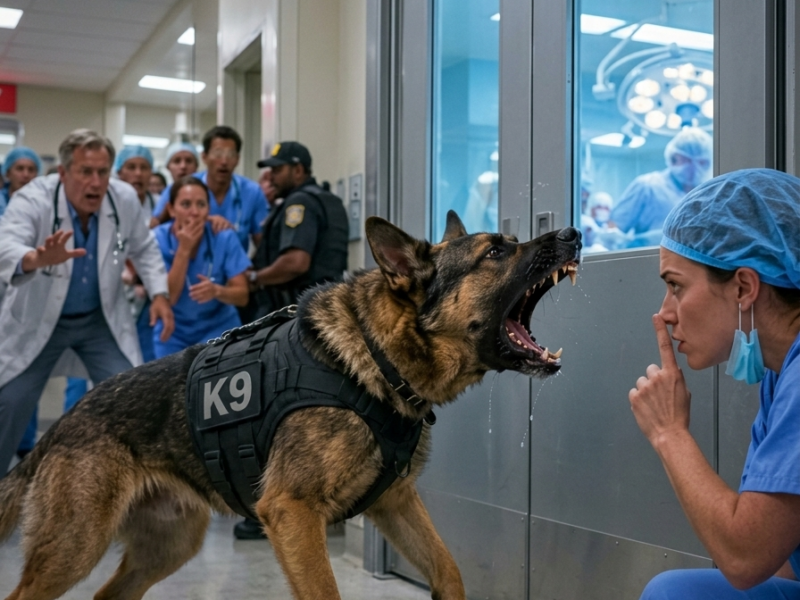
The K9 guard dog blocked the operating room doors while a SEAL captain’s heartbeat faded, and when the hospital commander ordered security to shoot the animal
The harsh fluorescent glare of the main surgical wing at Naval Medical Center Portsmouth vibrated with a sharp, metallic tension. As a night-shift surgical nurse with nearly five years of service in Norfolk, Virginia, I was used to late-night traumas, emergency evacuations, and the chaotic arrival of wounded sailors. But I had never seen a military working dog transform an operating room threshold into a standoff.
The German Shepherd—a broad-chested, muscular animal weighing at least ninety pounds—refused to yield a single inch of concrete floor. His posture was rigid, his teeth exposed in a silent, lethal snarl. He was guarding the double stainless-steel doors of Operating Room 3, where a surgical team was battling to stabilize Captain Michael Reeves, a highly decorated Navy SEAL brought in under top-secret transit orders after a covert mission went down in flames over the Atlantic.
“Get that dog out of my way!” Commander Ellis yelled, his voice echoing down the corridor. As the hospital’s chief of administrative medicine, Ellis was a man obsessed with procedure and chain of command. “He’s compromising the sterile barrier! Grab him!”
A hospital security officer stepped forward and reached for the thick tactical harness on the dog’s back. The Shepherd twisted with blinding speed, his jaws snapping shut inches from the officer’s wrist. The security guard gasped and scrambled backward, nearly falling into an IV stand.
Through the glass panel of the operating room door, a surgeon pressed his face against the window, his voice crackling through the wall-mounted intercom. “He’s going to get the captain killed! Captain Reeves’s arterial line is failing! We need to bring in the bypass cart, but we can’t open these doors!”
Commander Ellis’s face flushed a deep, furious crimson. He turned to a master-at-arms standing near the emergency exit. “Unholster your weapon. Take the animal down.”
I stepped forward before I could process the danger. “No! Don’t shoot him!”
“Lieutenant Bennett, step back!” Ellis barked, pointing a stern finger at my chest. “This is a medical emergency, not a canine shelter! That dog is rabid!”
“He’s not rabid,” I said, my voice shaking slightly as I observed the animal’s frantic movements.
The Shepherd wasn’t acting out of blind, frantic rage. His dark eyes weren’t wild; they were filled with a profound, intelligent terror. Every few seconds, he pressed his wet nose into the rubber seal between the double doors, snorting softly as if checking for the smell of blood or breath, and then immediately whipped his head toward the hospital’s eastern corridor—a long, dimly lit passageway leading to the administrative offices and the secondary loading docks.
He wasn’t keeping the surgeons out. He was watching the eastern hallway, keeping an unseen threat away from the man on the operating table.
My stomach tightened into a knot. Three years ago, my younger brother, Daniel Bennett, had vanished during a classified Joint Special Operations Command deployment in Eastern Europe. Daniel had been a Navy K9 handler, attached to an elite counter-terrorism unit. When the military casualty notification officer came to our door, he claimed a catastrophic explosion had killed Daniel and his entire squad. No body was recovered. No personal effects were ever returned. The only thing I received was a heavily redacted official report containing a strange, handwritten note at the bottom of the last page: The guardian remembers.
I had spent three agonizing years trying to bury those three words.
Now, looking closely at the Shepherd’s trembling frame in the dim hallway light, I noticed a distinct, jagged scar running through the fur above his left eye—a scar shaped like a crescent moon.
My heart skipped a beat. Daniel’s assigned working dog, a hero Malinois-Shepherd hybrid named Ranger, had sustained that exact same injury during a training exercise at NAS Oceana when a piece of shrapnel grazed his skull.
“Wait…” I whispered.
Ignoring Commander Ellis’s direct command to stand down, I took three cautious steps toward the snarling dog.
“Lieutenant, stay back!” Ellis shouted, his hand dropping toward his sidearm holster.
I knelt onto the cold floor, keeping my palms open, my posture non-threatening, and my voice as soft and steady as I could manage. “Easy, Ranger.”
The Shepherd’s ears immediately twitched forward. The sharp snarl died in his throat, replaced by a low, desperate whine. His dark eyes locked onto mine, searching my face with an almost human recognition.
I swallowed hard, my chest aching as I reached into the memory of our childhood in rural Virginia, back when Daniel used to practice his tactical dog commands in our backyard, laughing as he taught me the secret override word he trained into his animals so they would obey me if he was ever away.
I leaned closer and whispered the phrase into the quiet air.
“Silver Dawn.”
Ranger instantly dropped his hips to the floor. His front paws slid forward, his teeth vanished, and his heavy tail gave two slow, hesitant thumps against the linoleum.
The corridor fell into an absolute, suffocating silence. The security guards froze. Even Commander Ellis stood speechless, his mouth slightly open as he stared at the dociled beast.
I reached out with a trembling hand, slipping my fingers beneath the heavy nylon collar. Tucked inside the thick fabric was a small, worn metal tag, scratched and dented by fire and sharp steel. Only two words remained legible beneath the grime.
D. Bennett.
My brother’s initial and last name.
My knees nearly buckled beneath me. I leaned against the wall for support, tears stinging the back of my eyes. “That’s impossible,” I breathed into the dark fur of the dog’s neck. “Daniel is dead… he died three years ago…”
Before anyone in the hallway could move or speak, the pneumatic seals of Operating Room 3 hissed open.
A lead surgeon strode out into the corridor, his blue scrubs soaked in dark blood, his surgical mask hanging loosely around his neck. His hands were shaking inside his latex gloves.
“We need to know who trained that dog,” the surgeon demanded, his eyes scanning the room frantically. “The captain’s blood pressure just spiked! He woke up for three seconds on the table, fought the anesthesia, and kept repeating the same name over and over!”
I pushed myself up from the floor, my hands resting on Ranger’s head. “What name did he say?”
The surgeon looked directly into my eyes, his expression pale and shaken.
“Daniel Bennett.”
Before I could form a sentence, the overhead fluorescent lights flickered violently twice, hummed with a sharp electrical whine, and died entirely.
The secondary emergency generators failed to kick in. The hallway was plunged into pitch-black shadow, illuminated only by the faint red glow of the exit signs at the end of the hall. Every security monitor along the nursing station went completely black, their feeds severed at the source.
Ranger instantly surged to his feet, stepping directly between me and Commander Ellis. A deep, ominous growl vibrated out of his chest as he turned his face toward the dark eastern corridor.
Suddenly, the hospital’s emergency public address speaker crackled to life with a wave of static. A cold, mechanical voice echoed through the dark wing.
“Attention, medical staff. An unauthorized individual has entered the facility.”
A long, agonizing pause followed, filled only with the faint sound of heavy breathing over the radio line.
Then the speaker crackled again. The mechanical tone was gone, replaced by a soft, familiar voice—a voice I had dreamed of hearing every night for three long years.
“Tell Nurse Bennett her brother is waiting outside.”
My breath caught in my throat. I couldn’t move. I couldn’t breathe.
Because that voice unequivocally belonged to my brother, Daniel.
And the very last words he had spoken to me on a crackling satellite phone before disappearing three years ago were a terrifying promise that he would never come home.
The darkness inside the surgical wing felt heavy and suffocating, thick with the sharp tang of ozone from the failed electrical junction. The red glow from the exit signs cast long, distorted shadows across the floor.
“What is the meaning of this?” Commander Ellis yelled into the dark, pulling a heavy tactical flashlight from his belt and shining the beam down the corridor. “Security, get the emergency backup power online immediately! Secure the doors!”
“Sir, the main circuit breakers in the basement have been hard-bypassed,” a security guard reported, his flashlight beam shaking as he scanned the darkened hallway. “The whole grid for Sector 4 is dead!”
Ranger didn’t bark. He remained standing directly in front of me, his heavy head lowered, his dark eyes locked onto the eastern corridor. He nudged my right hip with his snout, pushing me backward toward the open door of Operating Room 3.
“Nurse Bennett,” the surgeon whispered, pulling me by the sleeve into the operating suite. “Get inside! We don’t know who is out there!”
I stepped back into the operating room, Ranger following tightly at my heels. Inside, the emergency battery backup was powering a single, dim surgical lamp suspended over Captain Michael Reeves. The SEAL captain lay pale and motionless on the operating table, his chest wrapped in heavy sterile dressings, his heart monitor emitting a fragile, erratic beep… beep… beep.
“Look at his monitors,” I said, pointing to the telemetry display.
Despite being under heavy paralytics and anesthetics, Captain Reeves’s brain activity on the EEG monitor was surging in violent, erratic waves. His right hand was twitching, his thumb and index finger locked into a rigid grip, pressing down against the surgical sheet as if trying to hold something steady.
“He was trying to speak again right before the power cut,” the scrub nurse said, her hands trembling as she adjusted his IV line. “He kept saying ‘The file is in the dog… don’t let Ellis take the dog.'”
My head whipped around toward the window facing the hallway. Outside in the dark corridor, Commander Ellis was whispering urgently into a handheld radio, his flashlight beam pointed down at the floor, far away from the eastern hallway. He wasn’t acting like a medical director dealing with a security breach. He was acting like a man waiting for a scheduled arrival.
“He’s not trying to save the captain,” I realized out loud, a cold wave of adrenaline washing over me. “Ellis is waiting for someone.”
I dropped to my knees beside Ranger. The dog stood calm under the surgical light, allowing me to run my hands along his neck, his chest, and his tactical harness.
“The file is in the dog,” I repeated under my breath.
I unbuckled Ranger’s heavy nylon harness. Beneath the padded chest plate, hidden against his thick fur, was a small, flat metal capsule sewn directly into the inner lining of the harness strap. It was sealed with heavy black electrical tape and stamped with an official military clearance symbol—a silver anchor wrapped in a chain.
My hands shook violently as I peeled back the tape. Inside the capsule was a micro-encryption drive, no larger than a fingernail, wrapped in a piece of waterproof paper.
I unfolded the paper under the faint surgical light. Written in dark, blue ballpoint ink was my brother’s unmistakable handwriting:
Claire—If you are reading this, Captain Reeves made it to Norfolk, and I am already dead or captured. Do not trust Ellis. Do not trust Navy Intelligence. The accident three years ago was staged to cover up the theft of four tactical dirty bombs by a black-budget contractor operating out of the naval shipyard. Reeves has the launch codes. Ellis has the detonators. Put this drive into the hospital’s independent landline array before they cut the hardwires.
A heavy, metallic thud echoed from the hallway outside.
BOOM.
The heavy double glass doors at the far end of the eastern corridor shattered into a thousand pieces. The sound of suppressed gunfire echoed through the tiled wing—soft, rhythmic pop-pop-pop sounds followed by the heavy collapse of security guards hitting the floor.
“They’re inside!” the scrub nurse screamed, diving behind an instrument cart.
Through the reinforced glass of the operating room door, I watched in terror as three men dressed in unmarked black tactical gear swept through the dark hallway. They moved with terrifying precision, using night-vision goggles and silenced carbines. Commander Ellis didn’t run. He simply stepped aside, raising his hands in a calm, practiced gesture as the lead operative approached him.
“Where is the drive?” the lead operative demanded, his voice muffled by a balaclava.
“It’s on the dog,” Ellis replied, pointing his flashlight directly at the door of Operating Room 3. “The dog is in the suite with the nurse. Clean up the captain, get the drive, and burn the room.”
My heart hammered against my ribs like a trapped bird. They weren’t here to rescue anyone. They were here to execute Captain Reeves, destroy the evidence, and eliminate anyone who had touched that dog.
“Claire,” the lead surgeon whispered, his face ghastly pale. “There’s a service hatch behind the linen scrub bay. It leads to the air scrubber shaft above the basement.”
“What about Captain Reeves?” I asked, looking at the unconscious man on the table.
“I’ll lock the interior surgical barrier,” the surgeon said, his voice setting into a grim line of resolve. “They need the drive first. They won’t burn the room until they find it. Go, Claire! Get that drive to the communications room!”
I grabbed the micro-encryption drive, jamming it deep into the pocket of my medical scrubs. I looked down at Ranger.
“Ranger, heel,” I commanded softly.
The dog immediately stepped to my left side, his shoulder pressed against my knee. Together, we ducked into the narrow, dark opening of the service hatch behind the linen bay, sliding into the cool, metal air shaft just as the heavy glass panel of Operating Room 3 shattered under a volley of suppressed gunfire.
The air scrubber shaft was narrow, cold, and smelled heavily of damp dust and floor wax. I crawled on my hands and knees through the dark metal tube, Ranger moving silently directly behind me, his wet nose occasionally brushing against my ankle to let me know he was there.
Below us, through the metal ventilation grates, the sound of booted footsteps and muffled commands echoed through the facility.
“Sector 4 is secure. Search the utility rooms! Find the nurse and the dog!”
I pressed my back against the corrugated metal wall of the shaft, trying to control my ragged breathing. My hands were coated in sweat and dust. In my pocket, the micro-encryption drive felt like a piece of burning coal against my leg.
My brother was alive—or at least he had been when he hid that capsule on Ranger. But why had he sent the dog here? Why had he spent three years hiding in the shadows, letting our family believe he was dead?
“Claire…” a voice whispered.
I froze, every muscle in my body locking up.
The sound hadn’t come from the hallway below. It hadn’t come from the emergency speaker. It had come from a small, tactical two-way radio clipped to the side of Ranger’s collar—a radio I hadn’t noticed in the dark when I removed his chest harness.
A tiny green LED light on the radio housing was blinking steadily.
With trembling fingers, I reached over Ranger’s shoulder and unclipped the small tactical receiver. I pressed the rubber earbud against my ear.
“Daniel?” I whispered into the small microphone stem. “Daniel, is that you?”
A long wave of static crackled through the earbud, followed by a heavy, shuddering breath.
“Claire… thank God,” Daniel’s voice came through, clear and raspy, laced with deep physical pain. “I saw the security grid for Sector 4 drop on my monitor. You have Ranger?”
“I have him,” I choked out, tears finally breaking past my eyes and tracing clean lines through the dust on my face. “Daniel… where are you? The military told us you died in an explosion three years ago! Mom nearly died of grief!”
“They lied to you, Claire,” Daniel said, his voice tight with effort. “Our entire unit was set up by Ellis and his private contractor network—a group called Apex Solutions. We discovered they were smuggling decommissioned tactical ordnance out of the Norfolk Naval Shipyard and selling it on the black market. When we tried to blow the whistle, they detonated a demolition charge under our command post in Poland.”
“How did you survive?”
“Captain Reeves pulled me out of the rubble,” Daniel rasped over the static. “We went underground. We’ve been fighting a shadow war for three years trying to get enough hard evidence to take down their network without getting erased by their assets inside Navy Intelligence. But two days ago, Apex found our safehouse in North Carolina. Reeves was shot protecting the encryption drive. I managed to slip Ranger onto the emergency medical transport helicopter carrying Reeves to Portsmouth.”
“Where are you now, Daniel?” I begged. “The speaker said you were outside!”
“I’m in the sub-basement beneath the loading docks, Claire,” he answered, his voice dropping into a raspy cough. “I came to retrieve the drive and get you out, but Ellis’s men have sealed the primary exits. They have heavy weapons in the courtyard.”
“Daniel, Ellis ordered them to execute Captain Reeves,” I said fast, my heart racing. “They’re in Operating Room 3 right now!”
A heavy pause stretched over the line.
“They won’t kill Reeves yet,” Daniel said with absolute certainty. “The drive you hold contains an automated dead-man’s switch. It requires Reeves’s biometric thumbprint to initiate the global broadcast to the Department of Justice. Ellis knows if he kills Reeves before extracting that thumbprint, the file locks forever.”
“What do I do?” I asked, looking down at Ranger, who was staring up at me in the dark with fierce loyalty.
“You need to reach the main communications server room on the second floor,” Daniel instructed. “The server room has an independent satellite landline that doesn’t run through the hospital’s main switchboard. If you plug that drive into Console Alpha, it will trigger the broadcast override.”
“The hallway is crawling with contractors!” I whispered frantically.
“You have Ranger,” Daniel said softly. “And you have me. I’m going to draw their primary security team down to the basement by triggering the emergency fire suppression system in the main lobby. When the alarms go off, you run for the second-floor stairwell.”
“Daniel, wait!” I cried into the microphone. “Are you hurt?”
A faint, sad chuckle came through the earpiece. “I’ve been better, sis. But I promised you three years ago that I’d never come home until the job was done. Help me finish it.”
Before I could answer, the radio channel went dead.
Five seconds later, a deafening, high-pitched alarm shattered the quiet of the air shafts. The heavy, metallic clatter of automated fire doors slamming shut echoed through the floors below, followed immediately by the roar of industrial water sprinklers deluge-testing the main lobby floor.
Below my ventilation grate, I heard the contractors yelling in panic as water began flooding the lower corridors.
“Fire in the lobby! All units, descend to Sector 1! Protect the basement perimeter!”
The heavy footsteps moved rapidly away down the hallway.
I looked at Ranger in the dark. I grabbed the edge of the aluminum ventilation panel, shoved it open with my foot, and dropped out of the air shaft onto the wet floor of the corridor, the micro-encryption drive held tight in my hand.
The second-floor corridor was choked with white emergency smoke from the automated fire suppression system, the amber warning lights flashing in rhythmic, silent loops.
I ran through the haze, my rubber-soled nursing shoes making no sound against the wet floor. Ranger moved beside me like a shadow, his ears pinned back, his eyes darting into every open doorway as we navigated the administrative wing toward the server room.
We reached the heavy reinforced door stamped with the red sign: CRITICAL NETWORK DATA CENTER — AUTHORIZED PERSONNEL ONLY.
My fingers flew across the digital key pad. As a staff nurse, my standard security badge was denied entry with a sharp, red error chime: ACCESS RESTRICTED.
“Dammit!” I spat, slamming my hand against the frame.
Ranger let out a low bark. He stepped up to the door, stood on his hind legs, and slammed his heavy front paws against the emergency mechanical override panel mounted on the side wall—a panel he had clearly been trained to recognize by my brother. The plastic cover shattered under his weight, exposing a yellow manual release lever.
I grabbed the lever and yanked it downward with all my strength.
CLACK-HISSS.
The heavy magnetic locks released, and the steel door slid open.
Inside, the server room was a vast, cold vault filled with tall metal racks of blinking blue and green servers, humming with a deep, industrial vibration. In the center of the room sat the master administrative terminal—Console Alpha.
I sprinted to the console, pulling the micro-encryption drive from my pocket. I jammed it into the primary hardware port on the side of the terminal screen.
The monitor immediately flared to life, a red command window opening across the glass:
UNAUTHORIZED ENCRYPTED PAYLOAD DETECTED.DECRYPTION KEY REQUIRED.BIOMETRIC SECONDARY AUTHENTICATION: PENDING…
“Biometric authentication,” I gasped, staring at the screen. “It needs Captain Reeves’s thumbprint!”
“It doesn’t need his thumbprint, Claire,” a cold voice spoke from the open doorway behind me.
I spun around.
Commander Ellis was standing at the entrance of the server room. His uniform jacket was wet from the fire sprinklers, his hair slicked back against his scalp. In his right hand, he held a sleek, silenced 9mm pistol, aimed directly at my chest.
Behind him stood two armed black-ops contractors, their carbines raised.
“Ellis…” I breathed, taking a slow step back against the console, shielding the terminal with my body.
“I have to admit, Lieutenant, your brother raised a remarkably persistent family,” Ellis said, his voice calm, chilling, and devoid of any emotion. “Daniel survived a demolition charge in Poland, Captain Reeves survived a three-story fall into the Atlantic, and you managed to navigate my security team using air ducts.”
“My brother is going to expose everything you’ve done,” I said, my voice steady despite the gun pointed at my heart. “The Department of Justice already has the preliminary telemetry from the hospital.”
Ellis chuckled softly, taking a step into the cold room. “The Department of Justice doesn’t know this server room exists, Claire. And as for your brother… Daniel is currently trapped in the sub-basement with four of my best men closing in on his position. He won’t survive the next three minutes.”
Ranger stepped in front of me, his teeth bared, a terrifying guttural snarl echoing off the metal server racks.
“Shoot the dog first,” Ellis ordered the contractor on his left. “Then take the nurse’s thumb. She shares thirty percent of her brother’s genetic markers—that’s enough to bypass the secondary biometric check on that prototype software.”
My blood ran cold. He didn’t need Captain Reeves alive. He only needed my DNA to unlock the file and erase it forever.
The contractor stepped forward, raising his silenced carbine toward Ranger’s head.
“Ranger, NO!” I screamed.
Before the contractor could squeeze the trigger, a blinding white explosion rocked the server room floor from directly beneath us.
KABOOM!
The concrete floor beneath Ellis and his two contractors shattered upward in a shower of sparks, dust, and flying rebar as a heavy breaching charge detonated from the floor below.
The shockwave threw Ellis and his men off their feet, slamming them hard against the metal server racks. Their weapons clattered across the floor, sliding into the darkness beneath the machinery.
Through the gaping, smoking hole in the concrete floor, a man hauled himself up using a thick steel conduit cable—a man covered in dust, blood, and soot, wearing a torn tactical vest, carrying an un-silenced service pistol in his left hand.
His left leg was heavily bandaged, his face scarred, but his grip on the weapon was rock-solid.
“Get away from my sister,” Daniel Bennett growled.
“Daniel!” I screamed.
My brother didn’t hesitate. Before the two contractors could recover from the blast shock, Daniel raised his pistol and fired four rapid, precise shots. The contractors collapsed onto the ruined floor, rendered motionless in seconds.
Commander Ellis, coughing through the thick concrete dust, scrambled backward across the floor, reaching desperately for his fallen pistol.
Ranger exploded into motion. The Shepherd launched himself across the ten-foot gap, his heavy jaws locking onto Ellis’s right forearm with crushing force. Ellis shrieked in pain as the dog slammed him onto his back, pinning his shoulder against the steel base of Console Alpha.
“Call him off! Call him off!” Ellis screamed, his eyes wild with terror as Ranger stood over him, his teeth inches from his throat, waiting for a single command.
Daniel limped heavily across the room, his left leg dragging slightly. He looked at me through the settling dust, a tired, blood-stained smile breaking across his scarred face.
“You grew up, Claire,” Daniel said softly, his voice thick with emotion. “You look just like Mom.”
Tears spilled freely down my face as I stepped over the rubble, throwing my arms around his neck, hugging him with everything I had. He smelled of gunsmoke, salt, and rain, but his embrace was real—warm, strong, and unmistakably alive.
“You idiot,” I sobbed into his shoulder. “You let us mourn you for three years.”
“I had to keep you safe, Claire,” he whispered, patting my back gently before turning his attention back to the computer console. “Now let’s finish this.”
Daniel stepped up to Console Alpha. He reached down to his own neck, pulling a small silver chain from beneath his torn vest. Suspended from the chain was a military medical dog tag embedded with a small micro-chip—a secondary biometric bypass key issued only to senior K9 handlers in classified units.
He pressed the chip into the terminal reader alongside the micro-encryption drive.
The red warning screen on the monitor instantly vanished, replaced by a brilliant green status window:
BIOMETRIC OVERRIDE CONFIRMED.DECRYPTION COMPLETE.INITIATING AUTOMATED GLOBAL BROADCAST TO:
DEPARTMENT OF JUSTICE / INSPECTOR GENERAL
NAVAL CRIMINAL INVESTIGATIVE SERVICE
JOINT CHIEFS OF STAFF / COMMAND CENTER
The progress bar filled instantly: 100% TRANSMITTED.
Across the entire facility, the secondary emergency systems suddenly flared to life. Bright white floodlights lit up every corridor. The main hospital speakers crackled as the voice of the Base Commander at NAS Norfolk broadcast across all military channels:
“ALL PERSONNEL, THIS IS BASE COMMAND. COMMANDER EDWARD ELLIS IS TO BE ARRESTED IMMEDIATELY FOR HIGH TREASON AND CONSPIRACY. ALL APEX SOLUTIONS PERSONNEL ARE TO BE DETAINED WITH EXTREME FORCE.”
Ellis let out a hollow, defeated groan, dropping his head against the cold steel floor as Ranger kept him firmly pinned.
Daniel looked down at the disgraced administrator, his face hardening into ice. “It’s over, Ellis. The whole world knows what you did in Poland.”
Twenty minutes later, the main courtyard of Naval Medical Center Portsmouth was filled with flashing red and blue lights. Dozens of Naval Criminal Investigative Service vehicles, military police cruisers, and medical transports lined the drive.
Commander Ellis and his surviving contractors were led out in heavy steel handcuffs, flanked by armed US Marines, their weapons held at ready.
In the surgical wing, Captain Michael Reeves was rolled out of Operating Room 3 by a fresh team of Navy surgeons. His vitals were stable, his surgery completed under full backup power, his life secured.
I stood near the entrance of the hospital, wrapped in a heavy green wool blanket, watching the sun begin to rise over the Elizabeth River. The dark clouds of the night storm were drifting away toward the ocean, replaced by a brilliant, golden light that warmed the freezing morning air.
Daniel stood beside me, leaning heavily on a crutch provided by the ER staff. Ranger sat quietly at his knee, his head resting comfortably against my leg.
“What happens now?” I asked, looking at my brother.
“Now… the Navy cleans house,” Daniel said, looking out at the rising sun. “And I go back home to see Mom. She’s going to kill me for losing my uniform.”
I laughed—a real, genuine laugh that I hadn’t felt in three long years. I reached down, my hand stroking Ranger’s soft, warm ears. The scar above his eye glinted in the morning sunlight, no longer a mark of trauma, but a badge of absolute, unyielding loyalty.
“He saved us, Daniel,” I said softly.
Daniel looked down at his dog, a deep pride shining in his eyes. “He did his job, Claire. The guardian always remembers.”
I rested my head against my brother’s shoulder, feeling the steady, rhythmic beat of his heart—a heart I had thought was stilled forever in the dark soil of Poland.
The long night was finally over. The shadows had vanished.
And for the first time in three years, we were both finally home.
The end.









