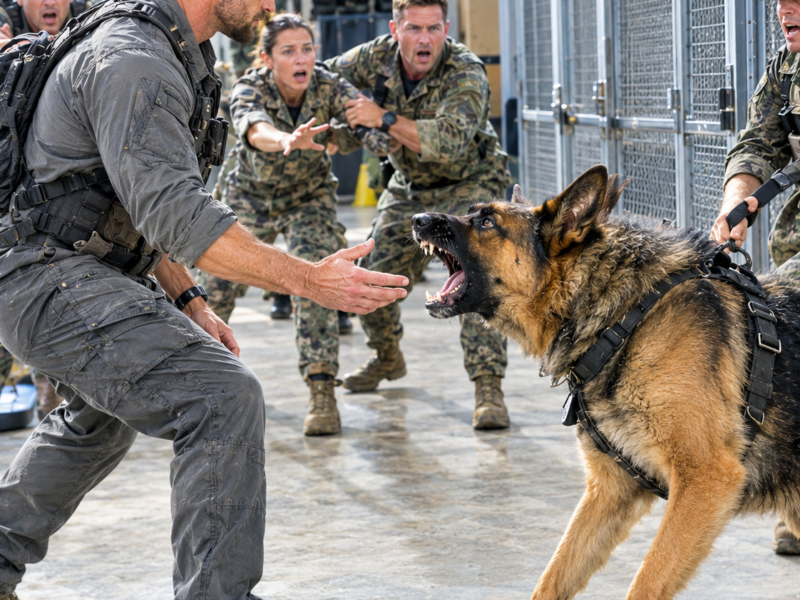
“The K9 dog had attacked three handlers, ignored every command, and left an entire military training team convinced he could never be controlled
The metallic click came again from inside the wall.
I raised one hand, signaling everyone to stay back, while Rex stood rigid behind the reinforced gate, his ears pointed toward the ventilation panel.
For a moment, the kennel block was so quiet I could hear the maintenance technician breathing.
“Captain,” I said without looking away from the opening, “I want every person who had access to this kennel during the past six weeks identified and kept available for questioning.”
Harris nodded to the security officer standing beside him.
“Do it.”
The technician carefully removed the remaining screws and eased the metal panel away from the wall.
Behind it was a narrow ventilation duct, dark with dust and barely wide enough for a man’s arm.
At first, I saw nothing unusual.
Then the technician aimed his flashlight downward.
Something small and black had been wedged between two metal supports.
“Don’t touch it,” I ordered.
He pulled his hand back.
I put on a pair of disposable gloves and leaned closer, careful not to block the light.
The object was a compact electronic device, no bigger than a matchbox, secured to the inside of the duct with a strip of black tape.
A thin wire ran from it toward a small battery pack.
Harris stepped closer.
“What is that?”
“I don’t know yet.”
I examined it without moving it.
There was no obvious label, no manufacturer marking, and no reason for a device like that to be hidden inside a military kennel’s ventilation system.
Rex gave a short, uneasy whine.
I looked at him.
“Easy, buddy.”
His ears shifted toward my voice, but his attention returned immediately to the device.
That told me something important.
Whatever had been placed in that duct, Rex had noticed it long before any of us had.
And whatever it was doing, it had frightened him enough to make him distrust every person who came near his kennel.
“Call the base security team,” I told Harris. “Have them document this before anyone removes it.”
Within minutes, two security specialists arrived and photographed the device from several angles.
They carefully disconnected the battery and placed the object inside a secure evidence container.
The technician then inspected the duct.
He found several fresh scratches along the metal supports and a small patch of dark residue near the device’s mounting point.
“Could it have been making a noise?” Cole asked.
“Possibly,” one of the specialists replied. “We’ll need a technical examination before we can say what it does.”
I watched Rex.
He had stopped growling, but he still wouldn’t approach the gate.
His body remained tense, and his eyes tracked every movement in the corridor.
I crouched again, keeping a comfortable distance.
“Nobody’s going to force you to do anything,” I told him quietly.
Rex stared at me.
For the first time, he didn’t bare his teeth.
It wasn’t trust.
Not yet.
But it was the first sign that he might be willing to listen.
The device was taken to the security office for analysis.
I spent the next several hours reviewing kennel access records, training footage, and incident reports.
At first, the records looked ordinary.
Different handlers had entered the kennel block throughout the day. Maintenance staff had logged routine repairs. Veterinary personnel had completed Rex’s examinations.
Nothing immediately suggested deliberate wrongdoing.
Then I noticed a discrepancy.
The first incident had occurred on a Thursday morning, during an obedience session with Staff Sergeant Miller.
According to the official report, Rex had attacked Miller after receiving a recall command.
But the kennel camera showed something different.
Three seconds before Rex lunged, Miller had reached toward his collar.
Rex recoiled.
His ears flattened, and he twisted his head away from Miller’s hand.
Then Miller grabbed the collar again.
That was when Rex attacked.
I replayed the footage.
The same sequence appeared in the second incident.
A handler reached toward Rex’s collar, the dog recoiled, and the confrontation escalated.
The third report described Rex attacking when someone approached with a food bowl.
But the video showed the handler carrying a small metal tool in his right hand.
He set the bowl down, reached toward the collar, and Rex reacted.
The reports had focused on the attacks.
They hadn’t explained what happened immediately before them.
I called Harris into the office.
“Look at this.”
He watched the footage twice.
His expression tightened.
“Why wasn’t this included in the incident summaries?”
“That’s what I want to know.”
He pulled a chair closer.
“Are you saying the dog was reacting to something specific?”
“Maybe. But I don’t think it’s just the collar.”
I paused the video and enlarged the image of Miller’s hand.
“Look at his fingers.”
Harris leaned toward the screen.
A dark band was visible around Miller’s wrist, partly hidden beneath his sleeve.
It might have been a watch strap or a bracelet. The footage wasn’t clear enough to tell.
“Could be nothing,” Harris said.
“It could.”
I wasn’t interested in building a theory around one blurry image.
I wanted evidence.
We requested the original footage from the security system and arranged for the veterinary team to conduct a more thorough examination of Rex, this time with a specialist familiar with behavioral trauma.
The veterinarian, Dr. Patel, arrived late that afternoon.
She watched the footage in silence, then reviewed Rex’s medical records.
“I can’t diagnose a behavioral cause from a video,” she said. “But the sequence is worth investigating. We should also consider pain, a frightening experience, and other environmental triggers.”
“Could the device in the duct have affected him?” Harris asked.
“Depending on what it is and whether it was active, possibly. But we shouldn’t assume that explains everything.”
I appreciated her caution.
Too many people had already decided Rex was either a vicious animal or an innocent victim.
Neither conclusion would help us if we didn’t understand what had actually happened.
When we returned to the kennel, Dr. Patel asked everyone to remain outside while she observed Rex from a distance.
I sat on the floor near the opposite wall.
Rex paced twice, stopped, and watched my hands.
I kept them resting on my knees.
After several minutes, he approached the gate.
His nose moved as he studied me through the bars.
Then he sat down.
Cole, standing behind us, let out a quiet breath.
“He’s never done that with anyone since the incident.”
“Don’t make it a big deal,” I said. “He’s just deciding what he thinks.”
Rex’s ears shifted toward me.
I lowered my gaze slightly and waited.
Eventually, he lay down.
It was a small change, but it mattered.
For the first time in weeks, the dog was choosing to remain near a person without being commanded.
Dr. Patel made a note.
“That’s encouraging. But we need to proceed slowly and let him control the pace.”
I agreed.
Rex hadn’t become dangerous because he had forgotten every command.
Something had happened that changed what those commands meant to him.
Until we understood that, forcing obedience would only make the problem worse.
The first major break came just before sunset.
The security team finished its preliminary examination of the device.
It contained a small speaker and a programmable sound module, along with a power supply and a simple control circuit.
The specialist couldn’t yet determine how long it had been installed or whether it had been activated remotely, but he confirmed that it was capable of producing repeated high-frequency tones.
“Would a dog hear those?” I asked.
“Absolutely. Dogs can hear frequencies well beyond the upper range of human hearing. Whether these particular tones would distress Rex depends on the output and circumstances.”
“Can you tell whether it was used?”
“Not conclusively. We may find traces in the device’s memory, if it has any. We’re sending it for a full forensic examination.”
I thought about Rex staring at the ventilation panel, his sudden fear when the technician loosened the screws, and his reactions whenever someone reached toward his collar.
The device might explain the sounds.
It didn’t yet explain who had placed it there or why.
Harris folded his arms.
“If someone deliberately used this to upset a military working dog, that’s a serious matter.”
“Then we find out who had the opportunity,” I replied.
The access logs showed that a maintenance contractor had entered the kennel corridor two days before the first attack.
His name was Evan Brooks.
He had been hired three months earlier to repair ventilation fans and electrical fixtures throughout the facility.
His work order listed a minor repair to the air circulation system near Rex’s kennel.
I checked the date.
It was the same day the hidden device could have been installed.
“Where is Brooks now?” I asked.
Harris consulted the personnel system.
“His contract ended last week.”
“Did he leave voluntarily?”
“It says his assignment was completed.”
“Who signed off on his work?”
Harris searched the record.
The approval had been entered under the name of Staff Sergeant Miller, Rex’s original handler.
I leaned back.
That was a connection worth investigating, but it wasn’t proof of anything.
Miller might have approved a legitimate repair without knowing what the contractor had done.
Brooks might have installed the device for an unrelated reason.
Or someone else might have used their access.
I had learned the hard way that suspicion could point you toward the truth, but it could also make you miss it.
“Get the original work order,” I said. “And arrange an interview with Miller. I want his account before we draw conclusions.”
Harris nodded.
But before he could make the call, the security officer returned with another update.
“Sir, we checked the contractor’s badge records. Brooks entered the kennel block at 6:42 p.m. on the day of the repair.”
“And left?”
“At 7:18.”
“Who else was in the building?”
The officer consulted his tablet.
“Staff Sergeant Miller. He entered at 6:51 p.m.”
Harris and I exchanged a glance.
For nearly half an hour, the contractor and Rex’s handler had been in the same corridor.
That still didn’t prove collusion.
But it meant we needed answers.
Staff Sergeant Miller arrived the following morning.
He was in his early thirties, broad-shouldered, and impeccably dressed. His right wrist was covered by a dark tactical watch.
I recognized it from the footage.
Miller noticed me looking at it and pulled his sleeve down.
“Captain Harris said you wanted to discuss Rex,” he said.
“I do.”
We met in a small interview room with Harris and a security investigator present.
I began with simple questions about Rex’s training history.
Miller described the dog as highly motivated, responsive, and sometimes stubborn.
“He was one of the best dogs in the program,” he said. “But he had a dominant streak.”
“Did he ever show aggression toward you before the first incident?”
“No.”
“Did anything change in the days leading up to it?”
Miller shrugged.
“Not that I noticed.”
I slid a still image from the training footage across the table.
It showed Miller reaching toward Rex’s collar.
The dog’s ears were flattened, and his body had shifted backward.
“Why did you reach for him after he recoiled?”
Miller glanced at the image.
“He needed to comply with the command.”
“That doesn’t answer my question.”
His jaw tightened.
“He’s a working dog. Sometimes you have to be firm.”
“Firm isn’t the same as ignoring a warning.”
Miller pushed the photograph away.
“Are you accusing me of mishandling him?”
“I’m asking you to explain what happened.”
The security investigator took over and asked about the ventilation repair.
Miller said he had approved the contractor’s work but hadn’t watched the repair itself.
“Did you know about the device found inside the duct?” the investigator asked.
“No.”
His answer came quickly.
Too quickly, perhaps, but a fast answer wasn’t evidence of guilt.
The investigator asked whether he knew Brooks personally.
“We worked together on the repair.”
“Outside the facility?”
“No.”
“Did you contact him after his contract ended?”
“No.”
The interview continued for another twenty minutes.
Miller denied wrongdoing and said he believed Rex’s aggression had been caused by a behavioral issue that no one had identified in time.
When he stood to leave, I noticed something.
He didn’t look toward the window or the door.
He looked at the photograph on the table.
At Rex’s frightened posture.
For a fraction of a second, something like shame crossed his face.
Then it was gone.
I waited until he had left the room.
“What did you make of that?” Harris asked.
“I think he’s holding something back.”
“Do you think he installed the device?”
“I don’t know.”
Harris exhaled.
“Jack, we need to be careful. Miller has a good service record. There are consequences to making an accusation like this.”
“I know. That’s why I haven’t made one.”
The investigator collected the photograph.
“We’ll continue looking into Brooks and the device. If the evidence supports a formal inquiry, we’ll proceed through the proper channels.”
I nodded.
That was the right answer.
Still, as I walked back toward the kennels, I couldn’t shake the feeling that Rex had been trying to warn us about something the rest of us had refused to see.
Over the next two days, I worked with Rex in short sessions.
I didn’t enter the kennel immediately.
I sat outside the gate, spoke quietly, and allowed him to approach when he was ready.
I learned that he reacted most strongly when someone moved suddenly toward his neck or raised a metal object near his head.
He also seemed unsettled by a particular high-pitched sound from the ventilation system, though the hidden device had been removed.
The maintenance team discovered that one of the fans had a damaged bearing.
When it spun at certain speeds, it produced a sharp whine that was barely audible to the staff but clearly detectable to Rex.
That sound might have become associated with the device or with whatever had happened during the evenings before the attacks.
It was another piece of the puzzle, not a complete explanation.
Dr. Patel recommended that Rex undergo a gradual desensitization program after further examination.
“No forced contact,” she reminded me. “No sudden collar grabs. We rebuild predictable experiences first.”
So that’s what we did.
I began by placing his food near the gate and moving away.
The next session, I stayed seated while he ate.
Later, I introduced a soft training lead, leaving it on the floor where he could inspect it.
By the fourth day, Rex would approach me and take a treat from my open palm.
He still stiffened if I moved too quickly.
He still watched my hands.
But he was beginning to learn that a person could reach toward him without hurting him.
Cole observed most of the sessions.
One afternoon, she sat beside me in the corridor.
“I thought he was just being stubborn,” she admitted.
“That’s an easy conclusion when a dog refuses to do what you want.”
“I was angry with him.”
“Of course you were. He hurt you.”
She looked through the bars.
“I’ve been a handler for eight years. I’ve worked with dogs that were anxious, reactive, even aggressive. But I never had one look at me like I was the threat.”
I let the silence settle.
“That doesn’t mean you failed him,” I said. “It means something changed, and nobody understood it in time.”
Cole rubbed the scar on her forearm.
“I kept thinking if I could just get him to obey, he’d go back to normal.”
“Sometimes obedience isn’t the first thing you need.”
“What is?”
“Safety.”
She looked at me, and I saw the tension in her face ease slightly.
For the first time, she seemed to understand that helping Rex didn’t mean proving she could control him.
It meant becoming someone he could trust again.
On the fifth day, the security investigator called us into the office.
The forensic team had recovered a partial configuration record from the device.
It showed that the sound module had been programmed to emit several short bursts at irregular intervals.
The device’s memory wasn’t complete, and investigators couldn’t establish exactly when it had been active. But the programming was consistent with deliberate testing rather than an ordinary piece of abandoned equipment.
More importantly, the investigation had uncovered a message between Brooks and an unidentified number.
The message had been recovered from a company-issued tablet Brooks had returned when his contract ended.
It read: “The dog reacts exactly as you described. Need to know when to stop.”
The reply had been deleted, but the message metadata provided a time and date.
It was the evening before Rex’s first attack.
Harris stared at the screen.
“Can we identify the number?”
“The investigator is working on that,” the security officer replied. “We’re also examining the contractor’s work records and any additional communications.”
I read the message again.
The words were vague, but they were troubling.
Someone had described Rex’s reaction in advance.
Someone had asked when to stop.
That was no longer just a question of a dog becoming difficult to handle.
It was evidence that someone might have been deliberately provoking him.
The investigator cautioned us against drawing a final conclusion.
“We still need to establish who sent the message, what the sender intended, and whether the device directly contributed to the attacks.”
I understood.
The investigation needed to be thorough, especially if it was going to lead to disciplinary action or criminal charges.
But for the first time, we had something concrete.
A deliberate act had likely occurred.
And Rex might have been blamed for the consequences of someone else’s choices.
The breakthrough came from a source none of us had expected.
A young kennel assistant named Noah Reed requested to speak with the investigator.
He had been working at the facility for only four months and had avoided discussing the incidents because he feared losing his job.
When he sat down across from us, he kept twisting the edge of his identification badge between his fingers.
“I saw Brooks near Rex’s kennel after hours,” he said.
“When?”
“The night before the first incident. I was finishing the evening cleaning rounds.”
“Did you see him enter the kennel?”
“No. He was near the ventilation panel with a toolbox. Miller was there too.”
Harris leaned forward.
“What were they doing?”
“I couldn’t tell. I heard them talking, but I was too far away to make out the words.”
“Why didn’t you report it?”
Noah’s face reddened.
“I thought it was an authorized repair. Miller was a staff sergeant. I was new. I didn’t want to accuse someone of doing something wrong when I didn’t understand what I was seeing.”
His answer sounded painfully familiar.
People often remained silent not because they approved of wrongdoing, but because they were afraid of being the only person willing to question it.
The investigator asked Noah whether he could identify the men.
“Yes. I’m certain it was Brooks and Miller.”
“Would you be willing to make a formal statement?”
Noah swallowed.
Then he nodded.
“I should have said something sooner.”
“You can only tell us what you remember,” the investigator said. “We’ll handle the rest.”
After Noah left, Harris sat quietly for several moments.
“I trusted Miller.”
“So did Rex,” I replied.
The words came out more sharply than I intended.
Harris looked at me, then lowered his eyes.
“You’re right.”
I wasn’t interested in humiliating Miller or proving that my instincts had been better than anyone else’s.
I wanted the truth established, and I wanted Rex to have a chance to recover.
The investigation continued without my involvement in the formal questioning.
Miller was placed on administrative duty while security personnel reviewed the evidence.
Brooks was located and interviewed.
At first, he denied installing any unauthorized equipment. When investigators presented the access records, the recovered message, and Noah’s statement, he changed his account.
He admitted placing the sound device in the duct.
He claimed Miller had asked him to test whether Rex would react to the tones, insisting it was meant to be a harmless training experiment.
But the device had been used beyond what Brooks initially described, and his explanation failed to account for the repeated bursts recorded in the recovered configuration.
Miller denied ordering any deliberate mistreatment.
Investigators would need to determine the exact responsibility of each man.
I refused to speculate about the outcome.
What mattered was that the evidence was no longer being ignored.
The dog had not been given a voice in any of the reports.
Now, at least, someone was finally listening.
The first time Rex allowed Cole to approach the gate without growling, she didn’t celebrate.
She stood still, her shoulders relaxed, and waited for him to make the next move.
Rex watched her hand.
She slowly lowered it to her side.
Then she stepped back.
“That’s enough for today,” she said.
I smiled.
“Good call.”
She glanced at me.
“I never thought I’d be happy about leaving a kennel without giving a command.”
“There’s a first time for everything.”
Over the next several weeks, Rex’s progress came in uneven steps.
Some days he accepted the lead and walked calmly beside me.
Other days, a sudden sound sent him retreating to the back of the kennel.
We didn’t punish him for those setbacks.
We adjusted the sessions, consulted Dr. Patel, and continued building predictable routines.
Cole began working with him again under supervision, starting with simple exercises and no physical pressure.
When Rex voluntarily touched his nose to her open hand, she blinked several times and looked away.
I pretended not to notice the tears gathering in her eyes.
That was the moment I knew she had begun to forgive herself.
Not because Rex had suddenly become easy to handle, but because she had stopped measuring success by whether she could make him obey.
One afternoon, I took Rex into the enclosed training yard.
The sun had broken through the clouds, leaving the ground warm beneath my boots.
I held the lead loosely while he explored the perimeter.
He paused near a stack of training cones, sniffed the ground, and looked back at me.
“Come on, buddy.”
He returned at a relaxed pace.
No snapping.
No lunging.
No fear-driven struggle.
Just a dog choosing to come back.
Cole watched from the gate.
“He looks different.”
“He feels different,” I said.
She opened the gate and joined us, keeping a respectful distance.
Rex studied her for several seconds.
Then he walked toward her.
Cole didn’t reach out.
She simply stood still.
Rex sniffed the air near her hand, then brushed his nose against her fingers.
Her breath caught, but she didn’t move.
After a moment, Rex turned and walked back toward me.
It was a brief interaction, barely worth recording in an ordinary training log.
But to the three of us, it felt enormous.
The dog who had once believed every approaching hand meant danger had made a choice.
He had approached someone who had frightened him.
And this time, nothing bad had happened.
The formal investigation took longer than anyone wanted.
The evidence supported the conclusion that Brooks had installed and activated the unauthorized sound device.
Investigators also found communications indicating that Miller had requested the test and had failed to disclose the device after Rex’s behavior changed.
Miller was removed from his handler assignment while the command reviewed the findings and determined the appropriate disciplinary action.
Brooks’s contract and access privileges were terminated, and the case was referred for further review under the applicable military and civilian procedures.
There were consequences, but they did not arrive in a single dramatic moment.
There were interviews, reports, hearings, and decisions made by people whose job was to establish responsibility fairly.
I was relieved that the process had moved beyond speculation.
I was also angry.
Not because Rex had become difficult.
Because people who had been trusted to care for him had treated his fear as an inconvenience instead of a warning.
The veterinary team completed a new assessment and recommended that Rex remain out of operational service while his recovery continued.
He wasn’t ready to return to the demands of field work.
That didn’t mean his life was over.
A specialist rehabilitation organization agreed to evaluate him for a long-term placement once he was stable.
The facility also asked whether I would consider helping with his transition.
I looked at Rex, who was lying quietly beside my chair.
He had begun to rest when people were nearby. He accepted food from Cole and allowed the veterinarian to examine his neck without struggling.
He was still cautious.
He still needed time.
But he was no longer the frightened animal who had slammed himself against the gate.
“I’ll help,” I said. “As long as we do what’s right for him, not what’s easiest for us.”
Harris nodded.
“That’s why I called you.”
I glanced down at Rex.
He lifted his head, then rested his chin against my boot.
For the first time in a long while, I felt the quiet satisfaction of having helped someone without needing to win a fight.
On the day I left the facility, the sky was clear and the air smelled of warm grass.
Rex walked beside me on a loose lead as we crossed the training yard.
Cole waited near the vehicle, holding a small bag of his belongings: his favorite blanket, a few toys, and the familiar food he had been eating during rehabilitation.
She crouched in front of him, leaving enough space for him to choose whether to approach.
“Take care of yourself, Rex,” she whispered.
Rex sniffed her hand.
Then he leaned forward and gently pressed his head against her shoulder.
Cole closed her eyes for a second.
I looked away to give her privacy.
When she stood, she wiped her face and gave me a small, embarrassed smile.
“I guess I needed that more than he did.”
“Maybe you both did.”
Harris met us at the gate.
“We’ll continue monitoring his progress,” he said. “If the rehabilitation team believes he’s ready for a permanent placement, we’ll make the arrangements.”
“Good.”
He extended his hand.
I shook it.
“Thank you, Jack.”
I looked back at the kennel block, at the windows reflecting the afternoon sun, and at the ventilation panel that had revealed so much.
“Don’t thank me yet,” I said. “Keep asking questions when something doesn’t make sense.”
Harris nodded.
“I will.”
I opened the passenger door.
Rex climbed inside carefully, turned around twice, and settled onto the blanket.
As I started the engine, I glanced at him.
He was watching me, his ears relaxed, his breathing steady.
For the first time since the call, he looked like a dog who could imagine tomorrow without being afraid of it.
I drove away from the facility with the windows cracked open and the ocean somewhere beyond the highway.
Rex rested his head near the passenger window, watching the world pass by.
I didn’t know exactly what his future would look like.
He might never return to operational work. He might always need patience around unfamiliar people and sudden sounds.
But none of that made him broken.
It made him a dog who had been frightened, misunderstood, and given another chance.
I had spent years believing strength meant pushing through pain and refusing to back down.
Rex taught me something different.
Sometimes strength meant noticing fear before it turned into anger.
Sometimes it meant stepping back instead of forcing your way forward.
And sometimes the bravest thing you could do for someone who had lost trust was to make no demand at all.
At a red light, Rex lifted his head and placed one paw gently on my arm.
I rested my hand against his shoulder.
“You’re all right, buddy,” I said.
He looked at me, then settled down again.
For the first time in years, I wasn’t driving toward another mission.
I was driving home with a friend who had reminded me that trust, once broken, could still be rebuilt—one quiet choice at a time.
The end.









