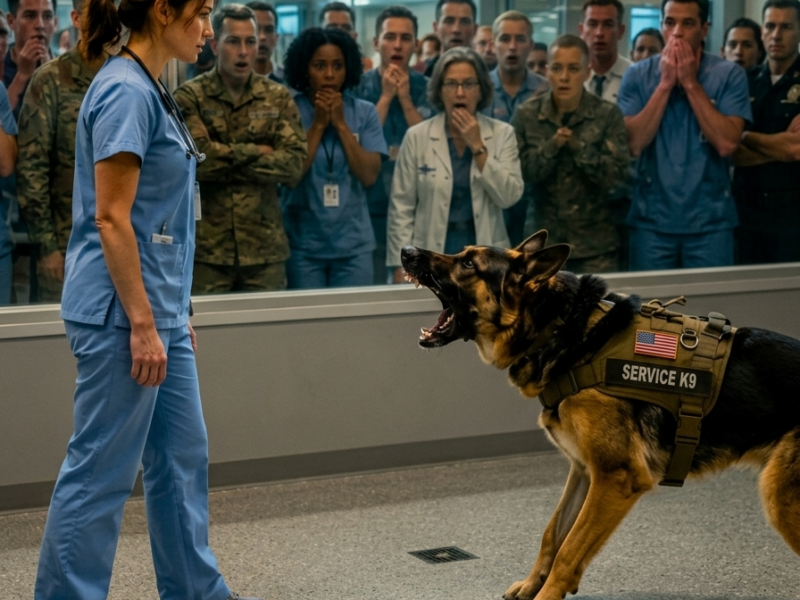
The hospital lobby fell silent when the service K9 lunged at my throat, yet the officer beside him only stepped back and coldly said, “Let her handle it,”
The fluorescent lights of St. Jude Memorial Hospital hummed with a low, oppressive vibration that always made the night shift feel endless. It was nearly two in the morning when the double doors of the emergency entrance hissed open, shattering the quiet routine of the lobby. A blast of rain-cooled air swept inside, carrying with it the frantic sound of boots scuffing against polished linoleum and a low, guttural snarl that raised the fine hairs on the back of my neck.
I was standing behind the central security desk, adjusting a heavy plastic tray loaded with prepped sedatives and diagnostic charts. As a triage nurse, I was accustomed to chaos, but the sudden shift in the room’s atmosphere was immediate and suffocating. The few patients waiting in the vinyl chairs sat up straight. The night receptionist stopped typing, her fingers hovering motionless above the keyboard.
A massive German Shepherd, wearing a tactical service vest marked with faded reflective lettering, bounded into the lobby. His body was a cord of tense muscle, his coat dark and matted with rain. He was straining against a thick leather leash held by a tall, broad-shouldered officer in a navy transport uniform. The dog was breathing in sharp, ragged gasps, his ears pinned flat against his broad skull.
“Clear the aisle!” the officer shouted, his voice echoing off the high ceilings. “Give him space!”
Everyone knew who the dog was. The hospital memo had gone out early that afternoon: Service K9 Rex, retired from municipal duty and assigned to a private security detail, had suffered an uncharacteristic and violent episode during a routine patrol near the lower parking garage. He had snapped at a paramedic and backed a security guard into a corner before being sedated and contained. The directive had been clear—Rex was to be moved to the isolated veterinary holding room in the basement wing pending a psychiatric evaluation or transfer to an animal control facility.
Somehow, in the confusion of the shift change, the assignment to escort the transport team down the restricted service corridors had fallen on me. I was a nurse, trained to administer medication and monitor vitals, not a professional animal handler. But the floor supervisor had been brief: Just lead them down the north elevator. Keep the corridor clear.
I stepped out from behind the desk, holding my tray tightly with both hands to mask the tremor in my fingers. The leather-bound clipboard tucked under my arm felt heavy and useless.
“Are you Nurse Vance?” the officer asked, his voice clipped and strained as he fought to keep the dog at arm’s length.
“Yes,” I said, my voice barely above a whisper. “I have the access key for the basement elevators.”
Before I could take another step, Rex’s head snapped toward me. His dark eyes locked onto mine with a terrifying, singular intensity. The low rumble in his chest erupted into a lunging bark. He surged forward with such violence that the leather leash snapped taut, pulling the officer off balance.
The hospital lobby fell silent as the service K9 lunged at my throat.
I froze, paralyzed by instinct. The dog’s dark muzzle was inches from my face, his sharp teeth flashing under the harsh white lights. Hot air, smelling of wet fur and iron, washed over my skin. I braced for the impact, expecting the tearing pain of a bite, but the officer beside him did not pull the leash back. He did not tackle the dog or draw his baton.
Instead, the officer deliberately took a step backward, releasing the tension on the strap. His expression was detached, almost cold.
“Let her handle it,” he said softly, his eyes fixed on me. He spoke as if he knew something about that dog that I didn’t.
“What are you doing?” I gasped, my knees shaking so violently that the plastic bottles on my medication tray rattled loudly against the counter. “Pull him back!”
“Don’t make sudden movements,” the officer warned from across the lobby, his tone entirely void of panic. “Just let him see you.”
Then, without another word, he turned his heel and walked away toward the main entrance doors, leaving the leash trailing on the floor behind the dog.
Panic surged through my chest like ice water. I was completely alone with an unstable, hundred-pound animal that had already tried to attack two people that morning. The security guard behind the desk was reaching slowly for his radio, but his hands were shaking too badly to press the button.
Rex remained standing on his hind legs for a fraction of a second before his front paws slammed back down onto the floor. He took a heavy, rhythmic step toward me. The tray in my hands was shaking so violently now that a bottle of saline slid off the edge and shattered on the tile floor, splashing liquid across the toes of my shoes.
I couldn’t understand it. Why had the officer abandoned him? Why was I left standing here in the middle of a public lobby with a dog everyone considered dangerous?
Instinct, buried beneath layers of medical training and raw fear, took over. I knew that turning and running would trigger his drive to chase. Slowly, agonizingly, I bent my knees. I lowered myself down until I was crouching on the cold floor, bringing myself down to his eye level, exposing my neck, breaking every rule of survival.
Then, something strange happened.
The instant my weight settled onto the floor, Rex stopped growling. The ferocious snarl vanished from his muzzle as if erased by a switch. His ears flicked forward, then dropped slightly. He stared directly into my eyes, his chest heaving with heavy, silent breaths.
He took three slow, deliberate steps toward me. The space between us collapsed. Instead of lunging, he lowered his massive head and rested his chin directly onto my left knee.
The entire lobby went completely quiet. The hum of the lights seemed to fade into the background. I could hear the rapid, shallow sound of my own breathing, contrasted against the deep, rhythmic rhythm of the dog’s chest.
“Good boy,” I whispered, my voice cracked and trembling, barely believing what I was seeing.
As my words echoed softly in the space, a tremor ran through the animal’s spine. His body began shaking—not with the aggressive tension of anger, but with a profound, terrifying fear. He pressed his head harder against my leg, whining low in his throat, a sound so mournful it vibrated straight into my bones.
I lifted a hand that felt heavy as lead and reached out. My fingers sank into the dense fur at the base of his neck. As I gently stroked the side of his neck, my thumb brushed against a hard, raised line beneath his heavy tactical collar. It was a jagged, old scar, hairless and pale against his dark skin.
Rex turned his head sharply at my touch. He didn’t bite. Instead, he gently pressed his wet nose against the inside of my left wrist, directly over my pulse point.
That was when I noticed it. Wrapped securely around the thick webbing beneath his tactical harness was a thin, worn silver chain. Hanging from it was a tiny, rectangular metal bar, half-hidden by his fur.
I reached out with two fingers and lifted the small piece of metal. Etched into the worn surface was a single name in delicate cursive script.
Emily.
My heart stopped. The air vanished from my lungs as if I had been struck in the chest with a heavy weight.
Emily had been my younger sister. She had died three years earlier in a sudden, violent house fire that destroyed our childhood home. The investigation had been brief, ruled an electrical accident, and the only personal item recovered from the ash and debris of her bedroom had been a small silver bracelet with that exact same engraving—a gift I had bought her for her sixteenth birthday.
My mind reeled, trying to connect the impossible dots. How did a police service dog have my dead sister’s name wrapped inside his harness?
I spun around to look for the officer who had brought him in, seeking answers, demanding an explanation. But the lobby doors were closed. The rain was drumming steadily against the glass exterior. The officer had completely disappeared into the night.
Before I could stand, Rex suddenly rose to his feet. The sadness in his posture vanished, replaced by an urgent, focused energy. He clamped his jaws gently around the sleeve of my scrub top and pulled. He wasn’t hurting me; he was guiding me. He released my sleeve, took three quick paces toward the dark hallway leading to the service elevators, and looked back over his shoulder to ensure I was following.
I left the medication tray abandoned on the floor and stepped after him, terrified, confused, and completely drawn into a reality that no longer made sense.
Rex led me past the main elevators, down a corridor marked for maintenance staff only, and stopped in front of a heavy steel door labeled Storage Room 4B. It was a room that had been locked for as long as I had worked at the facility, officially designated for archived paper records from the old hospital wing.
Rex stood on his hind legs and planted his paws against the metal surface. He scratched the door once with his heavy claws. A metallic screech echoed through the hallway.
He dropped down, looked at me, and scratched it again.
“Nurse Vance!” A loud voice shouted from behind me.
Two hospital security guards came running down the hall, their heavy boots thudding against the floor, hands resting on their holstered tasers.
“Get away from that dog!” the lead guard ordered. “He’s unsecured!”
“No, wait!” I yelled, stepping between them and Rex. “Look at him! He’s not attacking! He brought me here. Open this door.”
“That room is off-limits, Clara,” the second guard said, slowing his pace. “It’s archived storage. We don’t even have the key on our belt.”
“Then break it!” I screamed, a sudden, wild desperation taking hold of me. “Break it open now!”
The guards exchanged a look of concern and confusion, but the intensity in my voice seemed to sway them. The lead guard pulled a master key card from his pocket and swiped it through the secondary electronic lock, then took a heavy iron crowbar from an emergency tool cabinet mounted on the wall. He jammed it into the frame and leaned his weight into it. With a loud, groaning screech of bending metal, the heavy door popped open.
The air that rushed out of the room was thick with dust, mildew, and the stale odor of age.
Rex didn’t hesitate. He slipped past the guards and walked straight to the back corner of the room, where dozens of brown cardboard storage boxes were stacked against a brick wall. He pushed his nose against a medium-sized box resting on the floor, shoving it out into the center of the room.
My hands were shaking violently as I dropped to my knees beside the box. The dust on the cardboard was thick, but the tape sealing the top had been freshly cut.
I pulled the flaps open. Inside was a collection of old patient files from three years ago, a series of printed surveillance photographs, and, lying right in the center, a burnt, framed photograph of my sister, Emily. The edges of the paper were charred black, but her face—smiling, bright, and full of life—was perfectly intact.
My knees nearly gave out beneath me. I reached into the box, my breath coming in ragged hitches.
Lying directly on top of the documents was a single sheet of lined notebook paper. The ink was dark blue, written in a hurried, slanted hand that I knew better than my own. I had read that handwriting on birthday cards, school notes, and grocery lists for years.
It was Emily’s.
The note contained only six words, written in stark, precise lettering:
Rex knows what they did to me.
I stared at the words, the paper fluttering in my hand as the room seemed to spin around me. Rex sat silently beside me, his shoulder pressed firmly against my side, his dark eyes fixed on the paper as if he had spent three agonizing years waiting for someone to finally read it.
“Clara, what is that?” one of the security guards asked, stepping into the room, his voice filled with rising concern. “We need to report this to the shift supervisor right now.”
Before he could reach for his shoulder mic, I turned the burnt photograph of Emily over in my trembling hands. There was a message scribbled across the white backing board in fresh, black marker.
My blood ran completely cold as I read the eight words written on the back:
Your sister is still alive. Don’t trust anyone.
The world around me seemed to freeze, the noise of the hospital fading into a muffled, distant drone. I stared at the back of the photo, my thumb tracing over the freshly written black ink. Your sister is still alive. It was an impossible sentence, a cruelty designed to shatter whatever sanity I had left. I had gone to Emily’s memorial service. I had buried a closed casket filled with ash and stone three years ago. I had spent countless nights staring at the ceiling, consumed by the guilt that I hadn’t been there to save her from the fire.
“Clara, step away from the box,” the lead guard, whose name badge read Miller, said in a tone that had suddenly lost its casual demeanor. He wasn’t looking at the box anymore; he was looking at me, his hand resting firmly on the handle of his sidearm. “We’re calling administration. Nobody is supposed to be in this archive.”
Rex let out a low, warning rumble from deep within his chest, positioning his heavy body directly between Miller and me.
“Where did this box come from?” I demanded, standing up slowly, pressing the photograph against my chest. “Who brought this into the hospital?”
“I don’t know,” Miller said, taking a subtle step back as Rex bared his teeth. “This room is locked. Only facilities and high-level security have access codes to this floor. Clara, you look pale. Just leave the box and come with us to employee health.”
He was lying, or at least withholding something. I could see the nervous flicker in his eyes, the way his gaze darted toward the hallway camera positioned directly outside the storage door.
“No,” I said firmly.
I grabbed the lined notebook page and tucked it inside my scrub pocket along with the photograph. Rex didn’t wait for my command; he moved with calculated efficiency, nudging my leg toward the emergency exit door at the far end of the storage corridor—a door that led directly out to the lower loading docks, far away from the main security desk.
“Hey! Stop!” Miller shouted, reaching for his radio.
Rex turned and let out a fierce, deafening bark that echoed in the tight concrete hallway, causing both guards to instinctively flinch and cover their ears. That second of hesitation was all we needed. I pushed open the heavy emergency crash bar, and Rex bounded through beside me into the cool, rain-slicked night air of the rear loading bay.
The rain was falling in heavy, vertical sheets, soaking through my scrub top within seconds. The cold air burned my lungs, but the surge of adrenaline pushed me forward. Rex ran alongside me, his movements precise and purposeful, steering me away from the bright floodlights of the main parking structure toward the shadowy perimeter fence where the staff parking lot met the dense treeline of the county park.
My sedan was parked beneath a broken streetlamp at the far edge of the lot. My hands were shaking so badly I could barely press the key fob unlock button. The doors clicked open, and Rex leaped seamlessly into the front passenger seat, his eyes scanning the rear-view mirror as if he had been trained for tactical evacuations.
I threw myself into the driver’s seat, slammed the door, and locked it. The engine roared to life, and I pulled out of the parking lot without turning on my headlights until we cleared the hospital gates.
In the dim light of the dashboard, I pulled the handwritten note from my pocket. Rex knows what they did to me.
I looked over at the dog. He was sitting upright, his chest breathing steadily, staring out the front windshield into the rainy darkness.
“Who are you, Rex?” I whispered, my voice breaking. “Where did you come from?”
He turned his head slowly, resting his heavy snout on the center console, inches from my arm. Up close, under the amber light of the streetlamps we passed, I could see more than just the scar beneath his collar. There were faint, precise lines around his front paws—shaved fur that had grown back unevenly, identical to the marks left by long-term intravenous lines used in medical research facilities.
This wasn’t just a police dog. He had been in a lab.
I drove to the only place I knew was safe: my small, isolated house at the end of a gravel lane three miles outside the city limits. It had been my sanctuary since Emily’s death, a quiet place where I could hide from the grief that had stolen my family.
When we arrived, Rex exited the vehicle first, sweeping the perimeter of the small wooden porch with practiced precision before allowing me to unlock the front door. Once inside, he moved through every room—the kitchen, the small living room, my bedroom—sniffing the corners and checking behind doors before finally returning to the hallway and laying down facing the front entrance.
I locked the deadbolt, pulled the blinds shut, and sat down at the kitchen table beneath the harsh yellow glare of the overhead light.
I spread the items from the storage box across the wooden surface. The burnt photograph of Emily. The note written in her handwriting. And the tiny metal tag from Rex’s harness.
I carefully unclipped the silver chain from the harness loop Rex had let me touch earlier. The metal was cold. I turned the small rectangular bar over in my hand. On the front, as I had seen before, was the name Emily. But as I tilted it under the direct light, I realized the back wasn’t smooth. There were tiny numbers laser-etched into the bottom edge: 04-19-88-B.
It looked like a medical medical record number or a trial subject code.
My mind raced back three years. Emily had been twenty-two when she died. She was a senior radiology technician student interning at St. Jude’s advanced research wing—the restricted floor funded by private grants where clinical trials were conducted. The fire had occurred three weeks before her graduation. The police report had stated that a faulty space heater in her off-campus apartment had sparked the blaze, consuming the structure in minutes.
I had accepted it because I was consumed by grief. I had trusted the authorities, trusted the hospital administration who had sent flowers and established a small scholarship in her name.
Now, holding this metal tag, the horror of my own blind trust washed over me.
I pulled out my laptop, my fingers flying across the keys as I logged into the hospital’s off-site employee portal using my nursing credentials. I had restricted access to patient archives, but as a senior triage nurse, I had permission to search historical transport logs and facility safety incident reports.
I typed in the code etched on the silver tag: 04-19-88-B.
The screen flickered, loading a loading wheel that spun for nearly ten seconds. Suddenly, a bright red dialogue box popped up on the monitor:
ACCESS RESTRICTED: PROTOCOL 9 CLEARANCE REQUIRED
FLAGGED FOR DESTRUCTION: FILE ARCHIVED BY DR. ARTHUR VANE
My stomach dropped. Dr. Arthur Vane was the chief of surgery at St. Jude and the head of the hospital’s board of directors. He was a celebrated figure in the medical community, a man who had personally delivered the eulogy at Emily’s memorial service and wrapped his arm around my shoulders, telling me that the hospital family would always take care of me.
I stared at the screen, my pulse hammering in my ears. Before I could attempt to bypass the prompt, the screen suddenly went dark. The laptop fan whirred loudly, and a single line of text appeared in the center of the black display:
LOCATION CONFIRMED. REMAIN WHERE YOU ARE.
I slammed the laptop shut.
At that exact moment, Rex sprang to his feet in the hallway. A low, fierce growl vibrated in his throat. His ears were locked backward, his teeth exposed as he stared directly at the front door.
Outside in the rain, heavy gravel crunched beneath the tires of an approaching vehicle.
I grabbed my keys and the photograph, shoving the documents into my coat pocket. “Rex, move,” I hissed, keeping my voice as low as possible.
We didn’t go through the front entrance. I grabbed my flashlight from the counter, unlocked the back door that led toward the dark woods behind my property, and slipped out into the storm just as a heavy knock rattled the front door. Through the kitchen window, I caught a brief glimpse of two men dressed in dark, unbadged raincoats standing on the front porch, one of them holding a heavy iron tool used for forcing locks.
We ran into the treeline, the wet leaves and slick mud catching at my boots. Rex moved like a phantom beside me, matching my pace effortlessly, pausing every few yards to turn his head and scan the dark woods behind us. He was guarding my flank with absolute precision.
We walked for nearly twenty minutes through the rain until we reached an old overgrown fire road that led toward the neighboring township. My mind was spinning with a single thought: I needed someone outside the hospital system who could help me decode what Emily had left behind.
I thought of Marcus. Marcus Vance—no relation to me—was a former investigative journalist who had retired two years ago after trying to publish a series of articles about medical negligence and missing clinical trial data in the state hospital network. The local paper had pulled his articles, and he had been forced out of his career under the weight of non-disclosure lawsuits. He lived in a quiet cabin three miles down the ridge.
By the time Rex and I reached Marcus’s cabin, my clothes were soaked through, and my hands were numb with cold.
I knocked three times on the heavy timber door. A porch light flickered on, and the blinds swung open slightly. A moment later, the door cracked open on a heavy brass safety chain, revealing the worn, weary face of a man in his late forty with sharp grey eyes.
“Clara?” Marcus asked, his brow furrowing as his eyes traveled from my mud-splattered scrub pants down to the massive, drenched K9 standing at my side. “What happened to you? What is this?”
“I need your help, Marcus,” I gasped, shivering violently. “Please. It’s about Emily.”
Marcus hesitated for a second, looking past me into the dark woods, then unlatched the chain and pulled the door wide open. “Get inside. Quickly.”
Inside, the cabin was warm, smelled of woodsmoke and old paper, and was lined with floor-to-ceiling bookshelves stacked with legal binders and file folders. Marcus brought me a thick woolen blanket and a cup of hot black tea, his eyes never leaving Rex, who had immediately paced the perimeter of the room before settling himself near the wood-burning stove, his bright eyes remaining wide awake and vigilant.
I laid the burnt photograph, the six-word note, and the metal tag on his coffee table.
“Explain this to me,” Marcus said, leaning forward, picking up the silver tag with a pair of tweezers he grabbed from his desk. “Where did you get this?”
I told him everything—the violent incident in the hospital lobby, the officer who walked away, the locked storage room, and the sudden wipe of my laptop screen when I entered the code.
Marcus listened in absolute silence, his jaw tightening with every word. When I finished, he picked up the silver tag again and brought it under a magnifying lamp on his desk.
“This code,” Marcus said, pointing a pencil at the etched digits 04-19-88-B. “It’s not a patient file. It’s a subject identifier from the Aegis Initiative.”
“What is the Aegis Initiative?” I asked, wrapping the blanket tighter around my shoulders.
“Three years ago, before I was pushed out of the paper, I received an anonymous tip from a whistleblower inside St. Jude,” Marcus said, turning to look at me with a grim expression. “They were running an unauthorized, off-the-books clinical trial in the sub-basement of the research wing. They were testing experimental neural-regeneration pharmaceuticals—drugs designed to repair severe brain trauma, funded by defense contractors.”
He paused, taking a deep breath. “The problem was the side effects. The drugs caused extreme psychological volatility, amnesia, and in many cases, catastrophic organ failure. They were using specialized service animals first—specifically highly trained K9s—to test the neural stability of the compound before moving to human subjects.”
My stomach turned. “Rex…”
“Rex was likely one of their primary trial subjects,” Marcus said, looking down at the dog. “Look at the shaved skin on his limbs, the scar on his neck. That scar isn’t from a fight, Clara. That’s a surgical entry mark for a neural implant telemetry collar.”
“And Emily?” my voice trembled. “Why was her name on his harness? Why did the note say Rex knows what they did to me?”
Marcus walked over to a heavy metal filing cabinet tucked in the corner of his room. He unlocked it with a key from his pocket and pulled out a thick, yellowed folder marked St. Jude / Unresolved 2023. He laid a series of printed internal emails on the table beside my photograph.
“Emily wasn’t just a radiology intern, Clara,” Marcus said quietly. “She was assigned to imaging those trial subjects. She discovered that the hospital wasn’t just using animals. They had begun enrolling human patients—unclaimed trauma victims, people brought into the emergency room with no family, patients who couldn’t advocate for themselves.”
I felt the air leave my lungs. The horror was so vast, so overwhelming, that I couldn’t speak.
“Emily found out,” Marcus continued. “She downloaded the scan files and the subject logs onto an encrypted flash drive. She was going to bring them to me. The night before we were scheduled to meet… her house caught fire.”
“They killed her,” I whispered, tears finally breaking through and running hot down my cold cheeks. “They murdered my sister to keep her quiet.”
“I thought so too,” Marcus said, his voice dropping low. He picked up the burnt photograph I had brought and turned it over, staring at the message written on the back: Your sister is still alive.
“Who wrote this, Clara?” Marcus asked, his eyes locking onto mine. “Who brought that dog into the hospital tonight?”
“An officer,” I said, trying to recall every detail of his face. “Tall, broad shoulders, navy transport uniform with no name tag. He didn’t speak like a regular cop. He knew Rex would react to me. He told me to let her handle it, then he walked out.”
Marcus stood up and walked to his computer. He pulled up an archived database of police transport rosters and regional security contractors. “Describe him.”
“Jawline was square, short silver hair, a faded scar running through his left eyebrow,” I said.
Marcus typed rapidly into his keyboard. An image flashed on the screen. A mugshot and an official personnel file.
“Is this him?” Marcus asked.
I stepped closer to the monitor. My eyes widened. “Yes. That’s him.”
“That’s Lieutenant David Vance,” Marcus said softly. “He was the chief security officer at St. Jude three years ago. And Clara… he’s your uncle. The uncle who disappeared two months after Emily’s fire.”
The revelation hit me like a physical blow. Uncle David. My father’s younger brother, a retired military veteran who had cut all ties with our family years ago after a bitter dispute over my father’s estate. I hadn’t seen his face in over a decade, which was why I hadn’t recognized him under the dim, rain-slicked lights of the hospital lobby.
“Why would David be involved in this?” I asked, gripping the edge of Marcus’s desk to steady myself. “If he was head of security, he was working for Dr. Vane!”
“Or he was working from the inside to expose him,” Marcus countered, pulling a hard drive from his drawer and plugging it into his laptop. “David vanished right after the official police report on Emily’s fire was filed. Everyone thought he took a bribe and fled the state. But if he was the one who left Rex with you tonight, he’s been orchestrating this.”
Marcus began pulling up floor plans of St. Jude Memorial Hospital. The blue-printed schematics lit up the dark screen, showing the multi-level structure of the facility. He zoomed in on the sub-basement level—two floors beneath the parking garage, marked on official blueprints as a Mechanical and HVAC Maintenance Zone.
“Look here,” Marcus said, pointing his pen at a void space tucked behind the main elevator shafts. “This area isn’t listed on the public city building permits. It has a separate ventilation system, independent power generators, and a restricted elevator shaft accessible only from the private executive suite on the top floor—Dr. Vane’s office.”
“That’s where they took her,” I said, the truth settling into my chest with a terrifying, absolute certainty. “She didn’t die in that fire. They staged the fire, brought a unidentified body from the morgue to cover it up, and took Emily into that facility because she knew too much.”
“Or because she became a subject herself,” Marcus added grimly, his voice barely audible.
The room went dead quiet. Rex stood up from the floor, leaning his heavy body against my legs as if offering his strength. He looked up at me with those deep, intelligent eyes, letting out a soft, low whine that sounded like a plea.
“We have to go back,” I said, looking at Marcus. “Tonight.”
“Clara, going into that facility is suicidal,” Marcus warned, placing a hand on my shoulder. “Vane has a private security force. They control the cameras, the doors, the local police department. If you step back into that hospital, you won’t come out.”
“I left my sister behind once because I believed their lies,” I said, turning to look Marcus dead in the eye, my voice steady for the first time all night. “I am not leaving her there again. With or without you, I am going down to that sub-basement.”
Marcus stared at me for a long moment, seeing the determination in my face. He let out a long sigh, ran a hand through his grey hair, and turned back to his desk. He reached into a bottom drawer and pulled out two keycards with master security bypass overlays, along with a small black handheld frequency scanner.
“I kept these from my investigation two years ago,” Marcus said. “They overwrite basic door locks for thirty seconds by cloning master administrator signals. But once you use them, security will know someone is in the grid.”
“What about Rex?” I asked.
Rex let out a sharp bark, as if answering the question himself. He trotted to the door and stood waiting, his head low, ready to move.
“He knows the layout better than any of us,” Marcus said, grabbing his heavy rain coat. “He was in there. He’s your only guide.”
Thirty minutes later, Marcus’s dark SUV pulled into the rear service road behind St. Jude Memorial Hospital. The rain had turned into a thick, clinging fog that blanketed the ambulance bays and lower utility corridors.
We bypassed the main lobby entirely, sneaking through an unlocked laundry intake bay on the north side of the building. Rex led the way, his soft paws making almost no sound against the wet concrete floor. He moved with absolute tactical precision, halting at every intersection, scenting the air, and signalling us to move forward only when the hallways were clear.
We reached the central elevator bank in the basement. Marcus stepped up to the control panel, pulled out the frequency scanner, and pressed it against the keycard reader. The digital screen flickered from red to yellow, then flashed green with a sharp beep.
OVERRIDE ACCEPTED: ACCESSING SUB-BASEMENT LEVEL 3
The heavy steel doors slid open. The interior of the elevator was entirely industrial—unpainted stainless steel walls, reinforced floor plates, and no floor selection buttons, only a single biometric scanner beneath an emergency key slot.
“This elevator goes straight down,” Marcus whispered, pressing the override card against the internal reader.
The cab shuddered, then began to descend. The floor numbers on the overhead display didn’t count down from 1 to B; instead, the screen went blank, and the speed of the descent increased. I felt the air pressure change in my ears as we dropped deeper into the earth beneath the hospital foundation.
When the elevator finally ground to a halt, the doors slid open with a heavy, pneumatic hiss.
The corridor ahead was nothing like the hospital above. It was sterile, cold, lit by harsh blue LED strip lighting mounted along the ceiling. The air smelled strongly of ozone, chemical disinfectant, and something else—something iron-like and metallic that made my skin crawl.
Rex immediately stepped out of the elevator, his ears back, his tail held low and rigid.
We walked down the long, silent corridor. On either side were thick glass windows looking into darkened observation rooms filled with complex monitoring equipment, brain-wave telemetry monitors, and large stainless steel containment tanks.
At the end of the hall stood a double-reinforced steel door labeled RESEARCH UNIT B – RESTRICTED HUMAN SUBJECTS.
My heart pounded violently against my ribs. I reached out toward the door handle, but before my hand could touch it, the electronic lock clicked loudly on its own.
The heavy door slowly swung open.
Standing inside the room, lit by the pale glow of a dozen heart monitors, was Dr. Arthur Vane. He was wearing a immaculate white lab coat, holding a digital tablet in his hands.
And standing right behind him, dressed in a black tactical security uniform with a drawn sidearm, was my uncle, Lieutenant David Vance.
“I knew Rex would bring you to us, Clara,” Dr. Vane said, his voice smooth, warm, and entirely devoid of surprise. “You always were so wonderfully predictable, just like your sister.”
I froze in the doorway, my breath catching in my throat. Marcus stepped up beside me, holding the frequency scanner like a shield, while Rex dropped into a low, terrifying crouch, a sharp growl echoing continuously from his throat.
“David…” I whispered, looking at my uncle. “What is this? You gave me the dog… you led me here!”
David didn’t lower his weapon. His face was like stone, carved from years of discipline, but his eyes were filled with a deep, agonizing pain.
“Lower your weapon, David,” Dr. Vane commanded smoothly, placing a hand on my uncle’s shoulder. “She’s here now. There’s no need for dramatic theatrics anymore.”
David didn’t move his gun. Instead, his gaze shifted slightly to the right, toward the far corner of the sterile room.
My eyes followed his gaze, and my whole body went numb.
In the center of the room sat a specialized medical bed surrounded by advanced life-support machinery and IV pumps. Laying in the bed was a young woman. Her hair was shaved short, her skin was pale as linen, and a complex neural monitoring cap was fitted over her forehead, thin wires running to a large computer station behind her head.
Despite the hollow cheeks, despite the medical tubes, I recognized her instantly.
“Emily…” I sobbed, taking a frantic step forward.
“Careful, Clara,” Dr. Vane said, stepping between me and the bed. “She is in a delicate state of neural integration. Waking her abruptly could cause permanent brain damage.”
“You monster,” Marcus spat, stepping forward beside me. “You held her here for three years? You faked her death!”
“I saved her life!” Vane’s voice suddenly snapped with a sharp, terrifying arrogance. “The fire in her apartment was an unfortunate accident caused by her own carelessness when she tried to steal my research files. She suffered massive smoke inhalation and total brain hypoxia. She was clinically dead when David brought her to my private intake!”
I looked at David. “Is that true?”
David finally spoke, his voice raspy and choked with emotion. “Her heart stopped in the ambulance, Clara. The regular ER would have declared her dead on arrival. Vane promised me he had an experimental drug—the Aegis compound—that could regenerate her brain tissue. He said he could save her… if I helped him keep it off the record.”
“And you let him lock her in a basement?” I screamed, tears streaming down my face. “You let me bury an empty box!”
“I didn’t have a choice!” David barked, his hands trembling on the grip of his gun. “Once he injected her with the compound, she became dependent on the treatment! If I pulled her out, she would die within hours! He trapped me! He used my love for my family to force me to run his security, to cover up his illegal trials!”
“And what about Rex?” I demanded, pointing at the dog who was still growling at Vane. “What did you do to him?”
“Rex was Emily’s primary neural anchor,” Dr. Vane explained, stepping closer to Emily’s bed with a sickening sense of pride. “The Aegis compound requires a strong emotional stimulus to guide the neural pathways as they rebuild. We discovered that the human brain in a comatose state responds best to familiar biological and sensory frequencies. Rex was trained to stay beside her, to interact with her daily. The bond between them kept her brain activity alive.”
“Until Rex started rejecting the side effects,” Marcus interrupted, holding up his tablet. “I’ve seen the research logs, Vane! The compound causes violent neurological degradation over time! Rex didn’t snap in the lobby today because he was wild—he snapped because his brain is dying from your drug!”
My heart shattered as I looked down at Rex. The dog was trembling, his eyes bloodshot, fighting through immense neurological pain just to stand beside me. He hadn’t lunged at my throat in the lobby to attack me; he had been trying to get my attention, trying to pass on the tag, trying to save Emily before his own time ran out.
“Which is why today was our deadline,” Dr. Vane said calmly, reaching into his lab coat pocket and pulling out a small, glass syringe filled with a clear liquid. “Rex’s utility has expired. And unfortunately, Clara, your unexpected arrival has forced me to accelerate our final phase.”
Vane turned toward Emily’s IV line, raising the syringe.
“If I administer this terminal dose to Emily, the trial data will be complete,” Vane said, his eyes wild with fanatical ambition. “The defense contractors will receive their final results, and I will be credited with the greatest neurological breakthrough of the century. A few lost lives—a nurse, an old journalist, a dog—are merely rounding errors in the grand march of science.”
“Don’t move, Vane!” David suddenly shouted, swinging his gun away from us and pointing it directly at Dr. Vane’s head.
“Oh, please, David,” Vane laughed coldly without turning around. “You won’t shoot me. If I die, the access codes to the life-support maintenance protocols die with me. Emily will brain-bleed within ten minutes.”
Vane raised the needle toward the rubber port on Emily’s IV line.
“REX! ATTACK!” I screamed with everything I had left in my lungs.
Rex didn’t hesitate. Despite his pain, despite his failing body, the massive K9 launched himself through the air with a terrifying roar. He cleared the distance between the doorway and the medical bed in a fraction of a second, his heavy jaws locking onto Dr. Vane’s right wrist just as the needle was inches from the tube.
Vane let out a high-pitched shriek of agony as Rex’s weight slammed him against the glass wall of the room. The syringe flew from his hand, shattering against the hard floor, its clear liquid pooling harmlessly across the tile.
“Shoot him!” Vane screamed, blood dripping from his arm as he fought desperately to push the dog away. “David, shoot the damn dog!”
David didn’t shoot Rex. Instead, he swung his heavy weapon and brought the butt of his pistol crashing down onto the back of Dr. Vane’s neck.
Vane crumpled to the floor, unconscious.
Silence crashed over the sub-basement, broken only by the steady, rhythmic beep of Emily’s heart monitor.
Rex released Vane’s arm and stumbled backward, his breath heavy and labored. He collapsed onto his side beside Emily’s bed, his massive chest heaving.
“Rex!” I cried, throwing myself onto the floor beside him, pulling his heavy head into my lap. “No, no, no, stay with me! Good boy, stay with me!”
David rushed over to the central computer console, his hands flying across the keyboard as he initiated an emergency manual override. “I’m downloading the life-support protocols and the drug synthesis data to an external drive!” he shouted to Marcus. “Marcus, grab the medical transport gurney in the hallway! We’re moving her now!”
“Where?” Marcus asked, rushing out the door.
“To the state university trauma center,” David said, his voice cracking with emotion. “I’ve been in contact with a team of independent neurosurgeons for six months. They have the capability to reverse the compound’s toxicity if we give them the raw data! That’s why I brought Rex to you today, Clara! I needed someone who could get into the storage archive and trigger the security lockdown so Vane couldn’t destroy the original research files!”
I squeezed Rex’s paws, tears falling freely onto his dark snout. “You saved her,” I whispered to the dog. “You saved both of us.”
Rex let out a soft, gentle whine, pressing his wet nose against my wrist one last time, his breathing slowly stabilizing as the adrenaline faded from his system.
Within ten minutes, Marcus had the transport gurney ready. Together, David and Marcus carefully transferred Emily onto the mobile unit, disconnecting her from Vane’s custom rig and connecting her to portable life support.
As we pushed the gurney out toward the private loading elevator, David stopped beside Dr. Vane’s unconscious body, pulled a set of heavy steel handcuffs from his tactical belt, and secured Vane to the heavy iron support pillar in the center of the lab.
“The state police and federal medical regulators are already on their way,” David said grimly, holding up a small satellite phone. “I broadcast the live feed of this room to the Department of Justice five minutes ago.”
Three weeks later, the morning sun broke through the heavy rain clouds over the city, casting a warm, golden light through the window of Room 412 at the University Medical Center.
I sat in a comfortable armchair beside the bed, holding a warm cup of coffee. Sitting on the floor right beside my chair, his head resting comfortably in my lap, was Rex. The neural telemetry scar on his neck was healing, and the toxic effects of the trial drug had been successfully neutralized by the university’s veterinary specialists. He was officially retired, off-duty, and legally adopted as my permanent family member.
On the bed, the blankets rustled gently.
I looked up sharply.
Emily’s eyes were open. They were clear, bright, and focused on the sunlight streaming through the window. She turned her head slowly on the pillow, her eyes moving from the ceiling, to me, and finally dropping down to the dark fur of the dog resting against my knees.
A small, genuine smile touched her lips.
“Clara…” she whispered, her voice weak, hoarse, but unmistakably hers.
I set my coffee down, tears rising in my eyes, and took her soft hand in mine.
“I’m right here, Em,” I said, my voice thick with emotion. “You’re safe now. We’re both safe.”
Rex stood up on his front legs, resting his chin gently on the edge of her mattress. Emily reached out her trembling hand, her fingers sinking slowly into his dense fur, right where the silver tag had once hung.
“Good boy, Rex,” she whispered softly.
Rex let out a low, happy huff, closing his eyes, his tail sweeping back and forth against the wooden floor in a steady, unbroken rhythm. The long night was finally over.
The end.









