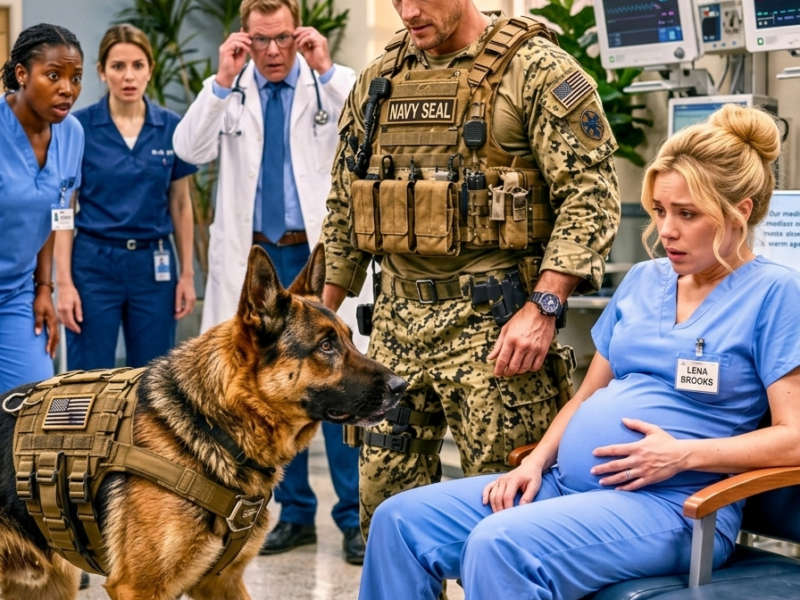
The hospital director laughed in front of the entire emergency room when he accused me of being a useless nurse
The harsh fluorescent lighting of St. Vincent’s Medical Center in Charleston, South Carolina, offered no warmth on a rainy Thursday night. I had worked in this emergency department for almost six years, and during that time, I had perfected the art of becoming invisible. In a chaotic trauma bay, quiet staff members were often treated like furniture—useful, functional, but ultimately ignored. I kept my head down, did my job, and kept my past where I believed it belonged: buried beneath layers of professional detachment and crisp blue scrubs.
“Look at those hands,” Director Arthur Mason’s voice boomed across the crowded nurses’ station, echoing off the tile walls. He stood at the central desk in a perfectly tailored charcoal suit, holding a clip-board and smiling with practiced condescension. “Nurse Vance, you’re shaking over a simple peripheral line insertion. If a standard midnight shift causes this much distress, maybe clinical nursing is simply too much for you. Some people just aren’t built for high-stakes medicine.”
A few junior residents looked away awkwardly. Two senior nurses shifted their weight, staring intently at their computer monitors. Nobody spoke up. Mason was not merely the hospital administrator; he was a powerful political figure in the Charleston healthcare system, a man who built his career on cold efficiency, ruthless budget cuts, and an unyielding demand for total deference.
I didn’t argue. I didn’t defend myself. I simply lowered my eyes, pulled my sleeves down over my wrists, and kept working. “Understood, Director,” I said softly, my voice barely above a whisper.
“Good,” Mason said with a dismissive chuckle, turning to a visiting board member standing beside him. “You see, gentlemen? Leadership is about identifying weak links before they snap.”
Before his laughter could fade, the heavy double doors of the ambulance bay burst open with a violent metallic crash.
“Trauma one! Incoming!” the triage coordinator yelled, springing from her chair. “Tactical unit transport, high-velocity blunt force trauma and shrapnel exposure!”
The room shifted instantly. Paramedics shoved a heavy transport gurney into the room, their boots slipping on the wet floor. On the mattress lay a broad-shouldered man in tactical pants and a blood-soaked combat shirt. His face was smeared with dirt and grime, his chest rising in shallow, ragged gasped breaths. His Navy SEAL identification tags clinked against the steel rail of the stretcher.
Right beside the moving gurney, running in perfect cadence, was a massive Malinois-German Shepherd cross. The dog’s dark coat was wet with rain, his muscular body rigid with tension. Around his chest was a reinforced tactical harness stamped with a unit callsign. Two paramedics were trying desperately to grab the dog’s lead, but the animal maneuvered between them with terrifying speed, keeping his body pinned against the side of the bed.
“Get that animal out of here!” Mason barked, stepping forward with an annoyed frown. “This is a sterile medical facility, not a kennel! Security, remove that dog immediately!”
“Sir, he won’t let us near the patient!” one of the paramedics shouted over the noise. “He’s a working K9—he was on scene during the training blast at the coastal range!”
The dog didn’t bark wildly. He didn’t panic. Instead, he planted his front paws squarely on the floor at the head of the stretcher, lowered his center of gravity, and bared his teeth with absolute, terrifying discipline. His dark, intelligent eyes scanned every human being in the room, tracking hands, pockets, and equipment.
“I said get it out!” Mason spat, taking an authoritative step toward the stretcher and reaching out to grab the patient’s central IV line to demonstrate control.
The K9 shifted instantly. In a single fluid motion, the dog placed his broad chest directly between Mason’s hand and the wounded operator. A deep, guttural growl vibrated through the animal’s chest—a sound so dangerous and primal that every doctor in the bay froze in place.
Mason scrambled backward, his face darkening with rage. “Control your animal!” he snapped, turning to the conscious paramedic.
“He won’t move for us, sir!” the paramedic replied, holding his hands up. “He’s locked into active defense protocol!”
Then, the dog’s head turned. His dark eyes locked onto me, standing quietly in the corner near the crash cart.
He relaxed his defensive posture, dropped his tail slightly, and began walking directly across the polished floor toward me. The entire room went dead silent. The heavy click of his claws against the linoleum was the only sound echoing in the trauma bay.
I froze. He stopped precisely two inches from my knees.
“He’s… he’s never done that before,” the wounded handler rasped from the gurney, his voice strained and thick with pain as he tried to lift his head. “He doesn’t approach civilian staff…”
I slowly sank down onto one knee, keeping my movements smooth, predictable, and devoid of threat. I held out the back of my hand, keeping my fingers curled. “Easy, boy,” I whispered softly. “I’ve got you. Easy.”
The massive operational dog lowered his broad head, resting his heavy snout directly into my palm, letting out a long, shuddering breath.
As I reached up with my left hand to gently stroke his neck, my scrub sleeve pulled back several inches. Exposed under the bright halogen lights was a thin, jagged, three-inch surgical scar running horizontally across the underside of my left wrist.
The wounded SEAL’s eyes widened. He stared at my wrist for several long, agonizing seconds. The air in the room seemed to vanish.
“You…” the operator whispered, his breathing hitching in his chest. “You were there. Camp Lejeune… 2018.”
My stomach dropped into a cold, bottomless pit.
Long before I became a quiet civilian nurse at St. Vincent’s, I had been petty officer Sarah Vance—a Navy hospital corpsman attached to a high-security surgical unit. Eight years ago, while stationed at a joint military medical facility, I had uncovered a massive black-market operation involving stolen high-grade narcotics, falsified trauma records, and wounded personnel whose files were quietly altered or scrubbed from the system entirely.
I had reported the corruption through official channels. Within seventy-two hours, my personal records were completely erased, my security clearance was revoked under false administrative pretenses, and I was quietly given a medical discharge. The military investigation vanished without a trace, as if the ring had never existed.
And the civilian administrator who had overseen the entire medical transition and record consolidation for that sector—the man who had personally signed off on my scrubbed service record—was sitting right in front of me.
I slowly turned my head and looked directly at Director Arthur Mason.
The color had drained entirely from his face. His confident smile was gone, replaced by a expression of sheer, unadulterated terror.
The wounded SEAL struggled to sit up, his blood-soaked fingers pointing weakly at Mason. “She knows,” the operator whispered, his voice echoing across the silent ER. “She’s the corpsman who filed the original report.”
The heavy silence in the trauma bay felt like an physical weight crushing down on everyone present. The medical staff stood paralyzed, looking between the bleeding operator, Director Mason, and me.
Mason took a involuntary step backward, his hand trembling slightly as he adjusted his silk tie. “This… this is absurd,” he stammered, his voice rising an octave as he attempted to regain his authoritative composure. “The patient is delirious from hemorrhagic shock and head trauma. He doesn’t know what he’s talking about. Nurse Vance, step away from that animal and return to your duties immediately!”
I didn’t move. My hand remained rested on the K9’s head. The dog didn’t growl at me, but his ears remained pinned back, his body acting as an immovable physical barrier between Mason and the gurney.
“He isn’t delirious, Director,” I said. My voice was no longer soft or hesitant. The timid civilian nurse persona I had spent six years building stripped away, revealing the quiet, unyielding discipline of a military combat medic. “He remembers Camp Lejeune. And so do I.”
“Security!” Mason yelled, turning toward the double doors where two hospital security officers stood looking confused. “Restrain this patient and remove this nurse from the premises! She is violating administrative protocol and endangering patient care!”
The two security guards took a step forward, but before they could reach us, the wounded SEAL reached into his tactical vest with a groan of exertion. He didn’t pull a weapon; instead, he produced a heavy, military-grade encrypted drive encased in waterproof orange casing and held it out toward me.
“Take it, Vance,” the operator rasped, coughing blood onto his lip. “Our unit… we weren’t just on a training exercise tonight. We were executing a federal warrant on a private medical storage depot off-base. The same network… the same stolen pharmaceutical batches… they’re still moving through St. Vincent’s.”
Mason’s eyes dilated with sheer panic. He lunged forward, abandoning all professional pretense, his hands grasping frantically for the orange drive in the operator’s hand. “Give me that! That is hospital property under administrative jurisdiction!”
Snap!
The Malinois moved like lightning. He didn’t bite, but he drove his heavy shoulder directly into Mason’s ribs with explosive force. Mason lost his footing, crashing backward onto a stainless steel supply cart. The cart tipped over with a deafening metallic roar, sending trays of sterile scalpels, gauze, and antiseptic bottles shattering across the floor.
Mason scrambled to his feet, his tailored suit covered in iodine, his face flushed red with rage. “You’re done!” he shrieked at me. “You are fired! I will have you arrested for assault, treason, and medical malpractice! You’ll spend the rest of your life in a federal brig!”
“I don’t think so, Arthur,” a firm voice called out from the back of the trauma bay.
Everyone turned. Standing near the entrance was Chief Inspector Marcus Reed of the Naval Criminal Investigative Service (NCIS), flanked by two armed federal marshals. Reed held up a badge, his face grim as he surveyed the chaotic room.
“NCIS,” Reed announced, his eyes locking onto Mason. “Director Mason, step away from the medical staff and keep your hands where we can see them.”
Mason froze, his mouth opening and closing like a fish out of water. “Inspector… this is a massive misunderstanding! This nurse is a disgraced former service member attempting to fabricate—”
“Save it, Arthur,” Reed interrupted smoothly, pulling a folded federal warrant from his jacket. “We’ve been tracking the off-base distribution network for eighteen months. We didn’t just come for the storage depot. We came for the administrator coordinating the civilian diversion pipeline.”
The two federal marshals stepped past the stunned hospital security guards, moving purposefully toward Mason.
Mason’s eyes darted wildly around the room, searching for an exit. His gaze fell upon his leather briefcase resting on the central nursing station desk—a high-security, locked leather bag he carried with him everywhere he went. He made a sudden, frantic dash toward the desk, reaching out to grab the handle.
Before his fingers could touch the leather, the K9 leaped across the fallen supply cart. He landed squarely on top of the desk, blocking Mason’s reach, and began barking violently—a sharp, deafening rhythmic bark—while furiously scratching his front paws against the leather locking mechanism of the briefcase.
“Good boy, Jax,” the wounded SEAL whispered from the bed, a faint smile touching his blood-stained lips. “Search… reveal.”
Inspector Reed walked over to the desk, shoved Mason aside, and picked up the briefcase. “Customs-grade scent marking,” Reed observed, looking at the dog with respect. “He’s trained to detect chemical signatures used in military-grade pharmaceutical packaging.”
Reed produced a pair of specialized shears from his belt, snip-snapping the leather seam open near the lock mechanism. He reached inside and pulled out a thick stack of printed documents, financial ledgers, and digital storage keys stamped with military classification markers.
“Copies of altered service records,” Reed said, scanning the first page, his jaw tightening. “Dated from 2018 to the present. Including the scrubbed medical file of Petty Officer Sarah Vance.”
Reed looked up at me, his eyes softening with a mixture of professional respect and deep apology. “You were right eight years ago, Petty Officer. We just needed someone inside to hold the line until the chain was broken.”
The emergency room remained in a state of suspended animation as the federal marshals pulled Mason’s arms behind his back, snapping heavy steel handcuffs around his wrists. The man who had ruled St. Vincent’s with an iron fist for nearly a decade looked small, broken, and completely defeated as his pristine suit was rumpled by the officers.
“This won’t hold!” Mason snarled, his voice echoing off the walls as he was turned toward the exit. “I have connections in Washington! You have no idea who is funding this operation!”
“They’ll be joining you soon enough, Arthur,” Inspector Reed said calmly, securing the briefcase and the orange encrypted drive in a evidence bag.
As the marshals escorted Mason toward the double doors, the hospital staff stood in stunned silence. Nurses I had worked alongside for six years stared at me as if seeing me for the very first time. The timid, shaking nurse who took the night shift abuses without complaint was gone; standing in her place was a woman who had stood her ground against a federal conspiracy.
I immediately turned my attention back to the wounded operator. “Trauma team, move!” I ordered, my voice ringing out with absolute command. “We have a penetrating blast injury, suspected internal bleeding, and a dropping blood pressure! Get two large-bore IV lines started, hang two units of O-negative blood, and prep Trauma Bay 1 for immediate surgical intervention!”
The ER staff snapped into action instantly, no longer questioning my authority or my hands. The young residents who had looked away earlier were now taking direct orders from me without a second of hesitation.
“What about the dog?” one of the junior nurses asked nervously, looking at the massive Malinois still standing guard near the bed.
“He stays with his handler,” I said firmly. “Sterile field rules apply to the surgical suite, but until he enters the operating room doors, this dog stays by his side. That’s an order.”
The dog—Jax—looked up at me, gave a single quiet pant, and fell into step alongside the gurney as we wheeled the operator down the corridor toward the surgical elevator.
Inside the elevator, the mechanical hum of the motor provided a momentary pause from the madness of the ER. I knelt down beside the operator, adjusting his oxygen mask and monitoring his weak pulse.
“You’re going to make it, Chief,” I told him, checking the saline drip. “Dr. Harrison is the best trauma surgeon in South Carolina. You’re in good hands.”
The operator looked up at me, his dark eyes clear despite the shock setting in. “Name’s Miller,” he rasped out gently. “Chief Master-at-Arms Jacob Miller. We… we knew about you, Vance. Your name was a ghost story in the corpsman community. The nurse who tried to stop the bleed at Lejeune.”
“I thought I failed,” I whispered, looking down at my scarred wrist. “I thought they wiped everything and won.”
“You didn’t fail,” Miller said, his breathing stabilizing under the high-flow oxygen. “You just planted the fuse. It took us eight years to light it.”
Jax nudged my hand with his cold nose, resting his head against my knee as the elevator rose toward the surgical floor. I stroked his head gently, feeling the deep tension that had locked my own chest for nearly a decade finally begin to melt away.
When the elevator doors opened on the third floor, the surgical team was waiting. They moved with practiced speed, taking the gurney from us.
“We’ve got him, Sarah,” Dr. Harrison said, giving my shoulder a firm, supportive squeeze. “You did incredible work down there. Go get cleaned up.”
I watched as they pushed Chief Miller into the operating suite. Jax attempted to follow, but I gently grabbed his tactical harness, pulling him back softly. “Hold, Jax. He’s in theater now. We wait here.”
The dog looked at the double doors, then looked up at me, sitting down heavily on his hindquarters against my leg. He was exhausted, his coat wet and stained with mud, but his duty was far from over.
I sat down on the floor of the surgical waiting hallway, pulling my knees to my chest, with the massive K9 leaning his heavy weight against my side. For the first time in six years, my hands were perfectly still.
An hour passed in the quiet surgical hallway. The rain outside battered against the floor-to-ceiling glass windows at the end of the corridor, casting long, rhythmic water patterns across the floor.
I had used a damp towel from the supply closet to clean the mud and drying blood from Jax’s coat. He sat patiently, allowing me to check his paws and ribs for injuries sustained during the training accident blast. Aside from minor abrasions on his pads, he was in remarkably good shape—a testament to his elite conditioning and resilience.
Inspector Reed walked out of the elevator bay, carrying two paper cups of hot black coffee. He walked down the quiet hallway, his heavy shoes echoing on the floor, and offered one of the cups to me.
“Thought you might need this,” Reed said, sitting down on the bench across from me.
“Thanks,” I murmured, taking the warm cup in my hands. Jax lifted his head, gave Reed a brief scent-check, and then rested his head back on my knee.
“Mason is in federal custody at the downtown precinct,” Reed said, taking a slow sip of his coffee. “His lawyers are already calling, but it’s useless. The documents in that briefcase… Sarah, it’s bigger than we imagined. He wasn’t just stealing narcotics; he was selling classified personnel medical files to private defense contractors who wanted off-the-books research data.”
I stared into the black coffee, watching my reflection ripple on the surface. “He ruined lives, Inspector. He destroyed careers, falsified psychiatric evaluations, and forced good corpsmen and nurses out of the service just to protect his bottom line.”
“I know,” Reed said softly. “And tonight, you helped put an end to it. Your original 2018 report is officially reinstated in the Navy personnel database. The Chief of Naval Operations signed an administrative order forty minutes ago. Your service record is fully restored, Sarah. Honorably discharged with full retro-active veteran benefits, or…” Reed paused, pulling an official blue folder from his jacket and placing it on the bench between us. “…a full reinstatement to active duty with the rank of Senior Chief Hospital Corpsman, if you want it.”
I looked at the blue folder. For six years, I had dreamed of clearing my name. I had imagined the moment my record was restored, believing it would heal the deep wound left by the betrayal of the system I had sworn to serve.
“Why now?” I asked quietly, looking up at Reed. “Why did it take Chief Miller’s team getting hit by a blast to finally bring this down?”
“Because Mason was protected,” Reed explained grimly. “He had layers of political armor in Washington and Charleston. It took an operational unit catching his delivery team red-handed on federal property to shatter that armor. But Miller refused to execute the warrant without knowing you were working the night shift at St. Vincent’s. He wanted you to be the one to stand there when Mason fell.”
Jax gave a soft whine, pressing his snout against the blue folder on the bench.
I reached out and picked up the folder, opening it. Inside were my original military enlistment papers, my combat medicine commendations, and the official seal of the Department of the Navy restoring my rank and status.
“What about Chief Miller?” I asked, looking toward the operating room doors.
“Dr. Harrison just stepped out of theater five minutes ago,” Reed smiled slightly. “The shrapnel missed his primary arteries. Internal bleeding is controlled. He’s going to make a full recovery.”
A heavy sigh of relief escaped my lips. I looked down at Jax, whose ears twitched up at the news of his handler. “Hear that, buddy? He’s going to be okay.”
Jax gave a quiet, low woof, his tail giving two distinct thumps against the floor.
“You don’t have to decide about reinstatement tonight,” Reed said, standing up and adjusting his coat. “Take a few days. You’ve earned it.”
Reed turned and began walking back toward the elevators. But as he reached the doors, the elevator chimed, and the heavy steel doors slid open.
The basement processing area of the Charleston Federal Courthouse was freezing cold, lit only by dim security lights as the night shift prepared to transfer high-profile detainees to the federal holding facility.
Arthur Mason sat in a small, windowless holding cell, his hands cuffed to a heavy steel loop anchored into the concrete wall. The tailored suit that had given him an air of supreme authority just hours earlier was now wrinkled, stained, and torn at the collar.
The heavy iron door of the holding cell block creaked open.
I walked down the corridor slowly, the heavy rubber soles of my nursing shoes silent against the concrete floor. Beside me, walking in a precise, disciplined heel position, was Jax.
Mason lifted his head slowly. When his eyes fell upon me—and the massive Malinois standing at my side—his face twisted into a bitter, venomous grimace.
“Came to gloat, Petty Officer Vance?” Mason sneered, his voice raspy and dry. “Came to see the disgraced administrator in a cage?”
I stopped directly outside the cell bars. Jax sat down beside me, his dark eyes locked onto Mason with cold, motionless intensity.
“I didn’t come to gloat, Arthur,” I said quietly, my hands resting calmly at my sides. “I came to return something you dropped.”
I reached into my pocket and pulled out the silver administrative lapel pin he had worn on his suit—the emblem of St. Vincent’s Medical Center—which had fallen off during his struggle in the ER. I tossed it through the bars, where it landed with a sharp metallic clink on the cold floor near his shoe.
Mason stared at the pin, then let out a harsh, dry laugh that echoed hollowly off the concrete walls.
“You think you won tonight, don’t you?” Mason said, leaning forward as far as his handcuffs would allow, his eyes gleaming with a disturbing, sinister light. “You think because you restored your little record and put me in cuffs, the world is suddenly clean again?”
“The network is destroyed, Mason,” I said firmly. “The storage depots are seized. NCIS has your financial ledgers.”
Mason’s bitter laughter grew louder, a chilling sound that filled the narrow corridor.
“You fool,” Mason whispered, leaning his face close to the bars. “I was just a logistics coordinator. A regional manager for a pipeline that spans six federal districts. You really think I was the only one?”
The air in the corridor seemed to drop ten degrees.
“There are board members in three major hospital networks,” Mason continued, his smile turning cold and vacant. “There are senior officers in Norfolk, Pentagon liaisons, and political directors who signed off on those trials long before I ever stepped foot in Charleston. My arrest isn’t the end of the story, Vance. It’s just an operational inconvenience.”
I kept my face completely stoic, refusing to let him see a single flicker of doubt. “Then we’ll find them too.”
“Will you?” Mason taunted, leaning back against the wall. “Look behind you, Nurse Vance. Look outside those hospital doors. The system doesn’t collapse because one cog breaks.”
Before I could answer, Jax’s ears suddenly snapped forward.
The dog didn’t growl at Mason. Instead, he slowly turned his head away from the cell, his body going completely rigid as he faced the dark, empty stairwell at the far end of the federal holding corridor.
A soft, rhythmic sound echoed from the darkness of the stairwell.
Step. Step. Step.
The heavy, measured impact of expensive leather dress shoes descending the concrete stairs. Slow. Deliberate. Unhurried.
Mason’s cold smile widened as he watched my reaction. “They’re already here to clean up the mess,” he whispered softly. “And your dog knows it.”
I didn’t turn back toward Mason. I looked down at Jax, who stepped in front of me, placing his body firmly between me and the darkening stairwell, his tail dropping into a low, tactical defense posture.
The footsteps stopped just short of the heavy metal door at the end of the hall. The shadow of a high-ranking official flickered across the frosted glass panel.
I reached down, my hand gripping Jax’s tactical harness tightly. The war wasn’t over. The battle had simply shifted to a larger stage.
I drew a long, quiet breath, squared my shoulders, and waited for the door to open.
The end.









