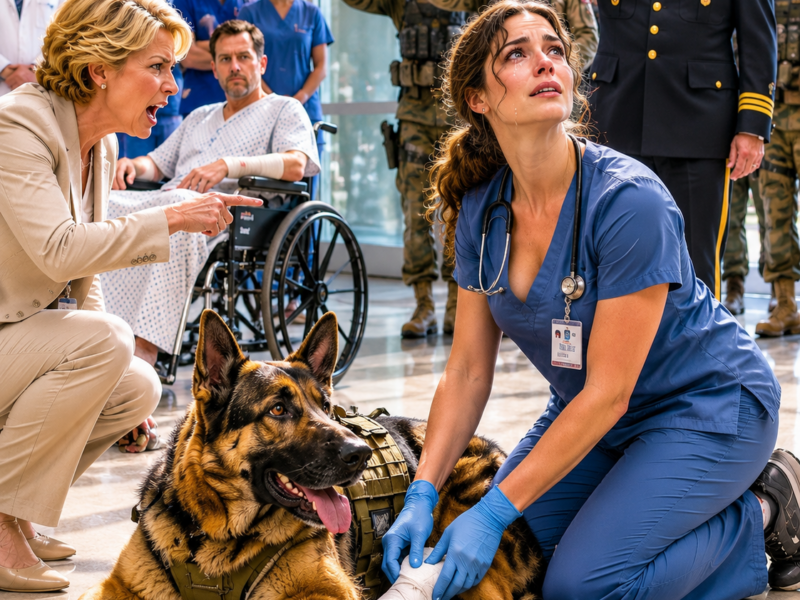
“The hospital director fired me in front of twenty nurses for refusing to let a wounded Army K9 be euthanized, but when a four-star
The general stopped in the middle of the emergency department and looked directly at Dr. Harris.
“Where is the dog?”
Dr. Harris straightened immediately. “Operating room two, sir. The surgical team is preparing him now.”
“Is he alive?”
“Yes, sir. His condition is critical, but we believe we can save him.”
The general let out a breath that seemed to have been trapped in his chest for hours.
“Then nobody touches that dog without authorization from me.”
Behind him, two uniformed officers entered the hospital. One carried a sealed equipment case. The other held a folder against his chest.
I stood near the nurses’ station, still holding my coat. I had no idea why I hadn’t gone home. Maybe I couldn’t bring myself to leave Rex after everything that had happened.
Then Dr. Harris spotted me.
“Lauren.”
The general turned.
“You’re Lauren Mitchell?”
“Yes, sir.”
“You’re the nurse who refused to euthanize the K9?”
I swallowed. “I refused to help kill an animal who still had a chance to live.”
For a moment, he simply studied my face.
Then he nodded.
“Good. I came here hoping I would find someone who still understood what duty means.”
Director Coleman appeared from his office, his expression changing the moment he saw the general.
“General, welcome to Fort Adams. I wish someone had informed me you were coming.”
“I don’t believe you would have wanted that, Mr. Coleman.”
The room became silent.
Coleman forced a smile. “There seems to have been a misunderstanding regarding the animal’s treatment. We were following hospital policy.”
“Hospital policy?”
The general opened the folder.
“Your policy apparently includes ordering the destruction of a military working dog before his authorized veterinary officer could assess him.”
“His injuries were extensive. We were concerned about the cost and the likelihood of recovery.”
“That decision was not yours to make.”
Coleman glanced toward the operating room.
“With respect, General, this is a civilian medical facility.”
“And that dog is a decorated military asset who was wounded while protecting American soldiers. His care was authorized through the military working dog program. You were informed of that authorization.”
Coleman didn’t answer.
The general turned toward the officer carrying the equipment case.
“Have you secured the harness?”
“Yes, sir. It was removed before the dog entered surgery and placed in the evidence room.”
“Good. Nobody opens it until the investigative team arrives.”
My stomach tightened.
The harness.
The little metal tag beneath Rex’s collar.
The general noticed my reaction.
“You’ve seen something.”
I hesitated. “When we first brought Rex in, I noticed a small metal tag underneath his collar. It wasn’t on the inventory sheet.”
“Did you remove it?”
“No, sir. I didn’t touch it. I only saw it when we were checking his wounds.”
The general looked at the officer.
“That’s the item.”
Coleman stepped forward.
“I don’t know what you’re referring to.”
The general’s expression hardened.
“Then you won’t mind explaining why someone from this hospital called an outside contractor and requested that a military evidence container be destroyed.”
Coleman’s face lost its color.
I looked at Dr. Harris. He seemed just as shocked as I was.
“An outside contractor?” Dr. Harris asked.
The general nodded.
“At 10:52 tonight, someone contacted the hospital’s equipment disposal service. The request specifically identified the K9’s harness and instructed them to destroy the embedded recording unit.”
Coleman shook his head.
“That is ridiculous. I never authorized anything like that.”
“Your electronic signature is on the request.”
For the first time since I had known him, Richard Coleman looked genuinely frightened.
The general turned to me again.
“Lauren, I need you to tell me exactly what happened when the dog arrived. Start at the beginning. Don’t leave anything out.”
I glanced at the operating room doors.
“Can I know whether Rex is going to survive first?”
The general’s expression softened.
“That’s a fair question.”
He looked at Dr. Harris.
“Give us your best estimate.”
Dr. Harris checked the surgical status board.
“The team is working to control the bleeding and stabilize his leg. His heart is strong, but the next hour will be critical.”
The general nodded.
“Then we’ll wait for that hour.”
He pulled a chair toward the nurses’ station and sat down, still wearing his uniform.
That surprised me more than anything else.
A man with four stars on his shoulders had arrived at midnight, and he was willing to sit in a plastic hospital chair because a wounded dog was behind a set of operating room doors.
I told him everything.
I explained how Rex had arrived, how Daniel Brooks had refused to leave his side, and how Dr. Harris had explained that surgery offered a real chance of recovery.
I told him about Coleman’s order.
I told him how he had threatened my job.
And I told him how he had fired me in front of the staff.
The general listened without interrupting.
When I finished, he looked toward Coleman.
“You dismissed her for refusing to participate in an unauthorized euthanasia?”
Coleman rubbed his forehead.
“I made a difficult management decision during an emergency.”
“No. You made a decision that could have ended the life of a soldier’s partner, and then you punished the person who refused to carry it out.”
Coleman tried to respond, but the general raised one hand.
“You’re done speaking until the investigators arrive.”
One of the officers stepped forward.
“Sir, we also recovered the hospital’s call log and the disposal request.”
“Secure both.”
“Yes, sir.”
Coleman backed toward his office.
“General, I would like to discuss this privately.”
“You’ll have an opportunity to speak with investigators. Until then, you’re not to access the hospital’s evidence room, computer systems, or medical records related to this case.”
The officer escorted him away.
For a few minutes, nobody spoke.
Then I heard hurried footsteps coming from the entrance.
Daniel Brooks appeared in the hallway, still wearing his bloodstained uniform.
He looked exhausted.
“Where’s Rex?”
The general stood.
“He’s in surgery, Sergeant.”
Daniel’s eyes moved from the general to me.
“Lauren?”
I nodded.
“He’s alive, Daniel.”
He closed his eyes.
For several seconds, he didn’t move.
Then he pressed one hand against his mouth and looked down at the floor.
“I thought I was going to lose him.”
“I know.”
“He kept looking at me in the ambulance. I kept telling him we were going home.”
His voice broke.
“I didn’t know if he understood.”
I stepped closer.
“He understood enough to keep fighting.”
Daniel wiped his face with his sleeve.
The general placed a hand on his shoulder.
“Sergeant Brooks, I need to ask you about the device in Rex’s harness.”
Daniel looked up.
“Did you find it?”
“We found the harness. The device is still being secured.”
Daniel’s expression changed.
“Sir, that recording could explain what happened out there.”
The general nodded.
“That’s why we’re here.”
Daniel glanced at me, then back at the general.
“What exactly did it record?”
“That’s what the investigation needs to establish.”
Daniel took a slow breath.
“Rex was trained to identify explosive materials, but his harness also carried a mission recorder. It logged his location, movement, and alerts during deployment. The device was designed to preserve data if a team encountered an explosive threat.”
“Was it active during the convoy operation?”
“Yes, sir.”
“Did you hear anything unusual before the explosion?”
Daniel hesitated.
“There was a radio instruction to take a different route. Our original route had been cleared, but command told us to use an alternate road because of a reported obstruction.”
The general’s face tightened.
“Who issued that instruction?”
“I couldn’t identify the voice. It came through the operations channel.”
“Did you question it?”
“We followed the order, sir. We had no reason to believe it wasn’t legitimate.”
Daniel stared at the operating room doors.
“Then the road exploded.”
The general looked toward the evidence officer.
“That recording may tell us whether the route change was legitimate.”
A few minutes later, another officer arrived carrying a secure laptop.
He spoke quietly to the general, who listened without taking his eyes off the screen.
“Are you certain?” the general asked.
“Yes, sir. The recorder’s last transmission was received before the blast. The encrypted storage unit appears intact.”
“Can it be accessed?”
“Not without the military technical team.”
“Then nobody attempts it here.”
The officer nodded.
I finally understood why the general had come himself.
Rex wasn’t simply a wounded dog whose treatment had been mishandled.
He might be the only surviving source of evidence from an attack that had nearly killed an entire convoy.
But one question remained.
Why would anyone at this hospital want that evidence destroyed?
The general seemed to be thinking the same thing.
He looked at Coleman, who was standing near the administrative offices with an officer beside him.
“Mr. Coleman, did anyone outside this hospital contact you about Sergeant Brooks’s unit?”
Coleman looked irritated.
“I’ve already told you I had nothing to do with the disposal request.”
“That wasn’t my question.”
Coleman swallowed.
“I received several calls from the regional medical administration office.”
“From whom?”
“Deputy Director Martin.”
The general’s eyes narrowed.
“Martin?”
“Yes. He asked whether we had received any military casualties from the convoy.”
“Did he tell you to destroy anything?”
“No.”
“Did he ask you to report the K9’s condition?”
Coleman hesitated.
“He asked whether the dog had survived.”
The general looked at the officer.
“Get me every call between this facility and Deputy Director Martin over the past twenty-four hours.”
“Yes, sir.”
Coleman shifted his weight.
“I don’t understand why this is becoming a federal investigation.”
“Because six American soldiers nearly died on a route that should never have been used, and someone tried to destroy the only recording that may explain why.”
The general paused.
“And because a hospital director thought the cheapest solution was to kill the one witness who couldn’t speak for himself.”
Coleman looked away.
I couldn’t tell whether the general believed Rex had deliberately been targeted or whether he was simply following the evidence.
But I knew one thing.
The situation was much bigger than a hospital budget dispute.
At 1:18 a.m., the operating room doors finally opened.
Dr. Harris stepped into the hallway.
His surgical cap was damp with sweat, and his eyes were red from concentration.
Everyone stood.
“He’s stable,” he announced.
Daniel grabbed the edge of the counter.
“Stable?”
“We controlled the bleeding, repaired the chest wound, and stabilized the damaged leg. We couldn’t complete every part of the reconstruction tonight, but we saved the limb’s blood supply.”
Daniel let out a sound that was half laugh, half sob.
“Can I see him?”
“Not yet. He needs to wake up and recover from anesthesia. But he’s alive, and we have a reasonable chance of getting him back on his feet.”
Daniel covered his face.
The general closed his eyes for a brief moment.
Then he turned to Dr. Harris.
“Doctor, thank you.”
Dr. Harris shook his head.
“Lauren deserves some of that thanks. She was the one who refused to give up on him.”
The general looked at me.
“That’s why I wanted to meet you.”
I didn’t know what to say.
“I just did what I thought was right.”
“That is often the hardest thing to do when the person giving the orders has more authority than you.”
He reached into his uniform pocket and handed me a card.
“An investigator will need your statement. You have my assurance that your dismissal will be reviewed.”
I looked at the card but didn’t take it immediately.
“Sir, I don’t want special treatment.”
“I didn’t offer you special treatment. I offered you a fair process.”
I accepted it.
For the first time that night, I felt that someone in authority had actually heard me.
But the most important discovery was still waiting.
At 3:40 a.m., the military technical team arrived.
They worked in a secured room with the recorder, the harness, and the evidence officer.
Nobody was permitted inside except the authorized personnel.
Daniel and I waited outside with the general.
Every few minutes, the general received a short update.
At 4:26 a.m., the technical officer emerged.
“Sir, we’ve recovered the data.”
The general stood.
“What did you find?”
The officer placed a tablet on the table.
“The recorder captured the route-change instruction, the GPS trail, and the warning alerts from Rex.”
He tapped the screen.
“The device shows that Rex detected an explosive signature before the convoy reached the final bend. He gave three alerts.”
Daniel leaned forward.
“Three?”
“Yes. The first occurred approximately four minutes before the blast. The second occurred ninety seconds later. The third was recorded just before the explosion.”
Daniel stared at the screen.
“That’s what he was trying to tell us.”
The officer continued.
“The recording also captured the radio traffic. The person who ordered the route change identified himself as an operations liaison.”
“Can you identify the voice?”
“We’re comparing it with authorized communications records.”
The general’s jaw tightened.
“Continue.”
The officer played a short audio segment.
A man’s voice came through the speaker.
“Convoy Seven, disregard the original clearance. Proceed through Route Twelve. The obstruction has been cleared.”
A second voice answered.
“Confirm Route Twelve is secure?”
The first voice replied.
“Confirmed. Proceed immediately.”
The recording continued with static, the sound of an engine, and then Rex’s warning signal.
The general leaned closer.
“That voice.”
Daniel looked at him.
“You recognize it, sir?”
The general didn’t answer immediately.
He listened to the segment again.
Then he turned to the officer.
“Compare it with the recorded voice of Deputy Director Martin.”
The officer nodded.
“We’re already doing that.”
A few minutes later, the result came back.
The voice was a match.
Daniel stood so quickly his chair scraped the floor.
“Martin sent us there?”
The general raised a hand.
“We have a voice match, but we still need to establish whether he acted alone and why.”
The officer brought up another file.
“Sir, there’s more.”
He displayed a message log recovered from the recorder’s encrypted cache.
The message was not part of the standard mission record.
It had been transmitted to the device shortly before the convoy departed.
The text read:
ROUTE TWELVE CLEARED. PRIORITY DELIVERY. DO NOT DELAY.
Daniel shook his head.
“We weren’t carrying a priority delivery.”
The general looked at him.
“What were you carrying?”
“Routine supplies and personnel. Nothing classified beyond the normal mission details.”
The officer enlarged the message metadata.
“It was sent from an administrative account linked to the regional logistics office.”
The general’s face became unreadable.
“That office reports to Deputy Director Martin.”
“Yes, sir.”
For a long moment, the only sound in the room was the air conditioner.
Then the general said something I would never forget.
“Someone used an official military channel to send six soldiers into an ambush, and then tried to erase the evidence.”
Daniel looked sick.
“Why?”
The general stared at the message.
“That is what we’re going to find out.”
The investigation began before sunrise.
Federal investigators secured the administrative offices, collected the hospital’s electronic records, and interviewed every staff member who had been present when Rex arrived.
I gave my statement twice.
I described Coleman’s order, the attempted euthanasia, and the request to destroy the harness.
I also provided the names of the staff members who had witnessed my dismissal.
Coleman was removed from his position pending investigation.
Deputy Director Martin was placed under military and federal investigation after the communications records connected him to the unauthorized route change.
The hospital’s equipment contractor confirmed that the destruction request had been canceled before anyone touched the harness.
The recording had survived.
But the hardest part of that night wasn’t the investigation.
It was waiting to see whether Rex would wake up.
For two days, Daniel barely left the veterinary recovery area.
He spoke to Rex through the glass, describing the six soldiers who had made it home.
He told him that their families were waiting.
He told him that he still owed him a steak dinner.
And every time Rex moved an ear, Daniel smiled as if he had just witnessed a miracle.
On the third morning, I received a call from Dr. Harris.
“Lauren, you should come in.”
“Is something wrong?”
“No. I think you’ll want to see this.”
I arrived within twenty minutes.
Rex was lying on a padded recovery bed, his injured leg supported and wrapped.
His eyes were open.
Daniel sat beside him, holding his paw.
When Rex heard my voice, his ears lifted.
“Hey, buddy,” I whispered.
His tail moved once against the blanket.
Then again.
I covered my mouth.
Daniel laughed through tears.
“He remembers you.”
I gently touched the side of Rex’s neck, careful to avoid his bandages.
“Of course he does.”
Rex leaned his head toward my hand.
For a moment, all the noise and anger of the previous night disappeared.
There was only a dog who had been given another chance.
And a handler who had refused to abandon him.
Over the following weeks, the investigation uncovered the reason behind the route change.
Deputy Director Martin had been coordinating unauthorized shipments through the regional logistics network.
The convoy’s original route would have exposed a discrepancy in the shipment records.
Martin had redirected the convoy to delay its arrival and create an opportunity to conceal the missing supplies.
He had not anticipated that Rex would detect the explosive device or that the recording unit would preserve the radio traffic.
Investigators found financial records and messages connecting Martin to a contractor who had provided false route-clearance information.
The blast had not been a random accident.
It had been the result of a deliberate effort to conceal corruption, and six soldiers had nearly paid for it with their lives.
Martin was arrested.
Several other officials were suspended while the investigation continued.
The general later told Daniel that the recovered recording had helped investigators establish the timeline and identify the people involved.
Rex’s alerts had also helped prove that the convoy had encountered a threat before the explosion.
The general visited the hospital again a month later.
This time, he didn’t arrive with a convoy of black vehicles or a team of officers.
He came to see Rex.
By then, Rex had begun rehabilitation.
He could stand for short periods, although his injured leg remained stiff.
The veterinary team believed he would regain much of his mobility, but his days of explosive-detection work were over.
Daniel had requested that Rex be retired and remain with him.
The general approved the request.
When he entered the recovery room, Rex lifted his head.
“There’s my soldier,” the general said.
He knelt beside the bed and rubbed Rex’s ears.
Daniel smiled.
“He’s been waiting for you, sir.”
The general looked at me.
“Lauren, I owe you an apology.”
I was surprised.
“For what, sir?”
“For allowing a system to place you in a position where doing the right thing cost you your job.”
He handed me an official letter.
My dismissal had been overturned.
An independent review found that Coleman had violated military working dog treatment protocols and hospital emergency procedures.
The letter confirmed that I was eligible for reinstatement, with my employment record corrected and the termination removed.
I read it twice.
I had imagined receiving an apology.
I hadn’t imagined how strange it would feel to have my name cleared after being treated like I had done something wrong.
“Do you want to come back?” the general asked.
I looked at Rex.
Then I looked at Daniel.
“I do. But I want to know that the next nurse who refuses an unethical order won’t have to stand alone.”
The general nodded.
“That’s a reasonable condition.”
The hospital’s leadership changed during the following months.
New procedures were introduced for military working dogs, including clear authorization requirements, independent veterinary review, and protections for staff who raised concerns about animal welfare.
Coleman never returned to his position.
The investigation into his actions continued separately from the case involving Martin.
I returned to work, but something about the hospital had changed.
People spoke more carefully when discussing the lives entrusted to their care.
And whenever a military working dog arrived, nobody treated him as a piece of equipment.
Rex eventually left the hospital with Daniel.
His rehabilitation took months.
Some days he walked almost normally.
Other days, his leg became painful, and he needed rest.
But he learned to climb the steps to Daniel’s home, sleep beside the bed, and spend long afternoons in the yard.
He never returned to active duty.
He didn’t need to.
He had already done more than anyone could reasonably ask of him.
Several months after his recovery, Daniel brought Rex to the hospital for a visit.
I was working at the nurses’ station when I heard familiar claws tapping against the floor.
I turned.
There he was.
Rex walked toward me with his head high and his tail moving slowly.
Daniel grinned.
“Someone wanted to visit his favorite nurse.”
I knelt and wrapped my arms around his neck.
“Look at you.”
Rex pressed his forehead against my shoulder.
I felt the familiar warmth of his fur and remembered the night I had placed my badge on the counter, believing I had lost everything.
I had thought I was choosing between my career and a wounded dog.
But I finally understood that the choice had never really been about my job.
It was about whether I could live with myself if I let fear decide what was right.
The general’s investigation had exposed corruption.
The recording had helped protect six soldiers from being forgotten.
And Rex had survived because one person refused to accept that his life was no longer worth saving.
Daniel scratched behind Rex’s ears.
“He’s retired now,” he said. “But he still thinks he’s in charge.”
I laughed.
“Some things never change.”
Rex gave a quiet bark, as if agreeing with us.
I looked down at him and remembered the words I had spoken that night.
A life doesn’t become disposable just because saving it is inconvenient.
I still believe that.
And every time I see Rex walk through those hospital doors, I know I would make the same decision again.
The end.









