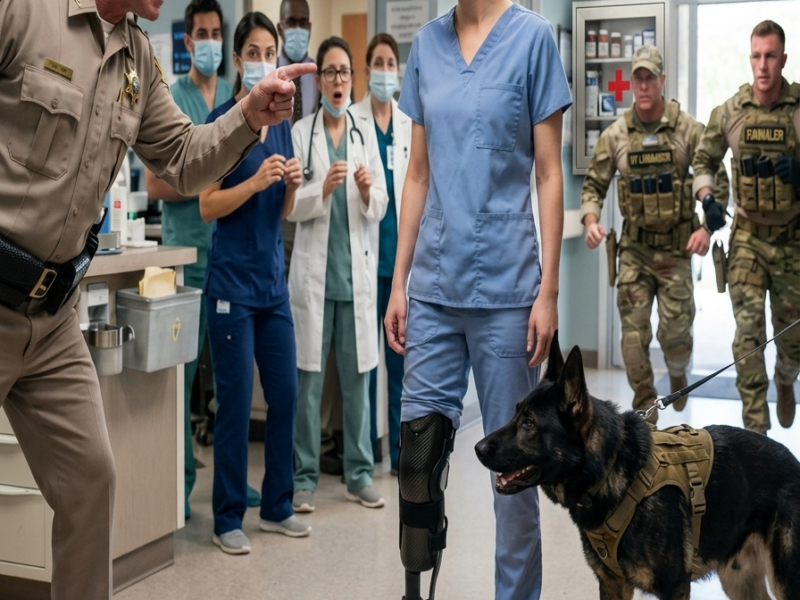
The hospital corridor erupted when security accused me of stealing morphine in front of thirty nurses, and the chief pharmacist coldly said, “We know it was you”
The third-floor corridor of St. Jude Memorial Hospital smelled permanently of cold floor disinfectant, industrial floor wax, and stale filter coffee. It was a space defined by quiet urgency—soft rubber-soled shoes squeaking against linoleum, the gentle chime of call buttons, and the dull, rhythmic hum of ventilator pumps from the intensive care unit. But at 8:15 on a rainy Tuesday morning, that delicate equilibrium shattered into public spectacle.
“Step away from the station, Nurse Vance!”
The voice belonged to Chief Security Officer Richard Vance—no relation to me, though he made a point of reminding everyone of that fact whenever possible. His heavy leather duty belt creaked loudly as he marched past the central nursing pod, flanked by two uniformed guards. Behind them walked Chief Pharmacist David Mercer. Mercer was immaculate, as always, his silver hair combed back with military precision, his white lab coat starched so stiffly it barely creaked when he walked.
Thirty nurses, floor techs, and resident physicians froze. A tray of phlebotomy tubes clattered against a metal cart.
“What is going on?” I asked, rising from my desk. My hands were shaking as I smoothed down the front of my faded blue scrubs.
“We know it was you, Chloe,” Chief Pharmacist Mercer said coldly, his eyes flat and devoid of warmth. He didn’t yell; he didn’t have to. His calm, clinical demeanor gave his words the weight of absolute authority. “Three hundred milligrams of liquid morphine sulfate and two dozen vials of fentanyl disappeared from the Vault B inventory over the weekend.”
“I didn’t take anything,” I stammered, my voice sounding paper-thin against the suffocating silence of the hallway.
Mercer didn’t even flinch. “Then explain why your electronic access badge logged into the medication room at 2:13 a.m. on Sunday morning.”
I couldn’t.
My mind raced wildly, searching for an anchor, a memory, anything. Sunday at 2:13 a.m. I had been in my bed, sound asleep in my tiny studio apartment three miles away. I had taken a double shift on Friday and Saturday; I was so exhausted I hadn’t even woken up when my neighbor’s car alarm went off at midnight.
“My badge was in my locker,” I whispered, my mouth dry. “I left it in my purse on Saturday night.”
“The audit logs don’t lie, Nurse Vance,” Vance sneered, unclipping a pair of heavy steel handcuffs from his belt. “Your badge was swiped. The door opened. The narcotics vault was accessed. And forty-five minutes later, the secondary security camera on Hallway C suddenly experienced a convenient power drop.”
The hospital suspended me before lunch. Human Resources gave me a manila folder containing an administrative hold notice, confiscated my temporary badge, and had two guards escort me to my employee locker to retrieve my coat.
By evening, the quiet, insidiously fast grapevine of a major hospital had done its work. The WhatsApp groups were buzzing. The floor nurses who had shared takeout pizza with me on night shifts three days ago suddenly looked down at their phones when I walked past the lobby. People I had known for four years—people whose kids’ birthday parties I had attended—averted their eyes. In a profession built entirely on trust, an accusation of narcotics theft is a lethal injection to a career.
I sat on the wooden bench in the lower-level employee locker room, staring at the concrete floor. The room was cold, lit by buzzing fluorescent tubes that cast long, sickly yellow shadows across the rows of blue steel lockers.
The heavy fire door swung open, introducing the sharp, earthy scent of wet fur and damp leather.
“Chloe Vance?”
I looked up. Standing in the doorway was Detective Mark Ellis from the County Sheriff’s Department. He was a tall man in his late forties, wearing a dark trench coat dusted with rain, carrying a worn leather case. Beside him, standing shoulder-to-height with his hip, was an aging German shepherd. The dog’s muzzle was frosted with grey fur, his chest broad, his dark amber eyes sharp despite his age. His leather harness bore the faded golden lettering: RETIRED K9 – COUNTY SHERIFF.
“I’m Mark Ellis,” the detective said, his tone measured and surprisingly gentle. “And this is Boone.”
“Are you here to arrest me?” I asked, my voice barely audible.
“I’m here because the hospital reported a high-level controlled substance breach,” Mark replied, stepping into the room. “Boone here spent nine years working narcotics and search-and-rescue before his hips started giving him trouble. The department lets me bring him along on property sweeps. We’re just checking the physical storage areas and locker bays while the state investigator finishes reviewing the digital logs.”
I barely noticed the old dog at first. I was too wrapped up in the cold terror of my own ruined life. But as Mark walked toward the far end of the locker bank, Boone lagged behind.
The old shepherd walked slowly along the aisle, his nose dipping close to the floor tiles. He paused in front of Locker 114—my locker.
His ears lifted sharply. His body went completely rigid.
“Boone?” Mark called out, turning around. “What is it, buddy?”
Boone didn’t bark. He lowered his snout directly to the seam where the bottom of my steel locker met the floor tiles. He sniffed deeply, his nostrils flaring. Then he lifted his heavy right paw and scratched the linoleum floor.
Scratch. Scratch. Scratch.
My stomach dropped into a fathomless pit. “I… I haven’t opened that locker since Saturday!” I cried, standing up so fast my knees hit the bench.
Within ten minutes, the locker room was packed. Chief Officer Vance, Pharmacist Mercer, two facility maintenance workers, and two hospital administrators crowded into the narrow aisle.
“Open it,” Vance ordered, pointing at my locker.
Mark didn’t move toward the locker door. He kept his eyes on Boone. The old dog hadn’t pointed at the locker door handle; he was sniffing the floor edge, two feet to the left.
“It’s not in the locker,” Mark said quietly. “Look at the floor.”
A maintenance worker stepped forward with a flat pry bar. He jammed the metal tip beneath the loose edge of the vinyl floor tile right where Boone had scratched. With a sharp crack, the aged adhesive gave way, popping the square of tile free.
Beneath it was a hollowed-out utility duct—a three-inch gap in the concrete subfloor designed for old plumbing conduits.
Sitting inside the dark gap was a clear plastic ziplock bag. Inside were twenty-four small, clear glass vials. Twelve of them were completely empty, their rubber stoppers punctured; twelve were still filled with liquid morphine sulfate.
Pharmacist Mercer immediately took a step forward, raising an accusing finger. “There it is! She planted them under the tile! She was probably planning to slip them out of the building during shift changes!”
“I didn’t put those there!” I yelled, tears finally breaking through my eyes. “I didn’t even know that tile was loose!”
“It’s over, Chloe,” Mercer said, his voice dripping with condescension. “Just confess now and save yourself the embarrassment of a full trial.”
Mark didn’t say a word. He looked at Mercer, then looked down at Boone.
The old K9 had stopped looking at the hollowed-out tile. He had turned his body completely around, his nose tilted upward into the ambient air draft coming from the hallway. He trotted out of the locker room, his nails clicking sharply against the floor.
“Boone, stay,” Mark called out, following him.
We all followed. Boone walked straight down the basement corridor, past the laundry chutes, past the boiler room, and stopped directly outside the private elevator that led straight up into the central pharmacy vault. He pressed his nose against the crack of the metal elevator doors, let out a soft, low whine, and sat down.
Mark crouched beside his old partner, patting his flank. “What is it, boy? Same scent?”
Mark looked up at Mercer. “Who has master key access to this utility elevator?”
Mercer flushed slightly. “Only senior administrative staff and pharmacy management. It’s a restricted lift.”
Mark reached into his coat pocket, pulled out a tablet device linked to the sheriff’s forensic network, and opened the raw security video feed that the hospital had provided earlier. “Let’s re-examine that 2:13 a.m. footage.”
He zoomed in on the frame showing the figure entering the medication room wearing a heavy dark hoodie. The figure had swiped my stolen badge.
“Watch the movement pattern,” Mark said, tracing the screen with his finger. “Notice the gait. The individual has a slight limp in the right knee. And look at the wrist.”
As the hooded figure reached up to wipe the camera lens, the sleeve pulled back three inches. On the right wrist was a distinctive gold chronograph watch with a blue lapis dial—a luxury timepiece worth thousands of dollars.
Mark turned his head slowly and looked at Chief Pharmacist David Mercer.
Mercer’s right hand instinctively twitched, pulling his lab coat cuff down over his wrist. But it was too late. Everyone in the hallway had already seen the gold band gleaming under his sleeve.
“Hold on a second,” Mark said, his voice dropping to a icy register. “Let’s check the secondary frame.”
Mark advanced the video frame by frame. At frame 1042, as the figure turned to exit the room, the hood caught slightly on the door frame latch, pulling back for a fraction of a second. The bright overhead halogen light caught the profile of a man’s face—silver hair, sharp nose, and a thin, arrogant lip.
“You took her badge out of her purse while she was working her double shift on Saturday,” Mark said, standing up to his full height. “You used her credentials to pull the narcotics, planted half of them under the tile outside her locker to set her up as the fall guy, and kept the rest for yourself.”
“This is ridiculous!” Mercer shouted, stepping back, his face turning a mottled, furious red. “You’re taking the word of a dog and a blurred security video over mine?!”
“Boone didn’t just smell the morphine, Mr. Mercer,” Mark said smoothly. “He smelled the chemical residue from the industrial adhesive you used to re-stick that floor tile forty-five minutes ago. It’s on your shoes.”
Two county deputies stepped up from the hallway entrance. Within three minutes, Chief Pharmacist David Mercer was in handcuffs, his starched white coat rumpled as he was marched out through the main lobby in full view of the entire nursing staff.
The hallway emptied slowly. The silence returned, but it was a different kind of silence—a quiet washed clean of suspicion.
Mark walked over to me, holding out my confiscated access badge. “I’m sorry you had to go through this, Nurse Vance.”
I took the badge with trembling fingers. I looked down at Boone. The grey-muzzled shepherd walked over, leaned his heavy torso against my knees, and rested his large head against my hand.
I sank to my knees right there on the linoleum, wrapped my arms around the old dog’s neck, and buried my face in his fur. The tears came in a violent, uncontrollable wave—not because I had been accused, but because after twelve hours of living in a waking nightmare, someone had actually looked past the lies and believed me.
Mark smiled softly, letting me process the relief. But then, his pocket radio buzzed with a harsh burst of static, followed by his phone ringing.
He answered it. “Ellis.”
As he listened to the voice on the other end, the gentle smile drained from his face. His posture stiffened. His eyes drifted slowly away from me and locked onto the heavy, reinforced steel door of the central pharmacy vault at the end of the hall.
“Are you sure?” Mark asked into the phone, his voice dropping to a whisper.
He hung up the phone.
“What is it?” I asked, wiping my eyes and standing up. “What’s wrong?”
Mark looked at me, his expression grave. “There’s a problem, Chloe.”
“What problem? You caught Mercer.”
“Mercer was stealing liquid morphine to sell to an illicit distributor,” Mark said quietly, glancing at the locked vault door. “But the inventory audit just came back from the state board. Three specific cases of military-grade paralytics—pancuronium bromide—were also cleared out of Vault C last night.”
“Pancuronium?” My nurse’s training kicked in instantly, a cold wave of horror washing over me. “That’s not a recreational drug! It’s a lethal paralytic used in surgical anesthesia! It stops a human heart in less than two minutes!”
“Mercer doesn’t have security clearance for Vault C,” Mark whispered, his hand slowly drifting down toward his service sidearm. “He wasn’t working alone. Someone else cleared those cases out twenty minutes ago.”
Beside us, Boone suddenly lifted his head. His ears folded back flat against his skull.
A low, deep rumble vibrated in the old shepherd’s throat as he turned his body toward the empty, darkened corridor leading to the ICU.
The rumble in Boone’s throat wasn’t the play bark of a house pet; it was the gut-deep warning of a combat-trained animal that had just smelled something predatory. The grey fur along his spine stood up in a rigid ridge.
“Mark…” I whispered, backing up a step. “What does he hear?”
Mark didn’t answer. He unclipped the retention strap on his leather holster with a subtle click. “Chloe, stay behind me. Don’t leave my sight line.”
The basement corridor was silent, save for the rhythmic, metallic thunk-thunk of the facility steam pipes overhead. But as we stepped carefully toward the junction leading to the central pharmacy vault, the low hum of the building’s emergency generators suddenly flickered. The overhead fluorescent lights buzzed, died for two terrifying seconds, and then snapped back on under dull, orange emergency power.
“They’ve killed the primary grid,” Mark muttered, taking his phone out. No signal. The thick concrete walls of the lower level had turned into a Faraday cage. “They’re cutting off communication to the upper floors.”
Boone pulled against his leash, leading us toward the heavy double doors of the Pharmacy Administrative Suite. The doors were reinforced glass with magnetic lock plates at the top. Normally, green LED lights glowed on the access keypads. Right now, the keypads were completely dark—fried by an intentional short-circuit.
Mark pushed the door gently. It swung open with a slow, mournful creak.
Inside, the suite was a disaster. Filing cabinets had been pulled open, paper records scattered across the carpet like autumn leaves. But it wasn’t a robbery in progress; it was a systematic destruction of physical records.
Sitting behind the primary desk, slumped sideways in a high-backed leather chair, was Dr. Edward Hayes—the hospital’s Chief of Surgery.
“Dr. Hayes!” I gasped, rushing forward instinctually.
“Chloe, wait!” Mark barked, but I was already at the doctor’s side, my nursing instincts overriding fear.
Dr. Hayes was alive, but barely. His skin was gray, covered in a slick sheen of cold sweat. His pupils were pinpoint, his breathing shallow and rattling. I immediately grabbed his wrist, feeling for a radial pulse. It was faint, thready, running at over a hundred and forty beats per minute.
On the floor beside his chair lay an empty auto-injector syringe.
“He’s been poisoned,” I said frantically, checking his airway. “It’s an organophosphate derivative or a rapid-acting sedative! We need an atropine kit and an oxygen tank right now!”
Mark crouched beside us, his eyes scanning the surrounding room. “He tried to stop them. Look at his hand.”
Dr. Hayes’ right hand was tightly clenched around a small slip of thermal paper—a printed internal prescription routing log from the ICU. I gently uncurled his stiff fingers and pulled the slip out.
Printed on the slip was an order for twelve doses of pancuronium bromide, routed directly to ICU Bed 4.
The patient in ICU Bed 4 was Senator Arthur Pendelton—a high-ranking federal chairman who had been admitted two days ago following a suspected stroke. He was currently on a ventilator, guarded by a private security detail on the fourth floor.
“They’re not just stealing drugs to sell on the street,” I realized, the horror dawning on me like an icy mountain weight. “Mercer’s theft was a distraction! A massive public scandal to draw security, police, and administration down to the basement so someone could access the restricted pharmacy files unnoticed!”
“And get the paralytics needed to assassinate Pendelton,” Mark finished the sentence, his jaw set in a hard, dangerous line. “If Pendelton dies in the ICU of a sudden respiratory arrest while on a ventilator, everyone will assume it was a complication from his stroke. The paralytic breaks down in the bloodstream within hours—it leaves almost no trace in a standard autopsy unless you know specifically what to look for.”
“We have to get up to the fourth floor,” I said, looking down at Dr. Hayes. “We need to call an code blue for Hayes first, or he’s going to die in this chair.”
Mark grabbed the desk landline. The dial tone was dead. He looked at the emergency wall phone—also dead.
“The internal comms are down,” Mark said grimly. “Someone has full control of the building management system. They’re running this from the central server room.”
Boone suddenly let out a sharp, ear-splitting bark—a single, commanding sound that echoed off the concrete walls. He sprinted toward the corner of the office where a small set of spiral stairs led upward toward the surgical prep rooms.
“Boone! Track!” Mark commanded, dropping into a low tactical movement.
We took the spiral stairs two at a time. The air grew warmer and smelled faintly of surgical scrub soap and burnt copper wire as we breached the second-floor surgical suite.
The operating rooms were dark, their huge round overhead lights looming like dead, metallic eyes in the gloom. The entire wing was empty—surgeries had been suspended due to the power fluctuation.
As we rounded the corner toward the main stairwell leading up to the ICU, a tall figure in green surgical scrubs stepped out from Behind Operating Room 3.
He didn’t have a surgical mask on. His face was cold, broad, and terrifyingly familiar.
It was Dr. Marcus Vance—Chief Security Officer Vance’s brother, and the lead anesthesiologist assigned to Senator Pendelton’s surgical team.
In his right hand, he held a heavy pneumatic bolt gun—a piece of specialized equipment used in orthopedic surgery, but in close quarters, a silent, lethal weapon. In his left hand was a metal transport case marked with a red biohazard symbol.
“You should have taken your suspension and gone home, Chloe,” Dr. Vance said, his voice flat, devoid of any human emotion. “You were supposed to be in a holding cell by now.”
“You poisoned Dr. Hayes,” I said, stepping back as Mark raised his gun. “You and Mercer engineered the whole thing!”
“Mercer was greedy,” Marcus Vance said sneeringly. “He took extra morphine for his own side business, which nearly ruined the timeline. But the core objective remains the same. Senator Pendelton’s vote on the federal healthcare defense bill dies tonight. And three million dollars settles into a Swiss account by midnight.”
“Put the case down, Vance!” Mark yelled, pointing his service weapon straight at Marcus’ chest. “It’s over! The state police are already surrounding the perimeter!”
Marcus Vance didn’t look afraid. A cold, unsettling smile played across his lips. “The state police are stuck outside the security gates, Detective. The electronic access system has locked down the entire perimeter. No one gets in. No one gets out. And the secondary power grid is about to dump.”
Suddenly, Marcus brought his left hand up and slammed a red emergency breaker bar mounted on the wall behind him.
CLANG!
Heavy, motorized fire doors slammed down from the ceiling with the force of guillotine blades, dropping between Mark and Marcus Vance.
“Mark!” I screamed.
The heavy steel fire door crashed into place, sealing the corridor in two. Mark was stuck on the other side in the dark surgical bay.
I was left alone in the hallway—facing the heavy steel door that led directly up to the fourth-floor ICU stairwell.
Behind me, I heard the faint, metallic scrape of boots against tile.
I turned around slowly, my heart pounding in my throat like a trapped drum.
Standing ten feet away, holding a spare security master key and a heavy steel wrench, was Chief Security Officer Richard Vance.
“My brother always was the messy one,” Richard Vance said quietly, stepping toward me. “He talks too much. I prefer to keep things simple.”
I looked around frantically. I was trapped in a twenty-foot section of the hallway between two blast doors. There were no windows. No side exits. No weapons.
Except for one thing.
Sitting beside my feet, his amber eyes locked onto Richard Vance’s throat, was Boone.
The old shepherd didn’t bark. He dropped his body into a low, predatory crouch, his muscles coiled like steel springs, waiting for the one command that his handler hadn’t given yet.
Richard Vance raised the heavy steel wrench. “That dog is fourteen years old, nurse. He can barely walk.”
“He doesn’t need to walk,” I whispered, my voice finding a sudden, terrifying strength. “He just needs to bite.”
Richard Vance lunged forward, swinging the heavy steel wrench in a wide, vicious arc aimed straight at my head.
“Boone! Attack!” I screamed, lacking the official tactical command but relying on pure survival instinct.
The old German shepherd didn’t hesitate. Age and stiff hips vanished in an explosion of pure instinct. Boone launched his ninety-pound frame off the linoleum floor, catching Richard Vance by the heavy leather sleeve of his right arm mid-swing.
The force of the impact drove the security chief backward against the concrete wall with a heavy THUD. The wrench clattered onto the floor, ringing like a dying bell.
Vance roared in pain, hitting Boone across the ribs with his free left fist. “Get this damn beast off me!”
Boone held on with unyielding tenacity, his jaws locked onto the thick ballistic fabric of Vance’s uniform sleeve, shaking his head violently to break the man’s balance.
I didn’t wait to watch. I snatched the heavy steel wrench off the floor, spun around, and jammed it into the manual override gear of the fire door access panel. I threw my entire body weight onto the makeshift lever, pulling down with everything I had.
SPARK!
A cascade of white-hot sparks flew from the wiring as I forced the electronic solenoid to short-circuit. With a loud, mechanical groan, the heavy steel blast door raised eighteen inches—just enough space for a body to slide through.
“Boone! Out!” I yelled.
Hearing my voice, Boone released his grip on Vance’s arm, dropped low, and slid under the rising steel door right beside me. Vance scrambled to his feet, blood seeping through his torn sleeve, but before he could reach the opening, I kicked the wrench out of the gear mechanism. The steel door slammed back down with a deafening CRUNCH, locking him on the other side.
Mark was waiting on the other side, his flashlight beam slicing through the darkness. He hauled me to my feet, his eyes wide. “Are you alright?!”
“I’m fine! But Richard Vance is right behind us!” I gasped, breathing heavily. “He and his brother are running the lockdown together! They’re heading for the ICU!”
Mark looked at Boone, whose ribs were heaving, a small trickle of blood visible on his grey muzzle from where Vance had struck him. “Good boy, Boone,” Mark whispered fiercely, checking the dog’s chest. “Good boy.”
“We need to get to Senator Pendelton before Dr. Marcus Vance reaches that ventilator line,” I said, my nurse’s brain running calculations. “Marcus has the pancuronium. All he needs is ten seconds to inject it into the IV Y-site, and Pendelton will stop breathing in under a minute. The nurses on duty won’t even realize it’s a murder—they’ll think it’s an acute respiratory failure from his stroke!”
“The main stairwell is blocked,” Mark said, pointing his flashlight down the corridor. “Vance locked the magnetic doors from the central console.”
“There’s another way,” I said, memory flashing through my mind. “The laundry chute bypass. It runs parallel to the main utility shaft from the basement all the way up to the fourth-floor linen room. It’s tight, but it’s not locked by the electronic security grid.”
We sprinted down the narrow service corridor, Boone trotting steadfastly at our heels despite his limp.
We reached the utility station. The laundry transport hatch was a square stainless-steel door, three feet wide, used for dropping heavy canvas bags of soiled linens down to the basement wash bays. Beside it was the service maintenance ladder—a narrow metal framework bolted directly inside the concrete wall shaft.
“You go first,” Mark ordered, pulling his service weapon back out. “I’ll cover the rear in case Richard Vance finds a way through that blast door.”
I didn’t argue. I pulled open the stainless-steel hatch and squeezed into the dark, vertical shaft. The smell of hot laundry detergent, dust, and ozone was suffocating. I grabbed the cold iron rungs of the maintenance ladder and began climbing upward in total darkness, my rubber-soled shoes scraping against the metal rungs.
Below me, Mark boosted Boone into the base of the shaft. The old dog grunted with effort, but his paws found purchase on the wide concrete ledge running alongside the ladder. He climbed with a soldier’s determination, his nose pressed against my heels, trusting me to lead him through the dark.
Ten feet. Twenty feet. Thirty feet.
My arm muscles burned with exhaustion. My bleeding, bruised shoulder from the earlier struggle throbbed with every step. But in my mind, I didn’t see the dark shaft—I saw Senator Pendelton lying helpless in ICU Bed 4, completely unaware that a lethal chemical was moving toward his IV line. I saw Dr. Hayes dying in his office chair. I saw my own name dragged through the mud by men who treated human lives like line items on a spreadsheet.
We reached the fourth-floor access hatch.
I pressed my ear against the cold metal door. Silence.
I pushed the latch slowly. The door creaked open six inches, revealing the dim, red-lit interior of the fourth-floor linen supply room.
I crawled out onto the floor, pulling Boone up after me. Mark emerged a second later, his face covered in gray dust and sweat.
I opened the linen room door an inch and peered out into the main ICU hallway.
The fourth floor was eerily quiet. The central nursing station was completely abandoned—the floor nurses had been lured down to the second floor by a false “Code Blue” alarm that Vance had triggered remotely five minutes ago.
Standing outside Room 404—Senator Pendelton’s private room—were two private security officers provided by the Senator’s family. But they weren’t standing guard.
Both officers were slumped motionless against the wall, their heads tilted back, completely unconscious. On the floor beside them lay two discarded medical cups—laced with the same rapid-acting sedative that had been used on Dr. Hayes.
The door to Room 404 was standing wide open.
Through the glass panel, I could see the silhouette of Dr. Marcus Vance.
He was standing beside the bed, holding a clear glass syringe filled with a thick, colorless liquid. He had already attached a needle to the injection port of Senator Pendelton’s primary intravenous line.
“He’s doing it right now,” I whispered, my blood turning to liquid ice.
Mark stepped out into the hallway, raising his service pistol with both hands. “Dr. Vance! Hands where I can see them!”
Marcus Vance turned his head slowly. He didn’t drop the syringe. Instead, his thumb hovered directly over the plunger.
“One step closer, Detective,” Marcus said smoothly, his finger applying light pressure to the glass piston, “and I depress this plunger. Three milliliters of pancuronium enters his central vein. He’ll be brain dead before you can cross this room.”
Mark froze ten feet away, his gun aimed straight between Marcus Vance’s eyes. “Drop the syringe, Marcus. It’s over.”
“It’s never over, Detective,” Marcus sneered. “You think you can stop a fifty-million-dollar contract with a single gun? The system is bigger than you. It’s bigger than this hospital.”
Marcus began to press the plunger.
A tiny drop of clear liquid appeared at the tip of the needle, right where it joined the plastic IV port.
“Boone…” Mark whispered, his voice barely audible. “TAKEDOWN!”
The word hadn’t even fully left Mark’s lips before Boone erupted into motion.
Despite his fourteen years, despite his stiffened joints and the grueling climb up three stories of concrete utility shafts, the retired K9 moved like a lightning strike. He didn’t bark. He launched his heavy body straight through the open doorway of Room 404, flying over the foot of the hospital bed.
His jaws locked onto Marcus Vance’s right forearm with crushing force just as the doctor’s thumb applied final pressure to the syringe plunger.
“AAAGH!” Marcus screamed in sheer agony as the force of the bite shattered his wrist bones.
The glass syringe flew out of his grip, spinning through the air, and smashed into a hundred harmless pieces against the hard linoleum floor. The lethal liquid pooled uselessly across the tiles, sparkling under the dim emergency lights.
Marcus crashed backward into the heavy heart monitor display tower, dragging cables and IV poles down with him in a deafening metallic avalanche.
Mark charged into the room, stepping over the debris, and slammed Marcus Vance down onto the floor, driving his knee into the doctor’s shoulder blade and snapping steel handcuffs around his wrists.
“Got him!” Mark gasped, breathing heavily.
I rushed directly to Senator Pendelton’s bedside. The Senator was pale, his eyes half-open, his breathing shallow beneath the plastic ventilator mask, but the IV line was clean—the paralytic hadn’t reached his bloodstream. I quickly clamped the primary line, disconnected the contaminated port, and checked his vitals.
“He’s stable,” I cried out, a massive wave of relief washing over me. “He’s okay!”
Beside the bed, Boone stood over Marcus Vance, his nose inches from the doctor’s face, letting out a continuous, terrifying rumble that kept the man completely pinned to the floor.
“Get him off me! Get this animal off me!” Marcus wept, his arrogant composure completely shattered by pain and terror.
“Boone, heel,” Mark commanded gently.
The old shepherd immediately stepped back, his ears lifting, and sat quietly beside my feet, his duty fulfilled.
Suddenly, the heavy double doors at the far end of the ICU hallway burst open with a loud BANG.
Standing in the doorway was Chief Security Officer Richard Vance. His uniform coat was torn, his right sleeve soaked in blood, his face twisted into a mask of pure, murderous madness. In his right hand, he held an emergency tactical shotgun he had retrieved from the base security armory in the basement.
“Marcus!” Richard screamed, seeing his brother handcuffed on the floor.
He raised the shotgun, leveling the barrel straight at Mark’s head.
“Nobody moves!” Richard roared, his eyes wild and bloodshot. “You destroyed everything! Everything we built for five years! Give me my brother, or I blow this entire room to hell!”
Mark was pinned behind the bed, his service pistol drawn, but Richard had the tactical advantage—a 12-gauge shotgun at twenty feet in a narrow doorway. Any crossfire would inevitably hit me, Senator Pendelton, or Boone.
“Richard, put it down!” I yelled, stepping slightly in front of the hospital bed to shield the unconscious Senator. “The state police are in the lobby right now! The main grid is coming back on!”
“Liar!” Richard screamed, his finger tightening on the trigger. “The grid is locked down! Nobody comes up here until I say so!”
As if on cue, the heavy ceiling fixtures flickered once, twice—and then snapped back to life with a brilliant, blinding white glare as the hospital’s primary backup generators fully engaged.
The sudden flash of intense light struck Richard Vance straight in the eyes, blinding him for a crucial fraction of a second.
“Now!” I screamed.
I grabbed a heavy, stainless-steel defibrillator paddle from the emergency crash cart beside me, stepped forward, and slammed the flat metal face directly into Richard Vance’s right knee with all the force left in my body.
CRACK!
Richard shrieked in pain as his kneecap gave way. His shotgun discharged wildly upward, blowing a massive hole in the acoustic ceiling tiles and showering the hallway in white plaster dust.
Before he could rack another shell, Mark closed the distance, sweeping Richard’s legs out from under him and driving him face-first into the plaster dust on the floor. Within ten seconds, both Vance brothers were handcuffed together, pinned under Mark’s absolute control.
The heavy stairwell doors at the end of the hall flew open again.
This time, it wasn’t conspirators. It was eight fully tactical officers from the County Sheriff’s SWAT team, led by the Assistant Chief of Police, accompanied by three frantic floor nurses and the hospital’s Executive Director.
“Drop your weapons! Sheriff’s Department!” the SWAT lead shouted, sweeping the hallway with laser sights before realizing the situation was already contained.
The Executive Director—a woman named Dr. Eleanor Vance (no relation, thankfully)—walked slowly into Room 404. She looked at the smashed syringe on the floor, the handcuffed Vance brothers, the unconscious private guards, and then at me—standing in my dirt-streaked blue scrubs, holding a steel defibrillator paddle.
“What… what happened here?” Dr. Eleanor stammered, her face pale.
Mark stood up, wiping plaster dust from his uniform jacket. He pointed down at the Vance brothers.
“Your Chief Security Officer and your Chief Anesthesiologist just attempted to execute a federal Senator using stolen paralytics,” Mark said, his voice ringing through the silent hallway. “They framed Nurse Vance to draw attention away from the vault, murdered Dr. Hayes down in the pharmacy suite—who needs immediate emergency resuscitation—and attempted to murder three officers.”
Dr. Eleanor looked at me, her eyes wide with shock and profound shame. “Chloe… I… we were told by Security that you—”
“You didn’t listen,” I said quietly, dropping the defibrillator paddle onto the cart. “None of you listened. You looked at a computer log and decided I was a criminal in five minutes.”
She lowered her head, unable to meet my eyes. “I don’t know what to say…”
“Don’t say anything,” I said, turning away from her. “Just get a medical team down to Dr. Hayes in the basement right now. He’s still breathing.”
Ten SWAT officers marched the Vance brothers down the hall. As Marcus Vance passed by, he looked at Boone—the old, grey-muzzled dog sitting calmly beside my leg.
“That damn dog…” Marcus muttered through broken teeth.
Mark walked over, placed a hand on my uninjured shoulder, and handed me my official hospital ID badge—the one that had been cleared of all fraudulent charges ten minutes ago by the state forensic team.
“It’s clean now, Chloe,” Mark said softly. “Permanently.”
I held the small plastic badge in my hand. I looked at my name—Chloe Vance, RN, Critical Care.
For twelve hours, that piece of plastic had felt like a scarlet letter, a symbol of shame that had stripped away four years of hard work, dedication, and pride. But now, holding it under the bright halogen lights of the ICU, it felt light again.
I looked down at Boone.
The old K9 was lying on his side on the linoleum floor, his heavy tail thumping against the ground three times in a slow, tired rhythm. He let out a long, contented sigh, his brown eyes looking up at me with absolute warmth.
I knelt beside him, wrapping my arms around his neck, pressing my forehead against his soft, silver-tinted fur.
“Thank you, Boone,” I whispered, tears finally slipping down my cheeks—not tears of fear or anger, but tears of pure, unadulterated gratitude. “Thank you for listening when nobody else did.”
Three weeks later, the autumn sun shone brightly through the tall floor-to-ceiling windows of the County Superior Courthouse. The air inside the rotunda was crisp, filled with the quiet murmur of reporters, legal teams, and hospital administrators.
The grand jury had returned its indictments in record time. Chief Pharmacist David Mercer, Chief Security Officer Richard Vance, and Dr. Marcus Vance were facing thirty-six federal counts—including attempted murder, high-level narcotics trafficking, treasonous conspiracy, and evidence tampering. The defense contractor behind the assassination plot had been exposed, its executive board dismantled by federal federal agents.
Dr. Hayes had survived, thanks to the rapid intervention of the emergency medical team I had sent to the basement. Senator Pendelton had made a full recovery and was currently preparing to testify before a Congressional committee on medical security infrastructure.
I stood on the marble steps outside the courthouse, wearing a crisp dark blazer and black slacks. My name had been cleared in every major newspaper in the state. St. Jude Memorial Hospital had offered me a full reinstatement, a formal written apology from the Board of Directors, and a promotion to Head Charge Nurse of the ICU.
I had turned down the promotion. I was going back to work, but I was going back on my own terms.
A blue Sheriff’s Department SUV pulled up to the curb at the bottom of the steps. The driver’s door opened, and Detective Mark Ellis stepped out, wearing his dark dress uniform.
He walked around to the passenger side, opened the door, and offered a hand downward.
Slowly, carefully, a broad grey-muzzled head emerged from the vehicle. Boone stepped out onto the sidewalk, wearing a brand-new leather vest adorned with a shiny gold medal—the Sheriff’s Department Medal of Honor, awarded for distinguished service in the line of duty.
“Hey, buddy,” I called out, stepping down the stairs.
Boone’s tail immediately began to wag, his heavy body swinging side to side as he trotted up the steps to meet me. He pressed his wet nose into my palm, letting out a happy, sharp woof.
“He’s been waiting for you all morning,” Mark said with a smile, leaning against the handrail. “Every time I put his vest on, he walks to the front door and stares at the driveway.”
I crouched down, scratching Boone right behind his ears—his absolute favorite spot. “How are his hips doing?”
“Much better,” Mark said. “The department approved a full medical retirement pension for him. No more narcotics sweeps. No more concrete basements. He’s officially a gentleman of leisure.”
“He earned it,” I said, looking into the old dog’s intelligent, amber eyes. “More than anyone I know.”
Mark reached into his pocket and pulled out a small, velvet-lined box. “The hospital board wanted me to give you this at the press conference inside.”
He opened the box. Inside was a silver pin shaped like a K9 paw print, with a tiny blue caduceus emblem stamped in the center.
“What is this?” I asked.
“It’s a custom badge,” Mark explained. “The hospital is establishing a new permanent security and narcotics detection team—one that operates completely independently of administrative oversight. They want you to head the nursing advisory side of the unit.”
I looked at the silver pin, then looked up at Mark. “On one condition.”
Mark raised an eyebrow. “What’s that?”
“Boone gets to be the chief consultant,” I smiled.
Mark laughed—a deep, warm sound that echoed across the sunny plaza. “I think that can be arranged. In fact, I’m pretty sure he’d refuse to let anyone else take the job.”
I pinned the silver paw print to my blazer lapel.
For four years, I had believed that being a nurse meant relying solely on charts, digital logs, medical equipment, and the word of authority figures in starched white coats. I had believed that the truth was something recorded in database files and administrative reports.
But a retired, grey-muzzled German shepherd with arthritis had taught me something far more valuable.
The truth isn’t found in system access logs or polished speeches. It’s found in the quiet moments—in the sharp, unyielding instinct that refuses to accept a lie, in the loyalty that braves a dark stairwell to save a stranger, and in the courage to stand up when everyone else tells you to bow your head.
I took Boone’s leash from Mark’s hand. The old dog walked beside me, his gait steady and proud, his gold medal gleaming in the midday sun.
We walked together down the courthouse steps, stepping out of the shadows of the past and into the bright, clear light of a brand-new day.
The end.









