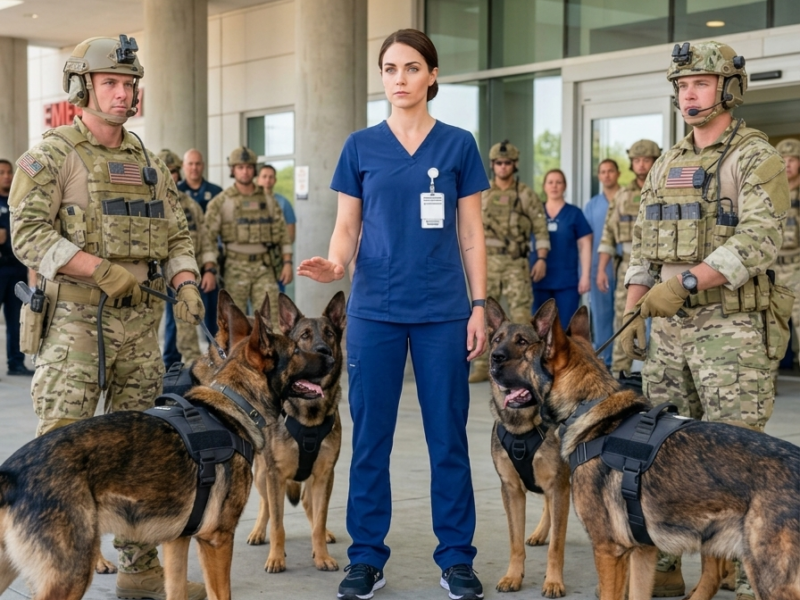
The hospital captain pointed at me in front of a crowded emergency room and ordered security to throw me out
I had spent eleven months at Harbor Ridge Medical Center in San Diego, keeping my head down and doing my job while everyone assumed I was just another exhausted civilian nurse.
I took the graveyard shifts that no one else wanted, scrubbed down the isolation rooms after messy trauma calls, and ate my cold lunches alone in the breakroom near the basement supply closets. To the rest of the staff, I was invisible—a quiet woman in pale blue scrubs who spoke only when spoken to, moved through the corridors like a shadow, and never pushed back when the higher-ups dumped extra paperwork onto my desk.
Captain David Reeves, the Chief of Emergency Medicine, never even bothered learning my name.
Reeves was a man driven entirely by ego and institutional politics. He wore his crisp, starched lab coat like armor, strutting through the triage corridors while barking commands at residents and belittling the nursing staff. To him, I was merely the nurse who spoke too softly, moved too slowly, and never argued when he demanded impossible turnarounds on patient charts. He called me “Nurse” or simply flicked his fingers toward a tray when he wanted something sanitized. He assumed my quiet demeanor was a sign of meekness. He had no idea it was a discipline learned through blood, fire, and absolute silence.
That changed one rainy Tuesday night.
At midnight, a fierce Pacific storm slammed into San Diego, throwing sheets of water against the floor-to-ceiling glass doors of the ambulance bay. The emergency room was already overflowing with local traffic accidents and hypothermia cases when the heavy double doors smashed open.
A wounded military officer was wheeled in on a gurney, surrounded by two armed guards in dark tactical fatigue uniforms. The patient was semi-conscious, his skin dangerously pale and slick with cold sweat. Blood soaked through the heavy pressure dressings wrapped tight around his lower torso.
Captain Reeves immediately took charge of the bay, shoving a young resident out of the way to position himself at the head of the gurney. “Clear Trauma Bay 3!” Reeves shouted, his voice ringing over the alarms of the monitoring equipment. “I want a full surgical setup now! Everyone else get out of this room. This is a secure military transfer. I don’t want civilian staff crowding the space.”
The nursing staff began backing out of the room, intimidated by both Reeves’ harsh command and the unyielding posture of the armed guards standing at the door.
I stayed where I was, standing beside the cardiac monitor.
My eyes weren’t on Reeves, nor were they on the armed guards. I was watching the digital telemetry lines spikes across the screen, tracking the patient’s rapidly changing vital signs. The pulse oximeter chimed a low, rhythmic warning tone.
I noticed something on the patient’s monitor that made my blood run cold.
His oxygen saturation levels were dropping rapidly, sliding from ninety-two down to eighty-six percent in a matter of seconds. Across his chest, a deep muscular tremor began to ripple under his skin. I glanced down at the IV drip bag Reeves had just opened up to full flow.
“Captain, something’s wrong,” I said. My voice was calm, but firm enough to cut through the hum of the suction pumps.
Reeves didn’t even look at me. He was busy adjusting his surgical gloves, his eyes fixed on the abdominal wound. “I said clear the room, Nurse. I am managing this patient.”
“His oxygen levels are crashing,” I insisted, taking a half-step toward the gurney. “Look at his pupils and the muscle fasciculations. His medication is reacting violently with the heavy sedative administered by the field medics.”
Reeves turned toward me, his face flushing a dark, blotchy red with immediate fury. He couldn’t stomach being questioned, especially not by the quietest nurse on his night shift in front of military personnel.
“You’re a nurse, not a doctor,” he spat, his voice laced with pure venom. “You don’t read pharmacology to me. You don’t diagnose my patients. Get out!”
“If you give him another dose of that paralytic without counter-acting the central nervous system depression, his airway is going to collapse entirely in under thirty seconds,” I said, my tone shifting instantly into the sharp, unquestionable cadence of a battle-tested medical commander.
The room went dead silent. The two armed escorts exchanged a quick, uncertain glance.
Reeves’ mouth twisted in absolute disbelief. The insolence of a low-level floor nurse challenging his authority in his own trauma bay was more than his fragile pride could bear. He ripped off his latex gloves and slammed them into the waste bin.
“That is it,” Reeves snarled, stepping up until he was inches from my face. “I am sick of your mouth and your pathetic attitude. You are relieved of duty effective immediately. Security!”
Two hospital security guards stepped into the doorway, looking uncomfortable.
“I said leave this hospital!” Reeves shouted, his voice echoing out into the main ER waiting area. “Escort this woman off the premises right now. She is fired!”
I didn’t flinch. I didn’t cry. I looked Reeves dead in the eyes, feeling every eye in the crowded emergency room lock onto us. Slowly, without a word, I unclipped my hospital ID badge, laid it flat on the stainless-steel counter, and turned to walk out.
I stepped through the automatic sliding doors of the ambulance bay into the cold, rain-swept night.
Just as my boots hit the wet concrete, a dark military convoy came screeching around the corner, headlights cutting through the downpour. Three heavy black SUVs slammed to a halt behind the ambulances, their tires spraying water into the air.
The doors flew open, and three senior military officers stepped out into the storm. Leading them was a tall man with steel-gray hair and four ribbons pinned to his dress uniform under a heavy wet overcoat.
The senior officer began rushing toward the ER doors, but the moment his eyes landed on me standing under the flickering halogen light, he stopped dead in his tracks.
His eyes widened in utter disbelief.
Slowly, deliberately, he straightened his wet uniform, pulled his shoulders back, brought his right hand up to his brow, and snapped to absolute attention.
“Lieutenant,” he said, his voice carrying the authority of a hardened commander.
Everyone in the ambulance bay froze. The security guards stopped dead. Captain Reeves, who had followed me out to ensure I was escorted off the property, stared at the senior officer with his jaw hanging open.
“What… what did you call her?” Reeves stammered, his face turning pale under the bright rain-slicked lights.
The senior officer didn’t answer Reeves. He didn’t even acknowledge his existence. He kept his arm raised, holding the crisp military salute, standing motionless in the pouring rain.
My hands were shaking inside my jacket pockets. Slowly, automatically, the muscle memory buried deep inside my bones took over. I pulled my right hand out, raised it to my temple, and returned the salute with flawless precision.
I had spent five years as a flight surgeon nurse in a specialized military evacuation unit before leaving active duty after a classified extraction mission went terribly wrong overseas. I had buried my uniform, hidden my decorations, and taken a low-paying civilian job because I wanted an ordinary life—a life free of blood, night terrors, and guilt.
I had never told a single soul at Harbor Ridge Medical Center about my past.
But as the automatic doors behind us opened again, the gurney with the wounded officer was wheeled out toward an awaiting military transport unit. His eyes flickered open briefly under the oxygen mask. He looked straight at me.
“She… she saved my team,” the wounded officer whispered, his voice weak but clear. “That’s Lieutenant Vance… she’s the one who stayed behind.”
Reeves looked at me differently now. Not with anger. Not with smug superiority.
With pure, unadulterated fear.
The senior officer lowered his salute and stepped forward, pulling a thick, water-resistant sealed folder from inside his coat. He walked past Reeves and slammed it heavily onto the metal intake counter.
“Captain Reeves,” the officer said, his voice dropping into a dangerous, icy register. “This folder contains the original, unredacted after-action report from that evacuation mission six years ago.”
Reeves went dead pale, his breath catching in his throat.
I stared at the folder, my chest tightening. I had never seen the original official report. For six years, I believed I had been dishonorably discharged due to a catastrophic logistical failure that cost lives. My signature was supposed to be on the final authorization page, taking full blame for the medicine inventory discrepancy.
The senior officer flipped the folder open to the final page, exposing the ink.
The signature at the bottom wasn’t mine.
Someone had forged my handwriting. Someone had altered the entire casualty report, fabricating evidence to ensure I looked solely responsible for the failure of that night, using my silence to protect themselves.
I slowly looked up from the page and stared straight at Reeves. He couldn’t meet my eyes. He was trembling, leaning his weight against the wall as if his legs could no longer support him.
The senior officer quietly reached into his pocket and slid a laminated photograph across the counter.
“We finally found the person who altered the official record,” the officer said softly.
I picked up the photograph. My breath stopped in my throat.
The man pictured in the photo was someone I had trusted with my life for years—my former military division director, a man who currently served on the executive board of Harbor Ridge Medical Center.
And suddenly, looking between the photo and the trembling doctor standing before me, I understood why Captain Reeves had been so desperate to make me leave the building tonight.
The rain rattled against the metal overhang of the ambulance bay like loose gravel. Nobody moved. Nobody dared to breathe.
The photograph in my trembling hand showed General Edward Hayes—a man who had been my mentor, my commander, and the person who had personally signed my discharge papers six years ago with a look of fake sympathy on his face. Standing right beside him in the photograph, smiling at a black-tie hospital gala three months prior, was Captain David Reeves.
“You knew,” I whispered, my voice cutting through the heavy silence like a razor.
Reeves swallowed hard, his throat bobbing as he tried to find his voice. “Clara… Lieutenant… you don’t understand the pressures—”
“Don’t speak her name!” the senior officer barked, taking a sharp step forward that made both security guards instantly back away. The officer’s name tag read COL. MARCUS VANE. He looked Reeves down with disgust. “You will address her by her rank, Doctor. She earned it in places you wouldn’t survive for five minutes.”
Colonel Vane turned his attention back to me, his cold eyes softening just a fraction. “Lieutenant Vance. Six years ago, fifteen million dollars worth of experimental military pharmaceuticals vanished from the forward distribution depot in Kandahar. That shipment wasn’t lost in an insurgent mortar strike as the public record claimed. It was intercepted, marked as destroyed, and funneled back into private pharmaceutical networks right here in California.”
My mind raced, connecting the dots that had remained jagged and broken for six agonizing years. “The evacuation convoy… we were ambushed because someone tipped off the local militia to cover up the missing crates.”
“Exactly,” Colonel Vane said firmly. “And when you survived the crash and managed to keep four critical patients alive through a eighteen-hour siege, you became a massive liability to the people who organized the theft. You saw the manifest. You knew what was actually in those crates.”
I remembered that night with terrifying clarity—the smell of burning diesel fuel, the freezing mud, and the heavy plastic cases stamped with military logistics seals. I had opened one looking for emergency plasma, only to find packed rows of unlabeled, high-grade experimental neuro-blockers.
“Hayes forged my signature on the loss report,” I said, my voice growing steadier as the old fog of self-doubt lifted from my mind. “He made it look like I ordered the misdirection of the supply truck, then framed me for negligence so I would be quietly forced out of the service without a court-martial where I could testify.”
“General Hayes made millions off that pipeline,” Colonel Vane explained, stepping closer to the counter. “And when he retired from the Joint Chiefs, he used those funds to secure a controlling seat on the board of trustees at Harbor Ridge Medical Center. He brought Reeves in as Chief of Emergency Medicine to oversee the local distribution of those same illicit pharmaceuticals through this very hospital’s pharmacy inventory.”
Reeves backed away until his shoulders hit the sliding glass door. “That’s libel! You have no proof! I am a respected physician! I ran this department—”
“You ran a criminal clearinghouse,” Colonel Vane interrupted flatly. He reached into his overcoat and pulled out an official military warrant stamped with the seal of the Department of Defense. “Ten minutes ago, federal agents executed a raid on General Hayes’ estate in Coronado. They seized his private servers. Every transaction, every email, every forged document—including the digital trail linking him directly to you—is currently in the hands of the Judge Advocate General.”
Reeves went completely gray. His hands shook so violently he could barely keep his footing.
“The wounded officer inside,” I said, turning my eyes back to Trauma Bay 3. “Major Miller. He wasn’t brought here by accident, was he?”
“No,” Colonel Vane shook his head. “Major Miller was part of our internal affairs task force. He was tracking the distribution chain. When his unit was ambushed tonight during a sting operation, he insisted on being brought to Harbor Ridge because he knew the hospital was the primary nexus. But he didn’t know you were here, Clara. Finding you working as a floor nurse in the very building we were targeting was a miracle.”
“It wasn’t a miracle,” I said softly, looking down at my hands. “I came here because… I thought I belonged in the dirt. I thought I had failed those men six years ago.”
“You didn’t fail anyone, Lieutenant,” Vane said, his voice dropping into a solemn, respectful tone. “You saved every single soul put into your care that night. The men from your unit have been fighting for years to get your case reopened. We never gave up on you.”
A loud commotion echoed from the main lobby inside the hospital. Heavy boots stomped across the polished tile, accompanied by the stern voices of federal marshals taking control of the building’s entry points.
Reeves realized his time had run out. His eyes darted wildly toward the dark parking lot beyond the ambulance bay. In a sudden, desperate burst of panic, he lunged sideways, shoving one of the hospital security guards out of the way, and sprinted into the blinding rain toward his luxury sedan parked near the perimeter fence.
“Stop him!” one of Vane’s escorts shouted, reaching for his sidearm.
“No,” I said, stepping into the rain before the guard could draw his weapon. “Don’t shoot.”
I didn’t run. I didn’t shout. I simply picked up the heavy, solid-steel IV pole standing near the bay entrance—a heavy piece of equipment I had moved hundreds of times during my shifts—and stepped out into the downpour.
Reeves was slipping on the wet asphalt, frantically digging into his coat pocket for his car keys. He reached his driver’s side door, his hands trembling so badly he dropped the keys into a swirling puddle of rainwater. As he bent down to grab them, I stepped into his path, swinging the base of the steel pole flat against the hood of his car.
The deafening metallic CRACK echoed across the parking lot like a gunshot. The hood dented instantly, alarms screaming into the night.
Reeves froze on his knees in the mud, looking up at me in absolute terror.
I stood over him, the rain streaming down my face, holding the steel pole casually at my side. I looked down at the man who had spent eleven months trying to make me feel small, worthless, and weak.
“You told me I was just a nurse, Captain,” I said, my voice calm, icy, and totally unwavering. “You were wrong. I am an officer of the United States Navy. And you are under arrest.”
By 2:00 AM, Harbor Ridge Medical Center was completely surrounded by federal tactical vehicles and military police units.
The bright blue and red strobes of federal cruisers reflected off the rain-soaked pavement, illuminating the front glass facade of the building. Patients and junior staff watched from the windows in stunned silence as uniformed federal marshals marched through the corridors, securing administrative offices, locking down the central pharmacy, and escorting senior executives out in handcuffs.
Inside Trauma Bay 3, the chaos had been replaced by quiet, razor-sharp efficiency.
I had stripped off my soaked jacket, pulled on a fresh sterile gown, and taken full command of Major Miller’s stabilization team. The civilian residents and nurses who had spent months watching me quietly sweep floors were now standing at attention, executing my orders without a second’s hesitation.
“I need two units of O-negative on the rapid infuser now,” I commanded, my hands moving with practiced, effortless speed as I adjusted the central line in Miller’s neck. “Set the ventilator to assist-control mode, titrate the norepinephrine down to five micrograms, and prepare a push of atropine to counteract the nerve-agent inhibitor.”
“Yes, Lieutenant!” a young resident yelled, sprinting to fulfill the order.
Colonel Vane stood near the glass doors, watching me work. A faint smile touched his hardened lips. “It’s like you never left the field, Vance.”
“Some things you don’t forget, Colonel,” I replied, checking Miller’s blood pressure monitor. The numbers were stabilizing, rising back into a safe, healthy green zone. The muscular tremors had completely stopped. “He’s stable. He can be safely transported to the Naval Medical Center at Balboa now.”
“Excellent work,” Vane said, stepping into the bay as the transport team moved in with an armored gurney. “The medevac team is waiting outside.”
As Major Miller was carefully loaded onto the gurney, his hand reached out, his fingers brushing against my sleeve. I leaned down close to his face.
“Thank you… Lieutenant,” Miller rasped, his eyes clear for the first time all night. “Six years ago… in that valley… I knew if we could just hold out until your chopper landed, we’d make it home. I never believed what they said about you.”
A lump formed in my throat, but I forced a warm, steady smile. “Rest up, Major. Your mission is over.”
Once the transport team cleared out, the heavy silence returned to the trauma bay. I stood beside the empty stainless-steel treatment table, slowly unclipping my blood-stained gown and throwing it into the biohazard hamper. My hands were clean, but my heart was pounding harder than it had in years.
Colonel Vane walked over, holding out a black thermos of hot coffee he had pulled from his staff car. “You look like you could use this.”
“Thanks,” I said, taking a sip. The warm liquid cut through the chill lingering in my bones. “What happens now, Marcus?”
Vane leaned his back against the counter, crossing his arms. “General Hayes is currently sitting in a holding cell at Miramar. He tried to claim diplomatic immunity through his board connections, but the paper trail JAG recovered from his private villa is ironclad. He’s facing charges of treason, grand larceny, embezzlement, and conspiracy to commit murder.”
I stared down at the black coffee. “And Reeves?”
“Reeves is weeping like a child in the back of a marshal’s van,” Vane said with zero pity in his voice. “He’s signing a full confession as we speak, hoping to cut a deal to avoid thirty years in a federal penitentiary. He admitted that Hayes ordered him to ensure you were disgraced and removed from the hospital the moment internal affairs started sniffing around San Diego.”
“He was terrified I’d recognize the batch numbers on the pharmaceutical crates,” I said, realizing the full scope of their paranoia. “Every time a shipment came through the basement bay, Reeves made sure I was assigned to the upper floor wards. He thought if I saw the military supply codes, the whole house of cards would come down.”
“And he was right,” Vane said. He reached into his briefcase and pulled out a thick, leather-bound folder embossed with the gold eagle emblem of the United States Department of the Navy. He laid it gently on the counter beside me.
I looked at the cover. “What’s this?”
“Your reinstatement papers, Clara,” Vane said softly. “Signed directly by the Secretary of the Navy an hour ago. Your discharge has been officially purged from the military record. It no longer exists. Your rank of Lieutenant Commander has been restored, along with six years of retroactive promotion, full back pay, and an invitation to return as the Chief Medical Logistics Officer for the Pacific Fleet.”
I stared at the pristine gold letters on the folder. For six long years, I had dreamed of this moment—dreamed of having my honor returned, of shedding the phantom shame that had followed me through every cheap apartment and low-rent job.
“I don’t know, Marcus,” I whispered, touching the cool leather cover with my fingertips. “I spent so long trying to be nobody. I don’t know if I can just step back into that uniform.”
Before Vane could answer, the door to the trauma bay opened softly.
Standing in the doorway was Sarah, a young twenty-two-year-old nursing assistant who worked the night shift with me. She was holding a stack of clean towels, her eyes wide with a mixture of awe, confusion, and deep respect. She hesitated on the threshold, clearly unsure if she was allowed to approach me now that my true identity was out.
“Clara… I mean… Lieutenant Vance?” Sarah stammered nervously.
I offered her a gentle smile, instantly dropping the stiff posture of an officer. “It’s still Clara, Sarah. What is it?”
Sarah stepped into the room, looking at Colonel Vane’s impressive uniform before looking back at me. “The entire night shift… we’re all sitting in the breakroom. We saw what happened outside with Dr. Reeves. We saw the marshals.” She paused, her throat bobbing. “We just… we wanted to know if you were leaving.”
I looked at Sarah, then looked back at the leather folder sitting on the counter. In that tiny moment, looking into the eyes of a young nurse who had spent months working beside me without ever knowing who I really was, I realized something profound.
My honor hadn’t been restored by a piece of paper signed in Washington. It had been restored the moment I chose to stand up for a dying patient in defiance of a corrupt authority.
“Give me a minute, Sarah,” I said gently. “I’ll be right out.”
The hospital breakroom was quiet when I pushed the door open twenty minutes later.
The rain outside had finally tapered off into a soft, misty drizzle, and the first gray light of dawn was beginning to bleed through the high high-altitude clouds over San Diego. Eight nurses, three orderlies, and two floor technicians were sitting around the long laminate table, paper coffee cups held tight in their hands.
When I walked in, every single one of them stood up.
There was no applause, no loud cheering—just a heavy, profound silence filled with respect. These were people who had seen me scrub floors, clean bedpans, and silently take the verbal abuse of David Reeves for nearly a year.
“Sit down, please,” I said, gesturing toward the chairs. “Please.”
Slowly, they sat back down, watching me as I walked over to the coffee pot and poured myself a fresh cup. I turned around, leaning my hip against the counter, looking across the room at the faces I had worked alongside in the dark hours of the night.
“I owe you all an explanation,” I said softly.
“You don’t owe us anything, Clara,” said Mark, a veteran ER nurse who had worked at Harbor Ridge for fifteen years. He shook his head, a look of deep regret on his face. “God… we feel like idiots. We watched Reeves push you around for months. We watched him dump his garbage work on your desk, and none of us ever stood up for you. We just thought you were shy.”
“I wanted you to think I was shy,” I admitted, looking down at my hands. “Six years ago, I was accused of something terrible. I was stripped of my commission, stripped of my pride, and told that I was responsible for a disaster that ruined lives. I came to this hospital because I wanted to hide. I thought if I made myself small enough, if I stayed quiet enough, the pain would eventually go away.”
“And last night?” Sarah asked quietly from the corner.
“Last night, I realized that hiding doesn’t protect you,” I said, looking up, my eyes sweeping across the room. “It just leaves the floor open for men like David Reeves and General Hayes to keep hurting people. Standing up to Reeves last night wasn’t about my past. It was about making sure that no doctor in this hospital ever treats a nurse or a patient like dirt again.”
Mark let out a long breath, a faint grin touching his lips. “Man, when you took that steel IV pole out into the rain and dented his hood… I think half the floor staff nearly cheered out loud.”
A light chorus of laughter rippled through the room, breaking the heavy tension that had gripped the building all night.
At 7:00 AM, the shift change bell chimed through the hallways. The day shift staff began filing into the building, entirely unaware of the dramatic federal raid that had transformed their workplace overnight. Interim hospital administrators appointed by the federal authorities were already taking over Reeves’ office, securing records, and ensuring that clinical operations continued without interruption.
I walked down to the basement locker room one last time.
My small metal locker sat at the end of the second row. Inside hung my faded blue civilian coat, my spare running shoes, and a small, framed black-and-white photo of my old medical evacuation unit from Kandahar.
I reached in and took the photo, running my thumb over the dusty glass. For six years, looking at that photo had brought a sharp spike of grief and shame. But today, looking at the smiling faces of the medics I had trained with, I felt nothing but pride.
“Lieutenant Vance?”
I turned around. Colonel Vane was standing in the doorway of the locker room, holding a garment bag draped over his arm.
“The transport to Balboa leaves in twenty minutes,” Vane said gently. “The Secretary of the Navy is hosting a formal press conference at noon to publicly clear your name and announce the indictment of Hayes and his network.”
He stepped forward and placed the heavy garment bag on the wooden bench beside my locker. He unzipped it slightly, revealing the immaculate, midnight-blue fabric of a Navy Service Dress White uniform, complete with the golden oak leaves of a Lieutenant Commander on the shoulder boards and a row of decorated service ribbons pinned to the chest.
“You don’t have to wear it if you don’t want to, Clara,” Vane said softly. “You’ve more than earned the right to walk away as a civilian and live a quiet life. No one will ever judge you again.”
I stared at the pristine white uniform. The golden insignia caught the fluorescent lights of the basement.
For six years, I had thought the uniform was a weight that had dragged me down into the dark. But staring at it now, I realized the uniform wasn’t what had broken me. The uniform was a promise—a promise to protect those who couldn’t protect themselves, to speak truth when it was dangerous, and to never leave a patient behind.
I slowly reached out and took the hanger from his hand.
“Give me five minutes, Marcus,” I said, looking him straight in the eye. “I have a press conference to attend.”
The grand auditorium at Naval Medical Center San Diego was flooded with light.
Dozens of television camera crews, national defense journalists, and high-ranking military brass filled the tiered seating rows. Microphones from every major news network bristled along the polished mahogany podium at the center of the stage.
Standing behind the curtains on the side of the stage, I adjusted the cuffs of my crisp white uniform sleeves. The fabric was stiff, cool, and carried the familiar, clean scent of formal wool. On my left chest, the white and gold ribbons of the Commendation Medal and the Air Medal gleamed under the stage lights.
Beside me stood Colonel Vane and a young military aide holding a leather portfolio.
“Are you ready, Lieutenant Commander?” Vane asked, turning to look at me.
I took a deep, steady breath, feeling the air fill my lungs completely—no longer burdened by the heavy knot of anxiety that had lived in my chest for six long years. “I’m ready.”
The heavy blue velvet curtains parted, and I stepped out onto the main stage.
The moment my boots crossed the threshold, the entire auditorium erupted into motion. Hundreds of uniformed officers, journalists, and hospital staff stood up simultaneously, delivering a deafening, standing ovation that echoed off the high rafters of the hall. Flashbulbs went off in a blinding, continuous strobe of white light.
I walked steadily to the podium, keeping my head high and my shoulders back. I placed my hands flat on the wooden edges of the desk, looking directly into the primary news camera lens positioned at the back of the room.
The applause slowly died down, leaving an intense, expectant silence hanging over the grand room.
“Six years ago,” I began, my voice clear, resonant, and carrying effortlessly through the speakers, “I was stripped of my rank and cast out of the United States Navy under a cloud of fabricated dishonor. I was told that my service didn’t matter, that my voice didn’t count, and that the truth could be erased by powerful men operating in the dark.”
I paused, sweeping my gaze across the sea of faces staring back at me.
“For six years, I lived in the shadows,” I continued, my voice growing stronger with every word. “I worked as an anonymous floor nurse in a civilian hospital, sweeping floors and taking orders from men who believed that authority was defined by loud voices and institutional titles. But true authority isn’t given by a title, a lab coat, or a golden rank insignia. True authority is earned through integrity, through duty, and through the refusal to remain silent when lives are on the line.”
In the front row of the gallery, sitting in wheelchairs and flanked by their families, were three men I hadn’t seen in six long years—the surviving members of my medical evacuation unit from Kandahar. They were weeping openly, their hands raised in proud, trembling salutes.
My chest swelled with an overwhelming wave of warmth and finality.
“Today, those who tried to destroy the truth are facing justice,” I declared. “But more importantly, today proves that no matter how deep you bury the truth, it will always find its way back to the light. My name is Lieutenant Commander Clara Vance. My honor has been restored. And my mission continues.”
The auditorium exploded into applause once again, the sound washing over me like a powerful ocean wave.
Three weeks later, the morning sun broke brightly over the blue waters of San Diego Bay.
I stood on the elevated deck of the Naval Medical Logistics Center overlooking the harbor, a fresh breeze rustling the brim of my officer’s cap. On the desk behind me sat a organized stack of operational manifests, requisitions, and personnel deployments for the entire Pacific Fleet’s medical corps.
A soft knock sounded at the open office door.
“Commander Vance?”
I turned around. Standing in the doorway was Sarah, dressed in a crisp, dark blue Navy hospital corpsman uniform, her military boots polished to a high shine. She stood straight, a proud smile on her face.
“Corpsman Sarah Miller reporting for duty, ma’am,” she said, snapping a crisp, perfect salute. “I transferred out of Harbor Ridge last week. I applied for active enlistment in the Navy Medical Corps, and I requested assignment to your logistics command.”
I looked at the young woman who had watched me sweep floors three weeks ago, now standing tall in the uniform of her country.
I slowly returned her salute, a genuine, radiant smile spreading across my face.
“Welcome to the team, Corpsman,” I said, lowering my hand and gesturing toward the second desk beside mine overlooking the bay. “Grab a clipboard. We have a lot of work to do.”
As Sarah stepped into the room and pulled out her chair, I looked back out over the sparkling expanse of the Pacific Ocean. The storm was over. The ghost was gone. And for the first time in my life, I knew exactly who I was, and exactly where I belonged.
The end









