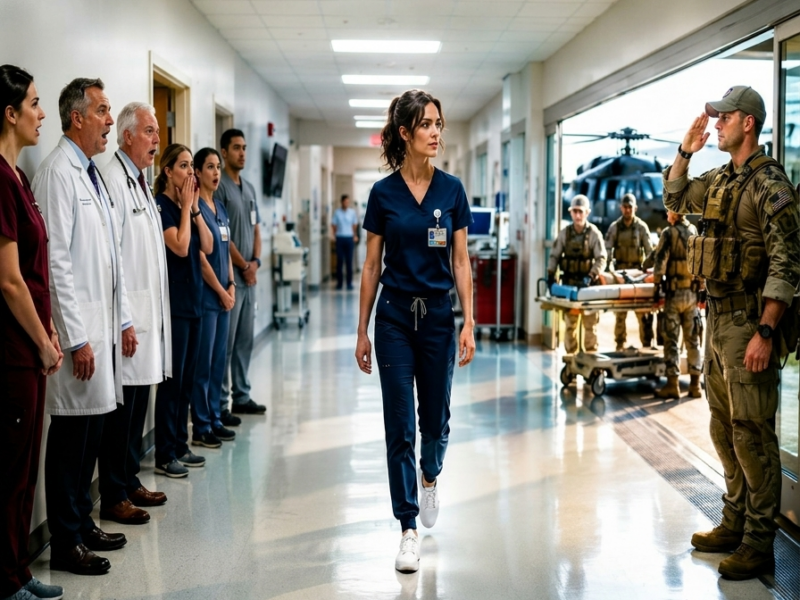
The hospital administrator publicly ordered me out of the emergency room at 2:17 a.m., calling me a useless night nurse in front of thirty terrified patients
The scent of rubbing alcohol and cheap industrial floor cleaner never quite managed to cover the metallic tang of old blood. At 2:00 a.m., St. Jude’s Memorial Hospital existed in a twilight zone where time stretched into something thick, agonizing, and cold. I stood beside the stainless-steel medication cart, my fingers wrapped so tightly around a paper cup of lukewarm instant coffee that the cardboard collapsed inward, spilling brown drops over my squeaking rubber shoes.
Behind me, Dr. Arthur Mitchell was holding court. He was forty-two, possessed a neatly trimmed beard, and wore a pristine white lab coat that had never seen a single drop of real emergency room mud. He was the kind of administrator who viewed patients as billable hours and nurses as disposable appliances.
“You’re slow tonight, Hayes,” Mitchell’s voice echoed across the quiet trauma bay, sharp enough to cut through the hum of fluorescent lights. “If you spend any more time lingering by the supply closets, I’m writing you up for dereliction of duty. In fact, I’m ordering you off the floor right now. Go lock yourself in the supply room and stay there until day shift arrives. You’re a useless night nurse anyway.”
A few terrified patients sitting in the plastic waiting chairs shifted uncomfortably, pulling their thin hospital blankets over their shoulders. Two junior residents lowered their eyes, terrified of drawing Mitchell’s wrath. Beside Mitchell, Dr. Vance, a senior surgeon with dark circles beneath his eyes, smirked into his clipboard.
I didn’t answer. I couldn’t. If I opened my mouth, the tremor in my jaw would betray the cold terror currently clawing its way up my throat.
It wasn’t Mitchell’s words that had made my blood run cold. It was what I had seen thirty minutes earlier in Isolation Room 4.
Three hours prior, a heavily redacted military transport had dumped an unidentified male patient onto our bay. He had arrived under guard, unconscious, his body a map of surgical scars and fresh trauma. A high-caliber bullet was lodged half an inch from his left lung. The military guards had vanished into the rainy night as soon as Mitchell signed the intake release, leaving the man in our care like an unwanted package.
When I had tried to check the man’s vitals, Mitchell had shoved me aside. “You’re a nurse, Hayes, not a detective. Stay away from him.”
But I hadn’t stayed away. While cleaning blood from the hallway floor outside Room 4, I had looked through the reinforced glass panel. The man was hooked to a cardiac monitor. His rhythm was erratic, spiking and dipping in unnatural bursts. Yet, as I watched his hand resting limply against the cold steel bedrail, I saw his index finger move.
Tap. Tap. Tap.
Pause.
Tap. Tap.
Pause.
Tap. Tap. Tap.
An ancient, buried memory exploded in my mind. Three taps, two taps, three taps. A tactical emergency call sign. A sequence burned into my skull six years ago in the scorched, dust-choked mountains of the Korengal Valley.
Six years ago, I wasn’t Nurse Rebecca Hayes. I was Specialist Rebecca Hayes, combat medic attached to the 75th Ranger Regiment’s covert evacuation unit, Task Force Vanguard. On a moonless night in 2020, our convoy was ambushed inside an abandoned oil refinery. Our armored transport flipped. I was pinned beneath two tons of burning steel, my ribs shattered, fuel pooling around my face.
The rest of the unit was wiped out in seconds. Except for one man.
I never knew his real name. He wore a matte-black tactical helmet and a patches-stripped uniform. He was known only by his radio call sign: Raven.
When the ammunition began to cook off inside the burning vehicle, Raven didn’t run. He threw his own body over mine, absorbed a wave of shrapnel, and ripped open the crushed frame with his bare hands. He threw me over his shoulder and ran through a hail of small-arms fire. As he dragged me into an extraction ditch, a sniper bullet caught him beneath the ribs—the exact same spot as the man lying in Isolation Room 4. He collapsed, shoved me toward the arriving rescue chopper, and vanished into the smoke.
Two days later, while lying in a military hospital in Landstuhl, I was handed a official document. It stated that Task Force Vanguard had been entirely neutralized. No survivors. Included in that dead list was my older brother, Corporal Thomas Hayes, who had served as the team’s radio operator.
For six years, I believed I was the sole living ghost of Task Force Vanguard. I buried my uniform, changed my life, took a low-pay night shift at a civilian hospital in upstate New York, and learned to live with the screams that haunted my sleep.
Until tonight.
Thirty minutes ago, after hearing those taps against the bedrail, I had slipped into the back supply closet, locked the door, and reached into the secret false bottom of my heavy duty medical bag. There, wrapped in oilskin, sat an old, illegal military-grade satellite transceiver—a souvenir I had never been able to throw away.
I set the frequency to a forgotten emergency channel and typed a single, eight-character encrypted sequence: VANGUARD-06-RECOVERY.
I expected dead air. I expected to confirm my own paranoia.
Instead, the tiny screen flared green. A voice, razor-sharp and cold as ice, blared through the tiny speaker: “Signal confirmed. Raven is alive. Give us your location.”
I had choked back a sob, typed St. Jude’s ER coordinates, hidden the radio, and stepped back out—only to be intercepted and humiliated by Dr. Mitchell in front of thirty patients.
“Did you hear me, Hayes?” Mitchell barked, stepping closer, his chest puffed out. “Get into the supply room or I’m terminating your contract on the spot!”
Before I could answer, the floor beneath our feet began to vibrate.
It started as a low, guttural thrum that rattled the medicine bottles on my cart. Then came the wind—a roaring, artificial gale that slammed against the double-paned glass windows of the emergency room entrance. Outside in the parking lot, car alarms began to blare in chaotic unison.
Through the rain-streaked glass doors, three massive, matte-black MH-60 Black Hawk helicopters dropped from the low cloud cover. They hovered just feet above the concrete, their rotor wash tearing down the hospital’s entryway awnings and turning plastic trash cans into flying projectiles.
“What in the hell…?” Mitchell muttered, turning pale.
The glass doors slid open—not by automated sensor, but by force.
Heavy combat boots thundered against the linoleum floor. A dozen Special Forces soldiers in full battle dress, equipped with night-vision gear and suppressed automatic rifles, poured into the lobby. They moved with terrifying, lethal synchronization, establishing a hard perimeter within five seconds. Patients screamed and dropped to the floor. Dr. Vance dropped his clipboard. Dr. Mitchell froze, his hands hovering mid-air like a deer caught in high beams.
From the center of the squad stepped an officer. He didn’t look at the screaming patients. He didn’t look at the armed security guards who had instantly dropped their batons in terror. He took off his helmet, revealing a deep, jagged scar that ran from his left temple down to his jawline.
He scanned the terrified room with desperate, frantic eyes.
“Where is Nurse Rebecca Hayes?” the commander’s voice boomed, cutting through the blare of car alarms and medical monitors.
Dr. Mitchell sneered, trying to recover his authority despite his trembling knees. He gestured toward me with a dismissive wave of his finger. “She’s right here. What has she done? If she stole medications—”
The commander ignored Mitchell completely. His eyes locked onto mine.
“Rebecca Hayes?” he repeated, his voice suddenly dropping its harsh combat edge.
I took a slow step forward from behind the medication cart. My hands were still shaking, but I forced my chin up. “I’m Rebecca.”
For one strange, heart-wrenching second, the hardened military commander looked as if he might break down and cry. His eyes glistened in the harsh fluorescent light. He took three fast strides toward me, snapped his boots together, and brought his hand up to his brow in a crisp, perfect, unwavering salute.
Every sound in the emergency room died at once.
Dr. Mitchell stared at the commander’s raised hand, then slowly turned his head to look at me. The smug, arrogant confidence that Mitchell had worn like armor for years collapsed so visibly that his jaw literally hung loose. His skin turned a sickly, paper-white shade of gray. I almost felt sorry for him.
Almost.
The commander dropped his salute and stood before me. “Specialist Hayes. I am Major Marcus Vance, Commander of the Joint Special Operations Recovery Unit. Six years ago, I was told you were dead.”
“I was told the same about all of you,” I whispered, my heart hammering against my ribs. I glanced toward Isolation Room 4. “Who is the man in that room?”
Major Vance leaned in close, his voice barely audible over the hum of the air vents. “That is Colonel Daniel Brooks. Call sign: Raven.”
My knees nearly gave way. Daniel. The ghost who had pulled me from the fire.
“He arrived here three hours ago,” I said, struggling to keep my balance. “He was shot. Why bring him to a civilian hospital?”
“Because our military medical facilities were compromised,” Vance said grimly. He reached inside his tactical vest and pulled out a thick, sealed Manila envelope stained with dark, dried blood. He didn’t hand it to me immediately. “Colonel Brooks regained consciousness for forty-five seconds aboard our transport before he was brought here. He refused our medics. He said there was only one person on the East Coast who could be trusted to handle the Intel stored inside his body.”
“Why me?”
Vance’s scar twitched. “Because before he slipped back into a coma, Colonel Brooks told us that the night your unit was ambushed in 2020 wasn’t an enemy attack. It was an internal execution. And he said the man who sold out Task Force Vanguard six years ago is standing inside this hospital right now, trying to finish the job.”
I involuntarily turned my head. My eyes locked with Dr. Mitchell.
Mitchell was already backing away toward the rear exit doors, his eyes darting frantically from soldier to soldier.
Suddenly, a high-pitched, rhythmic screeching shattered the air.
BEEP-BEEP-BEEP-BEEP!
It was the flatline alarm from Isolation Room 4.
“He’s going into ventricular fibrillation!” I screamed, my nurse’s instincts instantly overriding my shock. I threw my paper cup into the trash and sprinted toward Isolation Room 4, pushing past two armed soldiers.
I threw open the door. The cardiac monitor showed a chaotic, lethal squiggly line. Daniel Brooks was seizing on the bed, his back arching, blood leaking from his surgical dressing.
I grabbed the defibrillator paddles, slathered conductive gel across them, and yelled, “Charge to 200 Joules! Clear!”
I slammed the paddles onto his chest. His body jolted. The monitor beeped erratically, then settled back into a weak, barely functioning sinus rhythm.
I leaned over him, my chest heaving, wiping sweat from my forehead.
Suddenly, a hand as cold as steel whipped up from the bed sheet and clamped onto my right wrist with terrifying, desperate strength.
I gasped. Colonel Daniel Brooks’ eyes snapped open. They were bloodshot, milky with pain, but intensely focused on my face.
“Rebecca…” he rasped. His throat sounded like grinding stones. Tears gathered at the corners of his eyes and tracked down his bruised cheeks. “You… you need to listen… very carefully…”
“Don’t speak, Colonel,” I urged, trying to gently dislodge his grip so I could adjust his oxygen mask. “You’re safe now. Major Vance is here.”
“No!” Daniel’s fingers dug deeper into my skin, his grip unyielding. He pulled me down until my ear was inches from his lips. He swallowed painfully, his chest rattling with fluid, and whispered five words that shattered everything I believed about my life, my grief, and the last six years of my existence.
“Your brother… is still alive.”
Before I could scream, before I could even process the words, a second alarm—a red-level facility warning—began to blare from the hallway outside.
The shrieking red facility alarm echoed through the concrete corridors of St. Jude’s Hospital like a dying animal. The overhead white fluorescent lights flickered, died, and were instantly replaced by the blood-red glow of emergency backup power.
Inside Isolation Room 4, the air turned instantly frigid.
“Thomas?” I choked out, my hand locked in Daniel’s steel grip. “What do you mean Thomas is alive? I saw the casualty report! I saw his name on the memorial wall in Arlington!”
Daniel’s chest heaved violently as he tried to speak. “The report… was forged. They needed him… off the grid. Thomas didn’t die in the Korengal ambush, Rebecca. He was taken. Because he intercepted… the broadcast.”
“What broadcast?”
Major Vance burst through the isolation room doors, his sidearm drawn, two tactical soldiers flanking him. “Hayes! We have a breach! Main power to the facility was just manually cut from the basement junction box. Someone locked down the ICU doors from the master control console!”
I looked at Vance, my mind spinning in a whirlwind of grief, disbelief, and terrifying hope. “Major, he says Thomas is alive!”
Vance’s expression didn’t soften; instead, it grew impossibly darker. “We don’t have time for this, Rebecca. Whoever cut the power is shutting down the hospital’s auxiliary ventilation. They’re trying to smother this entire floor.”
Outside in the main hallway, screams echoed. Patients were coughing. A thick, sweet-smelling gray mist began to seep through the air vents overhead.
“Fentanyl gas,” I said, recognizing the faint, chemical aroma immediately from my tactical medical training. “A militarized aerosolized agent. If that hits the main ER floor, thirty civilians will be dead in under three minutes!”
“Vance!” Daniel gasped, his fingers finally loosening from my wrist as his strength ebbed away. “The envelope… give her… the envelope…”
Major Vance pulled the blood-stained Manila package from his vest and thrust it into my hands. “Take it. Colonel Brooks put his life on the line to fetch that from a dark-site facility in Berlin.”
I tore the top of the envelope open. Inside was a heavy, military-grade encrypted flash drive and a stack of printed surveillance photographs.
I flipped through the top photograph under the red emergency light.
My heart stopped.
The photograph showed a high-end private medical research facility nestled in the Swiss Alps. Standing on a snow-covered balcony was a man in a dark wool coat. He was older, his hair streaked with silver, a thin scar running across his upper lip.
It was my brother. Thomas.
He was alive. He wasn’t a corpse buried in a wooden box beneath Virginia soil. He was sitting in a luxury compound eight thousand miles away.
But it was the second photograph that sent a wave of icy terror straight down my spine.
Standing right beside my brother in the photo, handing him an silver briefcase, was Dr. Arthur Mitchell.
“Mitchell…” I breathed, the realization slamming into me like a freight train. “He isn’t just a dirty hospital administrator. He’s the broker.”
“He’s the supply line,” Vance corrected grimly. “Six years ago, Task Force Vanguard wasn’t ambushed by insurgents. Your unit discovered an illegal military-industrial coalition called Project Cerberus—a rogue syndicate harvesting combat-injured soldiers for classified neuro-tech experiments. Thomas found the transaction logs. When the syndicate realized they were burned, they ordered your team wiped out.”
“And Mitchell?” I demanded, clutching the photos to my chest.
“Mitchell was the field recruiter,” Vance said. “He used his position at St. Jude’s to divert unidentified combat casualties, fake their death certificates, and ship them overseas to Cerberus facilities. Colonel Brooks spent the last six years infiltrating Cerberus to find Thomas and bring down the network. Tonight, Brooks tracked Mitchell here. But Mitchell realized the net was closing.”
Suddenly, the heavy glass window of Isolation Room 4 shattered into a thousand glittering shards.
BANG! BANG! BANG!
Silenced rifle fire stitched a line of holes across the wall behind us. One of Vance’s soldiers took a round to the shoulder, spun, and crashed against the crash cart.
“Ambush!” Vance roared, swinging his weapon toward the hallway and firing back. TAP-TAP-TAP!
Through the cloud of fentanyl gas drifting down the hallway, four men in unmarked black tactical gear advanced. They weren’t police. They weren’t military. They were private mercenaries—Cerberus cleanup units.
“They’re here for the drive!” Daniel yelled from the bed, struggling to sit up despite his torn stitches. “Rebecca, get out of here! If they get that drive, Thomas dies, and Cerberus goes black forever!”
“I’m not leaving you again!” I shouted, ducking behind the steel medicine cabinet as another volley of bullets ripped through the room.
“You have to!” Vance yelled over the deafening chatter of gunfire. He grabbed my shoulder, forcing me to look him in the eye. “Listen to me, Specialist! You are the only person who knows how to decrypt that drive! Thomas encoded it using your childhood cipher—the one you two used on your father’s ham radio! If you die here, Thomas stays a prisoner forever!”
My tears dried instantly, burned away by a sudden, white-hot fury that I hadn’t felt in six years.
I was no longer just a tired night nurse taking abuse from corrupt doctors. I was a combat medic of Task Force Vanguard. And my brother was waiting for me.
“Where is Mitchell?” I asked Vance, my voice deadly calm.
“He fled toward the basement sub-level five minutes ago during the power outage,” Vance replied, reloading his rifle with a metallic clatter. “He’s got a private helicopter waiting on the south roof helipad!”
“He’s not leaving this building,” I said.
I grabbed a heavy brass laryngoscope from the emergency tray, tucked the blood-stained envelope inside my tactical scrub top, and grabbed two syringes of concentrated epinephrine from the crash cart.
“Major,” I said to Vance. “Cover the south corridor. I’m taking the maintenance stairwell.”
“Hayes, that’s suicide!” Vance shouted. “There are at least six mercenaries in the building!”
“This is my hospital,” I said, snapping the cap off the first syringe. “I know where every shadow hides.”
Without waiting for his answer, I dropped to my knees, crawled beneath the window frame, and rolled into the dark, gas-filled hallway.
The fentanyl gas was rising, hugging the ceiling. I pulled my scrub collar over my nose and mouth, staying low to the floor. Through the dim red emergency lights, I saw two mercenaries standing near the nurse’s station, their rifle lasers sweeping the floor.
They thought they were hunting helpless civilian nurses. They were wrong.
I slid silent as a ghost behind the linen cart I had pushed earlier that night. I reached out, grabbed the brake release, and kicked the heavy metal frame with all my weight.
The cart slammed into the first mercenary, knocking his feet out from under him. He crashed hard onto the linoleum, his rifle skittering across the floor. Before the second man could react, I sprang from the shadows, stepping inside his guard, and jammed the brass laryngoscope directly into his neck below the jawline.
He gasped, dropping his weapon as his nervous system buckled. I swept his legs, grabbed his dropped sidearm—a suppressed 9mm pistol—and racked the slide in one fluid, mechanical motion.
The second mercenary was struggling to stand up from beneath the linen cart. I stepped over him, pulled the hammer back, and leveled the barrel at his forehead.
“Where is Mitchell heading?” I demanded.
The man spit blood onto my shoe and sneered. “You’re too late, bitch. The package is already loaded.”
“What package?” I squeezed the trigger half an inch. “TELL ME!”
“Not just Mitchell…” the mercenary gasped, his eyes wide with fear. “The transfer… they aren’t just escaping. They brought your brother here tonight. He’s in the basement.”
My heart stopped beating. Thomas wasn’t in Switzerland. He was in the basement of St. Jude’s Hospital.
I didn’t waste another second. I brought the butt of the pistol down on the man’s helmet, knocking him unconscious, turned around, and sprinted toward the door marked BASEMENT ACCESS – AUTHORIZED PERSONNEL ONLY.
I threw the heavy fire door open and hurled myself down the dark, concrete stairs, three steps at a time.
The air grew colder, thicker with the smell of damp concrete and diesel exhaust. Down here, far beneath the clean white rooms of the upper floors, lay the forgotten foundations of the old 19th-century hospital—a labyrinth of abandoned steam tunnels, sub-basements, and storage vaults.
As I reached Sub-Level 3, the heavy steel door at the bottom of the stairs was slightly ajar. A thin strip of white light cut through the gloom.
I slowed my pace, holding the suppressed pistol in both hands, my breath coming in quiet, measured gasps. I pushed the door open.
It was an old, decommissioned operating theater, long abandoned by the modern hospital above. But it wasn’t empty tonight.
Portable surgical lights lit up the center of the room. Dozens of computer monitors hummed softly, hooked to portable generators. And in the center of the room, strapped to a bio-containment gurney, was a man.
He was thin, pale, his skin almost translucent under the harsh lights. Wires were attached to his temples, running into a black terminal tower.
“Thomas…” I choked out.
The man’s eyes fluttered open. He turned his head slowly toward me. Despite the years, despite the hollow cheeks and silver hair, I recognized those green eyes instantly.
“Becca…?” he rasped, his voice trembling. “No… no, Becca, get out… it’s a trap…”
Before I could move toward him, a sharp metallic click sounded directly behind my ear.
“Drop the gun, Nurse Hayes,” Dr. Mitchell’s voice whispered in my ear, slick with satisfaction. “Or I put a bullet through your brother’s brain right now.”
I stood motionless under the glare of the surgical lights, the icy steel of Mitchell’s handgun pressed against the base of my skull.
The smell of ozone and damp earth filled the subterranean operating room. On the gurney ten feet away, my brother Thomas strained against his leather restraints, his face contorted in agony as the electronic monitors around him beeped in erratic, high-pitched pulses.
“Slowly,” Mitchell instructed, his breath warm and foul against my neck. “Drop the weapon. kick it under the table. If your fingers twitch, I press the discharge button on this remote, and 400 volts of direct current pass through your brother’s neural implant. It will fry his brain stem before you can pull that trigger.”
In Mitchell’s left hand was a black detonator-like device, his thumb resting lightly on a glowing red toggle.
I took a slow breath, forcing my heart rate to drop. I lowered the suppressed 9mm pistol to the concrete floor and kicked it gently under the stainless-steel prep table.
“Smart girl,” Mitchell chuckled, stepping around me, keeping his gun aimed squarely at my chest. He looked different down here. The polished, cowardly hospital administrator had vanished, replaced by something cold, calculating, and utterly monstrous. “You always were too smart for your own good, Rebecca. That was your flaw. If you had just stayed in the supply closet like I told you, you could have survived tonight. You could have lived out your mundane little life delivering bedpans.”
“Where is the rest of Project Cerberus, Mitchell?” I asked, keeping my tone flat, gaining seconds, scanning the room for anything I could use.
On the tray beside Thomas lay a array of surgical tools: scalpels, bone saws, retractors. To my left, a heavy glass IV pole holding a bag of saline.
“Cerberus isn’t a place, Rebecca,” Mitchell sneered, pacing slowly around me like a predator enjoying a trapped meal. “It’s an evolution. Do you have any idea what your brother’s brain contains? When we took him from the Korengal Valley, he had decoded the complete telemetry algorithms for real-time tactical satellite interception. He was a genius. But his body was broken. We fixed him. We upgraded him.”
“You tortured him!” I snapped, my eyes flashing to Thomas, whose teeth were clenched tightly as tears streamed into his ears.
“We utilized his potential,” Mitchell corrected smoothy. “For six years, Thomas served as our master processing node. But civilian hospitals are so terribly expensive to run. Do you know how much money it costs to fund underground bio-tech research? Millions. So I made a deal with military contractors. I traded soldier data for unlimited funding. St. Jude’s was the perfect cover. Nobody asks questions when an unidentified casualty dies on the operating table at 3:00 a.m.”
“Until Daniel Brooks found you,” I said.
Mitchell’s face twisted into a snarl. “Brooks was a nuisance! He should have died in Afghanistan. But he was relentless. He tracked my offshore accounts, stole the decryption drive, and brought it right back here—to you. He thought you could save him.”
Mitchell raised his handgun, leveling it directly between my eyes.
“Hand over the drive, Rebecca. Hand it over, and I promise I’ll give your brother a painless death.”
“I don’t have it,” I lied smoothly, staring him dead in the eye. “I gave it to Major Vance five minutes ago.”
Mitchell laughed—a harsh, barking sound that echoed off the damp stone walls. “Do you think I’m an idiot? Vance’s team is currently pinned down on the second floor by my security team. You have the drive in your scrub top. I can see the bloodstain on your chest.”
He took a step closer, raising the gun. “Last chance, Nurse Hayes.”
On the gurney, Thomas suddenly screamed. “BECCA! THE SALINE!”
In that fraction of a second, Mitchell’s eyes flicked toward Thomas.
It was all the opening I needed.
I didn’t reach for my gun. I grabbed the heavy glass saline bag from the IV pole beside me, tore it from its hook, and swung it with all the force in my body into the side of Mitchell’s head.
CRASH!
The heavy glass shattered. Four liters of saltwater splashed across Mitchell’s face and torso, blinding him. He shrieked, firing his weapon wildly into the air.
BANG! BANG!
Concrete dust rained down from the ceiling.
I ducked beneath his wild aim, drove my shoulder into his midsection, and slammed him against the steel operating table. Mitchell crashed hard, the gun slipping from his wet fingers and sliding across the floor. He scrambled blindly, wiping saltwater and blood from his eyes, his hands frantically searching the floor for his lost weapon.
I didn’t go for the gun. I ran straight to Thomas’s gurney.
“Thomas!” I cried, my hands flying over the heavy leather straps binding his wrists and ankles.
“The remote!” Thomas choked out, pointing a trembling finger toward the floor. “He dropped the discharge remote! If it shorts out in that water, it’ll trigger the electrical pulse!”
I looked down. The black remote was sliding through the pool of saline water spreading across the concrete floor toward an exposed electrical cable running from the portable generator.
If the wet remote hit that bare wire, the charge would travel directly into the terminal tower hooked to Thomas’s head.
“Hold on!” I screamed.
I lunged across the wet floor, sliding on my knees, and grabbed the remote a fraction of a second before it touched the hot wire. Sparks burst into the air, singing my hair, but I pulled the device back to safety and smashed it against the concrete floor, shattering the internal circuit board.
Thomas gasped as the green LED lights on his head terminal flickered and died. The pressure in his chest released, and he collapsed back onto the gurney, breathing heavily.
“I’m sorry…” Thomas wept, reaching up with a weak, trembling hand to touch my cheek. “Becca… I’m so sorry… I couldn’t stop them…”
“Shh,” I whispered, wiping his tears with my thumb. “You’re okay. I’ve got you. I’m not letting anyone take you again.”
“How sweet,” a raspy voice dripped from the shadows.
I spun around. Mitchell was standing near the sub-basement exit door. His face was covered in small cuts from the shattered glass, blood dripping down his white lab coat. In his right hand, he held my dropped 9mm suppressed pistol.
“You really are resilient, Rebecca,” Mitchell spat, coughing up blood. “Just like your brother. But resilience doesn’t stop a bullet.”
He raised the pistol, aiming straight at my heart.
“Goodbye, Nurse Hayes.”
BOOM!
The heavy steel exit door behind Mitchell exploded inward with terrifying force, smashing Mitchell onto the concrete floor face-first.
A team of four Special Forces operators, led by Major Vance, poured through the shattered doorway, their weapon lights cutting through the smoke and dust.
“SECURE THE ROOM!” Vance shouted.
Two soldiers tackled the dazed Mitchell, pulling his arms behind his back and snapping heavy flex-cuffs onto his wrists. Mitchell groaned in pain, his face pressed against the wet floor.
Major Vance sprinted to my side, lowering his rifle. “Specialist Hayes! Are you injured?”
“I’m fine,” I gasped, leaning against the gurney to keep my legs from collapsing. “Get these restraints off my brother! Now!”
The soldiers quickly cut the heavy leather straps with combat shears. Thomas sat up slowly, rubbing his raw, bleeding wrists. He looked at Vance, then at me, a profound, exhausting disbelief covering his face.
“Major Vance…” Thomas whispered. “You… you made it.”
“Colonel Brooks made it possible, Corporal,” Vance said gently, clapping a hand onto Thomas’s shoulder. “He held out for six years just to get us to this room.”
“Where is Daniel?” I asked Vance, my heart pounding with sudden dread. “Is he alive?”
Vance’s face darkened slightly. “He’s stabilized. Our flight medics have him aboard the Black Hawk on the roof. But we have a critical problem, Rebecca.”
Vance pointed toward the master computer console on the far side of the room. The screens were flashing bright orange, lines of red code scrolling rapidly across the displays.
“What is that?” I asked.
Thomas looked at the screens, his eyes widening in pure horror. “It’s the fail-safe,” he rasped, his voice trembling. “When Mitchell lost control of the neural terminal, it triggered an automated purge protocol.”
“A purge protocol?” Vance demanded. “What does that mean?”
Thomas looked up at us, his face pale as chalk. “It means in three minutes, Project Cerberus is going to wipe its entire dark server network. And to ensure no physical evidence remains… they’ve set the hospital’s main oxygen storage vaults in the sub-basement to detonate.”
The orange emergency lights on the sub-basement ceiling began to strobe wildly, accompanying a rhythmic, synthetic female voice that echoed over the facility speakers:
“WARNING. FACILITY DECONTAMINATION INITIATED. THREE MINUTES TO PURGE. ALL PERSONNEL EVACUATE IMMEDIATELY.”
“Oxygen vaults?” Vance shouted over the alarm. “How much liquid oxygen is stored down here?”
“Ten thousand gallons,” I said, my voice rising in panic. “St. Jude’s is the regional medical hub! If those tanks detonate, it won’t just blow up the basement—it will collapse the entire eastern wing of the hospital! There are thirty civilians, nurses, and doctors trapped in the main ER upstairs!”
Dr. Mitchell, pinned to the floor by two soldiers, began to laugh hysterically. His face was bruised, blood dripping into his teeth.
“You can’t stop it!” Mitchell cackled, his eyes wild with madness. “The purge system is hardwired into the primary manifold valve! It’s a closed-circuit thermal charge! You can’t override it from a keyboard! In less than three minutes, this entire place becomes a mass grave, and Cerberus’s secrets die with it!”
Vance pulled his sidearm, pressing the barrel against Mitchell’s forehead. “Give me the override code, Mitchell!”
“Shoot me!” Mitchell spat. “Go ahead! It won’t stop the timer! We all die together!”
“Vance, stop!” I shouted, pushing Vance’s gun away. “He’s telling the truth about the manifold! I worked on the facility safety committee last year—the liquid oxygen vault is sealed behind a mechanical blast door at the end of the boiler corridor!”
“Can we manual-dump the pressure?” Thomas asked, leaning heavily on my arm as he forced his weak legs to stand.
“Only from inside the manifold control chamber,” I said, looking at Thomas. “There’s a manual release valve. But if someone opens it, the escaping zero-degree liquid nitrogen purge will instantly freeze the room solid. Whoever turns that valve won’t have time to get out before the blast door automatically seals to contain the pressure dump.”
A heavy, suffocating silence fell over the dark basement room.
“TWO MINUTES TO PURGE,” the automated voice droned.
“I’ll do it,” Major Vance said without a second of hesitation. He began stripping off his heavy tactical vest and radio gear. “I’m the commanding officer here. It’s my job to ensure my team and civilians survive.”
“No,” Thomas said softly, stepping forward. His voice was frail, but his eyes were filled with an absolute, unshakeable resolve. “You don’t know the valve sequencing, Major. It’s a dual-stage military pneumatic valve—the same ones used on Navy submarines. I spent six years studying Cerberus’s mechanical blueprints. I can open it in ten seconds. You can’t.”
“Thomas, no!” I screamed, grabbing his arm, my tears finally overflowing. “I just got you back! I spent six years thinking you were dead! I am NOT letting you walk into a sacrifice!”
Thomas turned to me. He reached up with his trembling, scarred hand and cupped my face, just like he used to when we were children sitting in our backyard in Ohio.
“Becca… listen to me,” he whispered softly, a painful smile touching his lips. “You spent six years living in darkness because of what happened to our unit. You became a nurse so you could keep saving people, even when your own heart was broken. But I’ve been a ghost for six years. I was Cerberus’s weapon. I won’t let them kill innocent people upstairs with my legacy.”
“There has to be another way!” I sobbed, clutching his coat. “Please!”
“There isn’t time!” Thomas shouted, his voice cracking with emotion. He grabbed the encrypted flash drive from my hands, pressed it firmly back into my palm, and closed my fingers over it.
“This drive contains everything,” Thomas said, looking deep into my eyes. “The names of every politician, every corrupt doctor, every general involved in Project Cerberus. Take it to the Federal Bureau. Finish what Vanguard started. Promise me, Becca. Promise me you’ll live.”
“ONE MINUTE TO PURGE.”
Before I could answer, Thomas pulled away from my grip, grabbed a wrench from the tool bench, and sprinted down the narrow boiler corridor toward the heavy steel blast door of the oxygen vault.
“THOMAS!” I screamed, trying to run after him.
Major Vance caught me around the waist, pulling me back with all his strength. “Specialist Hayes! NO! We have to move!”
“LET ME GO!” I fought against Vance, kicking and screaming, as two soldiers helped drag me toward the exit stairs. “THOMAS! DON’T DO IT!”
Through the thick reinforced observation glass of the blast door at the end of the hall, I saw Thomas.
He turned around, looked through the glass at me, and gave me a final, crisp, perfect military salute.
Then he grabbed the massive steel valve wheel and spun it counter-clockwise with all his remaining strength.
A deafening roar of escaping gas echoed through the subterranean pipes. White, freezing frost erupted across the inside of the glass window. The automated blast doors began to slide shut with a heavy, hydraulic hiss.
CLANG!
The steel doors locked into place.
Inside the manifold chamber, the red purge timer suddenly halted at fourteen seconds. The warning alarms shifted from high-pitched shrieks to a steady, low blue amber light.
“PURGE SYSTEM NEUTRALIZED. PRESSURE VENTED.”
I collapsed onto my knees on the cold concrete floor, staring at the sealed blast door. The glass was entirely covered in thick, white frost.
Silence descended over the basement.
Major Vance stood beside me, his head bowed, his helmet held against his chest. The two operators holding Dr. Mitchell dragged the weeping, defeated administrator toward the stairs.
Vance reached down, his hand gentle on my trembling shoulder. “Rebecca… he saved everyone in this hospital. He saved us.”
I sat on the cold ground, my chest heaving with dry, agonizing sobs, my fingers clutching the small metal flash drive so tightly that the edges dug deep into my skin, drawing blood.
“He didn’t just save us, Major,” I whispered, staring at the frozen door with eyes filled with burning, unquenchable fire.
I slowly stood up on my feet. I wiped the tears from my face, my expression hardening into stone.
“He gave me my orders.”
I turned toward the stairs leading back up to the light.
“Now let’s go destroy Project Cerberus.”
The first rays of dawn broke through the heavy grey rain clouds over New York State at 6:15 a.m., painting the water-slicked asphalt of St. Jude’s Hospital parking lot in pale shades of gold and amber.
The three massive MH-60 Black Hawk helicopters sat silently on the wet grass, their rotor blades slowly turning in the cool morning breeze. Dozens of federal vehicles—FBI, Department of Defense, and State Police—blocked off all four lanes of the surrounding highway. Red and blue emergency lights flashed silently against the brick walls of the hospital.
I stepped through the front glass doors of the emergency room into the crisp morning air.
I was still wearing my blue surgical scrubs, stained with water, dirt, and dried blood. Over my shoulders rested a heavy olive-drab military coat that Major Vance had placed there moments before.
The ER lobby was transformed. The thirty terrified patients who had been sitting in the dark three hours ago were now being attended to by military flight surgeons and civilian paramedics from neighboring towns. Dr. Vance, the arrogant surgeon who had smirked at Mitchell’s abuse earlier, was sitting on an overturned plastic box, head in his hands, being questioned by federal agents.
As I walked down the concrete ramp toward the lead helicopter, a stretcher was being wheeled out of the side exit.
Lying on it was Colonel Daniel Brooks. He was wrapped in a thermal blanket, an oxygen mask strapped over his face, but his eyes were open.
I walked over to the side of his stretcher. The paramedics paused, stepping back to give us space.
Daniel reached up and pulled his oxygen mask down slightly. His face was pale, but his breathing was steady.
“Rebecca…” he rasped, offering a small, exhausted smile. “You… you look like hell.”
“I learned from the best, Colonel,” I said, a soft, bitter-sweet smile touching my lips.
I reached out and gently laid my hand over his. “Thomas… he stopped the manifold blast.”
Daniel closed his eyes for a moment, a heavy sigh escaping his chest. “He was a true soldier, Rebecca. To the very end.”
“He left us this,” I said, pulling the encrypted flash drive from my pocket.
Daniel looked at the drive, then looked up into my eyes. “Do you know what happens once you hand that over to the Federal Prosecutor? You won’t be able to go back to being just a night nurse at St. Jude’s. You’ll have to testify before Congress. You’ll be in the crosshairs of every remaining Cerberus asset on Earth.”
“Good,” I said, my voice steady, devoid of any fear. “Let them come looking for me. I spent six years hiding from the ghosts of my past, Daniel. I’m done hiding.”
Daniel nodded slowly, a look of profound respect in his bloodshot eyes. “Then Task Force Vanguard rides again.”
“Always,” I whispered.
The paramedics slid Daniel’s stretcher into the belly of the lead Black Hawk.
A few yards away, two heavily armed federal marshals were shoving a handcuffed Dr. Arthur Mitchell into the back of an armored transport van. His pristine white lab coat was torn, ruined, and covered in mud. As he was shoved into the vehicle, he caught sight of me standing on the tarmac.
He froze, glaring at me with pure, pathetic hatred.
“You think you won, Hayes?” Mitchell screamed across the parking lot, his voice cracking with desperation. “You think taking me down stops anything? Cerberus is everywhere! They own the boardrooms! They own the generals! You’re nothing but a worthless nurse!”
I didn’t shout back. I didn’t get angry.
I simply walked up to the side of the armored van, stopped three feet from him, and looked down into his trembling eyes with total, absolute coldness.
“I was a nurse, Dr. Mitchell,” I said, my voice low and lethal. “Because I believed in healing people. But today… I’m Specialist Rebecca Hayes of Task Force Vanguard. And my shift just started.”
I slammed the heavy steel doors of the armored van shut, locking Mitchell into the darkness.
Major Vance walked up beside me, holding a secure satellite phone and a tactical folder.
“Specialist Hayes,” Vance said, standing at attention. “The Director of the Department of Justice is on line one. They have verified the initial file signatures from your drive. Federal raids have already begun in Geneva, Berlin, and Washington D.C. Over forty high-ranking officials are currently being taken into custody.”
“Is it over?” I asked, looking up into the golden sunrise.
“The network is dead,” Vance replied. He paused, looking at me thoughtfully. “The Department of Defense has officially reinstated your military record. Your dishonorable discharge from six years ago has been expunged, replaced with the Distinguished Service Cross. You are free to return to active duty… or walk away with a full pension.”
I stood on the tarmac, feeling the cool morning wind lift the hair from my neck. For six years, I had walked through the halls of St. Jude’s like a ghost, carrying the crushing weight of guilt, sorrow, and unanswered questions.
Now, the sun was rising. The dark was gone.
I turned to Major Vance and extended my hand. He took it, shaking it with a firm, respectful grip.
“Thank you, Major,” I said softly. “But I have one last mission to complete before I decide anything.”
“What’s that?” Vance asked.
I reached into my pocket and pulled out a small, worn photograph—a picture of Thomas, Daniel, and me sitting on the back of an armored vehicle six years ago, smiling under a desert sun.
“I need to go home to Ohio,” I said, a genuine, warm smile finally reaching my eyes. “And build a monument for my brother.”
Major Vance smiled, stepped back, and raised his hand in a crisp, sharp salute.
I returned the salute, turned on my heel, and walked toward the waiting helicopter, stepping into the bright, clear light of the new day.
The end.









