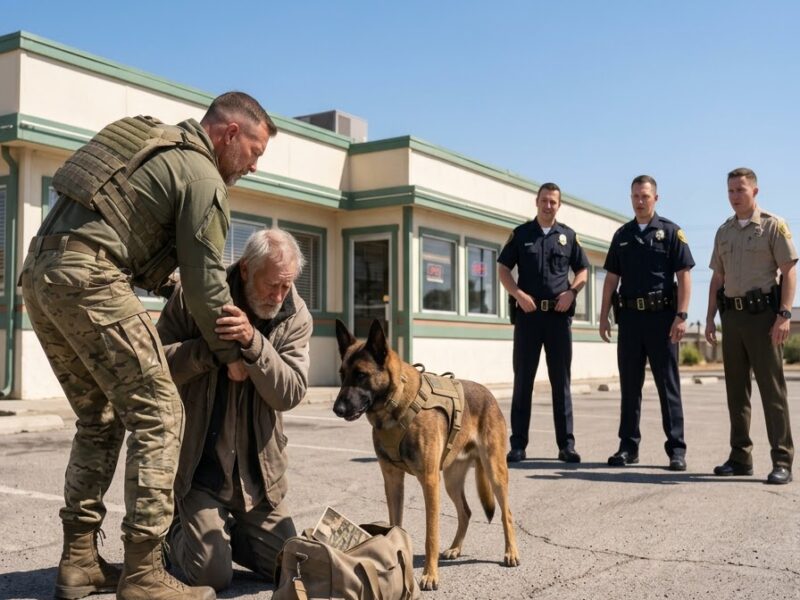
The homeless man collapsed beneath a bridge in San Diego while commuters stepped around him, but when a Navy SEAL and his German Shepherd stopped to help
The late afternoon sun in San Diego usually brought a warm, golden haze off the Pacific, but beneath the Interstate 5 overpass, the air was cold, damp, and smelled of exhaust fumes and sea salt. It was rush hour. Hundreds of cars crawled along the concrete arterial roads, their drivers desperate to escape the downtown gridlock.
I was sitting at a red light near the freeway exit, tapping my fingers against the steering wheel, when I saw the commotion on the concrete embankment.
A crowd had formed, but it wasn’t a gathering of concern. It was the typical, uncomfortable perimeter people draw when confronted with human misery. An older man, dressed in a grease-stained canvas jacket and filthy jeans, lay curled on his side beside a handwritten cardboard sign. His body was shuddering violently, his breathing shallow and metallic. Commuters stepped around him, eyes glued to their phones, treating his limp form like an inconvenient obstacle on their evening walk to the trolley station.
I pulled my car onto the gravel shoulder, clicked on my hazard lights, and grabbed my phone. Before I could step out, a battered dark blue Ford F-150 pulled onto the curb twenty feet ahead of me with a sharp squeal of brakes.
The driver’s side door flew open. A man stepped out, moving with an athletic, coiled precision that instantly set him apart from the crowd. He wore a dark grease-stained hoodie, tactical boots, and carried himself with the rigid authority of an active-duty operator. A massive, sable-coated German Shepherd leapt out of the truck bed right behind him, dropping into a low, alert heel without needing a single spoken command.
“Call 911!” the man shouted to me, his voice cutting clean through the roar of freeway traffic. “Tell them we have an unresponsive adult male, probable hypothermia or cardiac distress!”
“On it!” I called back, already punching the three digits into my phone as I hurried across the gravel.
The man dropped to his knees in the grime beside the collapsed stranger. He checked the old man’s carotid artery with two firm fingers, his jaw set in a hard, disciplined line. His hair was cropped short, his eyes a piercing, icy gray that scanned the surroundings with practiced situational awareness. I could see the faint outline of a Trident tattoo emerging from the cuff of his left sleeve. This was a Navy SEAL, someone accustomed to controlling chaos.
“Sir! Can you hear me?” the SEAL barked, tapping the old man’s shoulder.
The homeless man gave a weak, gurgling groan. His skin was gray, his lips tinged with blue. The German Shepherd stepped closer, lowering its massive head to sniff gently at the lapel of the man’s torn jacket.
Suddenly, the dog froze.
Its ears flared forward, pinned tight in absolute focus. A low, vibrating whine started deep in the animal’s chest.
The SEAL noticed the sudden shift in his dog instantly. “What is it, Ranger?”
The shepherd didn’t back away. Instead, using its teeth with remarkable, delicate precision, the dog nipped at a loose thread near the inner lining of the old man’s coat. The dog tugged carefully, pulling back a flap of torn insulation to reveal a faded, plastic-laminated photograph tucked deep inside a hidden pocket.
Ranger nudged the photograph with his nose, pushing it into the dust between his master’s knees.
The SEAL picked up the small rectangle of paper. He wiped away a layer of grime with his thumb. I leaned over his shoulder and saw three young men in desert camouflage standing in front of an MH-60 Black Hawk helicopter, arms thrown around each other’s shoulders, squinting against a blinding Middle Eastern sun.
The SEAL’s face drained of color. His fingers tightened on the edges of the laminate so hard the plastic bent.
“I know these men,” he whispered, his voice losing its authoritative edge, replaced by raw shock.
The old man’s eyelids fluttered open. His eyes were milky, bloodshot, and heavy with pain, but as they focused on the SEAL’s face, a sudden spark of recognition lit up his features.
“You’re… you’re one of them,” the old man rasped, his voice sounding like dry leaves scraping over concrete.
The SEAL stared at him, his gray eyes searching the old man’s wrinkled, scarred face. “Who are you?”
The stranger swallowed hard, his throat working dryly. “Tommy… Thomas Miller.” Then, leaning up slightly, he whispered a single, strange name into the noise of the traffic—a name that sounded like a military callsign or an operational code.
The SEAL’s hand began to shake violently. “That’s impossible. That name… that operation was buried twelve years ago.”
“Not buried,” Tommy wheezed, coughing up a chest-deep phlegm. “Hidden. They… they thought I was too broken to remember.”
Sirens wailed in the distance, growing louder as an ambulance navigated the crowded freeway off-ramp. Within two minutes, the red and blue lights illuminated the underside of the concrete bridge, casting long, eerie shadows against the graffiti-covered walls. Two paramedics stepped out, carrying heavy orange trauma bags and a folding gurney.
“Step back, sir,” the lead paramedic said, setting his gear down beside Tommy. “Let us take a look at him.”
The paramedics moved in, but before the lead medic could open his main equipment bag, Ranger moved.
The German Shepherd placed his solid ninety-pound frame directly over Tommy’s torso. His lips curled back, exposing long, white teeth, and a chest-rattling growl vibrated through the air. The dog wasn’t guarding Tommy from the medics—his yellow eyes were locked directly on the bottom compartment of the paramedic’s black medical kit.
“Whoa! Get your dog back!” the paramedic yelled, taking a startled step backward.
“Ranger, hold,” the SEAL commanded softly, but his eyes were fixed on the bag. He didn’t pull the dog away. Instead, he reached down, his movements slow and deliberate, and unzipped the lower pocket of the paramedic’s bag—a pocket that should have contained IV tubes and bandages.
Instead, resting inside was a heavy, waterproof titanium case, no larger than a hardcover book, stamped with a serial number and a red classified stencil.
Tommy reached out a trembling, dirt-caked hand, his fingers clawing at the SEAL’s coat sleeve. “That’s why they came for me,” Tommy gasped. “They tracked the box.”
The SEAL grabbed the metal case. He keyed in a five-digit mechanical combination on the latch without even looking at the dials—as if he had memorized the sequence a lifetime ago. The lid popped open with a soft hiss of pressurized air.
Inside lay three things: an old, blood-stained military identification card, two dark-room photographs, and an unformatted, military-grade encrypted flash drive.
The SEAL’s face turned stone-hard. “Where did you get this?”
Tommy looked past the paramedics, his eyes darting nervously toward the far end of the underpass, where the shadows were lengthening under the setting sun. “Your friend gave it to me. Two weeks ago. In an alley near the docks.”
“My friend died overseas,” the SEAL said, his voice dropping into a dangerous, icy whisper. “Lieutenant David Mercer died in a mountain pass in Kunar Province. I carried his dog tags out myself.”
Tommy shook his head, a tear cutting a clean track through the dust on his cheek. “No. He survived.” He pointed a shaking finger at the middle figure in the faded photograph—the tall young man with a crooked smile standing beside the Black Hawk. “He survived the crash. But he learned why the bird went down.”
The SEAL stared at the photograph, his breathing shallow. For twelve years, his entire team had believed their commander had been killed in an enemy ambush. The official debrief had been sealed at the highest levels of Special Operations Command.
“He told me,” Tommy whispered, coughing weakly, “he told me not to trust the people who came looking for him. He said they weren’t rescue. They were clean-up.”
A sharp bark from Ranger cut through the air. The dog stood up, his ears flattened against his skull, his tail rigid. He barked toward the far end of the access road.
A sleek, black Chevrolet Tahoe with tinted windows had pulled onto the gravel shoulder fifty yards away. The engine idling with a heavy, ominous purr.
The driver’s side and passenger doors opened simultaneously. Two men in dark, tactical windbreakers stepped out. They didn’t look like law enforcement. They moved with the quiet, predatory posture of contract operators.
Tommy grabbed the SEAL’s sleeve with surprising force. “They found me.”
The SEAL didn’t flinch. He snapped the titanium case shut, shoved it into his jacket, and looked at his dog. Ranger was already standing in an absolute defensive stance between us and the approaching men, his growl rising in volume.
Then Tommy pulled the SEAL down by his collar, whispering four words directly into his ear—words so sharp they made the veteran operator go completely still, his entire body locking up like iron.
“The man you’re looking for isn’t missing,” Tommy breathed, pointing a trembling finger directly at the black SUV. “He’s the one driving it.”
The SEAL turned slowly. Through the dark tint of the SUV’s open driver-side window, a face emerged into the twilight. Pale, scarred along the left jawline, with cold, unmistakable blue eyes that looked directly back at us.
It was Lieutenant David Mercer.
The world seemed to lose all sound except for the heavy thrum of the SUV’s engine and the distant, hollow echo of the freeway traffic above.
I stood paralyzed beside the paramedics, who were looking back and forth between the armed operators and the SEAL, sensing that the medical call had just turned into something profoundly dangerous.
“Get him on the gurney,” the SEAL ordered the medics, his voice terrifyingly calm. “Now. Get him into the back of your rig.”
“Sir, what’s going on here?” the lead paramedic asked, his hand hovering near his radio. “Who are those men?”
“Do it!” the SEAL snapped, turning his head just enough to display the absolute lethality in his eyes.
The medics didn’t argue further. They lifted Tommy onto the gurney, strapped him down, and wheeled him rapidly toward the open rear doors of the ambulance.
The two men who had stepped out of the black Tahoe stopped thirty feet away. They kept their hands resting casually near their waists—a clear posture of concealed carry. But my eyes were locked on the man stepping out of the driver’s side.
David Mercer looked older, his face etched with deep lines of hardship and cold calculation. The crooked, warm smile from the photograph was gone, replaced by an expression of sharp, clinical detachment. He wore a dark slate jacket, tactical trousers, and carried himself not like a man who had been rescued from the grave, but like a man who commanded it.
“Marcus,” Mercer said. His voice was deeper than the SEAL had remembered, raspier, as if his vocal cords had been damaged by fire or smoke. “I told you years ago to stop chasing old ghosts.”
The SEAL—Marcus—took three deliberate steps forward, placing himself directly between Mercer’s team and the ambulance. Ranger stayed glued to his left thigh, his black lips peeled back over sharp teeth, a low, continuous vibration rattling his ribcage.
“Twelve years, David,” Marcus said, his hands hanging loose at his sides, ready to draw at the first twitch. “Twelve years I carried your mother’s tears at the memorial. Twelve years I lived with the guilt of leaving your body in that valley.”
Mercer let out a short, humorless laugh that sounded like dry gravel being crushed under a boot. “You didn’t leave a body, Marcus. You left an asset. You left a classified casualty list that allowed a three-star general to pocket forty million dollars in off-book procurement funds.”
Marcus froze. “What are you talking about?”
“Operation Sunfall,” Mercer said, taking a slow step forward. His two contractors shifted behind him, spread out in a tactical angle to cross-fire the area. “Our bird wasn’t brought down by a Taliban RPG, Marcus. It was brought down by a thermite charge placed on the tail rotor by our own command element. We were sent into that valley to die so the paper trail for fifty tons of seized munitions would disappear forever.”
“You’re lying,” Marcus said, though the tremor in his voice told me he was already connecting the dots. “I was on that flight manifest!”
“And you survived because you were in the lead troop bay,” Mercer countered sharply, his blue eyes flashing with a sudden, wild intensity. “I was in the cockpit. I saw the telemetry before we hit the trees. I survived the fire, Marcus. I crawled out of that wreckage with half my skin melted off, and when I dragged myself to the extraction point, I watched our own retrieval team execute the survivors.”
A heavy, suffocating silence fell over the underpass. The paramedics had stopped loading the gurney, staring in horror at the former Navy SEAL officer standing on the dirt shoulder.
“I hid in those mountains for three years,” Mercer continued, his voice dropping into a dark, venomous register. “I rebuilt myself. And then I realized the only way to destroy a system that corrupt is to buy it. I didn’t come back to clear my name, Marcus. I came back to take control of the ledger.”
“And Tommy?” Marcus asked, gesturing toward the sick old man in the ambulance. “Who is he?”
“Tommy was the logistics sergeant who stamped the flight manifests at Bagram,” Mercer said coldly. “He was the only one who kept a physical duplicate of the shipping orders before they purged the digital servers. For twelve years, he was smart enough to stay lost. Then he got sick, got desperate, and tried to sell the titanium case back to my intermediaries.”
Mercer reached into his coat and pulled out a sleek, suppressed 9mm pistol, keeping it pointed down toward the gravel. “He’s a liability, Marcus. Hand over the case, step away from the rig, and walk back to your truck. You were my brother once. Don’t die for a broken old man who already has one foot in the grave.”
Marcus slowly reached into his own coat pocket. His hand wrapped around the heavy titanium box. He looked at the dog beside him, then looked up at the man who had once been his closest friend.
“You died in that valley, David,” Marcus said softly, a profound sorrow filling his voice. “The man standing in front of me is just the piece of shrapnel they left behind.”
Marcus didn’t pull out the box. Instead, his hand whipped out with lightning speed, holding a compact flashbang grenade he had pulled from his truck’s door pocket. He ripped the pin with his thumb and slammed the canister onto the concrete embankment at his feet.
“COVER!” Marcus roared.
A blinding, violet-white burst of light exploded under the bridge, followed instantly by a deafening, 170-decibel crack that shattered the windows of the nearby parked cars and sent a shockwave slamming through my chest.
The world turned into a chaotic blur of smoke, ringing ears, and flashing lights.
The flashbang disorientation hit Mercer’s contractors hard, sending them stumbling backward, hands clawing at their eyes. But Marcus didn’t hesitate. He grabbed me by my jacket collar, shunted me toward the open driver’s door of his F-150, and barked a single command to the medics: “DRIVE!”
The lead paramedic slammed the rear doors of the ambulance shut, threw the vehicle into gear, and hit the gas, the heavy rig screeching away from the curb with its red lights flashing wildly.
“Get in!” Marcus shouted at me, shoving me into the passenger seat of his pickup.
Ranger leapt into the narrow back cab in a single fluid motion. Marcus slammed his door, fired up the V8 engine, and stomped on the accelerator, spraying gravel across the black Tahoe as we tore out from under the bridge, following the ambulance onto the southbound lanes of Interstate 5.
My ears were ringing violently, my vision swimming with purple spots from the blinding burst. “Where are we going?” I yelled over the roar of the engine.
“Out of the city!” Marcus barked, his hands gripping the steering wheel like iron clamps as he checked his side mirrors. “Mercer owns half the private security assets in San Diego County. If we go to the police, his people will intercept the report before it hits the federal desk. We need high-bandwidth satellite uplink to broadcast the drive’s contents directly to the Department of Defense Inspector General.”
I looked out the rear window. Through the rain-slicked glass, two sets of heavy LED headlights cut through the evening traffic behind us. Mercer’s black Tahoe was already weaving through the commuter traffic, accompanied by a second dark sedan that had pulled out from an adjoining side street.
“They’re closing fast!” I shouted.
Marcus reached into his center console and pulled out a heavy tactical radio, throwing it into my lap. “Preset channel three! Keep the medics on the line! Tell them to head toward the Naval Amphibious Base at Coronado! If we can reach the main gate at Amphib Base, Mercer can’t touch us—the armed perimeter guards will lockdown the grid!”
I grabbed the radio, my hands shaking so violently I could barely hit the toggle switch. “Ambulance unit, do you copy? Head for the Coronado Bridge! Repeat, head for Coronado!”
“We copy!” the paramedic’s panicked voice crackled back through the speaker. “We’ve got a black sedan trying to pit-maneuver us near the downtown exit! This rig isn’t built for high-speed evasive!”
“Hold your lane!” Marcus grabbed the radio microphone. “I’m coming up on your left!”
Marcus slammed the F-150 into the left-hand lane, clipping the rear bumper of a commuter sedan, sending sparks flying into the night air. Up ahead, the towering, curving concrete spans of the San Diego-Coronado Bridge rose against the dark skyline, stretching out across the black waters of the bay.
The black sedan was trying to squeeze the heavy ambulance against the concrete bridge guardrail, its dark windows lowered as a contractor raised a weapon.
“Ranger, brace!” Marcus yelled.
Marcus didn’t touch the brakes. He drove the heavy steel bumper of his F-150 straight into the rear quarter-panel of the contractor’s sedan at sixty miles an hour.
The impact sounded like a cannon shot. Metal tore, glass exploded into shimmering dust, and the sedan spun out of control, slamming hard into the concrete divider and coming to a dead stop in a cloud of radiator steam and burning rubber.
“One down!” Marcus growled, stabilizing the truck as we hit the steep incline of the Coronado Bridge.
But Mercer’s black Tahoe was right behind us. It surged up the center lane, its heavy V8 engine roaring, ramming the rear tailgate of Marcus’s pickup with bone-jarring force.
The impact threw me against the dashboard. In the back cab, Ranger let out a sharp, furious bark, his claws digging into the leather seats to maintain his balance.
Mercer pulled his Tahoe alongside our left flank. Through the shattered passenger window, Mercer himself was holding a heavy semi-automatic rifle, his face cold, unreadable, and focused.
“He’s going to shoot out our tires!” I screamed.
Marcus slammed his foot on the brake pedal for a fraction of a second. The sudden drop in speed caused Mercer’s heavy SUV to overshoot us by half a car length.
Marcus reached into his door pocket, pulled his sidearm, and fired four rapid, precise shots through his own driver’s side window. The high-caliber rounds shattered the Tahoe’s front passenger tire and tore into its engine block.
The Tahoe wobbled violently, blue smoke pouring from under its hood as the shredded tire disintegrated. Mercer fought the steering wheel, his vehicle scraping along the concrete bridge wall in a blinding shower of yellow sparks before grinding to a halt near the crest of the bridge span.
Marcus didn’t stop to celebrate. He kept the accelerator pinned, guiding his battered truck down the long descent of the bridge toward the brightly lit perimeter gate of the Coronado Naval Base half a mile ahead.
The ambulance swept through the approach lane, its red lights illuminating the armed Navy Security Forces personnel standing behind the bulletproof glass of the guard shack.
Marcus slid the F-150 across three lanes, bringing the truck to a stop right behind the ambulance. He threw open his door, grabbed the titanium case from his jacket, and held his hands high in the air as four heavily armed Navy Security sailors surrounded the vehicles with rifles raised.
“Special Warfare Operator First Class Marcus Vance!” Marcus roared at the gate guard, pulling his military ID from his pocket and holding it high. “I have a medical emergency, a classified intelligence breach, and an active threat on the bridge! Lock down this gate immediately!”
The heavy steel anti-ram barriers rose out of the asphalt with a hydraulic hiss, sealing the entrance to the Naval base behind us.
Within ninety seconds, the gate area was swarming with armed Master-at-Arms personnel, base security officers, and a team of Navy medical staff who immediately took charge of the ambulance. Tommy was wheeled out of the rig on a stretcher, an oxygen mask strapped over his face, his frail hand still clutching the wool scarf Marcus had wrapped around his shoulders.
“Get him to the base hospital!” the lead Navy doctor ordered, barking commands to his medics. “Full cardiac panel and toxic screen! Move!”
Marcus stood under the bright floodlights of the security booth, his hands resting on his hips, his chest heaving as he watched the ambulance disappear toward the medical wing. Ranger sat beside him, his ears back, his tail resting quietly against the wet asphalt.
A tall man in a crisp blue Service Dress uniform walked briskly out of the base command building, flanked by two armed federal agents. His shoulder boards bore the three gold stars of a Vice Admiral.
“Vance,” the Admiral said, his voice deep, authoritative, and sharp. “What the hell just happened on the Coronado Bridge?”
Marcus snapped a crisp, rigid salute, his jaw set. “Admiral Hall, sir. I am in possession of classified evidence regarding the loss of MH-60 flight Call-Sign Valkyrie-two-zero in Kunar Province twelve years ago.”
Admiral Hall’s eyes narrowed instantly. He gestured to the two federal agents behind him. “Secure the perimeter. No one enters or leaves this facility until I say so. Vance, get inside the command vault. Now.”
Five minutes later, we were standing inside a SCIF—a Sensitive Compartmented Information Facility—deep in the basement of the base headquarters. The room was lined with soundproofing panels, copper shielding, and heavy steel security doors designed to block all electronic surveillance.
Marcus laid the heavy titanium case on the polished oak conference table.
Admiral Hall sat across from us, his hands clasped together, his face grim. Beside him sat a senior investigator from the Naval Criminal Investigative Service (NCIS).
“Explain,” Hall said simply.
Marcus reached out, opened the mechanical latch, and pulled out the unformatted flash drive. He slid it across the table toward the NCIS technician sitting at a secure terminal.
“Twelve years ago,” Marcus began, his voice steady despite the adrenaline still coursing through his veins, “Lieutenant David Mercer was reported Killed in Action following a helicopter crash during Operation Sunfall. We were told the flight recorder was destroyed, the survivors were zero, and the target area was sanitized by enemy artillery.”
Marcus pointed at the flash drive. “That drive contains the original, unedited telemetry logs kept by Sergeant Thomas Miller—the logistics officer on site. It proves the crash was engineered by internal demolition charges. It also contains the financial routing numbers for thirty-eight millions dollars diverted from foreign military sales accounts into a private holding firm in Panama.”
The NCIS technician plugged the drive into a hard-gapped computer. Lines of code scrolled rapidly across the screen, followed by thousands of scanned banking manifests, operational orders, and digital wire receipts.
The technician’s face went completely pale. “Sir… these files are signed with a master clearance key. A key belonging to Defense Intelligence Executive David Mercer.”
Admiral Hall leaned forward, his hands tightening into fists. “Mercer didn’t die. He used the crash to disappear, took the money, and built a private intelligence empire using un-vetted black-budget funds.”
“He didn’t just disappear, Admiral,” Marcus said, his voice dropping into a razor-sharp edge. “He tried to execute everyone who knew the truth. He hunted Sergeant Miller for twelve years because Miller held the physical drive that couldn’t be erased from a remote server.”
Suddenly, the red emergency phone on the conference room wall began to chime with a soft, pulsing beep.
Admiral Hall picked up the receiver. “Hall here.”
He listened for ten seconds. His face turned from grim to thunderous. He slowly lowered the phone back onto its cradle.
“Federal agents just secured the crash site on the bridge,” Hall said, looking directly at Marcus. “The black Tahoe was abandoned. Mercer and his men slipped down a maintenance ladder into a waiting fast-assault craft in the bay before the Coast Guard could establish a blockade.”
“Where is he going?” I asked, stepping forward.
Hall looked up at the wall monitor, which displayed a live radar feed of San Diego Bay and the surrounding offshore waters. A single, high-speed radar return was moving rapidly south toward the maritime border with Mexico.
“He’s heading for international waters,” Hall said. “Once he crosses the twelve-mile limit into Mexican territorial seas, our jurisdiction becomes a diplomatic nightmare. He has safe houses, private airstrips, and untraceable accounts waiting for him in South America.”
Marcus looked down at Ranger, who stood up immediately, his eyes fixed on his master’s face.
“He won’t make it to international waters,” Marcus said softly, reaching down to unclip his dog’s leash. “Because he thinks he won the game. He thinks the drive in this room is the only copy.”
Marcus reached into his tactical vest, pulled out his own personal dog tags, and unscrewed the hollow silencer rubber surrounding the metal tags. Embedded in the rubber lining was a second, micro-sized storage chip.
“Tommy didn’t just give me one drive,” Marcus said, a cold, ruthless smile breaking across his face. “He gave me the master key. And Mercer is flying straight into a trap he doesn’t even know I set.”
The Pacific Ocean off the coast of Point Loma was pitch-black, the cold swell tossing the thirty-foot Navy Special Warfare Interceptor boat as it sliced through the waves at forty knots.
Marcus stood at the helm, his tactical jacket zipped tight against the freezing spray, his night-vision goggles resting on his forehead. Ranger stood directly beside him in the center deck, wearing a waterproof tactical harness, his ears flat against the wind, his body shifting fluidly with every pitch and roll of the hull.
I sat in the passenger jump seat, holding tight to the aluminum handrail. Beside us were four fully geared Navy SEALs from Marcus’s old squad—men who had answered his personal call within twenty minutes of the vault briefing.
“Radar target acquired!” the navigator called out over the helmet headsets. “Two miles ahead, bearing one-eight-zero! A forty-foot private yacht, idling near the international boundary line!”
“He’s waiting for a helicopter pickup,” Marcus said into his microphone, his voice cutting clean through the radio static. “He thinks he’s safe because he crossed the harbor line. He doesn’t know we’re running under Joint Chiefs counter-terrorism authorization.”
Through the darkness ahead, the running lights of a sleek, white luxury yacht emerged from the sea mist. A heavy twin-engine helicopter was hovering five hundred feet above the vessel, preparing to drop its winch line for an offshore extraction.
“Cut the engines!” Marcus ordered.
The interceptor’s heavy triple-outboards went dead silent. The boat coasted through the dark water on momentum alone, riding the sea swells until we drifted right alongside the yacht’s low stern swim platform.
“Move!” Marcus barked.
The four SEALs scrambled onto the teak deck like shadows, their suppressed rifles raised, securing the side passages in seconds.
Marcus stepped onto the deck, Ranger leaping right beside him, his paws landing without a sound on the wet wood. I followed closely behind, carrying the secure satellite relay chest Marcus had brought from the base vault.
We moved up the spiral stairs to the main salon. The heavy glass doors were unlocked.
Inside, sitting at a mahogany desk surrounded by satellite monitors and open whiskey glasses, was David Mercer. He was typing frantically on a encrypted laptop, transferring millions of dollars between foreign accounts before his access codes could be revoked.
He didn’t hear us enter over the sound of the helicopter rotors overhead.
“The transfer won’t go through, David,” Marcus said quietly from the doorway.
Mercer’s fingers froze over the keyboard. He didn’t turn around immediately. He slowly closed the laptop screen, took a slow sip from his glass, and then turned his swivel chair to face us.
He looked at Marcus, then at the four armed SEALs standing in the doorway, and finally at Ranger, whose yellow eyes were locked on his chest.
“You always were too persistent, Marcus,” Mercer said, letting out a heavy, exhausted sigh. He set his glass down on the desk. “You could have stayed in your quiet little life. You could have let the past stay buried.”
“The past wasn’t buried, David,” Marcus said, taking three steps into the luxurious cabin. “It was bleeding out beneath a freeway overpass in San Diego. Tommy Miller died forty minutes ago at the base hospital.”
Mercer’s face flickered with a brief, almost imperceptible shadow of regret, but it vanished as quickly as it had appeared. “Tommy was a soldier. He knew the risks of getting involved in things bigger than himself.”
“He wasn’t a soldier when he died,” Marcus said, his voice rising with powerful, undeniable authority. “He was a witness. And his testimony just hit the Department of Justice secure server five minutes ago. Your accounts are frozen, David. Your assets are seized. Your helicopter up there? They’ve just been ordered to vector back to NAS North Island by Air Traffic Control.”
As if on cue, the heavy thrum of the helicopter above shifted tone. The aircraft banked hard to the east, its searchlight turning off as it abandoned the yacht and flew back toward the mainland.
Mercer looked up through the glass sunroof, watching his escape route vanish into the dark sky. The cold, arrogant detachment finally broke from his face, leaving behind the empty, hollow expression of a man who realized his entire kingdom had been built on sand.
He slowly reached toward his coat pocket.
CLICK.
Four laser designators locked onto Mercer’s chest instantly.
“Don’t do it, David,” Marcus said, his hand resting gently on Ranger’s head. “Don’t make me leave another body behind.”
Mercer’s hand stopped inside his coat. He looked down at the red dots dancing across his chest, then looked into the eyes of his former teammate—and the dog that had remembered a secret for twelve long years.
Slowly, painfully, Mercer pulled his hand out empty. He held his wrists together in front of him, his head bowing down in absolute defeat.
“Take him,” Marcus said quietly to the operators.
Two SEALs stepped forward, pulling Mercer from his chair and snapping heavy steel handcuffs over his wrists. They led him out to the rear deck without another word, leaving Marcus and me standing in the quiet, luxurious salon.
Marcus walked over to the large glass windows looking out toward the San Diego coastline. In the far distance, the golden lights of the city glittered against the dark water—the city where an old homeless man had lain dying in the dirt, carrying a secret that had finally brought justice home.
Marcus dropped to one knee on the carpet. He pulled Ranger’s head into his chest, wrapping his arms around the massive German Shepherd, resting his face against the dog’s thick fur.
“Good boy, Ranger,” Marcus whispered, his voice finally breaking, tears slipping quietly into his dog’s coat. “Good boy. It’s over. Dave’s finally coming home.”
Ranger gave a single, low, comforting whimper, resting his heavy chin on Marcus’s shoulder.
Outside, the first pale light of dawn began to break over the Pacific horizon, cutting through the dark sea mist and washing the world in clean, golden light. The storm had passed. The ghosts had been laid to rest. And as the boat turned back toward the shore, the future finally looked clear.
The end,









