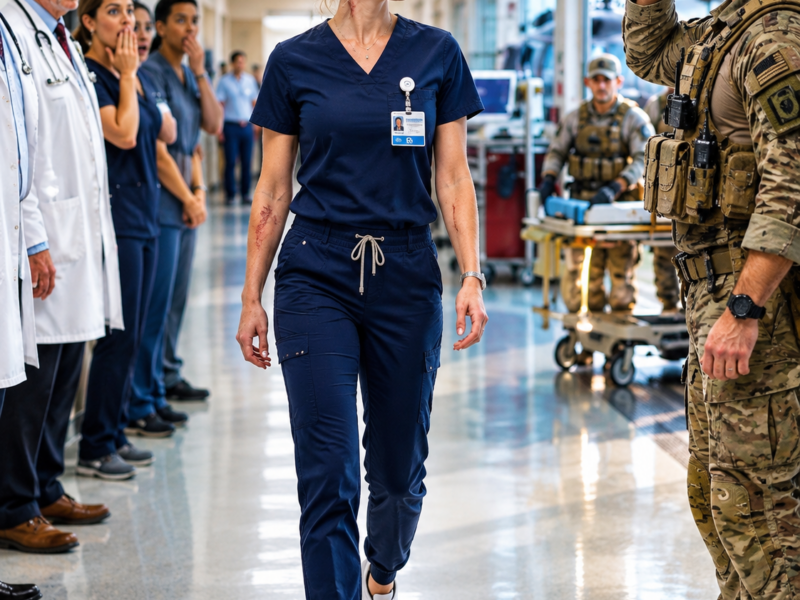
The helicopter hadn’t even touched down when four Special Forces soldiers arrived at Riverside Methodist Hospital
The next morning, Callahan Dre arrived at Riverside Methodist at exactly 5:45 a.m.
The hospital was beginning its familiar transition from night to day. Environmental services workers pushed carts through the corridors. The cafeteria was preparing breakfast. Somewhere on the second floor, a patient was calling for someone to help him find his glasses.
Nothing about the building suggested that anything extraordinary had happened the night before.
Dre walked through the staff entrance, scanned her badge, and headed toward the ICU step-down unit.
Her dark green scrubs were clean. Her hair was secured neatly away from her face. Her ID badge sat exactly where it always did.
At the nurses’ station, Pamela Holt was already reviewing assignments.
She looked up when Dre approached.
For a moment, Holt seemed uncertain what to say.
“Morning, Callahan.”
“Morning.”
Dre placed her bag beneath the desk, checked the patient list, and began reviewing the overnight notes.
Holt watched her for several seconds before returning to her computer.
It was an ordinary exchange.
That was what made it uncomfortable.
For six weeks, Holt had treated Dre as a competent but distant employee. She had complained about her lack of participation in the unit’s social atmosphere, questioned her quietness, and occasionally assigned her the patients nobody else wanted.
Now Holt had seen four Special Forces soldiers recognize that same woman as someone they trusted with the life of one of their own.
She had watched an experienced trauma surgeon follow Dre’s instructions.
And she had heard a military team leader ask a physician to step aside because the person they had requested had arrived.
Holt didn’t know what to do with that information.
Dre, apparently, didn’t need her to do anything.
She was already reading the chart of a patient in room 312.
At 6:20, Beverly Storch came up from the progressive care unit carrying two coffees.
She placed one beside Dre.
“Figured you could use this.”
Dre looked at the cup.
“Thanks.”
Beverly pulled up a chair.
For a few minutes, neither woman spoke.
Then Beverly asked, “How long were you with them?”
Dre kept her eyes on the chart.
“Long enough.”
“That’s not really an answer.”
“It’s the one I have.”
Beverly smiled faintly.
She had spent ten years in Army trauma nursing before transitioning to civilian medicine. She understood that some experiences were difficult to explain, and that people who had lived through them often had no desire to revisit them over cafeteria coffee.
She also understood the difference between someone who had learned to remain calm and someone who had been trained to remain useful when everyone else was losing control.
Dre was the second kind.
Beverly glanced toward the trauma bay.
“That man made it through surgery because they knew exactly where to bring him.”
Dre turned a page.
“The surgical team did good work.”
“You’re doing it again.”
“Doing what?”
“Giving everyone else the credit.”
Dre finally looked at her.
“Everyone else did their job.”
Beverly studied her for a moment.
Then she nodded.
She knew better than to push.
Across the nurses’ station, Holt pretended to concentrate on a staffing spreadsheet.
But she had heard enough to understand that there was a history here, one that had nothing to do with Riverside Methodist.
And for the first time, she wondered whether she had been looking at the wrong things.
The helicopter incident became an unofficial subject of conversation throughout the hospital.
Nobody had an official account. Nobody had been told what the team leader’s relationship with Dre was. Nobody knew the exact reason command had selected Riverside Methodist.
But hospitals are small communities, even when they occupy enormous buildings.
People noticed things.
A respiratory therapist mentioned that the military team had arrived with unusual urgency.
A surgical resident told a colleague that an ICU nurse had helped direct the trauma response.
A technician who had watched the team leader approach Dre said he had never seen a patient transport team behave that way around a staff member.
The stories changed slightly as they traveled.
Some people described Dre as a former military physician. Others thought she had been a combat medic. One person suggested she had worked with special operations units overseas.
Nobody knew.
Dre never confirmed anything.
When asked directly, she gave short answers and returned to her work.
By the following Monday, the hospital had mostly moved on.
Hospitals have a remarkable ability to absorb extraordinary events and turn them into another line in a shift report.
There were new admissions, new complications, new staffing problems, and new reasons for everyone to be tired.
Dre preferred it that way.
She had not come to Riverside Methodist to become a story.
She had come because she wanted to work.
But the people around her were beginning to notice details they had previously overlooked.
Her habit of checking equipment twice was not nervousness.
Her silence during tense situations was not indifference.
Her insistence on reviewing a patient’s entire clinical picture before making a recommendation was not perfectionism.
It was discipline.
And it had been built over years.
One afternoon, a junior nurse named Emily Lawson approached Dre during a quiet moment.
Emily had been working at Riverside Methodist for eight months. She was intelligent, hardworking, and still struggling with the emotional weight of critical care.
She had recently made a documentation error that nearly delayed a medication adjustment. Nobody had been harmed, but the attending physician had criticized her during rounds.
Since then, Emily had become visibly anxious.
She checked everything repeatedly, hesitated before calling physicians, and sometimes avoided making decisions she was qualified to make.
“Can I ask you something?” Emily said.
Dre looked up.
“Sure.”
“How do you know when something is wrong?”
Dre closed the chart.
“What do you mean?”
“With patients. Sometimes their numbers look fine, but something feels different. I don’t know if I’m overreacting or if I should call someone.”
Dre considered the question.
“Start with what changed.”
Emily frowned.
“What do you mean?”
“Don’t ask yourself whether the patient looks sick. Ask yourself what is different from an hour ago. Their speech. Their breathing. Their behavior. Their skin. Their level of attention. Their ability to do something they could do earlier.”
Emily nodded slowly.
“Then what?”
“Find out why it changed. Check what you can verify. Look at the whole picture. And if you’re concerned, escalate. You don’t need to be certain something terrible is happening before you ask for help.”
Emily looked relieved.
“I thought experienced nurses just knew.”
Dre shook her head.
“Experience doesn’t mean you know everything. It means you’ve learned not to ignore the things you don’t understand.”
Emily remembered that sentence.
She would remember it for years.
Holt overheard part of the conversation while walking past the station.
She stopped briefly.
For the first time, she saw Dre teaching someone without making the interaction about herself.
It was a different kind of authority than Holt was accustomed to seeing.
It didn’t come from seniority, a title, or the ability to make other people uncomfortable.
It came from the fact that people became better at their jobs after listening to her.
That realization stayed with Holt.
On Wednesday, the trauma surgery resident from the helicopter case came to the ICU step-down unit.
Her name was Dr. Rachel Mercer.
She was in her early thirties, had completed several demanding years of surgical training, and had developed the confidence of someone who had spent a long time proving she belonged in an operating room.
She approached the nurses’ station carrying a folder.
“Is Callahan Dre working?”
Holt looked up.
“She’s in room 316.”
Mercer nodded and walked down the corridor.
Dre was checking a patient’s medication record when Mercer entered.
“Hey.”
Dre glanced up.
“Doctor.”
“I wanted to thank you.”
Dre returned her attention to the chart.
“You already did the work.”
Mercer smiled.
“That’s not what I came to say.”
She leaned against the counter.
“I’ve been thinking about the operation. About those three moments when everything changed.”
Dre waited.
“I’ve assisted on difficult cases before. I’ve seen experienced surgeons make decisions under pressure. But that night was different.”
“Different how?”
“You were never surprised.”
Dre looked at her.
“Of course I was.”
Mercer shook her head.
“Maybe internally. But you never let the room lose direction.”
Dre placed the chart back in its holder.
“That’s what the patient needed.”
Mercer hesitated.
“Can I ask where you trained?”
Dre’s expression remained neutral.
“Military medical training.”
“Special Forces?”
Dre gave a small nod.
Mercer took a breath.
“I thought so.”
She looked toward the hallway, then back at Dre.
“I want to become better at managing emergencies. Not just knowing the procedures, but understanding how to lead when everyone is looking at you.”
Dre studied her.
“Then learn to listen before you speak. Know your equipment. Know your people. And never let being embarrassed keep you from asking for help.”
Mercer nodded.
“That’s it?”
“That’s a start.”
Mercer laughed.
She thanked Dre again and left.
Holt had been watching from the station.
She had heard the entire exchange.
Later that afternoon, she found Dre alone near the medication room.
“Callahan.”
Dre turned.
“Yes?”
“I owe you an apology.”
Dre said nothing.
Holt continued.
“I made assumptions about you. I thought you were distant. I thought you didn’t want to be part of the team. And I assigned you work without considering whether it was fair.”
Dre listened.
Holt looked uncomfortable.
“I saw what happened last Thursday. And I realized I had no idea who I was working with.”
Dre’s expression softened slightly.
“You don’t have to know someone’s history to treat them fairly.”
The words were quiet.
They landed harder than Holt expected.
“I know,” Holt said.
Dre nodded.
Then she returned to her medication room.
Holt stood there for a moment.
She had expected anger, perhaps a lecture, or at least some acknowledgment that the apology had mattered.
Instead, Dre had given her something much more difficult.
A standard to live up to.
The following weeks brought more changes.
Holt began reviewing assignments more carefully. She stopped treating the quietest nurses as automatic candidates for the most difficult work. She also started asking staff members what they needed instead of assuming she already knew.
Gideon changed, too.
It was less obvious.
He did not become a different person overnight. He was still confident, still demanding, and occasionally impatient.
But during morning rounds, he began asking Dre specific questions.
“Did you notice anything unusual overnight?”
“How has his mental status compared with yesterday?”
“Would you be comfortable with this patient transferring to the regular floor?”
At first, the other nurses were surprised.
Gideon had rarely asked a nurse for an opinion unless something had already gone wrong.
Now he was seeking Dre’s observations before making certain decisions.
One morning, he found her reviewing the chart of an elderly patient recovering from pneumonia.
“Callahan.”
“Doctor.”
“Anything concerning?”
Dre pointed to the intake and output record.
“His urine output has been declining over the last two shifts. His blood pressure is still within range, but his oral intake has dropped, and his creatinine is trending upward.”
Gideon reviewed the results.
“Good catch.”
He ordered further evaluation and adjusted the patient’s plan.
As he walked away, he stopped.
“By the way, I reviewed the documentation from the Daraway case again.”
Dre looked up.
Gideon seemed to search for the right words.
“You recognized the change before the rest of us.”
“That’s what nursing assessment is for.”
“Yes,” he said. “It is.”
He paused.
“I should have acknowledged that.”
Dre gave him a brief nod.
Then he left.
It wasn’t a dramatic reconciliation.
There was no speech in front of the staff. No announcement about how wrong he had been.
But it was a beginning.
The most important change, however, came from someone who had nothing to do with the helicopter.
A few days after the incident, a white envelope arrived in the unit’s interoffice mail.
Holt opened it, assuming it contained routine paperwork.
Inside was a handwritten card.
It was addressed to the nursing staff who had cared for Theodore Daraway.
The message was short.
Mr. Daraway explained that he had been recovering well and was grateful to everyone who had helped him. He mentioned that his family had been frightened when he suddenly became confused and unable to speak properly.
He had since learned that a nurse noticed the changes and called for help before his condition became worse.
He wanted to thank her personally.
The card ended with a simple sentence.
“I don’t remember much from that night, but I know someone was paying attention when it mattered.”
Holt read it twice.
Then she checked the schedule.
Dre was not working that day.
Holt placed the card on the charge desk beneath a small paperweight.
She did not write a note on it.
She did not leave it in an envelope with the other administrative documents.
She simply put it where Dre would see it when she came in.
On Friday morning, Dre arrived at 5:45.
She checked the assignment board, reviewed the overnight report, and noticed the envelope.
She opened it.
For a moment, she remained completely still.
Then she folded the card carefully and placed it inside her locker.
Holt saw her do it.
“That’s from Mr. Daraway,” she said.
“I saw.”
“He’s doing well. His family called yesterday.”
Dre nodded.
“Good.”
Holt hesitated.
“I think he wanted you to know.”
Dre looked at the card again.
“I appreciate it.”
She placed it beside the small metal coin on the locker shelf.
The coin had been there since her first day.
It was dull green, its edges worn smooth from years of handling.
One side carried an eagle.
The other showed a caduceus above crossed arrows, the emblem associated with Special Forces medical training.
It had traveled with Dre through years of work that most people in the hospital would never experience.
It had been present during long nights, difficult decisions, and moments when there had been no time to doubt herself.
She rarely touched it now.
But she had never left it behind.
That afternoon, Beverly Storch found her in the cafeteria.
“You’re smiling,” Beverly said.
Dre looked down at her coffee.
“Am I?”
“A little.”
Beverly sat across from her.
“Daraway?”
Dre nodded.
“He’s doing well.”
“Good.”
They ate quietly for a few minutes.
Then Beverly asked the question she had avoided for weeks.
“Do you ever miss it?”
Dre knew what she meant.
The military.
The teams.
The work.
The people.
She looked toward the cafeteria windows.
“Sometimes.”
“What do you miss?”
Dre thought about it.
“The people who knew what you meant before you finished saying it.”
Beverly nodded.
She understood.
There were things about military medicine that were difficult to translate into civilian life. The trust built between people who had depended on one another in situations where mistakes could have permanent consequences. The shorthand. The shared responsibility. The knowledge that everyone around you understood exactly what was at stake.
But there were other things Dre did not miss.
The exhaustion.
The losses.
The constant awareness that someone might not make it home.
Beverly took a sip of coffee.
“You know, you don’t have to explain your past to everyone.”
“I know.”
“But you also don’t have to pretend it didn’t happen.”
Dre looked at her.
For a moment, the cafeteria seemed quieter than usual.
Then Dre smiled faintly.
“That’s why I like eating lunch with you.”
Beverly laughed.
“Because I don’t ask too many questions?”
“Exactly.”
Their friendship continued in the same understated way it had begun.
Neither woman made a ceremony out of it.
They simply kept showing up.
Months passed.
Riverside Methodist continued doing what hospitals do.
Patients arrived with illnesses nobody had anticipated. Nurses worked double shifts. Residents learned difficult lessons. Families waited in corridors for news that sometimes changed everything.
Dre remained on nights.
She continued arriving at 5:45, checking her assignments, reviewing charts, and noticing the small changes that others sometimes missed.
Her badge remained straight.
Her locker remained nearly empty.
The coin remained on the top shelf.
But the atmosphere around her had changed.
The nurses no longer assumed her silence meant she wanted to be left alone.
The junior staff began approaching her with questions.
Holt started including her in difficult clinical discussions.
Gideon stopped walking past the nursing station without acknowledging the people working there.
And every now and then, someone would ask Dre about the military.
She would answer what she felt comfortable answering.
Sometimes that was very little.
Sometimes it was a brief story about training or a difficult medical situation.
She never embellished.
She never tried to impress anyone.
One night, several months after the helicopter incident, Emily Lawson was caring for a patient whose condition had begun to deteriorate.
The patient was a middle-aged man admitted with a complicated infection.
His vital signs were not yet alarming, but Emily noticed that he had become increasingly restless. His answers were slower, and his attention seemed to drift.
She checked his chart.
She reviewed his medications.
Then she remembered what Dre had told her.
Start with what changed.
Emily went back to the bedside.
She asked the patient a few questions, checked his orientation, reviewed his recent laboratory results, and noticed that his blood pressure had begun trending downward.
She called for assistance.
Dre arrived within minutes.
“What have you noticed?”
Emily explained everything.
Dre listened without interrupting.
“Good. Let’s get the physician involved.”
The team evaluated the patient and identified a worsening infection with developing sepsis.
Treatment began promptly.
Afterward, Emily found Dre at the nurses’ station.
“I almost convinced myself I was overreacting.”
“But you didn’t.”
“I remembered what you said.”
Dre looked up.
“Then remember something else.”
Emily waited.
“Next time, don’t wait until you’re scared enough to call. Call when the clinical picture tells you something needs attention.”
Emily nodded.
“Okay.”
Dre returned to her documentation.
Emily walked away with a little more confidence than she had arrived with.
From the far end of the station, Holt had watched the exchange.
She thought about how much time the hospital spent teaching people procedures, protocols, and documentation requirements.
All of those things mattered.
But some of the most important lessons were harder to put into a training manual.
How to pay attention.
How to speak up.
How to recognize when someone needed help.
And how to respect people whose value was not immediately visible.
Gideon eventually learned that lesson, too.
He remained a demanding physician, but his relationship with the nursing staff became more collaborative.
He began asking questions instead of assuming he already had every answer.
He learned to recognize that a nurse’s observation could be the first indication of a problem that had not yet appeared in laboratory results or imaging.
He also learned to say someone’s name when acknowledging their work.
It was a small change.
But on a hospital floor, small changes can have lasting consequences.
Nearly a year after Dre’s arrival, Riverside Methodist held its annual staff recognition event.
Holt submitted several nominations.
One was for a nurse who had consistently demonstrated exceptional clinical judgment.
Another was for a young nurse who had shown tremendous growth.
The hospital’s leadership approved both.
Dre was among those recognized.
When Holt informed her, Dre looked genuinely uncomfortable.
“I don’t need that.”
“I know,” Holt replied. “That’s why I think you should accept it.”
Dre glanced at the paperwork.
“What exactly is it for?”
“Clinical excellence. Patient safety. Mentorship.”
Dre considered the list.
“Those are things everybody should be doing.”
Holt smiled.
“Yes. But not everybody does them consistently.”
Dre eventually agreed.
She attended the ceremony in a simple dark outfit, wearing the same badge she wore every night.
When her name was called, she walked to the front, accepted the recognition, and thanked the staff.
She did not give a long speech.
She thanked the nurses who worked beside her, the physicians who listened, the technicians who noticed details, and the people who kept the hospital functioning when most of the city was asleep.
Then she returned to her seat.
Beverly, who had attended as a guest, leaned toward her.
“That was almost a speech.”
Dre gave her a sideways look.
“Don’t get used to it.”
Beverly laughed.
For a brief moment, Dre looked less like someone carrying a private history and more like someone who had finally allowed herself to enjoy the place where she was.
The recognition ceremony ended.
People returned to their shifts.
The hospital continued.
And somewhere in the building, the metal coin remained in Dre’s locker.
There was a final detail that only Beverly eventually learned.
One evening, while the two women were sitting together in the cafeteria, Beverly noticed Dre turning the coin between her fingers.
“Does it have a name?” Beverly asked.
Dre looked down.
“A name?”
“The coin. Does it have a name, or is it just something you keep?”
Dre rubbed her thumb across the worn edge.
“It’s a reminder.”
“Of what?”
Dre took a moment before answering.
“Of the people who trusted me to bring them home.”
Beverly didn’t ask anything else.
She understood that the sentence carried more weight than Dre intended to put into the conversation.
For years, Dre had worked in places where the distance between a medical decision and a person’s survival could be measured in seconds.
She had learned to assess injuries, organize treatment, and make decisions when the situation was changing faster than anyone could describe it.
She had also learned that survival was rarely the achievement of one person.
There were always others.
The person who held the airway.
The person who maintained pressure.
The person who recognized a change.
The person who kept working when everyone else was exhausted.
And the person who remembered to bring the team home.
That was what the coin represented.
Not a title.
Not a rank.
Not an invitation for people to admire her.
A responsibility.
The helicopter team had known that responsibility when they arrived at Riverside Methodist.
They had not come looking for someone with the most impressive title.
They had come looking for someone they trusted.
Someone who understood what they needed before they had to explain it.
Someone who had once stood beside them in difficult places and had never forgotten what it meant to be responsible for another person’s life.
That was why they had passed two trauma centers.
That was why their leader had stopped when he saw her.
And that was why he had said her name the way he did.
Back at Riverside, the story gradually became less about the helicopter and more about the nurse who had been there all along.
Holt never again assigned Dre the overflow simply because she was unlikely to complain.
Gideon made a habit of asking the nursing staff what they were seeing before deciding what they should do.
Emily became one of the more confident nurses on the unit.
Rachel Mercer continued developing as a surgeon and occasionally returned to ask Dre questions about emergency assessment.
Beverly remained her closest friend in the building.
And Theodore Daraway’s thank-you card stayed in Dre’s locker.
It was eventually moved from beside the coin to the small pocket of her clinical reference book.
She kept it there because the message reminded her of something she sometimes forgot.
The work mattered even when nobody noticed.
The person in the bed mattered even when the hallway was quiet.
And sometimes, the most important thing a medical professional could do was recognize that something had changed before anyone else realized there was a problem.
One night, a new nurse arrived for orientation on the ICU step-down unit.
She was nervous, overwhelmed by the equipment, and worried about making mistakes.
Holt introduced her to the staff.
When they reached Dre, she said, “This is Callahan. She’s one of our most experienced night nurses. If you need help, ask her.”
The new nurse nodded.
“Nice to meet you.”
Dre smiled.
“Welcome. It’s a busy floor, but you’ll learn.”
The new nurse glanced at Dre’s badge.
“How long have you been here?”
“Long enough.”
It was the same answer Dre had given Beverly.
The young nurse laughed, assuming it was a joke.
Dre returned to her chart.
Outside, the city was settling into another ordinary night.
Ambulances moved through intersections. Emergency departments filled. Families waited beside hospital beds.
And on the third floor of Riverside Methodist, a nurse in dark green scrubs continued doing what she had always done.
She checked the details.
She listened carefully.
She noticed the changes.
She spoke when something needed to be said.
She did not need the hospital to know everything about her past.
She did not need a special title or a room full of people applauding.
The people who had once depended on her already knew who she was.
And the people who worked beside her were finally beginning to understand.
Some people spend their lives trying to make sure everyone knows what they have accomplished.
Others carry their history quietly, allowing their actions to speak when the moment demands it.
Callahan Dre belonged to the second group.
Her badge said RN.
Her schedule said night shift.
Her locker held a spare pair of scrubs, a worn clinical manual, a thank-you card, and a small green coin.
That was all most people needed to know.
But whenever someone asked why four Special Forces soldiers had flown past two trauma centers to bring one injured man to Riverside Methodist, there was only one answer that mattered.
Because they trusted her.
And in the world Callahan Dre had come from, trust was never given casually.
It was earned, one decision at a time, when someone else’s life depended on it.
The end.









