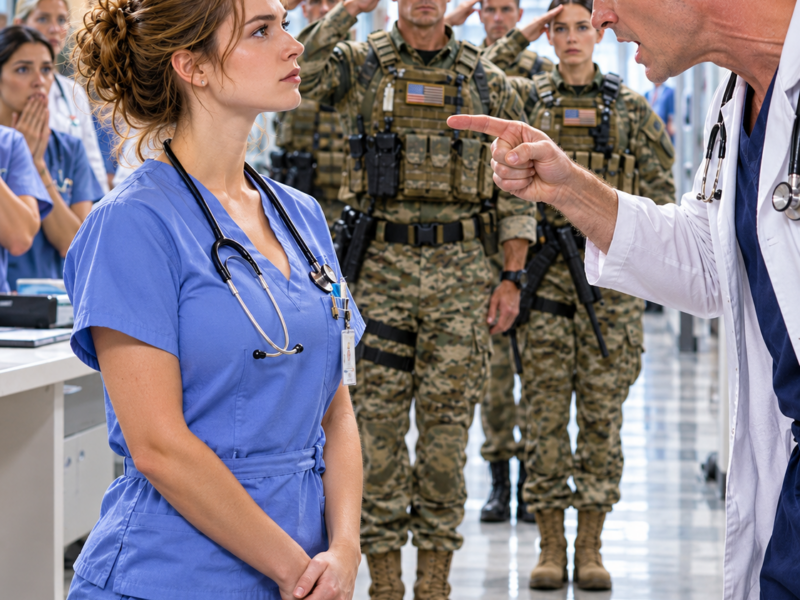
The heart monitor screamed as the trauma bay fell silent
The first thing Clara Dempsey noticed after the bleeding stopped was the silence.
Not the ordinary silence that sometimes settled over a trauma bay after a patient was stabilized. This was different. It was the stunned, uncomfortable quiet of people who had just watched their understanding of someone completely collapse.
Deputy Secretary Jonathan Cole lay on the trauma table, surrounded by medical personnel. The rapid infuser continued pushing blood into his system. A respiratory therapist adjusted the ventilator while an intern checked the patient’s monitor.
Clara kept her gloved hand near the surgical clamp.
“Pressure?”
“Coming up,” Susan Reed answered, looking at the monitor. “Seventy-eight over forty-six.”
“Better. Keep the blood moving. Don’t let the line clot.”
“Understood.”
“How’s his oxygen saturation?”
“Ninety-four and climbing.”
Clara nodded.
“Get the surgical team ready. We’re taking him upstairs.”
The patient was not out of danger. Not even close. But the immediate hemorrhage had been controlled, and that had bought the surgical team precious time.
Behind Clara, Dr. Harrison Cross stood against a supply cabinet.
His face had lost nearly all its color.
A few minutes earlier, he had been the loudest person in the building. He had commanded the trauma bay, humiliated nurses, and threatened to pull his surgical team whenever someone challenged him.
Now he couldn’t seem to find his voice.
Major Derrick Ford approached the table.
“Lieutenant, status?”
“Major, the femoral artery is temporarily controlled. He needs definitive vascular repair and exploration of the secondary injuries. He’s unstable, but transportable if we move now.”
Ford nodded.
“Do it.”
Clara looked toward the surgical team.
“Let’s move.”
The staff sprang into action.
As the gurney rolled toward the elevators, Ford stepped beside her.
“You all right?”
“Yes, Major.”
“That wasn’t my question.”
Clara gave him a brief look.
“I’m fine.”
Ford studied her face.
He knew that answer. He had heard it in field hospitals, in helicopters, and in the middle of operations when people were too exhausted to admit they were hurting.
He also knew Clara well enough not to push.
“Good to have you back,” he said.
She didn’t answer immediately.
“Good to see you too, Derrick.”
Then she followed the patient upstairs.
Behind them, the trauma bay remained frozen in disbelief.
And Harrison Cross was beginning to realize that the worst part of the morning might not be the arrival of the military convoy.
It might be the fact that everyone had seen him fail.
The operating room was ready when Clara arrived.
Dr. Michael Bennett, the senior vascular surgeon, had been called in from another procedure. He examined the temporary clamp, reviewed the patient’s condition, and immediately began organizing the surgical team.
“Who controlled the hemorrhage?”
“I did,” Clara answered.
Bennett looked at her.
“You found the vessel?”
“By touch. Visibility was poor.”
He glanced at the surgical field.
“Good work.”
He didn’t ask about her military background. He didn’t ask why she had been wearing civilian clothes when the emergency began.
He simply focused on the patient.
That was one reason Clara respected him.
Bennett understood that emergencies were not opportunities to establish dominance. They were problems to solve.
“Let’s get him through this,” he said.
Clara stayed long enough to make sure the handoff was complete.
She communicated the mechanism of injury, the suspected vascular damage, the interventions performed, and the patient’s response to blood replacement.
Bennett listened carefully.
“Anything else?”
“Watch for additional abdominal injuries. The impact pattern suggests more than the obvious wounds.”
“Agreed.”
He turned to his team.
“Let’s proceed.”
Clara stepped away from the table.
Her hands were covered in blood. Her jacket was stained beneath the disposable gown, and a small tear had appeared along one sleeve.
She looked down at herself.
Then she noticed that her hands were shaking.
Only slightly.
Enough.
She removed her gloves, washed her hands, and stood at the sink longer than necessary.
The water ran over her fingers.
For a moment, she wasn’t in Westside Memorial.
She was back in a dark ravine, hearing the distant thud of incoming fire and the strained breathing of a wounded operator beneath her hands.
She closed her eyes.
A voice interrupted the memory.
“Clara?”
She looked up.
Rachel Cobb stood in the doorway.
The master sergeant’s expression had softened.
“You with us?”
Clara turned off the water.
“Yeah.”
Rachel approached.
“I saw what you did in there.”
“You saw what everyone did.”
“Don’t do that.”
“Do what?”
“Make yourself smaller so other people can feel comfortable.”
Clara dried her hands.
“I’m not trying to make anyone comfortable.”
“Could’ve fooled me.”
Rachel leaned against the counter.
“Four years together, and you still think you have to pretend none of it happened.”
Clara folded the paper towel and dropped it into the trash.
“I don’t pretend it didn’t happen.”
“You just never talk about it.”
“There’s a difference.”
Rachel watched her for a moment.
Then she nodded.
“Fair enough.”
They stood quietly.
Finally, Rachel smiled.
“Ford wants to buy you coffee.”
“That sounds suspicious.”
“He says he has an offer.”
“That sounds even more suspicious.”
Rachel laughed.
“Come on, Lieutenant.”
By the time Clara returned to the trauma wing, the hospital had become a different place.
Federal agents occupied the corridors. Security officers controlled access to the elevators. Hospital administrators were moving between offices with phones pressed to their ears.
The staff had also begun talking.
Not whispering about Clara’s supposed cowardice this time.
They were talking about the woman who had stopped a catastrophic hemorrhage while a room full of experienced medical professionals watched.
Susan found her near the nurses’ station.
“Clara.”
“Hey.”
Susan looked her over.
“Are you hurt?”
“No.”
“Your jacket.”
“It’s fine.”
Susan shook her head.
“You know, I’ve worked here for twenty-seven years. I’ve seen people panic. I’ve seen people freeze. I’ve seen doctors make mistakes and nurses make mistakes.”
She paused.
“But I have never seen someone take control of a room like that.”
Clara looked toward the operating room elevators.
“The patient still needs surgery.”
“I know. He’s in good hands.”
Susan lowered her voice.
“I owe you an apology.”
Clara turned back.
“For what?”
“For not standing up for you yesterday. I knew Cross was wrong. I knew you were right about the medication. But I let him push you out because I was afraid of what he’d do to the rest of us.”
Clara said nothing.
Susan continued.
“I’ve been here longer than most of the doctors. I should have known better.”
Clara looked at the older nurse.
“You were trying to protect your staff.”
“That’s not an excuse.”
“No. But it’s the truth.”
Susan’s eyes filled.
“I don’t want us to work like that anymore.”
Clara nodded slowly.
“Then don’t.”
Susan gave a small, tired smile.
“You’re making it sound easy.”
“It won’t be.”
For the first time that morning, Clara smiled.
“But it can start with one person refusing to look away.”
At 12:30 p.m., hospital CEO Robert Whitmore called an emergency meeting.
The hospital board, senior administrators, and department chiefs gathered in the main conference room.
The atmosphere was tense.
A federal security liaison sat near the head of the table. Two Secret Service supervisors stood near the doors.
Linda Danvers, the HR director, was present with a folder containing Clara’s disciplinary paperwork.
Harrison Cross sat at the opposite end.
He had changed into a fresh white coat.
His hair was perfectly arranged, and he had regained enough composure to sit upright. But his eyes moved constantly around the room.
Whitmore began.
“We have a serious situation. A senior federal official has sustained life-threatening injuries, and our trauma department was involved in a major emergency response.”
He glanced at the federal representatives.
“First, I want to know the patient’s condition.”
Dr. Bennett answered.
“Deputy Secretary Cole underwent vascular repair and exploratory surgery. He is currently stable in intensive care. The next twenty-four hours remain critical, but his immediate injuries have been addressed.”
“Thank you.”
Whitmore turned to Cross.
“Dr. Cross, please explain what happened in the trauma bay.”
Cross cleared his throat.
“We received an extremely unstable patient. I began the initial response, but the situation was complicated by the arrival of the military team. Nurse Dempsey then assisted with emergency hemorrhage control.”
“Assisted?” asked one of the federal supervisors.
Cross hesitated.
“Yes. She performed the temporary clamp.”
The supervisor placed a tablet on the table.
“Would you like to review the footage?”
Cross’s face tightened.
“What footage?”
“Body-camera recordings from the agents who transported the patient.”
The supervisor tapped the screen.
The room watched.
The footage showed the gurney entering the trauma bay. It showed Cross approaching the patient, looking at the wound, and then backing away.
It showed his hands shaking.
It showed him dropping his equipment.
Then it showed Clara stepping forward, pulling him away from the table, and taking control of the emergency.
Her instructions were clear. Her movements were precise. Her voice remained steady even as the room erupted around her.
The footage ended with the patient being transferred toward the operating rooms.
No one spoke for several seconds.
Then Whitmore looked at Cross.
“Is there anything you’d like to add?”
Cross shifted in his chair.
“The footage doesn’t show the full context.”
“What context?”
“She has military experience. That gave her an advantage.”
“Does that explain why you couldn’t perform the procedure?”
Cross’s jaw tightened.
“I was trying to get the patient to an operating room.”
“While he was bleeding to death?”
“That is not a fair characterization.”
The federal supervisor leaned forward.
“Doctor, your own staff were shouting for you to intervene. You were the senior trauma surgeon in the room.”
Cross looked away.
The supervisor continued.
“Lieutenant Dempsey controlled the hemorrhage. Your staff then moved the patient to surgery. That’s what happened.”
Whitmore turned toward Linda.
“Now I want to discuss the previous day’s incident.”
Linda opened her folder.
“Dr. Cross submitted an expedited grievance against Nurse Dempsey after she refused to administer succinylcholine to a patient with suspected electrical burns.”
“Did she explain her reasoning?”
“Yes.”
“Was her concern medically valid?”
Dr. Bennett answered before Linda could.
“Absolutely.”
He opened a medical reference on his tablet.
“Electrical injuries and severe burns can create a significant risk of hyperkalemia. Succinylcholine can cause a dangerous potassium increase in susceptible patients. The concern was legitimate, and the alternative medication was clinically appropriate.”
Whitmore stared at Cross.
“Then why was she suspended?”
Cross’s expression hardened.
“Because she challenged a direct order in front of the entire team.”
Dr. Bennett shook his head.
“She raised a patient-safety concern. That’s not misconduct.”
“It undermined my authority.”
Whitmore leaned back.
“Your authority is not the purpose of this hospital, Dr. Cross.”
The words landed heavily.
Cross said nothing.
Whitmore looked at Linda.
“Is the grievance still active?”
“Yes.”
“Then I want it reviewed independently. And I want the board’s legal counsel involved.”
Cross pushed his chair back.
“This is absurd. You’re allowing a nurse to dictate surgical decisions.”
“No,” Whitmore replied. “We’re allowing qualified professionals to raise concerns when an order could harm a patient.”
He paused.
“And we’re going to investigate why this hospital has allowed intimidation to become part of its workplace culture.”
Cross’s face turned red.
“This is a witch hunt.”
The federal supervisor closed the tablet.
“No, Doctor. It’s a review of what happened.”
The investigation lasted several days.
The body-camera footage was only the beginning.
Westside Memorial’s legal department collected witness statements, reviewed medication records, examined the original incident report, and interviewed employees who had worked with Cross.
What they found was worse than the board expected.
Nurses described being shouted at in operating rooms.
Residents reported being threatened with negative evaluations when they questioned his decisions.
Several employees said Cross had used his influence over research funding to protect himself from complaints.
One nurse described an incident in which he had thrown a chart at her during a disagreement.
Another said he had repeatedly changed surgical schedules as punishment for staff members who refused to work unpaid overtime.
The complaints had been documented.
Some had even been investigated.
But each time, the matter had been quietly closed.
His grant money had made him valuable.
His reputation had made him difficult to challenge.
And the hospital had mistaken those qualities for a reason to tolerate his behavior.
Clara was interviewed twice.
She answered questions about the medication incident and the convoy emergency.
She provided her account of the events without exaggeration.
When the investigator asked whether Cross had intentionally endangered the first patient, she shook her head.
“I can’t speak to his intentions.”
“Do you believe he made a dangerous decision?”
“I believe he gave an order that I considered medically unsafe. I explained the risk and offered an alternative.”
“And when he told you to leave?”
“I left.”
“Why didn’t you report his behavior immediately?”
Clara considered the question.
“I thought the medication record and the patient’s outcome would speak for themselves.”
“Did you know he would file a complaint?”
“No.”
“Did you feel intimidated?”
Clara paused.
“Not by him.”
The investigator looked up.
“What do you mean?”
“I was concerned about the patient. I wasn’t concerned about winning an argument.”
The investigator wrote something down.
“Thank you.”
Clara stood.
As she reached the door, the investigator asked one more question.
“Lieutenant Dempsey, may I ask why you left military service?”
Clara stopped.
For a moment, she considered giving the usual answer.
Personal reasons.
A change of career.
A desire for civilian life.
All of them were true, but none told the whole story.
“I wanted a different kind of work,” she said.
The investigator nodded.
“Understood.”
Clara left.
The next morning, she found Major Ford waiting outside the hospital cafeteria.
He held two coffees.
“You’re late.”
Clara checked her watch.
“I’m five minutes early.”
“Military time. You’re late.”
She accepted the coffee.
“You’re still annoying.”
“Good to know some things haven’t changed.”
They found a table near the window.
Ford looked tired. His team had spent the previous days coordinating security and supporting the investigation surrounding the convoy attack.
“How’s Cole?” Clara asked.
“Improving. He’ll need rehabilitation, but he’s expected to recover.”
“Good.”
Ford took a drink.
“There’s been progress on the investigation.”
“On the attack?”
“Yes. The security teams are working through the evidence. I can’t give you details.”
“I didn’t ask.”
He smiled.
“Still as difficult as ever.”
Clara looked at him over her cup.
“Why are you really here?”
Ford leaned back.
“Because I want to make you an offer.”
“I figured.”
“We’re expanding the medical training program at Joint Special Operations Medical Training Command. We need an instructor who understands both combat medicine and civilian trauma systems.”
Clara said nothing.
Ford continued.
“You’d lead advanced trauma instruction for special operations medical teams. Pharmacology, hemorrhage control, evacuation medicine, clinical decision-making under pressure. You’d help build a program that teaches people to make the right decisions when the textbook isn’t sitting open in front of them.”
“Where?”
“Fort Liberty, initially. Some travel. Some training rotations.”
Clara looked into her coffee.
“Who else would be there?”
“Some of the old team. Rachel’s involved. Brooks is helping with communications and casualty evacuation training.”
She smiled faintly.
“Of course he is.”
Ford waited.
Then he said, “I know you didn’t leave because you stopped caring about the work.”
Clara’s expression changed.
“I didn’t say that.”
“No. You didn’t have to.”
He looked down at his cup.
“After Korangal, you carried a lot.”
Clara stared out the window.
The memory was not a single image.
It was a collection of moments.
The helicopter.
The ravine.
The men she had treated.
The radio calls.
The long hours without sleep.
And the three operators who had survived because she refused to stop working.
“I carried what happened,” she said quietly. “But I also carried what didn’t happen.”
Ford understood.
One of the men she had tried to save in the ravine had not survived.
His name was Daniel Mercer.
He had been twenty-three.
Clara had held pressure on his wound while the team fought to reach an extraction point. She had spoken to him when he could no longer answer. She had done everything she knew how to do.
It hadn’t been enough.
She had received the Silver Star for her actions that day.
For years, she had found that difficult to accept.
The citation described courage, determination, and extraordinary medical skill.
It did not describe the man she had failed to bring home.
Ford had never told her that she should forget him.
He knew better.
“You’re allowed to build something new,” he said.
Clara looked at him.
“Is that what this is?”
“Part of it.”
He placed a folder on the table.
“Read the offer. Take your time.”
She didn’t open it.
“You’re not going to pressure me?”
Ford smiled.
“I’ve seen you refuse orders from people much more intimidating than me.”
“That’s true.”
“Besides, I don’t need an answer today.”
He stood.
“Just don’t dismiss it because you think you have to keep proving you can do the civilian job.”
Clara looked down at the folder.
Ford touched her shoulder.
“You’ve already proved that.”
That afternoon, Clara returned to Westside Memorial for a final meeting with the hospital board.
She had not yet decided what to do.
But she wanted to hear the outcome of the investigation.
Robert Whitmore sat at the head of the conference table. Linda Danvers was beside him, along with two board members and legal counsel.
Dr. Bennett was also present.
Cross was not.
Whitmore began.
“Ms. Dempsey, thank you for coming.”
“Of course.”
“We’ve completed the initial review of the incidents involving Dr. Cross.”
Clara listened.
“The board has determined that his conduct violated multiple hospital policies. His actions toward staff, his handling of the medication disagreement, and his behavior during the federal emergency have raised serious concerns.”
He paused.
“His contract has been terminated, effective immediately. His surgical privileges have been revoked pending the completion of the external review.”
Clara nodded.
She felt no satisfaction.
Only relief that the situation had been addressed.
Whitmore continued.
“We also recognize that the hospital failed to respond appropriately when you raised a legitimate patient-safety concern. Your administrative leave is rescinded. Your employment record will reflect that the grievance was dismissed.”
“Thank you.”
Linda spoke next.
“We would also like to offer you the position of head charge nurse for the trauma wing.”
Clara looked at her.
“The position would include a substantial salary increase, administrative authority, and the ability to influence departmental training and staffing.”
Linda took a breath.
“We believe you could help us rebuild the culture of the trauma department.”
Clara remained silent.
Whitmore leaned forward.
“We need people like you.”
It was a generous offer.
It was also something Clara had never expected.
A year earlier, she might have accepted immediately. The opportunity to protect nurses from the treatment she had experienced was appealing.
But she thought about the conversation with Ford.
She thought about the old team.
She thought about what she wanted her life to look like in another five years.
“I appreciate the offer,” she said.
Linda smiled cautiously.
“Would you like some time to consider it?”
“I’ve already been considering it.”
Whitmore waited.
Clara placed her hands on the table.
“I’m going to decline.”
The room became quiet.
Linda’s smile faded.
“May I ask why?”
“Because I don’t think this is where I need to be next.”
Whitmore nodded slowly.
“Is there anything we could change?”
“No. The offer is fair.”
She glanced at Linda.
“But I don’t want to become an administrator just because I survived a bad one.”
Linda looked down.
Clara continued.
“I hope you fix the department. I hope nurses can disagree with surgeons without worrying about losing their jobs. And I hope the next person who raises a patient-safety concern gets listened to the first time.”
Whitmore nodded.
“We intend to make those changes.”
“Good.”
She stood.
“Then I wish you luck.”
Clara’s final shift at Westside Memorial was quieter than she expected.
She had not told many people she was leaving.
Word spread anyway.
By midafternoon, Susan found her at the nurses’ station, carefully organizing the contents of her locker.
“You’re really going?”
Clara looked up.
“Yes.”
“Where?”
“Military medical training command.”
Susan blinked.
“You’re going back?”
“Not exactly. I’ll be teaching.”
Susan smiled.
“That’s wonderful.”
“Maybe.”
“Don’t pretend you’re not excited.”
Clara laughed softly.
“I haven’t decided how I feel yet.”
Susan leaned against the locker.
“You know, when you first came here, I thought you were just shy.”
“I was.”
“Then I thought you were private.”
“I am.”
Susan studied her.
“But I never understood how much you were carrying.”
Clara folded a spare pair of scrubs.
“You don’t need to understand everything about someone to work beside them.”
Susan nodded.
“I suppose that’s true.”
She hesitated.
“Will you come back and visit?”
“If I’m in town.”
“Good.”
Susan reached out and hugged her.
Clara returned the embrace.
When they separated, Susan wiped her eyes.
“You’re going to make me cry.”
“You’re already crying.”
“Don’t be difficult.”
“Wouldn’t dream of it.”
Megan appeared around the corner.
“Is it true?”
Clara smiled.
“Apparently, everyone knows.”
Megan approached.
“You’re leaving?”
“Yes.”
Megan looked genuinely upset.
“But you can’t leave.”
“Why not?”
“Because you’re the person I come to when I don’t know what to do.”
Clara looked at her kindly.
“You know more than you think.”
“Not enough.”
“Nobody knows enough.”
Megan’s eyes filled.
“I learned so much from you.”
“Then keep learning.”
Clara picked up a small cardboard box.
“Ask questions. Speak up when something doesn’t seem right. And never let someone convince you that staying quiet is the same thing as being professional.”
Megan nodded.
“I’ll remember.”
Clara reached into the box and pulled out a small notebook.
It was an old pocket-sized notebook with a worn cover.
She handed it to Megan.
“Here.”
Megan looked at it.
“What’s this?”
“Notes from my first year in emergency medicine. Medication reminders, things I learned the hard way, little details people forget to teach you.”
Megan opened it.
The pages were filled with handwritten notes.
Some were practical.
Some were reminders about communication.
On one page, written in larger letters, were the words:
The patient is never an interruption to the work. The patient is the work.
Megan looked up.
“Thank you.”
Clara smiled.
“Take care of them.”
“I will.”
At 5:15 p.m., Clara walked out of the hospital carrying her box.
The late afternoon sun was bright enough to make her squint.
A black SUV waited near the entrance.
Ford stood beside it.
Rachel was leaning against the passenger door, and Brooks sat behind the wheel.
“You’re late,” Ford called.
Clara glanced at her watch.
“Five minutes early.”
“Military time.”
She shook her head.
“You people are exhausting.”
Rachel stepped forward and took the box from her.
“Welcome back, Lieutenant.”
Clara looked at her.
“I haven’t agreed to anything yet.”
“You’re standing next to the SUV.”
“That proves nothing.”
Brooks lowered the window.
“Do we need to leave without her?”
Ford looked at him.
“Don’t start.”
Clara laughed.
It was an easy, genuine laugh.
She placed one hand on the vehicle.
Then she looked back at Westside Memorial.
Through the glass entrance, she could see nurses moving between the desks. A patient was being wheeled toward imaging. Someone was talking on a phone.
The hospital was already returning to its usual rhythm.
She thought about the people she had helped there.
She thought about the people who had helped her.
And she thought about the quiet nurse who had walked into the building believing that keeping her head down was the safest way to live.
She was no longer certain that silence was protection.
Sometimes silence allowed the wrong people to control the room.
Sometimes speaking up was the only way to protect someone.
Clara turned toward Ford.
“Let’s go.”
He opened the passenger door.
“Where to, Lieutenant?”
She placed her box in the back.
“Coffee first.”
Rachel laughed.
“Still the same.”
“Some things are worth keeping.”
The training command was different from the hospital.
The buildings were larger. The hallways were quieter. The people who worked there understood the language of evacuation zones, casualty collection points, and medical readiness.
But the purpose was familiar.
People needed to learn how to save lives when circumstances were unforgiving.
Clara arrived on a Monday morning.
Her new office was modest. It contained a desk, two chairs, a computer, and a whiteboard covered with diagrams.
A framed photograph had been placed on the shelf.
It showed the old team beside the Pave Hawk.
Clara stopped when she saw it.
Ford appeared in the doorway.
“Thought you’d want that.”
She picked up the frame.
“Where did you get this?”
“Rachel had a copy.”
Clara examined the faces.
Ford.
Rachel.
Brooks.
And Daniel Mercer.
For a long moment, she said nothing.
Ford stood quietly beside her.
“Still think about him?” he asked.
“Every day.”
“Me too.”
Clara set the photograph down.
“Thank you.”
Ford nodded.
“First class starts in twenty minutes.”
“How many students?”
“Fourteen.”
“Experience?”
“Mixed. A few combat medics, several civilian paramedics, two nurses, and a physician who’s convinced he already knows everything.”
Clara smiled.
“There’s always one.”
“He’s yours.”
“Wonderful.”
Ford started to leave.
Then he turned back.
“One more thing.”
“What?”
“Don’t go easy on them.”
Clara raised an eyebrow.
“I wasn’t planning to.”
Ford smiled.
“Good.”
The classroom was full when Clara entered.
Fourteen students sat behind desks. Some wore military uniforms. Others wore civilian medical clothing.
A young medic near the front was tapping his pen nervously.
Clara placed her folder on the desk.
“Good morning.”
The room quieted.
“I’m Lieutenant Clara Dempsey. I’ll be leading your advanced trauma course.”
She wrote three words on the whiteboard.
DECISION. DISCIPLINE. RESPONSIBILITY.
Then she turned around.
“Before we begin, I want to establish something. This course is not about looking fearless. It’s not about acting tough. And it’s definitely not about proving that you’re the smartest person in the room.”
A few students exchanged glances.
Clara continued.
“Your job is to recognize what is happening, identify what matters most, and make decisions that give your patient the best chance of surviving.”
She picked up a marker.
“Sometimes that means moving quickly. Sometimes it means stopping someone from doing something dangerous.”
She looked around the room.
“If a senior physician gives you an order that you believe could harm a patient, what do you do?”
A young man near the back raised his hand.
“Follow the order and report it afterward?”
Clara shook her head.
“That could be too late.”
Another student spoke.
“Challenge the order?”
“How?”
The student hesitated.
“Explain the risk?”
“Good. Be specific. Be professional. Offer an alternative if one exists. And if the situation requires you to act immediately to prevent harm, don’t hide behind someone else’s authority.”
She placed the marker on the desk.
“Your responsibility is to the patient.”
A woman in the second row raised her hand.
“Ma’am, what if challenging the order puts your career at risk?”
Clara looked at her.
It was a question she understood.
“Then you have to decide what kind of professional you want to be.”
The room became quiet.
Clara continued.
“You can spend years building a career. You can earn titles, awards, and respect. But if you protect those things at the expense of the person lying on the table, you’ve forgotten why you came here.”
She glanced at the photograph on the shelf.
“Everything else is secondary.”
The first practical exercise began twenty minutes later.
A simulated casualty scenario involved multiple injuries, limited equipment, and conflicting reports from the field.
The students were divided into teams.
Clara watched without interrupting.
One team moved too quickly.
Another became trapped in an argument over who had authority to make decisions.
A third identified the primary injury but failed to communicate it clearly.
When the exercise ended, Clara called everyone back.
“Let’s discuss.”
The young medic who had been tapping his pen raised his hand.
“We lost time because we weren’t sure who was supposed to make the call.”
“Why?”
“Two people thought they were team leader.”
“What happened when you disagreed?”
“We stopped.”
Clara nodded.
“That happens in real emergencies. People focus so much on authority that they forget the purpose of authority.”
She wrote another sentence on the board.
Leadership exists to make the team more effective.
“Your leader should create clarity, not confusion. If everyone is waiting for permission while the patient deteriorates, something has gone wrong.”
She turned back to the students.
“Try again.”
They reset the exercise.
This time, the team communicated better.
The next scenario was harder.
A patient had injuries that made one of the requested medications unsafe. The simulated attending physician demanded that the medication be administered immediately.
The student playing the nurse hesitated.
Clara watched.
“What’s the concern?” she asked.
“The patient has a contraindication.”
“Then?”
“I need to tell the physician.”
“Go ahead.”
The student turned toward the actor playing the physician.
“Doctor, I’m concerned this medication could cause serious harm given the patient’s current condition. I recommend an alternative.”
The actor frowned.
“Just give it.”
The student swallowed.
“Doctor, I cannot administer a medication I believe is unsafe without resolving that concern. We need to reassess.”
Clara nodded.
“Good.”
The student exhaled.
“That was harder than it looked.”
“Most important things are.”
After the class, the young medic who had been tapping his pen approached Clara.
“Lieutenant?”
“Yes?”
“Can I ask something?”
“Go ahead.”
“Have you ever had to do that for real? Refuse an order?”
Clara looked at him.
“Yes.”
“What happened?”
“I was called a coward.”
He frowned.
“Seriously?”
“Very seriously.”
“What did you do?”
“I explained the medical risk, prepared a safer alternative, and refused to administer something that could have killed my patient.”
The young man nodded.
“Did they believe you?”
“Not immediately.”
“Then what changed?”
Clara thought about Westside Memorial.
“The patient survived. And eventually, the people responsible for reviewing the incident examined the evidence.”
He hesitated.
“Did you ever doubt yourself?”
Clara smiled slightly.
“Of course.”
“Even though you were right?”
“Especially because I was responsible for someone else’s life.”
The young medic looked thoughtful.
Clara continued.
“Doubt isn’t always weakness. Sometimes it reminds you to check your assumptions. But you can’t let fear of being criticized replace sound judgment.”
He nodded.
“Thank you, ma’am.”
“You’re welcome.”
He started to leave.
Then he turned back.
“One more thing. Is it true you received the Silver Star?”
Clara’s expression changed.
“Who told you that?”
“Major Ford.”
“Of course he did.”
The medic smiled.
“That’s incredible.”
Clara shook her head.
“It was a difficult day. That’s all.”
She returned to her desk.
The student left without asking anything else.
Several months later, the training command hosted an advanced medical symposium.
Military physicians, civilian emergency specialists, trauma nurses, and medical educators attended.
Clara was scheduled to deliver the closing presentation.
She had initially refused.
Ford had insisted.
“You’ve spent months teaching people how to respond under pressure,” he told her. “Now explain why it matters.”
So she agreed.
The auditorium was full.
Clara stood behind the podium and looked across the room.
She recognized several people from Westside Memorial.
Susan sat near the aisle.
Megan was beside her.
Dr. Bennett had also come.
Clara smiled when she saw them.
Then she began.
“I want to talk about something that doesn’t always appear in medical training manuals.”
She paused.
“Silence.”
The room settled.
“In medicine, silence can mean many things. It can mean concentration. It can mean that a team is listening. It can mean that a patient is stable.”
She looked across the audience.
“But sometimes silence means someone is afraid to speak.”
She described the culture she had encountered at Westside Memorial without naming every individual involved.
She explained how intimidation could make experienced professionals hesitate to raise concerns.
How junior employees could learn to prioritize approval over patient safety.
How a hospital could develop an impressive reputation while quietly allowing dangerous behavior to continue.
Then she spoke about the medication incident.
“I once worked with a surgeon who believed that questioning his orders was a sign of weakness. I disagreed. I believed that raising a legitimate safety concern was part of my responsibility.”
She paused.
“He called me a coward.”
Several people in the audience shifted.
Clara continued.
“The next day, I was asked to return to that same trauma center when a federal convoy was attacked. A critically injured patient arrived with catastrophic bleeding. The senior surgeon froze. I stepped in.”
She didn’t describe herself as a hero.
She described the team.
The people who brought blood.
The intern who responded to her instructions.
The operators who secured the area.
The surgical team that completed the repair.
“The patient survived because many people did their jobs,” she said. “Not because one person was extraordinary.”
She paused again.
“But there was a lesson in what happened.”
Her voice became quieter.
“Never confuse silence with fear. Never confuse confidence with competence. And never confuse authority with the right to be obeyed without question.”
The auditorium remained silent.
Then someone began to applaud.
The applause spread.
Clara stepped away from the podium.
She didn’t bow.
She simply nodded.
After the presentation, Susan and Megan approached her.
Susan hugged her immediately.
“You were wonderful.”
“Thank you.”
Megan smiled.
“I still have your notebook.”
“Good.”
“I added to it.”
Clara raised an eyebrow.
“What did you add?”
Megan pulled a small notebook from her bag and opened it.
On the first blank page, she had written:
Speak up for the patient, even when your voice shakes.
Clara read it.
Then she smiled.
“That’s a good one.”
Megan looked at her.
“I thought you might like it.”
“I do.”
Dr. Bennett joined them.
“Lieutenant, that was an excellent presentation.”
“Thank you, Doctor.”
He nodded.
“I wanted to tell you that the trauma department has changed.”
Clara looked at him.
“How?”
“We’ve introduced independent review for medication disputes. Nurses have a direct reporting channel for safety concerns. Residents receive additional training on team communication. And the board has finally stopped treating grant funding as a reason to ignore complaints.”
Clara smiled.
“That’s good.”
“We’re not finished.”
“You won’t be for a while.”
Bennett laughed.
“Probably not.”
He hesitated.
“There’s something else. We’d like you to return for a training workshop next quarter.”
Clara looked at Susan.
Then at Megan.
“Maybe.”
Bennett smiled.
“I’ll take that.”
That evening, Clara returned to her office.
The building was quiet.
She set her symposium folder on the desk and removed her jacket.
The photograph of the old team was still on the shelf.
She picked it up.
Four people beside a helicopter.
Four people who had believed they could handle anything as long as they stayed together.
Clara touched the frame.
She remembered Daniel Mercer.
She remembered Rachel pulling him out of the ravine.
She remembered Ford refusing to leave the last extraction position until everyone had been accounted for.
She remembered the terrible hours afterward, when the mission was over but her mind refused to accept that it was finished.
The Silver Star citation had described her actions in formal language.
It had never captured the things she still carried.
But she no longer felt that the award was a debt she had to repay.
She had done what she could.
She had saved three men.
She had lost one.
Both truths belonged to the same day.
She placed the photograph back on the shelf.
Then her phone rang.
Ford.
“How was the presentation?”
“Fine.”
“That’s all?”
“People clapped.”
“Good. Did you tell them the story?”
“Some of it.”
“Did you make yourself sound impressive?”
“No.”
Ford sighed.
“You’re impossible.”
“So I’ve been told.”
He laughed.
Then his voice softened.
“Rachel and Brooks are coming by tomorrow. We’re taking the team out for dinner.”
“Where?”
“That little place near the base.”
“The one with terrible coffee?”
“That’s the one.”
Clara smiled.
“I’ll be there.”
“Good.”
He paused.
“One more thing.”
“What?”
“I’m glad you came back.”
Clara looked at the photograph.
“So am I.”
The next morning, Clara arrived early.
She unlocked the classroom, turned on the lights, and began arranging the training materials.
Fourteen students were expected.
Some were experienced.
Some were nervous.
All of them would eventually face situations they could not fully prepare for.
Clara placed a marker on the desk and wrote the day’s lesson on the whiteboard.
WHEN THE PRESSURE RISES, REMEMBER THE PATIENT.
She stepped back.
The first student entered.
“Good morning, Lieutenant.”
“Good morning.”
More students followed.
The room filled with conversation.
Clara waited until everyone was seated.
Then she began.
“Today we’re going to work through a scenario that will make some of you uncomfortable.”
A few students exchanged nervous smiles.
“Good,” Clara said. “Discomfort is not the same as danger. Sometimes it’s where learning begins.”
She handed out the scenario sheets.
The exercise started.
A simulated casualty arrived.
The team moved.
One student made a mistake.
Another caught it.
A third hesitated before speaking up.
Clara watched carefully.
Then she stopped the exercise.
“Why did you hesitate?”
The student looked embarrassed.
“I didn’t want to challenge the team leader.”
Clara nodded.
“That’s understandable. But what was your responsibility?”
“Protect the patient.”
“Exactly.”
She walked toward the whiteboard.
“Remember this. The person with the loudest voice is not automatically the person with the best answer. The person with the highest rank is not automatically right. And the person who speaks quietly is not automatically afraid.”
She turned toward the class.
“Your job is not to protect someone’s ego. Your job is to protect the person who needs you.”
The room was completely still.
Then Clara smiled.
“All right. Reset the scenario. Let’s try again.”
The students returned to their positions.
The simulation resumed.
This time, when the team leader gave an unsafe instruction, the student spoke up immediately.
Clara nodded.
“Better.”
The team continued.
The patient was stabilized.
The exercise ended.
And Clara felt something settle inside her.
Not pride in being recognized.
Not satisfaction at having been proven right.
Something quieter.
The knowledge that the lessons she had learned through difficult years were helping someone else make a better decision.
That afternoon, Clara received an envelope from Westside Memorial.
Inside was a formal letter from the hospital board.
It acknowledged the failure to respond appropriately to her original patient-safety concerns and confirmed that the grievance against her had been permanently dismissed.
There was also a note from Linda Danvers.
Clara,
I have thought often about what you said during our final meeting. We have begun making changes, but I understand that actions will matter more than apologies. I am sorry we failed to listen when you first raised your concern.
I hope your new position brings you the purpose and satisfaction you deserve.
Linda
Clara read it once.
Then she placed it in a folder.
She didn’t need the apology to move forward.
But she appreciated that it had been offered.
She looked at the clock.
Her class was finished.
She had an hour before dinner with Ford, Rachel, and Brooks.
For once, she didn’t have to rush anywhere.
She made a cup of coffee and sat beside the window.
Outside, a group of young service members crossed the training grounds.
One of them was carrying a medical pack that looked almost identical to the one Clara had used years earlier.
She watched them disappear around the corner.
Then she opened her notebook.
On the first page, she wrote a new sentence.
The purpose of experience is not to make people afraid of you. It is to make the people around you safer.
She underlined it.
Then she closed the notebook.
That evening, the old team gathered at the restaurant.
Rachel arrived first.
She had changed into civilian clothes and looked less like the sharp-eyed operator Clara remembered, though her habit of scanning every entrance remained.
Brooks arrived ten minutes later.
Ford was last.
“You’re late,” Rachel told him.
“Five minutes.”
“Military time,” Clara said.
Ford pointed at her.
“Don’t start.”
They laughed.
For a while, they talked about ordinary things.
Rachel complained about paperwork.
Brooks described a training exercise that had gone badly.
Ford talked about the ongoing investigation into the convoy attack, though he kept the details appropriately limited.
Then Rachel raised her glass.
“To the team.”
Brooks lifted his.
“To getting everyone home.”
Ford looked at Clara.
“And to the woman who keeps refusing to admit she’s good at her job.”
Clara smiled.
“I admit it.”
“Really?”
“Yes. I’m excellent at making coffee.”
Rachel laughed.
“That’s debatable.”
They clinked glasses.
The conversation eventually turned to Korangal.
No one had planned it.
It simply happened.
Brooks mentioned the old helicopter.
Rachel remembered the day the team had first met Clara.
Ford recalled how she had insisted on carrying more medical supplies than the aircraft could reasonably accommodate.
They laughed at the memory.
Then the conversation quieted.
Daniel’s name came up.
No one rushed to fill the silence.
Clara looked at her friends.
“I still think about him.”
Rachel nodded.
“Me too.”
“I used to think that if I stopped thinking about that day, I would be forgetting him.”
Ford looked at her.
“And now?”
“Now I think remembering him doesn’t have to hurt every time.”
Brooks nodded.
“He’d have liked that.”
Clara smiled faintly.
“I think he would.”
They sat together for a while.
No speeches.
No promises.
Just people who understood what they had survived and what they had lost.
Eventually, Rachel lifted her glass again.
“To Daniel.”
They raised their glasses.
“To Daniel.”
Months later, Clara returned to Westside Memorial for the training workshop Dr. Bennett had requested.
The trauma department looked different.
The nurses’ station had been reorganized. New emergency protocols were posted on the walls. A designated staff member was responsible for documenting medication-safety concerns, and the hospital had introduced regular multidisciplinary case reviews.
Susan met Clara at the entrance.
“Look at you.”
Clara smiled.
“Look at you.”
“Still bossy?”
“Only when necessary.”
Susan laughed.
Megan appeared behind her.
“Lieutenant!”
“How are you?”
“Good. Better. Much better.”
Megan had grown more confident. She no longer apologized before asking questions, and she had begun mentoring new nurses.
Clara noticed the difference immediately.
They walked toward the conference room.
Dr. Bennett was waiting.
“Welcome back.”
“Thank you for inviting me.”
“We’re glad you’re here.”
The workshop focused on clinical judgment, communication, and responding to unsafe orders.
Clara spoke about the importance of medication review and the responsibility to question decisions when new information emerged.
She also discussed how authority could be used constructively.
“Leadership should make it easier for people to speak up,” she told the group. “If your team is afraid to tell you that something looks wrong, you don’t have a strong team. You have a quiet one.”
Dr. Bennett nodded from the front row.
After the workshop, several nurses approached her.
One young resident thanked her for explaining how to challenge a senior physician without turning the conversation into a personal conflict.
Another asked about her military service.
Clara answered briefly.
Then Megan approached with a cup of coffee.
“Still terrible,” Megan said.
Clara took a sip.
“Some traditions never change.”
They laughed.
For a moment, Clara felt completely at home.
Not because she had returned to the place where everything happened.
Because she could see that something good had grown from it.
Before leaving, Clara stopped outside trauma bay three.
The room was empty.
A fresh sheet covered the bed. The monitors were dark. The medication cart was stocked.
She stood in the doorway.
This was where Cross had called her a coward.
This was where she had refused to administer a medication she believed could kill a patient.
This was where her career at Westside Memorial had nearly ended.
And this was where she had learned that being respected by everyone was less important than doing what was right.
Susan appeared beside her.
“Thinking about the old days?”
“A little.”
“Do you miss working here?”
Clara considered the question.
“I miss the people.”
Susan nodded.
“That’s what matters.”
Clara looked at the room one last time.
Then she turned.
“Take care of them, Susan.”
“We will.”
They hugged.
Clara walked toward the exit.
Outside, the sun was shining.
A black SUV waited near the curb.
Ford stood beside it, holding two coffees.
“You’re late,” he called.
Clara checked her watch.
“Three minutes early.”
“Still late.”
She accepted the coffee.
“You’re never going to stop saying that, are you?”
“No.”
She opened the passenger door.
Before getting in, she glanced back at the hospital.
The people inside would continue their work.
Some would make mistakes.
Some would learn.
Some would save lives.
And some would one day face a moment when doing the right thing meant standing against someone more powerful.
Clara hoped they would have the courage to speak.
She hoped they would remember that a patient’s life mattered more than a surgeon’s pride.
And she hoped no one would ever again have to be called a coward for protecting someone who could not protect themselves.
She climbed into the SUV.
Ford started the engine.
“Ready, Lieutenant?”
Clara looked ahead.
“Ready.”
The vehicle pulled away from the hospital.
She had spent years learning how to survive the front lines.
Now she was teaching others how to save lives when the world around them fell apart.
And that was a mission worth keeping.
Because the strongest person in the room isn’t always the one giving orders. Sometimes, it’s the quietest person who knows when an order must not be followed.
The End.









