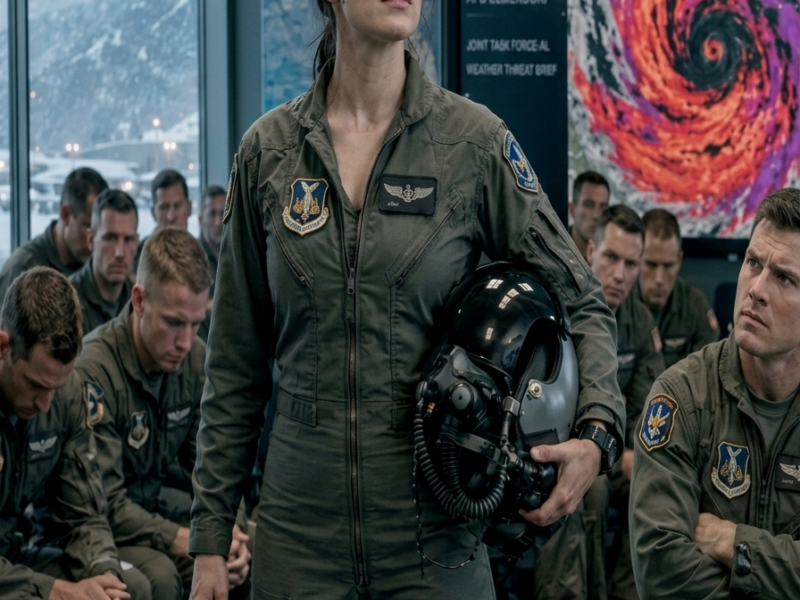
The hangar went silent when the storm warning turned red and every pilot refused the mission, until the quiet woman everyone had ignored picked up the helmet from the table and calmly said, “I will,”
Rain hammered the windows of the Oregon air base like handfuls of heavy gravel, the gale-force winds whipping off the Pacific and slamming directly into the corrugated iron of Hangar 4. Beyond the flooded tarmac, blinding sheets of mountain lightning illuminated the jagged spine of the Cascade Range, turning the ink-black peaks a ghostly, brilliant white for fractions of a second.
The emergency mission briefing had lasted less than six minutes. Major Miller had slammed the leather-bound weather log onto the briefing table, his jaw set in a rigid line of suppressed grief and quiet fury.
“Satellite telemetry confirms a microburst cell has locked over Blackwood Ridge,” Miller said, his voice flat and heavy. “Surface wind gusts are exceeding eighty knots. Icing conditions begin at eighteen hundred feet. Radar lost contact with Rescue Flight 202 forty minutes ago. Flight 203 attempted a high-altitude ingress, lost primary radio, suffered structural icing, and turned back. Current survival window for anyone on that ridge is under two hours.”
Miller swept his gaze across the room of seasoned Coast Guard and Air National Guard aviators.
“Nobody flies tonight,” he concluded, closing the red classified folder with a hollow snap. “The storm is a meat grinder. We hold until dawn.”
No one argued. The air in the room was thick with the smell of stale coffee, aviation fuel, and cold fear. Two hours earlier, Captain Thomas and his four-man crew—men who had logged thousands of flight hours over these exact mountains—had disappeared into that exact same storm. To launch another airframe into a violent, blind atmospheric vortex wasn’t a rescue operation; it was a mass suicide pact.
Then a chair scraped quietly against the concrete floor.
Evelyn Carter had spent most of the afternoon sitting alone near the far end of the maintenance bay, leaning against a stack of hydraulic fluid drums. She wore a faded, grease-stained flight jacket stripped of squadron patches, her dark hair pulled back into a tight, severe knot. She had kept to herself since arriving on a temporary transfer three weeks ago, doing quiet bench-check maintenance on turbine assemblies and speaking only when spoken to. Some of the younger pilots on the base barely knew she was still flight-qualified.
She stepped toward the briefing table, her movements slow, deliberate, and entirely unhurried.
Major Miller frowned, his eyes narrowing as she approached. “Carter. What are you doing?”
Evelyn reached out, her pale, slender hand hovering over the heavy flight helmet resting in the center of the wooden table.
“I’ll take the HH-60,” she said quietly. Her voice was surprisingly soft, yet it carried across the silent hangar with the sudden weight of a dropped iron bar.
A collective murmur rippled through the assembled pilots. Captain Davis, a veteran flight lead, stepped forward, shaking his head. “Evelyn, don’t be a fool. The downdrafts over Blackwood are dropping airframes right out of the sky. You can’t see the ridge, you can’t trust your altimeter, and the icing will weight the rotors in ten minutes.”
Major Miller stared at her, searching her face for any sign of hesitation, mania, or bravado. He found none. Her hazel eyes were calm—unsettlingly calm, like the eye of the dead hurricane sweeping over the coast.
“You understand the weather, Carter?” Miller asked, his tone dropping an octave.
“Yes, sir.”
“You understand the risk? If you go down, I cannot send a backup. You will be entirely on your own.”
“Yes, sir.”
“Then why in God’s name are you volunteering?”
Evelyn picked up the heavy helmet, cradling it in the crook of her arm, and looked Miller dead in the eye.
“Because they’re still out there.”
Nobody spoke. No one made a move to stop her as she turned and walked out of the briefing room toward the open, wind-swept tarmac.
I was assigned as her chief crew mechanic and flight engineer that night. As a senior master sergeant with twenty years on rotorcraft, I had seen my share of fearless pilots, reckless cowboys, and broken veterans. Evelyn Carter belonged to a category I had never encountered before. She didn’t look excited, nor did she look afraid. She looked like a woman executing a sentence that had been handed down years ago.
I sprinted through the torrential downpour behind her, ducking under the spinning main rotor blades of the Sikorsky HH-60 Jayhawk as the twin turboshaft engines whined to life, screaming against the roaring gale. I climbed into the left-hand crew seat, slammed the heavy side bay door shut, and pulled my headset over my ears.
“Engine numbers three and four stable,” I shouted over the intercom, my hands flying across the fuel management panel. “Barometric pressure is dropping like a stone, Ma’am. If we hit that ridge, we hit it blind.”
Evelyn adjusted her night-vision goggles, strapped her helmet chin-strap, and pulled the collective lever back with smooth, steady precision. The heavy helicopter lifted off the wet pavement, swaying violently for a split second as an eighty-knot gust slammed into our tail boom, before Evelyn countered with a sharp, instinctive foot pedal input.
She leaned into the radio mic. Her voice was a steady cadence amidst the howling tempest.
“Sergeant,” she said, without turning her head as the nose of the helicopter pitched down into the black abyss beyond the runway lights. “If I tell you to trust me tonight, don’t ask why.”
Before I could answer, the storm swallowed us whole. The amber runway lights of the Oregon air base vanished instantly, erased by a blinding wall of grey rain, ice, and atmospheric darkness.
Within eight minutes of leaving the coast, our secondary instruments began to fail. The artificial horizon flickered violently, spinning in a chaotic circle as static electrical charges built up along our composite nose cone. The radar altimeter began chiming a frantic, erratic warning—FIVE HUNDRED FEET… TWO THOUSAND FEET… FIFTY FEET—completely scrambled by the dense, iron-rich rock of the canyon walls surrounding us.
“Primary navigation is dead!” I yelled, my heart hammering against my ribs as the helicopter slammed into a severe air pocket, dropping two hundred feet in a fraction of a second. My harness bit painfully into my shoulders. “We’re losing altitude! We need to bank right, get back over the valley floor!”
The main cabin lights flickered, died, and left us immersed in the eerie green glow of the instrument panel. The radio speaker erupted into a wall of deafening, jagged static.
I reached frantically for the emergency avionics reset switch.
Evelyn’s gloved hand shot across the center pedestal, slapping my fingers away from the panel with shocking force.
“Don’t touch it,” she commanded.
“Ma’am! We’re flying blind into a mountain range!” I screamed, staring out the front windshield at absolute, pitch-black nothingness. Rain slammed against the reinforced glass so hard it sounded like automatic gunfire. “We have no radar, no horizon, and no altitude hold!”
“Wait,” Evelyn said simply.
“Wait for what?!”
She didn’t answer. She leaned forward, her face inches from the glass, her hands making microscopic, fluid adjustments to the flight stick and collective. She wasn’t looking at the dead instruments. She was feeling the air resistance through the pedals, listening to the pitch of the rotor blades as they bit into the dense, icy wind.
“I know this mountain,” she whispered softly.
A jagged bolt of lightning ripped across the dark sky directly above us, casting a harsh, blinding flash over the terrain below.
My breath hitched in my throat. Rising directly out of the darkness less than fifty yards ahead was the razor-sharp, vertical granite cliff face of Devil’s Needle. We were flying directly into a blind dead-end canyon.
“Impact! Pull up! Pull up!” I roared, reaching for the flight controls.
Evelyn didn’t pull up. She shoved the stick forward and kicked the left rudder pedal hard to the floor. The heavy Jayhawk banked at an impossible sixty-degree angle, slipping sideways through a narrow, treacherous notch between two soaring rock pillars with barely three feet of clearance on either rotor tip. The acoustic shockwave of our own engine exhaust bounced off the sheer canyon walls, roaring through the cockpit like a dying beast.
We plummeted out of the gap, falling through a dense cloud layer into a pocket of dead air beneath the storm.
And then I saw it.
Far below us, resting on a narrow, snow-dusted shelf of rock jutting out over a two-thousand-foot drop, was a tiny, flickering dot of amber flame.
“Target sighted,” Evelyn said, her voice completely devoid of excitement, as if she had expected the light to be sitting in that exact spot all along. “Deploying rescue hoist.”
It was the missing rescue helicopter from Flight 202. Its tail section had been sheared off by impact, the main fuselage resting precariously on the crumbling edge of the cliff. Thickets of thick black smoke were pouring from its crushed engine housing, illuminated by a faint hand-held emergency flare waving frantically in the storm.
Evelyn brought the Jayhawk into a rock-steady hover fifty feet above the ledge, holding the airframe perfectly level despite the ferocious mountain updrafts trying to hurl us against the rock face.
“Go down there and get them, Sergeant,” she ordered. “We have four minutes before the wind shifts and pushes us over the cliff.”
I unbuckled my harness, slid the heavy bay door back, and hooked myself to the steel hoist cable. Dropping through the roaring downwash, I descended onto the freezing, slippery ledge.
Two men were huddled inside the shattered cabin of Flight 202. One had a broken femur; the other was clutching a deep laceration across his forehead, his face covered in dried blood and soot. I worked quickly, clipping the rescue harness around the injured pilot first and signaling Evelyn to pull him up into the cabin before returning for the second man.
Within three agonizing minutes, both survivors were safely hauled through the open bay door of our helicopter. I scrambled back inside, slammed the door shut, and collapsed onto the aluminum floor, gasping for air as my lungs burned in the freezing cold.
The second survivor—the copilot of Flight 202, a veteran captain named Vance— sat propped against the cabin wall, shivering violently beneath a survival blanket. His bloodshot eyes wandered around the dim interior of the aircraft, eventually fixing on the figure sitting in the pilot’s seat.
He pushed his blanket aside and dragged himself forward on his knees until he reached the armored back of Evelyn’s seat. He reached out a trembling, frostbitten hand and grabbed her shoulder harness.
Evelyn stiffened. She slowly pulled off her helmet, letting her dark hair tumble loose around her shoulders, and turned her head to look at him.
Captain Vance stared at her face, his jaw dropping in absolute, paralyzed disbelief. His eyes went wide, his breath catching in his throat as if he were staring at a ghost rising from a grave.
“You…” Vance choked out, his voice a ragged whisper that cut straight through the drone of the engines. “You came back.”
Evelyn’s face remained an unreadable mask, but her knuckles turned white as she gripped the flight stick tighter. She said nothing.
I dragged myself over, staring between the two of them in utter confusion. “Captain Vance, what are you talking about? Do you know Lieutenant Carter?”
Vance slowly turned his head toward me, his lips trembling, his voice shaking with a terrifying, ancient dread.
“She flew this route before,” Vance whispered, staring at Evelyn’s back as she turned her eyes back toward the dark windshield. “Six years ago. The night of the Blackwood disaster.”
My blood ran cold. The Blackwood disaster was legendary in Pacific Northwest aviation lore—a classified military transport flight that had vanished without a trace during a blizzard. The entire four-person crew had been declared dead, their names carved into a bronze memorial plaque outside Hangar 1 back at the base.
“That’s impossible,” I stammered. “Everyone died on that flight. They found the wreckage two months later.”
“They found the airframe,” Vance corrected me, his eyes locked onto Evelyn with a strange mixture of awe and deep, unsettling pity. “They never found the crew. Because Evelyn didn’t die on that mountain. She walked out of the storm alone.”
The cabin fell silent, save for the deep, rhythmic thrum of the main rotors as Evelyn pulled us up into the sky, heading back toward the air base.
Vance leaned back against the bulkhead, clutching his injured arm, his eyes hollow as he looked at me. “She spent six years keeping the secret. Everyone thought she was the sole survivor. But she wasn’t.”
I swallowed hard, looking at the quiet woman piloting our aircraft through the howling night. “What secret?”
Vance took a deep, shuddering breath. “Someone else walked away from that crash, Sergeant. Someone high up in the military command who was officially declared dead to cover up what was inside that transport cargo. Someone who never left these mountains.”
The helicopter crested the coastal ridge, breaking free of the storm clouds into the quiet, rain-slicked skies above the airfield. The amber lights of the runway stretched out below like two parallel lines of glowing embers.
When we touched down on the wet tarmac, the ground crew immediately swarmed the aircraft. Fire trucks and ambulances flashed red and blue lights across the rain-soaked concrete.
Evelyn shut down the twin engines, the main rotor blades slowing to a quiet, rhythmic whistling overhead. She unbuckled her harness and stepped out of the cockpit onto the glistening runway.
Captain Vance was helped down by two paramedics, but as his feet touched the concrete, he stopped. He didn’t look at the medical tents. He didn’t look at the officers rushing over to congratulate him on his survival.
Instead, he turned his head slowly toward the far end of the airfield—toward the pitch-black, abandoned structure of Hangar 7, resting in the shadows half a mile away from the main terminal.
Vance looked at Evelyn, his voice dropping into a terrifying whisper that made the hair on the back of my neck stand up.
“He’s still here, Evelyn,” Vance whispered into the cold night rain. “He knew you would answer the call. He’s waiting for you.”
Evelyn froze in her tracks on the wet runway.
I watched her slowly remove her helmet, letting the freezing rain soak her hair and run down her pale cheeks. For the first time all night—after flying blind through a mountain canyon, defying a deadly storm, and risking her life on a sheer cliff—Evelyn Carter looked genuinely, utterly terrified.
Because the storm hadn’t been the reason she had picked up that helmet in the briefing room.
She hadn’t flown into the mountain to save Flight 202. She had flown into the mountain because she knew that after six long years in the dark, the man she had left behind on that ridge was finally coming home.
The rain showed no signs of stopping. It poured over the corrugated roofs of the airfield in a continuous, deafening drumbeat, washing oil and jet fuel across the asphalt in iridescent ribbons.
Inside the main medical bay, medics were working frantically on Captain Vance and his copilot, setting fractures and administering heated IV fluids. But I couldn’t stay inside. The look on Evelyn’s face as she had stood on the wet runway haunted me.
I walked out onto the covered walkway, drying my hands with a rag, and saw Major Miller standing near the operations desk, staring at a printout of our flight telemetry with absolute astonishment.
“Fifty feet of clearance between the Needle pillars…” Miller muttered to himself, shaking his head. “She flew an HH-60 through a needle’s eye in an eighty-knot crosswind. It doesn’t make navigational sense.”
“It makes sense if you’ve flown the route before, sir,” I said, stepping up beside him.
Miller looked up, his brow furrowing. “What’s that supposed to mean, Sergeant?”
“Captain Vance said something up there, Major. Before we landed. He said Evelyn was the pilot of the transport that went down on Blackwood Ridge six years ago. The classified flight. Operation Blue Ridge.”
Miller’s expression altered instantly. The color seemed to drain from his face, replaced by a tight, rigid mask of military protocol. He glanced around the hallway, ensuring no younger officers were within earshot, before grabbing my elbow and pulling me into his private office, slamming the door shut behind us.
“You will keep your mouth shut about Operation Blue Ridge, Sergeant,” Miller said, his voice dangerously low. “That flight was wiped from the public record under executive authority. As far as the Department of Defense is concerned, that airframe never took off.”
“Major, she survived that crash!” I argued, leaning across his desk. “And Vance claimed she wasn’t the only one! He said someone else survived. Someone who was declared dead. What was on that transport six years ago?”
Miller didn’t answer. He turned to the window, watching the rain streak down the glass. “Six years ago, Colonel Marcus Kane took off from this base carrying three experimental neural-interface guidance prototypes. His copilot was a brilliant young lieutenant named Evelyn Carter. They hit a mountain. The wreckage was found two months later in a ravine, burnt to a crisp. Forensic teams recovered two sets of remains.”
“Then who walked out?” I demanded. “Because Vance swore Kane didn’t die on that peak!”
“The second set of remains belonged to a civilian technician who was on the manifest,” Miller said, turning back to face me, his eyes dark with an unreadable emotion. “If Colonel Kane survived… if he stayed on that mountain for six years… then he wasn’t hiding from the storm, Sergeant. He was hiding from a court-martial for high treason.”
My breath caught in my throat. “Treason?”
“Kane didn’t crash because of the weather,” Miller whispered. “He brought that aircraft down on purpose to stage his own death and disappear with those prototypes. And Evelyn Carter was the only person who knew the truth.”
Before I could process what Miller had just revealed, the heavy emergency alarm on his desk began to chime—a sharp, high-pitched double-beep that signaled a security breach on the perimeter fence.
Miller hit the speaker button. “Base Security, report.”
“Sir! We have an unauthorized entry at the north gate near Hangar 7!” a security officer yelled over the speaker amid the sound of heavy static and howling wind. “Primary power to the perimeter cameras was manually cut from the inside! Someone opened the security door from the tarmac!”
I didn’t wait for Miller’s orders. I bolted out of the office, grabbing a heavy tactical flashlight and my foul-weather coat from the locker room, and sprinted out into the pouring rain toward the far northern edge of the air base.
Hangar 7 was a relic from the Cold War era—a massive, rusting steel structure with peeling green paint and boarded-up high-bay windows. It had been officially decommissioned five years ago and was used primarily for storing decommissioned engine blocks, rusted fuel bladders, and broken ground-support equipment. It sat isolated in the shadows, half a mile away from the active flight line, surrounded by a high chain-link fence topped with barbed wire.
As I approached the hangar, I saw the side pedestrian door swinging open in the wind, banging repeatedly against the steel frame with a loud, hollow metallic clatter.
I unholstered my service flashlight, clicking the high-intensity LED beam on, cutting a bright shaft of white light through the dark, torrential rain.
Fresh, muddy boot prints led off the wet concrete of the tarmac, through the open door, and straight into the pitch-black interior of the hangar. Beside those heavy, tactical boot prints were a smaller set of prints—soft, narrow flight boots.
Evelyn.
“Evelyn!” I called out, stepping into the cavernous hangar. My voice echoed off the high, curved steel ceiling, lost amidst the sound of rain hammering the roof like an infinite drum sequence. “Evelyn, get back here! Base security is on their way!”
No answer.
I advanced slowly into the dark space, sweeping my flashlight beam across rows of dusty, cloth-covered aircraft frames, abandoned tool carts, and towering stacks of wooden crates. The air inside smelled of damp concrete, old hydraulic oil, and something else—something fresh and sharp that made the hair on my arms stand up.
Ozone. And cigarette smoke.
In the center of the vast hangar floor, illuminated by a single hanging work light that swayed gently from a frayed ceiling cord, stood two figures.
Evelyn was standing rigidly, her flight jacket soaked through, her hands clenched into tight fists at her sides.
Standing ten feet in front of her was a man. He wore an ancient, faded shearling flight jacket over ragged military fatigue trousers. His face was deeply lined, covered in a thick, salt-and-pepper beard, and his skin was weathered by years of exposure to sun, frost, and high-altitude winds. But despite his wild, rugged appearance, he held himself with the rigid, terrifying posture of a senior commander.
In his left hand, he held a heavy, military-grade hard-shell briefcase, stamped with a faded red stencil: PROPERTY OF DEFENSE ADVANCED RESEARCH PROJECTS.
“You took your time, Evelyn,” the man said. His voice was raspy, dry, and deep, like two grinding millstones.
Evelyn stared at him, her chest heaving with deep, ragged breaths. “I hoped you were dead, Marcus. For six years, every time I closed my eyes, I hoped the mountain had finally finished what you started.”
Colonel Marcus Kane let out a soft, dry laugh that sent a cold shudder down my spine. “The mountain is a harsh mistress, my dear, but she honors those who respect her power. I’ve lived comfortably in that ridge bunker for six long years, waiting for the heat to die down, waiting for the right moment to retrieve the rest of the key codes.”
“You killed those three technicians,” Evelyn said, her voice shaking with a terrifying blend of rage and grief. “You pulled the fire suppression pins and locked them in the cargo bay before you slammed the stick into the slope!”
“They were collateral damage in a much larger equation,” Kane replied casually, stepping closer to her. “They were mid-level bureaucrats who didn’t understand the value of what we were carrying. Those neural guidance drives are worth eighty million dollars on the private market in Shanghai. And you… you were my ticket to freedom.”
“I gave Miller my full report six years ago!” Evelyn shouted, her voice echoing through the dark hangar. “I told them you died in the fire! I lied for you because you threatened to murder my family if I spoke the truth!”
“And you kept that secret remarkably well,” Kane said, his eyes glinting in the dim light like those of a predator watching its prey. “Until tonight. When you picked up that helmet and flew straight to my doorstep.”
“I didn’t fly out there for you!” Evelyn spat, taking a step toward him. “I flew out there to save those boys in Flight 202!”
“And yet, here we are,” Kane murmured, reaching into his heavy shearling coat and pulling out a heavy blue-steel semi-automatic pistol. He pointed it directly at her chest. “Full circle, Evelyn. You brought me the one thing I was missing to get off this base tonight.”
I stepped out from behind a stack of shipping crates, raising my tactical flashlight high, throwing the bright white beam directly into Kane’s eyes.
“Drop the weapon!” I roared, my hand reaching for my sidearm holster. “Base security is surrounding the building, Kane! You’re cornered!”
Kane didn’t even blink against the blinding light. He didn’t turn his head. He simply adjusted his grip on the pistol, his trigger finger tightening on the steel blade.
“You brought a mechanic to a ghost hunt, Lieutenant?” Kane said softly to Evelyn. “Unfortunate. He won’t survive the night.”
Before I could unholster my gun, Evelyn moved with blinding speed. She didn’t draw a weapon; she lunged forward, throwing her entire body weight directly into Kane’s chest, knocking both of them off their feet and sending them crashing hard onto the oil-slicked concrete floor.
The gun discharged with a deafening bang, the bullet ricocheting wildly off a steel girder overhead in a shower of brilliant yellow sparks.
The gunshot echoed through the cavernous metal hangar like a cannon blast, shattering two high-bay windows fifty feet above our heads. Shards of heavy glass rained down onto the concrete floor like jagged ice.
Evelyn and Kane tumbled across the oil-slicked floor in a desperate, silent struggle. Despite his age and years of isolation in the mountains, Kane possessed terrifying physical strength. He shoved Evelyn off him, his heavy boot kicking her in the ribs, sending her sliding across the wet concrete into a row of rusted tool carts.
He scrambled to his feet, wiping blood from his lip, his eyes wild as he raised the heavy pistol once more, aiming it directly at Evelyn as she gasped for air on the ground.
“You always were too sentimental, Carter!” Kane snarled, his finger tightening on the trigger.
I didn’t think. I lunged forward, throwing my heavy tactical flashlight straight at his head like a missile.
The heavy aluminum casing struck Kane squarely on his cheekbone, splitting the skin and knocking him sideways. The gun fired a second time, the heavy round tearing through the metal frame of a tool cart inches from Evelyn’s head.
Kane grunted in pain, dropping the pistol onto the slippery floor. Before he could retrieve it, I slammed into him with a full-body tackle, driving both of us hard into a towering stack of wooden crates filled with old aircraft parts.
The heavy crates collapsed around us in a chaotic avalanche of splintered wood, rusted iron gears, and thick clouds of decade-old dust.
Kane fought like a cornered animal. He drove an elbow hard into my ribs, shattering my breath, then grabbed my jacket collar and slammed my head back against the concrete floor. My vision flared with brilliant white stars, a dull roar erupting in my ears.
He stood over me, his face a twisted mask of rage, his hand reaching down to pick up his fallen weapon.
“Stay down, Sergeant,” Kane growled, raising the pistol toward my forehead.
CLANG.
A heavy steel torque wrench struck Kane across the side of his neck with bone-crushing force.
Kane reeled backward, dropping to one knee, a choked gasp escaping his throat.
Evelyn stood behind him, holding the heavy two-foot steel wrench in both hands, her hair hanging wild across her face, her eyes burning with a fierce, unyielding light.
“Get away from him, Marcus,” she said, her voice deadly quiet.
Kane slowly wiped the dark blood running down his neck, looking up at her with a terrifying, twisted grin. “You really think you can stop this, Evelyn? Look around you! The government built this base on lies! They buried Operation Blue Ridge because high-ranking generals approved the illegal sale of those neural drives! I didn’t steal them alone—I was the delivery boy!”
Evelyn’s eyes narrowed, her grip on the wrench tightening until her knuckles turned white. “I don’t care about your corporate buyers, Marcus. I don’t care about the generals. I care about the five men who died on that mountain six years ago. I care about the lives you destroyed to line your pockets.”
“They were soldiers!” Kane shouted, his raspy voice ringing off the metal walls. “They knew the risks!”
“They were my friends!” Evelyn screamed back, her voice breaking for the first time all night, revealing a deep, agonizing well of pain that six years of silence had failed to bury. “You made me live a lie! You made me carry the guilt of being the only survivor while you hid in the dark like a rat!”
Outside, the shrill wail of base security sirens began to cut through the heavy pounding of the rain. Bright red and blue emergency lights flashed through the shattered high-bay windows, sweeping across the dark hangar interior.
“Security team is at the doors!” a voice amplified by a megawatt bullhorn boomed from outside. “All personnel inside Hangar 7, drop your weapons and step into the clear with your hands on your heads!”
Kane looked toward the main sliding hangar doors, then back at the heavy black briefcase resting on the floor ten feet away. The realization hit him that his exit window was closing rapidly.
With a sudden, explosive burst of movement, Kane didn’t attack us. He dove across the floor, scooped up the hard-shell briefcase in his right arm, and sprinted toward the rear emergency exit of the hangar—a narrow metal door that led directly into the flooded drainage canals behind the airfield.
“Evelyn! The case!” I yelled, pushing myself up off the floor, holding my bruised ribs.
Evelyn didn’t hesitate. She threw the heavy steel wrench to the ground and bolted after him, her flight boots slamming against the wet concrete in rapid succession. I scrambled to my feet and followed, coughing through the thick dust hanging in the air.
Kane burst through the emergency exit, tearing out into the howling storm outside.
The area behind Hangar 7 was a desolate wasteland of flooded drainage trenches, tall security fencing, and rusted fuel storage tanks. The rain was falling harder than ever, transforming the mud banks into roaring torrents of grey water.
Kane slipped on the muddy incline of the primary drainage ditch, tumbling down into the knee-deep, rushing water at the bottom, but he clung to the heavy briefcase with a desperate, iron grip.
Evelyn slid down the muddy bank right behind him, landing in the rushing water with a splash. She lunged forward, grabbing the handle of the briefcase just as Kane tried to drag himself up the opposite slope.
“Let it go, Marcus!” she screamed over the roar of the rushing water and howling wind. “It’s over!”
“Never!” Kane roared, turning and driving a heavy, mud-caked fist into her jaw.
Evelyn stumbled back into the cold current, but she didn’t lose her grip on the case. She pulled back with all her remaining strength, dragging Kane down into the dark water with her.
They thrashed in the freezing torrent, fighting for control of the fifty-pound titanium container. Kane raised his arm to strike her again, but a sudden, terrifying sound echoed from the top of the drainage embankment.
CRACK.
A massive, forty-foot wooden utility pole, its base eroded by hours of torrential rain and floodwaters, snapped under the weight of a heavy electrical transformer mounted near its top.
The heavy wood pole collapsed downward with a deafening crash, bringing down hundreds of yards of thick, high-voltage copper electrical cables directly into the flooded drainage trench.
Live, blue electrical sparks erupted across the dark water in a terrifying, crackling web of death.
“Out of the water!” I screamed from the top of the bank, reaching out my arm. “Evelyn! Out of the water now!”
The blinding arc of blue electricity snapped across the surface of the flooded drainage trench like a violent school of light. The high-voltage copper cables hit the muddy slope fifteen feet upstream, sending a terrifying, hummed vibration through the water that made every nerve ending in my body scream in primitive terror.
Evelyn saw the danger a fraction of a second before it hit.
With a desperate, explosive effort, she didn’t try to pull the heavy briefcase away from Kane. Instead, she slammed her hands against his chest, shoving him backward into the deeper water, and used the recoil momentum to throw her body sideways, hauling herself up onto the slippery, mud-caked bank just as the electric current hit the trench.
A sickening, blinding flash illuminated the darkness.
Kane let out a choked, horrific cry as the electrical shock coursed through the water, locking his muscles in a terrifying spasm. The heavy black briefcase slipped from his paralyzed fingers, floating down the roaring drainage current toward the main river outlet.
“Evelyn! Grab my hand!” I roared, leaning down off the muddy lip of the bank, stretching my arm out as far as it could reach.
She reached up, her mud-covered, freezing fingers locking around my wrist with a desperate grip. I dug my boots into the soft earth, screaming through the pain in my cracked ribs, and hauled her up over the edge of the bank onto the gravel roadway just as the snapped utility pole fully submerged into the boiling water below.
We lay on the wet gravel side-by-side, our chests heaving, taking in deep, ragged gulps of cold rain and air as the bright blue electrical sparks continued to pop and fizzle in the flooded trench beneath us.
Down in the trench, the electrical current finally tripped the main circuit breaker at the base power sub-station. The blinding arcs died instantly, leaving behind only the sound of rushing water and howling wind.
In the middle of the flooded ditch, Colonel Marcus Kane lay motionless in the mud, half-submerged in the freezing water, his chest rising and falling in shallow, agonizing gasps. He was alive, but the severe electrical shock and hypothermia had completely broken his strength. He could do nothing but stare up at the storm-filled sky with hollow, defeated eyes.
Fifty yards downstream, the heavy titanium briefcase had lodged itself against a steel drainage grate, its bright red military stencil glinting under the sweep of incoming searchlights.
Heavy footsteps slammed against the wet gravel roadway.
Within seconds, a dozen heavily armed Air Force security officers surrounded us, their assault rifles raised, tactical flashlight beams cutting through the rain. Behind them came two armored SUVs, their doors flying open as Major Miller and a team of federal agents stepped out into the storm.
“Hold your fire! Hold your fire!” Major Miller shouted, pushing his way through the line of security guards.
He looked down at Evelyn and me lying on the gravel, then looked over the edge of the embankment at the broken figure of Colonel Marcus Kane lying in the flooded trench.
Miller stepped to the edge of the slope, looking at the floating briefcase pinned against the steel grate, then turned his eyes slowly back to Evelyn. His expression was a complex mixture of profound shock, deep military shame, and immense relief.
“Recover that case,” Miller ordered the tactical team, his voice steady once more. “Get a medical team down into that ditch. Secure Colonel Kane. Under no circumstances is he to speak to anyone outside this command chain.”
Two medics scrambled down the bank with a stretcher, while two armed guards hauled the trembling, semi-conscious Kane out of the mud. As they dragged him past us, Kane turned his head slowly, his bloodshot eyes locking onto Evelyn one last time. He didn’t speak. He didn’t have to. The look in his eyes was the look of a man who knew his ghost had finally been dragged into the light.
Major Miller walked over to where Evelyn was sitting on the wet gravel. He took off his long, dark rain trench coat and gently draped it over her shivering shoulders.
“You delivered Flight 202,” Miller said softly, kneeling down on one knee beside her. “And then you finished a flight that ended six years ago.”
Evelyn slowly pushed her wet hair away from her face, looking up at Miller with eyes that were no longer terrified, no longer haunted, but clear and fiercely resolute.
“It wasn’t a flight, Major,” she said, her voice steady and clear despite her body trembling from the cold. “It was a crime. And tonight, the manifest is finally clean.”
Miller stared at her for a long moment, then slowly nodded his head in silent, heavy agreement. “Come inside, Lieutenant. It’s time to come home.”
The dawn over the Oregon coast broke not with a sudden burst of sunlight, but with a slow, majestic clearing of the sky.
By seven in the morning, the violent atmospheric storm that had gripped the Cascade Range for twenty-four hours had completely broken apart. Long, golden rays of early morning sunlight cut through the retreating storm clouds, reflecting brightly off the flooded runways and damp evergreen trees surrounding the base.
Inside the briefing room of Hangar 1, the thick scent of fresh coffee replaced the stale air of the night before.
I sat near the window, my shoulder wrapped in a tight tensor bandage, sipping hot coffee from a foam cup as I watched the morning ground crew tow our battered HH-60 Jayhawk back into the main maintenance bay. The aircraft was covered in mud, soot, and structural ice remnants, but its rotors were whole—a silent, iron testament to a night that should have killed us all.
The door to Major Miller’s private office opened quietly.
Evelyn Carter stepped out into the hallway. She had changed into a clean, crisp operational flight suit stripped of any grease or mud. Her hair was neatly combed, her posture erect and proud. For the first time since I had met her three weeks ago, the dark, heavy shadows beneath her eyes were gone.
Beside her walked two men in tailored charcoal suits—federal investigators from the Department of Defense Inspector General’s office. One of them carried the black titanium briefcase, now secured with official heavy red evidence seals. They shook Evelyn’s hand with profound respect before turning and walking out of the building toward a waiting transport plane on the tarmac.
Major Miller stood in his doorway, watching them leave, before motioning for me to join them.
“How are the ribs, Sergeant?” Miller asked as I stepped into the room.
“They’ll heal, sir,” I said with a faint grin. “What about Colonel Kane?”
“He was airlifted to a secure military medical facility in San Diego two hours ago,” Miller said, leaning back against his desk, holding a thick stack of official clearance documents. “He’ll recover from the shock. But he will spend the rest of his life inside a federal maximum-security brig. The evidence recovered from that briefcase has already triggered seven high-level arrest warrants in Washington.”
Miller looked down at the documents on his desk, then looked up at Evelyn, his expression softening into one of deep respect.
“Official press release goes out at noon,” Miller continued. “The official record of Operation Blue Ridge is being formally corrected. The names of the four crew members who died on Blackwood Ridge six years ago are being restored to the military honor roll with full congressional commendations. And your name, Lieutenant Carter, has been completely cleared of all flight negligence charges.”
Evelyn stood quietly, taking in his words. She didn’t cheer. She didn’t celebrate. She simply let out a long, quiet breath—the breath of a woman who had carried a mountain on her shoulders for six long years and was finally setting it down.
“Thank you, Major,” she said softly.
“Don’t thank me, Carter,” Miller replied, shaking his head. “You’re the one who picked up the helmet when everyone else was looking at the floor. You’re the one who flew back into the fire.”
He pulled a blue velvet case from his desk drawer and pushed it across the polished wood toward her. Inside rested a newly minted Distinguished Flying Cross—the nation’s highest award for extraordinary aerial achievement.
Evelyn stared at the glowing gold and blue medal for a long moment, then gently reached out and closed the velvet lid.
“I don’t need a medal, sir,” she said quietly. “I just needed to bring them home.”
Half an hour later, Evelyn and I walked out onto the high observation deck overlooking the main runway.
The morning air was crisp, cool, and filled with the fresh scent of damp pine needles from the mountains. Far off in the distance, the soaring granite peak of Devil’s Needle stood tall against the bright blue sky, its snow-capped summit glistening like diamonds in the morning sun. The terrifying monster of the night before was once again just a mountain.
Evelyn leaned against the aluminum guardrail, her face turned toward the warm sunlight, closing her eyes as the soft morning breeze pulled at her hair.
“What’s next for you, Lieutenant?” I asked, leaning beside her, taking a sip of my coffee. “With your record cleared, you can have any flight assignment in the country. Pensacola, San Diego, Kodiak… name it.”
Evelyn opened her eyes, looking out over the endless green canopy of the Oregon forest stretching all the way to the blue waters of the Pacific Ocean.
“I think I’ll stay right here for a while,” she said, a small, genuine smile finally touching her lips—a real smile that reached all the way to her eyes. “The weather in Oregon can be rough… but on days like this, the visibility is endless.”
I looked out at the bright horizon, listening to the soft thrum of a departing Coast Guard aircraft lifting off into the clear blue sky.
“Endless visibility,” I agreed softly. “It’s a damn good day for flying.”
The end.









