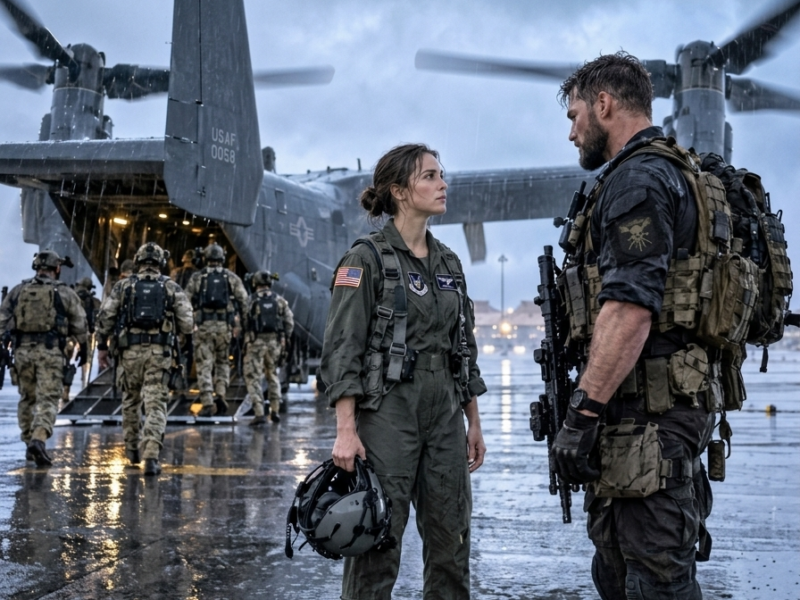
The hangar fell silent when I stumbled onto the flight line at Naval Air Station Whidbey Island, and the SEAL commander laughed in front of everyone, “You want to fly that monster?”
The hangar fell silent when I stumbled onto the flight line at Naval Air Station Whidbey Island, and the SEAL commander laughed in front of everyone.
“You want to fly that monster?” Commander Jack Mercer said, his voice echoing over the rhythmic hum of auxiliary power units, power tools, and the cold Pacific wind blowing off the Salish Sea. He stood beside the nose of the massive airframe with his arms crossed over his chest, his flight suit faded at the shoulders, his eyes hard and practiced. Around him, three members of his detachment snickered, leaning against ground support equipment.
He stopped laughing, though, when I climbed into the cockpit carrying the secret that had brought me there.
The aircraft was an old MH-53E Sea Dragon, a massive, tri-engine machine with scars across its dark gray fuselage, oil-stained sponsons, and a dark reputation that had outlived several pilots. It sat at the far end of line bay four, isolated from the sleek MH-60S Seahawks lined up neatly nearby. Nobody volunteered for it anymore. In the naval aviation community, airframes earned reputations, and this specific tail number—164782—was known as a graveyard.
That morning, Mercer was watching his crew prepare another aircraft for a Joint Special Operations exercise set for the following week. When I approached with my flight gear slung over my shoulder and my helmet bag tight in my hand, he hadn’t expected a five-foot-five female lieutenant with a spotless record and no combat deployments to walk up to the deadliest rotary platform in the inventory.
“You’re new,” Mercer said, turning his whole body toward me, stepping into my path with the easy dominance of a man who owned every square foot of the tarmac.
“Yes, sir,” I answered, keeping my spine straight and my chin level. “Lieutenant Maya Vance reporting.”
“Then stay new.”
A few men chuckled, and I felt heat crawl up my neck. I had spent years being the quiet one, the pilot who spoke softly in briefings, kept her head down during mess hall banter, and never fought for attention or praise. My instructors back at Pensacola called me meticulous, almost to a fault. They thought I lacked killer instinct. They didn’t understand that my precision wasn’t fear—it was preparation.
Because I knew something they didn’t.
Three years earlier, my father, Commander Arthur Vance, had died flying this exact aircraft. The official Navy Mishap Investigation Report concluded that he had suffered spatial disorientation during a low-altitude night mine-countermeasures mission off the coast of Alaska, leading to a controlled flight into terrain. Case closed. Pilot error.
Unofficially, weeks before he crashed, he had warned his upper command structure that something was deeply wrong with the Sea Dragon’s flight controls—specifically the integrated digital automatic flight control system and the mechanical linkages running through the tail pylon. He told them the aircraft was overriding human inputs under specific heavy-load configurations.
His final, detailed technical report disappeared two days after the crash. The command claimed it had never been submitted.
I had never believed their explanation. I knew how Arthur Vance flew. He was a mechanical engineer before he earned his wings. He didn’t get disoriented; he read instruments in his sleep. That was why I had transferred through three different squadrons, pulled every favor available in Bureau of Naval Personnel, and requested this exact assignment.
Not for revenge. For the truth.
Mercer stepped closer as the ground crew backed away to pull fuel lines. “The beast hasn’t flown in months,” he said, tapping a heavy boot against the left main landing gear tire. “She’s a hangar queen. A maintenance nightmare. Half the flight control sensors are legacy systems we don’t make parts for anymore.”
“I know,” I said.
“And you think you’re the one?” Mercer asked, his eyes narrowing as he scanned my uniform, taking in my fresh patches. “You think you can handle seven rotor blades and thirty-five thousand pounds of angry metal when the hydraulic lines start sweating?”
I looked at him, refusing to blink under the weight of his stare. “No, sir. I think I can follow the checklist and fly the aircraft.”
He smiled coldly, a sharp, humorless curve of his lips. “Good answer. Humility keeps you alive. Arrogance gets you buried in Puget Sound.”
Before the tension could break, a lead mechanic shouted from the right side of the fuselage, his voice tight with sudden panic. “Hydraulics are dropping! Primary system two is losing pressure!”
Everyone froze. Inside the cockpit, a harsh warning horn began to chime, its shrill tone bouncing off the concrete walls of the hangar. Red and amber caution lights began flashing across the Master Warning Panel.
Mercer cursed, turning around fast. “Shut it down! Kill the APU! Clear the line!”
I stepped past Mercer, stepping onto the boarding ladder and leaning into the cockpit. I stared through the thick windshield at the instrument cluster. The dual hydraulic pressure gauges were cycling violently—sweeping from three thousand pounds per square inch down to zero, then spiking back up in rhythmic, four-second intervals. It wasn’t a fluid leak. A physical breach would cause a steady, irreversible drop to zero. This was an electronic pulse overriding the valve relays.
It was a pattern I had seen once before. Hand-drawn in blue ink, sketched across the margins of my father’s personal leather-bound logbook, which sat hidden in my duffel bag in my quarters.
“Don’t shut it down,” I whispered.
Mercer turned sharply, grabbing the edge of the cockpit door. “What did you say?”
“The system isn’t failing,” I said, my voice cutting through the rising noise of the alarm. “It’s a false bypass signal coming from the main rotor pylon control box. The fluid pressure is fine. It’s an artificial lock.”
Mercer stepped up the ladder toward me, his frame blocking the light. “You’re telling me the entire maintenance team is wrong? That my chief tech doesn’t know his own aircraft?”
“I’m telling you my father saw this exact electrical loop three years ago,” I said, looking him dead in the eye.
His face changed. Only for a second. The cold confidence slipped, replaced by a sudden, razor-sharp stillness. The color drained slightly from his weathered cheeks. But I saw it.
“Get out of the cockpit,” Mercer said quietly, his tone no longer condescending, but dangerously low.
That was when I knew he remembered something. That was when I knew Commander Jack Mercer hadn’t just known my father—he had been there when the report vanished.
I didn’t step down. Instead, I swung my leg into the pilot seat, pulling my harness straps over my shoulders.
The crew stared up from the flight line in complete silence. The ground chief dropped his wrench onto the asphalt with a metallic clatter.
Mercer grabbed the sides of the ladder, his knuckles turning white. “Vance, you are disobeying a direct order. You are not qualified on this specific tail unit yet. You are not flying this.”
I reached for the helmet, pulling it over my head, snapping the chin strap, and looking down at him through the clear visor. “My father said the same thing about the person who sabotaged his aircraft. He said they were terrified of what would happen if the rotors started turning.”
Nobody moved. The entire hangar seemed to shrink around us, the air thick with the smell of JP-5 jet fuel and coastal ozone.
Mercer slowly released his grip on the ladder. He took one step back, his eyes fixed on me with an intensity that felt like a physical weight. He didn’t call base security. He didn’t pull his sidearm. He just stood there, weighing options in his head.
“Start the engines,” I said into the cabin intercommunication system.
He should have stopped me. He had the authority, the rank, and the physical force to pull me out of that seat. Instead, he stepped back, raising his hand slowly to give the ground crew the signal to clear the rotor arc.
The Sea Dragon roared to life, its massive T64 turboshaft engines spooling up with a deafening, metallic scream that shook loose years of dust from the steel beams of the hangar ceiling. The floor vibration traveled straight up through my boots and into my spine.
As the massive main rotor blades began to rotate overhead, casting heavy shadows across the cockpit instruments, my eyes caught something unusual down near the collective stick.
A tiny, non-standard inspection panel beneath my seat was missing its factory safety wire. The flathead screws holding it in place were freshly scratched, revealing shiny aluminum under the dark grey primer. It had been replaced recently.
I leaned down while keeping my left hand firm on the collective controls. Reaching down with two fingers, I slid the loose plate back an inch.
Roughly scratched into the metal frame underneath, etched with a sharp combat knife or a steel scribe, were three handwritten words. I recognized the jagged, hurried script instantly.
Trust no commander.
My father’s handwriting. Left behind inside the very machine that took his life.
I lifted my head and looked at Mercer through the thick cockpit glass. He wasn’t watching the rotor head or the instruments. He was staring directly at the floor of the cockpit, right where my hand had just been.
And for the first time that morning, the most feared man on the flight line looked afraid.
Then my radio headset crackled with a sudden, sharp burst of static. The frequency wasn’t the tower, and it wasn’t the ground control channel. It was an encrypted, point-to-point tactical line.
A voice, distorted by a scrambled synthesizer, whispered into my ears: “If you can hear this, your father wasn’t the only one they buried.”
I stopped breathing. My heart hammered against my ribs like a trapped bird.
Outside, Mercer took a step toward the nose of the aircraft, raising his hand toward his radio belt.
And somewhere deep inside the mechanical heart of the roaring aircraft beneath my feet, something heavy and metal clicked into place.
The click was mechanical, crisp, and terrifying. It reverberated through the flight controls, vibrating directly into my boots and the grip of the cyclic stick in my right hand. Instantly, the heavy hydromechanical flight system shifted. The sea of digital displays on the instrument panel flickered once, died for a split second, and then rebooted into a diagnostic interface I had never seen in any Navy flight manual.
Outside, Mercer saw the change in the aircraft’s profile before I could react. The massive seven-bladed main rotor swept through the air, but the pitch of the blades altered automatically, biting into the thick coastal air with a deep, pulsing thump that shook the surrounding ground vehicles.
Mercer pulled his radio from his tactical vest, his mouth moving rapidly as he yelled into his microphone. Around him, the flight line crew panicked. Ground crewmen grabbed chalks and tiedown chains, backing away from the storm of rotor wash that was kicking up dust, gravel, and sea salt off the tarmac.
“Vance, abort! Shut down engine three now!” Mercer’s voice finally burst through the primary radio override channel, cutting over the eerie whisper that had just chilled my blood.
“Sir, the control linkages are locking!” I shouted back, fighting the stick.
It wasn’t a lie. The cyclic stick was resisting my inputs, stiffening as if held by invisible hydraulic clamps. The aircraft was taking control of itself, drawing power from the secondary electrical bus.
“He’s lying to you, Maya,” the mysterious voice came back on the encrypted channel. It was clear now, the synthesizer masking tone dropping just enough to reveal a faint, breathless rasp. “Look at the fuel cross-feed selector. Look at what Arthur left you.”
My eyes darted to the overhead console. The fuel management panel was standard issue, except for a small blue toggle switch marked AUX X-FEED that had been hard-wired into the primary fuel lines. It was wrapped in vintage electrical tape—the same red vinyl tape my father used in his home garage.
My mind raced. Three years ago, my father didn’t just crash; he was erased. The Navy told my mother and me that his body had been swept away by the brutal tides of the Gulf of Alaska. They held an empty-casket funeral at Arlington. I had spent thirty-six months believing he was resting at the bottom of the ocean.
“Who are you?” I demanded out loud, ignoring Mercer, who was now climbing the boarding ladder again, his face twisted in fury.
“A ghost who ran out of time,” the voice replied. “Pull the emergency breaker on panel B-4. If you don’t, Mercer’s boys will trigger the remote engine kill, and you’ll never leave the deck.”
I didn’t hesitate. I reached over my right shoulder, found the square circuit breaker labeled FLT SYS AUX, and popped it out with my thumb.
The cockpit went dark for a fraction of a second before the backup battery kicked in. The mechanical lock on the cyclic stick snapped open. The Sea Dragon was fully mine again.
Outside, Mercer reached the cockpit door, pulling his body up onto the narrow ledge. He pounded his fist against the plexiglass window, shouting words I couldn’t hear over the thunder of the three T64 engines. He reached for the exterior emergency canopy release latch.
If he pulled it, the canopy would jettison, and I would be dragged out of the seat before I could get off the deck.
I grabbed the collective stick with my left hand, twisted the throttle to full military power, and pulled back sharply.
The 33-ton helicopter surged upward.
The sudden shift in G-force tore Mercer’s grip from the ladder frame. He slipped, falling eight feet to the asphalt below, rolling gracefully like the trained combat operative he was, coming up on one knee. His cap was blown away by the massive downwash of the rotors, revealing short-cropped gray hair and a scar that ran from his ear down to his collar.
The ground crew scattered like leaves in a gale. The Sea Dragon lifted ten feet, twenty feet, fifty feet into the foggy grey sky of Whidbey Island.
“Base tower, this is Navy Five-Seven-Eight, experiencing emergency system malfunction, departing airspace to the west,” I lied into the main radio, keeping my voice as flat as possible.
“Five-Seven-Eight, Whidbey Tower, negative! You are not cleared for departure! Return to pad immediately!” the air traffic controller screamed over the channel.
In the background of the tower’s transmission, I could hear sirens beginning to wail across the naval air station. Red emergency lights were flashing along the runways below. Mercer was already on his feet, sprinting toward a black SUV parked near the operations hangar.
“Heading two-seven-zero,” the voice on the private radio instructed. “Stay low. Get beneath the AN/FPS-117 radar sweep from the island’s north point. Follow the Strait of Juan de Fuca.”
I dipped the nose of the Sea Dragon. The massive machine responded with a heavy, muscular surge, accelerating hard toward the dark waters of Puget Sound. The mist closed in around the windshield, swallowing the grey concrete of the air station behind me.
My hands were shaking on the controls. Sweat was dripping down the back of my neck, soaking into the Nomex fabric of my flight suit.
“I need answers,” I said into my mask, keeping the aircraft fifty feet above the dark, white-capped waves. “Now. Who are you, and how did my father’s writing get under that seat frame?”
A long pause filled the headset, broken only by the rhythmic static of an unmonitored military channel.
“Your father built a fail-safe into Tail 782,” the voice finally said. “When he discovered what Commander Mercer’s team was using these heavy-lift platforms for, he knew they would silence him. They weren’t flying mine-countermeasure sweeps in Alaska three years ago, Maya. They were hauling black-budget cargo out of unregistered sites in the Aleutian chain.”
My stomach dropped. “What cargo?”
“Classified materials. Unmarked weapons. And money. Millions of dollars moving through dark channels to fund operations that no congressional committee ever authorized. Mercer wasn’t just a SEAL commander; he was the logistics chief for a rogue network within the Defense Intelligence Agency.”
“And my father found out.”
“Your father refused to sign off on the flight logs,” the voice corrected. “He tried to ground the entire squadron. When they realized he was going to the Inspector General, they tampered with his flight control computer during a night flight off Kodiak Island. They thought the sea would swallow the evidence.”
“Then how did this aircraft survive?” I asked, looking around the cockpit, feeling a cold horror wash over me. “Why is Tail 782 still here?”
“Because your father didn’t crash,” the voice whispered. “He ditched it in shallow water off a remote island. He survived the impact. The Navy recovered the airframe months later in secret, refurbished it, stripped the serial numbers, and re-issued it to Whidbey to bury it in plain sight. They thought no one would ever connect the dots.”
I gripped the cyclic stick tighter. “If my father survived the ditching… where is he?”
The radio went dead silent for five long seconds.
“Look inside the glove compartment to your right,” the voice said softly. “The key to the access panel underneath your seat is taped behind the emergency checklist.”
I kept my left hand on the flight controls, monitoring our altitude as we banked around a wall of thick fog near San Juan Island. With my right hand, I reached across the center console, opened the small metal glove box, and pulled out the worn laminate checklist.
Taped to the back was a small, brass tubular key.
Down below us, the dark green canopy of a dense, uninhabited island appeared through the mist.
Suddenly, my radar warning receiver lit up with a high-pitched electronic scream. A lock-on signal.
“Warning. Threat detected,” the automated voice of the threat system announced.
I glanced at the multi-function display. Two MH-60S Seahawks were rising fast out of NAS Whidbey Island, flying hard on my intercept vector. And behind them, moving at high speed along the water, was a naval fast-assault craft.
Mercer wasn’t calling the authorities. He was hunting me down himself.
The warning tones in my headset grew sharper, changing from a periodic sweep to a steady, solid whine. Mercer’s interceptors were painting my airframe with target-acquisition radar. They weren’t just trying to track me; they were preparing to force me down—or knock me out of the sky.
“Five-Seven-Eight, this is Commander Mercer leading flight Bravo-One,” his voice boomed over the tactical channel, completely dropping any pretense of flight safety. “You are piloting an unauthorized, compromised military asset over restricted airspace. Land immediately on the beaches of Cypress Island or we will engage.”
“He won’t shoot over public waters,” I muttered to myself, trying to convince my own racing heart.
“He will,” the voice on the secret channel warned instantly. “Mercer doesn’t operate under standard Rules of Engagement. He can frame your shoot-down as an active pilot hijack of a nuclear-capable or weaponized platform. You have three minutes before those Seahawks get into missile range. You need to put her down in the treeline at the northern tip of Orcas Island.”
“Put an MH-53 down in a dense forest?” I yelled into the mic. “That’s a suicide landing! The main rotor diameter is seventy-nine feet! The blades will disintegrate against the Douglas firs!”
“You don’t have a choice, Maya. There is an abandoned World War II radar station at Point Lawrence. The canopy has an old clearing. If you can slide her into the cut, the trees will block their thermal imaging and radar sweep.”
I looked out the left side of the bubble canopy. Through the swirling gray sea fog, the dark, jagged shape of Orcas Island rose like a sleeping leviathan out of the freezing waters of the Sound. The weather was deteriorating fast; rain was starting to streak across the plexiglass, drawn into long, violent lines by the slipstream.
“Holding altitude at three hundred feet,” I announced to the empty cockpit, reverting to the mechanical discipline my father had drilled into me since I was a child. “Lowering gear. Setting collective.”
Behind me, the two Seahawks burst through the fog bank, their twin engines roaring as they banked hard to cut off my escape route to the west. I saw the flash of an orange marker flare fired across my nose—a warning shot.
I slammed the cyclic forward, dropping the Sea Dragon’s nose. The massive thirty-five-ton helicopter plummeted toward the dark tree canopy below.
The trees rushed up to meet us at over one hundred knots. The dark green needles of massive, ancient pines filled the windshield. The ground crew at Whidbey always called the Sea Dragon a heavy, clumsy beast, but in that moment, I felt every pound of its momentum. I pulled back on the cyclic at the last possible second, flaring the nose up to bleed off airspeed while pulling full collective to cushion the drop.
CRASH.
The tips of the giant composite rotor blades clipped the top branches of the outermost Douglas firs with a series of explosive thuds. Wood splintered, needles exploded like green dust into the downwash, and the airframe bucked violently beneath me. The force tore the cyclic stick almost out of my hands, but I held on with everything I had, wrestling the giant machine down through the tree line into a narrow, muddy clearing surrounded by crumbling concrete ruins overgrown with moss.
The wheels hit the deep mud with a heavy, bone-jarring impact. The suspension compressed to its limits, then rebounded.
I immediately pulled the fuel shutoff levers, cutting power to the three engines. The deafening roar of the turboshaft powerplants died away, replaced by the slowing, rhythmic swish-swish-swish of the massive rotor blades overhead as they coasted down to a halt, slicing through the mist and rain.
Silence settled over the cockpit. Heavy, suffocating silence.
Outside, rain pattered against the glass. The scent of crushed pine needles, hydraulic fluid, and hot engine oil filled the cabin.
Through the high trees overhead, I heard the faint, distant thudding of the two Seahawks circling high above the fog layer, searching blindly with their surface radar. The dense forest and the thick weather were holding for now.
My hands were bleeding where the harness strap had chafed against my palm during the impact. I was breathing in short, jagged gasps.
“Good landing,” the voice whispered through my helmet. “Your father would have been proud of that drop.”
“Who are you?” I demanded, snapping off my flight helmet and letting it fall to the floorboards. “Tell me right now, or I swear to God I walk out into that woods and let Mercer take me.”
A soft, sad laugh came through the radio headset sitting on the floor.
“Reach down, Maya. Use the key. Open the panel under the seat.”
I grabbed the small brass key I had pulled from the glove compartment. I unbuckled my four-point shoulder harness, slid out of the armored pilot seat, and knelt on the cold aluminum deck of the cockpit floor.
I inserted the key into the small lock box concealed beneath the scratched inspection panel. It turned with a heavy metallic snap.
I lifted the cover plate.
Inside was not a collection of illegal documents, a hard drive, or stolen money.
It was a hardened military-grade digital flight recorder—a “black box”—custom-fitted into the structural frame of the helicopter. And next to it lay an old, tarnished dog tag attached to a silver chain, covered in dried sea salt and rust.
I reached down with a trembling hand and lifted the dog tag into the light filtering through the cockpit windshield.
The name stamped into the stainless steel read:
VANCE, ARTHUR E.
USN / O-5
My breath hitched in my throat. Tears blurred my vision, stinging my eyes. “This is his…”
“He didn’t leave that behind as a memorial, Maya,” the voice said, no longer coming from the radio speaker on the floor, but from a small portable tactical speaker mounted inside the bulkhead behind my head.
I turned around slowly, my heart stopping.
The rear cabin door that led from the cockpit back into the long, dark cargo hold of the Sea Dragon clicked open.
A tall man stepped out of the shadows of the hold.
He wore a dark waterproof jacket, his left arm supported by a rigid carbon-fiber brace. His face was weathered, deeply lined by sun and salt, and covered in a thick, silver-grey beard. His right eye was clouded over with white scar tissue that stretched up into his hairline.
He looked older, broken, and thin. But his eyes—his good left eye—was the exact same shade of pale blue as mine.
I stood up, backing against the pilot console, unable to form a word. My knees felt weak, ready to give way beneath me.
“Hello, Little Bird,” Arthur Vance said quietly, his voice raspy and broken, using the nickname he hadn’t spoken since I was twelve years old.
“Dad?” I choked out, the word barely a breath.
He took a slow, painful step forward, his eyes filling with tears as he looked at me in my flight suit. “You shouldn’t have come looking for me, Maya. I spent three years trying to keep you safe from this airframe.”
“You’re… you’re alive,” I sobbed, closing the distance between us and throwing my arms around his shoulders, burying my face into his jacket. He smelled of sea salt, pine, and engine grease—the smell of my childhood. He wrapped his right arm around me, holding me tight, his body shaking with quiet, long-suppressed grief.
“I had to die, Maya,” he whispered into my hair. “If Mercer knew I survived that crash off Kodiak, he would have come for you and your mother to force me out of hiding. I lived in the woods, on the outer islands, working with a small group of retired intelligence officers who knew what Mercer was doing.”
I pulled back, looking at his scarred face. “The voice on the radio… that was you?”
“That was me,” he nodded, reaching up to gently touch my cheek with his weathered fingers. “When I saw your transfer request hit the Whidbey Island roster last month, I knew you were trying to finish what I started. I tried to pull strings to reject your assignment, but Mercer overridden it. He wanted you here. He wanted to watch you, to make sure you didn’t know anything.”
“He knows now,” I said, looking back toward the cockpit window. “He saw me find the etching under the seat. He pursued us with two armed Seahawks and an assault boat.”
My father’s expression darkened, the warmth leaving his eye, replaced by the cold, tactical focus of a senior naval officer.
“He didn’t just pursue us to stop you,” my father said, turning toward the black box mounted beneath the pilot seat. “He pursued us because inside that recorder is the entire encrypted ledger of Mercer’s network—every transfer, every weapon shipment, every name in the Pentagon that took a bribe to look the other way.”
Suddenly, the dense woods around the helicopter echoed with the deafening, crackling sound of a high-powered loudspeaker.
“Arthur! Maya!” Mercer’s voice echoed through the trees, heavy, distorted, and close. “I know you’re in there! You’re surrounded by two squads of special warfare operators! There is nowhere left to fly!”
The sound of Mercer’s voice via the loudspeaker rattled the thin aluminum skin of the Sea Dragon. Outside, the rain was coming down harder, hammering against the outer hull like thousands of tiny steel ball bearings.
My father didn’t panic. He moved with a quiet, deliberate speed that showed he had rehearsed this exact scenario in his head for three years. He reached into his coat, pulled out a ruggedized Panasonic Toughbook laptop, and connected a thick data cable directly into the digital recorder I had just unlocked beneath the seat.
“How close are they?” I asked, looking out the narrow cockpit side windows. The forest around us was thick with heavy fog and towering fir trees, but I could see the faint green glow of tactical laser sights sweeping through the mist.
“They dropped by fast-rope from the Seahawks two miles south while we were landing,” my father said, his fingers flying across the keyboard as lines of code and encrypted file directories scrolled down the bright screen. “They’re using night-vision and thermal optics. They’ll have the perimeter completely sealed in less than five minutes.”
“Dad, we don’t have weapons,” I said, looking around the empty cargo hold. The MH-53E was a mine-countermeasures platform, not an attack helicopter. The door-mounted .50 caliber machine guns had been stripped before the aircraft was parked in line bay four. “We have two flight helmets and a signal flare kit.”
“We have something better,” my father said, a ghost of a smile touching his scarred lips. “We have the original control software.”
He tapped a final key on the laptop. A bright green progress bar appeared on the screen: TRANSFERRING FILE ARCHIVE TO DISPERSAL NETWORK [84%]
“What are you doing?”
“I’m uploading the entire master file—the black-budget transactions, the altered flight logs, the murder orders for my crew—directly to the secure servers of the Naval Criminal Investigative Service and the Department of Justice,” he said, keeping his eye on the screen. “It takes three minutes to complete the satellite link transmission through the aircraft’s high-gain antenna array.”
“Mercer isn’t going to give us three minutes!” I said.
Through the front windshield, a dark figure stepped out from behind a massive Douglas fir tree sixty feet away. It was Mercer. He wasn’t wearing his flight suit anymore. He was clad in full dark tactical armor, an M4 carbine slung across his chest, a radio headset clamped over his ears. Behind him, six heavily armed operators stepped out of the fog, their weapons raised, pointing directly at the cockpit.
Mercer raised a hand, signaling his men to hold their fire. He walked slowly toward the nose of the helicopter, stopping just outside the sweep arc of the motionless rotor blades.
“Arthur!” Mercer yelled over the sound of the rain. “I have to admit, I was impressed when I saw this tail number land here! I thought you were dead and rotting at the bottom of the Pacific!”
My father stood up from the deck, stepping into the cockpit space between the pilot and co-pilot seats so Mercer could see him through the windshield.
“I survived your sabotage, Jack,” my father called out, his voice strong and clear through the open side window. “Just like I survived the three years you spent turning this command into your personal criminal syndicate!”
Mercer shook his head, taking a step closer. “You always were too noble for your own good, Arthur. You thought the Navy was about honor and flags. You didn’t see the bigger picture. The world is changing. The operations we fund with this money keep thousands of American soldiers alive in places you’ll never read about in the newspapers!”
“You killed three men on my crew, Jack!” my father shouted back, his hand gripping the back of the pilot seat so hard his knuckles turned white. “You cut my hydraulic lines and blamed it on pilot error! You ruined my family!”
Mercer looked past my father, his eyes locking onto mine. A cold, calculating smile spread across his face.
“And now you brought your daughter into it,” Mercer said smoothly. “Look at her, Arthur. Lieutenant Maya Vance. Great career ahead of her. Clean record. It would be a tragedy if she died in an accidental aircraft fire in the middle of these woods. A tragic fuel explosion. No survivors.”
“The upload is at ninety-one percent,” my father whispered to me, keeping his face turned toward Mercer. “Maya, I need you to listen to me carefully.”
“I’m not leaving you,” I said immediately.
“You’re not leaving me,” he agreed, reaching down to grab the aircraft’s primary electrical master switch. “You’re going to fly us out of here.”
I stared at him like he was insane. “The main rotor tips are smashed! The engine intakes are full of tree branches and debris! If I start these engines, the turbine blades will disintegrate!”
“The main rotors are reinforced titanium-composite, Maya,” my father said, his voice deadly calm. “I designed the structural modifications on this specific tail unit myself back in ’21. She can take the strike. And the engines have emergency bypass doors. You just need to give me thirty more seconds.”
Outside, Mercer realized what we were doing. He saw the glow of the laptop screen inside the cockpit.
His smile vanished.
“Take them!” Mercer roared, raising his carbine. “Shoot out the cockpit glass! Secure the laptop!”
“Now, Maya! Hit the APU!” my father screamed.
I lunged into the pilot seat, slamming my hand onto the Auxiliary Power Unit start switch.
The APU unit in the tail section screeched to life with an ear-splitting howl. At the same instant, Mercer’s operators opened fire.
CRACK-CRACK-CRACK-CRACK!
Heavy 5.56mm rounds slammed into the bullet-resistant plexiglass of the front windshield. The glass didn’t shatter completely, but it instantly turned into a web of white, spiderwebbed fractures, blocking our view of the outside world. Sparks flew as rounds hit the metal nose cone and the landing gear struts.
“Upload complete!” my father yelled as the laptop chimed. He pulled the cable out, grabbed the small hard drive, and stuffed it into my flight suit pocket, zipping it shut. “Get us off the ground!”
I didn’t check the gauges. I didn’t run the checklist. I grabbed the three engine condition levers and rammed them forward into the full-power detent.
The three giant T64 engines roared into life simultaneously, fuel pouring into the combustion chambers. A cloud of black exhaust and hot fire spewed out of the side tailpipes, blowing directly into the faces of Mercer’s approaching team.
The massive seven-bladed rotor head overhead shuddered violently as it began to spin. Damaged tree branches and broken rotor tip caps were hurled outward like shrapnel, striking the trees and sending Mercer’s men diving for cover in the mud.
The helicopter shook as if it were going to tear itself apart at the rivets. The vibration was unbearable, rattling my teeth and blurring my vision. Caution lights flashed red across the entire panel like a Christmas tree.
“Pull the collective!” my father screamed over the roar of the engines, standing right behind my seat, leaning over my shoulder to hold the main fuel valve open manually.
I grabbed the collective lever with both hands and hauled it upward toward my ribs.
The 164782 Sea Dragon screamed, its damaged blades clawing at the thick forest air, and lifted straight up out of the mud.
The aircraft didn’t fly smoothly; it fought every inch of the way. The severe out-of-balance condition from the damaged rotor blades sent violent, rhythmic shocks through the airframe, making the entire cockpit shudder like a dying animal. But thirty-five tons of iron, titanium, and sheer mechanical force answered my call.
We broke through the top of the dark tree canopy in a storm of flying needles, branches, and rain, shooting up into the low-hanging gray clouds of Orcas Island.
Below us, through the web of shattered windshield glass, I saw Mercer standing in the clearing, his rifle lowered, staring up at us in disbelief as his dark empire slipped through his fingers. He pulled his radio to his mouth, screaming orders to his airborne Seahawks, but it was already too late.
“Heading one-eight-zero!” my father shouted into his headset, pointing toward the south. “Direct to Naval Air Station Whidbey Island! Don’t run from them, Maya! Fly straight back to the main base!”
“The main base?” I yelled back over the deafening mechanical scream of the imbalanced rotor head. “Mercer’s people control the security detachment at Whidbey!”
“They controlled it as long as this was a secret!” my father replied, pointing at the flashing green light on his laptop screen. “The evidence file just hit the military justice servers! Federal agents and the Naval Criminal Investigative Service are raiding Mercer’s headquarters right now! We just need to put this aircraft down on the center runway in front of the tower!”
Behind us, the two MH-60S Seahawks burst out of the cloud layer, attempting to close the distance. But the Sea Dragon, even battered and wounded, possessed raw, brutal speed that the smaller helicopters couldn’t match. With all three engines running at maximum continuous power, we surged across the dark waters of Puget Sound at one hundred and fifty knots.
The right engine temperature gauge spiked into the red zone. A thick trail of dark smoke began trailing from the number three exhaust port behind us.
“Engine three is dying!” I reported, watching the torque meters drop. “Primary hydraulic pressure is falling off!”
“Keep her nose up!” my father said, placing his hand over mine on the cyclic stick, adding his physical strength to mine as we fought the heavy controls together. “Ten miles to the field! We have the runway in sight!”
Through the heavy rain and dark clouds ahead, the long, bright parallel lines of the runway lights at NAS Whidbey Island appeared like a beacon in the night.
The air station was in utter chaos. Emergency vehicles with flashing red and blue lights were swarming the taxiways below. Standard military traffic had been halted. Federal law enforcement sedans were parked across the front of the main operations building.
“Whidbey Tower, this is Navy Five-Seven-Eight, inbound with critical mechanical failure and VIP onboard, landing main runway!” I broadcast on the open guard frequency.
“Five-Seven-Eight, Whidbey Tower, you are cleared to land on runway two-seven! Emergency services are standing by!” a voice answered—not the controller from earlier, but a calm, authoritative voice from the regional wing commander. “Lieutenant Vance, be advised, NCIS federal agents have secured the field. You are safe to land.”
“Hold her steady, Maya,” my father whispered, his breath heavy against my shoulder as he looked down at his home station. “Bring her home.”
I eased the collective down, pitching the nose up to bleed off our high forward speed. The dying number three engine let out a loud, metallic bang and seized completely, filling the cabin with the sharp smell of burnt electrical wiring. The second hydraulic system failed instantly.
The flight controls went rock hard.
“I’ve got it! I’ve got it!” I grunted, using my entire body weight to force the cyclic stick back to keep the nose level.
The Sea Dragon crossed the threshold of Runway 27 at fifty feet, thirty feet, ten feet.
We slammed onto the hard grey concrete with a loud screech of rubber tires. I instantly hit the wheel brakes and dropped the collective flat to the floor. The heavy aircraft skidded down the wet runway, trailing smoke and sparks from its undercarriage, before finally coming to a complete stop right in front of the main air traffic control tower.
The three massive engines whined down into silence. The damaged rotor blades gave one final, slow, creaking revolution and came to rest, dripping rain onto the concrete deck.
Silence filled the cockpit.
Outside, a dozen federal vehicles and naval security trucks surrounded the aircraft, their bright spotlights washing through the broken glass of the windshield, illuminating my father and me.
Agents in dark tactical vests with “NCIS” stamped across their backs jumped out of their vehicles, weapons low, securing the perimeter—not to arrest us, but to protect us.
I sat back in my pilot seat, my hands completely numb, my heart slowly dropping out of its panicked rhythm.
My father reached over, his hand trembling slightly, and gently unclipped my flight helmet. He looked at me with tears in his pale blue eyes, a smile breaking through his scarred face for the first time in three years.
“You flew her, Little Bird,” he said, his voice thick with emotion. “You flew the monster.”
“We flew her,” I corrected, reaching into my flight suit pocket and pulling out the small hard drive containing the truth that had cost so much. I placed it in his hand.
Ten minutes later, as the side door of the Sea Dragon was pulled open by medical personnel and federal agents, I looked back down at the metal deck beneath the pilot seat.
The rough, scratched words my father had etched into the aluminum frame three years ago—Trust no commander—were visible in the bright glare of the emergency spotlights.
My father stepped out into the crisp Pacific air first, stepping into the arms of the federal agents who were waiting to take his testimony and bring him back from the dead.
I stood in the doorway of the cockpit, looking out across the rainy flight line of Whidbey Island. In the distance, near the main gate, I saw a fleet of federal vehicles surrounding Mercer’s black SUV, pulling him out in handcuffs under the glare of the flashing blue lights.
I took a deep breath of the cold, clean sea air, feeling the heavy burden I had carried for three years finally slip from my shoulders.
The truth was out. The ghost was gone.
And Tail 164782—the monster that had taken my father and almost destroyed my life—sat quiet and still on the wet runway, its long, dark shadow finally at peace under the Pacific sky.
The end,









