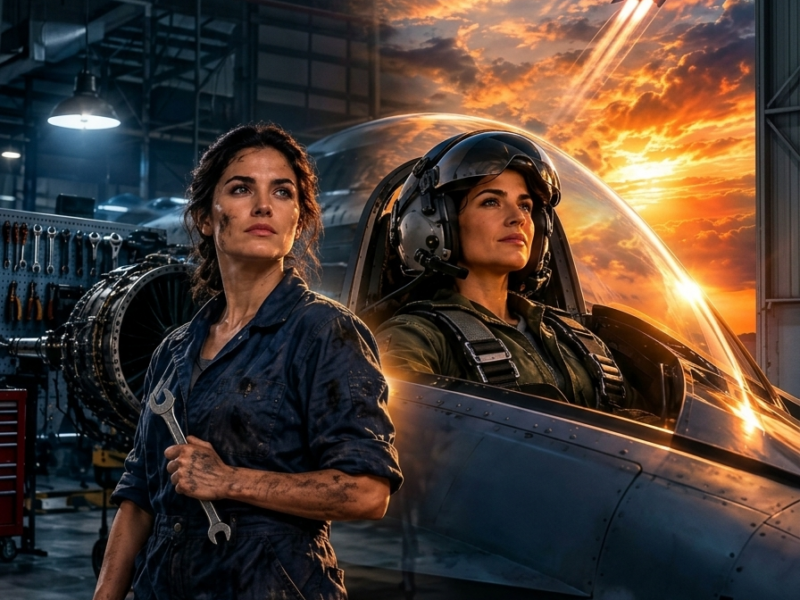
The hangar erupted in laughter when Captain Cole Bennett told me a quiet mechanic like me had no business touching an F-16, but minutes later
The metal floor of the main maintenance hangar at Hill Air Force Base vibrated with the deep, bass-heavy hum of twin F110 engines spooling down on the tarmac outside. Smells of high-grade jet fuel, baked rubber, and hydraulic liquid hung thick in the air.
I was on my back beneath the starboard wheel well of F-16 Fighting Falcon side-number 408, my fingers black with graphite grease as I calibrated a stubborn landing gear sensor.
Laughter bounced off the corrugated steel walls of the bay—sharp, arrogant, and loud.
“Hey, grease monkey,” Captain Cole Bennett called out, leaning against the yellow support strut of a tool chest, a silver helmet bag slung loosely over his shoulder. He tilted his visor up, a cocky grin spreading across his sun-tanned face. “Make sure you don’t leave a wrench inside the intake this time, Maya. Some of us actually plan on coming back down in one piece today.”
A couple of junior crew chiefs standing nearby chuckled nervously, eager to stay in the good graces of the 388th Fighter Wing’s star flight lead. Cole was the kind of pilot who looked like he had been born in a flight suit—golden-boy confidence, immaculate combat records, and an unshakable belief that the air belongs exclusively to those who hold the stick.
I didn’t stop my work. I tightened the micro-bolt with a precise quarter-turn, feeling the thread lock into place with a subtle click that only someone who lived under these machines would ever notice.
“The intake is clean, Captain,” I said softly, wiping my forearm across my forehead, leaving a streak of dark grease across my temple. “And if you check your hydraulic pressure line on engine start, you’ll find I fixed the bleed-off issue you missed during your pre-flight yesterday.”
Cole scoffed, crossing his arms over his harness. “I don’t need a mechanic telling me how to read my gauges, Maya. You stay down here with the spanners where it’s safe. Leave the real flying to the people who passed the physicals.”
I kept my mouth shut. I had spent four years at Hill Air Force Base under aircraft instead of inside them. I didn’t care about their rank or their flight suits. I knew every vibration, every strange smell, every subtle pitch change an engine made when a turbine blade was three flights away from structural failure. I could diagnose a fuel-line leak from fifty yards away just by the scent of burnt oil in the exhaust heat-haze.
To the pilots, though, I was invisible. I was just the quiet woman with grease permanently stained beneath her fingernails, the mechanic who never spoke at the squadron bar, the worker who slept four hours a night in the crew lounge.
My past was sealed under red-tape classification orders that even the base commander couldn’t open without an air staff clearance code. My service record was an empty shell—no prior units listed, no flight academy records, just an enlistment date and an assignment as a senior airframe technician.
Suddenly, the red emergency beacon mounted above the hangar doors began to rotate silently, casting blood-red flashes across the polished concrete floor. A moment later, the base horn blared out three long, chest-rattling blasts.
BZZZZT. BZZZZT. BZZZZT.
“All maintenance crew to Bay 3!” a voice barked over the squawk-box speaker system. “Inbound emergency recovery! Alert track approach!”
The hangar erupted into controlled chaos. Mechanics dropped their tools, safety runners dragged fire extinguishers across the floor, and Cole straightened up, his easy grin instantly vanishing.
Outside, a single F-16 was coming in low and fast over the perimeter fence. Its engine sounded terrible—a wet, sputtering cough accompanied by a thick trail of white hydraulic vapor venting from its tail section. The jet touched down hard on the runway, rubber smoking as it bounced twice before dragging its left main gear down the tarmac, skidding to a stop near the alert shelters.
Ground crews rushed the aircraft, securing the wheel chocks as the canopy opened. The pilot—a young lieutenant on his first operational deployment—stumbled down the boarding ladder, his face white as chalk, his hands shaking so violently he dropped his flight gloves onto the wet tarmac.
“The main flight control computer fried over the range!” the young pilot stammered to the crew chief. “The digital fly-by-wire system is locking up! Hydraulic system B is completely dead!”
Colonel Edward Thomas, the veteran commander of the 388th, stepped out of the flight line office, his face set like concrete. He looked at the smoking, crippled aircraft, then turned to the gathering crowd of pilots and maintenance personnel.
“We have an active alert mission,” Colonel Thomas announced, his voice carrying over the idle roar of distant jets. “An unannounced radar contact just crossed the northern border of our test range, flying low inside restricted mountain airspace. NORAD placed us on defensive readiness three minutes ago. Cole, your jet’s down for a fuel pump swap. We need to launch the standby airframe right now.”
Cole cursed under his breath. “Sir, four-zero-eight is the only alert airframe available, but its digital flight computers are stripped for maintenance! You can’t fly it on digital fly-by-wire!”
Colonel Thomas’s eyes swept across the room. “Is there anyone here who knows how to manually bypass the digital bus on a block-40 Falcon? Anyone who can fly a mechanical backup loop on a dead hydraulic feed?”
The pilots looked at each other in uneasy silence. Modern tactical pilots were trained on pristine glass cockpits and digital computers; mechanical reversion flight was a lost art taught only in high-level engineering test-pilot courses.
“We need someone who knows the bones of this aircraft,” Colonel Thomas insisted, his voice hard. “Someone who can feel the airframe without a computer telling them what to do.”
Every eye in the hangar slowly drifted toward the corner of Bay 2.
Toward me.
I slowly pulled off my heavy leather work gloves, letting them drop onto the tool cart beside my socket set. I wiped my greasy hands on a rag, my heart pounding a steady, rhythmic rhythm against my ribs.
Cole let out a sharp, incredulous laugh. “You’re serious? Colonel, she’s an airframe mechanic! She doesn’t even have a flight badge!”
I walked past Cole, stepping directly into the space between him and the commander. I met Cole’s eyes with a look so cold, so absolute, that his laughter died instantly in his throat.
“I rebuilt the mechanical flight control linkages on four-zero-eight with my own hands three weeks ago,” I said quietly to the commander. “I know where the wire slacks are. I know how much pressure the mechanical backup valves can take before they burst.”
Colonel Thomas stared at me for three agonizing seconds, searching my eyes. He saw no fear there. No hesitation.
“Get in the jet, Maya,” Thomas ordered.
The hangar went dead quiet. Nobody spoke. Nobody moved.
I climbed the narrow steel boarding ladder of F-16 side-number 408 with hands that were shaking for the first time in twelve years. Not out of fear, but out of a sudden, overwhelming surge of memory—the smell of cockpit oxygen masks, the familiar tight squeeze of the g-suit around my thighs, the cold glass of the HUD display in front of my face.
I strapped into the ejection seat, pulling the harness straps down tight over my green grease-stained work uniform. I didn’t have a modern pilot helmet; I grabbed an old spare helmet from the locker box, snapping the heavy visor down over my eyes.
The Pratt & Whitney F100 engine roared to life with a deafening, metallic scream. Heat rippled behind my tail as I taxied out toward the runway line, leaving the shocked crowd of mechanics and pilots standing motionless in the hangar bay door.
“Base, Alert 01 airborne,” I spoke into the oxygen mask, my voice dropping into a flat, professional, perfectly calm cadence.
I pushed the throttle forward into full afterburner.
The jet shot down the runway like a missile, the g-force slamming my chest back into the seat as we rotated into the grey afternoon sky over Utah.
For the first four minutes, everything felt like a long-forgotten dream. The sky was crisp, cold, and wide open. Below me, the jagged granite peaks of the Wasatch Range flashed past at six hundred miles per hour.
Then, the cockpit erupted into a nightmare.
BEEP! BEEP! BEEP!
Red warning lights flashed across my main panel in a terrifying sequence. The primary digital flight control computer blew its main breaker. The control stick locked solid in my right hand.
“Alert 01, Oceana Control!” Cole’s voice burst through my headset, loud, frantic, and laced with panic. “Your telemetry line just went red! Hydraulic system A pressure is collapsing! Your fly-by-wire is dead! Turn back immediately! Eject before you lose control!”
I looked down at the warning lights. The primary digital system was fried. The flight computer was blind.
But I didn’t panic. I knew this jet. I had spent two hundred hours under its belly with a flashlight and a torque wrench. I reached down to the lower console, flipped open a sealed safety guard, and manually pulled the red mechanical backup lever.
With a loud THUNK, the digital flight controls disengaged, and the raw, heavy mechanical cables locked directly into my hands. The stick shuddered violently, fighting me like an wild animal.
“I’m not turning back, Cole,” I said into the mask. My voice was so quiet, so steady, that the radio frequency fell dead silent.
I shoved the nose down, dropping the jet into a steep dive, skimming five hundred feet above the snow-capped mountain ridges, using the raw mechanical feel of the cables to guide thirty thousand pounds of screaming metal through the thin air.
Then, a dark shadow flashed across my radar screen.
An unidentified, unmarked swept-wing fighter emerged from the mountain pass directly ahead of me, flying low, painted matte-black with no national markings. It turned hard, sweeping into a firing position off my tail.
My breath caught in my chest.
“Alert 01! Break left!” the controller screamed in my ear. “He’s locking you up!”
I didn’t break left. A standard pilot would have broken left into the open valley, exposing their belly to an infrared missile.
Instead, as the matte-black fighter closed the distance, I remembered a voice from my past—a quiet, gravelly voice echoing in a small hangar behind an old farm in Nevada twelve years ago.
“When everyone expects you to panic, Maya… that’s when you think clearly. Don’t fly the jet. Fly the air.”
I reached out and cut the engine throttle to idle for three seconds.
The F-16 airbrakes deployed with a mechanical groan. My jet slammed to a near-halt in mid-air, dumping three hundred knots of airspeed in a heartbeat.
The black fighter behind me overshot my airframe, flashing past my canopy so close I could see the dark visor of its pilot.
I slammed the throttle back into full afterburner, pulled the mechanical stick hard into my stomach, and pitched the nose straight up into the sun, locking onto the enemy’s tail before he even realized where I had gone. I activated my radar warning system, forcing a simulated weapon lock tone that screamed directly into his cockpit.
Terrified by the impossible maneuver, the black fighter banked hard, dropped flare canisters, and dived into the deep mountain canyons to the north, fleeing back across the border.
Twenty minutes later, the screech of my landing tires echoed across the tarmac at Hill Air Force Base.
I taxied F-16 side-number 408 back to the maintenance apron. The engine spooled down to a quiet whine, and the canopy opened.
Nobody spoke. The entire squadron—pilots, mechanics, crew chiefs, and commanders—stood in a silent semicircle around the jet.
Cole Bennett was waiting at the foot of the boarding ladder. He stared at me as I climbed down, his face entirely devoid of color, his arrogance wiped clean, replaced by a deep, unnerved awe.
“You… you pulled a pugachev Cobra maneuver on a mechanical backup loop,” Cole whispered, his voice trembling. “You flew that broken jet like you’ve been doing it your entire life.”
He looked at my black, grease-stained hands.
“Who are you, Maya? You’ve done this before.”
I reached into the pocket of my grease-stained flight suit and pulled out a worn, faded, folded photograph wrapped in protective plastic. I unfolded it slowly and handed it to Cole.
The photograph showed a ten-year-old girl standing on a sun-drenched tarmac beside a legendary Air Force test pilot in front of a prototype F-16.
On the back of the photograph, written in dark blue ink, were six words:
If they find me, fly without them.
Cole stared at the photo, then looked at the cracked, plastic-laminated military identification card taped inside the plastic sleeve underneath it.
The name on the ID card wasn’t Maya.
It belonged to Colonel Marcus Vance—the legendary Air Force weapons developer officially declared dead twelve years ago after his secret jet disappeared over the Pacific.
My father.
Cole looked up at me, his eyes wide with horror as he finally understood. “Your father… he didn’t die in a crash.”
“No,” I said softly, taking the photograph back and tucking it against my chest. “He went into hiding because he found out who was stealing our jets. And today… they came back for me.”
The heavy steel door of the Wing Commander’s office clicked shut, cutting off the low ambient hum of the maintenance hangar outside.
Colonel Thomas sat behind his desk, his hands clasped tightly together over a thick black binder stamped with red security tape. Cole Bennett stood by the window, his eyes darting between the tarmac outside and me.
I sat in the wooden chair across from the commander, my hands folded calmly in my lap. My flight suit was still stained with black hydraulic grease, but nobody in the room was looking at my clothes anymore.
“Twelve years,” Colonel Thomas said, his voice heavy with disbelief. “For twelve years, the Air Force believed Marcus Vance perished during a high-altitude weapons test over the Pacific. The search and rescue team found nothing but oil slicks and titanium fragments.”
“My father didn’t crash, Colonel,” I said smoothly. “He ejected before the aircraft hit the water. He spent two days in an inflatable liferaft before reaching a private fishing vessel off the coast of California. He came straight to our home in Nevada, packed a single bag, handed me that photograph, and disappeared into the desert.”
Cole stepped away from the window, leaning against the edge of the mahogany desk. “Maya… if your father was alive, why did you drop out of the Air Force Academy? Why did you enlist as an enlisted mechanic under a fake identity?”
“Because the people who tried to kill my father were inside the Pentagon,” I answered cold-bloodedly. “My father realized that the digital flight control systems being installed on our new block-40 fighters had a back-door exploit embedded in the software code—a remote override that allowed an outside operator to hijack an F-16 in mid-air.”
Colonel Thomas’s eyes widened slightly. “Project NIGHTHAWK.”
“You know about it?” I asked.
“It was a classified research initiative in the late 2000s,” Thomas explained, reaching down to unlock a small steel drawer in his desk. He pulled out an old, faded operation map. “The goal was to create a fail-safe system that could allow air traffic controllers to remotely land a hijacked fighter jet. But the project was officially cancelled after a prototype crashed during sea trials.”
“It wasn’t cancelled,” I corrected him. “It was stolen. A private defense contractor called Aegis Dynamics took the source code, refined it, and built a rogue network. My father discovered that Aegis was selling the override key to foreign buyers. When he tried to blow the whistle to the Inspector General, his jet suffered a sudden, inexplicable ‘system failure’ over the Pacific.”
Cole ran a hand through his golden hair, letting out a low whistle. “And the black jet you fought today over the range… that wasn’t a foreign spy plane.”
“It was an Aegis prototype,” I said. “They detected an F-16 flying on a mechanical backup loop—an airframe operating without the digital software override. They came to destroy it before we could prove that the mechanical jet couldn’t be hacked.”
Colonel Thomas leaned forward, placing both forearms on his desk. “Maya… if what you’re saying is true, every single digital F-16 sitting on our flight line right now is vulnerable to remote hijacking.”
“Not just vulnerable,” I said chillingly. “They can be turned into weapons against us at any second.”
Before Colonel Thomas could respond, the red telephone on his desk began to ring with a sharp, high-pitched warble.
Thomas picked up the receiver. “Commander 388th.”
As he listened to the voice on the other end, the color drained from Thomas’s face until he looked as pale as a bedsheet. His grip on the receiver tightened until his knuckles turned white.
“Understood, General,” Thomas said quietly. He hung up the phone slowly, staring blankly at the wall.
“What is it, sir?” Cole asked, stepping closer.
“An alert division of four F-16s from Nellis Air Force Base just suffered a simultaneous, total loss of flight controls over southern Nevada,” Thomas whispered, his voice trembling. “The pilots report that their side-stick controllers are completely dead. The aircraft have locked into a automated formation and are currently flying east at five hundred knots… heading directly toward the nuclear testing facility at Yucca Mountain.”
My pulse spiked into overdrive. It was happening.
“The digital override,” I breathed. “Aegis just activated the back-door code.”
“Nellis tower tried to send a abort signal, but the jets’ communication arrays are jammed,” Thomas said, rising from his chair. “NORAD has ordered a defensive intercept, but every fighter we have in the region is running the same digital flight software! If we launch another digital squadron, Aegis will just hijack them too!”
Cole turned his head sharply to look at me. The arrogant pilot who had taunted me in the hangar four hours ago was completely gone; in his place stood a man who recognized a true master of the air.
“We have one jet that can’t be hacked,” Cole said, his voice ringing with fierce determination.
“Four-zero-eight,” I agreed, standing up from my chair. “The mechanical airframe. The one jet with its digital computers stripped out.”
“It’s a single fighter against four hijacked aircraft, Maya!” Colonel Thomas warned. “And four-zero-eight’s right hydraulic line is still held together with emergency patches!”
“Then I’ll fly gentle,” I said with a faint, dangerous smile.
“You’re not going alone,” Cole snapped, grabbing his helmet off the side table. “Four-zero-eight has a two-seat trainer variant parked in Bay 4—side number four-one-two. It’s an old Block-30 model with manual cable linkages! I’ll fly front seat, you take the weapons system seat in the back!”
I looked at Cole, searching his face. I saw no hesitation, no pride—just raw loyalty and a desire to make up for every joke he had ever cracked at my expense.
“Can you handle a heavy mechanical stick, Captain?” I asked.
Cole pulled his visor down over his eyes and grinned. “You can yell at me through the intercom if I pull the stick too hard, grease monkey.”
Ten minutes later, the twin-seat F-16D side-number 412 roared into the darkening Utah sky, its afterburner burning a long, bright orange needle into the sunset.
We climbed to thirty thousand feet, banking hard south toward the Nevada border. Inside the rear cockpit, my hands moved across the legacy analog radar dials, bypassing the digital filtering networks that Aegis was trying to jam.
“Target lock acquired!” I reported over the internal intercom. “I’ve got the four hijacked Nellis fighters on long-range scan! They’re flying in a tight diamond formation at twenty-four thousand feet!”
“Do you see any escort?” Cole asked from the front seat, leaning into his turn.
I adjusted the optical range finder. My screen flickered, showing a fifth radar return hovering two thousand feet above the hijacked formation.
It was a large, four-engine command aircraft—an airborne data relay platform carrying a massive radar dome on its spine.
“There’s your master control ship!” I shouted. “That command plane is broadcasting the hijack signal! As long as that plane is airborne, those four fighters are hostages!”
“How do we break the signal without shooting down four of our own Air Force pilots?” Cole asked, his voice tight.
I looked down at my analog weapons control board, then looked out at the dark mountain peaks approaching below.
“We don’t shoot the fighters,” I said cold-bloodedly. “We fly between them and slice the relay cable.”
The evening air over the Nevada desert was cold, thin, and stained a deep, bruised purple by the setting sun.
Our F-16D screamed through twenty thousand feet, its mechanical control cables vibrating through the airframe like guitar strings tight-strung under immense tension. Cole sat in the front cockpit, his shoulders tense as he fought the heavy, unassisted flight stick, while I operated the analog targeting arrays from the rear seat.
Three miles ahead, the four hijacked F-16s from Nellis flew in a rigid, unnaturally perfect diamond formation. Their tail lights glowed steadily, but their pilot control surfaces were frozen—the airmen inside were passengers in their own cockpits, screaming into dead radios as Aegis Dynamics guided their jets toward the military installation at Yucca Mountain.
Hovering two thousand feet above them was the Aegis command plane—a converted four-engine regional jet retrofitted with high-power phased-array transmitter panels along its belly.
“Oceana Control, Alert four-one-two,” I called into my mask, bypassing the main relay bus to transmit over an old high-frequency band. “We have visual on the hijacked strike package. The command relay ship is operating at high altitude.”
“Alert four-one-two, this is General Vance at NORAD,” a deep, commanding voice suddenly crackled through our headsets.
I froze. The breath caught in my throat.
General Vance.
“Dad?” I whispered, my hand halting over the radar control dial.
There was a three-second pause on the line—a pause heavy with twelve years of unspoken pain, secret tears, and lingering memories.
“Maya…” my father’s voice came through the static, softer now, stripped of its military armor. “I heard what you did at Hill Base. You flew four-zero-eight on a mechanical loop.”
“I remembered what you taught me,” I said, my eyes misting up behind my visor. “I flew the air, not the jet.”
“Listen to me, sweetheart,” General Vance said urgently. “The command plane above you isn’t just transmitting an override code—it’s running a microwave directional beam focused directly onto the receiver antennas on the tails of those four fighters. If you get between the beam and the fighters, the microwave radiation will fry your aircraft’s unshielded electrical battery!”
Cole glanced back at me in his rearview mirror. “Maya… our mechanical flight stick works on hydraulic pressure, but our fuel pumps still need electrical battery power. If our battery dies, our engine starves in ten seconds.”
I stared at the glowing blue transmitter beam visible through my night-vision goggles—a pencil-thin pillar of high-intensity energy connecting the command plane to the four hijacked jets below.
“We have ten seconds of battery life inside that beam,” I calculated quickly out loud. “Ten seconds to slice through the transmission line, break the digital lock, and allow the Nellis pilots to manually reset their onboard computers.”
“That’s suicide!” General Vance yelled over the radio. “Maya, pull back! We’re scrambling an F-22 intercept flight from Edwards!”
“The F-22s are ten minutes away, Dad!” I shouted back. “In ten minutes, those hijacked jets will hit the Yucca Mountain facility! I’m taking the shot!”
“Cole!” my father barked over the emergency channel. “As the senior officer in that airframe, I order you to turn back!”
Cole Bennett took a deep, steady breath. He looked out at the four hijacked fighters ahead, then looked back at me in his mirror.
“With all due respect, General,” Cole said smoothly, “Lieutenant Vance is the flight lead on this mission. And I don’t disobey my flight lead.”
Cole slammed both throttles forward into full afterburner.
Our Super Falcon lunged forward with a deafening roar, climbing steeply at sixty degrees, shooting straight toward the glowing blue microwave beam connecting the command plane to the hijacked formation.
“Entering the beam in three… two… one!” I counted down.
FLASH!
The moment our nose crossed into the microwave stream, every instrument display in our cockpit flared blinding white. The radio hummed with a deafening, high-pitched screech.
WARNING: BATTERY BUS FAILURE. MAIN GENERATOR OFFLINE.
Our cockpit lights died instantly. The digital HUD glass went black. The cockpit heater cut out, and freezing winter air began to seep through the seals.
“Battery is dead!” Cole yelled, shoving all his physical strength into the mechanical control stick as the hydraulics began to lose line pressure. “We’re on residual pressure! I’ve got ten seconds before the stick locks solid!”
“Hold her steady!” I screamed, leaning forward in my seat, reaching for the manual emergency signal jammer mounted under my display console.
The jammer wasn’t a military weapon—it was an old mechanical flare-dispenser loaded with conductive aluminum chaff flakes that I had hand-packed into the tail tubes back at Hill Base.
I yanked the manual ejection lanyard for the chaff dispenser.
BOOM! BOOM! BOOM!
A massive cloud of razor-thin aluminum strips erupted from our tail, scattering directly into the center of the microwave beam like a cloud of silver mirror fragments.
The high-intensity microwave energy hit the cloud of aluminum chaff and scattered instantly in ten thousand directions. The blue transmission beam shattered into a spray of harmless spark light.
Below us, the four hijacked F-16s shuddered violently. Their digital computers lost the override signal, and their emergency recovery screens flashed back to life.
“Nellis Lead, your controls are free!” I screamed into the backup battery radio. “Reset your breakers NOW!”
Inside the lead hijacked jet, the Nellis pilot slammed his hand into his circuit panel, resetting his flight computer. The four fighters broke out of their automated formation, banking hard away from Yucca Mountain, their pilots regaining full control of their aircraft.
“It worked!” Cole cheered, struggling to hold our dead jet level. “The fighters are free!”
“Cole! Pull up!” I screamed, looking up through the canopy glass.
The Aegis command plane, realizing its signal had been destroyed, tipped its massive wing downward, diving straight toward our dead airframe in a desperate, kamikaze effort to ram us out of the sky.
With no electrical power and hydraulic pressure fading to zero, our F-16 was a twenty-ton rock dropping through fifteen thousand feet.
“The stick is locked!” Cole growled, his muscles bulging as he pulled on the mechanical lever with both hands. “I can’t move the elevators! We’re going down!”
The massive black nose of the command plane loomed over our canopy, closing in at four hundred miles per hour.
Death was four hundred feet away and closing at four hundred knots.
The dark, imposing belly of the Aegis command plane filled our canopy glass, its four massive turbofan engines screaming as it tried to crush our unpowered F-16 out of the sky.
“Cole! Trim tab!” I shouted, my fingers clawing at the mechanical backup console on my right wall. “Use the manual trim wheel on your left hip!”
Cole didn’t ask questions. He released his grip on the locked stick, reached down with his left hand, and spun the heavy aluminum manual trim wheel backward with every ounce of strength in his body.
The mechanical trim tab on our tail surface deflected four degrees upward.
It wasn’t a smooth flight maneuver—it was a brutal, violent aerodynamic snap. The tail of our F-16 dropped sharply, kicking our nose straight up into the path of the incoming command plane.
Our nose cone missed the command plane’s wing root by less than six feet. The slipstream vortex from their giant engines slammed against our canopy, shattering the outer glass layer and sending a shower of white ice crystals spinning through the freezing cockpit.
The force of the near-miss tossed our jet into a wild, sickening tailspin, plummeting through ten thousand feet into the pitch-black darkness of the desert canyon below.
“Hydraulics zero!” Cole gasped, his face covered in frost as thirty-below-zero air whistled through the cracked canopy. “Engine is dead! We’re out of altitude, Maya! Eject! EJECT!”
“Not yet!” I yelled back, my hands flying over the emergency mechanical engine restart lever between my ankles.
Standard emergency procedures dictated that a jet needed at least fifteen thousand feet of altitude to perform a wind-mill engine restart. We were at three thousand feet, plummeting into a narrow mountain gorge surrounded by walls of razor-sharp granite.
“You can’t restart a dead turbine at three thousand feet!” Cole screamed over the roar of the rushing wind.
“I built this engine, Cole!” I roared back, my voice ringing with absolute, unshakeable authority. “I know its heart!”
I pulled the emergency fuel boost lever, then reached down and manually engaged the secondary hydrazine emergency power unit—a volatile, high-energy chemical reactor mounted near the engine tailpipe.
BOOM!
A bright violet flame erupted from the emergency exhaust port beneath our tail. The chemical explosion forced liquid fuel directly into the dead turbine blades.
The F100 engine screeched, shuddered, and burst back to life with a deafening roar that shook the entire canyon floor.
THUNNNNDER!
Thrust exploded behind us. Cole grabbed the mechanical stick as hydraulic pressure surged back into the lines. He pulled back with all his weight just eight hundred feet above the jagged rocks of the canyon floor.
Our Super Falcon leveled out fifty feet above a dry riverbed, its afterburner trail scorching the canyon walls, blowing clouds of dust and snow into the freezing night air.
We rocketed out of the canyon mouth, shooting back up into the moonlight sky like a phoenix rising from the abyss.
Above us, the Aegis command plane was banked heavily to the west, struggling to turn its massive airframe around to escape toward the Mexican border.
“They’re fleeing!” Cole called out, pulling us into a steep climb. “Maya, do we have weapons?”
I looked down at my legacy armaments panel. The digital missile lock systems were still dead from the microwave shock, but the analog gun-sight HUD was glowing a bright, steady amber.
Our aircraft was carrying five hundred rounds of 20mm Vulcan cannon ammunition—raw, kinetic lead that couldn’t be jammed, couldn’t be hacked, and couldn’t be redirected by a computer code.
“We don’t need missiles,” I said cold-bloodedly, snapping the mechanical gun-master switch to live fire. “Bring us in close, Cole. Four hundred yards, stern sweep.”
Cole grinned through his frost-bitten lips. “With pleasure, Lead.”
Cole pushed the throttle to maximum dry thrust, closing the distance on the fleeing command plane within fifteen seconds. We pulled up directly behind its left engine housing.
I aligned the mechanical crosshairs on my glass display over the command plane’s main transmitter array housing mounted along its belly.
“Target locked,” I whispered.
I squeezed the heavy iron trigger on my stick.
BRRRRRRRRRRRRRRRRRRRTTT!
The six-barrel Vulcan cannon erupted with a deafening roar that vibrated through our teeth. A solid stream of two thousand tungsten shells per minute shredded the belly of the command plane.
The transmitter dome exploded into a cloud of white composite debris and flying circuit boards. The high-power relay systems burst into a blinding cascade of orange electrical sparks.
Stripped of its transmitter and its hydraulic control lines severed by our gunfire, the Aegis command plane banked out of control, its left wing dipping into a steep, unrecoverable spin.
The two Aegis pilots ejected, their white parachutes opening in the moonlight, while the massive rogue command vessel plummeted down into the uninhabited alkali flats of the Nevada desert, exploding in a massive, fiery mushroom cloud that lit up the mountains for fifty miles around.
Silence fell across the radio frequency.
Down below, the four rescued Nellis F-16s formed a protective escort box around our damaged, glass-shattered fighter, their wingtip lights blinking in a synchronized salute to the mechanic who had saved their lives.
My emergency radio crackled to life one last time.
“Alert four-one-two, this is General Vance,” my father’s voice came through, clear, strong, and brimming with pride. “Target destroyed. The airspace is secure.”
I leaned back against my headrest, letting out a long, shuddering breath as hot tears melted the frost on my cheeks.
“We’re coming home, Dad,” I whispered into the mask.
Cole turned his head in the front cockpit, looking back at me through the cracked, icy canopy with a look of reverence that no gold pilot wings could ever purchase.
“You’re not a mechanic, Maya,” Cole said softly. “You’re the finest pilot this Air Force ever produced.”
I looked down at my black, grease-stained fingers, then looked out at the golden moon rising over the mountains.
“I’m both, Cole,” I smiled faintly. “And that’s why they couldn’t beat us.”
The morning sun broke over the Wasatch Mountains, casting long, golden beams of light across the concrete tarmac at Hill Air Force Base.
F-16D side-number 412 sat parked on the main apron, its nose cone scorched black by cannon smoke, its canopy glass cracked, its airframe resting proudly like a battle-hardened warrior returning from the front lines.
Around the aircraft, over three hundred men and women—mechanics in blue overalls, pilots in green flight suits, base commanders, and ground crews—stood lined up along the flight line in complete, motionless silence.
Cole Bennett and I stepped down from the boarding ladder. My work uniform was torn, stained with soot and oil, and my hair was a tangled mess of sweat and grease.
As my boots touched the concrete, Colonel Thomas stepped forward, raised his right hand to his temple, and executed a sharp, flawless salute.
Behind him, every single pilot in the 388th Fighter Wing snapped to attention, saluting the quiet mechanic they had spent four years ignoring.
Cole stepped up beside me, snapping his own salute to Colonel Thomas before turning to look at the crowd.
“At ease,” Colonel Thomas commanded, his voice echoing across the quiet tarmac. He walked forward, stopping right in front of me, his eyes filled with immense respect.
“Lieutenant Vance,” Thomas said formal and clear. “An hour ago, the Secretary of the Air Force signed an administrative order restoring your full officer rank, your flight status, and your position as Lead Test Pilot for the Air Force Materiel Command.”
A loud, thunderous cheer erupted from the crowd of mechanics standing behind the support line. Wrenches were clanked against steel toolboxes, and crew chiefs whistled into the morning air.
Cole stepped forward, pulling a small black velvet box from his dress jacket pocket. He opened it, revealing a pair of polished, silver Air Force Command Pilot wings.
“I think these belong to you, Lead,” Cole said, a humble, genuine smile gracing his face as he pinned the silver wings directly onto the grease-stained chest of my work shirt.
“Thank you, Cole,” I said softly, touching the cold silver metal with my fingertips.
Before Cole could speak, a black staff car with four-star flags mounted on its front fenders pulled up to the edge of the apron. The rear door opened, and a tall, grey-haired officer in a service dress uniform stepped out onto the tarmac.
He moved with a slight limp, his face weathered by age and decades of desert winds, but his slate-blue eyes were as sharp and clear as the day he had handed me that folded photograph twelve years ago.
General Marcus Vance.
The crowd parted silently as my father walked across the concrete floor. He stopped five feet away from me, his hands resting at his sides, his chest heaving as he looked at the daughter he had been forced to leave behind to protect.
“You grew up, Maya,” my father said, his voice cracking with emotion.
“I kept the jet clean, Dad,” I answered, a tear cutting through the dark grease on my cheek as I stepped forward and wrapped my arms tightly around his neck.
My father held me tight, burring his face into my shoulder as twelve years of secrets, hiding, and fear dissolved into the warm morning air.
“You didn’t just keep it clean, sweetheart,” General Vance whispered into my hair. “You saved the entire fleet.”
Ten minutes later, as emergency maintenance crews pulled side-number 412 back into Bay 1 for repairs, Cole walked up beside me as I stood near the open hangar door, watching the morning sun illuminate the flight line.
“So… what happens now, Chief?” Cole asked, leaning against the doorframe, leaning his shoulder against mine. “Are you moving to a corner office at the Pentagon?”
I looked down at my hands—at the permanent dark grease lines etched into my skin, at the small scars on my knuckles from years of working on high-pressure hydraulic lines.
I smiled, reached down to my tool cart, and picked up my favorite heavy socket wrench.
“The Pentagon has enough officers sitting behind desks, Cole,” I said, looking up at the sky where a four-ship formation of F-16s was screaming into the blue horizon. “Someone needs to stay down here and make sure the jets are built right.”
Cole laughed—a real, warm laugh that held no arrogance, only genuine camaraderie. “Need an assistant mechanic, Lieutenant?”
“Grab a wrench, Bennett,” I said, turning back toward the dark wheel well of an F-16. “We’ve got three more airframes to rebuild before sunset.”
The End









