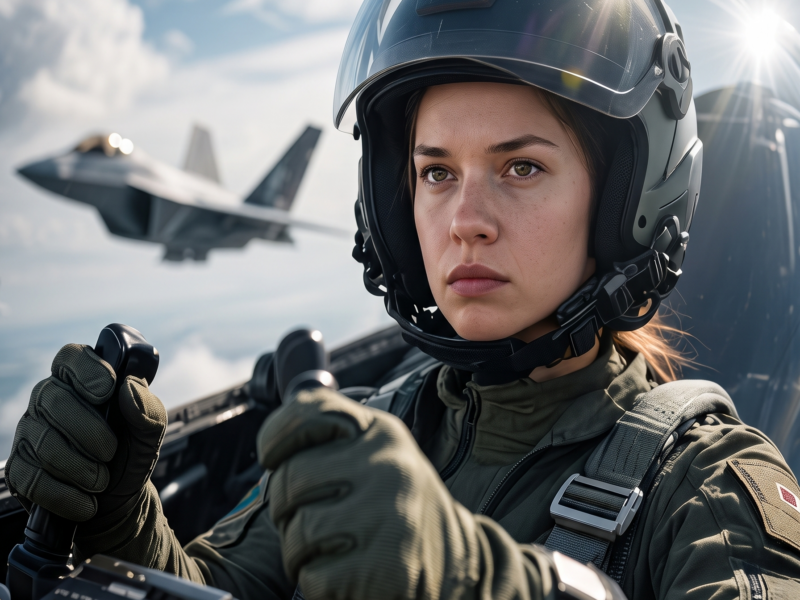
The hangar at Langley Air Force Base fell silent when the commander shoved a helmet toward me and said, “You? You’re the only one who can fly it?”
The hangar at Langley Air Force Base was standard military efficiency, a massive cavern of corrugated steel, echoing footsteps, and the sharp, industrial scent of jet fuel and hydraulic fluid. It was a world governed by procedure, protocol, and strict hierarchy. For the past three years, I had operated within the lowest profile possible in that hierarchy.
To the pilots who walked past me every morning with their flight suits zipped tight and helmets tucked under their arms, I was invisible. I was Claire Bennett, the quiet maintenance officer. The woman in grease-stained coveralls who checked fuel lines, signed off on pre-flight inspection reports, and kept her head down. Nobody asked why I knew the intricate wiring of an F-22 Raptor better than the engineers who built them. Nobody asked why I never looked up at the sky when the twin Pratt & Whitney engines roared down the runway. To them, I was just part of the ground crew. A fixture of the hangar floor.
Then the alarms started.
It wasn’t a standard drill klaxon. It was the sharp, unbroken tone reserved for a critical airborne emergency. The red status lights along the hangar rafters flashed in rhythmic, blinding pulses. Within seconds, the hangar erupted into controlled chaos. Crew chiefs dropped their tools, junior officers scrambled toward the communications desk, and the ambient noise of the base dissolved into a wall of shouting.
I stayed still, wiping my grease-covered hands on a rag, watching the main radar console in the center of the maintenance bay.
Colonel Vance, the base commander, burst through the side doors, his face rigid, flanked by two breathless lieutenants. “What’s the situation?” Vance barked, stepping up to the radar terminal.
“An F-22 from the morning training sortie, sir,” a young technician replied, his voice cracking slightly. “Catastrophic electrical failure following a bird strike near the edge of the range. Hydros are down, fly-by-wire is defaulting, and the pilot—Lieutenant Miller—is disoriented. He’s losing altitude fast.”
“Get the backup pilot up there!” Vance ordered, turning to the duty officer.
“Sir, the rest of the squadron is on a simulated deployment off the coast,” the lieutenant stammered. “There’s no one in the queue. The next qualified flight lead is forty minutes out from Andrews.”
“We don’t have forty minutes!” Vance slammed his hand against the terminal console. “Miller can’t eject over that populated corridor, and he can’t bring a dark bird down on an unlit runway. Who else is qualified to fly an F-22 on manual override right now?”
The hangar fell completely silent. The hum of the ventilation system seemed to turn deafening. Junior pilots looked at each other. Ground crew shifted their feet. No one stepped forward. Manual override on an F-22 with fried avionics wasn’t standard training; it was an extreme maneuver that required an instinctive, terrifying familiarity with the airframe’s raw aerodynamic quirks.
I stepped away from the maintenance rack, tossing my dirty rag into a recycling bin.
“How much fuel does he have?” I asked. My voice wasn’t loud, but in the quiet hangar, it carried effortlessly.
The technician glanced up, startled by a maintenance officer speaking out of turn. “Nine minutes. Maybe eight before total engine starvation.”
I took one long, deliberate breath. I walked directly past the lieutenant, stopping right in front of Colonel Vance.
“Give me the helmet,” I said.
Vance stared at me as if I had spoken in a foreign language. He looked down at my grease-stained uniform, my plain name tag, and then back up at my eyes. “Claire, this isn’t a simulator. This is a dead-stick landing of a thirty-million-dollar airframe in degrading visibility.”
“I know,” I replied softly.
A young lieutenant near the desk let out a short, nervous laugh. “Ma’am, with all due respect, checking hydraulic seals doesn’t mean you can—”
“Give me the helmet,” I repeated, ignoring the lieutenant entirely. I met Vance’s gaze, letting the flat, unwavering tone of an experienced aviator bleed through the quiet facade I had maintained for thirty-six months.
Vance’s eyes narrowed. Something in my expression clicked for him—a memory, or perhaps a faint ghost of a red-flagged security file he had seen somewhere deep in the Pentagon’s personnel database. He didn’t ask another question. He turned to the equipment rack, grabbed a flight helmet and a standard oxygen mask, and handed them to me without a word.
“Get her on the ladder,” Vance commanded the stunned crew.
I moved with absolute purpose. I didn’t rush. Rushing led to mistakes, and mistakes in a cockpit were fatal. I pulled the flight suit sleeves up, locked the helmet under my arm, and walked toward the primary alert aircraft parked at the head of the hangar bay. The F-22 Raptor sat like a dormant predator under the fluorescent lights, its dark, radar-absorbent skin gleaming.
I climbed the ladder. Each metal rung under my boots felt like a step back in time.
When I swung my leg into the cockpit and lowered myself into the ejection seat, the sensory shift was immediate. The smell of leather, ozone, and canopy sealant flooded my senses. The world outside the glass canopy faded into background noise. The cockpit felt like a room I had never really left.
My hands didn’t hesitate. They didn’t think; they remembered.
My left hand swept across the side panels, flicking power switches, activating the auxiliary generator, and starting the engine boot sequence in a fluid, continuous motion that took less than four seconds. My right hand found the throttle grips, checking the tension, feeling the familiar weight of the controls beneath my fingers. The glass cockpit displays flickered to life, casting a green and digital-amber glow over my face.
The hangar doors groaned as they rolled back, revealing the dusk sky outside—dark, bruised grey, streaked with storm clouds.
The radio headset inside my helmet crackled to life with standard ground control traffic. “Unknown pilot in Alert One, identify yourself for taxi clearance.”
I reached up, pulled the oxygen mask over my nose and mouth, clicking it into place, and pressed the push-to-talk button on the throttle.
“Captain Claire Bennett.”
The radio line went dead silent.
In the command center glass booth above the hangar floor, I saw Vance freeze, holding a microphone. I heard the sudden rustle of papers, the frantic clicking of a keyboard, and then Vance’s voice came back over the direct frequency, strained and laced with pure disbelief.
“Captain… Bennett?”
He had just pulled up my primary jacket. He had just cleared the top-secret classification buffer that buried my real military history beneath layers of administrative red tape and maintenance duties. He was looking at the name that hadn’t been spoken aloud at Langley in six years.
Six years earlier, I wasn’t a maintenance officer. I was a flight leader in a classified black-budget squadron, operating out of an undisclosed forward base in Eastern Europe. Six years ago, I had flown a mission that officially never happened, over air space where we were never supposed to be.
During that mission, my wingman—Lieutenant Marcus Vance, the commander’s younger brother—was targeted by an unidentified, highly sophisticated surface-to-air missile system. His aircraft took a critical strike to the port engine. The chain of command ordered an immediate retreat, commanding me to bug out and leave his falling aircraft behind to preserve the secrecy of our presence.
I disobeyed the order.
I turned my Raptor back into the kill zone. I engaged two hostile radar tracking stations, drawing off incoming fire, and stayed behind to cover Marcus as his burning jet descended into the shadowed, dense forests of the border region. I watched his beacon flash three times before it went completely dark. When I finally turned for home, my own airframe was shattered—shrapnel had torn through my left wing, my primary radios were dead, and my fuel tanks were leaking a white mist into the night air.
I brought the wrecked jet back to base against all mathematical odds. The mission was declared a classified success. But the subsequent military court inquiry needed a scapegoat to cover up the political nightmare of an unsanctioned dogfight in neutral airspace.
They couldn’t court-martial me without exposing the operation to the press. So, they did something worse. They blamed me for the loss of two advanced fighters due to ‘unauthorized pilot recklessness.’ They erased my combat hours. They wiped my flight status. They buried my record, handed me a wrench, and told me that if I ever spoke about that night, I would spend the rest of my life in a federal penitentiary.
Now, six years later, I was sitting in the same seat, looking at the same instruments.
“Clear for immediate departure, Alert One,” Vance’s voice came through the helmet again. The hostility was gone, replaced by a strange, heavy weight. He remembered his brother. He remembered who I was. “Bring my pilot back, Bennett.”
“Copy,” I said.
I slammed the twin throttles forward into full military power. The Pratt & Whitney engines roared to life behind me, pushing a terrifying wall of thrust through the air. The jet lurched forward, rolling out onto the tarmac and aligning with the center white line of the main runway. I didn’t wait for a secondary check. I pushed the levers past the detent into full afterburner.
Two brilliant streaks of blue and white flame erupted from the tailpipes. The acceleration shoved me back into the seat, the g-force pressing against my chest like a lead weight. The runway markers blurred into a single solid line.
Rotate.
I pulled back on the stick. The nose pitched up, and the F-22 tore into the dark, overcast sky, leaving the lights of Langley Air Force Base far below.
For thirty seconds, there was only the pure, rhythmic sound of the wind rushing over the canopy and the heavy, rhythmic breathing inside my oxygen mask. I climbed through six thousand feet, punching through a thick layer of dense stratus clouds before breaking out into the twilight sky above.
“Langley Control, Alert One is airborne,” I reported, sweeping my radar panel. “Vectoring to intercepted coordinates.”
“Alert One, Langley Control,” the voice on the radio came back. It wasn’t the technician this time; it was Vance himself, standing over the air traffic controller’s shoulder. “Target bird is twelve miles out, heading two-four-zero, dropping through four thousand feet. He has no throttle response. You’ll have to guide him down visually.”
“Solid copy, Langley. Moving to—”
I stopped speaking.
A sharp, high-pitched warble resonated through my helmet headphones. The digital display on my tactical screen flashed red. A threat warning indicator flickered in the corner of my primary HUD display.
“Captain, you’re being painted!” Vance shouted over the radio, his voice suddenly sharp with alarm. “We have multiple radar signatures painting your aircraft from the north!”
I checked the long-range sweep screen immediately. Two unknown radar returns had just crossed into restricted military airspace at an incredible speed—Mach 1.8—coming down from the cloud layer directly above my vector. They weren’t transmitting standard civilian IFF (Identify Friend or Foe) transponder signals, nor were they using standard NATO military codes.
“Alert One, do you have eyes?” Vance asked, his voice filled with rising tension. “Those aren’t part of the exercise! I repeat, those are unidentified contact signatures!”
My stomach tightened into a hard, cold knot. I rolled the F-22 forty-five degrees to the left, looking out through the side canopy glass into the grey expanse of the sky.
“I see them,” I whispered.
Two dark, sleek airframes swept out of the cloud cover, holding a tight, aggressive combat formation. They had no national markings, no serial numbers visible on their dark radar-absorbent paint. But I didn’t need markings to recognize them. I knew the swept-back delta wing design, the dual tail fins, and the distinct, razor-sharp edge of their forward canards.
I had seen that exact formation once before. Six years ago. On the night they erased my career and killed my wingman.
“Identify yourselves,” I called over the emergency guard frequency, my hands automatically adjusting the tactical switches on the flight control stick, arming the aircraft’s defensive countermeasure systems. “You are entering restricted US military airspace. Turn back immediately.”
The two unknown aircraft didn’t turn. They maneuvered with absolute precision, dropping onto my tail, locking their fire-control radars directly onto my airframe.
Then, the static on the emergency channel cleared. A single voice cut through the noise, clear, steady, and hauntingly familiar.
“Claire… if you’re hearing this, they lied to you.”
My fingers froze against the cold metal of the throttle. The blood turned to ice in my veins. The breathing in my oxygen mask stopped entirely.
I would have recognized that voice anywhere, through any amount of atmospheric distortion or electronic signal noise.
It was Marcus.
The wingman I had watched fall out of the sky six years ago. The man whose death I had been blamed for. The man who was supposed to be dead.
The air in the cockpit felt suddenly thin, as if the pressurization system had failed, though the environmental displays showed green. My knuckles were white where they gripped the control stick. Outside, the two dark, unmarked jets hovered on my right wing, close enough for me to see the reflection of the fading orange sun glinting off their grey-tinted canopies.
“Marcus?” My voice was barely a whisper against the rubber of my oxygen mask, but the push-to-talk button carried it across the encrypted local band.
“Don’t break formation, Claire,” the voice came back, calm, measured, and layered with a cold authority that belonged to someone who had lived in the shadows for far too long. “If you turn toward the base, the air defense systems will pick up our telemetry, and my lead element will be forced to engage. Keep flying west. Level off at eight thousand.”
Back in the Langley command trailer, the radio was screaming. Vance’s voice cut through the static, high-pitched and frantic. “Alert One! Claire! We’ve lost primary tracking on your tail! What is the status of those unknown bogies? We are scramble-launching two interceptors from Norfolk now!”
I didn’t answer Vance immediately. My mind was spinning, tearing through six years of grief, guilt, and buried military records. I looked to my right. The lead jet in the two-ship formation rolled slightly, showing its belly, before leveling out right beside me.
“Claire, listen to me,” Marcus’s voice returned over the private signal, bypassing the Langley control tower frequency entirely. “The strike six years ago wasn’t an ambush by foreign hostiles. It was a scrub operation. The weapon that brought my plane down was launched from within our own flight package.”
“That’s impossible,” I said, my voice shaking despite every ounce of my combat training. “I was there, Marcus. I saw the missile plume. I tracked the ground radar signatures—”
“You tracked what they wanted you to track,” Marcus interrupted coldly. “The flight computer in my aircraft was remotely overridden. I didn’t crash because of bad weather or operational failure. I was ejected automatically over foreign soil, pulled out of the air by a black-budget contractor team that was waiting on the ground before my jet even hit the trees.”
“Why?” I demanded, my thumb hovering over the master arm switch. “Why pull you out? Why erase me? Why let your brother spend six years believing you were buried under six feet of snow in a non-declared war zone?”
“Because of what was inside the telemetry drive of my jet,” Marcus replied. “And because Vance didn’t know. He still doesn’t know what his superiors signed off on. The command structure at Langley isn’t trying to save that training pilot up there, Claire. They staged the system failure on Miller’s plane to get an unencrypted airframe into the sky. They needed someone to fly an unmonitored route so they could wipe the last remaining server trace from the air-defense hub.”
Before I could digest his words, my main warning display flared bright amber.
“Alert One! Langley Control!” Vance’s voice crashed back into my headset, laced with static. “We have lost radar lock on Miller’s F-22! His transponder went dark over the coastal ridgeline! You are ordered to break off current engagement and return to base immediately! Do not engage those bogies! That is a direct order from Central Command!”
I looked down at my primary tactical display. The red dot representing Miller’s struggling aircraft hadn’t disappeared because of a crash—it was blinking erratically, showing altitude spikes that didn’t make physical sense for a jet with failed hydraulics.
“He’s right about one thing,” I said into the private channel, looking over at the dark wing of Marcus’s jet. “Miller’s plane isn’t falling. It’s being jammed.”
“He’s not a pilot, Claire,” Marcus said, his voice dropping into a dangerous, dark register. “The airframe flying Miller’s callsign is a fully automated drone prototype. It carries the data drive from my original crash six years ago. They’re running a live suppression test over the coast to prove the system can override active pilot controls without leaving a digital footprint.”
“And if I hadn’t stepped into this cockpit?” I asked.
“Then Miller’s jet would have ‘crashed’ into the ocean, the data would have been scrubbed forever, and you would have spent the rest of your life tightening bolts in a hangar, believing you were responsible for my death.”
Silence stretched between our three aircraft as we tore through the darkening evening sky at seven hundred miles an hour.
“Claire!” Vance’s voice broke in again, sharper now, carrying the unmistakable tone of a commander who felt control slipping through his fingers. “Acknowledge order! Abort mission and vector back to Langley immediately, or you will be declared hostile!”
I reached down to the center console. I looked at the switch that controlled the long-range tactical data relay—the direct link between my cockpit and the base mainframes.
If I flipped that switch down, I would sever my connection to Langley completely. I would be off the grid, flying dark in an armed stealth fighter, disobeying a direct order from a three-star general. I would be an outlaw, exactly what they had claimed I was six years ago.
If I left the switch up, I could turn back, land on the smooth tarmac of Langley Air Force Base, put my tools back in my chest, and go back to being invisible. I could survive.
I looked out the canopy glass to my right. Marcus’s jet dipped its wing once, a silent pilot’s signal. Your call, Lead.
I thought about six years of grease on my hands. I thought about the late nights sitting alone in my small military apartment, staring at the ceiling, wondering what I could have done differently to save my wingman. I thought about the lie that had defined half my life.
“Langley Control,” I said into the microphone, my voice absolute, clear, and colder than the air outside the glass. “Alert One is switching to manual tactical mode.”
“Claire, don’t do this!” Vance yelled.
“You told me to bring your pilot back, Colonel,” I said softly. “I’m going to bring them all back.”
I slammed my thumb down on the encrypted override switch.
me. The primary HUD monitor went dark for a split second before rebooting into a raw, unfiltered tactical layout. The bright blue lines of the civilian-approved GPS grid vanished, replaced by the jagged, high-density radar sweeps of a classified military frequency.
“Marcus,” I called out, pulling the throttle back slightly to align my nose with his trailing edge. “If we’re doing this, we have about four minutes before those Norfolk interceptors reach our sector.”
“Four minutes is plenty of time,” Marcus’s voice came back, accompanied by the low, predatory whine of his engines pitching up. “Follow my lead. We’re going down into the valley.”
Both dark jets banked sharply to the left, dropping their noses toward the thick, dark cloud bank below. I slammed my flight stick over, plunging my F-22 down right behind them, diving directly into the storm.
The cloud layer swallowed us instantly. Thunder rumbled against the airframe, shaking the instrument panel as rain lashed against the poly-carbonate glass of the canopy. Visibility dropped to zero. In conditions like this, pilots relied entirely on their instruments, but my instruments were currently displaying conflicting data—a intentional glitch generated by the automated drone ahead of us.
“Keep your eyes on my twin tailpipes, Claire,” Marcus instructed, his jet a shadowy, flickering silhouette just fifty yards ahead of my nose cone. “The drone is operating on a pre-programmed perimeter routine. It’s masking its signal by staying within three hundred feet of the terrain line.”
“If he’s that low in this weather, he’s going to hit the ridge!” I shouted over the open frequency.
“That’s the point,” Marcus replied bitterly. “If it crashes into the side of the mountain, it looks like an accident caused by pilot disorientation in bad weather. Clean, untraceable, and permanent.”
We broke through the bottom of the cloud deck at less than fifteen hundred feet above ground level. Below us, the black, pine-covered ridges of the Blue Ridge mountains stretched out like jagged teeth in the twilight. Ahead, barely visible against the dark background of the forest, was the rogue F-22—the automated drone—flying with terrifying, robotic precision along the contours of the terrain.
“I have visual on the target,” I declared, my thumb flipping the safety cover off the primary tactical tracking laser. “I can paint its central receiver, but I need to get within two hundred yards to bypass its electronic countermeasures.”
“You’ll be flying right in its jet wash, Claire!” Marcus warned. “At this altitude, one surge of dirty air will throw you straight into the trees!”
“I’ve flown worse!” I barked back.
I shoved the twin throttles forward into full military power. The thrust hit me instantly, slamming my shoulders back into the seat. The F-22 accelerated across the narrow valley floor, the trees below blurring into a solid green carpet. The air was violently turbulent; the stick kicked hard against my palm as pocket after pocket of low-pressure air tried to rip the aircraft off its line.
Five hundred yards to target.
Four hundred yards.
The warning lights on my panel flashed red again—not from Marcus, but from the drone itself. Sensing an approaching airframe, the drone’s defensive AI activated its proximity denial protocol. A cloud of high-intensity infrared flares burst from its lower fuselage, lighting up the dark valley in a sudden, blinding flash of magnesium white.
“Flares! Break off!” Marcus yelled.
“Negative!” I growled, squinting through the glare, holding the stick rigid with both hands.
The intense heat from the flares threw my thermal tracking off, but I didn’t rely on the computer. I pulled the flight stick up two inches, kicking the rudder pedal to slide my jet sideways through the smoke and fire. The scorching wash from the flares rattled the canopy, but I held the line, coming out on the other side less than one hundred and fifty yards behind the drone’s tail.
“I have the optical lock!” I shouted. “Initiating override sequence!”
I tapped the high-frequency transmitter button on my left console. A stream of raw, encrypted code—the master recovery signal that I had memorized six years ago during my time in the black-budget squadron—streamed from my nose radome directly into the drone’s primary sensor pod.
For three agonizing seconds, nothing happened. The drone continued its steep descent toward the rock face of the mountain ahead.
Then, the red navigation lights on its wingtips flickered. The dark control surfaces twitched.
“Come on…” I whispered, sweat dripping down my forehead inside the tight rim of my helmet. “Turn… turn!”
At less than four hundred feet from the sheer cliff face, the drone’s twin engine nozzles vector downwards. The dark airframe pitched up violently, its belly skimming the tops of the pine trees, sending a shower of pine needles and broken branches into the night air as it roared back toward the safety of the upper sky.
“Target override successful!” I breathed out a heavy sigh of relief, my chest heaving against the harness. “I have control of the airframe!”
“Good work, Captain,” Marcus’s voice came through, lighter now, carrying a hint of the young, cocky aviator he used to be. “Now let’s take this data package home before—”
He stopped mid-sentence.
A massive, high-intensity radar ping slammed through my avionics system—not from the ground, and not from the drone.
I looked up at the main display. Three high-speed radar signatures had just popped up on the grid, coming in fast from the east at Mach 2.2. They weren’t standard interceptors from Norfolk. Their transponder signatures carried the highest priority authority code in the entire military network: Black-Site Intercept Squadron Alpha.
“Claire,” Marcus’s voice turned dead serious. “We have company. The people who buried my file six years ago just sent their cleaning crew.”
The three incoming aircraft didn’t bother using radio communications. They broke through the clouds in a tight delta formation, their long, needle-like noses pointed directly at our flight path. These were specialized, unmarked interceptors designed for high-altitude air supremacy—and they were fully armed with live ordnance.
“They’re not trying to force us down,” I said, analyzing their attack vector. “They’re flying a kill-box formation.”
“They can’t afford to let that drone land, Claire,” Marcus replied, his voice flat and focused. “If that flight recorder reaches a civilian air traffic control server or a federal investigation team, every officer who signed off on the black budget project goes to federal prison for treason.”
“Then we don’t let them touch it,” I said, my voice hardening. “Marcus, take the drone on your wing. Set a direct course for Washington National airspace. If we enter civil radar control over a major metropolitan area, they won’t dare fire a live missile without exposing themselves to civilian authorities.”
“And what about you?” Marcus asked sharply. “You can’t outrun three of them alone!”
I looked down at the tactical display. My fuel counter was ticking down fast—less than four minutes of useful flight time remaining before my engines ran completely dry.
“I’m not going to outrun them,” I said, pulling my stick back and pitching my nose straight up into the clouds toward the incoming threat. “I’m going to draw their fire.”
“Claire, no! That’s what you did six years ago!” Marcus shouted over the encrypted channel. “I’m not leaving you behind a second time!”
“You’re not leaving me behind, Marcus,” I replied, a small, dark smile touching my lips behind the oxygen mask. “Six years ago, I didn’t have a weapon system. This time, I do.”
I didn’t wait for his answer. I slammed the throttle into full afterburner, the twin rockets roaring as my F-22 tore back up into the storm clouds, heading straight for the three interceptors.
The lead enemy fighter locked onto me instantly. The high-pitched scream of an incoming radar-guided missile warning filled my helmet.
Beep… Beep… BEEP-BEEP-BEEP!
“Missile launch! Missile launch!” the automated cockpit voice chimed calmly.
A white streak of smoke cut through the dark clouds as the first interceptor fired a medium-range air-to-air missile directly at my nose.
I waited. One second. Two seconds.
When the glowing tip of the missile was less than half a mile away, I pulled the flight stick violently back and to the right, kicking full left rudder. The F-22 executed a brutal, high-G Cobra maneuver—the nose pitching up nearly ninety degrees while the airframe continued sliding forward, acting as a massive aerodynamic brake.
The missile shot harmlessly beneath my belly, tearing into the cloud layer below before detonating in empty space.
The force of the maneuver slammed my body down into the seat with six times the force of gravity. The edges of my vision began to turn dark—a grey-out induced by the intense acceleration. I gritted my teeth, squeezing my core muscles to keep the blood in my brain, holding the stick steady.
As my nose fell back toward the horizon, the lead enemy interceptor overshot my position, passing directly in front of my canopy.
I didn’t press the missile trigger. Instead, I activated the direct optical data stream I had pulled from the drone moments earlier and jammed it directly into the interceptor’s targeting radar receiver.
The lead enemy jet flickered violently. Its flight computers, overwhelmed by the corrupted black-budget telemetry data, defaulted into safe-mode emergency protocols. The jet’s tail fins twitched, its engines sputtered, and it spiraled away out of control, its pilot forced to fight the controls just to keep from entering a flat spin.
One down. Two left.
The remaining two interceptors split up, banking hard to flank me from both sides.
“Alert One, this is Langley Control!”
A new voice suddenly crashed through the static on the main military frequency. It wasn’t Vance, and it wasn’t the military controllers. It was an automated broadcast signal override coming from the highest level of National Defense Command.
“All units in sector, cease fire immediately! Stand down! I repeat, STAND DOWN!”
The two enemy interceptors abruptly pulled off their attack vectors, banking away into the clouds without firing another shot.
I leveled my aircraft out, my chest heaving, my hands trembling slightly against the controls as the adrenaline began to clear from my system. My fuel gauge flickered red: LOW FUEL – 90 SECONDS REMAINING.
“Claire, do you read me?” Vance’s voice came back over the clear channel, his tone drained of all combat sharpness, replaced by a deep, hollow fatigue.
“I read you, Colonel,” I said, my voice hoarse.
“The pentagon just issued a ground-stop order for all regional black-site operations,” Vance said softly. “The flight data you relayed from that drone… it just went straight to the Secretary of Defense’s private terminal. It’s over, Claire.”
I looked out my canopy glass.
Breaking through the upper cloud layer into the clear twilight sky, two aircraft moved into formation beside me. On my left was the automated drone, holding a smooth, controlled level flight. On my right was Marcus, his canopy level with mine, his left hand raised in a crisp, formal pilot’s salute.
Below us, the dense clouds parted, revealing the long, brightly lit runways of Langley Air Force Base waiting in the distance.
The landing gear of my F-22 touched down on the damp concrete of Langley’s main runway with a sharp, burning screech of rubber. The jet rolled out smoothly, its twin engines spooling down into a low, metallic hum as I steered it toward the main hangar bay.
Behind me, two other aircraft touched down—Marcus’s dark, unmarked fighter and the automated drone, rolling in tight formation like a ghost squadron returning from the dark.
When I brought the jet to a final halt inside the illuminated mouth of the primary hangar, the scene was entirely different from the one I had left forty-five minutes ago.
Dozens of military police vehicles sat parked along the perimeter, their red and blue emergency lights flashing silently against the steel walls. Federal agents in dark suits stood alongside armed Air Force security personnel, surrounding three high-ranking staff officers who were currently being stripped of their sidearms and led away in handcuffs.
I popped the canopy latch. The heavy acrylic bubble lifted slowly, letting in the cool, crisp night air.
I pulled off my flight helmet, letting my hair fall down over my shoulders, and took a deep, unassisted breath of the damp Virginia air.
Colonel Vance was standing at the bottom of the maintenance ladder. He looked older than he had an hour ago, his face lined with quiet shock and the heavy burden of a truth he was only just beginning to comprehend.
I unclipped my harness straps, climbed down the metal rungs of the ladder, and stepped onto the concrete floor. My boots felt heavy, but for the first time in six years, my shoulders felt light.
Vance looked at me for a long time. He didn’t offer a lecture, and he didn’t demand an explanation. Slowly, deliberately, he came to attention and brought his hand up to his brow in a formal, unwavering salute.
“Thank you, Captain Bennett,” Vance said, his voice thick with emotion as he looked past me to the dark jet parking beside mine, where his brother was currently stepping down from the ladder. “For everything.”
I returned the salute, crisp and clean. “Just doing my job, Colonel.”
I turned away from the command staff, walking past the gathered crowds of maintenance techs, pilots, and federal agents. None of them looked at me like I was an invisible grease-monkey anymore. They stood in quiet, stunned silence, parting to let me through.
I walked over to the tool bench in the corner of the hangar—the bench where I had spent three long years quietly repairing engines while hiding from the world. I picked up my flight logbook, opened the dark leather cover, and turned to the last blank page.
With a simple black pen, I crossed out the line that read Status: Grounded / Maintenance Duty.
Beneath it, in clear, steady handwriting, I wrote the final entry:
Callsign: Alert One.
Mission: Cleared.
Status: Active Flight Lead.
I closed the book, tossed the pen onto the metal table, and walked out of the hangar into the cool night air, leaving the shadows behind me for good.
The end









