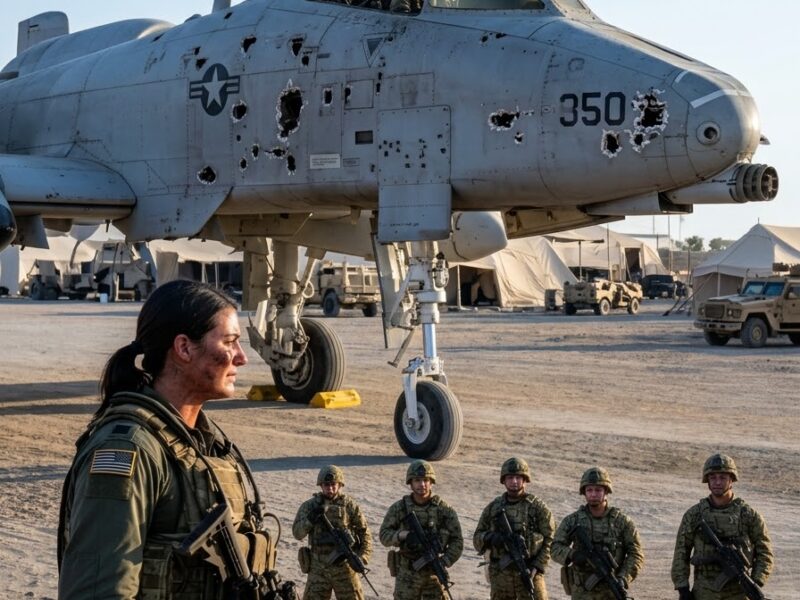
The hangar at Davis-Monthan Air Force Base went silent when my A-10 limped onto the runway, smoking and covered in bullet holes
The tarmac at Davis-Monthan Air Force Base smelled of scorched rubber, raw jet fuel, and hot metal. A low, agonizing whine groaned from the left TF34 engine of my A-10C Warthog as the heavy titanium bathtub skidded sideways across the concrete, sending a shower of orange sparks against the desert dusk.
Around the hangar, the usual clatter of maintenance crews, air wrenches, and shouted orders died instantly. Everything went silent. Mechanics froze mid-stride, dropping torque wrenches onto the pavement. Flight chiefs stopped dead in their tracks. Through the shattered canopy of my cockpit, every breath I took tasted like burning copper and ozone. Smoke was billowing from my tail section, thick and grey, swirling through bullet holes that littered the fuselage like open sores.
Standing at the edge of the taxiline was Colonel Vance. His uniform was pressed, his boots polished to a mirror finish, but his face was carved out of granite. He stared up at me through the cracked plexiglass with an expression that burned worse than the smoke in my eyes—it was the look reserved for a pilot who had not just disobeyed an order, but who had betrayed every fundamental rule of tactical command. He stood there, arms stiff at his sides, because he still didn’t know why I had refused to eject. He didn’t know why I had dragged a twenty-ton flying corpse across five hundred miles of hostile airspace when my wingman went down.
Before I was Captain Maya “Valkyrie” Vance, I was a mother. Long before I ever strapped myself into the armored seat of a ground-attack jet, my universe revolved around a quiet bedroom with glow-in-the-dark stars stuck to the ceiling. Every single mission—every pre-flight check, every throttle push, every drop into a hot landing zone—began with the exact same vision locked in my mind: my eight-year-old son, Ethan, asleep under a patchwork quilt, his small hand wrapped tightly around the tail of a scuffed, light-blue plush dinosaur named Barnaby.
That morning, at 0300 hours, before the transport humvees came to take us to the flight line, I had knelt beside his cot in the transit housing. The air had been cool, carrying the sharp scent of desert sagebrush. I had brushed a lock of brown hair away from his damp forehead, leaned down, and whispered, “Mom will be home soon. Keep Barnaby safe until I get back.”
Six hours later, I was flying through a sky that looked as if it had been torn wide open by a jagged blade.
We were flying low-altitude close air support near the jagged ridges of the Hindu Kush, a desolate valley where the rocks were sharper than glass and the shadows hid heavy machine-gun nests. My wingman, Lieutenant Jake “Ghost” Mercer, was flying flying off my right wing. We were searching for a stranded reconnaissance team when the sky detonated around us.
The first burst was heavy anti-aircraft fire—a 23mm anti-aircraft canon hidden in a dry creek bed. It didn’t ring; it sounded like a sledgehammer hitting a iron sheet right beside my head. The primary canopy shattered instantly. A wave of freezing, hundred-knot wind whipped through the cockpit, ripping my map from the knee-board and tearing at my oxygen mask.
“Valkyrie, break left! Break left!” Jake’s voice crackled through my helmet.
Before I could complete the turn, the second burst struck. It ripped through my left wing, severing the primary hydraulic lines in a cloud of pink fluid. The stick in my hand went slopy, vibration hammering through my forearms. Alarms began screaming—a chorus of high-pitched electronic wails indicating engine fires, pressure loss, and flight-control failures.
Then my radio filled with a blast of white static, followed immediately by Jake’s ragged voice.
“Mayday… Mayday… Valkyrie, I’m hit! Engine two is on fire! Controls are locked—”
I fought the heavy stick, forcing my banking jet back toward his trajectory. Through the broken frame of my canopy, I saw his A-10 trailing a heavy column of black smoke, banking violently into a steep, unrecoverable spiral toward the steep walls of the jagged canyon below.
“Jake, eject! Eject now!” I screamed into my mask, slamming the throttle forward despite the grinding screech coming from my own left engine.
There was no answer. Just the hollow hiss of open air on the frequency.
Standard operating procedure was clear, drilled into every pilot until it became instinct: When a wingman’s aircraft goes down in an active engagement zone and control is lost, high-altitude cover must be maintained until search and rescue is coordinated. Do not descend into low-altitude air-defense envelopes.
I should have climbed. I should have pulled the nose up, turned back toward the safety of the strike package, and let the rescue helicopters handle the ground.
Instead, I lowered my airbrakes and followed him down into the pit.
The canyon swallowed my aircraft like a throat. Dark, sheer walls of granite shot upward on either side, narrowing until the wings of my A-10 barely had room to roll. The air inside the gorge was turbulent, throwing my damaged jet violently against its structural limits. Below us, a dense plume of greasy black smoke rose from a dry creek bed, marking the impact point of Jake’s aircraft.
I lowered my altitude to three hundred feet, fighting the dead-weight feeling of the controls. Through the smoke and dust kicked up by the crash, I spotted movement near the twisted tail section of Jake’s Warthog.
They weren’t friendly forces.
A convoy of three pickup trucks had already converged on the crash site. Dozens of armed men were spilling out over the rocks, spreading out in a tactical line toward the crushed cockpit. They were moving fast, weapons raised, closing the distance to execute or capture whoever was left alive inside the wreckage.
I had seconds to decide. My master caution lights were flashing red, my fuel gauge was unwinding like a clock out of time, and my left engine was roaring in a death rattle. If I fired my weapons at this altitude in a narrow canyon, the blast wave alone could rip my unstable aircraft right out of the sky.
“Not today,” I growled through clenched teeth.
I rolled the damaged A-10 onto its side, pointing the massive, six-barreled 30mm GAU-8 Avenger cannon directly at the dry riverbed. The entire airframe shook violently as I squeezed the trigger. The sound was an apocalyptic roar—a continuous, terrifying metallic rip that echoed off the canyon walls.
The ground erupted in massive geysers of rock, dirt, and fire. The heavy explosive shells tore through the enemy vehicles, shredding the threat in a matter of seconds. The shockwave slammed upward, catching my low-flying jet and throwing my right wing skyward.
Then, something struck my cockpit. A heavy heavy-caliber round blew through the lower titanium floorboard. A burst of shrapnel slammed into my body armor, the force of a battering ram knocking the wind out of my lungs. My helmet bounced off the canopy frame, and for several agonizing seconds, the world went completely black.
When I opened my eyes, the cockpit was bathed in the crimson light of emergency warnings.
The wind was screaming through the hole beneath my feet. Fuel was leaking out of the self-sealing tanks faster than the pumps could manage. Hydraulics were down to critical reserve levels. My left engine finally died with a dull, sickening metallic thud, its turbine blades seizing completely.
And yet, through the haze of smoke and my own blurred vision, I saw something that stopped my heart.
Jake was alive.
He was out of the wreckage, lying on his back in the red dirt a few yards from his burning cockpit, waving a single flare. His orange survival suit was stained dark with blood, his left leg pinned awkwardly beneath a sheared piece of the wing root. He couldn’t walk. He couldn’t run. And more enemy reinforcements were undoubtedly on their way down the mountain passes.
To my left, stretching along the canyon floor, was a narrow, unpaved dirt track—a dry lakebed littered with boulders and deep ruts. It was never meant for an aircraft that weighed thirty thousand pounds and had only one functioning engine and half its flight controls.
“Hold on, Jake,” I muttered, pulling the throttle back on my remaining engine.
I dropped the landing gear. The mechanical clunk was delayed, agonizingly slow. I lined the nose up with the uneven dirt strip, fighting the violent drag of the dead left wing. The ground rushed up to meet me at a terrifying speed. The wheels touched down with a bone-jarring impact that nearly snapped the landing struts. The jet bounced high into the air, slammed down again, and dragged its left wingtip through the red dust, spinning sideways before finally grinding to a halt less than fifty yards from Jake’s position.
I unstrapped myself, threw open the heavy canopy, and scrambled down the maintenance ladder with a pry bar in hand. My legs felt like lead, my chest burning from the impact of the shrapnel.
“Maya… you’re insane…” Jake wheezed as I reached him. His face was pale from shock, sweat streaking through the dirt on his skin. “You were supposed to… go home.”
“Shut up, Mercer,” I gasped, jamming the steel bar beneath the twisted aluminum spar pinning his thigh. “We’re both going home.”
With a final, desperate surge of strength fueled by pure adrenaline, I leveraged the metal away from his leg. Jake screamed as his leg freed. I grabbed him by his tactical vest, dragging his full weight across the rutted dirt toward my idled, smoking aircraft. Every step was a battle against gravity and exhaustion. I hauled him up the narrow access ladder, practically stuffing his frame into the tiny cargo storage space behind the ejection seat.
I climbed back into the pilot seat, slapped the canopy down, and shoved the remaining throttle to maximum military power. The single engine screamed in protest, but the Warthog lurched forward, bouncing wildly across the rocks until the wings caught just enough air to lift us out of the canyon floor, clearing the mountain ridge by mere inches.
By the time the scorched ridgelines of the desert faded and the long, flat runways of Davis-Monthan appeared on the horizon, my aircraft was barely an airplane anymore. It was a metal miracle held together by titanium, prayer, and sheer stubbornness.
The landing was violent. Without proper hydraulic pressure, the brakes locked immediately upon contact with the tarmac, blowing out both main tires in a cloud of rubber smoke. The A-10 slid hundreds of yards, screaming along the runway like a wounded beast before finally shuddering to a halt right in front of the primary search-and-rescue hangar.
Fire trucks and ambulances roared across the concrete, their red and blue lights flashing against the gathering darkness. Ground crews rushed forward with foam hoses, spraying down the glowing left engine.
I sat in the cockpit, my hands frozen around the control stick, my knuckles bone-white. The engine ground to a silence, leaving only the sound of my own heavy, ragged breathing inside my flight helmet.
Outside, Colonel Vance pushed through the firemen and technicians. His face was pale, his eyes wide with a terrifying mix of relief and fury.
I unlatched my helmet, pulling it off my sweat-soaked hair, and unclipped my safety harness. My whole body was shaking—a violent, uncontrollable tremor that started in my knees and radiated up to my shoulders. I unlatched the canopy and stepped down the ladder onto the firm, unmoving concrete. I could barely stand; my knees buckled, and I had to catch myself against the jagged edge of the hole in my fuselage.
Colonel Vance stopped two feet away from me. He looked at the shattered wings, the hundreds of bullet holes peppering the metal, the missing wingtip, and the trail of hydraulic fluid pooling around my boots.
“You were ordered to return to base forty minutes ago, Captain,” Vance said, his voice dangerously low, stripped of all emotion. “You broke formation. You endangered a multi-million-dollar asset, and you disregarded a direct tactical directive from central command.”
I stood up straight, though my legs felt like water. I met his eyes directly, refusing to look down.
“I know, sir,” I managed to say, my throat dry and raw.
He stepped closer, his jaw tight. “You risked an entire aircraft, your life, and the security of this unit for one single man. Give me one logical reason why I shouldn’t strip you of your wings right now.”
I looked past his shoulder. Behind him, paramedics were carefully lifting Jake Mercer out of the belly of my jet on a spine board, securing an IV to his arm. Jake was conscious, looking over at me through his oxygen mask, giving a faint, trembling nod of gratitude before they slid him into the back of the waiting ambulance.
I turned back to Colonel Vance. My voice broke, betraying the sheer emotional wall I had been holding up for the last three hours.
“No, sir,” I said softly, wiping a smear of grease and dust from my cheek. “I didn’t risk it for a pilot. I risked it because someone was waiting for him to come home.”
Silence settled over the tarmac once more. Vance stared at me, his eyes searching my face, the rigid anger in his posture slightly fracturing.
A few yards away, near the shadow of a dark transport vehicle, a group of four men stood in silence. They wore unmarked tactical gear, night-vision mounts on their helmets, and custom equipment. They were Navy SEALs—the quick-reaction force that had been staged to recover us if we had gone down in enemy territory. They had watched my broken jet land from their staging area.
Not one of them spoke. But as I caught the eye of the team leader, a hardened operator with a scarred chin, he slowly raised his hand to his brow and held a crisp, silent salute. Beside him, another operator brushed a hand across his eyes, turning his head away toward the runway lights.
Colonel Vance slowly let out a long, heavy breath. The hard lines of his face seemed to soften, if only for a fraction of a second. He reached into the inner pocket of his tactical jacket and pulled out an object.
It was a standard military-issue, sealed manila envelope. But written across the center in large, unformed childish scrawl were two words: MOMMY’S JET.
My heart stopped. My hand reached out instantly, taking the paper with fingers that wouldn’t stop trembling.
“One of the crew chiefs found this stuck under the seat cushion in your cockpit before you took off this morning,” Vance said softly, looking away toward the horizon. “It must have slipped out of your flight bag.”
I stood on the oil-stained tarmac, surrounded by the smell of fire suppressant and aviation fuel, and broke the paper seal on the envelope.
Inside was a simple piece of construction paper, folded into quarters. I unfolded it slowly, carefully, as if it were made of delicate glass. It was a crayon drawing. Ethan had drawn an A-10 Warthog—disproportionate, with huge wings and grey crayon strokes covering the sides. Inside the cockpit was a little figure with long yellow hair and a smiling face. Surrounding the plane was a dark blue sky, thick with hand-drawn yellow stars, each one carefully outlined in black marker.
At the very bottom of the page, in his neat, painstaking eight-year-old handwriting, he had written:
Mom, if you get scared in the dark sky, just follow the stars home. Barnaby and I are holding the door open.
A single tear cut a clean path down through the dust on my cheek, splashing onto the waxy crayon surface. I pressed the drawing tightly against my tactical vest, right over my chest where my heart was hammer-striking against my ribs. In that single moment, all the noise of the base, the screaming sirens, the scolding of the colonel, and the terror of the canyon vanished completely. I was no longer a pilot who had barely survived a dogfight; I was just a mother holding a piece of her son’s heart.
I looked up at Colonel Vance. He was staring at the ground near his boots, his hands clasped behind his back, pretending to inspect a scuff on his leather shoes. Now I understood why he couldn’t look me in the eye when he handed it to me. He had a daughter of his own back in the States. He knew what that paper meant.
“Get yourself to the infirmary, Vance,” he said quietly, his voice lacking any of its previous military harshness. “Have the medics look at those shrapnel wounds on your leg. That’s an order.”
“Yes, sir,” I whispered.
“And Captain?” Vance added, turning his head back toward me as I turned to walk away. “Good flying down there.”
I nodded once, holding the drawing against my chest. But as I pulled my flight glove off with my teeth to re-fold the paper, I felt something thick and rigid still sitting inside the bottom of the manila envelope.
I paused. I reached my bare fingers back inside the paper sleeve.
My fingertips brushed against the smooth, plastic surface of a photograph.
I pulled it out. It was a physical, gloss-coated photographic print—the kind that hadn’t been produced in years, yellowed slightly around the edges from age.
The image showed a young man in a worn-out flight suit, standing in front of an older model fighter jet on a dusty runway. He had dark, messy hair, a cocky half-smile, and familiar, sharp hazel eyes. He was wearing an old-style flight jacket, and his arm was wrapped affectionately around the shoulder of a younger version of Colonel Vance.
My breath caught violently in my chest. The world around me seemed to tilt on its axis.
I knew that face. I had seen that exact smile every single day for the past eight years—because every time Ethan smiled at me from across the kitchen table, it was that exact same face looking back at me.
It was my husband. Major David Vance. The man who had been officially declared Killed in Action nine years ago, when his reconnaissance aircraft was shot down over the northern mountain corridors before Ethan was even born. The man whose dog tags hung around my neck beneath my dog tags.
My hands shook so violently the photo nearly slipped from my grip. I flipped the photograph over to the blank white backing.
Written across the center, in thick, dark blue ink—written in the precise, distinct block lettering that I had spent years reading in old love letters tucked inside my memory box—were five short words.
Your father is still alive.
The air in my lungs froze. The tarmac beneath my feet felt as though it had opened up, dropping me into an endless, dizzying void.
Nine years.
Nine years of military honors, of a folded American flag sitting inside a glass case on my living room mantle, of holding Ethan while he cried in the middle of the night, asking why all the other kids at school had fathers who picked them up from soccer practice while his father was just a photograph on the wall. Nine years of grieving a man whose body was never recovered from the deep snows of the northern ridges.
I whirled around, my eyes searching wildly across the flight line for Colonel Vance.
He hadn’t walked away. He was standing twenty yards away beside his command vehicle, watching me. His face wasn’t rigid anymore; it was heavy with a profound, painful sorrow. He had known. He had held this secret, waiting for the right moment, or perhaps forced by circumstances far higher than his own command.
I marched toward him, the pain in my shrapnel-wounded leg completely forgotten. My voice came out as a fierce, desperate rasp.
“What is this?” I slammed the back of the photograph with my thumb. “Colonel! What is this?!”
Vance stepped toward me, placing a single, heavy hand on my shoulder. He looked around the tarmac, ensuring the ground crews and medics were out of earshot, before leaning in close.
“David didn’t die in that crash nine years ago, Maya,” Vance said, his voice dropping to a harsh whisper that thrilled through my nerve endings. “His plane went down, but he was recovered by a deep-cover intelligence network operating outside of Allied command. He’s been living under an assumed identity, working high-value asset extraction behind enemy lines. If his real name ever surfaced, if anyone knew he had a family… you and Ethan would have become immediate targets for every hostile group in the sector.”
“He let me think he was dead?” Tears spilled over my eyelashes, hot and furious. “He let his son grow up believing his father was dust in a mountain canyon?!”
“He had no choice!” Vance snapped softly, his grip tightening on my arm. “He accepted the assignment to protect you. But three days ago, his operational cell was compromised in the exact same valley where you just pulled Mercer out of the dirt.”
My heart pounded against my ribs like a trapped bird. The dry canyon. The ambush. The heavy anti-aircraft fire that had targeted my wingman. It hadn’t been a random insurgent patrol.
“The men surrounding Mercer’s crash…” I whispered, the realization hitting me like a physical blow. “They weren’t looking for a downed pilot. They were looking for him.”
“David was the asset your recon team was sent to find,” Vance said, his eyes hard and unwavering. “He was captured twelve hours before you flew your sortie. He is being held in a hardened subterranean complex six miles north of where you landed your aircraft. The high command considers the area too hot for a standard rescue mission. They’re planning to airstrike the facility to prevent intelligence leakage.”
“They’re going to bomb the site?” I roared, stepping into his space. “With David inside?!”
“Unless someone who knows the canyon floor better than anyone else leads a low-altitude Insertion team beneath their radar coverage,” Vance replied, his voice calm, cold, and calculated.
He looked at me—really looked at me. Not as a subordinate officer who had just broken the rules, but as a warrior, a mother, and a wife who had just proven she could fly a dying plane into the gates of hell and come back out alive.
“Your aircraft is wrecked, Captain,” Vance said quietly. “But there is an operational A-10 sitting in Hangar 4, fueled, armed with bunker-busting munitions, and prepped for engine start. A team of Navy SEALs—the ones who just watched you land—are currently loading into a low-profile transport helicopter in twenty minutes.”
He reached out and gently tapped the crayon drawing of the blue dinosaur and the star-filled sky that I was still clutching in my left hand.
“Ethan drew you a map, Maya,” Vance whispered, a faint smile touching the corner of his lips. “He told you to follow the stars home. Are you going to go bring his father back, or are you going to let them turn that canyon into glass?”
I didn’t answer with words.
I looked down at the photograph in my hand—at the cocky smile of the man I had loved, the man who had sacrificed his life to keep us safe in the shadows. Then I looked at the drawing of the stars, at Ethan’s small, brave handwriting.
I wiped the tears from my eyes with the back of my tactical glove, leaving a smear of dark charcoal across my cheek. The shaking in my hands stopped completely. A cold, absolute clarity settled over my mind, sharper than any diamond, stronger than any titanium armor.
“Clear Hangar 4 for immediate departure,” I said, my voice dead steady. “Tell the SEALs they’ve got ten minutes to get their gear strapped down. I’m taking the lead.”
I turned on my heel and began running toward the flight line, my boots slamming hard against the tarmac, heading straight back toward the sky.
The end.









