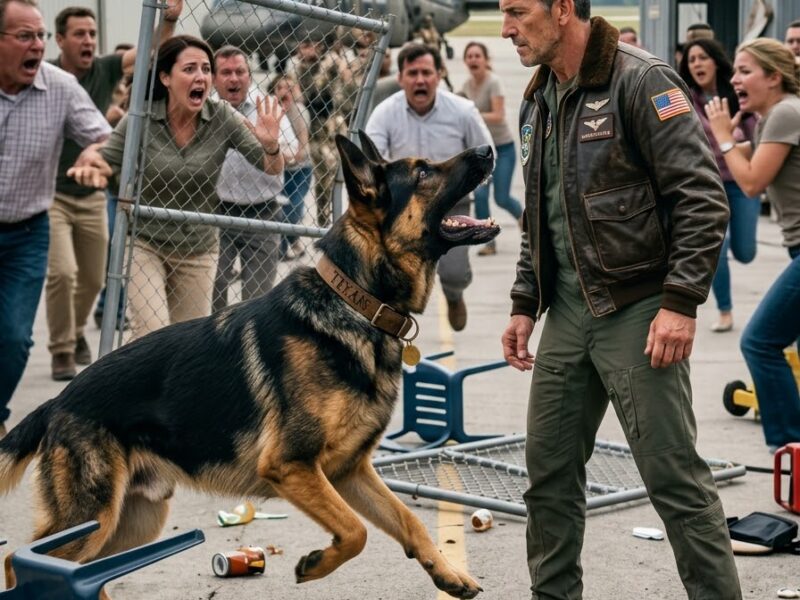
The giant German Shepherd burst through the gates of a quiet Oregon neighborhood and sent everyone running for cover
The rain in Western Oregon does not simply fall; it saturates the air until the sky seems to collapse directly onto the spruce and Douglas firs. It was late afternoon, and the Pacific Northwest gloom had turned the suburban streets of Willow Creek into a slick, charcoal maze.
I had spent nineteen years in the cockpit of C-130 Hercules transport planes, landing on dirt strips in bad weather and navigating severe turbulence over oceans. Flying teaches you to read movement before it becomes action—it teaches you to look at a storm and measure its velocity by the subtle shifts in the air.
I was forty-eight years old, recently retired from active service, and driving my old Ford Ranger back toward a quiet house that had felt far too large for three years. The wipers scraped rhythmically against the windshield, clearing a crescent of visibility through the downpour.
Then, the neighborhood blew open.
At the cul-de-sac ahead, a set of heavy wrought-iron security gates rattled violently before swinging wide. A massive shadow broke through the opening, splashing through a deep puddle with enough force to spray water six feet into the air.
It was a German Shepherd, but not like any pet I’d seen in the suburbs. He was towering—easily over ninety pounds—with a thick sable coat soaked to the skin, black markings across his spine, and a broken, frayed nylon leash whipping behind him like a snapped tether.
Panic spread down the street faster than the dog could run.
“Get inside! Move!” a man shouted, dropping a bag of groceries on his driveway as he scrambled up his porch steps, slamming the front door until the deadbolt clicked.
Across the street, a woman let out a sharp, terrified shriek, snatching her young son by his jacket collar and yanking him behind a wooden privacy fence, latching the gate with a metallic bang.
“Call animal control! He’s wild!” someone yelled from an upper-window.
The dog didn’t look at the houses. He didn’t look at the screaming people or the doors slamming shut. He sprinted into the center of the road, his paws throwing up sheets of water, and then stopped cold. He spun in a frantic circle, his broad chest heaving, his dark muzzle dripping with rain and foam. He raised his snout to the gray sky and let out a sound that chilled me to the marrow—not a bark, and certainly not a territorial growl, but a sharp, broken, rising pitch of pure, unadulterated terror.
I pulled the truck to the curb, shifting into park. Through the driver-side window, I watched him.
In the military, you learn to spot the difference between an aggressor preparing to strike and a soldier who has been separated from his unit during an artillery barrage. An aggressive dog holds his tail high, stiffens his spine, and fixes a cold, predatory stare on a target.
This animal was shaking. His ears were pinned flat against his skull, his eyes darting frantically from side to side, glossy with a wild, hyperventilating panic. He wasn’t hunting. He was drowning in fear.
Then, his gaze swept across the street and locked directly onto my windshield.
Our eyes met through the rain-streaked glass. Something shifted in his posture—a sudden, rigid pause, as if an electric current had passed straight through his spine.
I turned off the ignition, pulled the key, and pushed the driver’s door open.
“Don’t get out!” a neighbor screamed from behind a drawn curtain down the street. “He’ll tear you apart!”
I stepped out of the cab. The cold Oregon rain hit my face instantly, soaking through my flannel shirt. The pavement hummed with the downpour. I stood tall beside the open door, keeping my arms loose at my sides, refusing to back up or make any sudden, aggressive movements.
“Easy, buddy,” I said. My voice was low, carrying the calm, steady cadence I used to use over the cockpit intercom when an engine failed at twenty thousand feet. “Easy now.”
The Shepherd lowered his head until his snout nearly touched the wet asphalt. A deep, agonizing whine ripped from his throat. Then, he charged.
Ninety pounds of muscle and wet fur came accelerating straight at me across thirty yards of asphalt.
“Look out!” a voice yelled.
I didn’t move an inch. I didn’t brace for an impact, nor did I raise my hands to cover my throat. I simply stood my ground, breathing slowly through my nose.
The dog reached me in three seconds flat. But he didn’t leap, and he didn’t bare his teeth.
He slammed his entire body directly into my knees and chest, burying his wet, heavy head under my left arm. The force of his weight nearly knocked me back against the truck frame, but he held on, pressing himself against my torso with an intensity that felt less like an animal and more like a drowning person grabbing a lifeline.
He was trembling so violently that the vibration rattled right through my boots into the pavement.
“I’ve got you,” I murmured, bringing my hand down gently onto the thick, wet fur at the base of his neck. “I’ve got you, big guy. You’re okay.”
The dog let out a ragged, shuddering breath. He lifted his head, his dark, amber eyes searching my face with a terrifying intensity. Then, his head snapped to the left, looking toward the dark wall of spruce trees that marked the edge of the state forest reserve behind the neighborhood.
He whined again, sharper this time. He lunged forward, grabbed the thick canvas sleeve of my heavy jacket between his molars, and pulled hard—not biting into skin, but using his jaw like a hook, yanking my arm toward the woodline.
He let go, ran five paces toward the trees, stopped, and looked back over his shoulder.
“Alright,” I said, wiping the rainwater from my eyes. “Show me.”
The moment I stepped off the paved road, the dog turned and plunged into the thick underbrush.
The edge of Willow Creek bordered a vast tract of protected timberland—dense, old-growth timber crisscrossed by old logging roads, steep ravines, and muddy drainage ditches. The canopy was so thick that the afternoon light vanished almost instantly, replaced by a deep, oceanic green twilight.
“Stay close, boy,” I called out, but he didn’t need the instruction. Every fifteen yards, the Shepherd would stop, spin around in the mud, and wait until he heard my boots crunching through the wet fern beds before lunging forward again.
The terrain sloped downward sharply. The rain had turned the forest floor into a slick layer of decaying pine needles and liquid clay. I slipped twice, grabbing onto the rough bark of young fir trees to keep my footing. My breathing grew heavy, the cold air burning in my lungs, but the dog moved with purpose, following an unseen line through the gloom.
We traveled nearly three hundred yards off the main road, deep into a section of the woods where the sounds of the neighborhood—the rain on aluminum gutters, the distant murmur of traffic—were completely swallowed by the forest.
Suddenly, the dog stopped at the lip of a steep, rocky drop-off.
He dropped his front quarters low to the ground, his paws digging into the soft earth at the edge of the ridge, and began to bark—a series of sharp, desperate bursts that echoed off the damp trunk walls of the ravine.
I scrambled up beside him, sliding down on my heels to reach the drop-off.
“What is it?” I panted, leaning over the ledge.
Thirty feet below us, lying at an awkward, violent angle in the rocky creek bed, was a dark blue Ford F-250 pickup.
The truck had clearly carried too much speed coming off an old, abandoned logging access road higher up the ridge. It had clipped a boulder, vaulted off the ledge, and slammed driver’s-side first into the massive trunk of a hundred-year-old Douglas fir. The cab was crushed like a aluminum soda can, the roof buckled downward, and the driver’s side door was completely folded around the tree trunk.
Steam was still rising lazily from the shattered radiator, hissing as the cold rain hit the hot engine block.
“Hey!” I shouted, my voice cutting through the sound of the running water down in the creek. “Is anybody in there? Can you hear me?”
For three agonizing seconds, there was only the sound of the rain hitting the metal frame of the wreck.
Then, from deep inside the crushed cab, came a low, wet groan.
The Shepherd didn’t hesitate. He launched himself over the edge of the slope, scrambling down the loose shale and mud, his paws sliding until he hit the bottom of the ravine. He sprinted straight to the broken passenger window, reared up on his hind legs, and thrust his broad upper body halfway inside the crushed cabin, whining frantically as his tongue worked at something inside.
I slid down the bank after him, my boots landing heavily in the icy creek water.
I reached the passenger side of the truck. The glass had been completely blown out by the impact. I stuck my head inside, the smell of copper, crushed pine, and leaking coolant hit my nose immediately.
A man was crumpled across the bench seat. He was in his late fifties, wearing a dark canvas work coat soaked in blood from a deep laceration across his forehead. His left leg was violently pinned beneath the collapsed dashboard, the heavy metal of the steering column pressed hard against his ribs.
“Sir! Don’t move,” I said, reaching through the frame to press two fingers against the side of his neck. His pulse was thready, fast, and weak. “I’m here. Help is coming.”
I pulled out my cell phone. Miraculously, despite the remote location, I had one faint bar of signal clinging to the screen. I dialed 911 immediately.
“Emergency, what is your location?”
“I have a single-vehicle rollover accident in the woods off Willow Creek Road, about a quarter-mile past the main gate,” I said clearly, keeping my eyes on the driver. “One male trapped. Severe chest and leg trauma. Vehicle is unstable in a creek bed. I need heavy rescue, jaws of life, and a medical chopper on standby.”
“First responders are en route. Stay on the line, sir.”
I hung up, shoving the phone into my pocket, and leaned closer to the driver. The Shepherd was still there, his head wedged through the window, resting his snout against the man’s bloody shoulder, letting out low, rhythmic whines.
The driver’s eyelids fluttered open. He was in deep shock, his pupils dilated, his skin ghostly pale beneath the mud and blood.
“The… the dog…” the man rasped, his voice barely a rattle in his chest. “Did he… did he get… help?”
“He found me,” I said, reaching in to take the man’s right hand. “He ran all the way to the street and brought me right to you. You’re going to be okay. The fire department is on their way.”
The man’s right arm was trembling violently, but his fingers were locked shut in a vice-like grip. He wasn’t reaching for the steering wheel or trying to push the dashboard off his crushed leg.
He was holding a small, laminated photograph, gripping it so tightly that his knuckles were stark white.
“Keep him… keep him safe…” the driver whispered, his thumb lightly brushing the glossy surface of the picture before his eyes rolled back, his body going completely limp as he lost consciousness.
The next twenty minutes were a chaotic blur of sirens, bright lights, and the mechanical roar of hydraulic equipment.
The Willow Creek Fire Department arrived in force. They ran heavy lines down the steep embankment, securing the crushed truck with steel cables to prevent it from sliding further down the creek bed. The air in the quiet woods was torn apart by the deafening screech of the jaws of life slicing through the pillars of the cab.
I stood back near the base of the ridge, my arm resting over the broad shoulders of the German Shepherd. The rescue crew had tried to clear the dog away from the immediate scene, but he refused to move more than ten feet from the wreck. When a young firefighter tried to grab his collar, the dog didn’t bite, but he planted all four paws and let out a growl so deep it vibrated through the mud beneath our feet.
“Let him stay,” I told the paramedic captain. “He won’t hurt you. He’s the only reason this man is alive right now.”
It took forty-five minutes to cut the driver free from the wreckage. They slid him out on a rigid spinal board, his leg immobilized in a vacuum splint, an oxygen mask clamped over his mouth.
Even in his unconscious state, his right hand remained locked in a tight, protective curl around that single, laminated photograph.
As the team swung the stretcher around to haul it up the steep embankment using a pulley system, one of the paramedics tried to gently pry the picture from his frozen fingers to hand it off to the hospital team.
“Careful, don’t tear it,” the paramedic muttered, pulling the small piece of plastic free. He turned toward me, holding it out. “Hey, sir, you were first on the scene. Can you hold onto his personal effects until we clear the transport?”
“Yeah,” I said, reaching out to take the photo. “I’ll keep it safe.”
The paramedic turned back to his team, shouting orders as they began hoisting the stretcher up the muddy slope.
I wiped the mud and droplets of rainwater from the surface of the laminated picture with the thumb of my jacket. The dog stepped up beside me, leaning his heavy ribcage against my thigh, his eyes fixed on the small rectangle in my palm.
The rain caught the light of a firefighter’s lantern, illuminating the image.
It was a bright, sunlit photo taken on a tarmac outside a hangar. In the center stood a young woman, no more than twenty-six years old. She was wearing a sage-green flight suit with an Air Force flight officer patch sewn onto her left shoulder. Her dark hair was pulled back in a tight, neat bun, and her smile was wide, radiant, and utterly fearless.
Sitting right beside her, his ears oversized for his small body, was a six-month-old German Shepherd puppy with a thick sable coat and black markings across his back.
My breath stopped in my throat. The air left my lungs so fast I felt as though I’d been struck in the chest with a sledgehammer.
I knew that smile. I had seen it every single day for twenty-six years.
It was my daughter, Sarah.
My hand began to shake so violently that the photo almost slipped through my fingers into the mud. I dropped to my knees in the wet grass, staring at the small piece of paper, my heart hammering against my ribs like a caged animal.
Sarah.
She had been an Air Force instructor pilot, flying T-6 Texans out of Vance Air Force Base in Oklahoma. Three years ago, during an advanced night-formation training flight, her aircraft had suffered an unrecoverable engine failure during a low-altitude approach. She had stayed with the plane to steer it away from a residential area near the runway.
She never made it to her ejection seat.
For three years, I had lived in the echo of that loss. I had left the service six months later, moving back to our old family home in Oregon, living a quiet, ghost-like existence in a house full of her old books, her childhood flight jackets, and photos hung on every wall.
I looked down at the dog standing beside me in the mud.
He leaned his head down, pressing his cold nose against the laminated surface of the photo, right against Sarah’s face, letting out a soft, mournful sigh that seemed to break the silence of the forest.
I looked back up toward the ridge where the paramedics were loading the driver into the back of the waiting ambulance.
I knew who the man in the truck was now.
His name was Major Robert Vance. He had been Sarah’s senior flight instructor—the man who had mentored her, taught her how to handle low-altitude stalls, and who had delivered the eulogy at her military funeral three years ago.
“Sarah…” I choked out, my voice breaking down into a rough, pathetic sob. “Oh God, Sarah…”
The dog stepped closer, wrapping his head over my shoulder, pressing his massive, warm body against mine as I sat in the mud and wept.
Two hours later, the storm had finally passed, leaving behind a cold, clear night sky filled with a million brilliant stars.
I stood outside the intensive care unit at Oregon Health & Science University in Portland. The hospital was quiet, bathed in the low, blue glow of night lights and the distant hum of medical monitors.
Through the glass window of ICU Room 308, I watched Major Vance lie beneath a heavy blanket. His surgery had been successful—they had repaired his leg and stabilized three broken ribs. He was awake now, staring up at the ceiling with a vacant, exhausted expression.
The nurse nodded to me as I gently pushed the door open.
The German Shepherd moved with me. He didn’t pull or whine now; he walked with a slow, solemn tread, his nails clicking softly on the linoleum floor.
Major Vance turned his head slowly toward the door. When his eyes met mine, a look of profound, agonizing recognition swept across his pale face.
“Captain Miller…” Vance whispered, his voice dry and scratchy from the breathing tube they had removed an hour earlier.
“Robert,” I said quietly, pulling a vinyl chair up to the side of the bed. “Don’t try to get up. You’ve been through hell.”
Vance’s eyes drifted from my face down to the dog, who had rested his broad chin on the edge of the mattress, right beside Vance’s uninjured arm.
“He found you…” Vance choked out, a single tear cutting through the bandage paste on his cheek. “He actually… he found you.”
“Why did he have that photo, Robert?” I asked, my voice trembling despite my best efforts to keep it steady. “Where did he come from?”
Vance swallowed hard, his eyes closing for a moment as he gathered his strength.
“When… when Sarah passed…” Vance began, his chest heaving under the monitor straps, “she left the dog in her military will. His name is Maverick. She got him when he was just eight weeks old, right after she finished her commission.”
I sat in silence, listening to the rhythmic beep… beep… beep… of the heart monitor.
“After the accident,” Vance continued softly, “Maverick was devastated. He wouldn’t eat. He wouldn’t sleep. Sarah’s fiancé tried to keep him, but he was too big, too stressed—he kept running away, trying to get back to the airfield. Eventually, a military family in Idaho adopted him, but he never settled. He spent three years being passed between handlers who didn’t understand him.”
Vance reached out his hand, his fingers sinking deep into Maverick’s sable fur.
“Six months ago, I finally tracked him down,” Vance whispered. “He was living on a farm in eastern Washington, locked in a kennel because the owners said he was ‘unmanageable’ and kept staring at the road, waiting for someone who was never coming back.”
I covered my mouth with my hand, tears stinging the corners of my eyes.
“I bought him from them on the spot,” Vance said, his voice breaking. “I brought him home to my place in Eugene. But I knew… I knew he didn’t belong with me, Captain. He belonged with her family. He belonged with you.”
Vance turned his head to look directly into my eyes.
“I was driving him to your house this morning,” Vance said softly. “I had your address written on a card on the dashboard. I was going to bring him to your front door as a surprise. But when the rear tire blew on that logging road… I lost control. The truck went over the edge.”
Vance reached out, touching my wrist with his trembling hand.
“When the truck hit the tree, the windshield shattered. Maverick escaped through the glass. I was pinned… I couldn’t move. I told him… I looked him right in the eyes, held up Sarah’s picture, and I told him: ‘Go find him, boy. Go find her dad.'”
Vance smiled through his tears, a quiet, awestruck expression on his face.
“He didn’t know your neighborhood. He had never been to Willow Creek in his life. But he ran three miles through those woods until he hit that road. And out of all the people, out of all the houses…” Vance stopped, wiping his eyes with the back of his sleeve. “…he knew you. He smelled her on you, Captain. He knew who you were the second he saw you.”
I looked down at Maverick. The dog lifted his head, resting his forehead against my knee, letting out a long, peaceful breath that seemed to vibrate through my entire body.
“Thank you, Robert,” I whispered, reaching over to grip the old instructor’s hand. “Thank you for bringing him home.”
It was nearly 4:00 AM by the time I finally drove my truck back up the driveway of my house in Willow Creek.
The neighborhood was completely silent now, dark under the cold blanket of the midnight sky. The houses were shut tight, their porch lights casting long, amber shadows across the wet pavement where, hours earlier, a scene of pure terror had unfolded.
I opened the passenger door of the truck. “Come on, Maverick. We’re home.”
The dog hopped down gracefully onto the driveway, his tail giving a single, tentative wag against my leg.
We walked up the front steps together. I unlocked the heavy oak door, pushed it open, and stepped into the quiet, dark hallway.
The house smelled of old wood, faint coffee, and the quiet, stagnant air of a home that had been lived in by only one person for three long years.
Maverick stepped over the threshold. He didn’t run. He didn’t sniff around the kitchen or look for food.
Instead, he walked with absolute, unhesitating purpose down the main hallway, passing the living room, passing my master bedroom, until he reached the very end of the hall.
He stopped in front of a closed white door.
It was Sarah’s room.
I hadn’t opened that door in over eight months. It had remained shut, a shrine to a life that had been cut short, holding her old books, her high school track ribbons, her flight academy graduation cap, and her neatly made bed.
Maverick stood before the door, his nose pressed against the gap at the bottom, taking in a long, deep breath.
Slowly, I walked down the hall, reached out, and turned the brass doorknob.
The door swung open with a faint creak.
The room was bathed in the pale, silver light of the moon streaming through the large bay window. Everything was exactly as she had left it. On the wall hung a large, framed photograph of Sarah in her dress whites, smiling broadly under a bright blue sky.
Maverick walked softly across the hardwood floor. He didn’t touch her desk or knock over her books.
He walked directly to the foot of her bed, where a thick, faded wool blanket—the one she had taken with her to college and then to pilot training—was neatly folded across the mattress.
The dog leaped up gently onto the bed, his heavy frame settling down into the center of the wool blanket. He rested his chin over his paws, his deep brown eyes looking up at the large photograph hanging on the wall above him.
I walked into the room, pulled up her old desk chair, and sat down beside the bed.
I reached out, burying my hand into his thick, warm coat, feeling the slow, steady rhythm of his breathing.
“She loved you so much, Maverick,” I whispered into the quiet room, my eyes fixed on my daughter’s picture. “She talked about you every time she called home.”
Maverick let out a soft, contented huff, his heavy eyelids fluttering down as the exhaustion of the day finally took hold. For the first time in three years, the house didn’t feel cold. It didn’t feel empty. The heavy, suffocating silence that had occupied every corner of these rooms had been replaced by the warm, living presence of the animal she had loved more than anything else.
I sat there in the pale moonlight for hours, my hand resting on his back, listening to the quiet wind rustling the spruce trees outside the window, watching the stars move slowly across the dark Oregon sky.
Just before sunrise, as the first faint lines of gold began to cut through the gray horizon, Maverick’s ears suddenly swiveled.
He lifted his head off his paws, his body tensing slightly, but not with fear.
He didn’t bark. He didn’t growl.
He simply sat up on the bed, staring fixedly at the closed bedroom door that led out into the dark hallway.
A faint, soft whining sound escaped his throat—a gentle, welcoming sound I had never heard him make before.
I turned in my chair, following his gaze toward the door.
From the other side of the dark hallway, cutting through the silence of the early morning, came a faint, rhythmic sound.
Scratch… scratch… scratch…
It was light, steady, and deliberate, right against the bottom panel of the wood, as if someone—or something—was gently tapping from the dark corridor outside, waiting for the door to be opened.
Maverick didn’t move away. He tilted his head, his tail giving three slow, heavy thumps against Sarah’s blanket, his eyes bright and peaceful in the growing light of the new day.
The end.









