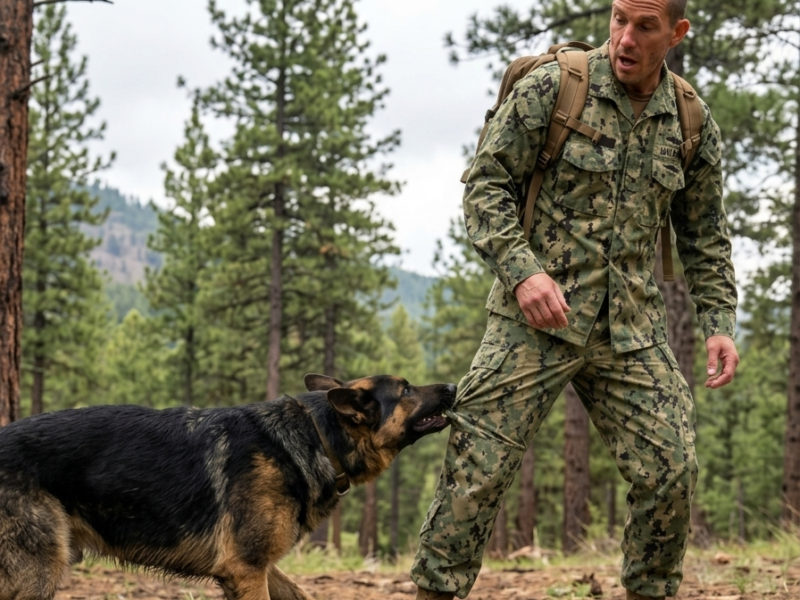
The German Shepherd blocked my path outside a quiet Virginia gas station, trembling and whining until I followed him behind the building, while I kept asking who had hurt him
The rain had been falling over Northern Virginia for three straight days, turning the back roads of Shenandoah County into slick, black ribbons that reflected the low gray sky. I had pulled my truck into the desolate gas station off Route 11 around 11:30 PM, the engine idling with a tired, rhythmic hum. I was thirty-eight, a retired Navy corpsman living off a modest pension and the quiet routine of a carpenter, seeking a solitude I’d spent eight years earning.
As I stepped out into the damp air, the soles of my boots sank into the gravel. I filled the tank, my eyes half-closed against the stinging spray of water blown off the awning.
That was when the German Shepherd emerged from the treeline behind the dumpster.
He was thin—his ribs outlined sharply under a coat soaked through with mud and rain—but his posture wasn’t that of a stray. His ears were held high, his chest was broad despite his emaciated frame, and his eyes had a piercing, intelligent clarity that immediately made my spine stiffen. He didn’t approach the trash cans looking for food. He didn’t cower from the glaring sodium lights overhead. He walked directly toward me, stepping over the puddle near the pump, and stood dead center in my path.
“Easy, pal,” I muttered, raising one hand, palms open. “I don’t have anything for you.”
The dog didn’t back down. He whined, a low, vibration-heavy sound in his chest, then spun around and trotted three steps toward the dark line of white pines bordering the rear lot. He stopped, turned his head, and looked back over his shoulder.
I stood there holding the gas pump nozzle. “I’m heading home, dog. Get going.”
He came back. This time, he didn’t just whine. He reached forward with a sudden, deliberate motion, caught the canvas sleeve of my jacket between his teeth, and pulled. He didn’t bite down to hurt—he pulled with the disciplined firmness of a working dog executing a breed-specific task.
Years in the Navy had taught me to trust patterns more than explanations. Animals didn’t waste energy in a downpour unless their survival depended on it—or someone else’s did.
“Alright,” I said, releasing the pump latch and letting the nozzle click off. “Lead the way.”
The Shepherd let go of my sleeve immediately and trotted toward the gloom behind the gas station building, where an abandoned mid-90s pickup truck sat rusting on flat tires under a canopy of dripping pines. The air smelled of wet pine needles, engine oil, and old rust. The dog stopped beside the truck’s driver-side rear tire, dropped his nose to the gravel, and whined again—louder this time, a frantic, desperate frequency.
I crouched down, the knees of my jeans soaking up the freezing rainwater. I shone the narrow beam of my pocket flashlight beneath the rusty frame of the truck.
Half-buried in the wet mud was a small, bright red children’s backpack, decorated with faded cartoon butterflies.
“What do we have here?” I murmured.
I reached under, dragged the pack out into the rain, and unzipped the main compartment. Inside was a child-sized pink windbreaker, a half-empty plastic water bottle, a small bag of stale crackers, and a glossy 4×6 photograph sealed inside a clear ziplock bag to protect it from the weather.
I pulled out the photograph and flicked my light across it.
My heart stopped in my chest.
The photo showed a young girl—maybe six or seven years old—with bright blue eyes and dark brown pigtails, hugging the very same German Shepherd currently standing beside me. But it wasn’t the girl that made my breath catch in my throat. Standing in the background, partially out of frame, was a man wearing a olive-drab flight jacket. Across his right shoulder was a distinct scar—a jagged, star-shaped burn mark from a shrapnel tear.
I knew that scar. I had stitched it closed myself inside a triage tent in Fallujah in 2014.
I turned the photograph over. Written in dark, shaky permanent marker across the white backing was a single line:
If he finds you, trust him. – Miller
“David Miller,” I whispered. My former squad leader. The man who had carried me three miles through a mortar zone when my leg was opened up by an IED.
I looked up at the dog. He was staring at me, his ears pinned back, his tail tucked low.
“Where is she?” I asked him, my voice dropping an octave as my old tactical instincts kicked back into gear. “Where’s the girl, boy?”
The Shepherd barked once—a sharp, muffled sound—and bounded deeper into the tree line, heading toward a concrete drainage ravine that ran parallel to the highway.
I unholstered my pocket knife, gripped my flashlight tightly, and ran after him into the dark.
The rain beat against the canopy above, dropping heavy, ice-cold droplets through the leaves. The dog led me down a steep embankment into a dry-stream bed littered with dead branches and plastic debris. At the end of the culvert sat an ancient concrete storm drain, roughly three feet wide, choked with rusted iron bars and accumulated silt.
The dog stopped at the mouth of the drain, placing his front paws on the concrete ring, and began licking the air through the gaps in the iron grate.
I dropped to my knees in the mud. “David?” I called out softly. “Miller?”
Silence, except for the roar of the rain on the highway two hundred yards away.
Then, from the deep, pitch-black interior of the pipe, came a sound that made every hair on my neck stand up.
Tap. Tap. Tap.
Three faint, deliberate knocks against the corrugated steel wall of the drain.
“Is he with you?” a tiny, trembling voice whispered from the dark.
I leaned my face closer to the rust-caked bars, shining my flashlight down the pipe. Sitting roughly ten feet inside, curled into a tight ball on an old piece of cardboard, was the little girl from the photograph. Her face was smeared with mud, her hands were scraped raw, and she was shaking so hard her teeth were clicking together.
“Who?” I asked gently, holding the light away from her eyes so I wouldn’t blind her. “Who are you asking about, sweetie?”
“My dad,” she sobbed, clutching a small stuffed rabbit to her chest. “He told me to stay here. He told Bear to go get help.”
Bear—the Shepherd—whined loudly at the sound of her voice, shoving his nose as far through the iron bars as it would go.
I took the handle of my heavy pocket knife, jammed it into the gap between the rusted frame of the grate and the soft concrete, and put all my weight behind it. With a sickening crunch of flaking iron, the old latch snapped. I swung the heavy grate open, reached into the pipe, and pulled the little girl out into the open air.
She immediately buried her face in my neck, her small arms locking around my throat with a terrifying, desperate strength. I pulled off my dry canvas coat, wrapped it completely around her shivering body, and lifted her into my arms. Bear circled my legs, leaning his heavy body against mine as if trying to shield both of us from the wind.
“Where is your father?” I asked her, keeping my voice as calm as I had kept it when treating wounded soldiers under fire. “Where did he go, honey?”
She pointed a tiny, mud-stained finger back into the dense, black woods behind the gas station, toward the old gravel access road that led up into the ridge.
“He told me to hide in the pipe,” she whispered, her eyes wide with terror as she looked at the dark trees. “He said bad men were coming. Men with guns.”
Before I could ask her another question, Bear’s ears went flat against his skull. He let out a deep, chest-vibration growl that shook his entire body, his lips peeling back to expose clean, white teeth.
Through the rain and the heavy thrashing of the pine branches, I heard the crunch of heavy tires on gravel.
Twin beams of high-intensity LED headlights cut through the gloom of the access road above us. A large, black, unmarked SUV rolled to a slow stop on the shoulder directly above the ravine.
The doors clicked open.
I shoved the girl down behind the lip of the concrete culvert, dropping into a low crouch while keeping one hand on Bear’s harness to keep him from charging up the muddy embankment.
Two men stepped out of the SUV. They wore heavy dark raincoats and tactical boots, their movements swift, methodical, and disciplined. One of them held a large, waterproof spotlight, sweeping its powerful white beam back and forth across the treeline, while the other kept his right hand buried deep inside the front pocket of his jacket—a classic concealed-carry draw stance.
“Check the drain!” the man with the spotlight barked, his voice carrying clearly over the sound of the storm. “He wouldn’t have left the kid far from the vehicle!”
I pulled my phone out of my pocket, keeping the screen dimmed against my chest, and dialed 911.
“Shenandoah County Emergency, what is your location?” the dispatcher’s voice cracked quietly through the speaker.
“I need immediate armed backup at the abandoned gas station off Route 11, south of mile marker 42,” I whispered, keeping my eyes fixed on the boots moving along the top of the ridge. “I have a lost child here. Two unknown armed men are tracking us.”
“Sir, stay on the line, units are—”
Before she could finish, the spotlight beam snapped down into the ravine, illuminating the red backpack I had left lying open on the mud.
“Found her bag!” the second man yelled. “She’s down here!”
“Cancel that, send everyone you have!” I snapped into the phone, dropping the device into the mud and standing up straight, pulling the girl completely behind my legs.
Bear didn’t wait for my command. The moment the spotlight beam hit us, the Shepherd exploded out of the culvert with a deafening, terrifying roar, scrambling up the wet clay of the embankment like a rocket.
“Watch out!” one of the men screamed.
A loud thud echoed through the trees as Bear hit the man with the spotlight, sending the heavy metallic flashlight flying through the air into the brush. The beam spun wildly before coming to rest against a rock, casting long, distorted shadows across the forest floor.
I didn’t waste a second. I scooped the girl up with my left arm, scrambled up the opposite side of the ravine away from the SUV, and sprinted toward the rear entrance of the gas station.
“Stop right there!” the second man shouted, the sharp clack-clack of a handgun slide being racked echoing through the woods behind us. “Where is the drive, Miller? Give us the drive and you walk away!”
They thought I was David. In the dark and the pouring rain, wearing a heavy tactical jacket with a dog at my side, they had mistaken me for my old team leader.
I reached the rusted back door of the gas station, kicked the emergency latch with the heel of my boot, and slammed through into the dark, abandoned storage room inside. The building had been closed for months—the air inside was thick with the smell of mildew, damp cardboard, and dry rot.
I set the girl down behind a stack of old wooden pallets.
“Stay here, don’t make a sound,” I whispered to her, looking her dead in the eye. “What’s your name?”
“Lily,” she sobbed softly, wiping her nose with the sleeve of my oversized coat.
“Lily, my name is Sam. I worked with your dad. I am not going to let anyone hurt you. Do you understand me?”
She nodded once, clutching her rabbit tightly.
Outside, the heavy rear door slammed open. Bootsteps echoed across the concrete floor of the main garage area.
“We know you’re in here, David!” a voice called out—the driver of the SUV. “You can’t run on that knee forever! Just give us the hardware! The General wants this closed tonight!”
I reached into my pocket, pulling out the small red backpack I had managed to grab from the mud. My hands were shaking slightly—not from fear, but from the sudden, violent surge of adrenaline that always accompanied a fight.
I unzipped the small front compartment of the bag—the part I hadn’t searched down at the culvert.
Tucked beneath a small plastic hairbrush was a hidden inner zipper, sewn crudely into the lining with thick black nylon thread. I pulled the tab back.
Inside lay a heavy, metal-cased military flash drive—waterproofed, shock-resistant, and fitted with a high-grade hardware encryption pad.
Engraved clearly across the steel casing was a set of custom tactical serial codes—and right beneath them, a set of initials that made my blood run cold.
S.A.V. – CPO – USN
Samuel Andrew Vance. My initials.
David hadn’t just trusted a dog to find a stranger. He had trained this dog to track my specific scent using an old pair of my military fatigue pants he must have kept for years. He hadn’t sent Bear into the woods randomly—he had brought the dog to my home county, knowing I lived within twenty miles of this highway, and set him loose to hunt for the only man he still trusted with his life.
Before I could process the sheer weight of what David had done, my phone—still in my pocket—began to vibrate continuously.
The caller ID showed a blocked, private number.
I pressed the phone to my ear, keeping my thumb over the microphone.
“Sam,” a voice rasped into the receiver—weak, ragged, wet with the sound of internal bleeding. “Sam, tell me you have her.”
“David?” I whispered back, leaning my head against the wooden pallet. “David, where are you?”
“Listen to me…” David coughed violently, the sound echoing hollowly through the receiver. “They… they hit my car on Route 11… two miles north. I took two rounds to the chest… I’m done, Sam. I’m not making it out of these woods.”
“Hold on, David! I called local emergency, they’re on their way—”
“No!” David snapped, his voice surging with a sudden, desperate strength. “No cops! The local sheriff… he’s on their payroll! That drive… it has the entire logistics layout for the illegal weapons transfers out of Naval Station Norfolk! They’re cleaning house, Sam! They’re killing everyone who signed off on the manifests!”
A heavy crash sounded from the front of the gas station. Glass shattered as the front store window was kicked in.
“David,” I said quietly. “Who is hunting you?”
“Commander Vance’s old unit…” David whispered, his breathing getting shallower by the second. “The shadow team… Aegis Security. Sam… if Bear brought you Lily… you’re already in their system. They won’t stop until—”
A gun blast echoed through the phone line, followed by the heavy, cold sound of a body hitting the dirt.
Then a new voice picked up David’s phone. Cold, methodical, completely devoid of emotion.
“We have the father,” the voice said calmly into the line. “Now bring us the girl and the drive, Miller… or we start burning down every house in this township.”
The line went dead.
I stood in the pitch-black storage room of the gas station, the dead receiver still pressed to my ear, listening to the heavy rain hammering against the corrugated metal roof overhead.
“Sam?” Lily’s tiny voice called out from behind the wooden pallets. “Is my dad coming?”
I lowered the phone slowly, shoving the encrypted flash drive deep into my inner jeans pocket. I looked down at the little girl sitting in the dirt, her bright blue eyes wide with a combination of trust and unspoken terror that I had seen on the faces of children in a dozen warzones across the globe.
“Your dad is making sure the road is clear for us, Lily,” I lied smoothly, crouching beside her and buttoning my heavy coat around her small shoulders. “We have to move. Now.”
The sound of heavy tactical boots crunching over shattered glass echoed from the main retail floor of the station.
“Check the back rooms!” a voice ordered—the second man from the SUV. “And shoot that damn dog if he comes out of the dark again!”
A faint whine sounded near the broken rear door. I turned my flashlight beam to the floor and saw Bear slipping quietly through the doorway, his chest covered in mud and red clay, a deep graze along his left shoulder where a bullet had creased his hide. He didn’t make a sound. He trotted straight to Lily, dropping his heavy head into her lap, letting out a single, long sigh of relief.
“Good boy,” I whispered, patting his uninjured flank. “Good boy, Bear.”
I grabbed an old iron tire iron leaning against the workbench, jammed it into the heavy back door to wedge it shut behind us, and lifted Lily back into my left arm. “Bear, heel,” I commanded softly.
We slipped out through a side ventilation hatch that opened into a narrow maintenance alley between the gas station and an overgrown auto body repair yard. The rain was coming down harder now, cold and blinding, washing away our footprints as fast as we made them.
I didn’t head back to my truck. If the local sheriff’s department was compromised, as David had warned, my license plate would already be flagged on every automated reader along Route 11.
Instead, I cut deep into the dense brush of the ridge, moving uphill through the thick oak and pine forest, heading toward an abandoned railway line that I knew ran parallel to the river three miles to the west.
As we walked, my mind raced back through the years.
Naval Station Norfolk. 2018. Before I retired, I had worked administrative medical clearances for special logistics units. I remembered David Miller—he had been assigned to a security oversight detail for high-value cargo moving through the port terminals. He had complained once, over a beer at an off-base dive bar, about manifest discrepancies—shipping containers logged as empty that weighed thirty tons on the crane scales.
I had told him to leave it alone. I had told him that guys who asked questions about naval logistics usually ended up assigned to cold-weather stations in Alaska—or worse.
He hadn’t listened.
“Sam?” Lily whispered into my neck as I pushed through a dense thicket of mountain laurel. “Bear’s leg is hurting.”
I stopped under the shelter of a massive white oak tree, setting Lily down on a dry patch of pine needles beneath the trunk. I crouched beside Bear, examining his left shoulder with my flashlight dimmed to a pinprick behind my thumb.
The bullet had torn a two-inch furrow through the thick muscle layer above his shoulder blade. It was bleeding steadily, dark red blood mixing with the rainwater in his fur.
I pulled a clean bandana from my pocket, along with a small tube of antibiotic ointment I always carried in my field kit, and bound the wound tightly, tying the cloth securely around his chest. The dog didn’t growl once; he simply licked the side of my hand as I worked.
“He’s tough, Lily,” I said, looking up at her. “Just like your dad.”
Suddenly, Bear turned his head toward the valley floor below us.
Down along Route 11, three miles away, a cascade of red and blue emergency lights filled the rainy night. I could hear the faint, distant wail of sirens echoing off the mountain walls.
“The police are there!” Lily said, her eyes lighting up with a sudden burst of hope. “They can help us!”
“No, Lily,” I said, standing up and scanning the highway through my small pocket binoculars.
Through the optics, I could see two local sheriff’s cruisers pulled up alongside the black SUV. But the deputies weren’t arresting the men in the raincoats. They were standing together under a heavy pop-up tent, looking at a digital tablet being held by the man with the spotlight.
David was right. The corruption wasn’t just a couple of rogue contractors—it had rusted the entire local structure.
My phone vibrated again in my pocket. A new text message from an unregistered satellite number:
We have your vehicle registration, Samuel. We know you own the cabin on Creek Road. Give us the girl and the drive at the Old Mill on Passage Creek by 02:00, or we burn the cabin with your brother inside.
My blood turned to ice.
My younger brother, Luke, was staying at my timber cabin while he recovered from a leg injury sustained at his construction site. He had no idea what was happening. He was sitting in a recliner three miles away, completely unaware that a team of professional killers was heading his way.
I looked at my watch. 12:45 AM.
“Sam?” Lily asked, sensing the sudden, lethal change in my energy. “What’s wrong?”
I closed my pocket knife with a sharp click and tucked the flash drive into the waterproof lining of my boots.
“Lily,” I said, dropping to one knee so I was eye-level with her. “We’re going to make a pit stop. We’re going to get my brother, and then we’re going to put an end to these men.”
I looked down at Bear. The Shepherd stood up, his ears forward, his body rigid despite his injury.
“Bear,” I said quietly, pointing up the mountain trail that led toward Creek Road. “Find Luke.”
The dog barked once—a clear, resonant tone that cut straight through the storm—and led the way into the mountain dark.
The rain had turned into a thick, clinging fog by the time we reached the perimeter of my property on Creek Road. The mountain air was bitter cold, carrying the sharp scent of damp earth and woodsmoke from my cabin’s chimney.
I held Lily close to my side, ducking behind an ancient stone wall that marked the property boundary.
“Stay low,” I whispered to her.
Fifty yards ahead through the dense pine trees sat my cabin—a heavy, two-story structure built from rough-hewn oak logs. My truck wasn’t in the driveway, but a sleek, silver sedan with dark tinted windows was parked under the canopy of the car port, its engine idling with a barely audible hum.
Two men were stationed outside. One was standing on the front porch, a suppressed carbine slung across his chest, smoking a cigarette beneath the overhang. The second man was pacing near the rear pump house, checking his watch every few seconds.
They hadn’t set fire to the place yet. They were waiting for 02:00—or waiting for me to walk right into their net.
“Bear,” I whispered, crouching beside the dog. “Stay with Lily behind this wall. If anyone comes near her, you take them down. Understand?”
The Shepherd rested his broad head on Lily’s lap, his dark eyes fixed on my face with absolute comprehension.
I pulled off my heavy, water-logged boots, slipping into a pair of soft-soled leather moccasins I kept in my pack for silent tracking. I pulled my old Navy-issue combat knife from my field kit—a seven-inch fixed blade with a non-reflective black oxide coating—and vanished into the foggy brush.
I circled wide around the perimeter, using the roar of the rain on the tin roof of the pump house to cover the sound of my approach.
The man near the pump house turned his back to light a fresh cigarette.
I moved like a ghost through the fog, closing the fifteen-yard gap in less than three seconds. Before he could turn his head, I caught him around the neck with my left arm, cutting off his airway, while driving the heel of my palm sharply into the base of his skull. He went limp instantly. I dragged his unconscious body into the dark shelter of the pump house, stripping him of his tactical radio and his suppressed 9mm sidearm.
I checked the magazine—fifteen rounds of high-velocity hollow-points.
I slipped around the side of the cabin toward the front porch.
The second man was still standing near the door, flicking his cigarette butt out into the muddy driveway.
I picked up a heavy river stone from the garden bed and threw it high into the brush twenty yards to his left.
The stone crashed through the pine branches with a loud crack.
The guard snapped his weapon up, his head turning toward the noise. “Vance?” he called out softly into the fog. “Is that you?”
He stepped down off the wooden porch, taking two cautious steps into the wet driveway.
I stepped out from the shadow of the porch pillar behind him.
I drove the butt of the captured handgun directly into the side of his jaw with a sickening crunch. He collapsed into the mud without making a sound. I disarmed him, dragged him onto the porch, and bound his hands and ankles tightly with heavy zip-ties from his own belt.
I opened the front door of the cabin and stepped inside, keeping the gun held at low-ready.
“Luke?” I called out softly.
The living room was dark, lit only by the dying embers of the stone fireplace.
Sitting in his recliner in the corner was my younger brother, Luke. His hands were tied behind his back with duct tape, a gag stuffed into his mouth, his eyes wide with sheer panic as he looked at me.
Beside him, sitting on the sofa with a glass of my scotch in his hand, was an older man wearing a sharp tweed coat and polished leather boots. His hair was silver, meticulously combed, and his face was marked by the cold, arrogant authority of a man who spent his life commanding others from behind a mahogany desk.
General Thomas Vance.
“Hello, Samuel,” the General said smoothly, setting his glass down on the side table with a soft clink. “You always were remarkably efficient at close-quarters security. It’s a pity you chose to leave the service when you did.”
“Get away from my brother, General,” I said, pointing the weapon dead center at his chest.
“Or what?” General Vance smiled—a thin, lifeless expression. “You’ll shoot a retired flag officer in your own living room? Do you really think that solves your problem, Sergeant?”
He reached into his coat pocket. I raised the weapon’s sight to his eye line.
He didn’t pull a gun. He pulled out a sleek, black satellite phone and tossed it onto the coffee table between us.
“Your former squad leader, David Miller, was a fool,” Vance said, his voice dripping with condescension. “He thought he could use administrative records to bring down an entire defense contracting ecosystem. He thought a few stolen manifests from Norfolk meant something in the grand scheme of national security.”
“He died tonight, General,” I said, my voice shaking with a cold, lethal fury. “He died in the rain two miles from here while your men hunted his seven-year-old daughter like an animal.”
The General didn’t even blink. “Collateral damage is an unfortunate reality of high-stakes operations, Samuel. You know that as well as I do. Now, give me the drive, and I will ensure your brother walks out of this cabin alive. Refuse… and my team at the perimeter will level this property before the local fire department even receives the call.”
I looked at Luke. My brother was shaking his head frantically against his gag, his eyes screaming at me not to give in.
I reached into my pocket, pulled out the heavy, steel-cased flash drive, and held it up between my thumb and forefinger.
“You want this?” I asked quietly.
“It is the only thing standing between you and a very short life, Sergeant,” Vance said, extending his hand.
I didn’t hand it to him.
Instead, I raised my left hand and whistled—a short, sharp two-tone signal that echoed through the open front door of the cabin.
A split second later, a seventy-pound German Shepherd tore through the doorway like a whirlwind, slamming his heavy body directly into General Vance’s chest.
The General went down under the dog’s weight with a harsh gasp of pain, his glass of scotch shattering against the stone hearth as Bear pinned him to the floor, his jaws locked around the lapel of the General’s tweed coat, growling with a guttural, terrifying intensity that echoed off the high log ceilings.
“Hold!” I barked.
Bear stopped instantly, his teeth hovering an inch from Vance’s exposed throat, his dark eyes burning with pure instinct.
General Vance lay on the floor, his face pale, his immaculate silver hair disheveled, his chest heaving as he stared up at the dog in horror.
“You… you crazy bastard…” Vance gasped, his voice trembling for the first time. “He’ll kill me!”
“He’s a trained military working dog, General,” I said, stepping forward and placing my boot squarely on Vance’s wrist, kicking the satellite phone away across the floor. “He only kills when I tell him to.”
I pulled my knife, sliced the duct tape from Luke’s hands and mouth in one smooth motion, and hauled my brother out of the chair.
“Sam!” Luke gasped, coughing violently as he rubbed his raw wrists. “There are three more vehicles down at the bridge! They’ve got the whole road blocked off!”
“I know,” I said. I handed Luke the captured suppressed sidearm from the guard on the porch. “Can you shoot?”
Luke gripped the weapon, his jaw setting hard. “I can shoot.”
“Take the General’s car,” I ordered, tossing him the keys I had snatched from the coffee table. “Get Lily. Drive north through the mountain trail toward the West Virginia line. Don’t stop until you reach the Federal Building in Martinsburg. Hand this drive directly to the Special Agent in Charge.”
I pulled the steel flash drive from my pocket and slammed it into Luke’s hand.
“What about you?” Luke asked, his eyes wide with concern.
I looked down at General Vance, then out the open doorway toward the foggy road where the headlights of the contractor team were beginning to cut through the trees.
“The General and I are going to have a little chat with his employer,” I said, grabbing Vance by his coat collar and hauling him violently to his feet. “And Bear is going to make sure nobody interrupts us.”
Ten minutes later, the rain had backed off to a fine, freezing mist as the main convoy of Aegis Security vehicles pulled up to the stone bridge over Passage Creek. Four dark SUVs sat idling in a semicircle, their high-beam headlights focused entirely on the center of the old wooden bridge.
Six heavily armed contractors stepped out into the mist, weapons raised, forming a tactical line across the road.
Standing in the center of the bridge, illuminated by the blinding white light of the headlights, was General Thomas Vance.
Beside him stood Bear, the German Shepherd’s coat dripping with rain, his eyes fixed on the line of contractors.
Behind them, sitting on the wooden rail of the bridge with my hands resting calmly on my knees, was me.
“Stand down!” General Vance shouted into the dark, his voice carrying across the rushing water of the creek below. “All units, stand down immediately!”
The lead contractor—a tall, scarred man wearing a tactical headset—took three cautious steps forward, his rifle lowered slightly. “General? What’s going on? Where is the target?”
“The operation is compromised!” Vance yelled, his voice cracking with humiliation and fear as he felt the cold steel of my hidden wire restraint wrapped tightly around his wrist beneath his sleeve. “The federal authorities have already received the digital package! The drive is in Martinsburg!”
The lead contractor stopped dead in his tracks. He looked at Vance, then at me, then at the German Shepherd standing at my side.
Slowly, the contractor reached up and pressed his headset button. “Command, this is Team Leader. Target package has been transmitted. The General is compromised. Requesting immediate extraction.”
A cold, electronic voice crackled back through his speaker—loud enough for all of us to hear in the stillness of the night.
“Negative, Team Leader. Scrub the site. No loose ends. Repeat, no loose ends.”
The lead contractor lowered his hand from his headset. He looked at General Vance with a cold, hollow pity.
“I’m sorry, General,” the contractor said softly, raising his rifle. “Orders are orders.”
“Get down!” I roared.
I grabbed General Vance by the back of his coat and hurled both of us over the wooden railing of the bridge just as a deafening hail of automatic gunfire tore through the timber, shattering the heavy oak posts into a cloud of wooden splinters.
We hit the freezing, churning waters of Passage Creek with a massive splash.
The cold water hit my chest like a physical blow, knocking the air from my lungs as the current dragged us downstream through the dark ravine. I kept one arm locked around Vance’s collar, swimming furiously with my legs, fighting the heavy drag of the current as bullets whipped into the water around us like tiny, lethal needles.
Beside us, a dark shape broke through the foam.
Bear was swimming furiously in the whitewater, his powerful legs churning against the current, keeping his head high as he guided us toward the shallow gravel bar at the bend of the river.
We dragged ourselves out of the icy water fifty yards downstream, tumbling onto the muddy bank beneath the shelter of a massive concrete retaining wall.
In the distance, above the roar of the creek, the high-pitched wail of dozens of federal federal sirens echoed down from the highway.
Federal Marshals, FBI tactical units, and State Police cruisers rolled onto the bridge above, their blue and red lights painting the foggy trees in a brilliant, flickering storm of colors. The contractor team was surrounded instantly, their weapons dropped to the wet pavement as tactical teams moved in from both sides of the river.
I lay on my back in the wet mud, staring up at the gray morning light that was finally beginning to break through the clouds over the Shenandoah Mountains.
General Vance lay beside me, coughing up river water, his hands shaking violently as he listened to the megaphones on the bridge announcing his arrest.
Bear trotted over to where I lay, dropping his wet, heavy body down on the mud right beside me. He leaned his head against my chest, his warm breath rising in small white clouds in the freezing morning air.
I raised my wet hand and rested it gently on the dog’s soft, damp head.
“You did good, boy,” I whispered softly into the quiet of the morning. “You brought her home. You brought all of us home.”
The Shepherd let out a long, quiet sigh, closed his eyes, and rested his head against my hand as the morning sun finally broke through the rain.
The end.









