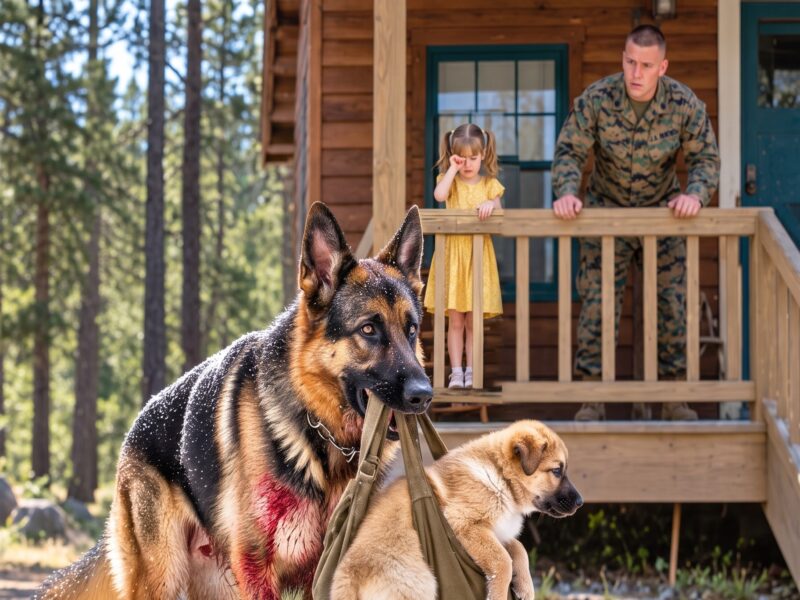
The German Shepherd appeared at my cabin door just before midnight, soaked from the freezing rain and carrying a trembling puppy by the scruff
The wind in the Montana mountains did not merely blow; it hunted. It screamed through the pines, driving freezing rain against the cedar logs of my cabin until the wood groaned like an old ship taking on water. I sat three feet from the cast-iron stove, watching the flames lick the dry tamarack, a half-empty mug of black coffee cooling in my hands.
Since leaving the Marine Corps six years ago, I had learned to value silence above almost everything else. Here, thirty miles from the nearest town and six miles past where the county snowplows turned back, the world was simple. The dark was absolute, the cold was predictable, and nobody asked me questions about Helmand Province or the men who hadn’t come back with me.
Then came the sound.
It was not the wind. It was three slow, deliberate scratches against the heavy oak of the front door, low down near the threshold.
I set the mug down, my muscle memory instantly overriding my tired mind. My hand went automatically to the shelf beside the door, fingers curling around the cold grip of my flashlight while my left hand unlocked the heavy deadbolt. I pulled the door open half an inch, expecting a stray raccoon or a desperate coyote driven down from the ridgeline by the storm.
Instead, a massive German Shepherd stood on the porch, drenched to the skin, her dark coat slick with ice. Her ribs showed beneath her soaked fur, and her legs were shaking violently from exhaustion and cold. But she wasn’t alone. Clutched gently in her jaws, held by the scruff of its neck, was a tiny puppy, no more than a few weeks old, shivering just as hard as its mother.
The big dog didn’t bark. She didn’t growl. She raised her head, looked directly into my eyes with an intelligence that was almost terrifying, and stepped forward. With meticulous care, she laid the tiny, trembling ball of black-and-tan fur down on my doormat. Then she took a step back and looked at me again.
“Easy, girl,” I muttered, lowering my voice to the low, steady register I used to use when approaching working dogs in the service. “Easy.”
She didn’t flinch. She nudged the puppy forward with her snout, pushing it toward the warmth radiating from the open doorway.
I dropped to one knee, pulling a wool blanket off the bench inside. I wrapped the small puppy tightly, tucked it inside my coat, and then reached out to inspect the mother. As I brought the flashlight beam closer to clear the matted fur around her neck, my hand froze.
Hanging from a thick, military-spec nylon collar was a heavily tarnished brass tag. It was scratched, pitted, and darkened by years of exposure to the elements, but the deeply stamped letters were still legible under the sharp white light of my torch.
RANGER
I felt the air leave my lungs in a single, cold gasp.
Ranger had been the elite multi-purpose canine assigned to my squad in Afghanistan. More specifically, she had belonged to my spotter and best friend, Corporal Daniel Hayes. Twelve years ago, during a night raid in the mountains outside Sangin, our unit had been ambushed. Daniel had taken a fatal hit while clearing a compound, and according to the official debriefing, Ranger had been killed alongside him by a remote-detonated explosive device. I had spent twelve years believing they were both buried beneath the sand.
My hands trembled so violently that the flashlight beam bounced crazily against the cabin wall. I leaned in closer, my thumb wiping away a crust of dried mud from the underside of the brass tag.
Below the name was a serial number. 0311-8542.
It wasn’t a dog’s registration number. It was my old squad identifier—the exact string of digits printed on the dog tags I still kept in a wooden drawer beside my bed.
I stared into the dog’s eyes. They were cloudy with age, yellowed at the edges, but the focus was sharp, unwavering, and hauntingly human.
“Where did you come from?” I whispered, my voice breaking in the drafty doorway. “You’re supposed to be dead, Ranger. Both of you.”
The dog gave a single, low whimper. She turned her head toward the black void of the tree line, where the blizzard was rapidly turning the forest into a wall of white noise. She walked down the three porch steps, stopped in the snow, and looked back over her shoulder at me.
She wasn’t asking for shelter. She was leading.
I didn’t think. I pulled on my heavy canvas parka, shoved my boots into their laces without tying them fully, and swept the wrapped puppy into the deep inner pocket of my coat. I grabbed a high-lumen tactical lantern and stepped out into the freezing rain.
The dog moved immediately, her pace steady despite her obvious physical ruin. She led me away from the cabin path, straight into the thick timber of the national forest where there were no trails, only ancient Douglas firs and jagged granite outcroppings. The snow swallowed her tracks almost as fast as she made them, forcing me to keep my lantern locked on her dark shape as she navigated the rising terrain.
We climbed for nearly twenty minutes, the grade growing steeper until my lungs burned with the icy air. Finally, the dog slowed, stopping in a shallow ravine choked with fallen timber. Half-buried beneath a massive drift of snow sat the collapsed frame of an abandoned Forest Service ranger station—a structure that had been decommissioned in the 1980s and left to rot.
Ranger slipped through a broken window frame into the pitch-black interior. I followed, ducking my head under the splintered joists, the beam of my lantern cutting through decades of dust, bat droppings, and dry rot.
The dog stood in the far corner of the cabin, pressing her nose against a loose pine floorboard. She scratched it once. Then twice.
I dropped to my knees, setting the lantern on a rotten bench. I jammed the blade of my pocketknife into the seam between the boards and levered the wood up. It snapped with a loud crack, revealing a shallow cavity in the dirt foundation below.
Inside lay a heavy, green waterproof ammo can, wrapped tightly in a decaying sheet of oilcloth.
My fingers were numb, but I managed to pop the rusty metal latches of the box. Inside, protected from the dampness, were three things: a stack of polaroid photographs, a standard-issue military field notebook, and a thick Manila envelope sealed with electrical tape. Written across the front of the envelope in faded blue ink was my name: LANCE CPL. MARK SUTHERLAND.
My heart was hammering against my ribs like a trapped bird. I sliced the tape with my knife and pulled out a folded sheet of lined paper.
The handwriting was unmistakable. Slanted, loose, and sharp. Daniel.
Mark, the letter began. If you’re reading this, they finally found the cabin, or Ranger finally brought you here. Which means I’m out of time. I don’t know how many years it’s been since Sangin, but what they told you was a lie. I didn’t die in that compound. Neither did Ranger. We were taken—not by the Taliban, but by our own command. They needed us dead on paper so no one would look for what we took out of that valley.
I stopped reading. The air in the ruined station suddenly felt razor-thin.
Before I could turn the page, Ranger let out a low, terrifying growl from the broken window. Her ears swept back, her hackles rising along her spine as she fixed her gaze on the dark tree line outside.
A sharp crunch sounded in the fresh snow fifty feet away. Someone was standing outside in the storm.
A heavy shadow shifted between two pines, moving with practiced, tactical discipline.
At that exact second, the cell phone in my coat pocket—which hadn’t had a single bar of service in three years—began to vibrate violent against my chest.
I pulled it out with a freezing hand. The screen read: UNKNOWN CALLER.
I pressed the phone to my ear, my eyes never leaving the shadow in the trees. “Who is this?”
For five agonising seconds, there was only the sound of slow, calm breathing on the line. Then a man’s voice, raspy and devoid of any emotion, spoke softly.
“You were never supposed to find Ranger, Sutherland. Put the box down and walk away.”
The call disconnected with a sharp click.
I lowered the phone, my breath catching in my throat. I looked down at the box. Lying directly beneath Daniel’s letter was one final photograph I hadn’t seen yet. It showed a younger Daniel, sitting in the back of a humvee, holding a newborn puppy with dark, distinct markings.
I flipped the photo over. Scrawled in Daniel’s frantic handwriting were four words that changed everything:
She knows who betrayed us.
The line was dead, but the cold silence that followed was far worse.
I lowered the phone, my thumb tracing the worn plastic edge as my brain kicked into survival mode. Tactical assessment: I was six miles from my cabin, inside a rotting wooden structure with no rear exit, holding a metallic box of unknown intel, armed with nothing but a pocketknife and a high-lumens lantern.
Outside, a trained operator was closing in.
“Ranger, heel,” I whispered.
The old dog didn’t hesitate. Despite her trembling limbs, she fell back to my left side, her body coiled, her lips drawn back over weathered teeth. In the coat pocket against my chest, the puppy gave a faint, warm squirm.
I grabbed the ammo box, crammed the letter and the photograph back inside, and slammed the heavy lid shut. I tucked the metal box under my left arm, seized my lantern with my right, and slammed the light off.
Instant, terrifying darkness engulfed us.
The storm raged outside, the wind howling through the gaps in the timber. I knew the layout of the woods better than any outsider, but whoever was out there had access to high-end tech—they had tracked me here, and they had managed to ping a dead cell phone in a dead zone. That meant satellite relays. Military-grade logistics.
Crunch.
A footstep right outside the collapsed window.
I grabbed a loose, heavy pine joist off the floor and pitched it as hard as I could through the far side window frame. The rotting wood shattered with a loud crack, mimicking the sound of someone scrambling out.
“Moving left!” a voice barked outside—sharp, professional, distinctly American.
The moment the boots shifted toward the noise, I moved. I grabbed Ranger by her collar, slipped out through the side doorway into the deep snow, and stayed low beneath the snowbank.
We moved fast and quiet through the blizzard, using the blinding snowfall as cover. The wind tore through my canvas jacket, but adrenaline kept the cold at bay. Ranger moved like a phantom beside me, her old instincts taking over. She didn’t make a sound, her paws sinking into the fresh powder with practiced silence.
We didn’t head back toward my cabin. If they knew about Ranger, they knew where I lived. They would have a team sitting on my porch within fifteen minutes.
Instead, I drove deeper into the ridge, heading toward an old logging trench that cut through the granite cliffs. It was a natural blind spot, shielded from infrared heat signatures by heavy pine canopy and overhanging rock ledges.
After twenty minutes of hard marching, we ducked beneath a shelf of granite. I set the ammo box down, dropped to one knee, and pulled the tactical lantern out, cupping the lens with my hand so only a sliver of crimson light leaked out.
Ranger dropped to the dirt, her breath coming in ragged, heavy rasps. Her energy was fading fast. I pulled the small puppy out of my coat, wrapped it tighter in my dry wool scarf, and placed it between Ranger’s front paws. The old dog immediately began licking her pup, her yellow eyes turning back up to me.
“Good girl,” I murmured. “Hold on, Ranger. Just hold on.”
I opened the ammo box again. My hands were stiff from the cold, but I unsealed the notebook Daniel had left behind.
The first thirty pages were standard operational logs from our deployment in 2014—patrol routes, grid coordinates, equipment manifests. But starting on page thirty-four, the tone shifted drastically.
July 14, 2014, Daniel had written. The high-value target in Sangin isn’t an insurgent commander. The intel coming down from Forward Operating Base Apache is forged. Captain Vance is running a private extraction network. They’re using active combat sweeps to cover up the transport of untracked shipments out of the valley. Raw materials, seized cash, untraceable assets. Mark doesn’t know. Nobody in the squad knows. Vance is keeping us in the dark so we act as his clean cover.
My stomach dropped. Captain Thomas Vance had been our company commander. He was the man who had stood at Daniel’s memorial service, hand on his heart, offering condolences to Daniel’s mother. He was the man who had personally signed my honorable discharge papers two years later when my lungs were damaged by smoke inhalation.
I turned the page.
Vance realized I figured it out, the entry continued. He offered me a cut. Said it was the only way any of us were coming home with a future. I refused. Now he’s staging a fake insurgent strike on the eastern compound. He thinks he’s going to eliminate me and Ranger in the crossfire and scrub the paper trail. If I make it out of tonight, I’m taking the dog and going dark. I can’t go to Military Intelligence—Vance’s uncle sits on the Armed Services Committee. I have to hide the evidence until I can find someone who can’t be bought.
If you are reading this, Mark, it means Vance found me before I could reach you. Look at the dog’s collar. Look inside the brass tag.
I looked up from the notebook. Ranger was watching me, her head resting on her paws.
I reached out and took hold of the heavy brass tag again. I inspected it closely under the thin red light. The front had her name and my unit number. But as I pulled the tag hard against its steel ring, I noticed the metal was unnaturally thick—almost two layers of brass pressed together.
I took my pocketknife, slipped the thin tip between the two layers of the tag, and twisted.
With a soft pop, the back of the tag split open.
Inside, embedded in a carved-out notch of solid brass, was a tiny, black MicroSD memory card, preserved in a shell of clear silicone resin.
“You kept it for twelve years,” I whispered, staring at the dog. “You kept it the whole time.”
Suddenly, Ranger’s head snapped up.
A high-pitched, metallic whine cut through the howling wind overhead. It wasn’t the sound of the storm. It was the distinct, low-frequency hum of a surveillance drone hovering just above the tree canopy.
A bright, blinding thermal spotlight cut through the pine branches right above our granite shelf, turning the white snow into a brilliant, glaring white.
A voice boomed out from a loudspeaker mounted on the drone, distorted by the wind but chillingly clear:
“Mark Sutherland. Step out into the open with your hands on your head. You are in possession of classified military property. Stand down immediately, or lethal force will be authorized.”
The spotlight burned through the darkness, washing over the jagged rocks and turning the falling snow into a wall of blinding light.
I didn’t think; I acted on pure instinct refined by years of combat. I grabbed the ammo box, snatched the puppy into my coat pocket, and whistled once—a low, flat frequency that Ranger responded to instantly. We scrambled backward deeper into the rock overhang just as a heavy burst of suppressed automatic fire chewed through the dirt where we had been sitting a second before.
They weren’t trying to capture me. They were clearing the board.
“Run!” I yelled, shoving Ranger ahead of me into the narrow crevice at the back of the granite shelf.
The crevice opened into a steep, timbered chute that dropped down toward the frozen bed of Blackwood Creek. We slid down the bank in a avalanche of loose gravel and ice, the thick pine canopy closing over our heads and blocking out the drone’s searchlight.
We hit the frozen creek bed at a dead run. My boots slipped on the black ice, but I kept my balance, my arm clamped tightly around the green metal box. Behind us, down from the ridge, tactical flashlights swept through the trees like hunting beams. There were at least four men on the ground, moving in a sweeping wedge formation. Professionally trained, fully equipped, and completely ruthless.
Vance hadn’t just sent a few private contractors; he had deployed a full black-budget recovery team.
My cabin was gone. My truck was compromised. The entire county was a trap. The only advantage I had was the terrain and fifty miles of unforgiving wilderness that these city contractors didn’t know.
“Come on, girl,” I breathed, checking on Ranger. The old dog was limping heavily now, her left hind leg dragging slightly in the snow. She was running on pure heart, pushed by an ancient instinct to protect the truth her master had died for.
We followed the winding path of the creek for two miles, staying beneath the thick river-willows until we reached the ruins of the old Blackwood Sawmill. It was an industrial skeleton of rusted steel, shattered concrete, and rotting timber, abandoned thirty years ago. It was the only place within ten miles that offered structural cover and a chance to bleed off their momentum.
We ducked through a collapsed loading bay, stepping into the cavernous, pitch-black interior of the main milling floor. The smell of old engine oil, damp earth, and pine sawdust was thick in the air.
I collapsed against a concrete pillar, my lungs burning like fire. I pulled the puppy out—it was warm, sleeping fitfully inside my wool scarf, completely unaware of the hell surrounding us. I laid it on a bed of dry burlap sacks in a hidden corner behind an old generator, and Ranger sank down beside it, instantly wrapping her body around the small creature.
“Stay,” I whispered to her. “Don’t move until I come back.”
I took my pocketknife, a length of discarded industrial wire from the floor, and three empty glass bottles sitting on a workbench. Within five minutes, I had rigged a crude mechanical tripwire across the main entrance of the mill. It wouldn’t stop a tactical team, but it would buy me five seconds—and in a close-quarters fight, five seconds is a lifetime.
I retreated to the upper catwalk, pulling myself up a rusted iron ladder into the shadows of the roof rafters.
Three minutes later, the main bay door creaked open.
Two men stepped inside. They wore unmarked tactical gear, dark night-vision goggles mounted on their helmets, and held short-barreled carbines equipped with heavy suppressors. They moved with absolute precision, covering each other’s blind spots as they swept their light beams across the abandoned machinery.
“Thermal is useless in here,” one of them whispered—his voice echoed faintly in the cavernous space. “Too many cold pockets and metal reflections. Check the lower bays. Vance wants the dog and the box secured before dawn.”
“And the Marine?” the second man asked.
“Zero footprint. Take him down on sight.”
They stepped deeper into the mill. The second man’s boot caught the thin wire I had stretched across the floor.
CLANG.
A heavy steel pulley fell from the rafters twenty feet away, crashing into an old tin hopper with a deafening rattle.
Both men spun toward the noise, their weapons instantly locking onto the distraction.
That was all the opening I needed. I dropped from the upper catwalk, landing square on the back of the rearmost operator. The sheer impact drove him face-first into the concrete floor, knocking the rifle from his hands. Before he could recover, I drove my knee into his side, grabbed his tactical vest, and slammed his helmeted head against the steel pillar. He went limp.
The second operator turned, raising his carbine, but I was already rolling behind the heavy housing of the diesel engine. Suppressed rounds chewed through the iron casing, sending bright sparks showering into the dark.
“Sutherland!” the operator called out, his voice sharp and aggressive. “You’re fighting for a dead man! Hayes died twelve years ago! Whatever you think is in that box isn’t worth your life!”
“He didn’t die for nothing!” I shouted back, my voice echoing off the corrugated iron walls to mask my exact position.
I reached down, grabbed a heavy iron wrench off the floor, and pitched it toward the far wall. The man flicked his weapon toward the sound, and in that split second, I lunged from the shadow, closing the distance between us.
I grabbed the barrel of his rifle, pushing it upward as a volley of rounds shattered the glass roof above us. We slammed into the concrete floor, trading heavy blows in the dark. He was younger, faster, and fully armored, but I was fighting with the terrifying clarity of a man who had nothing left to lose.
I managed to strip the sidearm from his chest holster, jammed the barrel under his vest plate, and fired once.
The sound was a dull thump. The man gasped, his grip slackening instantly. He collapsed backward against the concrete, breathing heavily.
I stood up, gasping for air, holding his tactical sidearm. I wiped blood from my forehead where a piece of flying glass had cut me.
I walked over to the downed man, my breathing ragged. “Who ordered the strike? Was it Vance?”
The operator coughed, a thin line of blood trickling down his jaw. He gave a cold, bitter laugh. “Vance? Vance isn’t calling the shots anymore, Sutherland… Vance is a Senator now. And he doesn’t leave loose ends.”
The words hung in the freezing air of the mill like a death sentence.
Senator Vance.
I stood over the downed operator, the heavy weight of the tactical sidearm cold in my hand. Everything made sense now. The resources, the satellite tracking, the complete lack of local police response—this wasn’t just a rogue officer covering up an old crime. This was a high-ranking politician using state-level intelligence assets to scrub his past before it could destroy his career.
I stepped away, secured the operator’s radio and spare magazines, and rushed back to the hidden alcove behind the generator.
Ranger was sitting up, her eyes wide, guarding her pup. The sound of the gunfire had terrified the little creature, but the mother had stayed put, obeying my last command with unbroken discipline.
“Good girl,” I said softly, dropping to my knees. “We have to move. Now.”
I packed the ammo box into a tactical canvas bag I took from the downed operator, scooped up the puppy, and helped Ranger to her feet. The old dog was near total exhaustion; her body was giving out, but her spirit remained unbroken.
We slipped out through the rear drainage outlet of the mill, emerging into a narrow canyon that led toward the old county highway. The storm was finally beginning to break, the dense clouds fracturing to reveal a cold, pale dawn creeping over the eastern peaks.
I knew I couldn’t run forever. They had the roads blocked, they had air cover, and eventually, exhaustion would claim all three of us. If I wanted to survive this night, I had to stop running and strike back.
We reached an old, abandoned forest service telephone relay shack two miles down the highway. It was a tiny brick structure with a locked steel door, completely invisible from the main road. I kicked the door open, pulled Ranger inside, and locked it behind us.
I pulled out the MicroSD card I had retrieved from Ranger’s collar. I took the operator’s tactical toughbook laptop—which I had pulled from his pack at the mill—and inserted the tiny card into the slot.
The screen flickered to life, illumination cutting through the dim room. The card was encrypted with an old military cipher—one that Daniel and I had used for private communications during our deployment.
I typed in our old squad callsign: GHOST-06.
The encryption cleared instantly, opening a folder containing dozen of video files, audio logs, and scanned financial ledgers dating back to 2014.
I clicked on the first video file.
The screen filled with the grainy, night-vision footage of an airfield in southern Afghanistan. A younger Captain Vance was standing beside two men in civilian clothes, watching crates marked with diplomatic seals being loaded into the belly of a private transport plane.
Then the camera shifted. Daniel’s voice came through the laptop speakers, quiet and strained:
“This is Corporal Daniel Hayes, ID 8834-A. If you are watching this, I have successfully extracted evidence of Operation Black Sky. Captain Vance is diverting seized foreign currency and unregistered assets through non-governmental channels. I have documented over forty million dollars in illegal transfers. They realized I saw the manifests. They’re coming for me tonight.”
The video cut to a second file, dated three days later.
Daniel was sitting in a crude earthen cellar, looking haggard, his tactical vest torn. Ranger was sitting beside him, her ear bleeding from a shrapnel wound.
“I made it out of the compound,” Daniel whispered into the lens. “Ranger saved my life. She drew their fire while I broke through the rear perimeter. I can’t get back to base—Vance has declared me KIA and branded me a deserter if I turn up alive. I’m getting out of the country through the northern border. I’m taking Ranger to Montana… to Mark’s family land. If I don’t make it, Ranger will know where to go. She knows the trail.”
The video ended.
I sat in the cold room, tears burning the corners of my eyes. Twelve years. For twelve years, Daniel had lived like a ghost, running from the very government he had sworn to serve, hiding in the deep wilderness, waiting for the right moment to bring the truth to light.
He hadn’t died in that Afghan valley. He had lived, fought, and survived just long enough to pass the torch to me. And when old age or Vance’s hunters finally caught up to him, Ranger had carried out his final mission—bringing the evidence straight to my door.
Suddenly, the toughbook screen flickered. A red icon began flashing in the top corner of the display.
GPS LOCATION TRANSMITTING…
My blood ran cold. The laptop was hardwired with an automatic homing beacon. The moment I unlocked the encrypted files, it had pinged their central server.
Outside, the distant, heavy thrum of multiple helicopter rotors began to echo through the canyon, rattling the thin glass windows of the relay shack.
Vance was coming in person to seal the vault.
The air inside the relay shack grew heavy with the vibration of twin turbine engines. Two heavy utility helicopters descended through the morning mist, hovering fifty feet above the highway before settling heavily onto the asphalt.
I looked down at Ranger. She was lying on her side now, her breathing shallow and fast. Her journey was over; her body had given everything it had to give. She looked up at me, her brown eyes peaceful, as if she knew that her burden had finally been delivered into safe hands.
“You did your job, Ranger,” I whispered, resting my forehead against her cold snout. “You brought him home. I’ll take it from here.”
I pulled the wool scarf over the tiny puppy, placing it inside a heavy steel tool locker near the floor, leaving the door cracked an inch so it could breathe.
I took the tactical rifle I had secured from the mill, loaded a fresh magazine into the chamber, and tucked the encrypted MicroSD card into the inner lining of my dog tags—right next to my own heart.
I unlocked the heavy steel door of the shack and walked out into the cold, gray morning light.
The highway was lined with armed men in gray tactical uniforms. Standing in the center of the pavement, flanked by two heavily armed bodyguards, was a man in an expensive wool overcoat. His hair was silver, his posture immaculate, his face instantly recognizable from national news broadcasts.
Senator Thomas Vance.
“Mark,” Vance said, his voice smooth, resonant, and practiced. He stepped forward, his hands resting casually in his coat pockets. “It’s been a long time, son.”
“Not long enough, Senator,” I replied, bringing the rifle up to rest casually against my hip, my finger resting alongside the trigger guard.
Vance sighed, looking around at the snow-covered pines with a look of mild disappointment. “Look at you. Living like a hermit in these mountains, clinging to the memory of a war that ended a decade ago. You were a good Marine, Sutherland. A fine soldier. Don’t ruin your legacy for a ghost.”
“Daniel wasn’t a ghost,” I said, my voice cutting through the idling whine of the helicopter engines. “He was a better man than you ever were. You sold out your country, you murdered your own men, and you hunted a dog across twelve years just to keep your seat in Washington.”
Vance’s expression didn’t change. The warmth dropped from his eyes, leaving only a cold, reptilian detachment.
“Daniel was idealist,” Vance said coldly. “He didn’t understand how the world actually works. Power isn’t given, Sutherland. It’s built. It’s funded. That money built schools, funded campaigns, put me in a position to shape national policy. What did Daniel’s precious honor get him? A cold grave in the woods.”
“He got the truth out,” I said. “And it’s not in the woods anymore.”
I reached into my pocket with my left hand and pulled out the operator’s satellite phone—the one I had used ten minutes ago inside the shack to upload the entire encrypted archive to three major international news outlets and the Department of Justice Inspector General.
“The file transfer finished four minutes ago, Senator,” I said softly. “By noon today, every newspaper from New York to London will have the video log. They’ll have your bank accounts. They’ll have the flight manifests.”
Vance’s face went dead white. The polished political mask cracked, revealing the panicked, desperate criminal underneath.
“Kill him,” Vance snapped, stepping back toward his helicopter. “Kill him now!”
The two bodyguards raised their weapons, but I was already moving. I dived behind the thick concrete base of a transformer box as a hail of gunfire shattered the snow around me.
I leaned out, firing three precise shots that dropped the lead shooter, then pivoted to suppress the second. The canyon exploded into chaotic gunfire, the sound bouncing off the granite walls like thunder.
From the tree line behind the shack, a dark shape suddenly burst through the snowdrifts.
It was Ranger.
With a final, miraculous surge of strength, the old dog threw herself into the fight. She launched her body at the second bodyguard, her jaws locking onto his arm just as he aimed at my position. The man screamed, tumbling backward into the snowbank as his rifle discharged harmlessly into the sky.
“Ranger!” I yelled.
I broke cover, closing the distance between myself and Vance. The Senator scrambled toward the open door of the helicopter, his polished shoes slipping on the ice. I caught him by his collar, dragged him backward onto the asphalt, and drove my forearm into his chest, pinning him to the frozen ground.
He gasped for air, his eyes wide with absolute terror as he stared up into the barrel of my rifle.
“It’s over, Vance,” I growled, my voice shaking with twelve years of buried rage. “It’s over.”
Distant sirens began to wail down the valley—local county sheriffs and state troopers, alerted by the emergency satellite distress signal I had triggered alongside the data leak.
Vance lay on the ground, panting, his expensive coat ruined, his empire crumbling into the snow around him.
I lowered the rifle, turned around, and knelt beside Ranger.
The old dog was lying in the snow, her body still, her heavy breathing slowing down to a quiet, peaceful rhythm. The fire in her eyes was fading, replaced by a deep, final rest. She had held on through twelve years of cold, hunger, and pursuit, living only to finish the mission Daniel had given her.
I rested my hand on her wet head, stroking her fur as the morning sun finally broke over the mountains, bathing the white wilderness in warm, golden light.
“Rest now, girl,” I whispered, tears finally streaming down my face. “Mission complete.”
She gave one last, faint thump of her tail against the ice, closed her eyes, and went to sleep.
Ten minutes later, state police cruisers surrounded the scene, their red and blue lights flashing against the snow. Federal agents secured Vance, taking him away in handcuffs while heavy transport trucks secured the perimeter.
I walked back into the relay shack, opened the steel locker, and pulled out the small, warm bundle wrapped in wool.
The puppy blinked up at me with bright, intelligent dark eyes, letting out a tiny, soft bark that echoed in the quiet room.
I tucked the little creature securely inside my coat, walked out onto the highway, and looked up at the mountains. The wind was still blowing through the pines, but the storm had passed.
Daniel was finally at peace. Ranger was home. And as I stepped onto the road toward the valley, I knew that the story wasn’t ending—it was just beginning a new chapter.
The end.









