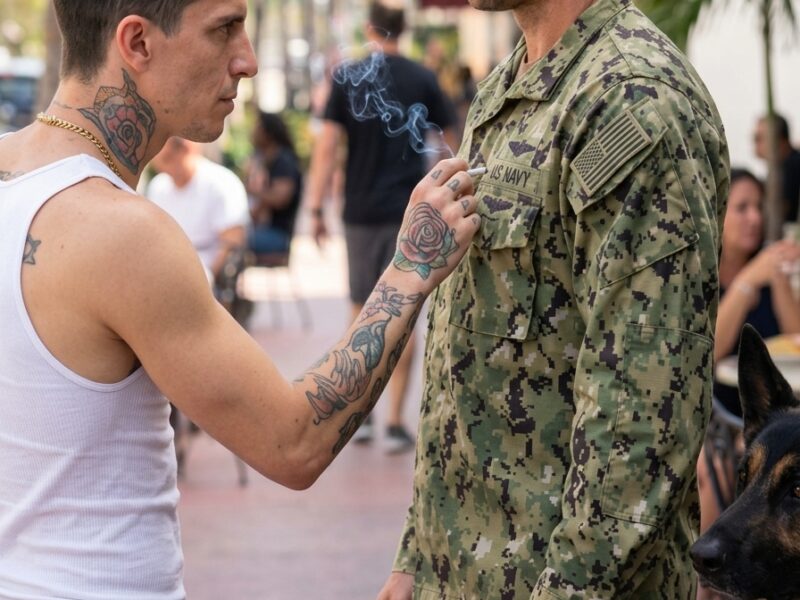
The gang laughed when they dumped my coffee into my lap at a downtown Seattle café, but when their leader grabbed my dog’s collar and sneered, “What are you going to do about it, old man?”
The coffee was cheap, dark, and scalding, the kind of brew served only in Seattle diners that smelled perpetually of damp wool and old grease. It pooled in my lap, soaking through my faded denim, hot enough to raise red welts on my skin. I didn’t flinch. I sat motionless on the cracked vinyl booth, my right hand resting lightly on the brass handle of my cane, my left flat against the Formica table.
Around us, the café vibrated with the sound of rain beating relentless knuckles against the glass windows. Outside, the downtown traffic crept through gray smog, taillights bleeding red across the wet asphalt. Inside, five young men stood over me, their laughter sharp, jarring, and entirely artificial—the kind of noise bred by impunity and small-town cruelty.
Their leader, a muscle-bound kid in a soaked leather jacket with slicked-back hair and a jawline built like a anvil, stepped closer. He didn’t look more than twenty-five, but his eyes carried the dead, glassy film of someone who had never faced a single real consequence in his life. He reached down, his heavy, ring-adorned hand wrapping violently around the thick leather collar of my dog.
“What are you going to do about it, old man?” he sneered, twisting the collar just enough to strain the breath in the animal’s throat.
I wiped the black coffee from my hands with a paper napkin, moving with deliberate, excruciating slowness. Beneath the table, Atlas sat rigidly. He was a Belgian Malinois, lean, dark-muzzled, with scars running beneath his fur that matched the ones under my jacket. He didn’t bark. He didn’t scramble. His amber eyes were locked onto my right hand, waiting for the single knuckle flex that would permit him to crush the boy’s windpipe.
“Don’t,” I whispered, my voice raspy from decades of disuse and smoke.
The leader laughed louder, a wet, arrogant barking sound. His companions moved in a loose semicircle, blocking the narrow aisle between the counter and the door. Phones came out, their dark lenses reflecting the fluorescent lights overhead. In the corner, an elderly woman pulled her cardigan tightly around her neck and stared at the linoleum floor. The teenager behind the counter shrank against the coffee machine, his hands trembling over a damp rag.
One of the boys—a scrawny kid with a brass knuckle ring—leaned down and kicked Atlas’s stainless steel water bowl. It clattered violently across the tile floor, splashing murky water against the wooden counter base.
That was when something inside my chest tightened. It wasn’t anger. Anger is cheap, unpredictable, and loud. What settled into my bones was memory. Pure, cold, methodical memory. I had spent fifteen years in places without names, hunting men who considered themselves gods because they held weapons in lawless zones. I had learned long ago that the most dangerous man in a room was almost never the one shouting.
“Pick up your bowl,” the leader said, shoving his face closer to mine. The smell of cheap vodka and tobacco rolled off him. “Pick it up, or I’ll drag this mutt out to the alley and put a boot through his ribs.”
I looked up, meeting his eyes directly for the first time. “You should leave.”
He leaned even closer, his grip tightening on Atlas’s harness until the metal buckle whined. “Or what?”
Atlas didn’t bark. He produced a low, sub-audible vibration deep in his chest—a sound more felt than heard, like a motor idling beneath a floorboard. The atmosphere in the small café vanished; the ambient hum of the espresso machine and the drone of the rain seemed to drop away entirely.
The leader reached down with his other hand, grabbing the harness near the shoulder blade to pull the dog out from beneath the booth.
I stood up. Slowly.
I wasn’t tall, nor did I carry the muscular bulk of my youth. My knees groaned, and my left hip threw a dull spike of familiar agony up my spine. But as my posture straightened, the boy’s smile faltered. There is a shift in air pressure when a predator stops pretending to be prey. His grip on the leather slackened just a fraction.
“Take your hand off my dog,” I said softly.
He didn’t. Instead, he tried to grin, sneering to impress his friends who were recording every second on their screens. “Make me, old—”
I moved.
To the human eye unaccustomed to violence, it looked like a blur. I didn’t strike his face. I didn’t throw a wild fist. My left palm struck the inside of his right wrist, breaking his grip on Atlas, while my right hand clamped down on his forearm like a hydraulic vise. I stepped inside his center of gravity, pivoted my heel, and levered his elbow over my shoulder while stepping back down hard on his heel.
One second he was standing over me, towering and triumphant. The next, he hit the linoleum floor with a concussive thud that rattled the coffee cups on the counter. His right wrist was pinned flat against the dirty tile beneath my left knee, his arm locked straight, his shoulder screaming at the absolute limit of its range of motion.
The phones dropped an inch. His four friends froze, their mouths half-open, caught mid-taunt. Nobody laughed anymore. The silence in the room was absolute, broken only by the boy’s ragged, terrified gasps for air.
“I’m not looking for trouble,” I whispered, leaning down so only he could hear me. I released his arm and stepped backward, my cane clicking once against the floor as I reclaimed my balance.
The leader scrambled backward like a crab, clutching his wrist against his chest, his face drained of all color. He stared up at me, his arrogance entirely shattered, replaced by the instinctual horror of a child who had accidentally stepped into an cage with an unscheduled beast.
“Who the hell are you?” he choked out, his voice cracking.
I didn’t answer him. My eyes were no longer focused on his face. As he pulled his collar up, the black fabric of his shirt dragged across his jawline, revealing the bare skin behind his right ear.
There, ink-stamped into the flesh just above his jawbone, were three distinct, jagged black marks. Three vertical lightning bolts crossed by a horizontal line.
My stomach plummeted, a cold stone falling through hollow space.
I knew those marks. I had seen them on burnt-out vehicles in the mountains of Eastern Europe. I had cut them off dead men in muddy trenches outside Jalalabad. It was the mark of the Triad-V, a mercenary logistics group that specialized in liquidating classified military assets and hunting down compromised intelligence teams. They were the ones who had laid the ambush at Red Ridge twelve years ago—the ambush that had put five of my brothers in plastic bags and put me in a hospital bed for three years with a shattered body and a erased identity.
The boy saw my eyes lock onto his neck. His expression shifted instantly from bruised pride to something far darker, far older than his years.
“You recognize it,” he whispered.
I looked down at Atlas, who had stepped out from beneath the table and now stood at my left hip, his ears flat, his hind legs coiled like springs. I looked back at the boy on the floor.
“Where did you get that tattoo?” I asked. My voice wasn’t angry; it was entirely empty of humanity.
Before he could open his mouth, a quiet, shuddering voice spoke up from the counter.
“He’s the one,” the woman near the cash register said.
Everyone turned. She was mid-forties, wearing an apron stained with dish soap, her hands clasped against her chest. Tears were streaming down her face, cutting clean tracks through the dust on her cheeks.
“He… he was there,” she sobbed, pointing a trembling finger at the young man on the floor. “Three weeks ago. In the alley behind the docks. He killed my brother.”
The young leader didn’t look at her. His eyes remained locked on mine. Slowly, deliberately, he reached inside his wet leather jacket. My hands instinctively tightened on the head of my cane, ready to drive the steel tip through his collarbone if he pulled iron.
He didn’t pull a gun. He pulled out a crumpled, water-damaged photograph and threw it onto the wet table between us.
It was an old black-and-white print, glossy, yellowed at the edges. It showed four men in unmarked tactical gear, standing shoulder-to-shoulder in front of a ruined concrete bunker in the snow. I was on the far left, twenty pounds heavier, holding a suppressed carbine, my face smudged with soot. Beside me was Marcus. Beside Marcus was Miller. And on the far right was David.
My photograph. Taken twelve years ago during Operation Gray Lantern.
I didn’t want to look at it, but my eyes were dragged down to the bottom margin. Written in thick, black permanent marker were four words that caused the diner, the rain, and the entire city of Seattle to dissolve into static:
Your team wasn’t betrayed.
My fingers hovered over the paper. My heart hammered against my ribs like a trapped bird. “Where did you get this?”
The boy stood up slowly, clutching his sprained wrist, a sick, twisted smile creeping back onto his lips. “You think you’re the only ghost alive, old man? Turn it over.”
With trembling fingers, I flipped the photograph. On the back, written in fresh, bright blue ink, was a single sentence:
He’s still alive.
Directly beneath the text was a finger-print made of dried, brown blood, smudged over a small set of GPS coordinates.
Atlas suddenly let out a low, gut-wrenching growl, his eyes snapping toward the metal fire door at the back of the kitchen. The kitchen light flickered once, twice, and then went completely dark.
Then, from the other side of the heavy steel door, came a sound.
Three slow, measured knocks.
Thump. Thump. Thump.
A two-second pause. Then two fast ones.
Thump-thump.
My breath caught in my throat. It was the breach-and-clear knock of the 7th Tactical Extraction Group. My unit. The signal we used when radios were jammed and no one else in the world was supposed to know we were alive.
I looked from the dark kitchen corridor back to the locked door, my heart pounding against my ribs like an iron drum. The boy with the tattoo grinned, stepping back into the shadows near the entrance.
“They’ve been waiting for you to come out of the woods, Captain,” he whispered.
The sound of the signal hung in the thick, damp air of the café like a blade suspended by a thread. Nobody moved. The rain outside seemed to quiet down, muffled by the sheer weight of the tension inside the room.
The four teenagers who had been filming on their phones were no longer looking at their screens. They were looking at me, then at the dark hallway leading to the kitchen, their cockiness completely vaporized. They didn’t understand the knock, but they understood the shift in the atmosphere. The ambient air had gone from a sidewalk shakedown to a kill zone.
“Out,” I said, without turning my head.
“What?” the scrawny kid with the brass knuckles stammered.
“Get out. All of you. Now.”
I didn’t have to raise my voice. The tone was one I hadn’t used in over a decade—the tone reserved for clear-zone evacuations before the artillery dropped. The boys didn’t argue. They turned, pushed through the glass door of the café, and bolted out into the torrential Seattle rain, their sneakers splashing wildly through the gutters. The young leader with the tattoo stayed near the door for a fraction of a second, his eyes reflecting the yellow streetlights, before he too slipped backward into the mist and vanished.
“Ma’am,” I said, looking at the crying woman behind the counter. “Take the boy and go out the front. Lock yourself in the dry cleaner’s across the street. Don’t call the police.”
“Why?” she wept, clutching the teenager’s arm. “Who is back there?”
“People who don’t leave witnesses,” I said softly. “Go.”
She didn’t hesitate. She dragged the boy through the front door, leaving it wide open behind them. The cold Pacific Northwest wind swept inside, carrying the smell of ocean salt, wet concrete, and exhaust, fluttering the paper napkins on the tables like dying birds.
I stood alone in the center of the room. Just me, Atlas, and the black-and-white photograph lying face down on the wet Formica.
Thump. Thump. Thump.
Thump-thump.
The knock repeated, identical in tempo and weight.
I reached down to my hip. Underneath my heavy oilskin jacket, resting against the small of my back, was a heavy Sig Sauer P226—a weapon I had carried across three continents and never intended to use again. I unholstered it, the cold slide feeling terrifyingly familiar against my palm. I racked the slide, chambering a round with a mechanical clack that sounded like a gunshot in the empty room.
“Atlas, heel,” I murmured.
The dog fell into position at my left hip, his head low, his eyes locked on the dark kitchen threshold. We walked forward, my cane tapping a rhythmic accompaniment to our steps.
I stepped past the counter, pushing through the swinging wooden doors into the commercial kitchen. The room was dark, illuminated only by the faint green glow of the emergency exit sign over the rear door. Stainless steel counters gleamed dully in the shadows. Deep fryers smelled of rancid canola oil.
Standing in the center of the kitchen, his back to me, was a man in a long, dark trench coat. He was tall, broad-shouldered, and completely motionless. He didn’t turn around when I entered. He just stood there, staring at the heavy steel fire door that led out into the alleyway.
“You’re late, Eli,” the man said.
The voice hit me like an electric shock. It was low, gravelly, with a faint Southern drawl that had been rasped down by years of sandstorms and cigars.
It was Marcus.
My hand holding the Sig Sauer trembled—just a millimeter, but for a man who used to shoot coins out of the air at fifty yards, a millimeter was an ocean.
“Marcus?” I whispered, my voice barely carrying over the hum of the commercial refrigerator. “You died at Red Ridge. I buried your dog tags in North Carolina.”
The man turned around slowly.
The faint green light caught his face, and my breath seized in my throat. Half of his face was a tapestry of shiny, twisted scar tissue—the undeniable signature of a thermite explosion. His left eye was gone, replaced by a clouded, milky orb that stared straight ahead without seeing. But his right eye—bright, blue, and razor-sharp—was undeniably the eye of the man who had pulled me out of a burning Humvee in Fallujah.
“You buried a box of dirt, Captain,” Marcus said. He reached into his coat, and for a split second, my finger tightened on the trigger. But he didn’t draw a gun. He pulled out a cigarette, placed it between his scarred lips, and lit it with a battered Zippo. The smell of harsh tobacco filled the kitchen. “They lied to you, Eli. They lied to all of us.”
“Who lied?” I demanded, keeping the front sight of the pistol leveled straight at his chest. “The Ridge wasn’t a tactical failure. We were ambushed by three companies of heavy infantry. The satellite feeds were cut. The air support never scrambled. I watched Miller take a round through his helmet.”
“Miller died, yeah,” Marcus agreed, taking a long drag and exhaling a cloud of blue smoke toward the ceiling. “So did Hayes. But we weren’t ambushed by enemies, Eli. We were sold. By Langley. By the Department. By the very man who gave us the grid coordinates for the drop.”
“Colonel Vance,” I said, the name bitter on my tongue.
“Vance,” Marcus nodded. “He didn’t just sell us out to erase a black-budget paper trail. He sold us to the Triad-V. They wanted the drive we recovered from the bunker. Vance got twenty million dollars and a promotion to Undersecretary of Defense. We got six feet of dirt and a posthumous Bronze Star.”
My mind raced, tearing through twelve years of pain, nightmares, and isolation. I had spent over a decade living like a ghost in the forests of Washington State, believing I was the sole survivor of a tragic tactical disaster. I had carried the guilt of five dead men on my shoulders every single day. I had looked into the eyes of their widows at Arlington and told them their husbands were heroes who died for their country.
“If you survived…” I began, my voice thick with sudden, overwhelming rage, “why didn’t you find me? Why now? Why did you send that tattooed punk into the diner?”
“I didn’t send him,” Marcus said, his blue eye darkening. “He’s Triad-V. They’ve been tracking me for six months. They trailed me to Seattle. I used him to find you because I knew if he caused a scene in your local haunt, you’d react. I needed to see if you were still the man who took out an entire squad in Helmand with a broken leg.”
“I’m an old man with a cane, Marcus,” I said, lowering the gun slightly, though my heart was hammering against my ribcage. “I’m done fighting.”
“You don’t have a choice, Eli,” Marcus said softly. He stepped forward, pulling a small, blood-stained thumb drive from his pocket and setting it on the stainless steel prep table between us. “David is alive.”
The room seemed to drop another ten degrees.
“David?” I stammered. “David was in the lead vehicle. It vaporized.”
“The front half vaporized,” Marcus corrected him. “David was thrown clear into the ravine. Triad-V picked him up. They’ve been keeping him in a dark site in Blackwater Bay for twelve years, using his biometric keys to unlock the old intelligence caches we buried in ’08. He’s alive, Eli. But they’re clearing house. Vance is running for Senate next year, and he’s cleaning up every single loose thread from Gray Lantern.”
Before I could process his words, Atlas suddenly spun around, facing the alley door. His lip curled back, exposing yellow fangs, and a deep, terrifying growl rattled through his ribcage.
Marcus’s single blue eye snapped to the ceiling. “They’re here.”
“Who?”
“Vance’s cleanup crew,” Marcus said, drawing a suppressed Glock 19 from his trench coat with practiced fluidity. “They followed the kid.”
CRASH.
The heavy steel fire door blown inward with an explosive charge, the concussion wave knocking over a rack of baking sheets with a deafening metallic roar. Smoke and flame poured through the opening, blindingly bright flashbangs detonating in rapid succession inside the enclosed space.
BANG! BANG! BANG!
White light flooded my vision. High-pitched ringing pierced my ears. My balance failed me, and I went down onto one knee, my cane clattering across the wet floor. Through the blinding haze and the roar of static, I saw dark silhouettes pouring through the ruined doorway, submachine guns raised, laser sights painting red dots across the smoke-filled kitchen.
Atlas leaped forward into the flash, a blurred mass of fur and muscle, tearing into the fog toward the intruders.
“Eli! Get up!” Marcus yelled, his voice sounding like it was underwater. He opened fire, the rhythmic thwip-thwip-thwip of his suppressed weapon cutting through the chaos.
I shook my head, fighting through the blinding white pain in my eyes, reaching blindly into the smoke for my gun.
The tactical advantage of an older warrior isn’t speed; it’s muscle memory.
Before my eyes could clear the magnesium flash, my hands were already moving. My fingers found the checkered grip of the Sig Sauer lying near the edge of the dishwashing station. I didn’t try to stand. Standing was a death sentence in an enclosed kill zone. I rolled onto my side, bringing my knees up toward my chest, sweeping the floor-level shadow with my barrel.
A man in a black tactical jumpsuit, wearing a night-vision visor, stepped through the smoke, his rifle angled down toward Marcus. He didn’t see me on the floor beneath the counter.
I fired twice. Both rounds struck the unarmored gap beneath his side plate. He folded like a piece of wet cardboard, dropping his weapon with a heavy thud.
“Atlas!” I roared over the ringing in my ears.
A sharp yelp came from the darkness, followed instantly by the sickening crunch of bone and a screaming man being dragged down into the grease trap. Atlas had caught the second intruder by the throat, using the dog’s weight to snap the man’s head back against the concrete floor.
“Move! West exit!” Marcus barked. He was crouched behind the commercial stove, pouring cover fire down the hallway toward the alley. Spent brass casings clinked wildly against the stainless steel walls.
I scrambled to my feet, using the edge of the sink to pull my heavy body upright. My left hip screamed in protest, a white-hot knife of nerve pain shooting down my leg, but the adrenaline flowing through my system buried it under a layer of ice. I grabbed my cane, hooked it onto my belt, and reached down to grab the blood-stained thumb drive Marcus had left on the table.
“Where’s the third man?” I demanded, leaning against the doorframe as Marcus slapped a fresh magazine into his Glock.
“Outside. Sniper on the roof across the street,” Marcus spat, ducking as a heavy burst of automatic fire chewed through the kitchen wall, sending plaster and insulation exploding into the air. “They didn’t come to talk, Eli. This is a total burn.”
We moved. Marcus took the point, his movement jagged and aggressive, a relic of a life lived in combat boots. I covered our rear, with Atlas flanking my left leg, his fur matted with dark blood that wasn’t his own.
We burst out of the side door into the narrow alleyway running between the café and an abandoned meatpacking warehouse. The Seattle rain hit us like a wall of cold needles, washing the smell of gunpowder from our clothes, but doing nothing to cool the heat of the ambush.
A red laser dot danced across the brick wall right at my eye level.
“Down!” I screamed, grabbing Marcus by the shoulder of his leather coat and dragging him into a alcove behind a rusted dumpster.
A heavy round struck the brick where his head had been a second before, blowing a hole the size of a grapefruit into the masonry and showering us with red dust and sharp fragments.
“He’s on the fire escape! Four hundred yards, twelve o’clock!” Marcus yelled, wiping blood from his scarred forehead where a piece of brick had sliced his skin. “We can’t outrun a high-caliber optic down this alley, Eli. Not with your leg.”
“I’m not running,” I said, breathing heavily, my lungs burning like furnace grates.
I leaned my back against the wet dumpster, taking deep, measured breaths to drop my heart rate. In the old days, I had been the marksman of the 7th. Marcus was the brawler; David was the brains; I was the eye. Age steals your endurance, it steals your joints, but it doesn’t take away the geometry of a sight picture once it’s burned into your optic nerve.
I drew my Sig Sauer, checking the remaining rounds. Four bullets left in the magazine.
“You’re going to take out a sniper with a nine-millimeter pistol at four hundred yards in the rain?” Marcus stared at me with his single blue eye, a mixture of disbelief and sudden, fierce hope flickering in his expression.
“He’s cycling a bolt-action,” I said, listening to the metallic echo bouncing off the damp brick walls above us. “He’s got a six-second delay between shots while he resets his sight line through the rain haze. He has to lean out past the iron handrail to clear the drainage pipe.”
“You have one shot,” Marcus said softly.
“I only need one.”
I closed my eyes for two seconds. I didn’t think about my broken body. I didn’t think about the twelve years I had spent hiding in a log cabin in the mountains, chopping firewood and waiting to die. I didn’t think about Colonel Vance sitting in his air-conditioned office in Washington D.C., deciding who lived and who died with the stroke of a pen.
I thought about David, sitting in a dark room in Blackwater Bay, waiting for a team that had never come.
I stepped out from behind the dumpster.
The rain beat down on my face, blurring my vision for a fraction of a second, but I cleared it with a sharp blink. High up on the third-tier platform of the abandoned warehouse across the street, a black shape leaned over the iron railing. The faint glint of a magnified lens caught the streetlight glow through the downpour.
The red dot swung toward my chest.
I raised the Sig Sauer with both hands, locking my elbows, relaxing my shoulders, letting the air completely out of my lungs. I didn’t look at the gun. I didn’t look at the rain. I looked at the dark spot two inches above the glint of the scope.
Trigger pressure. Wall. Break.
BANG.
The gun barked in my hands. The recoil rode up my arms into my shoulders.
For a terrifying second, nothing happened. The rain continued to fall. The city hummed in the distance.
Then, high above, the silhouette on the fire escape jerked violently backward. The rifle slipped from his hands, falling four stories down through the darkness, shattering against the pavement with a loud metallic crash. A second later, the body followed, hitting the roof of a parked van with a deafening THUD that set off every car alarm on the block.
Silence returned to the alley, broken only by the wailing car horns and the relentless patter of rain.
Marcus stepped out from behind the dumpster, looking from the wrecked van up to the high fire escape, then back at me. A slow, terrifying grin spread across his scar-mutilated face.
“You haven’t lost it, Captain,” he whispered.
“I never had the luxury of losing it,” I replied, my voice cold, though my hands were shaking violently as the adrenaline spike began to ebb. I reholstered the gun and picked up my cane, leaning heavily against it as my left hip finally collapsed under the weight of the effort.
Atlas trotted to my side, nudging my gloved hand with his wet nose.
“We need to get off the streets,” Marcus said, looking around as distant police sirens began to wail through the Seattle fog, miles away but drawing closer. “Vance knows his hit team failed the second they don’t check in. He’ll lock down the state. Air, land, and sea.”
“Where do we go?” I asked, looking down at the small thumb drive in my palm.
Marcus pulled a set of keys from his pocket and tossed them to me. “I’ve got a boat down at Pier 54. Unregistered, dark hull, diesel engine. But if we’re going to open that drive and find David, we need a clean network. Somewhere Vance’s surveillance satellites can’t reach.”
I looked at the thumb drive, then turned my head back toward the quiet street where the café stood dark and abandoned. The life I had built—my quiet, invisible, peaceful retirement—was dead. Buried beneath brass casings and shattered glass in a rain-soaked alley.
“There’s an old fallout shelter under the timber mill in Aberdeen,” I said softly, looking Marcus dead in his single eye. “Built during the Cold War. Off the grid. No fiber optics, no cell towers. My grandfather built it.”
Marcus nodded once. “Then we move.”
We turned to head toward the docks, but as we reached the mouth of the alley, a sound stopped us dead in our tracks.
It wasn’t a gunshot. It wasn’t a siren.
It was a small, high-pitched electronic chime coming from the pocket of the dead hitman lying on the roof of the van.
Chime. Chime. Chime.
Marcus stepped over to the van, reached onto the blood-soaked roof, and pulled a secure satellite phone from the tactical vest of the dead sniper. The screen was illuminated in dark blue, displaying an incoming call from a restricted international number.
Marcus looked at me. I gave him a curt nod.
He hit the speaker button and held the phone between us.
“Report,” a voice spoke through the speaker.
It wasn’t a gravelly tactical voice. It was smooth, refined, educated—the voice of a man who spent his afternoons in country club boardrooms and his evenings writing federal policy.
Colonel Vance.
Marcus took a deep breath, his eye flashing with murderous intent. “The report is negative, Colonel,” Marcus said, his gravelly voice dropping an octave. “Your boys ran into a couple of ghosts.”
A long, excruciating silence stretched over the satellite link. On the other end, we could hear the faint sound of classical piano music playing softly in a carpeted room thousands of miles away.
“Marcus?” Vance’s voice didn’t waver. There was no panic, no surprise. Only the cold, calculating boredom of a man who owned the board. “I must admit, I am impressed. I thought the fire in the ravine took care of you twelve years ago.”
“You made a mistake, Vance,” Marcus spat into the phone. “You left Eli alive. And now we have the drive.”
A dry, soft chuckle echoed through the small speaker.
“I didn’t leave Eli alive by mistake, Marcus,” Vance said smoothly. “I left him alive because I needed him to stay quiet until the statute of limitations expired on the intelligence funds. But more importantly… I needed him to lead you out of hiding.”
My heart stopped. I stared at the dark phone in Marcus’s hand.
“What are you talking about?” Marcus growled.
“Did you really think you found that drive by accident in Berlin, Marcus?” Vance asked softly. “Did you really think that little punk with the tattoo was tracking you? I put the coordinates in your path six months ago. I knew you couldn’t resist going to Eli. I couldn’t hunt two ghosts across forty-eight states. It was so much easier to let you find each other.”
Vance paused, and the sound of a tea glass setting down on a saucer chimed faintly over the satellite connection.
“Look at the GPS tracker built into the casing of that thumb drive in Eli’s hand,” Vance whispered. “I have your location pinpointed within three inches. Strike package is already in the air. You have four minutes.”
The line went dead.
“Throw it!” I screamed, lunging forward and grabbing the drive from Marcus’s hand.
Without waiting for his response, I pulled back my arm and hurled the small plastic rectangle with all the strength left in my shoulder. It flew through the heavy rain, sailing over the alley fence and disappearing with a tiny splash into the deep, churning waters of the Puget Sound drainage canal fifty yards away.
“Move! MOVE!” Marcus bellowed.
We didn’t run toward the harbor. Running to the boat was what Vance expected; a dark hull trapped in a narrow channel was a shooting gallery for a drone strike. Instead, we veered left, ducking beneath the heavy timber overhang of an old waterfront cannery, Atlas moving like a dark streak ahead of us, clearing the corners before we reached them.
The sound came three minutes later.
It wasn’t the loud, dramatic roar of a jet engine. It was a high-pitched, electric whine, like an angry hornets’ nest suspended high in the clouds above the Seattle skyline. A Hellfire missile, dropped from an unseen Reaper drone hovering five thousand feet above the rain cover, slammed into the alleyway where we had been standing three minutes prior.
BOOM!
The shockwave hit us from behind, a hammer of compressed air that shattered every window within two blocks and threw us flat onto the wet wooden planking of the wharf. Splinters, brick dust, and scorched metal rained down around us like hail. The dumpster we had hidden behind was torn into jagged shreds, burning fuel painting the brick walls in brilliant shades of yellow and orange.
I lay on the cold, wet wood, my ears ringing violently, my breath knocked completely out of my lungs. The heat from the explosion washed over my back, drying the wet fabric of my coat in seconds.
“Eli! You alive?” Marcus gasped, crawling toward me through the smoke and floating debris, his coat singed, his face covered in soot.
“I’m here,” I rasped, rolling over onto my back and coughing up gray dust. “Atlas?”
A dark head emerged from beneath a pile of collapsed wooden crates. The dog shook himself violently, sending a spray of water and ash flying, before trotting over and pressing his warm snout against my neck. He was unhurt, his eyes burning with the wild, ancient intelligence that had kept us both alive through three wars.
“He played us,” Marcus growled, pounding his fist against the charred wooden floor of the pier. “The drive was a homing beacon. David… David might not even be alive. Vance pulled us out into the open to burn us both in one strike.”
“No,” I said, forcing myself to sit up, my joints cracking like dry twigs. “Vance isn’t that smart. He’s arrogant. Arrogant men always make one fatal operational error.”
Marcus looked at me, wiping blood from his cheek. “What error?”
“He spoke to us,” I said, my voice hardening into iron. “He wanted to brag. He wanted to hear the fear in our voices before the missile hit. But he forgot who he was talking to.”
I reached into my inner jacket pocket. Before throwing the thumb drive away, my fingers had felt the tiny plastic ridge along its base. I hadn’t thrown the drive away blind—I had popped the micro-SD card out of the casing using my thumbnail before hurling the shell into the canal.
I held up the tiny black square of plastic between my thumb and forefinger.
Marcus stared at it, his single blue eye widening in absolute shock. Then, slowly, a deep, raspy laugh tore from his throat—a sound born of pure survival and cold revenge.
“You beautiful old bastard,” Marcus whispered.
“We need a terminal,” I said, standing up with the help of my cane, my jaw set, the pain in my hip completely forgotten. “A closed-circuit reader. No internet connection. No cloud sync. Just raw data processing.”
“My boat,” Marcus said, pointing down the dark shoreline toward a small, rusted fishing vessel moored at the end of a private dock. “It’s got an old naval radar rig and a hardened military laptop from the ’90s. No external transmitter. Completely air-gapped.”
We moved quickly, slipping through the shadows of the burning waterfront like ghosts returning to the grave. Five minutes later, we were inside the cramped, wood-paneled cabin of the Nautilus, a thirty-foot crab boat that smelled of diesel fuel, salt, and old copper.
Marcus locked the heavy hatch behind us, pulling dark canvas curtains over the tiny portholes. He flipped a breaker switch, and the cabin flickered to life with the dull amber glow of old incandescent bulbs. He swept a pile of mechanical tools off a bolted-down steel desk, revealing a heavy, green Panasonic Toughbook—a relic from the early Iraq invasion, encased in magnesium alloy and thick rubber armor.
He opened the lid, flicked the power toggle, and the screen hummed to life with a low CRT buzz, displaying a green command prompt line.
“Insert it,” Marcus said, his hands trembling slightly as he handed me a USB adapter drive.
I slotted the micro-SD card into the reader and plugged it into the side of the ancient laptop. The hard drive clicked violently as it read the ancient sectors, lines of green hexadecimal code cascading down the monitor like falling rain.
For three minutes, neither of us spoke. The only sound in the cabin was the steady thump-thump of the tide against the hull and the low hum of the laptop fan.
Then, the code cleared.
A single file directory opened on the screen. It contained three folders:
GRAY_LANTERN_FINANCIALS.pdf
RED_RIDGE_TELEMETRY.LOG
FACILITY_BLACKWATER_CURRENT.MOV
My fingers hovered over the cracked plastic trackball. I moved the cursor over the third file and double-clicked.
A video window popped up. The footage was grainy, taken from a static security camera positioned high in the corner of a windowless concrete room. The timestamp in the lower right corner read: TODAY – 02:14:09 PST.
In the center of the room sat a man.
He was stripped to the waist, his skin pale and stretched tight over visible ribs. His hair was long, white, and matted with dirt. His wrists were bound to the arms of a steel chair with heavy industrial zip-ties. But despite the starvation, despite the twelve years of darkness, his posture was straight. His chin was held high.
Across his chest was a long, jagged scar that ran from his left collarbone down to his right hip—the mark left by the shrapnel of our lead vehicle’s engine block at Red Ridge.
It was David.
He was alive.
“My God,” Marcus breathed, dropping his face into his scarred hands. “He’s really there.”
“Look at the back wall,” I said, leaning closer to the glowing screen, my heart pounding in my ears.
Behind the chair where David was bound, painted on the bare concrete wall in high-visibility orange paint, was a serial code: US-GOVT-FACILITY-77-BLACKWATER.
“That’s not in Afghanistan,” I said softly. “That’s not in Eastern Europe.”
Marcus looked up, his single eye searching my face. “Where is it?”
“Blackwater Island,” I whispered, pointing to the coordinate string displaying at the bottom of the video file. “It’s an abandoned Naval Weapons Annex in the San Juan Islands. Forty miles north of where we’re standing right now.”
Marcus reached down and grabbed his tactical vest from a locker, pulling it over his shoulders with a dark, terrifying resolve. “We have the location. We have the data. We take this to the FBI, Eli. We take it to the Department of Justice. Vance can’t hide from this.”
“No,” I said, reaching out and slamming the laptop lid shut with a loud, final snap.
Marcus froze, looking at me in shock. “What do you mean, no? We have the proof, Eli! We can destroy him!”
“Vance owns the federal prosecutors in this district, Marcus,” I said, stepping closer to him, my eyes burning with a fire that had been dormant for twelve long years. “He owns the U.S. Marshals. If we walk into a federal building with this drive, we won’t make it to the third floor before a heart-attack toxin is slipped into our water cups, and the drive disappears into an incinerator.”
“Then what are we going to do?” Marcus demanded.
I looked down at Atlas, who was sitting by the hatch, his amber eyes fixed on me, waiting for the command he had been trained to execute since he was a pup. I reached down, unhooked my heavy cane from my belt, and unscrewed the brass handle with a sharp twist.
Inside the hollow steel shaft of the cane rested a long, silver key—the master override key for the heavy weapons locker buried beneath my grandfather’s shelter in Aberdeen.
“We aren’t going to arrest him, Marcus,” I said, my voice as cold as the sea dropping outside the hull. “We’re going to finish the mission.”
The rain had turned into a thick, blinding coastal fog by the time the Nautilus cut its diesel engine two hundred yards off the southern shore of Blackwater Island.
The island rose out of the dark water like a jagged black tooth, shrouded in pine trees and surrounded by razor-sharp granite reefs that had torn three lumber schooners apart in the nineteenth century. On the highest cliff, hidden beneath dense hemlock canopy, sat the concrete bulk of Facility 77—a forgotten relic of World War II coast defense, modernized by black-budget contractors to keep men who didn’t exist away from a world that had forgotten them.
The water was black, freezing, and dead calm.
Marcus sat in the stern of the boat, checking the action on an M4A1 carbine we had pulled from the Aberdeen shelter four hours earlier. Beside him lay three tactical vests, green night-vision goggles, demolition charges, and eight magazines of armor-piercing ammunition.
I stood at the helm, adjusting the straps of my chest rig over my oilskin jacket. My left hip was wrapped tightly in heavy elastic bandages, numbed by four industrial painkillers I had swallowed back at the shelter. I didn’t feel the pain anymore. I didn’t feel the cold. I felt only the absolute, terrifying clarity that comes to a man who knows he is walking into his final battle.
“Thermal sweep shows six guards on the perimeter,” Marcus reported, adjusting his optic. “Two on the lower dock, two on the roof, two patrolling the concrete courtyard. All carrying automatic weapons. Standard contractor patrol patterns.”
“And Vance?” I asked, checking the suppressor on my Sig Sauer.
“His private helicopter landed on the pad ten minutes ago,” Marcus said, his single blue eye gleaming in the green glow of his night-vision visor. “He came to clean up the asset himself before the Seattle news reports hit the wire.”
“Good,” I said softly. “It saves us a trip to Washington.”
We lowered a dark, inflatable Zodiac boat into the water. Atlas hopped in first, sitting silently between the rubber pontoons, his dark fur blending seamlessly into the night. We rowed silently through the mist, our oars dipping into the black sea without a splash, landing on a narrow gravel beach beneath the shadows of the eastern cliffs.
“Phase one,” I whispered as we hit the shore. “Cut the power.”
Marcus nodded. He moved off into the shadows toward the generator shack at the base of the radar tower, carrying two blocks of C4 explosive with short-delay timers.
I took Atlas and began the slow, agonizing climb up the iron ladder built into the face of the cliff. Every step was a battle against my own broken body, but my mind was entirely detached from the physical reality. I wasn’t an old man with a limp anymore. I was Captain Eli Vance’s ghost, returning to collect a debt that had accrued twelve years of interest.
We reached the top of the cliff.
The concrete courtyard of Facility 77 lay before us, bathed in the harsh yellow glow of halogen floodlights. Two guards in dark fatigues stood near the heavy steel blast doors, cigarettes glowing red in the damp darkness.
I reached down and tapped Atlas twice on the shoulder.
“Take the left,” I breathed.
The dog vanished into the low ferns surrounding the courtyard like a phantom. Three seconds later, a sudden, choked gasp erupted from the shadows near the generator shed as Atlas took the first guard down without a single bark.
Before the second guard could react, I stepped out from the treeline, raised my suppressed carbine, and fired twice.
The double tap struck him square in the center of his chest plate, the low subsonic thwip-thwip swallowed instantly by the sound of the surf crashing against the rocks below. He dropped without a sound.
At that exact moment, the generator shack down the hill erupted in a brilliant orange flash.
BOOM!
The lights across the entire complex died instantly. The halogen floodlights sputtered out, plunging the courtyard into pitch-black darkness, broken only by the emergency red running lights flickering along the concrete corridors inside.
“Power knocked out!” Marcus’s voice crackled through my earpiece. “Moving to main breach!”
“Copy,” I said. “Entering lower level.”
I kicked open the side entry door, stepping into the narrow, damp concrete corridor of the facility. The smell of mold, salt, and old grease was overpowering. Atlas fell in behind me, his claws clicking softly against the concrete floor.
We moved down the hall, clearing room after room with brutal, practiced speed. The private contractors Vance had hired were well-paid, but they were mercenaries—men who fought for a paycheck. We were men who were already dead, fighting for the only thing we had left in the world: our brothers.
A guard rounded the corner near the armory, his weapon raised, but I drove the steel muzzle of my carbine into his throat before he could pull the trigger, stepping past his collapsing body without slowing down.
At the end of the main corridor stood the heavy steel door marked SECTOR 4.
I set a breach charge against the lock housing, pulled the pin, and stepped back around the corner.
BANG!
The steel door blew inward, hanging off its hinges by a single twisted steel pin.
I stepped through the smoke, my weapon raised, ready to clear the room.
The chamber was large, cold, and illuminated only by the red glow of a single battery-powered lantern standing on a table in the center.
Bound to the heavy steel chair in the middle of the room was David. His head was hanging low, his chest rising and falling in slow, ragged breaths.
Standing directly behind him, holding a nickel-plated revolver against David’s temple, was Colonel Vance.
He was wearing a tailored charcoal suit, his hair perfectly combed, though his silk tie was loosened at the collar. His face, usually so composed on television broadcasts, was pale, slick with sweat, his eyes wide with a mixture of terror and unadulterated fury.
“Stop right there, Eli!” Vance screamed, his voice echoing loudly against the bare concrete walls. “One more step and I paint this wall with his brains!”
I stopped five yards from the table. I lowered my carbine, letting it hang from its tactical sling against my chest, but my hand remained firmly on the grip of the Sig Sauer at my hip.
Atlas stepped up to my left leg, his ears flat, his dark lips pulled back to expose long white fangs.
“Put the gun down, Colonel,” I said. My voice wasn’t loud. It was terrifyingly calm, carrying the dead weight of three thousand miles of cold ocean and twelve years of buried pain.
“You ruined everything!” Vance shrieked, his grip tightening on the revolver until his knuckles turned white. “I was three months away from the Senate confirmation! I built a legacy! I served this country for thirty years!”
“You sold five men for twenty million dollars, Vance,” a voice spoke from the shadows near the breach door.
Marcus stepped into the red light, his M4 raised, his single blue eye locked onto Vance’s face like a target scope.
Vance gasped, looking from me to Marcus, his hands beginning to shake violently. “Marcus… you… you were dead…”
“We all died twelve years ago, Colonel,” Marcus said softly. “You’re just the last one to realize it.”
Vance’s eyes darted frantically around the dark room, realizing there was no tactical escape, no helicopter coming to save him, no lawyer who could undo the scene unfolding in this concrete basement. A dark, hysterical smile broke across his face.
“If I’m going down,” Vance spat, twisting the barrel of his revolver deeper into the skin of David’s forehead, “I’m taking him with—”
I didn’t wait for him to finish the sentence.
I didn’t draw my pistol. I didn’t pull a trigger.
I looked at Atlas and gave the single, silent hand command I had taught him in the deep timber of the Cascade mountains—the command that meant total elimination.
Atlas didn’t bark. He didn’t growl.
He launched himself off the concrete floor like an artillery shell, crossing the five yards of open space in a fraction of a second. His hundred-pound body slammed straight into Vance’s chest before the older man could pull the trigger, the force of the impact throwing Vance backward over the table, his revolver flying from his hand and clattering across the floor into the shadows.
Vance hit the ground screaming as Atlas pinned his shoulders to the deck, the dog’s fangs inches from his throat, waiting for my next signal.
Marcus ran forward, pulling a combat knife from his belt and slicing through the heavy zip-ties securing David’s wrists.
David collapsed forward into Marcus’s arms, coughing violently, his trembling, skeletal hand reaching out to grab the front of Marcus’s tactical vest. He looked up, his hollow, bloodshot eyes finding mine through the red gloom.
“Eli…” David croaked, his voice like dry leaves scraping over stone. “You… you came…”
I walked over, dropping to my knees beside the chair, and placed my hand on David’s frail, scarred shoulder.
“I told you on the helicopter in Fallujah, Dave,” I whispered, my eyes burning with hot, blinding tears that I finally let fall after twelve long years. “We don’t leave anyone behind.”
Behind us, Vance lay weeping on the floor, terrified of the dog standing over his chest, his polished life entirely destroyed, his secrets exposed to the light.
“What do we do with him?” Marcus asked, looking over his shoulder at the ruined Colonel, his thumb resting on the selector switch of his rifle.
I stood up slowly, leaning on my cane, looking down at the man who had ordered our deaths from a comfortable desk thousands of miles away. I looked at Marcus. I looked at David, who was finally breathing clean air for the first time in over a decade.
“We leave him,” I said softly.
Marcus frowned. “Leave him? Eli, he’ll use his political connections—”
“He won’t,” I interrupted, reaching into my pocket and pulling out the encrypted satellite phone we had taken from the dead hitman in Seattle. “I started streaming the security feed from this room to every major media outlet and the Inspector General’s office five minutes ago when we breached the courtyard. The entire world just watched him admit to the ambush at Red Ridge.”
Distant sound began to echo across the dark water outside the facility—the heavy, rhythmic thump-thump-thump of Coast Guard cutter engines and federal tactical helicopters approaching Blackwater Island from the south.
Vance heard the sirens. He lay on the concrete floor, his eyes hollow, realizing that the rest of his life would be spent inside a six-by-eight foot cell in a federal supermax prison, remembered only as the greatest traitor in the history of the armed forces.
“Come on,” I said, putting my arm around David’s waist to support his weight as Marcus took his other side. “Let’s go home.”
We walked out of the dark concrete bunker into the cool Pacific Northwest air.
The sun was just beginning to peek over the jagged horizon, burning away the heavy grey fog that had covered the Puget Sound for three days. Golden light broke through the hemlock trees, reflecting off the calm water like a field of crushed diamonds.
Atlas trotted out ahead of us, stopping at the edge of the cliff to look back over his shoulder, his ears perk up, his tail wagging slowly in the fresh morning sea breeze.
I took a deep breath of the cold, clean salt air. For the first time in twelve years, my chest didn’t feel tight. The ghost had finally stopped running.
The end









