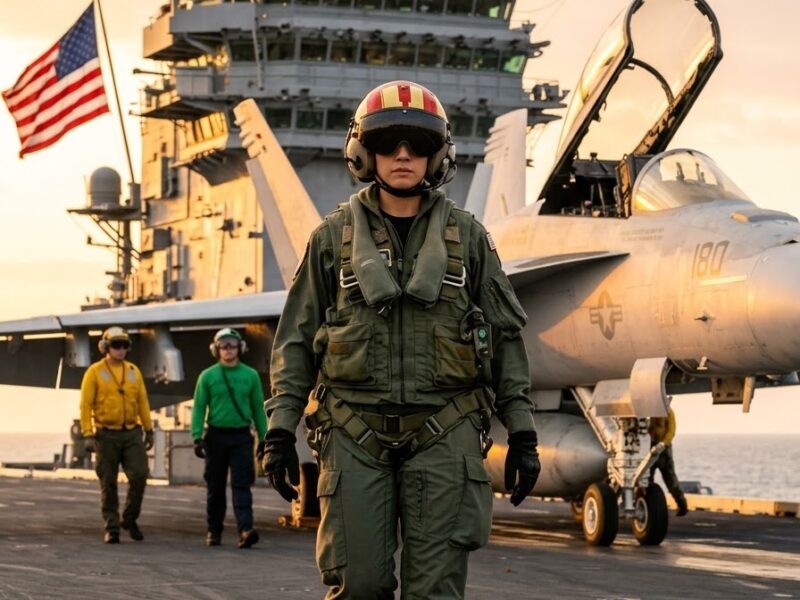
The flight deck of the USS Nimitz froze when my Navy jet returned without landing gear, scraping sparks across the deck as the SEAL captain shouted, “She’s finished,”
The flight deck of the USS Nimitz froze when my Navy jet returned without landing gear, scraping sparks across the steel as the SEAL captain shouted, “She’s finished,” unaware that I had gone silent on the radio because someone aboard our own ship had just betrayed us.
The screech of raw titanium tearing against the high-traction non-skid surface of the carrier deck was a sound that vibrated straight through the teeth of every sailor standing within two hundred yards. Fire crews in heavy yellow proximity suits were already sprinting forward before my F/A-18E Super Hornet had even completed its violent, unguided slide toward the foul line. Thick white foam erupted from the emergency nozzles, washing over the canopy in heavy sheets, smothering the white-hot sparks that flew like dying stars into the dark ocean air.
Inside the cockpit, the smell of burnt hydraulic fluid, ozone, and scorched rubber filled my oxygen mask. My fingers were still locked around the control stick, my knuckles white under the leather of my gloves. The twin engines were dead, choked out when the intake ramps scraped bottom, but my heart was still pulling a full 9000 RPM inside my chest.
I had always been the quiet pilot in Strike Fighter Squadron 103.
Not because I was afraid of the noise, and not because I lacked an opinion. In a world full of aviators who lived to hear their own callsigns echoing across the ready room, I learned early that talk was just excess weight. Talking never saved a man hanging in a harness over hostile territory. Talking never kept a surface-to-air missile from locking onto a tailpipe.
Flying did.
That morning, four hours before the belly-landing that nearly painted my jet across the carrier’s waist, our mission had been drawn up on the dry-erase board in the dark depths of Intelligence Center 1. It was supposed to be simple. Standard, routine, low-risk. Captain Mason and his six-man SEAL element were inserting via low-altitude drop into a barren stretch of the Iranian coastline. Their objective was to extract a captured intelligence officer holding active nuclear telemetry data from a remote, reinforced compound built into a coastal ridge.
My job was to hold the high block at 22,000 feet. Provide airborne cover. Keep an eye on the airspace. If anything with a engine or a launch track moved within fifty miles of Mason’s team, I was supposed to put a laser-guided bomb through its roof.
Then the radio died.
It didn’t fade out with distance. It didn’t drop into the fuzzy soup of atmospheric interference. It died all at once. Every channel, every frequency, primary tactical, secondary guard, satellite uplink—gone in a single microsecond. The sudden absence of the radio’s low background hum was like a physical punch to the ear. Nothing remained but thick, heavy static.
I looked down at my integrated instruments and felt something cold and hard settle in the pit of my stomach.
Someone hadn’t just jammed us from the ground. Ground-based jamming leaves signatures—directional noise, wide-band spikes, digital hash that the jet’s electronic warfare suite can easily identify and counter. This wasn’t external. This was internal logic failure. My flight control system wasn’t even trying to broadcast. The encryption keys had been purged from the flight computer’s volatile memory mid-flight.
“Pilot, do you copy?” I whispered into my mask, testing the internal loop. Even the internal voice recorder was dead. I couldn’t answer the ship. I couldn’t answer the ground team. I couldn’t answer anyone.
Below me, three miles down through a scatter layer of grey morning clouds, Captain Mason’s team was already on the ground, moving fast through a narrow dry wash toward the target compound. They were totally blind to what was coming above them.
Then the first missile rose from the desert floor.
It didn’t come from the compound. It came from a hidden position two miles to the west—an SA-15 gauntlet system mounted on the back of a civilian flatbed truck, perfectly concealed under a radar-absorbent camo net that hadn’t appeared on any of our pre-mission satellite passes.
I banked hard, snapping the stick to the left, putting the jet into a violent 7-G turn that drained the blood from my eyes until my vision collapsed into a narrow grey tunnel. The missile tore past my starboard wingtip, missing by inches, its rocket blast rattling the airframe so hard the Master Caution light flashed red across my main display panel.
Another missile followed immediately. Then another.
They weren’t firing blindly into the sky hoping for a hit. They knew exactly where the SEAL team was moving on the ground, and somehow, with terrifying mathematical precision, they knew exactly where my jet was positioned in the stack.
I glanced down at my mission tablet strapped to my thigh. The encrypted digital map suddenly refreshed. The coordinates of the target compound hadn’t just updated; the designated extraction point—the safe zone where Mason was supposed to bring his men and the high-value asset—had been shifted three kilometers east, directly into a prepared kill box surrounded by heavy anti-aircraft artillery.
My blood ran cold.
The extraction point wasn’t a escape route. It was a mass grave.
I couldn’t warn the SEALs over the radio. I couldn’t drop a message container. I couldn’t call the Nimitz to launch the alert fighters resting on the catapults two hundred miles out at sea.
So I did the only thing a quiet pilot could do.
I dropped the nose, pushed the twin throttles past the gate straight into full afterburner, and flew directly toward the enemy positions on the ground.
Down in the wash, Captain Mason saw my Strike Hornet coming down out of the clouds like an anvil falling from the sky. He shouted into his dead tactical radio, his face twisted in confusion and rage. “What is she doing?!”
I brought the aircraft down to fifty feet above the desert floor—so low that the supersonic shockwave tore the canvas roofs off the enemy trucks and threw up a two-hundred-foot wall of dust and sand behind my tailpipes. The enemy gunners on the ridge stopped firing at the wash. Every radar dish, every heavy machine gun, every shoulder-fired missile system turned away from the crawling SEALs and aimed directly at the grey streak roaring through their front yard.
That was the moment Mason understood.
I wasn’t attacking the target. I was making myself the only target in the valley.
For twelve agonizing minutes, I danced the twenty-ton aircraft through a forest of tracer fire and missile trails. I twisted between narrow canyon walls, flying so close to the granite faces that my wingtips left grey paint marks on the rock. Flares erupted from my dispensers in blinding orange clusters, burning behind me like falling stars, drawing off three separate thermal-homing missiles into the dirt.
They sprinted through the smoke while I drew the sky’s wrath away from them.
Then the third missile caught my tail section.
The detonation felt like a sledgehammer hitting the back of my ejection seat. The aircraft lurched violently to the right, the control stick kicking violently against my hand as hydraulic pressure in system one dropped straight to zero. Red warning text flooded every digital display screen in front of me.
FIRE IN RIGHT ENGINE. HYDRAULIC BUS B FAILURE. FLIGHT CONTROL COMPUTER COMPROMISED.
I looked out toward the distant western horizon, where the metallic sheen of the ocean met the pale morning sky. The Nimitz was out there, beyond the radar horizon.
Then I looked at the fuel gauge. The leak in the starboard wing tank was pulling the digital counter down like a stopwatch counting down to zero.
Almost empty.
I knew I might not make it back over the blue water. I knew the jet was dying beneath me, its systems failing one by one like lights being turned off in an empty house.
But down in the valley, through the thick cloud of dust, I saw six black dots carrying a seventh man across the low ridge toward the real, original extraction vector—away from the trap.
“Keep running,” I whispered into the quiet of my helmet.
Captain Mason finally reached the safe zone. The moment his last operator crossed the ridge line, he stopped and looked up into the grey sky. My jet was trailing a thirty-foot plume of black smoke, its damaged engine coughing sparks as it turned out toward the sea, slowly disappearing into the cloud layer.
Then, ten miles out from the fleet, the landing gear handle jammed.
I pulled the mechanical override. Nothing. I tried the manual emergency blow down using compressed nitrogen. The valves clicked, but the heavy main gear stayed locked inside the wheel wells, frozen solid by the blast damage to the belly hydraulics.
No radio. No gear. No backup fuel. No second chance.
I lined up on the final approach vector for the Nimitz, keeping the nose up, using pure throttle control to keep the bleeding aircraft from stalling into the waves. The carrier’s deck looked like a postage stamp floating on a lead-grey sea.
“Don’t drop me now,” I muttered to the machine.
The jet hit the steel deck hard.
Metal screamed. Sparks exploded beneath the fuselage in a blinding wall of yellow fire. The aircraft skidded sideways, tearing through the emergency arresting barricade net, before finally grinding to a halt less than fifty feet from the bow.
For several long seconds, nobody moved. The entire flight deck was dead silent save for the hiss of fire foam against hot metal.
Captain Mason, who had been brought back to the ship via a quick-reaction helicopter just minutes prior, was the first man to reach my cockpit. He scrambled up the maintenance ladder, his tactical gear covered in desert dust, his face pale behind his goggles. He pulled the manual canopy release from the outside and slammed the glass back, staring at me through the cracked, smoke-stained plastic.
“Why didn’t you call for help?!” he roared over the sound of the foam pumps. “Why didn’t you turn back when the radios went out?!”
I pulled my mask down, my breath coming in shallow, ragged gasps. I looked at him with bloodshot eyes.
“I couldn’t.”
He frowned, his brows pulling together in confusion. “Why?”
I didn’t answer with words. I raised one gloved hand and pointed toward the lower left section of the avionics panel, right beneath the primary tactical display.
A tiny, unlisted red LED light was still blinking in a rhythmic, three-flash sequence. It wasn’t a Navy diagnostic light. It was a third-party hardware bypass—a physical bridge board spliced directly into the encryption bus.
Mason’s face changed. The color drained from his skin, replaced by an expression of pure horror.
He understood instantly. This wasn’t a mechanical glitch. This wasn’t combat damage. Someone had physically walked into the maintenance bay before takeoff, pulled the access panel, and deliberately disabled my radio system to ensure I couldn’t warn his team when they walked into the kill box.
Mason stepped down off the ladder, turned slowly toward the island structure of the ship, his hand resting on his sidearm holster.
“Who had access to your aircraft before launch?” Mason asked, his voice dangerously low.
I swallowed hard, the taste of copper heavy on my tongue.
“Only four people,” I said. “The air wing maintenance chief, the avionics officer on duty, the strike planner…” I stopped, my eyes scanning the crowd of deck officers standing behind the fire team. “…and the intelligence lieutenant who briefed your team this morning.”
Mason turned his head to follow my gaze.
The lieutenant who had drawn the red line on the mission map three hours ago—the man who had stood beside Mason in the briefing room, telling him the extraction route was clear—was already moving quickly toward the rear access ladder leading down into the ship’s dark interior.
Before Mason could even draw his weapon, the man vanished down the steel hatch.
The interior of an aircraft carrier during an active flight deck emergency is a labyrinth of screaming alarms, steel hatches slamming shut, and dark passageways smelling of stale coffee and diesel exhaust.
Captain Mason didn’t wait for the Master-at-Arms detail. He didn’t wait for Security Division to issue a ship-wide lockdown order over the 1MC public address system. The moment the intelligence lieutenant—Lieutenant Commander Eric Vance—disappeared down the metal stairs of Frame 110, Mason was moving.
I unbuckled my harness, threw my helmet onto the deck of the ruined jet, and scrambled out of the cockpit after him.
“Stay here, pilot!” a yellow-shirted flight deck officer shouted at me, grabbing for my shoulder. “You’re hit! You need to go to Medical!”
I shoved his hand off me without saying a word. I didn’t need Medical. I needed answers. My hands were still shaking from the adrenaline of the belly landing, but the cold rage that had kept me alive in the canyon had now shifted targets.
I caught up to Mason three decks down, near the forward bomb assembly bays. The passageway here was narrow, lit only by red emergency battle-lanterns as the ship maintained Condition Zebra.
“He went down toward the auxiliary machine spaces,” Mason said, his voice a flat, lethal whisper. He had drawn his Sig Sauer P226 pistol from his chest rig. “He knows the layout of the ship better than my men do. If he reaches the steering gear flats or the lower bilge pumps, he can hide in the maintenance voids for days.”
“He’s not trying to hide,” I said, my voice raspy from smoke inhalation. “He’s trying to reach the satellite communications node in the sub-level processing bay. If he drops the ship’s main network keys from inside the hull, he can wipe his own digital signature before the IT officers back on the bridge even know what happened.”
Mason looked at me sideways, his grey eyes hard as flint. “You seem to know how his mind works, Miller.”
“I spent two years as an avionics integration officer before I got my wings, Captain,” I replied, stepping past him into the gloom of the pipe gallery. “I know where the wires run.”
We moved fast, our boots making no sound on the rubberized deck matting. The deeper you go into a Nimitz-class carrier, the less it feels like a military vessel and more like a heavy industrial city buried under a mountain of steel. The hum of the nuclear reactors deep in the hull vibrated through the bulkheads, a low, continuous bass note that drowned out the sound of distant footfalls.
We reached the entrance to Auxiliary Machinery Room 2. The heavy steel door was unlatched, swinging open an inch, its rubber seal showing fresh grease marks where someone had forced it open in a hurry.
Mason signaled with two fingers, pointing toward the left side of the hatch. I took the right, grabbing a heavy steel spanner wrench from a emergency tool rack mounted on the bulkhead.
Mason kicked the hatch open.
The room inside was a three-story pit of spinning turbines, high-pressure steam pipes, and narrow catwalks suspended over dark bilges. The air was hot—over a hundred degrees—and thick with the roar of forced-air ventilation fans.
A single shot cracked through the noise.
The bullet slammed into the steel door frame two inches above Mason’s head, spraying metal flecks across his face. He ducked back into the passageway, pulling me down with him by my flight suit collar.
“He’s got a sidearm,” Mason grunted, wiping a thin line of blood from his cheek. “9mm service pistol. He’s posted on the lower catwalk near the main breaker panels.”
“He has to cover three different ladders from down there,” I said, my mind instantly mapping the 3D layout of the machinery space. “He’s watching the main gantry. He can’t see the maintenance crawlspace behind the high-pressure steam lines on the upper deck.”
“Can you get through there?” Mason asked.
“It’s tight. It’s hot. But I can do it.”
“Go,” Mason said, racking the slide of his pistol. “The second you’re in position, I’ll draw his fire.”
I didn’t waste time nodding. I turned and climbed the narrow iron ladder behind us, pulling myself into the narrow ventilation crawlspace that ran above the main steam lines. The heat inside the shaft was suffocating—like stepping directly into an oven. My flight suit soaked through with sweat in seconds, the metal walls of the duct burning through the heavy fabric where my knees touched the floor.
I crawled twenty yards through the dark, following the sound of the roaring fans, until I reached an open grating that looked directly down onto the lower catwalk.
Lieutenant Commander Vance was standing there, his back pressed against a grey computer rack. He was holding a high-encryption USB drive in his left hand, trying frantically to jam it into a maintenance port on the ship’s primary tactical data hub, while keeping his pistol trained on the main hatchway with his right.
His uniform shirt was unbuttoned at the collar. He didn’t look like an intelligence officer anymore. He looked like an animal caught in a trap, his eyes darting frantically between the ladders, his breath coming in ragged gasps.
“Vance!” Mason’s voice boomed from the lower hatchway, echoing off the steel walls, making it impossible to pin down his exact location. “It’s over! The flight deck is locked down! The strike group commander already knows about the hardware bypass on Jet 104!”
“You don’t know anything, Mason!” Vance screamed back, his voice high and shrill, crackling with panic. “You think this is about you?! You think this is about your little Six-man team?!”
“Who paid you, Vance?!” Mason shouted back. A second later, Mason fired two quick shots into the heavy steel pillar near Vance’s feet. The loud CLANG-CLANG of the lead impacting steel sent Vance ducking behind the server rack, his weapon flailing wildly.
“Nobody paid me!” Vance screamed, squeezing off three blind shots toward the doorway. “It’s not about money! It’s about balance! If your team took that intelligence officer out of the compound alive, forty-eight hours from now the entire eastern sector goes to war! I was stopping a war!”
Above him, I silently unlatched the heavy iron security grating.
I didn’t have a gun. I had a four-pound steel spanner wrench and twenty feet of gravity.
I didn’t shout. I didn’t give a dramatic warning.
I dropped through the opening.
I hit Vance from behind like a fallen timber. The weight of my body slammed him hard into the diamond-plate steel floor of the catwalk. His pistol flew out of his grip, clattering off the railing before plunging fifty feet down into the dark oily bilge water below.
Vance gasped as the air was knocked out of his lungs, but he was driven by raw panic. He rolled over, his face twisted in rage, and drove his elbow hard into my bruised ribs. Pain exploded through my side—two of my ribs had been cracked during the hard landing on the deck, and his hit landed directly on the fracture.
I didn’t make a sound. I just locked my arms around his neck, pulling him into a tight sleeper hold, wrestling him against the steel frame of the server rack.
“You… quiet… little bitch…” Vance choked out, his hands clawing wildly at my arms, his fingers digging into my skin, tearing at my flight suit. “You were supposed… to crash… in the valley…”
“I don’t crash,” I whispered into his ear, tightening my grip until the tendons in my forearms screamed. “I land.”
Mason came up the metal stairs three at a time, his gun out, his face a terrifying portrait of controlled violence. He didn’t fire. He stepped up, planted his heavy combat boot directly onto Vance’s right knee with a sickening CRACK, instantly disarming any remaining fight in the man.
Vance let out a high-pitched shriek and went limp against the floor.
Mason knelt down, pulled Vance’s hands behind his back, and snapped a pair of heavy steel flex-cuffs around his wrists. Then he reached down, picked up the high-encryption USB drive that had fallen onto the deck, and looked at me.
I was leaning against the railing, clutching my side, breathing heavily, blood from a small cut on my forehead trickling down into my eye.
“You alright, Miller?” Mason asked, his voice dropping its harsh operational edge for the first time.
“I’m fine,” I grunted, wiping the blood away with the back of my glove.
Mason looked down at Vance, then back at me, his eyes dark. “He wasn’t acting alone. A lieutenant commander doesn’t get access to hardware bypasses for F/A-18 flight computers without help from someone wearing flag rank on their shoulders.”
He held up the USB drive.
“This drive isn’t a wipe utility,” Mason said quietly, reading the tiny laser-etched serial number on its side. “It’s a transmitter log. He wasn’t trying to delete data. He was trying to send a final signal to whoever gave him the order.”
He looked at me, his expression grim.
“The real traitor isn’t on this ship, Miller. He’s sitting in the Operations Center at Fifth Fleet Command in Bahrain.”
Thirty-six hours later, the USS Nimitz was sitting dead in the water forty miles off the coast of Oman, shrouded in a heavy sea fog that reduced visibility to less than fifty yards.
The ship was silent. The flight deck had been cleared of all routine operations. My ruined Strike Hornet had been pushed into the rear hangar bay, covered with a black tarp like a corpse awaiting an autopsy.
I sat in a small, windowless interrogation room deep inside the ship’s island structure. The only light came from a single overhead fluorescent tube that buzzed with a low, irritating hum. Across the metal table sat Rear Admiral Thomas Sterling—the commander of Carrier Strike Group 11.
Sterling was a veteran of three wars. His uniform was immaculate, four rows of ribbons pinned to his chest, his hair cut so short it looked like silver frost on his skull. But his eyes were exhausted.
“Lieutenant Miller,” Sterling said, resting his thick forearms on the table. “I’ve reviewed the flight telemetry from your aircraft. I’ve also reviewed the recorded data extracted from the drive Captain Mason recovered from Lieutenant Commander Vance.”
He paused, opening a thick leather folder.
“What you did out there… diving into that valley without radio contact, drawing fire away from the ground element, and navigating that dead aircraft back to this deck… it’s the most extraordinary piece of flying I’ve seen in thirty years of service.”
I didn’t say anything. I just sat at attention, my side wrapped in heavy medical bandages under my clean khaki shirt.
“However,” Sterling continued, his voice dropping into a hard, dangerous register, “you violated seven different direct operational directives. You took a fifty-million-dollar fighter jet into an unauthorized engagement window. You ignored standard vector pull-out procedures. If you had failed, Mason’s team would be dead, your jet would be in enemy hands, and this nation would be facing an unmitigated strategic catastrophe.”
“If I had followed procedure, Admiral,” I said quietly, speaking for the first time in forty-five minutes, “Mason’s team would already be dead. And Vance’s handlers would have their story.”
Sterling stared at me for five long seconds. The corner of his mouth twitched slightly.
“You don’t talk much, do you, Miller?”
“No, sir.”
“Good. Because what I’m about to show you doesn’t leave this room.”
Sterling reached into his folder and pulled out three glossy photographs. He laid them out in a neat row across the cold metal table between us.
The first photo showed a senior civilian official standing on the balcony of a private estate in Dubai.
The second showed an active-duty Vice Admiral—the Deputy Commander of Naval Forces Central Command—entering a private bank building in Geneva.
The third photo made my jaw tighten.
It was a copy of the original operational flight plan for my squadron’s deployment to the region. At the bottom of the page, where the final authorization signature sat, was a name that every aviator in the Pacific Fleet knew: Vice Admiral Richard Vance.
Lieutenant Commander Vance’s father.
“The leak didn’t start with the intelligence briefing,” Admiral Sterling said, leaning back in his chair. “It started six months ago in Washington. Vice Admiral Vance is part of a high-level military-industrial intelligence ring that has been selling real-time force positioning data to private defense contractors and foreign intelligence buyers. They use rogue operations—like the trap Mason walked into—to manufacture military crises. A dead SEAL team in enemy territory creates a mandate for a multi-billion-dollar military response.”
“And my jet?” I asked.
“You were the wild card,” Sterling replied. “Your reputation as a silent, meticulous pilot meant you were predictable on paper. They assumed that if your radio failed, you would follow standard naval flight doctrine: abort the mission, climb to high altitude, and orbit until a recovery tanker arrived. They didn’t count on you ignoring the manual and diving into a canyon.”
“Where is Vance now?”
“Lieutenant Commander Vance is currently in the brig on Level 4,” Sterling said. “He’s talking. He’s terrified that his father will have him silenced before he reaches a federal court. But his father… Vice Admiral Vance… knows the net is closing. Two hours ago, he boarded a private military transport at Naval Support Activity Bahrain. He’s heading for an unlisted airfield in northern Jordan.”
I looked up, meeting the Admiral’s cold gaze. “He’s fleeing.”
“He’s not just fleeing, Miller,” Sterling said softly. “He took the master encryption keys for the entire Fifth Fleet’s tactical communications network with him on a secure portable drive. If he reaches that airfield and hands those keys to his contacts across the border, every ship, plane, and ground unit in this hemisphere will be completely compromised. We won’t be able to fly a single sortie without the enemy seeing our vector before our engines spool up.”
“Why haven’t you shot down his transport?” I asked.
“Because he’s flying in a civilian-marked Gulfstream V through international air corridors,” Sterling said bitterly. “If we hit that plane with a standard fleet interceptor, it looks like an act of illegal piracy against a diplomatic vessel. We can’t use standard forces. We can’t use standard rules.”
Sterling closed the folder with a sharp SNAP.
“We need an aircraft that doesn’t exist on today’s flight schedule. We need a pilot who doesn’t follow standard procedures. And we need it done before that Gulfstream crosses the border into non-extradition airspace in forty-five minutes.”
I stood up from the table. The pain in my ribs flared up instantly, sharp and hot, but I didn’t flinch.
“My jet is scrap, Admiral,” I said.
Sterling reached into his pocket, pulled out a brass key, and laid it on the table.
“There’s an unmodified, unlisted F/A-18F sitting in Hangar Bay 3,” Sterling said, a small, cold smile touching his lips. “It belongs to the operational testing division. No markings. No unit insignia. Full fuel tanks and a pair of long-range air-to-air intercept missiles mounted under the gloves.”
He looked at me.
“Can you fly it, Miller?”
I picked up the key.
“I don’t need to talk to fly it, sir.”
Ten minutes later, I was back in a black flight suit, standing in the shadows of Hangar Bay 3.
The jet was a masterpiece of cold, lethal machinery. Painted in an experimental dark-grey radar-absorbent coating, it sat on the deck like a strike predator carved from obsidian. Unlike my damaged Strike Hornet, this aircraft had no squadron logos, no tail numbers, and no pilot names painted beneath the canopy rail.
It was a ghost.
Captain Mason was standing beside the nose gear, holding a dark leather helmet and a high-frequency short-range tactical radio headset.
“The Admiral gave me clearance to fly back seat,” Mason said, his face deadpan.
I looked at him, surprised. “You’re a SEAL, Captain. You belong on the ground.”
“I belong wherever the man who tried to kill my team is hiding,” Mason replied, slapping the back seat of the tandem cockpit. “Besides, you need someone to operate the long-range targeting systems while you keep us from hitting the dirt. You fly. I handle the hardware.”
I looked at him for a second, then gave a short, single nod. “Don’t touch the ejection handle unless I tell you to.”
“Deal.”
We climbed the ladder. The ground crew moved in total silence—no lights, no hand signals, no loudspeaker calls. The hangar bay doors slid open just enough to allow the jet to be wheeled out onto the aft aircraft elevator.
The elevator rose through the heavy morning fog, bringing us up to the silent flight deck.
The ship was still running dark. No deck lights were lit. The steam catapult was pre-pressurized, a thin white cloud of vapor rising from the deck slot into the damp air.
We strapped into the tandem seats. The canopy closed down, sealing us into the instrument-lit dark of the cockpit. I spooled the twin F414 engines up to full power. The airframe vibrated with immense, restrained power, the twin afterburners burning deep blue against the dark fog.
“Catapult three ready,” Mason called out from the rear seat, his voice calm through the internal intercom. “Target vector loaded into the strike computer. Gulfstream V is currently at 31,000 feet, heading 290, sixty miles ahead of us.”
I gave the deck officer the signal—a simple hand gesture into the dark.
The catapult fired.
The acceleration was violent—zero to one hundred and seventy miles per hour in two seconds. The force slammed my back into the seat, my vision narrowing as the black sky replaced the carrier deck. We cleared the bow, dropped ten feet toward the grey waves, and then I pulled the stick back hard, sending the dark jet rocketing straight up into the cloud layer at an eighty-degree climb angle.
We broke out of the tops of the clouds at 15,000 feet into a sky of brilliant, cold starlight.
“Target acquired on passive infrared,” Mason said from the back seat. “He’s moving fast. 540 knots. He’s ten minutes away from the border line.”
“He thinks he’s safe,” I said, pushing the throttles into full afterburner. The jet accelerated past Mach 1.2, the sonic boom echoing uselessly into the empty sky miles behind us.
The landscape below transformed from the dark waters of the Gulf into the rugged, mountainous terrain of northern Arabia. The tactical display showed the target—a small, bright green dot moving steadily toward a red dashed line that marked the edge of non-extradition airspace.
Once Vice Admiral Vance crossed that line, foreign air defense networks would protect his aircraft. We couldn’t shoot him down over friendly or neutral territory without triggering an international catastrophe.
“We have to force him down,” I said.
“How?” Mason asked. “He’s not answering radio calls. He’s running on a pre-cleared diplomatic flight plan.”
“He thinks he’s flying alone,” I replied. “Let’s show him he’s not.”
I pulled the jet up to 32,000 feet, coming in from the Gulfstream’s high-blind spot at six o’clock—directly behind his tail section where his weather radar couldn’t see us.
I closed the distance at eight hundred miles per hour.
Five miles out… two miles out… half a mile out.
The twin-engine civilian jet appeared ahead, its white wings gleaming under the moonlight, its navigation lights blinking rhythmically in the thin air.
I brought my jet down until my nose cone was sitting less than fifteen feet from his rudder assembly. The wake turbulence from his aircraft rattled my wings, but my hands were rock-solid on the stick, making micro-adjustments every second.
“You’re awfully close, Miller,” Mason said, his voice tense over the intercom. “One air pocket and we’re both scrap metal.”
“He can’t see us yet,” I said. “Now he will.”
I clicked the master arm switch to ON.
Instead of firing a missile, I flipped on the jet’s high-intensity nose-mounted landing searchlights—a pair of 300,000-candlepower halogen beams designed to illuminate carrier decks during night landings.
The blinding white light cut through the dark sky, hitting the rear windows of the Gulfstream like a flashbulb.
Inside the luxury cabin of the civilian jet, Vice Admiral Vance was sitting at a leather conference table, a glass of scotch in his hand, a heavy steel briefcase locked to his wrist.
The sudden, terrifying glare of twin searchlights illuminating his entire cabin from ten feet away made him spill his drink. He turned his head, his eyes widening in horror as he looked out the rear window.
Sitting right on his tail, painted in pitch black, its twin engines glowing hot orange, was an unmarked Navy fighter jet.
“Tell him to land,” I told Mason.
Mason switched his tactical transmitter to the emergency guard frequency.
“Gulfstream 4-5-Victor,” Mason’s voice thundered through the civilian jet’s cockpit speakers. “This is an unidentified interceptor. You are operating with stolen military assets. Turn your aircraft left to heading 180 immediately and prepare to land at Air Base Azraq, or your aircraft will be destroyed in five seconds.”
Inside the Gulfstream, the civilian pilot panicked. He looked back at Vice Admiral Vance.
“Sir!” the pilot shouted. “They’ve got a hard lock on us! That’s a military fighter!”
“Keep flying!” Vance roared, his face red with fury. “He’s bluffing! He’s an American jet over neutral airspace—he won’t shoot!”
“Five,” Mason counted down over the radio. “Four.”
Vance grabbed his seat armrests, his teeth clenched, staring at the black demon tailing his aircraft. “Keep going! We’re three miles from the border!”
“Three,” Mason said.
I didn’t wait for “one.”
I pulled the stick slightly to the left, brought my starboard wing up, and brushed my wingtip against the Gulfstream’s outer vertical stabilizer.
The metal-on-metal impact was a sharp THUMP that sent a violent shockwave through the civilian jet’s flight frame. It didn’t destroy the aircraft, but it sheared off three feet of his rudder control surface, sending the Gulfstream into an uncontrollable, violent yaw that dropped its port wing twenty degrees.
Inside the cabin, Vance was thrown out of his seat, slamming hard against the bulkhead, his glasses flying off his face, his scotch glass shattering against the carpet.
“He’s taking off our wings!” the pilot screamed into his headset, pulling the throttles back in absolute terror. “I’m turning! I’m turning! Don’t shoot! DON’T SHOOT!”
The civilian jet banked hard to the left, leaving the path to the border behind, plunging down toward the lights of the military airfield in the Jordanian desert below.
Mason looked out the canopy at the descending plane, then back at me.
“Nice touch,” Mason grunted over the intercom. “Did they teach you that in flight school?”
“No,” I replied, rolling the dark fighter onto its back and keeping our nose locked onto the falling jet. “They taught me that in the canyon.”
The tarmac at Air Base Azraq was lit by bright floodlights as the Gulfstream rolled to a stop at the far end of the runway, surrounded by five heavy tactical vehicles belonging to the Royal Jordanian Special Forces and a squad of armed US Marines.
My black F/A-18 landed two minutes later, its tires smoking as it rolled down the parallel taxiway, coming to a stop fifty yards from the civilian aircraft.
The engines spooled down to a low whine. Mason and I popped the canopy, pulling off our helmets as the cool desert night air hit our faces.
Down on the tarmac, the door of the Gulfstream was forced open from the outside.
Two heavy Marines reached into the cabin, grabbed Vice Admiral Richard Vance by his collar, and dragged him down the air stairs onto the concrete floor.
The three-star admiral was disheveled, his uniform jacket torn, blood trickling from a cut on his lip where he had hit the bulkhead during the wing-clip maneuver. The heavy steel briefcase containing the fleet encryption keys was still handcuffed to his left wrist.
He was screaming at the Marines, his voice echoing across the empty tarmac.
“Do you know who I am?!” Vance shrieked, struggling against the iron grips of the young lance corporals. “I am the Deputy Commander of Naval Forces! You are committing treason! Release me immediately!”
Admiral Sterling stepped out from the shadow of a command vehicle that had arrived just moments prior on a fast C-130 transport.
Sterling walked slowly up to Vance, stopped two feet away, and looked down at his former colleague.
“You’re not a Vice Admiral anymore, Richard,” Sterling said quietly, pulling a sealed document from his coat. “As of 0400 hours, you have been stripped of your rank, your command, and your security clearances by order of the Secretary of the Navy. You are under arrest for treason, conspiracy to commit murder, and espionage.”
Vance stopped screaming. His eyes went wide as he stared at the paper in Sterling’s hand. The reality of his complete downfall hit him like a physical collapse. His legs gave out, and the two Marines had to hold him up by his shoulders to keep him from falling onto the dirty concrete.
Then Vance looked past Sterling, his eyes fixing on the black, unmarked jet parked fifty yards away.
He saw me standing next to the ladder, my helmet resting under my arm, my dark flight suit covered in soot and sweat, my face totally impassive.
“Who is that?” Vance whispered, his voice cracking. “Who flew that jet?”
Sterling turned, looked back at me, and then turned back to Vance.
“That’s Lieutenant Miller,” Sterling said, his voice carrying a quiet pride that echoed across the silent airfield. “The pilot your son tried to murder on the Nimitz.”
Vance stared at me, his mouth open, unable to speak a single word. He had spent months constructing a web of high-level treason, manipulating fleet movements, bribing officers, and engineering lethal traps for elite ground forces—and the entire complex network had been shattered by a quiet pilot who refused to stay down in the valley.
“Take him away,” Sterling ordered.
The Marines dragged Vance toward the rear of an armored transport vehicle, his boots scraping uselessly across the dirt, his steel briefcase clanking against the bumper as the doors slammed shut behind him.
Mason climbed down the ladder of our jet, walked over to me, and unclipped his gloves, throwing them into his helmet.
“Well, Miller,” Mason said, looking up at the sky where the first grey light of dawn was beginning to break over the eastern horizon. “Looks like the mission is finally over.”
“It’s never over,” I said softly, looking at the dark fighter sitting on the tarmac behind us. “There’s always another flight.”
Mason chuckled, shaking his head. “You really don’t talk much, do you?”
“Only when I have to.”
An hour later, the sun rose over the Middle Eastern desert, painting the empty sky in brilliant shades of gold and amber. The black jet was refueled and prepped for the return leg back to the Nimitz.
I stood beside the starboard wing, running my gloved hand over the small, grey scrape mark on the wingtip where we had clipped the Gulfstream’s tail. It was barely visible—just a tiny scratch in the dark radar-absorbent paint.
Admiral Sterling walked up beside me, holding a small velvet box in his hand.
“The Navy isn’t going to give you a public medal for this, Miller,” Sterling said, looking out toward the runway. “The Pentagon can’t acknowledge this jet exists. It can’t acknowledge what happened on the Nimitz. If the public knew how close we came to losing the encryption keys, it would cause a panic.”
He opened the velvet box. Inside was a simple, unadorned brass strike badge—the classic navy wings, stripped of all rank markings and squadron symbols.
“You’re officially listed as transferred to Special Programs,” Sterling said, handing the box to me. “No more routine carrier patrols. No more administrative briefings. You fly for the Strike Command dark fleet now.”
I took the box, looking down at the heavy brass metal shining under the morning sun.
“Does it come with a radio?” I asked, a tiny, rare flicker of a smile touching the corner of my mouth.
Sterling let out a loud, sudden laugh that startled the ground crew standing nearby.
“Only if you want one, Miller,” Sterling said, clapping me on the shoulder. “Only if you want one.”
I closed the box, tucked it into my flight jacket, and put my helmet back on. I climbed up the iron ladder, stepped into the single-seat cockpit of the dark fighter, and pulled the heavy glass canopy down, sealing out the noise of the world below.
I didn’t need a radio. I didn’t need a medal. I didn’t need my name in a news report.
I spooled the twin engines into a deafening roar, released the wheel brakes, and shot down the desert runway into the rising sun, leaving the broken web of traitors far behind in the dust.
The end.









