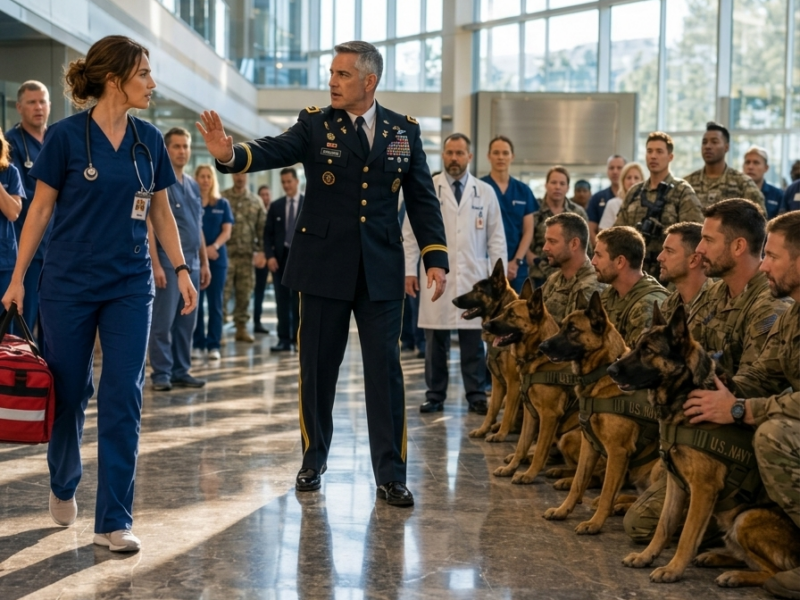
The five military K9s were dragged into the hospital covered in blood, and when the director demanded to know who had saved them
The cold linoleum of the auxiliary trauma wing smelled permanently of chlorine, dried iodine, and copper. It was an off-grid medical ward nestled near the western perimeter of Womack Army Medical Center, reserved strictly for classified transit cases—incidents that public affairs officers preferred to label as routine mishaps or erase from the logbooks entirely.
I was the nurse everyone forgot was in the room.
My name is Emily Ward. For nearly three years, I had walked those narrow corridors like a ghost, keeping my gaze anchored to clipboard margins and digital monitors. I spoke only when an order demanded confirmation, ate alone in the subterranean breakroom, and volunteered for the graveyard shifts that left my skin pale and my eyes ringed with hollow shadows. In a military installation crawling with chest-thumping bravado, invisible people survived the longest.
Until twenty past two in the morning, when the reinforced blast doors at the rear bay were blown off their pneumatic tracks by the raw panic of half a dozen operators.
They arrived without sirens. Two heavily modified tactical transports skidded across the rain-slick tarmac, their engines whining like wounded beasts before cutting out. Men in sterile multicam—no patches, no unit tabs, no identifying insignia—flooded through the red-lit threshold, slipping on their own boots as they carried the wreckage of an operation gone catastrophic.
“Clear the floor!” a sergeant barked, his voice shredded by soot and screams. “We have multiple casualties! Human and working assets, move, move, move!”
There were two human handlers, both suffering from concussive burns and shrapnel lacerations, but they were upright, leaning against the doorframes while refusing stretchers. Their desperate, bloodshot eyes were fixed entirely on the stretchers behind them.
Five military working dogs—Belgian Malinois and German Shepherds—were dragged into the bay, their coats matted with black soot, gray concrete dust, and hot, sticky arterial blood. The stink of singed fur and burning flesh hit the back of my throat, sickeningly familiar.
The chaos was instant, suffocating, and deafening. Orderlies scrambled for tourniquets, veterinarians from the base clinic had not yet arrived, and the human trauma surgeons were shouting over one another, paralyzed by the sight of war dogs writhing in violent agony.
One dog, a massive shepherd with a shattered left flank, had a deep, yawning wound carved across his muscular chest that bubbled with every ragged breath. A tension pneumothorax. Another Malinois lay flat on his side, his tongue blue, his lungs filling with fluid from blast-wave overpressure. The youngest of the pack—a slender, two-year-old female barely past juvenile training—shook uncontrollably on the concrete floor, her teeth snapping at empty air in a state of blind, hysterical neurological shock.
Nobody moved toward them. In the military, these animals were multimillion-dollar tactical assets, but to the civilian surgical residents on duty, they were fifty-kilo predators dying with teeth bared.
“They’re going to bleed out!” an orderly screamed, jumping back as the chest-wounded shepherd snapped his jaws in agony. “We can’t sedate without the vet’s clearance! Where is Dr. Mitchell?!”
I didn’t wait for Dr. Mitchell.
Something cold and mechanical clicked behind my ribcage—a dormant reflex buried deep beneath layers of quiet obedience. I dropped my tray of sterile gauze, bypassed the human surgical bay entirely, and moved directly into the blood-soaked center of the trauma floor.
“Hold his muzzle with your sleeve,” I ordered the nearest soldier, my voice cutting through the panic with flat, icy authority. “Do not let him thrash. If he moves, the rib punctures his pericardium.”
The soldier, a seasoned operator twice my size, didn’t question me. He saw the cold focus in my eyes and instantly dropped to his knees, wrapping his cordura-clad forearm around the thrashing shepherd’s neck.
I didn’t have veterinary instruments. I grabbed a fourteen-gauge human angiocatheter, tore the packaging with my teeth, and located the second intercostal space along the dog’s ribcage by touch alone. My fingers sank through blood-slick fur, feeling the jagged edge of bone. Without hesitation, I drove the needle straight into the pleural cavity.
A loud, hissing gasp of trapped air and dark fluid erupted from the catheter hub.
The dog’s heaving ribcage instantly eased. His frantic, wild eyes softened, the tongue slipping back into his jaw as his lungs re-inflated.
I didn’t stop to breathe. I moved down the line like a machine. I packed the second dog’s arterial bleed with celox gauze, driving my knuckles deep into the wound until the clotting agent bonded against the torn femoral vessel. For the suffocating Malinois, I shoved an endotracheal tube down his throat, bag-ventilating him manually with one hand while using the other to inject eighty milligrams of furosemide directly into his cephalic vein to clear the pulmonary edema. For the trembling youngest dog, I pushed midazolam to break the seizure cycle, wrapping her shivering body in a heated thermal blanket.
By the time the heavy boots of the hospital director echoed down the hall, all five animals were stable. The air was thick with the chemical tang of coagulants and wet dog hair. I was kneeling in a widening pool of red, my pale blue scrubs soaked through to the skin, my bare forearms smeared with dark crimson.
Dr. Arthur Vance, the director of Womack’s classified surgical division, strode into the bay surrounded by two armed base security officers. His silver hair was perfectly combed, his coat immaculate, but his eyes were darting, searching the carnage with intense, calculated suspicion.
“Who authorized veterinary triage in an emergency human surgical suite?” Vance demanded, his voice echoing off the stainless steel cabinets. “Who saved these dogs?”
The room went dead silent. The surgical residents stepped back, looking at the floor. The orderlies raised their hands in defense.
Then the sergeant by the door—his face covered in soot, his eyes wide with disbelief—raised a calloused finger and pointed toward the far corner where I had retreated to rinse my arms in the scrub sink.
“The quiet nurse,” the soldier said, his voice trembling slightly. “She did it. All of them. In under eight minutes.”
Vance turned slowly. His gaze raked over me, taking in my soaked sleeves, the bloody trauma shears hanging from my pocket, and the absolute lack of panic on my face. A deep, ugly furrow creased his brow.
“You?” Vance asked, stepping toward me. “Nurse Ward?”
“I stabilized their vitals, Director,” I replied quietly, keeping my head slightly lowered, retreating back into the shell of the harmless orderly. “They were dying. There were no other hands.”
He looked at the sheer volume of blood covering my uniform, then at the chest tube I had fashioned out of an IV line and a one-way flutter valve. “What exactly did you do? This isn’t civilian nursing technique. This is combat field stabilization. You performed an emergency thoracostomy on a tactical animal without anesthesia.”
“Nothing special,” I murmured. “Basic battlefield medicine. It’s in the standard trauma manual.”
That was when the oldest K9—the massive German Shepherd who had nearly died of the collapsed lung—slowly lifted his heavy head from the operating pad.
He ignored the armed guards. He ignored the director. He ignored the handlers who had carried him through the fire. With a low, guttural groan of pain and recognition, the dog dragged his front paws forward across the slick table, lowered his muzzle, and pressed his damp, blood-stained nose firmly into the palm of my right hand.
A collective gasp went through the room.
“Watch out!” one of the handlers shouted, stepping forward. “That dog doesn’t let anyone touch him except his primary! He bit three handlers during intake in Poland!”
The dog didn’t bite. He let out a long, shuddering sigh, closing his amber eyes as I instinctively let my fingers curl around the thick fur behind his notched left ear, scratching the exact spot where a shrapnel scar met his jawline.
“It’s okay, Duke,” I whispered softly. “You’re safe now. Good boy.”
The words slipped out before my conscious mind could swallow them.
The silence that followed was heavy enough to crush bone.
Director Vance froze mid-stride. The color drained from his weathered face with terrifying speed, leaving his skin the shade of damp chalk. He took one slow, deliberate step closer, his eyes narrowing into cold, predatory slits.
“How do you know his name?” Vance asked, his voice barely louder than the hum of the fluorescent lights, but vibrating with lethal intent.
I didn’t answer. I couldn’t.
My throat closed around a block of pure ice. Because I wasn’t supposed to know Duke. I wasn’t supposed to know any of them.
According to official Department of Defense records, Duke was an unassigned tier-one asset belonging to Naval Special Warfare Development Group. But before that, Duke had belonged to Master Chief Aaron Cole.
Aaron Cole. The man who had trained these five exact dogs in an off-grid compound in the Blue Ridge Mountains. The man who had been my husband for four secret, glorious months before his entire unit was reportedly wiped out during a deep-reconnaissance breach in the mountains of northern Syria three years ago.
Aaron had died three years earlier. His body had been brought home in a lead-lined casket that I was forbidden to open. I had been visited by two men in dark suits who handed me a folded flag, a nondisclosure agreement carrying a twenty-year federal prison sentence, and a brutal, unequivocal instruction: Forget you ever knew him. Never speak his name again. You are Nurse Emily Ward, and you have no past.
And I had obeyed. Until tonight.
Vance stepped directly into my personal space, his breath smelling of stale coffee and nicotine. “I asked you a question, Nurse. Where did you learn that dog’s name? These assets were transported under black manifests. Their operational identifiers are classified Level Four.”
I looked at Duke’s amber eyes. Then I looked past him, down the row of metal tables. The other four K9s—even the young, shivering female—had turned their heads toward me. Their ears were pinned back, their eyes locked onto my face with the absolute, unshakable loyalty of pack animals reuniting with their alpha.
“I knew their handler,” I whispered, the confession tasting like copper.
“Which one?” Vance hissed. “The handlers on this operation were Staff Sergeants Miller and Hayes.”
“Not them,” I said, my voice finally finding a steady, dangerous edge. “Aaron.”
Vance went completely, horrifyingly still. The hand he had rested on his sidearm twitched. “That’s impossible. Aaron Cole has been dead for thirty-six months. His remains are buried in Section 60 at Arlington.”
“I know,” I replied.
Suddenly, Duke let out a sharp whine. He didn’t look at Vance; he lowered his head toward the floor beneath the heavy stainless-steel examination table where he lay. With his right paw, despite the agony of his punctured chest, he began scratching at the baseboard.
Scrape.
Scrape.
Scrape.
Three rhythmic strikes, a pause, then two more. A tactical code. Aaron’s code.
My hands began to shake with a violent, uncontrollable tremor. I dropped to my knees beside the table, uncaring of the blood soaking into my pants. Beneath the rim of the stainless-steel cabinet was a false kickplate, painted to match the gray industrial floor. I wedged the tip of my trauma shears into the seam and wrenched it back.
The metal plate popped free.
Inside the hollow cavity of the wall sat a small, black Pelican case, sealed with waterproof gasket tape. It had been sitting there for years, gathering dust behind the plumbing pipes.
“Don’t touch that!” Vance barked, reaching for his weapon.
“Step back, Director!” the wounded handler by the door yelled suddenly, his sidearm clearing his holster before Vance could draw. “She touches the box! Those were Cole’s orders if this pack ever came back to Womack!”
The air in the room stretched until it screamed. Vance slowly raised his empty hands, his eyes burning with venomous fury.
With numb, freezing fingers, I popped the black latches of the case.
Inside, resting on top of a military-grade encryption drive, was a physical photograph. A glossy five-by-seven print, preserved against the moisture.
In the picture, Aaron stood in full combat gear against the backdrop of a snow-covered pine forest. His dark hair was clipped short, his crooked, familiar smile cutting through the exhaustion on his face. Around him sat all five dogs, their coats thick and healthy.
And standing right beside him, wearing a dark green field jacket with her arm looped through his, was me.
I stared at the photograph, the room spinning beneath my knees. But it wasn’t the sight of Aaron that stopped my heart.
It was the date-stamp printed in yellow digital ink in the bottom right corner of the frame:
OCTOBER 14, 2023.
Two weeks after the Pentagon had delivered his closed casket to Arlington National Cemetery. Two weeks after I had watched six inches of Virginia dirt thrown over his empty grave.
“Where did you get this?” Vance whispered, his face twisted in genuine, unmasked terror. “Emily… what did you do?”
“I don’t remember,” I choked out, a sudden, blinding headache tearing through my frontal lobe like a hot needle. Memories that had been locked behind a chemical wall began to crack, bleeding jagged shards of light into my mind.
Before I could process the image, the youngest K9—the slender female—let out a sharp, piercing whine.
She crawled off her table, dragging her back legs, and pushed her snout into my chest. Around her neck, concealed beneath the thick nylon of her tactical collar, was a tiny, circular metal tag that hadn’t been issued by the quartermaster.
I turned the tag over with a trembling thumb.
Three words were stamped into the oxidized steel:
SHE KNOWS EVERYTHING.
Before the breath could leave my lungs, the emergency backup generators let out a sickening, dying groan.
SNAP.
Every light in the trauma ward extinguished at once. The hum of the oxygen concentrators died. The monitors went pitch-black.
The darkness was total, thick, and suffocating.
In the absolute blackness, I felt Duke’s massive, warm body press hard against my left leg, his low growl vibrating through the floorboards.
Then, from the far end of the darkened corridor outside the bay—floating through the shattered blast doors on the damp, cold night air—a man’s voice whispered through the dark.
A voice I had heard in my dreams every night for three agonizing years.
“Emily.”
My heart ceased to beat.
Because it was Aaron’s voice. And he was coming down the hall.
The voice hung in the pitch-black corridor like smoke, clinging to the damp air and freezing the marrow in my bones. It was Aaron. Not a recording. Not the warped phantom of a grieving mind. It carried that slight, gravelly catch on the second syllable—the permanent rasp left behind by an old cordite burn in his throat that no surgeon had ever been able to smooth out.
“Emily.”
Beside me in the dark, Duke didn’t bark. A civilian dog would have erupted into frantic howling; an attack-trained K9 would have launched forward on an intercept angle. But Duke did neither. He leaned the full, solid weight of his seventy-pound frame against my shin, his hackles flattening against his spine. It was the tactical posture of an animal who recognized the team leader. The other four dogs had stopped their whining entirely. In the blackness, five rhythmic, synchronized patterns of breathing filled the vacuum of the room.
“Director, move!” one of the base security guards yelled, his voice cracking with the sharp edge of panic.
The click of weapon safeties being disengaged echoed sharply off the tile walls—three distinct metallic snaps.
“Hold your fire, you idiots!” Vance’s voice cut through the dark, not with the authority of a hospital commander, but with the raw, sweating terror of a man who realized the walls of his kingdom had just turned into the bars of a cage. “Night-vision optics, now! Seal that corridor!”
“Optics are fried, sir!” the guard shouted back. “Whatever killed the main grid threw an EMP pulse through the sub-panel! The flashlights are dead!”
A match flared in the corner—a handler attempting to spark an old lighter. The tiny, flickering yellow flame lived for less than a second before a suppressed round spat through the dark with a soft, mechanical pfft-crack.
The lighter was torn from the handler’s grip, ricocheting against the ceiling with a shower of dead sparks. The soldier let out a choked gasp, falling back against the crash cart. He wasn’t dead; the round had taken the mechanism cleanly from his fingers with pinpoint, impossible accuracy.
“Nobody moves,” the voice came again, closer now. It was directly outside the threshold of the auxiliary bay. “Vance, if your men raise their barrels three inches off the floor, Duke will tear your femoral artery out before your finger finds the reset. You know he’s trained on the voice command.”
Vance’s breathing was ragged, wet with panic. “Cole… you’re dead. The asset manifest was signed off by the Joint Chiefs. You were burned in the facility outside Aleppo!”
“You always were a lazy bureaucrat, Arthur,” Aaron replied.
A heavy, tactical combat boot stepped over the threshold. The faint silhouette of a man framed against the gray moonlight filtering through the shattered ambulance bay doors emerged into view. He was tall, lean, moving with that fluid, predatory grace that Kevlar and ceramic plates could never hide. On his hip, a suppressed combat sidearm was drawn, pointed at the concrete six inches in front of Vance’s polished shoes.
“Emily,” he said softly.
My fingers were still tangled in Duke’s coat. The blood on my skin had turned cold, tacky, and stiff. “Aaron?” My voice was barely a breath, a fragile thread suspended over an abyss. “I… I buried you. I stood in the rain in Virginia and watched them lower the brass box into the ground.”
“You buried a manifest, Em,” he said, his voice dropping into that quiet, intimate cadence that had once belonged only to our kitchen in the small house outside Southern Pines. “You buried eighty pounds of pig iron and biometric scrap while Vance’s cleanup crew pumped you full of scopolamine and amnestic inhibitors to make sure you didn’t remember what we loaded onto the transport at Fort Bragg three years ago.”
The headache struck again—a white-hot blade sliding between the hemispheres of my brain.
I saw a rainy airfield. Concrete bunkers. Heavy aluminum shipping crates bearing the seal of the Defense Advanced Research Projects Agency.
I saw myself, dressed in combat fatigues, holding a refrigerated cryo-case while Aaron locked the collars around five eight-week-old puppies.
I remembered the scent of his skin beneath the tactical vest—rain, gun oil, and cedar.
“No…” I gasped, pressing the heel of my bloody palm against my forehead. “No, I’m an ER nurse. I came from Johns Hopkins. My file—”
“Your file is a lie written by the man standing three feet to your left,” Aaron said coldly.
He didn’t look at Vance, but the muzzle of his weapon drifted an inch toward the director’s knee.
“Tell her, Arthur,” Aaron commanded. “Tell her why she’s here. Tell her why those five dogs were routed to this exact civilian annex instead of the veterinary center at Fort Bragg tonight.”
Vance swallowed. In the dim moonlight, his eyes darted toward the door, calculating the odds of security arriving from the main hospital. “The transport had an engine fire,” Vance stammered. “The blast was an accident during training—”
“The blast was an execution,” Aaron cut in, his tone devoid of rage, carrying only the terrifying weight of absolute certainty. “You planted an explosive charge on the transport’s underside to incinerate this pack because the Senate Select Committee requested a full physical audit of Project Cerberus yesterday morning. You couldn’t let them inspect the dogs. Because if they ran a blood panel on Duke, they wouldn’t find canine DNA.”
My breath caught. My hand on Duke’s neck tightened involuntarily. Underneath the thick fur and the scar tissue, the dog’s heartbeat felt… different. The rhythm was slower, heavier, with a mechanical regularity that defied biological baseline.
“What did you do to them?” I whispered, looking from the dog up to the shadow of the man I had loved.
“Not to them, Emily,” Aaron said, taking a slow step toward me. The moonlight caught the side of his face.
He was older. A jagged, pale scar ran from his right ear down into the collar of his combat shirt. His eyes were hollowed by years of operating in the cold dirt, but beneath the exhaustion was the same fierce, unyielding devotion that had made him stand between me and a court-martial three years ago.
“Not to them,” Aaron repeated softly. “To us.”
Before I could ask what he meant, Duke let out a sudden, sharp bark of alarm.
From the roof of the ambulance bay, two floors above us, came the heavy, unmistakable chop of approaching rotor blades. No navigation lights. No radio squawk on the base tower channels. The low, thrumming beat of an MH-60 Black Hawk operating under stealth acoustic baffling.
“They’re not base security, Cole,” Vance hissed, a sudden, sinister confidence creeping back into his voice. “You think you’re the only one who survived the project? The Board has already sanctioned the containment protocol. In ninety seconds, this entire wing will be declared a biological hazard zone. Thermobaric charges will level this building, and nobody will ever find the scrap.”
“Then we have seventy-five seconds,” Aaron said calmly.
He reached into his tactical vest, pulled a heavy, cylindrical object from a pouch, and tossed it to me.
I caught it by instinct. It was cold, milled titanium, about the size of a flare casing, with a digital thumb-scanner integrated into the cap.
“Duke won’t leave you, Emily,” Aaron said, his weapon coming up to cover the shattered doorway as the first flash of searchlights from the helicopter swept across the tarmac outside. “Take the pack. The sub-tunnel beneath the morgue connects to the old artillery bunkers under the rail spur. The code on that cylinder is your thumbprint.”
“Aaron, I am not leaving you again!” I cried, my voice shattering the cold professional mask I had worn for three years. “You died once! I can’t do it again!”
“You’re not leaving me, Em,” he said, turning his head just enough for me to see the faint, tragic smile touching his lips. “I’m the distraction. You have the cargo.”
“What cargo?!”
He looked down at the five dogs who were now standing around me in an impenetrable defensive circle, their teeth bared toward the approaching shadow of the helicopter.
“Look at the tag on the pup, Emily,” Aaron whispered as the glass windows of the trauma bay blew inward under the rotor wash of the gunship. “Look at the tag.”
The shockwave of the Black Hawk’s rotor wash pulverized the remaining glass panes into a storm of crystalline shrapnel. Down the corridor, the red emergency exit signs flickered wildly as the building’s foundations groaned under the sonic pressure.
“Move!” Aaron bellowed over the roar of the turbine engines.
He didn’t wait for Vance to react. Aaron lunged forward, his combat boot driving into the director’s chest with crushing force, sending the older man crashing into the metal instrument trays. Before the two security guards could level their weapons through the blinding dust, Duke moved.
He was a blur of black and tan fur. Despite the fresh sutures in his chest, the old shepherd launched himself across the gap, his jaws snapping shut on the lead guard’s tactical vest, dragging the two-hundred-pound soldier to the concrete floor with brutal, calculated efficiency. He didn’t tear at the throat; he pinned the man by his weapon arm, locking his joints in place with the precision of a trained wrestler.
“Duke, break! Escort!” Aaron barked.
The command was instant. Duke released the guard, spun on his hind legs, and slammed his shoulder against my hip, driving me toward the heavy stainless-steel door of the morgue supply closet at the rear of the bay.
The other four dogs moved as a single tactical unit. The two Malinois took the rear flank, their bodies forming a living barrier between me and the hallway, while the youngest female limped fiercely beside my right knee, her eyes fixed on the shadows.
“The morgue elevator!” Aaron shouted, firing three rapid shots into the ceiling above the doorway. The plaster collapsed in a heavy avalanche of sheetrock and wiring, temporarily blocking the entrance against the team of dark-clad operators rappelling onto the tarmac outside. “Floor minus three! Emily, do not hesitate!”
I didn’t think. The years of quiet, submissive nursing fell away like a discarded uniform, burned off by an adrenaline surge that made the world slow down to an unbearable crawl.
I hit the morgue door with my shoulder, the five dogs streaming in behind me like liquid shadows. The room was freezing, smelling of formaldehyde and industrial freon. In the far corner, half-hidden behind the rolling stainless steel cadaver racks, was the freight elevator—an ancient, hydraulic lift used to move bodies to the subterranean autopsy suites.
I slammed the titanium cylinder Aaron had given me into the recessed console beside the elevator call button.
The small, circular screen glowed red, then blue.
BIOMETRIC CONFIRMATION: WARD, E. – CHIEF MEDICAL DIRECTOR / PROJECT CERBERUS.
ACCESS GRANTED. LEVEL 5 CLEARANCE DETECTED.
The heavy steel doors groaned open.
“Get in!” I commanded the dogs.
They didn’t hesitate. Duke limped inside first, followed by the others, their claws clicking sharply on the diamond-plate steel floor. I threw myself inside after them and slammed the manual override lever downward.
The cables shrieked. The car plunged into the vertical darkness of the shaft just as a hail of heavy-caliber armor-piercing rounds shredded the steel door above our heads, leaving a row of jagged, smoking puncture holes in the ceiling.
The elevator dropped three levels, the air growing colder, thicker, smelling of ancient concrete, ozone, and seventy years of military secrets.
When the car shuddered to a halt, the doors didn’t open automatically. I had to use both hands to force the manual release, wedging the steel panels apart.
We stepped out into an underground corridor that looked nothing like the modern hospital above.
It was a cold-war bunker. The walls were arched, reinforced concrete, ribbed with rusted iron bulkheads. An old rail spur, long abandoned, vanished into the blackness toward the southwest. But fifty yards down the tunnel, an illuminated clean-room facility glowed with clean, sterile, fluorescent light—powered by an independent geothermal generator that had survived the EMP pulse.
Duke nudged my hand, his tail wagging once, a low whine escaping his throat.
“Good boy,” I whispered, falling to my knees on the damp tracks, my hands shaking so violently I could barely breathe. The reality of what was happening was crushing me.
I looked at the slender young female dog who sat shivering against my shoulder. I reached down, her warm fur parting beneath my fingers, and pulled the small metal tag from her collar.
SHE KNOWS EVERYTHING.
I turned the tag over again. In the brighter light leaking from the clean room, I noticed a microscopic seam running along the rim of the steel disc. Using the edge of my trauma shears, I twisted the seam.
The tag popped open.
Inside, embedded in a tiny square of silicone, was a high-density micro-transponder and a rolled strip of synthetic microfilm, no wider than a matchstick.
I walked toward the glass doors of the clean-room laboratory. Beside the biometric lock was an optical reader. My hands moved without my conscious mind directing them; procedural memory, hard-wired into my neural pathways, took over. I fed the microfilm into the scanner slot.
The terminal hummed to life. A massive digital dossier unfolded across the high-resolution monitors lining the lab wall.
The header was stamped with the black insignia of the Defense Advanced Research Projects Agency and the Department of the Navy:
PROJECT CERBERUS – PHASE IV: SYNTHETIC NEURAL ARCHITECTURE.
PRINCIPAL INVESTIGATOR: DR. EMILY WARD-COLE.
TACTICAL DIRECTOR: MASTER CHIEF AARON COLE.
I stared at the screen, my heart hammering against my ribs like a trapped bird.
There were hundreds of files. Surgical logs. Neural telemetry charts. Genetic mapping sequences.
And then I saw the photographs.
They weren’t dogs.
Not entirely.
The files detailed an eight-year black-budget research initiative designed to solve the ultimate vulnerability of modern autonomous warfare: cyber-warfare infiltration and electronic counter-measures. A drone could be hacked. A satellite could be jammed. An autonomous ground vehicle could be disabled by a single high-altitude electromagnetic pulse.
The solution had been biological storage.
A living, genetically modified neural network that could carry terabytes of military encryption keys, covert identity databases, and operational launch protocols inside the non-coding DNA and specialized brain structures of tier-one working dogs. The animals weren’t just scouts or attackers; they were the physical servers of the nation’s most classified intelligence network.
And Duke was the primary archive.
The five dogs were carrying the entire covert operations infrastructure of the United States military in their blood and neural pathways.
“The Board didn’t want to destroy the project because it failed,” a voice said from the shadow of the tunnel behind me.
I spun around, grabbing a stainless-steel bone saw from the surgical prep tray, holding it like a combat knife.
Aaron stood in the airlock threshold.
His tactical vest was shredded along the left ribcage, blood seeping through the nylon weave, but his weapon was holstered. He had dragged the heavy iron blast doors of the rail tunnel shut behind him, jamming the locking wheel with a steel pry-bar.
“They wanted to destroy it because we found out who was buying the data,” Aaron said, his chest heaving as he leaned against the concrete doorframe.
“Aaron…” I lowered the tool, my eyes welling with tears as the final barrier in my mind shattered.
The memories didn’t bleed back in fragments; they struck me with the concussive force of an ocean wave.
I remembered the secret laboratory in the Blue Ridge Mountains.
I remembered synthesizing the synthetic genetic vectors, testing them on cell cultures, working eighteen hours a day while Aaron sat on the floor with five newborn puppies, teaching them his scent.
I remembered our small white house, the ring he had slipped onto my finger by the light of the fireplace, the promise that once the project was delivered to the Pentagon, we would resign our commissions and disappear to the coast.
And I remembered the night Director Vance arrived with private defense contractors from Geneva.
“Vance wasn’t working for the Pentagon,” I said, the words falling from my lips like cold lead. “He was selling the biological network to a private syndicate. A private intelligence firm that could blackmail every government on earth if they held the master keys.”
“You found the offshore routing logs,” Aaron said, taking three slow, agonizing steps toward me, dropping heavily onto an examination stool. “You knew they were going to kill us both to clean the ledger. So you did the only thing that could keep you alive.”
He reached out, his calloused, blood-stained fingers gently touching my cheek, wiping away a tear that had cut a clean path through the soot on my skin.
“You programmed Duke’s neural matrix to respond only to your voice and your genetic profile,” Aaron whispered. “You locked the master decryption key inside your own memory using a targeted chemical block. You made yourself forget so they couldn’t torture the code out of you. And you made me promise to run the pack into the dark until the day the buyers tried to take delivery.”
“Tonight,” I breathed, looking at the monitors. “The training exercise at Fort Bragg… that wasn’t a training exercise.”
“It was the exchange,” Aaron said, his voice tightening with fury. “Vance brought the contractors to the drop zone. But the dogs knew. Duke broke the perimeter, the pack followed him, and Vance’s security detail triggered the demolition charge to keep them from escaping.”
He looked down at his bleeding side, his breath turning shallow, a dark bubble of blood appearing at the corner of his mouth.
“Aaron!” I rushed forward, catching him as his head fell forward against my shoulder.
“The helicopter… on the roof,” Aaron rasped, his hand gripping my wrist with fading strength. “That was the syndicate’s extraction team. Vance’s people. They breached the blast doors five minutes ago, Emily. They have thermite charges. They’re coming down the ventilation shafts.”
From the ceiling above the clean room, a deep, rhythmic vibration began to rattle the fluorescent light fixtures.
Thump.
Thump.
Thump.
Heavy hydraulic cutting torches biting through four inches of cold-war steel.
“We can’t outrun them through the rail tunnel,” I said, looking at the five dogs who had gathered around Aaron’s feet, their heads resting against his knees, their amber eyes filled with desperate, silent understanding. “There’s no exit for three miles.”
“There’s an override, Emily,” Aaron whispered, his eyes fluttering closed as consciousness began to slip away. “In the terminal. The Ghost Protocol. You wrote it.”
“What does it do?”
“It purges the data from the dogs,” he choked out. “Permanently. It erases the network, converts the synthetic DNA back to baseline canine biology. It makes them just dogs again. Ordinary, harmless dogs.”
“And the master key?” I asked, looking at the glowing terminal. “The proof of what Vance did? The names of the syndicate buyers?”
“It broadcasts,” Aaron whispered, his voice barely audible over the screech of metal from the ceiling. “To every public server on the planet. But the terminal requires two biometric signatures to transmit.”
He forced his heavy right hand up, placing his bloody thumb on the glass scanner of the desk.
“Mine is set,” he breathed. “It’s waiting for yours, Doctor.”
The ceiling shrieked as the hydraulic torches cut through the final steel plate of the ventilation intake. Chunks of burning magnesium and white-hot sparks showered down onto the linoleum floor twenty feet from the clean-room glass, hissing viciously as they hit the damp concrete.
“Hostiles through the primary intake!” a voice shouted from the darkness of the outer tunnel. “Breach! Breach! Contain the biological assets!”
Footsteps—disciplined, heavy, muffled by tactical boots—echoed through the concrete corridor. Four men in sterile, dark-gray composite armor dropped into the light, their weapons equipped with suppressors, infrared illuminators, and high-capacity drum magazines. Leading them through the ruined airlock was Arthur Vance.
He had abandoned his doctor’s coat. Over his tailored shirt, he wore a lightweight tactical vest, his face flushed with murderous adrenaline, a nine-millimeter automatic gripped tightly in his right hand.
“Emily!” Vance shouted, stepping to the threshold of the clean room, his weapon leveled directly at my forehead. “Step away from that console! Step away now, or I swear to God I will put a round through Cole’s skull before he takes his next breath!”
Aaron lay motionless against the wall, his head lolling to the side, his pulse thready, rapid, and weak beneath my fingers.
The five dogs stood in a straight line between Vance’s weapons and the examination table where Aaron rested. Duke was in the center, his notched ear flattened, his lips drawn back over gleaming, white fangs in a low, terrifying snarl that didn’t stop. The other four had fanned out, their bodies rigid, their claws digging into the linoleum, ready to die on this floor to buy us three seconds.
“You won’t shoot him, Arthur,” I said, my voice eerily calm, devoid of any tremor. My left thumb hovered half an inch above the glowing glass scanner of the primary console. “You shoot Aaron, you lose the primary verification token. You shoot me, the Ghost Protocol permanently defaults to dead-man status. The servers will wipe, the network will dissolve, and the four billion dollars your Swiss partners wired into your shell companies yesterday morning will turn into an international contract on your life.”
Vance stopped. The two operators flanking him held their fire, their weapon sights darting between my thumb and the snarling pack of dogs.
A cold, oily smile spread across Vance’s face, though the sweat pouring down his temples betrayed the terror beneath his mask.
“You always were the smartest mind DARPA ever bought, Emily,” Vance said softly, taking half a step forward. The dogs growled louder, a wall of pure sound that shook the glass partitions. “You think you can broadcast that archive? Look at the terminal, you fool. Look at the routing header.”
I glanced sideways at the screen without moving my hand.
The transmission path wasn’t routed to a congressional server or a federal judge.
The primary destination node on the monitor was a secure, encrypted drop-box belonging to the United States Naval Special Warfare Command—specifically, the internal review board that had signed off on the Syria mission three years ago.
“The military knows, Emily,” Vance whispered, his voice dripping with venomous amusement. “They’ve always known. Aaron wasn’t sent to Syria to die; he was sent to be extracted by our private buyers. He betrayed the agency first. He took fifty million dollars from the syndicate to fake his death, and he left you behind to take the blame while he lived in the shadows!”
A heavy, sickening silence fell over the room, competing only with the hiss of the dying magnesium sparks on the floor.
I looked down at Aaron. His face was gray, blood soaking through his fatigues, his fingers still locked against the edge of the desk.
“Is that true, Aaron?” I asked softly.
Aaron didn’t open his eyes, but a weak, rattling laugh escaped his throat. “Ask him… ask him why he needs your thumbprint, Em… if I took the money… why couldn’t I give him… the key?”
The puzzle pieces in my mind snapped into place with terrifying, absolute geometry.
“He couldn’t give you the key,” I said, turning my eyes back to Vance, “because Aaron never had it. You tried to buy him. You offered him everything to turn the pack over to your contractors. But instead of taking the money, he used your own offshore accounts to fund the resistance network that’s been tracking your buyers for thirty-six months. He didn’t abandon me, Vance. He was protecting me from you.”
Vance’s face darkened, the aristocratic composure shattering into ugly, desperate rage.
“Enough of this theater!” Vance roared. “Kill the dogs! Take the woman alive!”
The two operators to his left raised their carbines.
“Duke! Execute!” I screamed.
The clean room turned into an abattoir of sound and motion.
The five dogs didn’t attack like normal animals. They didn’t rush in a pack to be cut down by automatic fire.
They moved with the tactical doctrine that Aaron and I had engineered into their neural pathways years ago.
The two younger Malinois went low, sliding across the polished floor on their ribs beneath the sightlines of the operators’ barrels, slamming their full mass into the knees of the lead shooter. The man’s legs snapped backward with a sickening crunch, his burst of automatic fire chewing uselessly into the ceiling as he collapsed.
Duke launched himself high. He cleared the five-foot examination table in a single, explosive leap, using the stainless-steel tray as a springboard. He hit the second operator square in the chest with all seventy pounds of his armored weight, the titanium-reinforced strike plate on his tactical vest driving the operator’s head back against the concrete pillar with a dull, concussive crack.
Gunfire ripped through the room—two deafening, unsuppressed rounds from Vance’s handgun.
One round shattered the primary monitor into a shower of black plastic and liquid crystal.
The second round caught Duke in the flank—the same flank I had patched together thirty minutes earlier.
The old dog let out a sharp, choked yelp, his body twisting in mid-air before he crashed heavily onto the floor beside Vance’s feet. He didn’t rise. A dark, widening pool of crimson immediately began to spread across the linoleum beneath his ribs.
“Duke!” I screamed.
Vance stood over the fallen shepherd, his gun smoking, his eyes wild with triumph. He raised the weapon, pointing it directly at Duke’s head to finish him.
“Now, Emily!” Vance shouted, his chest heaving. “Step away from the console, or the dog dies right now!”
I didn’t step away.
I looked into Duke’s amber eyes.
The dying dog looked back at me. There was no fear in his gaze. No pain. There was only the calm, absolute resolve of an operator who had completed his final breach. With the last ounce of strength in his massive body, Duke reached his front leg forward, hooked his claws around Vance’s ankle, and pulled with savage, dying ferocity.
Vance slipped on the blood-slick tile, his balance vanishing, his arms flailing as he crashed hard onto his back.
In that single, fractured second, I slammed my thumb down onto the glowing glass scanner of the primary console.
BIOMETRIC MATCH CONFIRMED.
DUAL-AUTHORIZATION ACCEPTED.
GHOST PROTOCOL: INITIATED.
A high-pitched, piercing tone resonated through the laboratory’s public-address system. On the secondary monitors that remained intact, millions of lines of code began to cascade downward in a green, blinding waterfall.
DECRYPTING MASTER ARCHIVE…
BROADCASTING TO GLOBAL OPEN-SOURCE REPOSITORIES…
TRANSMITTING TO THE DEPARTMENT OF JUSTICE…
TRANSMITTING TO THE INTERNATIONAL CRIMINAL COURT…
WIPING LOCAL NEURAL STORAGE MATRICES: 10%… 30%… 60%…
“No!” Vance screamed from the floor, scrambling to his knees, his gun coming up toward my chest. “Stop it! Abort the sequence!”
“It can’t be aborted, Arthur,” I whispered, stepping around the shattered desk to stand directly between his barrel and the five dogs. “The truth belongs to everyone now.”
Vance pulled the trigger.
CLICK.
The hammer of Vance’s automatic dropped onto an empty chamber. The slide had locked back, the final casing ejected into the dark pool of blood on the floor.
Vance stared at the open chamber of his weapon, his mouth working silently, his eyes bulging as the realization of his absolute, catastrophic failure washed over him.
Behind him, from the dark throat of the subterranean rail tunnel, came a sound that froze the remaining breath in his lungs.
The rhythmic, heavy crunch of thirty pairs of combat boots moving in rapid, tactical synchronization.
“Federal agents! Drop your weapons! Drop them now!”
The red beam of fifty laser sights flooded the clean room, painting Vance’s chest, arms, and face in a web of lethal crimson. Men in dark blue windbreakers with bold, yellow lettering—FBI TACTICAL HOSTAGE RESCUE and MILITARY POLICE SPECIAL INVESTIGATIONS—poured through the blast doors like an unstoppable tide.
The two wounded syndicate operators immediately threw their hands flat against the concrete floor.
Vance slowly let the empty gun slip from his numb fingers. It hit the linoleum with a dull, hollow clatter. He looked at the monitors, where the progress bar on the global broadcast had just reached one hundred percent.
TRANSMISSION COMPLETE.
ALL ARCHIVES DUMPED TO PUBLIC REPOSITORIES.
NEURAL REVERSION COMPLETE: SUBJECTS RESTORED TO BASELINE.
A woman in a tactical vest bearing the gold shield of the United States Attorney General stepped through the perimeter, her weapon drawn, her face carved from gray granite.
“Arthur Vance,” the agent said, her voice echoing off the arched concrete walls. “You are under arrest for treason, conspiracy to commit murder, illegal human biomedical experimentation, and the unauthorized sale of classified defense assets. You will never see the sky again.”
Two marshals grabbed Vance by his arms, wrenching him backward onto his knees, ratcheting heavy steel cuffs around his wrists with brutal, uncompromising force.
He didn’t look at them. As they dragged him toward the tunnel, his wild, bloodshot eyes remained fixed on me.
“You destroyed it, Emily,” he hissed, spitting blood onto the floor. “You destroyed the greatest tactical weapon this nation ever built! They’re just dogs now! Worthless, ordinary dogs!”
“They were never weapons, Arthur,” I said, my voice quiet, dropping into the vast, echoing silence of the bunker. “They were our family. Get him out of my sight.”
The marshals hauled him into the darkness.
The moment the heavy steel doors slammed shut behind them, the cold, military detachment that had kept me standing collapsed completely. I dropped to my knees beside Duke, my hands tearing into the emergency medical kit on the examination cart.
“Pressure dressing! Somebody give me a sterile field and a pediatric chest tube, right now!” I screamed, my voice breaking into a ragged, desperate sob.
Duke lay on his side, his breathing shallow, wet, and rattling. His amber eyes were half-closed, his tongue gray, his body shivering under the immense shock of the second gunshot wound.
“Duke, stay with me,” I pleaded, pressing my bare hands against the hole in his chest, feeling the hot, dark blood pulsing between my fingers. “You don’t get to die now. We won. Duke, look at me! Look at your mama!”
A large, warm hand covered mine over the wound.
I looked up.
Aaron was on his knees beside me. He was pale as a corpse, his own wound bleeding through his makeshift bandage, but his eyes were wide, focused, and filled with tears. He leaned down, pressing his forehead against Duke’s notched left ear, whispering into the dog’s fur the same words he had whispered into the cold mountain wind three years ago:
“Mission complete, buddy. Stand down. You’re coming home.”
Beside us, the young female dog pushed her nose under Duke’s chin, whining softly, while the other three K9s rested their muzzles against his paws, their warm breath surrounding the dying warrior like an unbroken circle of life.
Duke let out a long, deep, shuddering breath.
His ribs heaved once against my palms.
Then, the ragged rattle in his chest cleared.
The synthetic neural matrix had dissolved, but the heart beneath it was the heart of an elite military working dog—strong, stubborn, and refusing to surrender. His tongue pinked. His amber eyes snapped fully open, clear and bright, and with a faint, weary thump, his tail struck the bloody linoleum floor once.
Twice.
Three times.
A choked, hysterical laugh tore from my throat as I buried my face in his thick fur, weeping with a relief so violent it felt as though my chest was splitting open.
Aaron pulled me against his shoulder, his uninjured arm wrapping tightly around my back, holding me against him as the tactical teams secured the bunker around us. For the first time in three years, the scent of rain, gun oil, and cedar was real. It was alive. It was home.
Six months later.
The morning sun rose over the barrier islands of the North Carolina coast, painting the gray Atlantic waters in blinding shades of liquid gold and deep copper. A sharp, clean salt wind whipped through the sea oats, carrying the scent of marsh grass and cold foam.
On the wrap-around porch of an old, weather-beaten cedar cottage tucked behind the dunes, two steaming mugs of black coffee sat on a low wooden table.
Aaron stepped through the screen door, wearing faded jeans and a dark wool sweater, the morning breeze ruffling his dark hair. The limp in his left leg was permanent now, a souvenir of the tunnel in North Carolina, but the hollow, haunted look in his eyes had been washed away by months of salt air and unbroken sleep.
He walked over to the porch railing and stood beside me, his arm slipping naturally around my waist, his thumb hooking into the belt loop of my jeans.
“You’re up early,” he murmured, his voice warm, pressing a kiss against the side of my neck.
“The tide was turning,” I replied, leaning my head against his shoulder, watching the white foam break against the sandbars three hundred yards away.
Down on the hard-packed sand near the water’s edge, five shapes were moving at full gallop.
The young female was in the lead, chasing a piece of dried driftwood with wild, exuberant energy, her paws kicking up sprays of white spray. Flanking her were the two Malinois, wrestling each other into the shallow surf with loud, happy barks that carried clearly on the offshore wind.
And trotting slowly behind them, his head high, his graying muzzle tasting the ocean breeze, was Duke.
He had a deep, jagged scar across his ribs, and his left ear was missing a piece of cartilage, but his stride was steady, strong, and unburdened. Around his neck was a simple, flat brown leather collar, devoid of GPS units, transponders, or tactical tags.
He was just a dog.
A beloved, ordinary dog living out the rest of his days under the warm Carolina sun.
“The Justice Department signed the final expungement order yesterday,” Aaron said softly, taking a sip from his mug. “The names Emily Ward and Aaron Cole don’t exist in the defense registry anymore. We’re officially ghosts.”
“Good,” I said, turning in his arms to face him, looking into the dark, familiar eyes that had found their way back to me through fire, death, and three years of manufactured silence. “I’ve had enough of being an asset.”
Duke suddenly stopped near the surf line. He turned his heavy head toward the porch, his amber eyes locking onto the two of us standing together against the weathered wood of the house.
He didn’t bark. He didn’t drop into a tactical crawl.
He simply raised his head, let out a single, deep, joyful woof of contentment, and bounded back toward the water to join the rest of his pack.
I smiled, resting my hand over Aaron’s heart, feeling the steady, unbroken rhythm of tomorrow.
The end.









