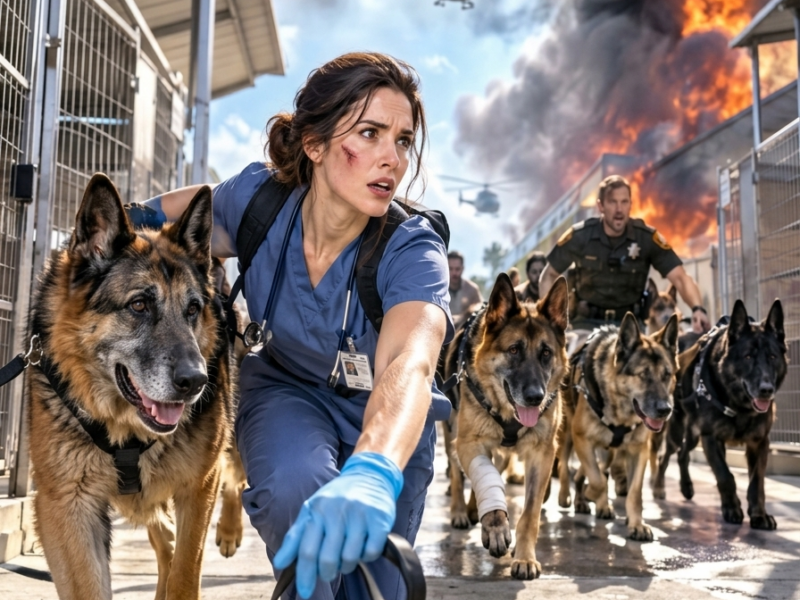
The five K9s suddenly refused to move outside a Dallas emergency room, and when the officers tried to drag them away
The fluorescent lights of the Dallas emergency room buzzed with a low, sickening hum that vibrated straight through my teeth. It was 3:14 AM. The air smelled of sharp antiseptic, wet pavement, and the metallic tang of dried blood.
My shirt was stiff across my chest. It was my father’s blood—soaked into the fabric during those frantic, breathless minutes on the living room floor before the paramedics kicked open the front door.
I leaned against the cold tile wall, my legs trembling so violently I had to lock my knees to stay upright. My father, Thomas Vance, was fifty-eight years old, a retired arson investigator, and a man built like an iron pillar. He had never been sick a day in his life. But three hours ago, he had collapsed without a word, clutching his chest as if an invisible spear had driven through his heart. The paramedics had lost his pulse twice in the back of the ambulance.
Then came the dogs.
They hadn’t arrived in a marked k-9 unit. Two black SUVs had pulled up to the ambulance bay, and out stepped six uniformed officers accompanied by five Belgian Malinois. These weren’t standard patrol dogs. They wore tactical harnesses emblazoned with federal markings.
The moment they reached the sliding glass doors of the ER entrance, all five dogs stopped dead in their tracks.
“Ranger, heel!” Officer Miller, a broad-shouldered man with a weathered face, tugged hard on the thick leather lead.
Ranger, a massive, scarred Malinois with graying fur around his muzzle, didn’t move. He didn’t bark. He simply sat down on the slick concrete, his front paws planted like oak roots. The four younger dogs immediately mirrored him, forming an unbroken arc in front of the automatic doors.
“What the hell is wrong with them?” another officer muttered, pulling on his dog’s leash. “They’re acting like there’s a chemical spill.”
People in the waiting room stared through the glass. A security guard shuffled backward, his hand resting nervously on his belt.
Officer Miller pulled Ranger’s leash again, putting his whole weight into it. “Come on, boy. Clear the walkway.”
Ranger wouldn’t budge. His amber eyes were locked, completely unblinking, on the glass doors leading into the trauma center.
I took a shaky step forward, pulling my jacket tighter around my bloodstained shirt. “He was a K-9 handler twenty years ago,” I said, my voice crackling with exhaustion. “My father. Thomas Vance. He used to train dogs for the department.”
Miller glanced at me, his expression softening slightly as he noticed the blood on my clothes. “I know who your dad is, son. Thomas is a legend in the division. But Ranger never served with him. Ranger was brought onto the force five years ago. There’s no reason for him to react like this.”
The automatic sliding doors whistled open. A night-shift nurse, her scrubs rumpled and her hair pulled back in a messy bun, hurried out toward us with a clipboard. She took two steps onto the pavement, glanced at the line of five rigid dogs, and froze. The color drained from her face so fast it was like someone had pulled a plug inside her.
“Who brought these dogs here?” she asked, her voice hushed, almost frantic.
“His department,” I said, pointing a thumb at Miller. “They heard he was brought in. They came to pay respects.”
She stared at Ranger for several long, agonizing seconds. The old dog’s chest heaved with heavy, silent breaths, but his eyes never shifted.
“That’s strange,” she whispered.
“What?” Miller asked, stepping closer. “Is there a threat? Is there something in the air?”
“No,” she said, shaking her head slowly. She pointed a trembling finger through the glass toward the dimly lit hallway of the trauma bay. “He’s not looking at your father’s room.”
My stomach tightened into a hard, cold knot. “Then what is he watching?”
The nurse turned her head slightly, following the exact angle of Ranger’s laser-focused gaze. “Supply Room 3. Right past the triage desk.”
I followed her eyes through the double glass doors. Inside, past the bright lights of the main hallway, sat a small, windowless storage room. The door was slightly ajar. Nothing moved inside. Just metal shelves loaded with sterile boxes, plastic IV bags, and a tall, gray steel cabinet sitting in the corner.
Then Ranger began to whine.
It wasn’t an aggressive growl or a pain-filled whimper. It was a soft, desperate, rhythmic sound—a high-pitched vibration that rattled in his throat.
I stepped closer to the glass. My father had always hated hospitals. He used to say that walls built to hold sickness only trapped secrets. But whenever he was terrified—really terrified—he had one strange, unconscious habit. He would tap his wedding ring against his palm. Three taps. A pause. Then three taps again.
As I watched Ranger through the glass, my father’s final words from the previous night crashed through my mind.
He had called me at midnight, his voice sounding hollow, as if he were speaking from the bottom of a dry well. “Ethan,” he had said, skipping any greeting. “If anything happens to me tomorrow… if my heart gives out, or if they tell you I had an accident… don’t trust the first story they tell you.”
I had laughed it off. I thought it was just the heavy blood pressure medication the doctors had prescribed him last week making him paranoid. Now, standing in the cold air of the ambulance bay with five tactical dogs refusing to enter the building, a wave of nausea hit me.
“Unlock the door,” I told the nurse.
“Sir, that’s a restricted—”
“Unlock it!” Miller commanded, stepping up beside me. “My dog doesn’t freeze unless there’s something he’s trained to find. Open it now.”
The nurse pulled a keycard from her pocket, walked back through the sliding doors, and swiped it against the scanner on Supply Room 3. The green light clicked.
The moment the latch released, Ranger didn’t hesitate. He broke away from Miller, tore through the automatic doors, and launched himself down the corridor. The four other dogs followed in a silent, coordinated surge.
They didn’t go to Trauma Room 1 where my father lay hooked up to life support. They flooded into Supply Room 3.
Ranger stopped dead in front of the gray steel cabinet. He lowered his snout to the bottom seam, inhaled deeply, and scratched the metal door once.
Clang.
Then he scratched again.
“Get back,” Miller ordered, drawing his sidearm as he stepped into the cramped supply room. He pulled the steel cabinet open.
Inside, sitting on the bottom shelf between stacks of folded blankets, was a heavy, sealed black medical bag. It wasn’t hospital property. It was thick ballistic nylon, covered in dust, with a piece of faded white tape stuck to the handle.
Written on the tape in thick, black permanent marker was a name: THOMAS VANCE.
Nobody spoke. The room went dead quiet except for the steady, heavy breathing of the five dogs anchored around the cabinet. My hands went numb.
Miller leaned down, took a pair of trauma shears from the counter, and sliced through the heavy plastic zip-tie locking the bag’s zippers together. He pulled the bag open.
Inside lay three items: an old, yellowed Polaroid photograph, an unlabelled black flash drive, and a folded piece of heavy cream-colored stationery.
The nurse leaned in, her eyes wide. Miller pulled out the folded note carefully by its edges.
I recognized the handwriting instantly. The sharp, elegant slant of the cursive was unmistakable. It belonged to my mother, Sarah.
She had died in a burning car nineteen years ago. I was six years old when they pulled her charred ring from the ashes of our old sedan on Highway 77.
The note contained only seven words:
Thomas knows what happened that night. Help.
Before I could breathe, before I could process the surreal nightmare unfolding in front of me, a loud, piercing scream echoed down the hallway.
BEEP-BEEP-BEEP-BEEP!
It was the heart monitor in Trauma Room 1. Flatline.
“Code Blue! We need a crash cart in Trauma 1 now!” a voice yelled over the intercom.
Doctors and nurses rushed down the hall, their shoes squeaking against the linoleum. Ranger spun around, his head whipping toward the corridor. He stood beside me, his fur bristling along his spine, staring intently at the note still in Miller’s gloved hand.
At that exact second, the heavy black flash drive sitting inside the open bag began to vibrate. It didn’t ring—it just vibrated rapidly against the nylon fabric, its tiny red indicator light flashing in the dim room.
I looked at Miller, my chest heaving, tears finally burning the corners of my eyes. “Why would my dead mother leave a bag in a hospital supply room for my father? Why is her handwriting on this?”
Miller stared at the note, his face pale, unable to offer a word.
Then, the ER nurse stepped close to me. She looked at the photograph in the bag, then looked up into my eyes. She grabbed my forearm, her fingers digging deep into my skin, and whispered something so terrible, so mathematically impossible, that the hospital floor felt like it dropped out from beneath my feet.
“Your mother isn’t dead,” she whispered. “She was admitted to the psychiatric unit on the fourth floor forty-five minutes ago.”
The world flattened into a dull, roaring silence.
The emergency room around me dissolved into a blur of running medical staff, red flashing warning lights, and the relentless, flat tone of my father’s heart monitor screaming down the hall.
He’s dying, my mind screamed. Dad is dying right now.
“Charge to two hundred!” a doctor’s voice echoed from Trauma Room 1. “Clear!”
Thump.
I looked back toward my father’s room, every instinct screaming at me to run to his bedside, to grip his cold hand before he slipped away forever. But Ranger moved first. The old dog didn’t head toward the trauma bay. He stepped directly between me and the hallway leading to my father, placing his broad chest against my knees. He looked up at me, let out a deep, chest-rattling bark, and turned his head toward the elevator banks.
“Ethan,” Miller said, his hand touching my shoulder. His voice was grim, stripped of all official authority. “The doctors are working on Thomas. You can’t help him in that room right now. But whatever is on this drive… whatever is upstairs… your dad kept this hidden for twenty years. If someone brought her here tonight, it wasn’t an accident.”
“She died in 2005,” I rasped, my throat raw. “I went to her funeral. I watched them lower a closed casket into the ground at Oakridge Cemetery. I stood next to my father while he cried!”
“Did you ever see her body, Ethan?” Miller asked softly.
The question hit me like a physical blow.
No. I hadn’t. I was six years old. My father had kept me in the car during the identification process. He had come out of the morgue looking like a ghost, wrapped his arms around me, and said, “Mommy is gone, Ethan. The fire took her.”
“The fourth floor,” I breathed, turning toward the nurse. “Take me up.”
“I can’t,” she said, backing away, her hands shaking so violently she dropped her clipboard. “The psychiatric hold is a secure ward. It’s restricted access. She was brought in by private security—unmarked ambulance, no state paperwork, just a high-priority transfer order signed by a federal magistrate.”
Miller didn’t ask another question. He grabbed the black nylon bag, stuffed the flash drive and note back inside, and looked at his fellow officers. “Cover the floor. Keep an eye on Thomas’s room. No one goes in or out without my authorization. Ethan, with me.”
We didn’t wait for the elevator. Miller pushed open the heavy steel door to the emergency stairwell, and Ranger sprinted up the concrete steps ahead of us, his claws clicking like gunfire against the risers. The four other dogs stayed behind with the officers, establishing a tactical perimeter in the main lobby.
As we climbed, the air grew colder, heavy with the scent of stale paint and industrial bleach.
“Your dad was an arson investigator for Dallas Fire-Rescue back in the early two-thousands,” Miller said, his boots pounding the steps right behind me. “He worked the North Dallas warehouse fires. You remember those?”
“I was a kid,” I panted, my lungs burning. “I just remember him coming home smelling like smoke every night. He retired abruptly in 2005. Right after Mom died.”
“He didn’t retire, Ethan,” Miller said, halting for a fraction of a second on the landing between the third and fourth floors. “He was medically discharged. Official record says PTSD and smoke inhalation. But the rumor in the department was that Thomas found something inside one of those burning warehouses that he wasn’t supposed to see. Three days later, his wife’s car goes off a guardrail on Highway 77 and explodes.”
We reached the heavy double doors of the fourth floor. A blue illuminated sign above the crash bar read: BEHAVIORAL HEALTH – RESTRICTED ACCESS.
Miller pulled his master keycard—a perk of his high-ranking police clearance—and swiped it. The magnetic lock gave an unnerving, heavy CLACK.
The hallway beyond was entirely different from the chaos of the ER below. It was eerily quiet. Soft carpet lined the floor to deaden sound. The walls were painted a sterile, sickening shade of pale green. High overhead, security cameras swiveled silently on heavy mounts, their small red lenses tracking our every movement.
Ranger stopped ten feet down the hall. He lowered his head, sniffing the edge of the carpet.
“Which room?” I called out into the empty corridor.
No nurses stood at the central desk. The computer monitors were left logged in, screens glowing blue with patient charts, but the swivel chairs were empty.
“Where is everybody?” Miller murmured, unclipping the thumb-break on his holster.
Ranger walked with slow, deliberate steps toward Room 412 at the end of the hall. The door had a small, reinforced glass window built at eye level, reinforced with thick wire mesh.
My heart hammered against my ribs like a trapped bird. Every instinct in my body screamed at me to turn back, to wake up from this grotesque nightmare. I walked up to the door and pressed my face against the cold glass.
The room inside was dimly lit by a single floor lamp. A bed was bolted to the floor in the center.
Sitting on the edge of the mattress, wearing a plain gray hospital gown, was a woman.
Her hair was silver-white, cut short, falling raggedly around her face. Her hands were thin, spotted with age, rests tightly in her lap. But even after nineteen years, even through the haze of gray hair and aged skin, I recognized the profile. The gentle slope of her nose. The posture.
It was her.
My mother.
I gasped, my breath fogging the small glass pane. “Mom?” I whispered.
The woman in the room didn’t look up. She sat completely still, staring at the far wall.
Then, I noticed her hand.
Her right hand was resting on her knee. Her thumb was slowly, rhythmically tapping against her index finger.
Tap. Tap. Tap.
Pause.
Tap. Tap. Tap.
My father’s nervous habit. The exact same cadence.
“Mom!” I slammed my hand against the reinforced glass. “Mom, it’s Ethan! Open this door!”
The woman stopped tapping. Very slowly, her head turned toward the window.
When her eyes met mine, a cold chill washed over my skin. Her eyes weren’t wild or insane. They were sharp, intensely clear, and filled with a profound, terrifying sorrow.
She stood up from the bed and walked toward the door. Each step was measured, slow. She reached the glass, pressed her palm against it, directly opposite where my hand rested.
“Ethan,” she whispered. Her voice was faint through the thick door, but I heard it. It was the same voice that used to sing me to sleep. “You shouldn’t have come.”
“What happened to you?!” I choked out, tears running freely down my face now. “Dad told me you died! We buried you!”
“He had to,” she said, her eyes darting nervously toward the ceiling cameras. “He had to hide me to keep you alive. They found him, Ethan. The men from the warehouse. They found out he kept the drive.”
“What drive?” Miller interjected, pushing his face near the glass. “Mrs. Vance, I’m Officer Miller, Dallas PD. What drive?”
Before she could answer, the light on the wall speaker above the door flashed red. A harsh electronic buzz filled the corridor.
“Officer Miller,” a heavy, synthesized voice boomed from the speaker overhead. “You are in a restricted federal holding zone. Unlawful entry is a felony. Step away from the door and drop your weapon immediately.”
Ranger let out a low, menacing growl, staring up at the speaker.
“Who is this?” Miller demanded, pulling his weapon fully from its holster. “I have a medical emergency and a missing person case!”
“You have five seconds to comply,” the voice responded coldly. “Four. Three…”
Suddenly, the heavy steel fire doors at both ends of the fourth-floor corridor slammed shut with a deafening metallic bang. Heavy magnetic locks engaged with a thunderous echo.
The lights in the hallway instantly died, plunging us into total darkness.
In the pitch black, the only thing visible was the tiny, vibrating red light of the flash drive sitting in the bag at Miller’s hip—and the sudden, horrific sound of heavy footsteps descending from the ceiling vents above us.
“Ethan, get behind me!” Miller shouted into the dark.
The beam of his tactical flashlight cut through the gloom, slicing across the pale green walls. Ranger was already snarling, his body coiled like a steel spring, barking frantically at an air vent positioned high on the wall near the end of the corridor.
Inside Room 412, my mother began pounding violently on the reinforced glass. “Get out!” she screamed, her voice muffled through the heavy door. “They’re not police! Ethan, run!”
CRASH.
The metal grating of the ceiling vent blew outward, crashing onto the carpeted floor. Down dropped two figures dressed in slick, non-reflective black tactical gear, equipped with night-vision optics and suppressed sidearms. They didn’t wear badges. They had no law enforcement markings.
“Dallas PD! Drop your—!” Miller started, bringing his firearm to bear.
Before he could finish the sentence, a muted POP-POP echoed down the narrow hallway.
Miller took a heavy step backward with a gasp. The flashlight slipped from his hand, rolling across the floor and illuminating his chest. Blood was already blooming across his dark blue uniform shirt.
“Miller!” I screamed, lunging to catch him as he hit his knees.
“Go…” Miller wheezed, blood spitting from his lips as he shoved the black nylon bag hard into my chest. “Take the dog… the flash drive… get out!”
Ranger launched himself through the air with a terrifying, gut-wrenching roar. He hit the first tactical operator in the chest, his jaws locking around the man’s forearm. The man shrieked, firing wildly into the floor as he went down under the dog’s weight.
“Ranger, heel!” the second operator barked—not with a command of panic, but using a very specific, military-grade hand-and-vocal code.
To my horror, Ranger hesitated for a fraction of a second, his ears twitching at the recognized command structure. That split second was all the second operator needed. He raised a heavy taser unit and fired. Two metal prongs slammed into Ranger’s side. High-voltage electricity surged through the dog’s body, knocking him to the carpet in a painful, muscular spasm.
“No!” I yelled.
I didn’t think. I grabbed Miller’s fallen heavy metal maglite off the carpet, charged forward, and swung it with all the strength in my body.
The heavy aluminum flashlight connected squarely with the side of the second operator’s helmet. The plastic cracked, and the man stumbled sideways, dropping his weapon.
I grabbed Ranger’s heavy tactical collar, pulling the dog’s two-hundred-pound frame toward the emergency exit stairs. “Ranger, up! Get up!” I sobbed.
The old dog shook his head, his legs wobbling violently from the electrical shock, but his instincts kicked back in. He scrambled to his feet, baring his teeth at the downed men.
I pulled the heavy brass emergency release bar on the stairwell door. The alarm screamed, a deafening siren echoing down the empty hall. I shoved Ranger into the concrete stairwell, slammed the heavy steel door behind us, and jammed Miller’s tactical flashlight through the door handles, wedging it tight against the frame.
BANG! BANG!
Bulging dents formed in the steel door as the men inside kicked and fired against the wedged handle, but the heavy metal held.
“This way!” I yelled, taking the stairs three at a time, racing down toward the basement levels.
Ranger was right beside me, his breathing heavy and ragged, his claws tearing at the concrete. My mind was spinning, fractured into a thousand pieces. My father was flatlining on the first floor. My mother—who I had grieved for two decades—was trapped in a dark room on the fourth floor. And men with suppressed weapons were hunting us through a public hospital.
We reached the sub-basement level—the maintenance tunnels beneath the hospital complex. I threw open the door and dragged Ranger inside, collapse-sliding against a stack of wooden pallets in the dim, pipe-filled hallway.
I pulled the black nylon bag open with hands that were shaking so hard I could barely grip the zipper.
I needed answers. I needed to know why my family had been destroyed.
I pulled out the unlabelled black flash drive. Near the base of the USB connector was a small digital screen that I hadn’t noticed before. It was powered by an internal battery, and a line of tiny text was scrolling across the display:
DECIMAL LOCATION ATTACHED. DECRYPTION KEY: BLOODLINE.
My phone was in my pocket. I pulled it out with cold, slick fingers. My screen showed six missed calls from the hospital main line and three text messages from an unknown number:
UNKNOWN: They are turning off your father’s life support in 5 minutes. If you want the truth about 2005, plugs the drive into the main network terminal in the maintenance basement. Floor B2, Room 09.
I looked up at the rusting door across the tunnel. The faded stencil on the rusted steel read: ROOM B-09: MAIN DATA ROUTER.
“They set a trap,” I whispered to Ranger.
The dog sat beside me, his nose resting on my knee. His amber eyes looked up into mine, steady, ancient, and completely fearless. He didn’t look like a police dog anymore. He looked like a guardian.
I stood up, gripping the flash drive tightly in my palm. “If they wanted me dead, they would have shot me in the hall,” I murmured to myself, trying to find logic in the madness. “They want the drive. They need me to unlock it.”
I walked over to Room B-09, pushed the heavy door open, and stepped into a freezing, air-conditioned room packed with towering server racks. The blue and green LED lights flickered like thousands of tiny eyes in the dark.
In the center of the room sat a primary diagnostic terminal—a heavy laptop interface plugged directly into the hospital’s fiber-optic trunk.
I stood before the screen. The monitor was black, except for a single prompt flashing in white text:
INSERT ENCRYPTED MEDIA.
My thumb hovered over the USB port. I thought about my father’s quiet, solemn life. I thought about the way he never remarried, the way he kept my mother’s bedroom completely untouched for nineteen years, the way he stared out the window every night at 3:00 AM holding his wedding ring.
He hadn’t been grieving. He had been waiting.
I plugged the flash drive into the terminal.
The screen immediately flashed red. A high-speed stream of code began scrolling down the monitor at an impossible rate.
Then, a high-definition video file automatically opened and began to play.
The timestamp in the upper corner read: OCTOBER 14, 2005 – 02:44 AM.
It was security footage from an old industrial warehouse. Smoke was billowed through the steel rafters. In the center of the frame stood three men in fire-retardant suits. One of them had his helmet off.
It was my father, twenty years younger, his face covered in soot.
He was holding an axe, standing over a broken wooden crate. Inside the crate were dozens of silver, military-grade canisters marked with biohazard symbols.
Beside him stood another man—a man wearing a high-end tailored suit over a bulletproof vest. The man in the suit reached into his coat, pulled out a thick envelope of cash, and extended it toward my father.
My father took the envelope. He looked directly into the camera lens, smiled, and shook the man’s hand.
My throat went dry. My knees buckled. “No…” I whispered, shaking my head violently. “No, Dad… no…”
Then, the audio track on the video kicked in.
“Good work, Thomas,” the man in the suit said, his voice crystal clear through the server room speakers. “The fire will erase all traces of the shipment. Your wife and son will be paid fifty thousand dollars a month for the rest of their lives. All you have to do… is let the building burn.”
And on the screen, my father nodded, stepped back, and threw a flare into the pile of chemical crates.
I stared at the glowing monitor, the icy air of the server room biting into my skin.
My father wasn’t a hero. He wasn’t a victim. He was an arsonist for hire. He had helped burn down evidence for money. Everything my life was built on—my respect for him, my memories of his quiet dignity, his tragic grief—was a lie constructed out of ash and blood.
“Is that what you wanted me to see?” I shouted at the silent servers, my voice echoing off the metal racks. “Is this the grand secret?!”
Ranger suddenly stepped up to the server desk. He didn’t look at the screen. Instead, he placed his front paws onto the desk, leaning his heavy head over the keyboard.
He pressed his wet nose directly against the spacebar.
Click.
The video paused. The screen blinked, and the interface minimized, revealing a second hidden partition on the flash drive that had just finished auto-extracting.
A new audio file began to play. The timestamp was different: OCTOBER 14, 2005 – 03:12 AM. Just twenty-eight minutes after the fire started.
It was an audio recording from an wiretap.
“He didn’t take the bribe,” a panicked voice whispered through the speaker. “Thomas Vance turned down the money! He’s staging the crate to look like a chemical arson so the ATF gets involved! He took the real manifest!”
“Where is the manifest now?” a harsh, aristocratic voice responded on the phone line.
“He gave it to his wife! Sarah has it! She’s taking the kid and driving north on Highway 77!”
“Kill them both. Make it look like an accident on the guardrail. And get that manifest back.”
My breath hitched in my throat. Tears flooded my eyes so fast the screen turned into a blur of light.
The video wasn’t real. It was an edited forgery—a deepfake created twenty years ago using cut-together footage to frame my father and black-mail him into silence. They had used the altered video to force him to hand over the manifest to save my life.
And my mother… my mother hadn’t been running away from my father. She was running for him. She had taken the real evidence to draw the killers away from our house, away from me.
A loud, electronic BEEP rang out from the main network terminal.
DECRYPTION COMPLETE. MAIN FILE UNLOCKED.
A massive PDF document opened on the screen. It was a digital copy of the original 2005 shipping manifest. Page after page of chemical weapon precursor codes, corporate shell companies, and government shipping contracts.
And listed at the very bottom of the document, as the primary board member and managing director of the logistics company that ordered the fire, was a name I recognized instantly.
DR. ARTHUR HOLLOWAY – CHIEF OF MEDICINE, DALLAS GENERAL HOSPITAL.
The floor beneath my feet felt like it tilted.
The man who owned the company that ordered my mother’s car forced off the road… was the chief doctor overseeing the emergency room upstairs. The man who was currently holding my father’s life in his hands.
CLICK.
The light in the server room suddenly shifted. The door behind me swung open.
Standing in the doorway, framed by the dim light of the tunnel, was a man in an immaculate white lab coat. He had silver hair swept neatly back, gold-rimmed reading glasses, and a calm, clinical expression on his face.
Behind him stood three of the armed tactical operators from the fourth floor.
“I must admit, Ethan,” Dr. Holloway said, his voice smooth, warm, and entirely devoid of emotion. “Your father was remarkably stubborn. Most men break after five or six years of threats. But Thomas… Thomas kept that drive hidden so well we spent two decades searching every property he owned.”
Ranger instantly dropped into a low crouch, his upper lip pulling back to reveal razor-sharp teeth, a deep, lethal snarl vibrating from his chest.
“Don’t let the dog move, Ethan,” Holloway said gently, gesturing toward the armed men behind him. “If he leaps, my men will put three rounds through your heart before he clears the table. And then your father’s life support will be turned off remotely with a single keystroke on my tablet.”
“You ruined my family,” I spat, stepping in front of the server desk to block the terminal screen. “You locked my mother in an asylum for nineteen years! You poisoned my father!”
Holloway sighed, pulling a pair of leather driving gloves from his coat pocket and slowly slipping them onto his hands. “I didn’t poison him. His heart simply gave out under the stress of knowing we had finally located Sarah. We brought her here tonight to show him she was still alive—to force him to give up the encryption key to that drive. He collapsed the moment he saw her on the security feed.”
Holloway stepped into the room, his shoes tapping softly against the concrete floor.
“You see, Ethan, that manifest on the screen contains information that would dismantle a three-billion-dollar pharmaceutical defense firm. Your father was a simple fireman who stumbled into a war he couldn’t possibly understand. But he was clever. He encrypted that drive using a biometric key tied to his K-9 unit’s microchips and his family’s DNA.”
He stopped three feet from me, looking down at Ranger.
“That dog,” Holloway chuckled softly. “Ranger. He isn’t a police dog. He was bred and trained by your father twenty years ago as part of the original SAR unit. That dog’s microchip contains the secondary decryption key. That’s why Ranger brought you right to the supply cabinet. He was following his original programming.”
Holloway reached into his coat and pulled out a sleek, metallic cylinder—a pneumatic bone-density scanner used for high-level military ID verification.
“Now,” Holloway said, extending his hand toward me. “Erase the terminal, hand over the physical drive, and I will ensure your father lives through the night. You and your mother will be given fresh identities in another state. Refuse… and all three of you die in this basement tonight, framed for an emergency room bio-hazard attack.”
I looked at Holloway. Then I looked down at Ranger.
The dog’s tail gave a single, distinct tap against the steel leg of the desk.
Tap.
Then two more.
Tap. Tap.
Three taps. My father’s code.
I looked back up at Holloway, a slow, dark smile touching my lips. “You forgot one thing, Doctor.”
Holloway blinked behind his gold glasses. “What’s that?”
“My father didn’t just train Ranger to find evidence,” I whispered. “He trained him to protect it.”
I slammed my hand down on the red Emergency System Wipe button on the server console.
“Kill him!” Holloway roared, dropping his calm demeanor instantly.
“TAKE HIM, RANGER!” I screamed.
Ranger didn’t attack Holloway. He didn’t attack the armed men.
With blinding speed, the massive dog launched himself backward onto the central server terminal, his entire body weight smashing into the main fiber-optic trunk line plugged into the wall. The heavy glass junction box shattered under his weight. High-voltage sparks erupted in a blinding shower of blue light, showering the room in fire.
BOOM!
The hospital’s main electrical breaker instantly blew. The entire server room—and the entire sub-basement complex—was plunged into total darkness as the short-circuit tripped the emergency fire suppression system.
Heavy, high-pressure halon gas and water cannons instantly erupted from the ceiling vents, filling the room with a roaring wall of white mist and deafening alarm sirens.
POP-POP-POP!
The tactical operators fired blindly into the dark mist, their muzzle flashes illuminating the chaos in brief, strobe-like bursts. But they couldn’t see. The halon gas blinded their night-vision optics, turning their screens into useless, glaring white light.
I didn’t run for the door. I grabbed the heavy server rack monitor, ripped it from its mounting arm, and swung it in a massive arc through the cloud of gas.
It hit the lead operator square in the chest, knocking him backward into his teammate. They tumbled to the slick floor in a tangle of limbs and tactical gear.
“Ethan!” a voice barked through the roaring fog.
It was Officer Miller.
He burst through the basement door, holding a heavy tactical shotgun in one hand, his uniform shirt torn and soaked in blood from his shoulder wound, but his eyes blazing with fury. Behind him stood the four other K-9 officers, their four Belgian Malinois surging into the room like a pack of wolves.
“Clear the room!” Miller yelled, racking the shotgun with a lethal CLACK-CLACK.
The four police dogs flooded the space, tackling the remaining tactical operators before they could acquire targets in the blinding smoke. Shouts, crashing metal, and the chaotic sounds of combat filled the air.
Dr. Holloway scrambled backward through the fog, screaming in panic, trying to reach the emergency stairwell.
I vaulted over the fallen server desk, my shoes skidding across the wet concrete floor. “Holloway!” I roared.
He turned, pulling a small derringer pistol from his lab coat pocket, his face twisted in desperate rage. “You little bastard—!”
Before he could pull the trigger, Ranger hit him like a freight train.
The old dog launched himself through the cloud of smoke, his jaws locking around Holloway’s right wrist. The doctor shrieked in pain as the gun flew from his hand, clattering harmlessly onto the wet concrete. Ranger drove Holloway to the ground, pinning him to the floor with his massive paws, his jaws hovering inches from the doctor’s throat, growling with a sound like grinding stones.
“Ranger! Hold!” I commanded, stepping through the smoke.
The dog froze, his muscles trembling with absolute discipline, keeping Holloway pinned to the floor.
Holloway lay on his back, gasping for air, his pristine white coat ruined, his gold glasses crushed beneath his face. “You… you can’t prove anything…” he wheezed, blood dripping from his arm. “The servers are destroyed… the drive was wiped…”
I walked over to the shattered server console. Sitting in the middle of the smoking, water-drenched wreckage was the black nylon bag.
I unzipped the side pocket.
The black flash drive was gone. In its place, I pulled out a small, waterproof cellular transponder that had been quietly transmitting the entire server room audio and raw video feed to a secure cloud server from the moment I pressed the spacebar.
On the screen of my phone, a notification popped up:
UPLOADING COMPLETE. DALLAS DISTRICT ATTORNEY & ATF REGIONAL COMMAND RECEIVED.
I walked back to Holloway, knelt down beside him, and showed him the screen. “My father was an arson investigator, Doctor,” I said softly, my voice cold and steady. “He taught me that no matter how big a fire is… something always survives the ash.”
Three hours later, the sun was beginning to peek over the Dallas skyline, painting the clouds in shades of pale orange and gold.
The hospital parking lot was a sea of blue and red flashing lights. Federal agents, state police, and dozens of media vans packed the streets surrounding the complex. Dr. Holloway and seven executive members of the hospital board were taken away in handcuffs, charged with federal conspiracy, kidnapping, and attempted murder.
I stood on the fourth-floor balcony, watching the breeze carry the smell of morning rain through the air.
The heavy steel door behind me clicked open.
My mother stepped out onto the balcony. She was wearing a warm coat provided by one of the paramedics. Her eyes were still red, her skin pale, but for the first time in nineteen years, she was standing in the open sunlight.
She walked over to me, wrapping her thin arms around my waist, resting her head against my chest. I held her tightly, tears finally falling silently down my face—not tears of terror, but of relief.
“He’s awake,” she whispered gently.
I pulled back, looking down at her. “Dad?”
She nodded, a faint, beautiful smile breaking across her face. “The doctors stabilized his heart. He’s out of surgery. He’s asking for you, Ethan.”
We walked down to the third-floor recovery unit together.
The room was quiet. The harsh screaming monitors were gone, replaced by the soft, rhythmic beep of a stable heart monitor.
My father, Thomas Vance, lay in the center of the bed. His face was pale, lined with age and two decades of unbearable burden, but his eyes were open, clear, and bright.
Beside his bed, resting his graying muzzle on the edge of the mattress, sat Ranger. The old dog’s tail tapped softly against the floor every few seconds.
I stepped into the room. My father turned his head toward me. He didn’t say anything at first. He just reached out his trembling, calloused hand.
I grabbed it, gripping his fingers tightly.
“I knew you’d figure it out, son,” he rasped, his voice rough as gravel, a single tear slipping down his cheek. “I knew… if I gave Ranger the lead… he’d bring you home.”
I looked at my mother, who stood on the other side of the bed, reaching down to take my father’s other hand. For nineteen years, our family had been shattered, broken apart by greed, fear, and fire. But standing in that quiet hospital room, as the morning sun flooded through the window, the shadows were finally gone.
My father slowly turned his palm upward. With his thumb, he gently tapped my knuckle.
Tap.
Tap.
Tap.
Three taps. We were safe. The story was finally finished.
The end,









