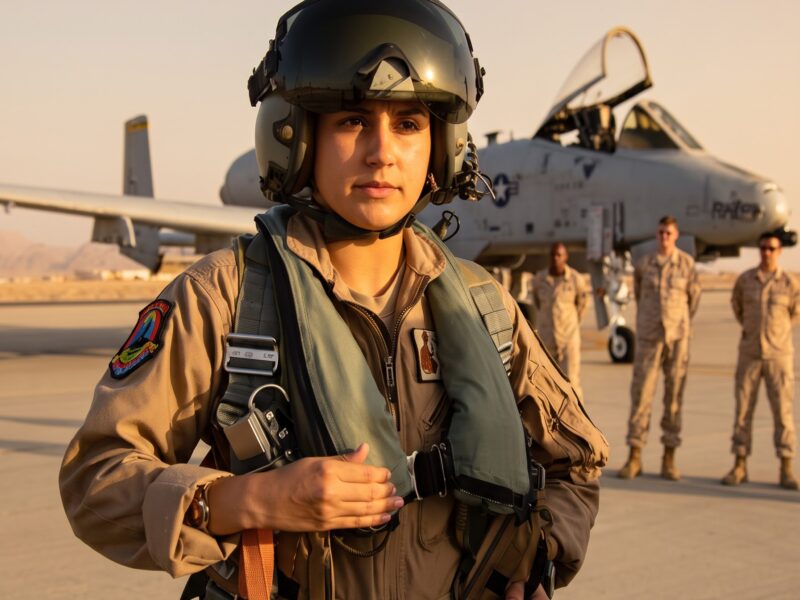
The first time I watched an F-18 tear through the burning skies above Syria, I laughed when our commander called its female pilot reckless
The desert air over Northern Syria didn’t just feel hot; it felt heavy, thick with the sharp metallic scent of burning jet fuel and pulverized limestone. High above the jagged teeth of the valley, an F-18 Hornet tore through the twilight, its twin engines roaring like a wounded beast.
Down in the dust, pressed flat against the razor-sharp rocks of the canyon floor, our Navy SEAL element was dying by inches. The ambush had sprung thirty minutes ago. What was supposed to be a low-visibility recon operation had turned into a slaughterhouse when an entire heavy-weapons battalion rolled out from hidden subterranean bunkers. Mortars rained down with rhythmic, terrifying precision, walking their explosions closer and closer to our position with every passing minute.
“She’s not making it through there,” Lieutenant Carter muttered. He didn’t sound angry; he sounded defeated. He was staring at the glowing green outline of the incoming aircraft on his tactical display, his fingers white-knuckled as he gripped the frame of the handheld command console.
The pilot on that screen was Captain Emily Hayes. To the senior officers sitting safely in the air-conditioned command tents at Incirlik, her name had become a convenient punchline. Too young. Too stubborn. And, as Carter had loudly declared over morning coffee just three days ago, “Too convinced she can do what the rest of us can’t.”
I hadn’t taken a side back at the base. I was just a staff sergeant carrying a heavy radio and trying to stay alive long enough to see my daughter’s third birthday. But watching that glowing green icon on Carter’s screen, diving straight into a narrow, winding trench of rock that intelligence had marked as completely unnavigable, I felt a knot tighten in my throat.
The canyon erupted.
Heavy anti-aircraft artillery—dug-in 23mm cannons—lit up the dark walls with blinding strings of crimson tracer fire. The noise was a deafening, continuous hammer. The F-18 appeared between two towering jagged peaks, flying so impossibly low that the thermal shockwave kicked up a wall of dust that blew straight across our faces, blinding us for two agonizing seconds.
“She’s going to crash,” someone in the dirt beside me whispered. It sounded like a prayer.
She didn’t.
Instead of pulling up to escape the curtain of lead, Hayes threw the multi-million-dollar fighter into a violent, ninety-degree knife-edge roll. The right wing tip cleared the sheer granite face of the cliff by what couldn’t have been more than a few feet. The jet slipped between the cliffs like a ghost, vanished behind a thick column of black oil smoke, and reappeared on the other side with terrifying precision.
A heartbeat later, the first enemy anti-aircraft position erupted into a cascading ball of orange fire as a pair of precision-guided munitions found their mark. Then a second position went dark.
Our tactical radios, usually governed by strict radio discipline, exploded into a chorus of frantic, disbelieving voices.
“How is she seeing through that smoke?”
“She’s below the rim! I repeat, she is below the canyon rim!”
Carter snatched the tactical microphone off his vest, his face twisted in a mix of fury and panic. “Hayes, abort! Break off right now! You’re flying straight into a pre-registered kill zone!”
Her response came through the static. It wasn’t the high-strung, adrenaline-spiked shout of a pilot under heavy fire. It was eerily, unnaturally quiet.
“Negative.”
Carter slammed his bare fist against the stone outcrop, drawing blood. “That’s an order, Captain! Abort!”
For three agonized seconds, the radio produced nothing but the harsh whistle of white noise and the distant thud of exploding artillery.
Then her voice drifted back through the earpieces, steady as a heartbeat. “Sir… you gave me this mission because nobody else could finish it.”
The words acted like a physical blow. The radio fell silent.
I leaned forward, my eyes glued to the silhouette of the jet as it maneuvered deeper into the belly of the valley. Missiles streaked toward her from hidden shoulder-launched emplacements, leaving thick white trails across the darkening sky. Rocks collapsed from the cliff sides under the concussive force of her sonic booms.
She wasn’t flying like a pilot executing a standard close-air support run. She wasn’t flying like someone trying to survive. She was flying like someone who had already calculated the exact cost of her own life and decided the price was worth paying.
Suddenly, a bright red warning prompt flashed continuously across our team leader’s display. A second enemy convoy—three armored personnel carriers and two heavy pickup trucks mounted with machine guns—had just rounded the northern spine of the ridge, cutting off our only clear extraction route.
Carter swore, a ragged, breathless sound. “We’re trapped. They’ve pinned us.”
Emily’s voice returned instantly, cutting through the noise. “Not yet.”
Her F-18 pulled into a vertical climb that strained the engine to its absolute limit, vanishing into the overhang of smoke and fire. For five endless seconds, the sky was empty. Then, with a deafening roar that shook the teeth in my jaw, the jet returned. She pitched down through a natural gap in the rock wall so narrow I could barely see daylight around her wingtips.
She dropped her payload at point-blank range.
The valley trembled as the lead vehicle of the enemy convoy turned into a column of melted steel and fire. The remaining vehicles screeched to a halt, their movement completely blocked by the debris. The oppressive wall of gunfire that had been chewing up our dirt cover abruptly vanished.
The valley fell dead silent.
For a long moment, none of us moved. We lay in the red dirt, breathing hard, listening to the crackle of burning rubber and metal.
Carter slowly pushed himself up on one elbow, his eyes wide, staring at the empty sky where the jet had just been. “Who trained her?” he asked no one in particular. “Where the hell did she learn to fly like that?”
Before anyone could answer, our attached intelligence officer, Petty Officer Noah Brooks, pulled up a thick, red-flagged digital file on his hardened laptop. His face went pale under the layer of dust and dried sweat.
“Captain Hayes wasn’t supposed to be flying tonight,” Brooks said, his voice barely audible over the crackle of small arms fire miles away.
I turned my head toward him, wiping sweat from my eyes. “What are you talking about? She came off the carrier.”
Brooks stared at the screen, his thumbs trembling as he scrolled through lines of heavily redacted text. “Her flight clearance was revoked six hours ago. According to Central Command’s roster… Captain Emily Hayes has been listed as missing in action for eleven months.”
A cold, heavy knot settled in my stomach.
High above, the roar of the F-18 began to fade into the distance, turning into a low hum beyond the mountain ridge. But before her signal vanished entirely, one last transmission echoed through our tactical headsets.
“Tell my brother I didn’t forget.”
Brooks slowly closed the laptop screen. He looked up at Carter and me, his eyes wide with a quiet, sickening horror.
“Her brother,” Brooks whispered, “was Lieutenant Thomas Hayes. He died eleven months ago… on this exact same grid coordinate.”
And somewhere beyond the burning canyon walls, out in the pitch-black sky, Emily Hayes was still flying.
The sudden silence of the canyon was heavier than the gunfire that had preceded it. We didn’t waste time marveling at our survival. Survival in a hot zone is a fleeting grace, and Carter knew it. He barked orders, forcing us to move through the burning debris of the destroyed convoy, pushing toward the designated secondary extraction point three miles south.
My mind, however, refused to leave the radio transmission.
Missing in action for eleven months.
As we moved through the shadow of the cliffs, I fell into step beside Brooks. The intelligence officer was practically jogging to keep up, his heavy pack bouncing against his armor, his hands still clutching the encrypted data pad like a lifeline.
“Brooks,” I hissed under my breath, keeping my eyes scanned on the ridge above us. “Explain what you saw on that screen. How does a pilot who’s been MIA for nearly a year hijack an F-18 off an active supercarrier and execute a close-air support run for a unit she was never assigned to protect?”
Brooks swallowed hard, wiping a sleeve across his dust-caked forehead. “She didn’t hijack it, Miller. That’s the terrifying part. Her security clearance was active until six hours ago. Someone inside Task Force 74 kept her profile alive in the network. They cleared her for takeoff, assigned her the bird, and uploaded our emergency distress coordinates directly to her flight computer.”
“Who?”
“I don’t know,” Brooks muttered, his eyes darting toward Carter, who was thirty meters ahead, setting a brutal pace. “The file was heavily encrypted under an old JSOC protocol. But the casualty report for her brother… that wasn’t classified. I remembered the name the second I saw the personal notes.”
“Thomas Hayes,” I said, remembering the transmission. “Tell my brother I didn’t forget.”
“Eleven months ago,” Brooks whispered, his voice trembling slightly. “Thomas was leading a reconnaissance team right here in this valley. They caught wind of something big—something moving out of a black-market facility near the border. His team called for emergency air support. Command denied the request. Said the air defense envelope was too thick, the risk of losing an aircraft was too high. Thomas and four other operators were wiped out.”
I felt a sickening surge of realization. “And Emily was serving on the same carrier strike group back then?”
“She was a senior flight instructor at Fallon at the time,” Brooks corrected. “When Thomas died, she requested an immediate transfer to the frontline. They turned her down twice. Said she was too emotionally compromised. Then, eleven months ago, she went dark. Official record says she was lost during a routine ferry flight over the Mediterranean. No wreckage was ever found.”
“She wasn’t dead,” I realized out loud. “She went looking for the people who left her brother to die.”
Before Brooks could answer, Carter dropped to one knee and signaled for a perimeter freeze. We instantly fanned out, taking cover behind a line of scrub brush and boulders.
Up ahead, the mouth of the canyon opened into a wide, barren plain. But the sky above us was no longer empty.
A high-altitude radar warning tone began to ping softly on my tactical chest rig. Two radar signatures were approaching from the west at supersonic speed. They weren’t enemy jets. Their transponders were broadcasting standard NATO identification codes.
“Friendly air,” Carter said, adjusting his night-vision goggles. “Strike package coming in from Incirlik. Looks like our actual air support finally decided to show up.”
“Lieutenant,” I called out, moving up beside Carter. “Those jets aren’t here to support us. Read their mission profiles.”
Carter checked his display. His brow furrowed. The two incoming F-15E Strike Eagles weren’t orbiting to provide ground coverage for our extraction. They were running a intercept vector—straight toward the last known coordinates of Emily Hayes’s single F-18.
Over the command channel, a cold, clinical voice cut through the static.
“All units on ground, this is Apex Control. Be advised, Rogue Aircraft designated Echo-01 is operating without authorization. Echo-01 is classified as hostile and non-compliant. Engaging units are authorized to use lethal force to prevent Echo-01 from exiting the operational area.”
I stared at the radio in disbelief. “Hostile? She just saved our lives!”
“Shut up, Sergeant,” Carter snapped, though his own face was tight with sudden strain. He reached for his radio, keying the command frequency. “Apex Control, this is Ground Team Leader. Echo-01 just neutralized two heavy enemy emplacements and saved my team from being overrun. Requesting clarification on hostile designation.”
The response was instantaneous and sharp as a razor.
“Ground Team Leader, break your transmission immediately. Echo-01 is carrying compromised tactical assets and is in direct violation of international protocol. Do not attempt to establish further communication with Echo-01. Focus on your extraction.”
“Compromised assets,” Brooks muttered beside me, his hands flying across his pad as he intercepted the raw telemetry data being fed to the incoming interceptors. “She didn’t just take an F-18, Miller. She took an aircraft equipped with the experimental Tac-Net recorder—the hard drive that logs real-time Command decisions, satellite feeds, and unedited radio traffic for the entire theater.”
I looked out toward the dark horizon, where the distant heat trails of the two interceptors were visible through our night-vision optics.
Emily Hayes hadn’t come to Syria to execute a revenge hit with bombs and missiles. She had come to retrieve the undeniable, unedited proof of who had deliberately ordered her brother’s unit to be left behind—and she had used our distress call as the ultimate shield to force her way into the canyon.
Suddenly, the night sky to the north lit up with a brilliant, blinding flash of light. A distant, thunderous detonation rolled across the plain, shaking the earth beneath our boots.
One of the incoming interceptors had just fired a long-range air-to-air missile.
And on my tactical screen, the single, lone green icon representing Emily Hayes turned bright, flashing red.
“Target hit!” Brooks yelled, his eyes glued to the telemetry stream on his handheld monitor. “No—wait! She dumped chaff and pulled a high-G break! She dodged the primary warhead, but the proximity fuse detonated!”
“Is she airborne?” Carter demanded, grabbing Brooks by the shoulder. “Is she down?”
“She’s losing altitude fast,” Brooks stammered, scanning the falling numbers on his screen. “Engine two is offline. Hydraulics are bleeding out. She’s gliding… she’s down in the badlands, six miles northwest of our extraction point.”
Silence descended on our team once more, but this time it was thick with a heavy, uncomfortable shame. We were operators. We were trained to never leave a man behind. Yet here we stood, listening to the command network celebrate the neutralization of a pilot who had literally carved a path through rock and fire to keep us breathing.
“Apex Control to all ground elements,” the cold voice returned over the network. “Hostile aircraft Echo-01 has been brought down. Search and Recovery assets are en route from the staging base. Ground teams are ordered to proceed to primary extraction immediately and maintain zero contact with the crash site.”
Carter stood motionless in the dust. His jaws were clenched so hard I could see the muscles twitching beneath his skin. He looked at the extraction coordinates floating on his screen—just two miles to the south, where a heavy transport helicopter was already hovering in a holding pattern. Safe. Easy. A ride back to base, a clean shower, and a strict warning to sign non-disclosure agreements before sunrise.
Then he looked at me. He looked at Brooks.
“Sergeant,” Carter said, his voice terrifyingly quiet. “What did you see in that canyon?”
I straightened up, meeting his eyes. “I saw a Navy pilot risk everything to pull four ground guys out of a meat grinder, sir.”
Carter turned to Brooks. “If those ‘Search and Recovery’ assets from Apex reach that crash site before we do… what happens to Captain Hayes?”
Brooks looked down at his screen, then slowly met Carter’s gaze. “Given what’s on that aircraft’s recorder? She won’t make it back to a military tribunal, Lieutenant. She’ll be listed as a fatality of the crash. Case closed.”
Carter took a deep breath. He unhooked the command tablet from his chest plate, dropped it into the dirt, and ground his boot heel straight through the glass screen, smashing it into a dozen pieces.
“My radio died,” Carter said, his face completely devoid of emotion. “Signal got lost in the canyon. Did any of you hear a command to head south?”
The men around us—seasoned, battle-hardened SEALs—slowly shook their heads.
“Didn’t hear a damn thing, Lieutenant,” one of the veterans muttered, checking the magazine on his rifle.
“We move northwest,” Carter ordered, his voice taking on a dangerous, razor-sharp edge. “Six miles. Keep it low, keep it fast. If we hit enemy patrols, we bypass them. If we hit Apex security teams… we don’t shoot unless fired upon, but we do not let them reach that cockpit first.”
We broke into a silent, disciplined trot, leaving the safe extraction route behind and plunging deeper into the dark, lawless expanse of the Syrian badlands.
The terrain was a brutal labyrinth of collapsed earth and jagged basalt stone. Every footstep threatened to turn an ankle, but no one slowed down. High above us, the two F-15 interceptors circled like vultures in the night sky, their jet engines a distant, ominous hum behind the cloud cover. They were waiting for ground teams to confirm the kill.
Forty minutes later, we crested a low ridge overlooking a desolate salt flat.
The wreckage of the F-18 lay strewn across the pale ground like the skeleton of a prehistoric beast. A long, smoking trench cut through the dirt where the jet had belly-landed at terrifying speed. The right wing was completely sheared off, resting a hundred yards back. The main fuselage was charred, twisted, and venting a toxic haze of hydrazine gas and atomized fuel into the cold night air.
“Covering positions!” Carter hissed, dropping behind a bank of packed dirt. “Brooks, check for life signs. Miller, on me.”
I followed Carter down the slope, our rifles raised, scanning the dark perimeter for movement. The heat radiating off the shattered jet was intense, blistering the skin on my face as we approached the crumpled nose section.
The canopy was gone—blown free during the emergency impact sequence.
I scrambled up the jagged edge of the wing root and looked into the cockpit.
The ejection seat was empty.
Blood—bright, fresh, and crimson—was smeared across the control stick and the side of the shattered instrument display. A heavy survival knife had been pulled from its sheath on the side of the console; the empty housing was still swinging gently by a leather strap.
“She’s alive,” I called out, dropping back down to the ground. “She pulled herself out.”
“She can’t be far,” Carter said, looking down at the ground. “Look.”
Distinct, uneven footprints led away from the left side of the aircraft, dragging through the white salt dust toward a small cluster of abandoned stone structures a quarter-mile away. Intermittent drops of blood trailed alongside the prints.
“Lieutenant!” Brooks called out from the rear of the tail section, his hands jammed into the open access panel of the flight recorder bay. “The Tac-Net drive… it’s gone. She took it with her.”
Before Carter could respond, the sky above us was shattered by the sound of approaching rotors. Heavy, muffled rotor blades—the unmistakable sound of blacked-out stealth transport helicopters.
Two dark, angular shapes emerged from the gloom, hovering low over the far end of the salt flat. Beams of harsh, infrared searchlights began sweeping across the terrain, hunting for anything that moved.
“Apex security,” Carter growled, pulling me down into the shadow of the burning engine casing. “They’re here to clean up the mess. Move to those structures! Now!”
We reached the ruined stone structure moments before the searchlights swept over our previous position. The building was an ancient, roofless mud-brick hut, its walls crumbling under decades of wind and rain.
“Hayes!” Carter called out in a low, sharp whisper as we crossed the threshold, our weapons tucked tight into our shoulders. “Captain Hayes! We’re friendly! Navy SEAL team—you pulled us out of the canyon!”
Silence greeted us, save for the whistling wind.
Then, from the darkest corner of the room, behind a collapsed wooden beam, came the unmistakable clack of a 9mm pistol slide being racked back.
“Take one more step,” a raspy, blood-choked voice warned, “and I drop the charge.”
I held up a hand to stop the men behind me. Through the gloom, I could see her.
Captain Emily Hayes was sitting with her back pressed against the mud wall. Her flight suit was torn open at the shoulder, revealing a deep, jagged puncture wound soaked in dark blood. Her face was pale, smeared with sweat and carbon, but her eyes—piercing, icy blue—were locked onto us with lethal intensity.
In her left hand, she held her service pistol, aimed squarely at Carter’s chest. In her right hand, she clutched a small, ruggedized military hard drive—the missing Tac-Net recorder—wrapped in wires connected to a small thermite grenade resting on her lap.
“Captain,” Carter said calmly, lowering his rifle slightly to show good faith. “We’re not here on Apex orders. I’m Lieutenant Carter. This is Sergeant Miller and Petty Officer Brooks. You saved our lives an hour ago in the trench.”
Emily’s eyes shifted to me for a fraction of a second, recognizing the radio rig on my back. The barrel of her pistol dropped an inch, but her thumb remained pinned to the pull-ring of the thermite charge.
“You shouldn’t have come,” she breathed, her chest heaving as she fought through the pain. “They’re not going to let anyone leave this grid section alive if they know you’ve seen this.”
“Why did you do it, Hayes?” I asked softly, stepping closer. “Why throw away your career—your life—for a recorder?”
She let out a dry, bitter laugh that turned into a agonizing cough. She gestured weakly with the drive.
“My brother… Thomas… didn’t die because of an unexpected ambush,” she rasped, her voice trembling with a mixture of rage and grief. “He died because he found out that a senior commander in our own operational chain was leaking real-time troop movements to local warlords in exchange for secure intelligence on high-value targets.”
Brooks gasped, taking a step forward. “Operation Blindside…”
Emily looked at Brooks and nodded slowly. “Thomas logged the entire conversation on his unit’s encrypted tactical network. When he realized what was happening, he tried to beam the raw file back to the carrier. But the commander… he pulled the air support. He left Thomas’s squad to be slaughtered so the file would be buried in the dirt with them.”
She held up the glowing hard drive. “They thought they deleted the master logs from the central server. But they forgot that the F-18 tactical network automatically backs up all local theater transmissions onto the bird’s onboard black box whenever a jet is within ten miles of an active broadcast. I needed an active distress call from this exact valley to trigger the automatic data recovery sequence.”
The horror of it hit me like a cold wave.
She hadn’t just saved us out of bravery. She had monitored our radio frequency, waiting for a unit in this specific canyon to call for help, knowing that our emergency broadcast would force the local network to link with her jet—and pull her brother’s final, erased transmission out of the digital ether.
“You used us as a key,” Carter said, his voice flat, but without anger.
“I used myself as a target,” Emily corrected, looking Carter straight in the eye. “I knew if I pulled the drive, they’d shoot me down. I just needed to survive long enough to transmit this file to an off-site civilian server.”
“Did you finish the upload?” Brooks asked frantically.
Emily looked down at her handheld terminal, which was wired into the hard drive. A thin red bar was moving slowly across the screen.
Progress: 78%…
“The transmitter is too weak down here in the ruins,” she whispered, her head slumping back against the wall. “It needs… three more minutes. But I’m out of time.”
Outside, the heavy thrum of helicopter engines grew deafeningly loud. Bright, artificial white light flooded through the cracks in the mud walls. Harsh, amplified voices echoed across the salt flat.
“Attention unidentified personnel in the structure. This is Apex Security. You are surrounded by an armed military force. Drop your weapons, abandon the technical equipment, and exit the building with your hands visible. You have thirty seconds to comply.”
Carter looked at the doorway, then looked at Emily Hayes. He reached down, grabbed his spare magazines, and slapped them into his tactical vest.
“Sergeant Miller,” Carter said, checking his rifle’s optic.
“Sir?”
“Set up a defensive line at the entry point. We hold this room.”
Brooks looked panicked. “Lieutenant… those are private security contractors working under a classified JSOC mandate! If we open fire on them, we’re committing treason!”
Carter looked down at the pale, bleed-out face of Emily Hayes, then turned to Brooks with a look of pure, unadulterated contempt.
“They murdered four American soldiers in this dirt eleven months ago, Brooks,” Carter said, pulling the bolt back on his rifle with a heavy clack. “I don’t give a damn what mandate they’re wearing tonight. We hold the door.”
The first breaching charge detonated against the eastern mud wall, showering us with debris and blinding gray dust.
“Contact!” I roared, raising my weapon and firing a tight three-round burst into the heavy smoke as two dark figures in unmarked tactical gear tried to force their way through the breached wall.
The sound inside the enclosed room was absolute, bone-shattering chaos. Muzzle flashes illuminated the swirling dust like lightning strikes. Carter was a rock beside me, firing with rhythmic, brutal precision, laying down suppressive fire that forced the incoming assault team back into the open courtyard.
“Brooks! How much time?” Carter shouted over the deafening roar of gunfire.
Brooks was crouching over Emily’s terminal, shielding the delicate screen with his own body as bullets chipped away the stone inches above his head.
“Eighty-nine percent!” Brooks screamed back, his voice cracking with terror. “It’s lagging on the satellite handshake! We need sixty seconds!”
Outside, the tactical situation turned rapidly catastrophic. A third helicopter had landed on the northern ridge, setting up a heavy caliber machine gun position that began chewing through our mud-brick cover like paper. Large chunks of ancient wall collapsed inward, narrowing our defensive perimeter by the second.
A round caught the SEAL standing to my left in the shoulder, knocking him backward. I grabbed his vest and dragged him into the corner, yelling for Brooks to apply a tourniquet while I took over guarding the main doorway.
“Hayes!” I yelled, glancing back.
Emily had managed to push herself up onto one knee. Despite the massive blood loss, her hand on her service pistol was deathly still. She wasn’t watching the door; she was watching the progress bar on the terminal screen.
94%… 95%…
“They’re pushing the front entrance!” Carter barked, reloading his rifle under heavy fire. “I’m out of primary ammo! Miller, toss me a mag!”
I tossed him my last full magazine just as a flashbang grenade came tumbling through the breached roof.
“Cover your eyes!” I shouted.
The world went white. A blinding detonation knocked me off my feet, filling my ears with a high-pitched, ringing agony. Through the haze, I saw two heavily armed contractors burst through the front opening, their weapons raised to finish us off.
Before they could acquire their targets, two sharp gunshots echoed through the ringing in my ears.
Bang. Bang.
The contractor in front collapsed instantly, a bullet hole drilled neatly through his visor. The second man stumbled backward as another round caught him in the neck.
I turned my head. Emily Hayes was standing upright, her body leaning heavily against the structural pillar in the center of the room. Her left arm was completely useless, hanging limply at her side, but her right hand held the pistol steady as iron.
99%…
“Hold them!” she whispered, her teeth stained with blood.
The satellite uplink chirped once—a tiny, melodic chime that cut through the thunder of the surrounding battle like a silver bell.
Upload Complete. File Distributed to International Press Network and Department of Justice Inspector General.
A sudden, strange hush seemed to fall over the room, even as bullets continued to crack through the roof above us.
Emily looked down at the terminal screen, a faint, exhausted smile gracing her pale lips. She let out a long, shuddering breath, her fingers relaxing as the pistol slipped from her grip and clattered onto the stone floor.
“Thomas…” she whispered, her eyes drifting toward the open ceiling, where the dark Syrian stars were visible through the smoke. “It’s done.”
Outside, the heavy machine gun fire abruptly ceased.
The command radio on my chest—the one Carter had abandoned, but which was still picking up theater-wide emergency channels—suddenly burst into life with an avalanche of chaotic, screaming voices.
“All units, all units! This is NATO Central Command! Execute immediate cease-fire! I repeat, CEASE FIRE! Security clearances for Apex forces have been revoked across the entire theater! Stand down immediately!”
The contractors outside heard it too. Through the cracks in the mud wall, we watched their searchlights flick off one by one. The heavy stealth helicopters quickly lifted off the dust, retreating into the night sky like cowards fleeing the light.
The truth had broken free. In a matter of seconds, the encrypted evidence of betrayal, murder, and high-level corruption had reached hundreds of secure servers across the globe. There was no clean-up left to perform. There were no secrets left to kill for.
Carter slowly lowered his empty rifle. He walked over to Emily Hayes, who had collapsed against the base of the pillar, her breathing shallow and ragged.
He knelt beside her, pulling a field dressing from his kit and pressing it firmly against her shoulder wound.
“Hold on, Captain,” Carter said softly, his rough voice surprisingly gentle. “Hold on. Air medevac is on its way. Real medical support this time.”
Emily looked up at him, her eyes heavy, but clear of the ghosts that had haunted them for eleven long months.
“Did… did the team make it?” she whispered, her voice barely a breath.
Carter looked back at the four of us—dusted, bleeding, battered, but alive.
“Every single one of us,” Carter replied, placing a dirt-caked hand over hers. “Thanks to you.”
She closed her eyes, letting her head rest against the cold stone, as the distant, comforting sound of standard U.S. military rescue helicopters began to fill the night sky above the canyon.
The story of Thomas Hayes had finally been told. And the ghost of the canyon was finally coming home.
The end.









