The first time I saw a military dog refuse to let an entire trauma team near his handler, I understood two things.
The words followed me down the corridor.
Night Mercy.
For a moment, the hospital disappeared around me. The fluorescent lights became the harsh glare of military floodlamps. The distant sound of an ambulance became the roar of an approaching helicopter.
And the smell of antiseptic brought back the smell of dust, smoke, and blood.
I stopped beside the entrance to Trauma Bay One and closed my eyes.
Eight years.
Eight years since I had promised myself that nobody in that hospital would ever learn what happened during the Night Mercy operation.
Eight years since I had walked away from the uniform.
And eight years since I had last seen Atlas.
“Emily!”
The charge nurse’s voice pulled me back.
“Are you coming?”
I nodded and entered the trauma bay.
A military commander was being wheeled through the automatic doors. Two Navy officers followed the stretcher, their faces tense. His uniform was torn, and a blood-soaked dressing covered his upper abdomen.
“Blood pressure is dropping,” the paramedic announced. “We lost consciousness during transport.”
Dr. Cole arrived seconds later.
“Move him to the center. Get another line. Prepare for imaging.”
I stepped toward the equipment.
The team moved quickly, but I noticed something everyone else had overlooked. The transport tubing on the patient’s left side was stretched dangerously close to the bed rail.
“Secure that line before repositioning him,” I said.
A nurse immediately adjusted it.
As the stretcher moved, the tubing pulled tight. The connection held.
The surgeon glanced at me.
“Good catch.”
I didn’t respond. I was already checking the monitor.
A warning tone sounded.
The pressure reading suddenly dropped.
“Stop the transfer,” the technician said.
Dr. Cole looked toward the monitor.
“What’s happening?”
“Pressure is falling.”
I examined the transducer connection.
“Check the setup before changing the treatment plan.”
The technician hesitated, then inspected the equipment.
A connection had shifted during transport.
He corrected it.
The reading stabilized.
“It’s equipment,” he announced.
Dr. Cole nodded.
“Continue.”
The team returned to work.
I moved aside to make room for the military escort. One of the Navy officers watched me with an expression I recognized immediately.
He wasn’t simply observing my medical work.
He was studying the way I moved.
The way I cleared space before people needed it.
The way I anticipated the next movement of the stretcher.
He approached Colonel Brooks, who had just entered the room.
“Sir,” he whispered, “where did you find that nurse?”
Brooks glanced at me.
“I didn’t find her. She works here.”
The officer shook his head.
“That isn’t what I meant.”
Before Brooks could ask another question, the commander on the stretcher moved his hand.
His fingers brushed the edge of my sleeve.
I looked down.
His eyes remained closed, but his lips moved.
“Mercy…”
My blood turned cold.
The officer heard it too.
He stared at me.
“Did he just say Night Mercy?”
I gently moved the commander’s hand back beneath the blanket.
“His condition is unstable. Please give the medical team room.”
I returned to the monitor.
But I could feel Colonel Brooks watching me.
He knew the answer was somewhere in my past.
And he was getting closer.
When I returned to Trauma Bay Two, Staff Sergeant Daniel Reeves was beginning to regain consciousness.
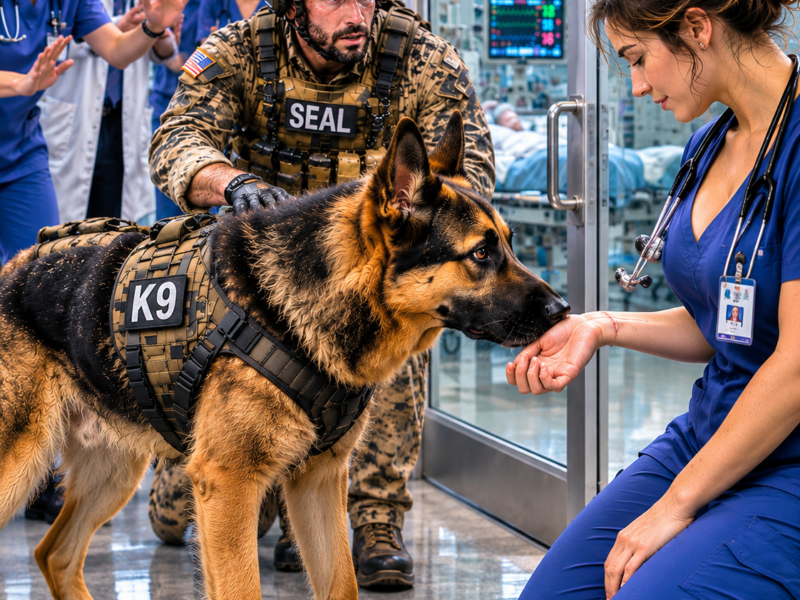
Atlas remained beside his bed, sitting upright with his eyes fixed on the doorway.
The moment I entered, his ears lifted.
He stood.
Then he walked toward me.
His handler tightened his grip on the leash.
“Atlas, stay.”
The dog ignored him.
He approached my left side and gently touched his nose against my wrist.
I closed my eyes for half a second.
“Easy, Six.”
The words escaped before I could stop them.
Atlas immediately stepped backward.
He turned in a small circle and lay down beside Reeves’s bed.
The handler stared at me.
“Six?”
I looked at him.
“It’s an old command.”
“That’s not part of his current handling protocol.”
“I know.”
The handler’s expression changed.
Colonel Brooks, standing near the doorway, had heard every word.
“Miss Carter,” he said, “I think we need to talk.”
“Not now, Colonel.”
“Then when?”
I looked toward Reeves.
His breathing had become irregular. The oxygen tubing had shifted slightly beneath the blanket.
I corrected it and raised the head of the bed.
“After he’s stable.”
Brooks studied me.
Then he nodded.
“Very well.”
I returned my attention to the patient.
A few seconds later, Reeves opened his eyes.
His gaze wandered across the room before finally settling on Atlas.
“Buddy…”
Atlas raised his head.
Reeves tried to lift his hand.
The dog moved closer and pressed his muzzle against the soldier’s fingers.
Then Reeves looked at me.
His expression changed.
At first, it was confusion.
Then recognition.
Finally, something resembling disbelief.
“You…”
I placed two fingers against his wrist.
“Don’t try to talk yet, Sergeant.”
His lips trembled.
“You came back.”
I froze.
The monitor continued beeping.
Atlas looked up at me.
Reeves swallowed painfully.
“Night… Mercy…”
I leaned closer.
“Save your strength.”
He tightened his fingers around my sleeve.
“You weren’t supposed to disappear.”
I gently released his hand.
And for the first time that morning, I couldn’t hide what I was feeling.
Colonel Brooks waited until Reeves had been stabilized before approaching me.
He carried a tablet with a black security banner across its screen.
“Night Mercy Nine,” he said.
I stared at the floor.
“That’s not a name I use anymore.”
“Apparently, it is still in military records.”
“Then the records should remain closed.”
Brooks lowered his voice.
“Emily, I have spent twenty years working with military personnel. I know what an ordinary medical background looks like. Yours doesn’t explain what happened in that room.”
I remained silent.
He continued.
“You knew how to approach a military working dog without challenging him. You recognized his stress signals. You used a command that isn’t in his current protocol. You anticipated the movements of a military evacuation team.”
He paused.
“And that soldier recognized you.”
I folded my arms.
“What do you want from me?”
“The truth.”
I looked at the tablet.
A photograph appeared on the screen.
It showed a younger version of me wearing a military medical uniform. My hair was shorter. My face was thinner. There was dust across my cheeks, and my left wrist was wrapped in a dark medical band.
Beside me stood Atlas.
He was younger too, but his eyes were unmistakable.
The photograph had been taken eight years earlier.
Brooks turned the tablet toward me.
“Former Tactical Medic, Night Mercy Nine. Emily Carter. Status: presumed lost.”
I stared at the screen.
“I wasn’t lost.”
“Then why did the report say you were?”
I took a slow breath.
“Because I asked them to leave my name out of the final report.”
Brooks looked surprised.
“Why?”
“Because the people who died deserved to be remembered for what happened to them. I didn’t want my survival to become another story about heroism.”
He studied me for a long moment.
Then he asked the question I had been avoiding.
“What happened during Night Mercy?”
I looked toward Atlas.
The dog was resting beside Reeves, his head on his paws.
And suddenly, I was eight years younger.
The operation had begun before sunrise.
Night Mercy Nine was a small medical extraction team assigned to recover wounded personnel from a remote forward position.
I was the team’s senior tactical medic.
Our job was simple in theory.
Reach the wounded.
Stabilize them.
Get everyone out.
But military operations rarely followed the plan.
The convoy had been struck before reaching the extraction point. Communications were failing, visibility was poor, and several soldiers were trapped inside a damaged structure.
Among them was a young Navy corpsman named Daniel Reeves.
He was barely twenty-three.
Atlas was assigned to our unit as a military working dog. His original handler had been injured during the first minutes of the operation, so I had taken temporary responsibility for him.
He was intelligent, stubborn, and exceptionally sensitive to changes in his surroundings.
He trusted very few people.
But he trusted me.
We had spent months training together.
I learned his signals.
He learned mine.
And when the operation went wrong, he became the only reason I found the final wounded soldier before the structure collapsed.
That soldier was Reeves.
I reached him just as another explosion shook the building.
He was bleeding heavily.
His breathing was shallow.
Atlas stood over him, barking at anyone who approached too quickly.
“Easy, Six,” I told him.
The dog immediately moved aside.
I treated Reeves as best I could.
Then I heard Danny Quinn over the radio.
Danny was our team leader.
He was also my closest friend.
“Carter, listen carefully,” he said.
His voice was broken by static.
“Extraction point is compromised. You have wounded personnel at your position. Get them out.”
“What about you?”
“I’ll hold the western route.”
“Danny, that’s not going to work.”
“That’s an order.”
I looked at Reeves.
Then at Atlas.
Then toward the damaged doorway.
We had seconds to decide.
Danny gave me one final instruction.
“Take the survivors. Do not come back for me.”
I hated him for saying it.
But I followed the order.
We evacuated the wounded.
Atlas stayed close to Reeves, refusing to leave his side.
By the time we reached the secondary extraction point, the radio had gone silent.
Danny was never recovered.
The official report later listed him as killed in action.
But the report also contained a discrepancy.
The evacuation beacon had supposedly been activated before the final extraction window.
It hadn’t.
I had heard Danny’s last transmission.
I knew the beacon was never activated.
And I knew that if the extraction team had received the correct information, they might have reached him in time.
I submitted a statement.
I asked for an investigation.
I was told the records were complete.
Then I was told to stop asking questions.
Weeks later, I requested reassignment.
I left the military medical unit.
Atlas was transferred to another handler.
And I changed my life.
I became Emily Carter, emergency nurse.
I told myself that I had done everything possible.
But some nights, I still heard Danny’s voice.
Take the survivors.
Do not come back for me.
Colonel Brooks listened without interrupting.
When I finished, he looked down at the tablet.
“Danny Quinn,” he said.
I nodded.
“He was my team leader.”
Brooks tapped the screen.
“His personnel file was closed eight years ago. But something happened last month.”
I looked up.
“What?”
“A records audit uncovered a discrepancy in the Night Mercy evacuation logs.”
My heart began beating faster.
“What kind of discrepancy?”
“The original beacon activation record was replaced after the operation. The timestamp doesn’t match the communications archive.”
I felt the room tilt slightly.
“Are you saying the record was changed?”
“I’m saying we have evidence that the official timeline may be inaccurate.”
I looked toward Reeves.
“Does he know?”
“Not yet. His statement may be important.”
Brooks lowered the tablet.
“And there’s something else.”
He opened a second file.
A photograph appeared.
It showed a damaged military radio unit.
The serial number was familiar.
I had carried that radio during the operation.
“Where did you get this?”
“Recovered from a storage facility during the audit.”
I stared at it.
Brooks continued.
“The radio contains a damaged memory module. Our technical team believes it may hold a fragment of the final transmission.”
My hands went cold.
“Have you listened to it?”
“Not yet. The recording is corrupted. But the technicians believe they can restore it.”
I turned away.
For eight years, I had tried to bury that night.
Now it was coming back.
The next hour passed slowly.
Reeves was moved to a monitored room, and Atlas remained beside him.
The military team arranged for a handler to accompany the dog.
But Atlas refused to leave the soldier’s bedside whenever I stepped away.
Colonel Brooks watched the interaction.
“He doesn’t behave this way with anyone else.”
I looked at the dog.
“He remembers.”
“Dogs remember more than people give them credit for.”
I nodded.
Then Brooks received a message.
He read it once.
His expression hardened.
“What is it?” I asked.
“The technical team recovered part of the radio transmission.”
I felt my throat tighten.
“What’s on it?”
“An incomplete message from Danny Quinn.”
I couldn’t move.
Brooks looked at me.
“They want you present when they play it.”
I shook my head.
“I don’t think I can.”
He didn’t pressure me.
Instead, he said something I hadn’t expected.
“Emily, you have spent eight years carrying a decision you made under fire. You deserve to know whether the people responsible for that decision told you the truth.”
I looked toward Reeves.
Then toward Atlas.
The dog lifted his head.
I slowly nodded.
“Play it.”
We gathered in a small conference room.
Colonel Brooks stood beside a communications officer. Dr. Cole remained near the doorway, having insisted that I should not leave the hospital without support.
A technician connected the recovered radio module to a laptop.
The first few seconds were nothing but static.
Then a voice emerged.
“Night Mercy… this is Quinn…”
I gripped the edge of the table.
The recording crackled.
“Carter, if you receive this, listen carefully.”
I stopped breathing.
It was Danny.
Older in memory, but unmistakable.
The same voice that had ordered me to leave.
The same voice I had heard in my nightmares.
“Do not come back for me. You have Reeves. You have the others. Get them out.”
Static swallowed the next few seconds.
Then his voice returned.
“One more thing. The beacon never activated. Repeat, the beacon never activated. Someone marked it active before we reached the extraction point.”
Colonel Brooks leaned closer to the laptop.
The recording continued.
“Carter, none of this is your fault. You hear me? None of it.”
My eyes filled with tears.
Danny took a breath.
“If they tell you the window was clear, they’re wrong. If they tell you I had support coming, they’re wrong. I made the decision to hold the route because the wounded needed time.”
A sharp burst of static interrupted him.
Then came the final words.
“Tell Reeves he did his job. Tell Atlas he was a good boy.”
The recording ended.
Nobody spoke.
I lowered my head.
For eight years, I had believed that my decision to leave Danny behind had been the last mistake of my life.
But he had known.
He had understood.
And he had wanted me to survive.
I covered my face with both hands.
Colonel Brooks waited.
Dr. Cole stepped closer but said nothing.
For the first time in years, I allowed myself to cry.
Not because I had discovered that I was innocent.
But because I finally heard the words I had needed to hear.
None of it was your fault.
The investigation continued over the following weeks.
The original evacuation records were reviewed alongside the recovered radio transmission.
Investigators confirmed that the beacon had not been activated at the time recorded in the official report. The discrepancy had resulted from a serious failure in the reporting process.
However, there was insufficient evidence to prove that anyone had deliberately altered the record to cause Danny’s death.
That answer wasn’t perfect.
It didn’t bring Danny back.
It didn’t erase the eight years I had spent blaming myself.
But it corrected the record.
Danny Quinn had made the decision to hold the route while the wounded were evacuated.
And Emily Carter had followed his final order.
The military formally amended the Night Mercy report.
Reeves was interviewed once he was strong enough to speak. His testimony confirmed the sequence of events and supported Danny’s final transmission.
He also requested that Atlas remain with him during his recovery.
The dog never left his side.
Except when I visited.
Then Atlas would stand, walk toward me, and gently rest his nose against my left wrist.
Every time.
Three weeks later, I visited the hospital’s rehabilitation garden.
Reeves was sitting in a wheelchair, his recovery progressing slowly. Atlas lay beside him, enjoying the afternoon sunlight.
Colonel Brooks stood near the garden entrance.
He held a small envelope.
“Your discharge from military service was voluntary,” he said. “Your record has now been corrected. The unit would like to acknowledge your contribution.”
I accepted the envelope.
Inside was a formal letter recognizing my service as a tactical medic during Night Mercy Nine.
There was also a photograph.
Danny stood in the middle of our team, smiling at the camera.
Atlas sat beside him.
I traced the edge of the photograph with my thumb.
“Thank you,” I whispered.
Brooks nodded.
“You know, there’s something I still don’t understand.”
I looked up.
“What?”
“How did you know Atlas would accept you?”
I glanced at the dog.
“I didn’t know.”
“Then why did you approach him?”
I thought about the question.
“Because everyone was trying to make him stop protecting Reeves. Nobody was asking why he felt he had to protect him in the first place.”
Brooks remained quiet.
“I wasn’t trying to control Atlas,” I continued. “I was trying to make the room feel safe enough for him to choose what to do.”
The colonel smiled faintly.
“That’s probably why he trusted you.”
I looked down at my wrist.
The faded mark was still there.
A reminder of a life I had once tried to forget.
But it no longer felt like a wound.
It felt like part of my story.
Several days later, Reeves was transferred to a rehabilitation facility.
Atlas was scheduled to return to military service after his handler completed the necessary evaluation.
But Reeves made a request.
He wanted Atlas to retire.
The medical team supported the recommendation. The dog had served for years, and after everything that had happened, he deserved a quieter life.
The military approved the retirement.
Reeves would recover.
Atlas would have a home.
And I would be the one to take him.
When the paperwork was completed, I stood outside the hospital entrance waiting for the transport vehicle.
The rear doors opened.
Atlas stepped down beside his handler.
For a moment, he simply looked around.
Then he saw me.
His ears lifted.
His tail moved once.
He trotted toward me with the same calm confidence he had shown in the trauma bay.
I knelt.
“Hello, Six.”
Atlas lowered his head and pressed his nose against my left wrist.
I smiled.
“It’s been a long time.”
His handler handed me the leash.
“He’s yours now.”
I looked toward the hospital.
Through the glass doors, I could see nurses moving between rooms. Dr. Cole was speaking to a family. Colonel Brooks stood near the reception desk.
Everything looked ordinary.
But nothing was quite the same.
I had returned to the past, faced the truth, and finally stopped punishing myself for surviving.
Atlas leaned gently against my shoulder.
I placed one hand between his ears.
“Come on,” I whispered. “Let’s go home.”
Months passed.
My life settled into a new rhythm.
Atlas became familiar with the neighborhood, the small park near my apartment, and the quiet mornings when I drank coffee beside the window.
He slept near the front door at night.
Sometimes, when distant sirens echoed through the streets, he would lift his head and listen.
I would place a hand against his shoulder.
“It’s okay, Six.”
He would settle again.
I still worked at the hospital.
Dr. Cole had become a different kind of physician. He listened more carefully, questioned assumptions, and never again dismissed a quiet observation simply because it came from someone who didn’t demand attention.
The nurse who had once laughed at my suggestion became one of the most patient members of the emergency team.
And the instrument cart in Trauma Bay Two?
Its wheel was repaired.
But the folded towel remained in the supply drawer.
A small reminder of the morning everything changed.
One afternoon, I received a letter from Reeves.
He had returned home and was beginning to walk without assistance.
He wrote that Atlas had saved his life twice.
Once on the battlefield.
And once in the hospital.
At the bottom of the page, he had added one sentence.
Tell Emily that Danny would have been proud.
I folded the letter carefully and placed it beside the photograph of Night Mercy Nine.
For the first time, I could look at that photograph without feeling the weight of everything we had lost.
I could remember Danny laughing.
I could remember Reeves surviving.
I could remember Atlas resting his head against my wrist.
And I could remember that I had done what I was supposed to do.
That evening, I took Atlas for a walk.
The sun was setting, and the neighborhood was quiet. He walked beside me without pulling on the leash, stopping occasionally to investigate the grass or watch a passing car.
When we reached the end of the street, he looked up at me.
I smiled.
“What is it, Six?”
He gently pressed his nose against my wrist.
I reached down and stroked his head.
For years, I had believed that silence meant something had been lost.
Now I understood that silence could also mean peace.
I had spent eight years trying to forget who I had been.
But perhaps I had never needed to forget.
I only needed to forgive myself.
Atlas leaned against my leg as the last sunlight disappeared beyond the rooftops.
And for the first time since Night Mercy Nine, I felt completely at home.
THE END.









