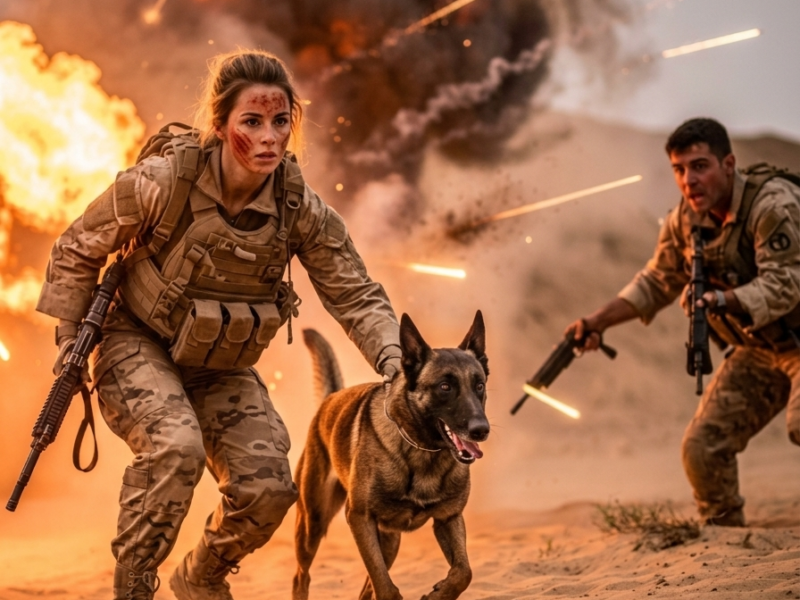
The first thing I heard on that moonless Afghan road was my K9’s low growl, but my team leader waved me forward and laughed it off—seconds later
The desert night in Kandahar Province did not just lack light; it possessed a physical, suffocating weight. A moonless sky hung overhead like a sheet of black canvas, absorbing the dim glow of our Humvee’s tactical dashboard lights. My hands were clammy against the worn leather of my rifle’s handguard. Beside me, sitting rigid in the passenger well of our lead vehicle, was Ranger, a four-year-old Belgian Malinois whose instincts had saved my life more times than I cared to count.
We had been on patrol for nineteen straight hours, clearing supply routes along a stretch of dirt road known simply as Route Iron. Exhaustion was a heavy blanket pulling down on every soldier’s eyelids. But Ranger was not tired. The first indication that something was fundamentally wrong was not a visual cue or a thermal signature on our night-vision optics. It was a sound—a low, rhythmic rumble vibrating deep within Ranger’s chest.
He froze, his ears pointing straight toward a dry stone wall bordering an abandoned pomegranate orchard thirty yards out.
I leaned down, pressing my helmet against his neck. “What is it, boy?” I whispered, my voice barely audible over the low diesel idle of the Humvee.
Ranger growled again, his lips curling back to expose white teeth in the gloom. The hair along his spine stood up in a sharp, rigid ridge.
Our convoy came to a halt. The pause lasted barely three seconds before Sergeant Cole, our squad leader sitting in the command seat, leaned back toward me. His face was smeared with dust and sweat, his eyes bloodshot from lack of sleep.
“Keep moving, Davis,” Cole ordered, his voice clipped and dry. “It’s just a stray dog or a jackal behind the rocks. We’re thirty minutes from the FOB.”
“He’s locked on something, Sarge,” I argued, my thumb instinctively sliding the safety selector on my M4 from Safe to Semi. “Ranger doesn’t growl at jackals. You know that.”
“We’ve been awake for twenty hours, Davis,” Cole snapped, shaking his head. “Every shadow looks like an insurgent after enough time in the field. Drive.”
I wanted to push back harder, but fatigue makes men doubt their own instincts. I tugged gently on Ranger’s tactical harness, trying to command him to drop back down into the footwell. He refused to budge. He planted all four paws firmly against the floorboards, straining against his leash, his gaze locked onto the dark line of stones outside.
That was when the unnatural nature of the environment hit me like a physical blow.
Normally, the Afghan night was filled with ambient sound—crickets chirping in the irrigation ditches, the distant howling of feral dogs, the soft rustle of dry wind blowing through the scrub brush. Now, there was nothing. No insects. No wind. No distant voices. Just a total, absolute silence that seemed to press inward against the vehicle’s armored glass.
I raised my left hand, signaling the driver to hold. “Wait.”
Cole let out a heavy sigh of frustration. “Davis, we don’t have time for this paranoia—”
Before Cole could finish his sentence, Ranger lunged. He didn’t jump out, but he pulled heavily toward the open window frame, his head jutting toward the stone wall. I leaned forward, straining my eyes through the green-hued lens of my night-vision goggles, following the precise line of the dog’s stare.
At the base of the wall, almost completely hidden beneath a pile of loose shale and gravel, I caught a glint of something unnatural. A thin, black copper wire stretched across the dirt, disappearing directly beneath the rocks beneath our front tires.
My stomach dropped into a cold, hollow abyss.
“Stop the vehicle! Back up now!” I roared.
Nobody had time to move.
The night exploded.
A blinding flash of orange and white light tore through the darkness, followed immediately by a concussive roar that shattered the air pressure inside my lungs. The blast originated from under the second Humvee in our line, barely fifteen yards behind us. The immense force lifted the multi-ton armored vehicle off the ground like a toy, flipping it onto its side in a shower of sparks, twisted metal, and burning dirt.
The shockwave hit our vehicle a fraction of a second later, blowing out our side mirrors and showering us in debris. The world went completely black as thick, acrid smoke swallowed everything. My ears were ringing with a deafening, high-pitched whine, cutting off the frantic screams that erupted from behind us.
I was thrown into the footwell, my shoulder slamming violently against the transmission tunnel. Coughing through the dust and the sharp smell of burnt ammonium nitrate, I reached out blindly into the dark.
“Ranger!” I choked out. “Ranger!”
I crawled out of the side door on my hands and knees, dragging my rifle through the dirt. Smoke hung so thick in the air that my night-vision goggles were useless, rendering the world in a blur of noisy green light. I ripped them off my helmet and used my flashlight.
Ten yards away, standing near the burning wreckage of the second vehicle, was Ranger. Blood was dripping from a shrapnel cut on his front left paw, but he was standing upright, his eyes wide and clear. He didn’t whimper. He didn’t look at his wound. He turned his head and looked at me once—a brief, steady glance that communicated complete clarity.
Then he turned back toward the stone wall.
Another growl, darker and more urgent than before, cut through the sounds of crackling flames and shouting soldiers.
I scrambled to my feet, my chest heaving, and ran to his side. “Where is it?”
Ranger moved forward step by step, ignoring the burning debris falling around us. He stopped three feet from a second pile of broken stones. I dropped to my knees and swept the dirt away with my tactical gloved hands.
My heart halted in my chest.
It was a second improvised explosive device—a daisy-chained command-detonated bomb made from two sixty-pound artillery shells. It was positioned mere feet from where our lead Humvee had halted. It was bigger than the one that had just detonated. It was closer. And it was still completely intact, its arming wire running further up the hill into the shadows.
Sergeant Cole stumbled up behind us, holding a bleeding gash on his forehead, his face pale as chalk under the firelight. He stared down at the unexploded shells, then at the wire, and finally at my dog.
“How…” Cole’s voice trembled uncontrollably. “How did he know? The main charge was buried two feet deep.”
I looked down at Ranger. His body was trembling from the adrenaline coursing through his veins, but his eyes were entirely free of fear. He wasn’t just smelling explosives; he was tracking a human presence. He was listening to something subtle, something moving through the terrain that human ears could never pick up.
Without warning, Ranger spun on his hind legs and bolted across the dirt road, charging directly toward a half-collapsed mud-brick farmhouse standing isolated in the field across from us.
“Ranger, heel!” I shouted, sprinting after him into the dark. “Cole, cover me!”
Ranger didn’t stop. He smashed through the rotten wooden framing of the farmhouse door and disappeared into the pitch-black interior. I burst through the entrance seconds later, weapon raised, the beam of my tactical light cutting through clouds of ancient dust.
The interior of the house was cool and smelled of dry earth and old copper. It was devoid of furniture, but the floor was covered in hundreds of loose sheets of paper and printed photos.
I lowered my beam to the ground. They were military surveillance photographs.
I stepped forward, my boots crushing small pieces of glass. I picked up one photograph. It was a high-resolution, long-range photo of our entire patrol leaving the Forward Operating Base four hours ago. I picked up another. It was a close-up photo of Ranger, taken through a powerful telephoto lens while he was eating at his kennel inside our camp.
My breath hitched in my throat. My hands began to shake as I pulled up a third photograph from the pile.
It was a picture of me. I was sitting on a sandbag wall, smiling, holding a cup of coffee, completely unaware that a camera was focused on my face.
I flipped the photo over. On the back, written in thick, dark blue ink in precise English, was a single handwritten line:
THE DOG WAS NEVER THE TARGET.
My blood went completely cold, a chill racing down my spine that made the desert heat vanish in an instant.
Behind me, the doorway creaked. Sergeant Cole stepped into the room, holding his side, his pistol drawn. “Davis… what is this place? What did you find?”
I didn’t answer. I couldn’t. I held up the photograph with trembling fingers. Cole stepped closer, his eyes scanning the writing on the back. His face drained of what little color it had left.
“Davis…” Cole whispered, his voice cracking. “Look at him.”
I turned slowly.
Ranger had walked past the scattered photos and was standing at the far end of the room, positioned directly in front of a heavy, iron-reinforced wooden door set deep into the rear mud wall.
He didn’t bark. He had dropped into a low, crouching stance, his head lowered level with his shoulders.
From the other side of the heavy wooden door, a sound emerged.
Scratch.
It was a soft, deliberate metal scrape against wood.
Then it happened again.
Scratch.
Ranger lowered his ears and let out a sound I had never heard him make in four years of combat. It wasn’t a warning to an unseen enemy in the dark outside. It was an unmistakable, terrified growl—a reaction to a threat that had already planned for our arrival, knew our names, and was waiting right behind that door.
The air inside the small room felt instantly pressurized, as if the oxygen was being sucked through the cracks of the wooden door. I leveled my rifle at the center of the heavy iron frame, my index finger resting flat against the trigger. My heart hammered against my ribs like a trapped bird.
“Cole, get back,” I muttered without taking my eyes off the door.
“We need to fall back to the convoy, Davis,” Cole whispered frantically, stepping backward toward the broken front entrance. “We’ve got wounded out there on the road. The second vehicle is turned over. We don’t know how many insurgents are surrounding this place.”
“Read the back of that photo again, Sarge,” I said, my voice dropping into a dangerous, icy tone. “They didn’t set that IED to kill the convoy. They set it to stop us right in front of this house. They knew we’d come inside.”
Ranger took one step forward, his claws digging into the dry mud floor. His growl shifted from a low vibration to a harsh, resonant warning. The metallic scratching sound behind the door ceased instantly.
For five agonizing seconds, nothing moved. The room was dead silent save for the crackle of distant flames outside and the heavy breathing of two terrified men and a war dog.
Then, a voice came from behind the door.
It was not shouted in Pashto or Dari. It was spoken in clear, measured, accentless English—a quiet, cultured voice that sounded almost warm.
“You should listen to your sergeant, Corporal Davis,” the voice said. “He understands tactical reality. You, on the other hand, rely too much on the animal.”
Cole froze in his tracks. “Who the hell is that?”
I kept my aim fixed on the door handle. “Show your hands and open the door slowly! Move now!”
A low, soft laugh echoed from behind the wood. “If I open this door, Corporal, your dog will die. And frankly, I find him far too valuable to destroy. He is a magnificent specimen. Highly trained, exceptionally perceptive. It’s a pity his handler lacks his foresight.”
Ranger suddenly snapped his jaws together, a wet spray of saliva flying from his mouth as he barked once—a deafening explosion of sound in the small room. He stepped closer to the iron latch, his snout inches from the gap.
“What do you want?” I demanded, sweat dripping into my eyes, burning them.
“I wanted to see if the rumors about military working dog M-842 were accurate,” the voice replied smoothly. “They say he has a ninety-eight percent detection rate for concealed explosives. They say he saved a platoon in Helmand by detecting a pressure plate through two feet of wet mud. But I was curious… can he detect a betrayal?”
Cole’s head snapped toward me. “What is he talking about?”
“Shut up, Cole,” I snapped.
“I’m serious, Davis! Who is this guy? Is this an ambush?” Cole raised his rifle toward the door as well, his hands shaking so violently the barrel wobbled in small circles. “We need to clear this room or throw a grenade through the latch!”
“No grenades!” I shouted. “The whole structure is mud brick! You’ll bring the ceiling down on us!”
“Listen carefully, Corporal,” the voice behind the door continued, unbothered by our panic. “The charge outside was merely an invitation. Your team leader knows why you were routed down Route Iron tonight. Ask him why the primary route was cleared of drone coverage twenty minutes before you departed.”
I felt a sudden, sickening drop in my chest. I glanced sideways at Cole. The sergeant’s face had gone from pale to utterly ghostly. His eyes darted toward the front door, avoiding my gaze entirely.
“Cole?” I whispered. “What is he talking about? Route Iron was picked by Battalion Headquarters.”
“He’s playing mind games with you, Davis!” Cole yelled, his voice rising into a panicked strain. “He’s trying to stall us until his fighters flank the building! We need to pull out right now!”
Cole didn’t wait for my response. He turned and sprinted back through the front entrance toward the burning Humvee outside.
“Cole, wait!” I called out.
The moment Cole stepped outside into the moonlight, a single, sharp rifle shot echoed across the valley.
SNAP.
It was the distinct, high-velocity crack of a specialized sniper rifle. Outside, Cole let out a short, choked gasp and collapsed heavily onto the dirt road.
“Cole!” I screamed.
I made a split-second decision. I couldn’t reach Cole without exposing myself to the sniper’s line of sight, and the man behind the wooden door was still inches away. Before I could make a move, Ranger lunged.
With incredible power, the 80-pound Malinois threw his entire bodyweight against the heavy wooden door. The rotten wooden frame cracked under the force. Ranger hit it a second time, his shoulder slamming into the central panel. The lock sheared off with a screech of torn iron, and the door swung wide open into the darkness beyond.
“Ranger, NO!” I yelled, dropping my shoulder and charging in behind him, light ablaze.
The light swept across the small, subterranean chamber behind the door. It was an old escape tunnel, dropping five feet down into a hand-dug trench that ran beneath the perimeter wall of the compound.
The room was empty.
There was no gunman. No insurgent. No sniper.
Instead, resting on a small folding table in the center of the subterranean room, was an encrypted military tactical radio—the exact same model used by our own platoon leadership. Beside the radio was a small speaker, connected to a digital voice modulator that was still pulsing with a faint green LED light.
The voice had been pre-recorded and transmitted remotely from somewhere else entirely.
Ranger dropped his nose to the earthen floor, sniffing frantically around the legs of the table. He picked up a scent, let out a short whine, and looked down the long, dark tunnel that stretched away into the deep subterranean darkness.
I stepped up to the table, my heart hammering against my sternum. Sitting beside the radio was another photograph.
I picked it up with a gloved hand.
This photo was different. It wasn’t taken from a distance. It was a close-up picture of a military dossier file, stamped with a bright red classification seal: DIRECTORATE OF SPECIAL INVESTIGATIONS — OPERATION BLACKTHORN.
Beneath the stamp was a list of four names.
The first name was crossed out with a thick red line: Staff Sergeant Marcus Vance (Killed in Action – Helmand).
The second name was crossed out: Lieutenant Thomas Reed (Killed in Action – Kabul).
The third name was crossed out: Sergeant First Class David Cole (Wounded in Action – Route Iron).
And the fourth name on the list, uncrossed and highlighted in yellow marker, was mine: Corporal Aaron Davis (Handler – MWD Ranger).
Underneath my name was a short handwritten note:
The dog wasn’t trained to find bombs, Aaron. He was trained to find us. And now he has led you right to the end of the line.
A cold sweat broke out across my forehead. The victims weren’t random soldiers caught in insurgent ambushes. Everyone on that list had been part of a specialized MWD tracking unit assigned to a classified intelligence operation three years ago in the mountains of Tora Bora. An operation where three million dollars in seized foreign currency had vanished without a trace.
Suddenly, from deep inside the tunnel ahead of us, a faint metallic sound echoed.
Clack.
It was the sound of a night-vision mount being clipped into a tactical helmet.
Ranger immediately took a rigid stance at the edge of the tunnel drop-off, his back hair bristling, his eyes locked on the pitch-black corridor ahead.
“Aaron…” a voice called out from the dark of the tunnel.
It wasn’t a recording this time. It was real. It came from thirty yards inside the subterranean passage, muffled by the dirt walls, but completely human.
“You always were too smart for your own good,” the voice said, heavy with tired resignation. “You should have stayed in the Humvee, kid.”
I recognized that voice instantly. My hand froze on the grip of my rifle.
It was the voice of Captain Richard Harris—our company commander, the man who had ordered our patrol onto Route Iron two hours ago.
The stench of damp earth and old gunpowder pulled thick through the subterranean passage. My mind struggled to process the reality standing thirty yards down that narrow dirt vein. Captain Harris—a decorated officer, a man who had pinned my handler wings to my uniform two years ago—was standing in the dark, calling my name.
“Captain?” My voice sounded strange to my own ears, thin and hollow against the earthen walls. “What is this? What happened to Cole?”
“Cole was a loose end, Aaron,” Harris’s voice drifted back, terrifyingly calm, as if he were giving a morning briefing in the FOB tactical operations center. “He panicked three years ago in the cave complex at Tora Bora, and he’s been panicking ever since. He started talking to Army CID last month. He thought he could trade a confession for immunity.”
Ranger didn’t care about confessions. He took two slow, calculated steps down the steep slope of the tunnel, his claws leaving deep impressions in the soft dirt. His growl had settled into a steady, vibrating pitch that rattled in his throat.
“Stay beside me, Ranger,” I commanded softly, dropping a hand to grip the heavy nylon loop on his harness. He stayed, but his body was as tight as a coiled steel spring.
“You don’t understand how this works, Corporal,” Harris continued from the shadows. “That three million dollars didn’t belong to the Taliban, and it didn’t belong to the US government. It was off-the-books intelligence funding meant for regional warlords who turned on us the second the wind shifted. We didn’t steal it. We recycled it.”
“You killed Vance,” I said, my teeth grinding together as pieces of a three-year-old puzzle fell into place with sickening clarity. “Vance didn’t die from a stray mortar in Helmand. You put a bullet in his back.”
“Vance grew a conscience,” Harris replied coldly. “Consciences are dangerous things in this country, Aaron. They get people killed. Just like Lieutenant Reed in Kabul. They couldn’t let it go. They kept keeping logs, keeping evidence, tracking the financial transfers. And they used you and your dog to do it.”
I frowned, pulling Ranger slightly closer to my hip. “What are you talking about?”
“Why do you think Ranger was assigned to your unit?” Harris laughed, a dry, bitter sound that echoed down the tunnel. “You think it was random luck? M-842 wasn’t just trained for C-4 and ammonium nitrate. Before he was transferred to conventional infantry support, he was part of a specialized counter-trafficking MWD unit. He was imprinted on the specific chemical scent markers used by the Department of the Treasury to track covert currency shipments. High-grade polymer inks and specialized security strip adhesives.”
My breath caught.
Memory flared in my mind: six months ago, during a routine search of the command headquarters compound, Ranger had broken away from my side and aggressively alerted on a heavy metal sea-crate stored behind Captain Harris’s private quarters. At the time, I had assumed it was a false alert caused by spent shell casings or oil drums. I had scolded him, pulled him away, and logged it as an operational error.
It hadn’t been an error. Ranger had smelled the missing millions.
“He found the money in my quarters, didn’t he?” Harris said, reading my silence. “I watched you pull him away that day. I saw the look on your face. You didn’t realize what he was telling you then, but I knew it was only a matter of time before you put it together. That’s why I had to bring you out here tonight.”
“You set up the entire patrol,” I whispered, disgust rising in my throat like bile. “You blew up our Humvee. You sacrificed four soldiers just to put me and Ranger in a pit!”
“I offered Cole a way out,” Harris said softly. “He was supposed to lead you into this farmhouse alone. You were supposed to be killed by an ‘insurgent command-detonated device’ inside the building. Simple. Clean. Another tragedy on Route Iron. But your dog ruined the timing. He found the secondary charge outside before Cole could position you.”
“He’s smarter than you’ll ever be, Captain,” I snarled, raising my M4 and aligning the red-dot sight with the center of the dark corridor. “It’s over. Turn yourself in. The convoy radio is still working out on the road. The rest of the squad will be here in minutes.”
“There is no rest of the squad, Aaron,” Harris said flatly. “I routed the secondary quick-reaction force three miles south on a false contact report. Nobody is coming to help you. It’s just you, me, and that damn dog.”
Suddenly, the dim light coming from the entrance behind me flickered and vanished.
A heavy steel door at the top of the subterranean chamber slammed shut with a deafening metallic CLANG, followed instantly by the sharp sound of a heavy crossbar sliding into place from the outside.
We were locked in the dark.
Total darkness swept over us, absolute and impenetrable. I immediately flipped down my night-vision goggles, but a harsh burst of white light flared through the tube, blinding me instantly. Harris had activated a thermal flare at the far end of the tunnel, washing out my optics with overwhelming infrared radiation.
I ripped the goggles off my face, plunging back into blackness.
“Ranger, strike!” I roared.
I didn’t need to see. Ranger didn’t need light.
The Belgian Malinois unleashed a furious, blood-curdling bark and launched himself down the pitch-black tunnel like a kinetic missile. I heard his powerful paws tearing into the loose dirt, the sound of his breath ragged and intense as he charged toward the source of the scent.
“Get off me!” Harris’s panicked scream echoed through the tight space, followed instantly by the deafening crack of a sidearm firing in an enclosed space.
BANG! BANG!
The muzzle flashes illuminated the tunnel for micro-seconds like strobe lights. In those flashes of fire, I saw the horrifying tableau: Captain Harris pressed against the dirt wall, his tactical flashlight dropped on the ground, frantically trying to aim a heavy SIG Sauer pistol down at eighty pounds of furious fur and teeth that had slammed directly into his chest.
Ranger’s jaws locked onto Harris’s right forearm, the crushing force of his bite shearing through tactical fabric and flesh. Harris screamed in agony, dropping the pistol onto the dirt floor as both men and dog tumbled hard to the ground.
“Ranger, HOLD!” I screamed, sprinting down the corridor with my flashlight sweeping the floor.
I reached them in three seconds. Harris was on his back, beating wildly at Ranger’s head with his free left hand, but the dog held his bite with iron determination, his eyes locked on the officer’s face, a low, terrifying growl shaking his entire body.
I planted my boot squarely on Harris’s chest, leaning all my weight onto his sternum until he gasped for air, and pointed the muzzle of my M4 directly between his eyes.
“Move again and I’ll end it right here!” I yelled, my finger taking up the slack on the trigger.
Harris froze, his breathing coming in ragged, painful hitches. Blood pooled beneath his arm where Ranger’s teeth remained sunk deep into his muscle.
“Out, Ranger! Out!” I commanded.
Ranger released his grip instantly, stepping back two paces, his chest heaving, his mouth stained red, but his eyes never leaving the defeated captain for a fraction of a second.
“Get up,” I growled, kicking Harris’s dropped pistol down the tunnel into the deep shadows. “Get on your knees and put your hands behind your head.”
Harris groaned, rolling onto his knees with agonizing slowness, clutching his mangled right arm to his ribs. “You think… you think you won something here, Davis?” he wheezed, spit and dirt smeared across his face. “You think you can just walk back to the base with me in cuffs?”
“That’s exactly what I’m going to do,” I said, pulling a pair of heavy-duty plastic zip-cuffs from my tactical vest.
“Look down the tunnel, Aaron,” Harris whispered, a sickening, bloody smile breaking across his pale lips in the beam of my torch. “Look at the table behind me.”
I swept my flashlight beam past Harris’s head, illuminating the far end of the subterranean passage where the tunnel opened into a second, larger storage cavern.
Sitting in the middle of that cavern was an olive-drab military crate. Its lid was propped open, exposing stacks of banded hundred-dollar bills.
And strapped directly to the inside lid of the crate was a commercial demolition charge wired to a digital timer counting down from sixty seconds.
00:48… 00:47… 00:46…
“I told you,” Harris wheezed, laughing weakly through the pain. “The dog was never the target. Neither were you. The target was the evidence. And this whole place is rigged to burn.”
The red LED numbers on the digital timer ticked downward with cold, mechanical precision.
00:42… 00:41… 00:40…
The charge wasn’t just a simple block of C-4. Wired alongside the high explosive were four two-gallon military jerrycans filled with racing fuel, designed to turn the subterranean cavern into a roaring thermobaric furnace that would cremate everything—the money, the documents, and anyone trapped inside—leaving nothing behind but ash and melted alloy.
“You’re insane,” I breathed, my eyes darting frantically around the cavern walls looking for an exit. “You set a suicide trigger?”
“It’s not suicide if you have the key to the back door, Corporal,” Harris gasped, dragging himself backward against the mud wall, pointing with a blood-soaked finger toward a narrow vertical shaft cut into the rear ceiling of the cavern, twenty feet behind the explosive crate. A rusted iron ladder ran up the center of the shaft, leading to the surface. “That shaft leads out to the dry wash behind the compound. But you’ll never make it up that ladder in forty seconds while dragging me.”
Ranger let out a sharp, urgent bark, turning his head toward the iron ladder, then looking back at me, his tail stiff, his ears pinned back. He could smell the volatile fuel fumes filling the heavy underground air.
“Get up!” I grabbed Harris by his tactical vest, hauling him to his feet with a surge of adrenaline-fueled strength. “You’re climbing first!”
“I can’t climb with this arm!” Harris screamed, wincing in agony as his mangled right arm hung limp at his side. “Leave the money, Aaron! Leave me! Save yourself and your damn dog!”
00:31… 00:30… 00:29…
“Nobody dies down here today,” I gritted through my teeth.
I shoved Harris toward the base of the vertical shaft. “Use your left hand! Put your feet on the rungs and push! If you stop, I shoot you myself!”
Terrified by the ticking clock and the barrel of my rifle pressed into his lower back, Harris scrambled onto the rusted iron rungs, hauling his dead weight up the narrow vertical tunnel using only his left arm and legs. He groaned with every inch, blood dripping from his arm down onto my helmet and chest as I climbed directly beneath him, pushing his hips up with my left hand while holding my rifle in my right.
“Ranger! Up!” I yelled down into the dark.
Ranger didn’t hesitate. Belgian Malinois aren’t built for vertical ladders, but Ranger’s survival instinct was extraordinary. He leaped onto a ledge of exposed shale near the base of the shaft, used his powerful hind legs to launch himself onto a wooden support timber four feet up, and began scrambling up the uneven mud walls of the narrow shaft right behind us, his claws tearing into the packed dirt for traction.
00:18… 00:17… 00:16…
The air in the shaft was growing choked and hot as the chemical timer began to hum, activating the electronic detonator cap below. The smell of aerosolized gasoline drifted up from the cavern floor like a poisonous wave.
“Faster, Harris! Move!” I roared, slamming my palm into his shoulder to push him higher.
“I’m at the top! It’s blocked!” Harris cried out in panic from above me.
My heart nearly stopped. “What do you mean it’s blocked?!”
“There’s a steel grate over the opening! It’s locked from the outside!”
I pushed past Harris, squeezing my body into the tight space beside him near the top of the shaft. Five inches above our heads was a heavy steel rebar storm grate set into a concrete collar, securing the exit shaft against animal intrusion. Through the metal bars, I could see the cold, clear brilliance of the stars in the Afghan night sky.
I jammed the muzzle of my M4 through the rebar grate, aiming directly at the heavy brass padlock holding the locking latch together.
00:08… 00:07… 00:06…
“Cover your eyes!” I screamed.
I pulled the trigger, firing three rapid shots directly into the padlock body at point-blank range.
BANG! BANG! BANG!
Sparks erupted in the tight vertical tube, blinding us temporarily and filling the confined space with a deafening ring. The brass casing of the lock shattered under the impact of the 5.56mm rounds, the locking mechanism shearing away.
I slammed my shoulder upward against the iron grate with all the force my legs could muster. The rusted steel swung open, slamming back against the dirt surface outside.
“GO! GO! GO!”
I grabbed Harris by his collar and threw him out onto the open ground above. I reached back down into the dark shaft where Ranger was struggling to find footing on the slippery dirt walls three feet below the rim.
“Ranger, UP!”
I reached down with both arms, gripping the chest harness of his tactical vest just as his front paws caught the edge of the concrete collar. I hauled his eighty-pound frame up and out into the cool desert night air, tumbling backward onto the sand beside him.
00:01… 00:00…
A fraction of a second later, the ground beneath us heaved.
A deep, hollow thrum vibrated through the earth, followed instantly by a muffled subterranean roar that shook the desert floor for fifty yards in every direction. A violent jet of orange flame and black smoke erupted out of the vertical shaft like the exhaust of a rocket engine, blowing dirt and small rocks fifty feet into the sky.
The roof of the subterranean cavern collapsed inward with a sickening crunch of tearing earth, swallowing the entire compound into a forty-foot crater of settling dust and raging fire.
The explosive charge, the paper evidence, the missing currency, and the tunnel system were completely obliterated in a single catastrophic wave of heat.
I lay on my back in the cool dirt, gasping for air, my lungs burning, my entire body trembling from exhaustion.Beside me, Ranger collapsed onto his side, his pink tongue lolling out of his mouth, his wet nose coated in grey dust, his sides heaving in rhythm with mine. He turned his head slowly and pressed his cool, wet snout directly against my cheek.
I reached out with a shaking hand and buried my fingers in the thick fur at his neck. “Good boy, Ranger,” I whispered, my voice breaking. “Good boy.”
Twenty yards away, Captain Harris lay in the dirt, clutching his ruined arm, watching the burning crater consume every trace of his three-year cover-up.
Far down Route Iron, the faint, rising whine of heavy diesel engines cut through the quiet night air. Bright halogen headlights rounded the bend two miles out.
The main convoy had finally arrived.
The morning sun rose over the jagged peaks of the Hindu Kush, casting long, crimson shadows across the concrete airfield at Bagram Air Base. The crisp mountain air carried the smell of jet fuel and dry dust.
A C-17 Globemaster military transport aircraft sat on the tarmac, its massive rear cargo ramp lowered to the ground. Auxiliary power units hummed steadily nearby, creating a low, comforting background drone.
I stood near the edge of the flight line, dressed in my clean dress uniform, holding a canvas duffel bag over my left shoulder. Beside me, sitting attentive and proud on the asphalt, was Ranger. His front left paw was neatly wrapped in a pristine white medical bandage, but his head was held high, his ears pointed forward, watching the flight crew load pallets of equipment onto the transport.
A sleek black civilian SUV pulled up near the tail of the C-17. The door opened, and a tall man in a tailored grey suit stepped out, holding a thick leather briefcase. He walked slowly across the tarmac toward us, his polished shoes clicking against the concrete.
It was Agent Miller from the Department of Defense Inspector General’s office—the lead investigator assigned to the corruption case following the events on Route Iron three weeks ago.
“Corporal Davis,” Miller said, halting three feet away and offering a short, respectful nod. “Or should I say, former Corporal Davis.”
“Just Aaron now, sir,” I replied, adjusting the strap on my duffel bag.
“The final report came through from Washington this morning,” Miller said, opening his briefcase and pulling out a sheaf of stamped official documents. “Captain Harris has been formally charged under the Uniform Code of Military Justice with treason, grand larceny, and three counts of premeditated murder. He’s being transferred to the military brig at Leavenworth tomorrow morning. He won’t see the outside of a fence for the rest of his natural life.”
I looked down at Ranger. The dog turned his head up to look at me, his deep brown eyes completely calm.
“And Sergeant Cole?” I asked quietly.
“Cole survived the sniper round,” Miller answered, closing the briefcase with a sharp click. “It hit his shoulder plate. He’s in stable condition at the regional medical center in Germany. He’s signed a full confession detailing the entire operation at Tora Bora. His testimony cleared both you and Sergeant Vance’s family of any wrongdoing.”
I let out a long, slow breath that felt like releasing three years of accumulated weight from my chest. “Thank you, sir.”
“No, Aaron,” Miller said, his tone softening as he stepped closer and looked down at the Belgian Malinois sitting at my side. “Thank you. And thank him. If M-842 hadn’t alerted on that secondary charge and trailed Harris into that subterranean network, that money would have funded private military contractors and rogue insurgent networks for the next decade. The Pentagon owes this dog a debt it can never repay.”
Miller reached into his suit jacket pocket and pulled out an official military envelope stamped with the official seal of the United States Army Medical Department and the Military Working Dog Program. He handed it to me.
I opened the flap and pulled out the document inside.
It was an official Certificate of Early Medical Retirement and Discharge for Military Working Dog M-842, serial number 842-Alpha. Attached to the back of the certificate was an official adoption approval form, signed by the Commander of the United States Army Forces Command.
Adoption Applicant: Aaron Davis.
Status: APPROVED.
“He’s officially off the books, Aaron,” Miller said with a faint, genuine smile. “He’s no longer government property. He’s just your dog now.”
A lump formed in my throat. I folded the paper carefully and placed it into my inner jacket pocket. I knelt down on the hard asphalt, reaching out with both hands to frame Ranger’s face. He let out a soft, happy huff, leaning his heavy head directly into my chest, his tail thumping rhythmically against the tarmac.
“Ready to go home, boy?” I whispered into his ear.
Ranger stood up immediately, shaking his entire body until his tactical collar jingled like small bells.
We turned and walked up the long steel ramp into the dark belly of the C-17 transport plane. The loadmaster ushered us toward a row of webbing seats along the fuselage wall. I sat down and buckled my harness, and Ranger immediately climbed up, resting his massive head across my lap, his heavy paws tucked neatly beneath his chest.
The giant jet engines roared to life, shaking the metal floorboards beneath us as the C-17 taxiing toward the main runway. Through the small circular window across from my seat, I watched the dusty mountains of Afghanistan slowly retreat as the aircraft lifted into the bright, clear blue sky.
For four years, every sound in the night had meant danger. Every shadow had hidden a threat. Every growl from the magnificent animal beside me had meant a fight for survival.
Now, as the aircraft climbed higher into the clouds heading west toward home, Ranger let out a long, contented sigh, closed his eyes, and drifted into a deep, peaceful sleep on my lap.
There were no growls left in the dark. Only silence. And for the first time in my life, that silence meant we were finally safe.
The end.









