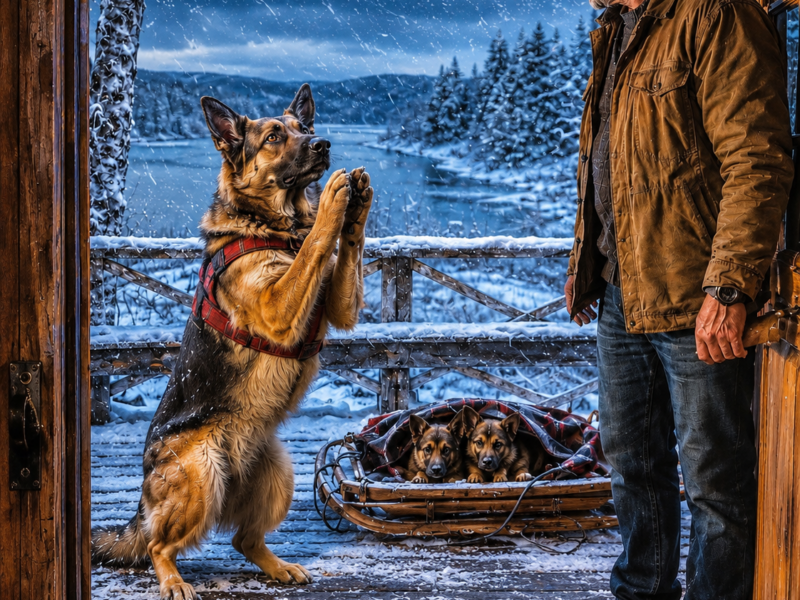
The first thing Emmett Rain noticed was that the German Shepherd wasn’t asking him to save her.
Three weeks after the storm, Emmett Rain’s cabin no longer looked like a place where one man lived alone.
A wooden box lined with clean towels sat beside the stove. A small metal scale occupied the corner of his workbench. Feeding schedules and veterinary instructions covered the wall above it.
Two additional mugs stood beside the sink.
And three German Shepherds had somehow taken control of the warmest part of the cabin.
Ceda had recovered remarkably well. Her black-and-gold coat was beginning to shine again, and the trembling in her legs had disappeared. She still watched the puppies whenever they moved, but she no longer panicked when Emmett picked them up.
The stronger puppy had become an energetic little troublemaker.
Emmett named him Rivet because he clamped his tiny mouth onto anything he could reach and refused to let go.
The smaller female was quieter. Her breathing had improved, and she was gaining weight, but she remained noticeably smaller than her brother.
Emmett named her Micah.
Every morning, he weighed both puppies and recorded their progress.
Every evening, he checked their breathing before going to bed.
He told himself it was simply a responsibility.
He didn’t ask himself why he had started looking forward to waking up.
Dr. Meera Landon visited almost daily.
One morning, she found Emmett sitting on the floor with Rivet asleep on his boot.
“You know,” she said, examining Micah, “most people buy a dog bed.”
“I have one.”
“Then why is the puppy sleeping on your foot?”
“He chose it.”
“Clearly, you have no authority in this house.”
Emmett glanced down at Rivet.
The puppy stretched, yawned, and returned to sleep.
For a moment, Emmett laughed.
It was a small, rough sound, but Meera noticed it.
She didn’t comment.
She understood that some people needed time to become comfortable with happiness.
That afternoon, a brown utility truck appeared through the trees.
The driver was Cyrus Ren, a seventy-two-year-old retired carpenter who had known the Bryce family for decades.
He carried dog food, roofing materials, and a waterproof black ledger.
Ceda recognized him immediately.
She hurried onto the porch and pressed her forehead into his hand.
Cyrus lowered himself carefully onto one knee.
“Well, girl,” he whispered. “You made it through another one.”
Emmett watched them.
“You know Ceda?”
Cyrus nodded.
“I knew her before she had puppies. Matthew trained her.”
Emmett looked toward the brass tag hanging beside the door.
“Matthew Bryce?”
Cyrus stood slowly.
“The same.”
He carried the supplies inside and placed the black ledger on the table.
“Paula thought you should see this.”
Emmett opened it.
The pages contained fourteen locations around Silver Wake Lake. Each had a name, a contact schedule, medical information, and notes about the safest routes during winter.
At the bottom of the list was station W14.
Emmett’s cabin.
Beneath his name, Matthew had written several observations.
Does not answer the door.
Avoid questions about military service.
Left split wood beneath rear overhang.
Generator running unevenly. Checked exhaust from outside.
Cabin dark two nights. Chimney active by dawn.
Emmett read the final line twice.
Someone had been watching his cabin.
Not from a distance.
Someone had noticed when his generator malfunctioned, when his firewood was running low, and when his lights remained off for too long.
He looked at Cyrus.
“Why was Matthew checking on me?”
Cyrus sat opposite him.
“Because he knew what it looked like when someone started disappearing.”
“I never asked him to.”
“No. You didn’t.”
“Then why?”
Cyrus studied him for a moment.
“Matthew didn’t believe people had to ask before they deserved to be noticed.”
Emmett closed the ledger.
“That doesn’t give him the right to interfere in my life.”
“Probably not,” Cyrus replied. “But he never knocked. He left what you needed and went home.”
Emmett looked toward the window.
He remembered finding firewood behind the cabin after a storm. He remembered the generator cover being secured with a knot he hadn’t tied. He remembered a bag of ice melt appearing beside the porch.
He had assumed those things were coincidences.
They weren’t.
“Who was Matthew?” he asked.
Cyrus’s expression changed.
“He served in the Coast Guard before becoming a forest ranger. Later, he helped maintain the emergency radio network around the lake.”
“Why?”
“Because he knew what winter could do to people living alone.”
Cyrus explained that Winter Watch had started with three isolated homes.
An elderly widow who could no longer drive.
A retired mechanic who depended on medical equipment.
And a farmer who always claimed he had enough firewood, even when his shed was nearly empty.
Matthew checked on them.
Cyrus provided tools and supplies.
Jonah Vale helped with rescue routes.
Irene managed emergency contact information.
Over time, the network grew.
Fourteen locations.
Fourteen families who could call for help when ordinary emergency services couldn’t reach them quickly.
Emmett looked at the ledger again.
“And Matthew ran everything?”
Cyrus shook his head.
“He tried.”
“What happened?”
“The North Ridge radio repeater failed two months ago. A storm was coming. Matthew went up there to repair it.”
“Alone?”
“Jonah told him to wait. Irene told him to wait. I offered to go with him at first light.”
Cyrus lowered his eyes.
“He went anyway.”
Matthew never returned.
Ceda, lying near the stove, lifted her head at the sound of his name.
Cyrus rubbed the dog’s ears.
“She waited by Irene’s door for days.”
Emmett looked at the red harness.
“Then she was sent to my cabin because the radio network had failed?”
“Partly.”
“What’s the other part?”
Cyrus hesitated.
“Matthew believed you could help.”
Emmett felt his jaw tighten.
“He didn’t know me.”
“He knew enough.”
“Enough to put my name on a list?”
Cyrus didn’t argue.
He simply stood, collected his empty gloves, and prepared to leave.
Before stepping outside, he turned back.
“Matthew was a good man, Emmett. But he wasn’t always wise. Don’t make the mistake of remembering only the good parts.”
The truck disappeared among the trees.
Emmett remained at the table for a long time.
The ledger lay open in front of him.
He had spent years avoiding people who wanted to know how he was doing.
Yet Matthew Bryce had found a way to check on him without demanding a conversation.
For reasons Emmett couldn’t explain, that troubled him more than any direct question could have.
Then the radio crackled.
A weak voice emerged through the static.
“East Narrows… generator shed… can’t get out…”
The transmission broke apart.
Emmett looked down at the ledger.
Station W6.
Clive Danner.
Seventy-one years old.
Retired electrician.
Medical equipment dependent on electricity.
He immediately reached for his jacket.
Then he stopped.
He looked at Ceda.
The dog stood beside the puppy box, watching him.
For years, Emmett would have walked out without telling anyone.
He would have believed that speed mattered more than anything else.
This time, he picked up the telephone.
He called Sheriff Paula Drexler.
Then Jonah Vale.
Only after both answered did he prepare to leave.
The road to East Narrows was nearly buried.
Jonah drove the tracked rescue vehicle while Paula handled the radio. Emmett sat in the rear beside the emergency equipment.
The journey took longer than he wanted.
Every fallen branch seemed to cost another minute.
Every turn reminded him that Clive might be losing consciousness.
He kept looking through the windshield.
Jonah noticed.
“You’re thinking about going faster.”
“I’m thinking about the man in that shed.”
“So am I.”
“Then why are we moving so slowly?”
“Because I want to arrive with enough people to bring him home.”
Emmett looked away.
He understood the words.
He just didn’t like them.
The generator shed was behind Clive’s small house, near a narrow inlet where the frozen lake curved between two wooded ridges.
A pine tree had fallen across the roof.
The metal door was bent inward.
The generator was still running.
Jonah stopped before approaching.
“Gas detector first.”
Through a narrow gap, Emmett could see a boot and a motionless hand.
“He’s inside.”
Jonah checked the detector.
It sounded almost immediately.
The shed was full of carbon monoxide.
Emmett stepped forward.
Jonah caught his arm.
“Not yet.”
“I can see him.”
“And I can see you about to make another mistake.”
The words struck harder than Emmett expected.
He stared at Jonah.
For a moment, he remembered Elliot.
The broken concrete.
The dust.
The radio going silent.
He remembered believing that if he moved quickly enough, he could make up for everything that had already gone wrong.
Jonah released his arm.
“Let’s do this properly.”
They shut down the generator from the external fuel connection.
Paula cleared the exhaust outlet while Jonah monitored the air.
They opened the damaged wall to ventilate the shed and stabilized the fallen roof.
Only when the detector showed a safer reading did Jonah allow Emmett to enter.
Emmett crawled through the opening with a safety line attached to his harness.
Clive lay near the back wall.
His leg was trapped beneath a broken support beam. His face was pale, and his glasses lay cracked beside him.
Emmett checked his pulse.
Weak, but present.
“Clive, can you hear me?”
The old man opened his eyes slightly.
“Generator…”
“It’s off.”
“I thought I could fix it.”
“I know.”
Jonah entered behind him.
Together, they freed Clive’s leg, secured him to a rescue board, and moved him out through the opening.
The entire rescue took less than twenty minutes.
When they finally reached the vehicle, Clive began coughing.
It was an unpleasant sound.
But it was the best sound Emmett had heard all day.
At the clinic, doctors confirmed that Clive had suffered carbon monoxide exposure and a serious leg injury, but he was expected to recover.
As Paula finished taking his statement, Clive looked toward Emmett.
“Matthew left something for you.”
Emmett frowned.
“What?”
“An equipment case. Blue latch. Top shelf in my workroom.”
Paula arranged for an officer to retrieve it.
When the case arrived, they found radio components, an old circuit assembly, and a small waterproof journal.
Emmett opened it carefully.
Most entries were ordinary technical notes.
Battery readings.
Weather observations.
Radio frequencies.
Names of volunteers.
But the final pages were different.
Matthew had written about the failing repeater and the approaching storm.
He had noted that Jonah advised him to wait.
Cyrus had offered to accompany him in the morning.
Irene had begged him not to leave.
Then came a sentence underlined twice.
If someone calls from the west cabins and nobody hears them, I will have to live knowing I stayed home.
Emmett stopped reading.
The words were painfully familiar.
He had used the same reasoning before.
He had told himself that nobody else could do the job.
That waiting was unacceptable.
That taking risks was simply part of being responsible.
But Matthew’s journal showed something Emmett had never considered.
Matthew hadn’t died because he didn’t care about other people.
He had died because he believed caring meant carrying everything alone.
Jonah stood beside the window.
“He was a good man,” Emmett said.
“Yes.”
“Then why did nobody stop him?”
Jonah looked at the journal.
“We tried.”
“Not hard enough.”
Jonah’s expression tightened.
“You think that hasn’t kept me awake?”
Emmett said nothing.
Jonah removed his cap.
“I’m angry because Matthew gave everyone else permission to need help, but never gave us permission to help him.”
The sentence followed Emmett all the way home.
Two days later, Emmett visited Irene Bryce at the hospital.
She was sitting upright beside the window, wearing a pale blue cardigan. Her silver hair was pinned back with a dark wooden clasp.
She looked tired, but her eyes were clear.
A county veteran services officer named Leah Monroe sat beside her, reviewing paperwork.
Leah was forty-two, with warm brown skin, curly black hair, and thin rectangular glasses. She had been helping Irene understand her medical options and the legal arrangements for the house.
After Leah stepped outside to answer a call, Irene looked at Emmett.
“The last thing I said to Matthew was cruel.”
Emmett pulled a chair closer.
“What did you say?”
“I told him that if he died up there, I would never forgive him.”
She looked down at the scarf in her lap.
“He put on his coat and left anyway.”
Emmett didn’t interrupt.
“People called him brave afterward,” Irene continued. “They talked about his service, his sacrifice, and how much he loved this community.”
Her voice trembled.
“But there was nothing beautiful about waiting for someone who had decided he was the only person allowed to carry the burden.”
She looked directly at him.
“He didn’t die because nobody loved him, Emmett. He died because he wouldn’t let love slow him down.”
Emmett looked toward the hospital window.
He thought about Jonah.
He thought about the safety line at Clive’s shed.
And he thought about the tiny puppy sleeping against Ceda’s chest.
Irene reached for a folder.
Inside were early plans for rebuilding Winter Watch.
Rotating volunteers.
Paired check-ins.
Documented routes.
Equipment inspections.
A central communication station.
“Matthew wanted this to become something bigger than himself,” she said. “I want to finish what he started.”
Emmett shook his head.
“I can’t run another rescue operation.”
“I didn’t ask you to run it.”
“People will start depending on me.”
“People already depend on one another. That’s what a community is.”
He looked at the papers.
For a moment, he considered agreeing.
Then fear returned.
“I won’t become Matthew.”
Irene nodded slowly.
“I hope you don’t.”
He left without giving her an answer.
The next meeting took place at Irene’s house.
Present were Paula, Jonah, Cyrus, Meera, Leah, and a woman Emmett had never met.
Her name was Dana Kesler.
She was fifty-one, tall and lean, with ash-blonde hair cut at her jaw and a thin scar crossing her left eyebrow.
She wore a Navy rescue jacket and carried a waterproof case.
Cyrus disliked her immediately.
“You brought enough paperwork to bury a good idea,” he muttered.
Dana placed the case on the table.
“Paperwork doesn’t bury people, Mr. Ren.”
“Depends who’s holding the shovel.”
Paula closed the door.
“Can we get through one meeting without threatening each other?”
Dana opened her case.
“The county repeater is public emergency infrastructure. Winter Watch has been using a secondary channel without an approved operating agreement, documented dispatch procedures, liability coverage, or a proper chain of command.”
Cyrus leaned back.
“It has worked for twelve years.”
“And it has depended on one man doing the work of six.”
Dana looked around the room.
“Both statements can be true.”
She unfolded a county map.
Red circles marked areas with unreliable cellular coverage. Black lines showed roads that frequently became impassable during winter.
Several Winter Watch stations lay beyond the normal response range of county emergency services.
“The need is real,” Dana said. “But sending untrained volunteers into dangerous conditions without proper oversight is unacceptable.”
Paula nodded.
“She’s right about the procedures.”
Cyrus looked offended.
“Matthew saved lives.”
“And he died doing work that should never have depended on him alone,” Dana replied.
The room fell silent.
Irene looked at the woman.
“Your husband?”
Dana’s hand tightened around the edge of the map.
“His name was Peter.”
She explained that ten years earlier, Peter had joined a volunteer rescue team responding to a car that had broken through the ice near Northstar Point.
Three volunteers went out before the professional rescue team arrived.
They had one rope, no proper flotation suits, and no second anchor.
Peter reached the driver and pushed him toward safety.
The driver survived.
Peter didn’t.
“People called him brave,” Dana said. “They held a benefit and put his name on a plaque. They told me he died doing what he loved.”
She paused.
“He didn’t love drowning.”
Nobody moved.
“He loved helping people. Those are not the same thing.”
Cyrus lowered his eyes.
Dana continued.
“I know Winter Watch matters. But I also know what happens when a community becomes so grateful for one capable person that it stops protecting him.”
Irene looked toward Matthew’s red wool cap hanging beside the door.
“Matthew would have hated you.”
Dana nodded.
“I’ve been told worse.”
A faint smile appeared on Irene’s face.
“He would also have needed you.”
For the first time, Dana’s expression softened.
Leah leaned forward.
“Then perhaps we’re not deciding whether Winter Watch should exist. We’re deciding how to make sure nobody has to die keeping it alive.”
Irene nodded.
She proposed a new system.
No solo rescues.
No unofficial dispatches.
Every volunteer would have a partner.
Every route would be logged.
Medical information would be updated regularly.
The county would provide equipment inspections and communication support.
And the Bryce house would become the central station.
Dana listened carefully.
Then she delivered the news nobody wanted to hear.
“Until those arrangements are approved, access to the county repeater is suspended.”
Cyrus pushed back his chair.
“And if someone calls tonight?”
“They call 911.”
“Some of these people can’t reach 911!”
“Then we fix the coverage before sending volunteers into situations they aren’t equipped to handle.”
Emmett had been silent throughout the meeting.
Paula finally turned toward him.
“What do you think?”
He looked at Dana’s map.
Then at Matthew’s journal.
Then at the people around the table.
“She’s right about the system,” he said.
Cyrus stared at him.
Emmett continued.
“Matthew carried too much. Everyone knew it. And somehow, everyone allowed him to keep carrying it.”
Cyrus’s face tightened.
“You weren’t here.”
“No. I wasn’t.”
“Then don’t pretend you understand what he did for this community.”
Emmett looked down.
“I understand what happens when a man thinks nobody else can do his job.”
He remembered Elliot beneath the concrete.
He remembered the way his own hands had shaken after the rescue.
And he remembered how many years he had spent believing that accepting help was another way of admitting failure.
Dana closed her folder.
“Then perhaps we have a place to begin.”
But Emmett wasn’t ready to agree.
He stood and walked toward the window.
Outside, the snow was beginning to melt.
Ceda rested beside the porch, watching Micah and Rivet tumble clumsily through the soft white ground.
For the first time, Emmett understood that saving people wasn’t the only responsibility that mattered.
Sometimes the harder task was building something that could continue after you were gone.
Meera approached him.
“You know what your problem is?”
He didn’t turn.
“I imagine you’re about to tell me.”
“You think you’re afraid of becoming Matthew.”
Emmett said nothing.
“You’re not.”
He finally looked at her.
“Then what am I afraid of?”
Meera glanced toward the others.
“Depending on people. Letting them depend on you. And one day discovering that you can’t save everyone, no matter how hard you try.”
Emmett’s jaw tightened.
She continued quietly.
“You lost Elliot. You couldn’t change that. But you have spent years punishing yourself as though loneliness could somehow prevent another loss.”
He looked away.
“I don’t want another person following me into danger.”
“Then stop making yourself the only person responsible for deciding what happens.”
Before he could answer, the radio crackled.
Paula turned toward the receiver.
A weak voice came through.
“Station W14… this is Irene’s house…”
Everyone stopped.
The signal broke, returned, and broke again.
Then another voice emerged.
It was a woman, frightened and breathless.
“We need help. The north access road is blocked. There’s a child here with a medical emergency.”
Paula reached for the microphone.
“Identify your location.”
The woman gave the name of an isolated cabin near the western ridge.
Jonah checked the map.
His expression changed.
“That road is beyond the repeater’s reliable range.”
Dana looked at the radio.
“Do we have a confirmed team?”
Nobody answered.
Cyrus moved toward the door.
“I’ll get my truck.”
Jonah stopped him.
“Not alone.”
Emmett looked at the map.
Then he looked around the room.
For years, he would have grabbed his jacket and gone straight into the storm.
This time, he waited.
He looked at Jonah.
“What do we have?”
Jonah began listing the available equipment.
Paula contacted emergency dispatch.
Dana checked the communication alternatives.
Meera gathered medical supplies.
Cyrus called two volunteers who knew the western ridge.
And Emmett began marking the safest route.
No one rushed ahead.
No one acted alone.
The rescue was still dangerous.
But for the first time, Emmett wasn’t carrying it by himself.
He picked up his jacket.
Ceda rose beside the door.
Micah and Rivet were asleep in their basket, warm and safe.
Emmett crouched and rubbed Ceda’s ears.
“You stay here, girl.”
She watched him.
“I’ll come back.”
Then he stood and faced the team.
“Let’s bring everyone home.”
Outside, the winter wind swept across Silver Wake Lake.
The old cabin light shone through the trees.
And somewhere in the darkness, someone was waiting for help.
This time, Emmett Rain would not go alone.
The end.









