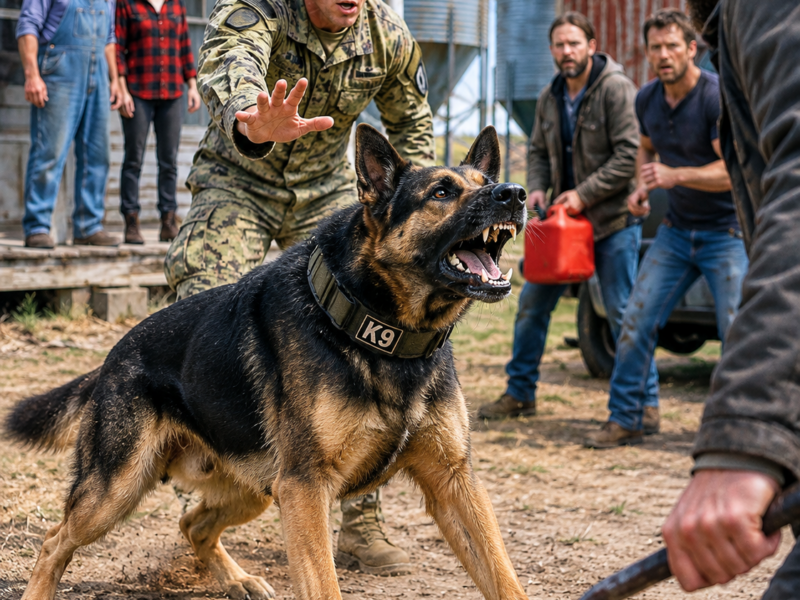
“The first man poured gasoline across my barn while the second laughed and told me to get off my own property before they burned it to the ground
Ryan didn’t move toward the truck.
He stood between me and the three men, one hand holding his phone, the other resting near Diesel’s collar.
“Mr. Hayes, stay behind me.”
I pushed myself up from the mud, wincing as my knee protested.
“Ryan, there’s something in that barn. Something my wife kept hidden.”
“I figured as much.”
The man with the lighter looked toward the road.
“Come on. We’re leaving.”
Ryan raised his voice.
“Nobody touches anything until the sheriff gets here.”
The man with the crowbar took another step toward him.
“You think you’re going to stop us?”
Ryan didn’t raise his voice.
“I don’t have to think about it.”
Diesel moved half a step forward.
The man’s courage seemed to disappear.
Then the passenger door of the black pickup opened wider.
A figure stepped out.
It was a woman.
She wore a dark coat over a white blouse, and even from where I stood, I recognized her face.
My stomach tightened.
“Laura?”
My daughter-in-law.
Daniel’s wife.
She looked at me for a moment, then lowered her eyes.
“Hello, Walter.”
I couldn’t understand what I was seeing.
“Why are you here?”
She didn’t answer.
Ryan looked from her to me.
“You know her?”
“She’s married to my son.”
The three men exchanged glances.
Laura walked toward the barn, carefully avoiding the spilled gasoline.
“Where is it, Walter?”
I stared at her.
“Where is what?”
“The cabinet.”
For a moment, the only sound was the wind moving through the trees.
Then I understood something that hurt more than the shove that had put me in the mud.
She hadn’t come because of Richard Cole.
She knew about the cabinet.
And she’d known long before tonight.
“How do you know about that?” I asked.
Laura’s lips trembled.
“Your wife told me.”
I shook my head.
“Margaret never told you anything about that cabinet.”
“She did.”
“You’re lying.”
She looked up at me.
“I wish I were.”
Before I could ask another question, Ryan’s phone connected.
“Dispatch, this is Ryan Mitchell. I have three suspects attempting an arson on private property. There is gasoline on the structure, and we have a vehicle with another individual involved. Send the sheriff and fire department.”
The man with the crowbar muttered something under his breath.
Ryan continued giving the dispatcher the location.
Laura stood perfectly still.
I looked at her.
“Why would you help these people burn down my barn?”
She swallowed.
“Because I thought it was the only way to protect Daniel.”
My son’s name hit me like a fist.
“What does Daniel have to do with any of this?”
She opened her mouth, but the man with the lighter interrupted.
“That’s enough. We’re done here.”
He reached toward her arm.
Diesel barked once.
The man pulled his hand back.
Ryan stepped between them.
“Don’t touch her.”
The first siren sounded in the distance.
The three men began backing toward the truck.
Ryan didn’t chase them.
Instead, he kept himself between the suspects and Laura while relaying their movements to the dispatcher.
When the sheriff’s cruiser finally turned into my driveway, the men had nowhere left to go.
Deputy Collins arrived first, followed by two other officers and a fire engine.
The gasoline had not reached the barn’s wooden siding, and the lighter had never been used.
The firefighters spread absorbent material over the spill while the deputies separated everyone.
Laura sat on the tailgate of a patrol vehicle, her hands trembling.
I stood beside Ryan and Diesel.
“Are you going to tell me who you really are?” I asked.
He glanced at me.
“Ryan Mitchell. Former Navy SEAL. I left active duty two years ago.”
I looked at his clothing.
“And the dog?”
“Diesel served with my unit. He’s retired now.”
I looked down at the German Shepherd.
The animal sat quietly beside my leg as if we’d known each other for years.
“Well,” I said, “I’m glad you two decided to live down the road.”
Ryan gave me a tired smile.
“Me too, sir.”
Deputy Collins approached.
“Mr. Hayes, I need you to tell me what’s happening.”
I pointed toward Laura.
“Start by asking my daughter-in-law why she knows about a locked cabinet in my barn.”
Collins looked at her, then back at me.
His expression changed.
“Laura Hayes?”
She nodded.
The deputy took a breath.
“Ma’am, I think we need to have a conversation.”
Laura looked toward me.
“Please don’t call Daniel yet.”
That request told me more than she realized.
“He’s my son,” I said. “If his name is involved, I have a right to know.”
She wiped her cheeks.
“I know.”
“Then tell me.”
She looked at Ryan, then at the deputies.
“Not here.”
I almost laughed.
“Your friends were trying to burn down my barn. I think we’ve passed the point of worrying about privacy.”
Ryan placed a hand lightly on my shoulder.
“Let her talk, Mr. Hayes. But we need to do this somewhere safe.”
Deputy Collins agreed.
He had the three men taken into custody, and the firefighters stayed until the barn was secure.
The black pickup was towed for examination.
Laura was not arrested that night.
Instead, she agreed to accompany the deputies to the station and give a statement.
Before leaving, she turned toward me.
“Walter, I didn’t want anyone hurt.”
I looked at the gasoline soaking into the dirt.
“Then you should have thought about that before you brought them here.”
She lowered her head.
I watched the patrol car disappear down the road.
Ryan remained beside me.
For several minutes, neither of us spoke.
Then he said, “You mentioned a promise your wife made you keep.”
I nodded.
“She told me never to open that cabinet unless someone came looking for the property.”
“Did she explain why?”
“No.”
“Did she give you a key?”
I looked toward the barn.
“She kept it in her sewing box.”
Ryan nodded slowly.
“Then let’s find out why somebody was willing to set this place on fire.”
***
The next morning, I opened Margaret’s sewing box.
It sat in the bedroom closet, exactly where she’d left it.
I hadn’t touched it since her funeral.
The little wooden box smelled faintly of cedar and the lavender sachets she used to tuck between her clothes.
Inside were needles, thread, a pair of reading glasses, and several folded scraps of fabric.
At the bottom lay a small brass key.
There was also an envelope with my name written across it.
My hands shook as I opened it.
The letter was dated eleven months before Margaret died.
Walter,
If you’re reading this, someone has finally come looking for what I kept in the barn.
I wanted to tell you everything, but I was afraid that knowing the truth would put you in danger.
I need you to understand that Daniel did not create the problem we’re facing.
He was only a boy when it began.
Please don’t blame him for something he doesn’t know.
If the cabinet is opened, make sure you are not alone.
And whatever you do, don’t let Richard Cole convince you that the land belongs to him.
I read the letter twice.
Then a third time.
Ryan stood by the doorway.
“Anything?”
I handed it to him.
He read it carefully.
When he reached the last sentence, his eyes narrowed.
“Richard Cole knew about this long before he made you an offer.”
“Looks that way.”
“Did your wife ever mention the name Cole?”
I thought for a moment.
“No. But she did mention someone from her past once.”
“What did she say?”
“That there were things a person could spend a lifetime trying to bury, only to discover they were still waiting in the same place.”
Ryan folded the letter.
“Let’s open the cabinet.”
We walked to the barn.
In daylight, the damage from the gasoline looked less dramatic, but I could still smell it on the dirt.
The metal cabinet stood behind the hay loft, partly hidden by a stack of old wooden crates.
I’d built a false wall around it years earlier because Margaret had asked me to.
I found the keyhole beneath a strip of faded tape.
The brass key turned with a reluctant click.
Inside were three thick envelopes, a leather-bound notebook, a small digital recorder, and a manila folder marked with a date.
There was also an old photograph.
I picked it up.
Margaret stood beside a younger man in a Navy uniform.
He was tall, clean-shaven, and smiling.
Behind them was a building I didn’t recognize.
On the back, Margaret had written:
“October 1989. Before everything changed.”
I stared at the photograph.
“Who is this?”
Ryan leaned closer.
“May I?”
I handed it to him.
He studied the man’s uniform and the background.
“Looks like a military facility.”
“Margaret never served in the Navy.”
“Maybe she was visiting someone.”
I turned the photograph over again.
There was a second line of handwriting beneath the first.
“Thomas Reed. He kept his promise.”
The name meant nothing to me.
Ryan opened the leather notebook.
The first several pages contained dates, names, and property descriptions.
Then he stopped.
“Mr. Hayes, you need to look at this.”
He pointed to a page dated 1991.
There were several handwritten entries beside a list of parcels of land.
One name appeared repeatedly.
Richard Cole.
I leaned closer.
“That can’t be right.”
Ryan turned another page.
The same name appeared beside a series of payments.
Some were marked as consulting fees.
Others were simply marked as cash.
“What was Margaret involved in?” I whispered.
Ryan didn’t answer immediately.
He opened the manila folder.
Inside were photocopies of property deeds, bank records, and a document with several official-looking signatures.
One line caught my eye.
A transfer of ownership had been filed for a parcel of land that included the northern half of my farm.
The document claimed the property had been sold decades ago.
But I had never sold it.
My deed said otherwise.
Ryan compared the dates.
“These records don’t match.”
I felt a chill move through me.
“Someone forged a land transfer?”
“Possibly. We’ll need a title attorney and investigators to establish exactly what happened.”
He turned another page.
There was a handwritten note from Margaret.
“Original survey retained. Never surrender.”
I looked toward the back of the barn.
The old wooden toolbox stood beneath the loft.
My father had built it himself, and I’d kept it for nearly fifty years.
I opened the lid.
Under the wrenches and old measuring tape was a flat wooden compartment I had never noticed.
Inside lay a rolled survey map wrapped in oilcloth.
I unrolled it across a workbench.
The map showed our property boundaries as they had been recorded in 1978.
A red line marked a section of land along the northern creek.
Beside it was a handwritten note.
“Right of access and mineral rights reserved to original owners.”
Ryan studied it.
“That’s interesting.”
“Why?”
“Because if someone altered the later records, this original document could be important evidence.”
I sat down on an overturned bucket.
For forty-six years, I’d believed Margaret’s only secrets were the little surprises she kept for birthdays and Christmas.
Now I was looking at documents that suggested she’d spent much of her life protecting something I didn’t even know existed.
And someone had just tried to destroy it.
***
Daniel called at 9:17 that morning.
I watched his name appear on my phone.
For a moment, I didn’t answer.
Then I picked up.
“Dad?”
His voice sounded strained.
“Are you okay?”
“I’m sitting in my barn, looking at the remains of a gasoline spill. What do you think?”
Silence.
Then he said, “Laura told me.”
I tightened my grip on the phone.
“She did?”
“She said there was an incident. She said nobody got hurt.”
“Your wife was here with three men who were trying to burn my barn.”
Another silence.
“She told me she was going to talk to you.”
“With a crowbar and gasoline?”
“Dad, please.”
I closed my eyes.
“Daniel, what do you know about Richard Cole?”
I heard a chair move on the other end.
“Why are you asking about him?”
“Because his name is in your mother’s records.”
Daniel didn’t respond.
I looked at Ryan.
He had stopped working and was watching me.
“Son, what is going on?”
Daniel finally spoke.
“About eight months ago, I started getting calls from a company connected to Cole.”
“What kind of calls?”
“They said they were reviewing an old property claim. They asked me about Mom’s paperwork.”
“What paperwork?”
“I didn’t know what they meant at first. Then Laura told me Mom had left something in the barn.”
I stood up.
“She told you?”
“Yes.”
“And you didn’t think to tell me?”
“Dad, I thought it was some old business matter. Laura said she could handle it.”
I rubbed my forehead.
“Why would she need to handle it?”
His voice dropped.
“Because we were in trouble.”
The words hung between us.
“What kind of trouble?”
Daniel took a breath.
“Six months ago, I lost my job.”
I hadn’t known.
He had been working in commercial construction for nearly fifteen years, and he’d always been proud of the work he did.
“What happened?”
“The company lost a major contract. They cut half the staff.”
“Why didn’t you tell me?”
“Because I didn’t want you worrying.”
I almost smiled at the familiar excuse.
He continued.
“We had a mortgage, school expenses, and some credit card debt. I tried to keep everything going. Laura knew someone who could help.”
“Richard Cole.”
“Yes.”
I looked toward the locked cabinet.
“What did he offer?”
“A loan.”
“And what did he want in return?”
Daniel hesitated.
“Access to the property records. He said there might be an old ownership issue that could be resolved if I signed a few documents.”
I felt the room grow smaller.
“Did you sign them?”
“I signed something, Dad. I thought it was a permission form.”
“What did it say?”
“I don’t know. Laura handled the paperwork.”
My voice became sharper.
“Daniel, you signed legal documents without reading them?”
“I know.”
I heard him exhale.
“I know, Dad.”
For a few seconds, neither of us spoke.
Then I asked the question I had been avoiding.
“Did you know they were coming to burn my barn?”
“No.”
His answer came immediately.
“Absolutely not.”
I wanted to believe him.
But I had spent seventy-four years learning that people could sound sincere while hiding things they were ashamed to admit.
“Then come home,” I said.
“Now?”
“Yes. We need to talk.”
He paused.
“I’ll be there tonight.”
Before hanging up, he said something that stayed with me.
“Dad, there’s something else about Mom.”
I waited.
“She knew Richard Cole’s father.”
The call ended before I could ask another question.
***
Daniel arrived just after six.
He looked older than I remembered.
His hair had more gray in it, and the lines around his eyes were deeper.
He stood in the kitchen holding his jacket.
For several seconds, neither of us moved.
Then he hugged me.
“I’m sorry, Dad.”
I patted his back.
“Sit down.”
Ryan was outside with Diesel, giving us privacy.
I placed the notebook and the documents on the kitchen table.
Daniel looked at them.
His face went pale.
“Where did you get these?”
“Your mother’s cabinet.”
He sat slowly.
I showed him the photograph.
The moment he saw the man in uniform, he closed his eyes.
“You’ve seen this before,” I said.
He nodded.
“Once. When I was little.”
“Who is Thomas Reed?”
Daniel rubbed his forehead.
“Mom told me he was an old friend.”
“What else?”
“She said he helped our family a long time ago.”
“How?”
“I don’t know.”
I leaned back.
“Your mother spent forty-six years keeping this secret. Somebody tried to burn the barn to destroy it. I think we deserve more than ‘I don’t know.'”
Daniel looked at the photograph again.
“There’s something I remember.”
I waited.
“When I was about twelve, I woke up one night and heard Mom talking on the phone. She was crying.”
“What did she say?”
“I only heard one sentence.”
He looked at me.
“She said, ‘I won’t let you take another family’s land.'”
The kitchen seemed to go quiet around us.
I looked down at the notebook.
“Another family?”
Daniel nodded.
“Then she hung up and sat in the hallway for a long time. When she saw me, she told me everything was fine.”
I felt a familiar ache in my chest.
Margaret had been carrying something alone while I slept beside her for decades.
I wondered how many nights she’d listened to the same silence I now heard in the house.
Daniel looked at me.
“Dad, I didn’t know what I was signing.”
“That may be true.”
“I never wanted your property.”
“I know.”
He looked surprised.
I continued.
“But you let someone else handle decisions that affected this family. And you didn’t tell me when you realized something was wrong.”
His eyes filled.
“I was ashamed.”
I understood that more than he probably knew.
Still, understanding wasn’t the same as excusing.
I reached across the table and placed the photograph between us.
“We’ll find out what your mother was protecting.”
Daniel nodded.
“And I’ll help.”
***
The following morning, Ryan arranged for us to meet with a retired military investigator named Thomas Reed.
He lived in a small house outside Nashville.
When he opened the front door, he looked at the photograph in my hand and immediately recognized Margaret.
“Where did you get that?”
“She was my wife.”
He stepped aside.
“Come in.”
His living room was lined with bookshelves, old military photographs, and framed commendations.
He was in his late seventies, with silver hair and a slight limp.
When he saw Daniel, his expression softened.
“You must be Margaret’s boy.”
Daniel nodded.
“Yes, sir.”
Thomas sat down and looked at the photograph for a long time.
“Your mother saved more people than she ever told you.”
I leaned forward.
“Then tell us what happened.”
He folded his hands.
“Back in 1989, I was assigned to investigate a network of fraudulent property acquisitions in several rural Tennessee counties. People were losing land through forged deeds, manipulated surveys, and threats.”
“Richard Cole?” I asked.
Thomas nodded.
“His father, Edward Cole, was involved. Richard was much younger then, but he worked for the family company.”
He explained that Margaret had been working as a county records clerk.
She had noticed that several deeds had been altered after being officially filed.
At first, she thought they were clerical errors.
Then she discovered the same names appearing across multiple fraudulent transactions.
One of the families affected had owned a large stretch of land near the creek.
They had been pressured into leaving after receiving threats and being told their property had already been sold.
Margaret had secretly copied the original documents before they disappeared.
Thomas had been assigned to help investigate the operation.
“She was brave,” he said. “She knew those people had influence. She also knew that if they discovered what she was doing, she could lose her job or worse.”
“Why didn’t she tell me?” I asked.
Thomas looked down.
“Because the threats eventually reached your family.”
I felt my throat tighten.
“What threats?”
“Someone left a note at your house. They knew your son was attending school nearby. Margaret believed that if she told you everything, you would confront the people involved.”
I looked at Daniel.
He was staring at the floor.
Thomas continued.
“She asked me to help secure the original records. We placed copies in several locations. Your barn was one of them.”
“Why my barn?”
“Because nobody would suspect an ordinary farmer’s storage building. And because Margaret trusted you with her life, even if she couldn’t tell you everything.”
I looked at the photograph.
“And the man in the picture?”
“That was taken after we recovered the first set of original deeds.”
Thomas paused.
“The investigation was never fully resolved.”
“Why?”
“Because Edward Cole died before the final case could be brought. Some of the records disappeared. Others were buried in civil proceedings. Richard took over the company and eventually built a legitimate-looking development business around it.”
I thought about the expensive SUV, the polite smile, and the offer to buy my farm.
“Why does he want my land?”
Thomas looked directly at me.
“Because your northern boundary contains the last surviving original survey that contradicts a deed his company has been using for years.”
I remembered the red line on the map.
“And the creek?”
Thomas nodded.
“That land was part of the original family’s property. Your deed includes a reservation that could help establish the true boundary. If your survey is authentic, several properties Cole’s company has acquired may have been transferred illegally.”
Daniel leaned forward.
“So this isn’t just about Dad’s farm.”
“No,” Thomas replied. “It’s about a chain of ownership that could unravel years of transactions.”
I looked at him.
“Then why didn’t you come forward?”
Thomas’s expression changed.
“I tried. But without the original documents, my testimony was not enough. Margaret kept the evidence safe. She was waiting for the right time.”
“Why didn’t she give it to you before she died?”
Thomas looked away.
“She became ill very quickly. By the time I learned how serious it was, she had already made arrangements to keep the evidence in the barn.”
I felt a wave of anger.
Not at Thomas.
Not even at Margaret.
At the years we’d lost to fear and silence.
“She should have told me,” I whispered.
Thomas nodded.
“Yes. She should have.”
For a long moment, nobody spoke.
Then Thomas reached into a drawer and placed an old envelope on the table.
“There’s one more thing.”
Inside was a letter written by Margaret.
It was addressed to Thomas.
He handed it to me.
I recognized her handwriting immediately.
Thomas,
If Richard ever comes looking for the documents, it means he has discovered that the old survey still exists.
Do not let Walter face this alone.
He has spent his life believing the land was all I ever wanted to protect.
But what I was really protecting was the truth about the people who lost theirs.
I looked up.
“What people?”
Thomas answered quietly.
“The original family who owned the northern land.”
He opened another folder.
Inside was a photograph of an elderly woman standing beside a small farmhouse.
On the back was a name.
Eleanor Brooks.
Thomas explained that Eleanor had been forced off her property in 1990 after a fraudulent transfer.
She had spent years trying to reclaim it.
She died before the investigation could be completed.
Her daughter, however, was still alive.
And her name was Rachel Brooks.
***
We met Rachel two days later at a small diner near the courthouse.
She was in her early sixties, with short brown hair and a careful way of choosing her words.
When Thomas introduced us, she looked at me with suspicion.
I couldn’t blame her.
For all she knew, I was another landowner who had benefited from what happened to her family.
“I’ve heard about your farm,” she said.
I nodded.
“My wife kept records connected to your mother.”
Rachel’s face tightened.
“Your wife?”
“Margaret Hayes.”
She looked down at her coffee.
“I remember that name.”
“Did you know her?”
“She came to see my mother once. I was a teenager.”
Rachel told us that Margaret had visited their farmhouse shortly before they were forced to leave.
She had asked Eleanor to sign a statement about the original property boundaries.
Eleanor had refused.
“She said she was tired of fighting people with money and lawyers.”
I understood that feeling.
Rachel continued.
“My mother believed the land had been stolen. But after years of being told she had no legal claim, she stopped talking about it.”
I placed a copy of the survey on the table.
Rachel stared at it.
Then she reached into her handbag and removed a small photograph.
It showed a younger Eleanor standing beside a wooden fence.
Behind her was a creek and a line of old oak trees.
I looked at the photograph.
Those trees were on my property.
I’d seen them every day for decades.
Rachel’s voice softened.
“That’s where I grew up.”
I looked at her.
“Your family lived on the northern section?”
She nodded.
“Until the county records said we didn’t own it anymore.”
I didn’t know what to say.
For years, I’d believed the northern pasture was simply part of the farm Margaret and I had bought.
Now I was beginning to understand why she had insisted that I never sell it.
Rachel studied the survey again.
“Is this original?”
Thomas nodded.
“It appears to be.”
She covered her mouth.
For a moment, she looked like a little girl trying not to cry.
Then she asked the question I had been afraid of.
“Mr. Hayes, did your family know?”
I thought about Margaret’s letter.
I thought about the nights she’d sat alone in the hallway.
And I thought about the promise I’d made without understanding it.
“No,” I said. “I didn’t know. But my wife did.”
Rachel looked away.
“That’s hard to hear.”
“I understand.”
She stood up.
“I need some time.”
I didn’t try to stop her.
Before she left, she turned back.
“If this is real, I want my mother’s name cleared.”
I nodded.
“So do I.”
***
The investigation took several weeks.
The sheriff’s department recovered the pickup truck and found evidence connecting the men to Richard Cole’s company.
The man with the lighter eventually agreed to cooperate after being shown security footage and phone records.
He admitted that he and the others had been paid to destroy the barn and retrieve the documents.
He also confirmed that Laura had arranged the meeting.
But the most important evidence came from Daniel.
After speaking with an attorney, he turned over the paperwork Laura had asked him to sign.
The documents were not permission forms.
They were part of an agreement transferring certain claims and granting access to property records.
One signature had been added to a page Daniel said he’d never seen.
His name had been used to support an application for a disputed transfer.
He cooperated fully with investigators.
Laura eventually admitted that Richard had promised to erase their debts if she helped locate Margaret’s records.
She had convinced herself that the documents were worthless and that destroying them would prevent the family from losing everything.
She also admitted she’d known the men intended to set the barn on fire.
That was the part I couldn’t forgive.
Not immediately.
Not after seeing the gasoline on the ground where Margaret had planted flowers every spring.
Richard Cole was arrested after investigators uncovered financial records, communications, and forged documents connecting him to the scheme.
His attorneys denied the allegations.
The case moved slowly, as complicated legal cases often do.
But this time, the original survey and Margaret’s notebook were preserved.
The county reopened the disputed property records.
And Rachel Brooks finally had the evidence her mother had spent decades trying to find.
***
Daniel and Laura separated shortly afterward.
He moved into a small apartment near his workplace and began rebuilding his life.
For several weeks, he visited me every Sunday.
Sometimes we talked about the investigation.
Sometimes we talked about Margaret.
Other times, we sat on the porch without saying much.
One Sunday, he arrived carrying a box.
“I found these in the garage,” he said.
Inside were old family photographs.
Margaret holding Daniel as a baby.
Me standing beside the tractor.
The children sitting on the barn steps.
And one photograph of Margaret and me on our wedding day.
Daniel held that one for a long time.
“I should’ve listened when Mom told me not to sign anything.”
I looked at him.
“Your mother spent too much of her life trying to protect us by keeping us in the dark.”
He nodded.
“I know.”
“Don’t make the same mistake.”
He swallowed.
“I won’t.”
I reached over and squeezed his shoulder.
He was still my son.
And I wasn’t ready to give up on him.
***
Three months after the fire attempt, Rachel came back to the farm.
She stood beside the northern fence, looking toward the creek.
The autumn leaves had begun turning gold, and the afternoon sun reflected off the water.
I walked over with two cups of coffee.
“Thought you might need one.”
She smiled faintly.
“Thank you.”
For a while, we watched the creek.
Then she said, “My mother used to tell me that the old oak tree was where she and my father first met.”
I looked toward the largest tree near the water.
“I’ve sat under that tree more times than I can count.”
Rachel nodded.
“She would have liked knowing someone cared for it.”
I handed her the second cup.
“I’m sorry your family lost so much.”
She looked at me.
“Your wife tried to help.”
I nodded.
“She did.”
“She couldn’t fix everything.”
“No,” I said. “But she didn’t stop trying.”
Rachel reached into her coat pocket and took out a small photograph.
It was the same farmhouse photograph we’d seen at the diner.
Her mother stood beside the old fence, smiling.
“I want to put this in the courthouse record when the case is settled,” she said. “I want people to know who lived here before the paperwork changed.”
I looked at the picture.
“That’s a good idea.”
Then she surprised me.
“Would you mind if I planted a tree here?”
I looked at the creek.
“What kind?”
“An apple tree. My mother loved them.”
I thought about Margaret’s orchard.
“She’d like that.”
We planted it the following Saturday.
Daniel came to help.
Ryan brought Diesel.
Thomas Reed arrived with a shovel and complained about his back for nearly twenty minutes before getting to work.
For the first time in months, the farm sounded like it used to.
People laughing.
Tools hitting the earth.
A dog moving through fallen leaves.
When the young apple tree was finally in the ground, Rachel stepped back and brushed dirt from her hands.
“Mom would’ve liked this.”
I looked at the small tree.
“Margaret would’ve liked it too.”
***
The legal case took nearly a year to reach its conclusion.
Richard Cole eventually accepted a plea agreement involving fraud, conspiracy, and attempted destruction of evidence.
The court ordered restitution and imposed penalties connected to the fraudulent property transactions.
The county corrected several records, and Rachel’s family claim was formally recognized.
She didn’t move back to the property.
She had built a life elsewhere.
But she visited whenever she could, and the northern creek no longer felt like a piece of land with a troubled history.
It felt like a place where two families’ stories had finally been allowed to meet.
Laura sent me a letter through Daniel.
She apologized for what she’d done.
She wrote that fear had made her selfish and that she’d convinced herself she was saving her marriage by doing something unforgivable.
I read it once.
Then I put it in the kitchen drawer.
I wasn’t ready to answer.
Forgiveness, I had learned, wasn’t a door you opened just because someone knocked.
It was something that had to be built, sometimes slowly, sometimes not at all.
As for Ryan and Diesel, they stayed at the Miller place through the winter.
Ryan helped me replace the damaged boards on the barn.
Diesel became a regular visitor, especially when I was working near the garden.
One afternoon, I asked Ryan why he’d chosen to settle in such a quiet place.
He leaned against the fence and watched Diesel chase a fallen leaf.
“After years of being somewhere every sound meant something, I wanted a place where I could hear the wind again.”
I understood that.
“Well, you picked a good road.”
He smiled.
“Seems I did.”
***
The following spring, I finally repaired the barn’s damaged wall.
I used the same kind of wood Margaret and I had chosen decades earlier.
The old photographs went back inside.
My father’s toolbox returned to its shelf.
And the metal cabinet remained where it had always been.
But I didn’t lock it again.
Instead, I placed Margaret’s letter inside a wooden frame and hung it above the workbench.
Not because I wanted everyone to know her secrets.
Because I wanted to remember that she had tried to do the right thing, even when she was afraid.
On the anniversary of her death, Daniel came to the farm.
We sat together on the porch as the sun lowered behind the hills.
He held two cups of coffee.
One for me.
One for himself.
After a while, he looked toward the barn.
“Do you think Mom knew we’d find everything?”
I watched the apple tree near the creek.
Its branches were still thin, but tiny green leaves had begun to appear.
“I think she hoped we’d be brave enough to look.”
Daniel nodded.
A few minutes later, Diesel came trotting up the driveway with Ryan behind him.
The dog dropped a stick at my feet.
I picked it up and threw it toward the pasture.
He raced after it, his tail moving like a flag.
For the first time in a long while, I laughed without feeling guilty about it.
I looked at the barn, then at the land stretching beyond it.
Men had come in the darkness believing they could erase a family’s history with gasoline and a match.
They had mistaken an old man’s silence for weakness.
And they had forgotten that some things, once planted deep enough, refuse to burn.
Margaret had spent her final years protecting a truth she believed deserved to survive.
In the end, it wasn’t the documents that mattered most.
It was the people who finally came together because of them.
I took another sip of coffee.
The evening breeze moved through the apple tree, and somewhere near the barn, Diesel barked at a squirrel.
For forty-six years, I had thought that farm was the life Margaret and I had built together.
Now I understood something else.
It was also the place where the truth had waited for us.
And this time, nobody was going to make us leave.
THE END.









