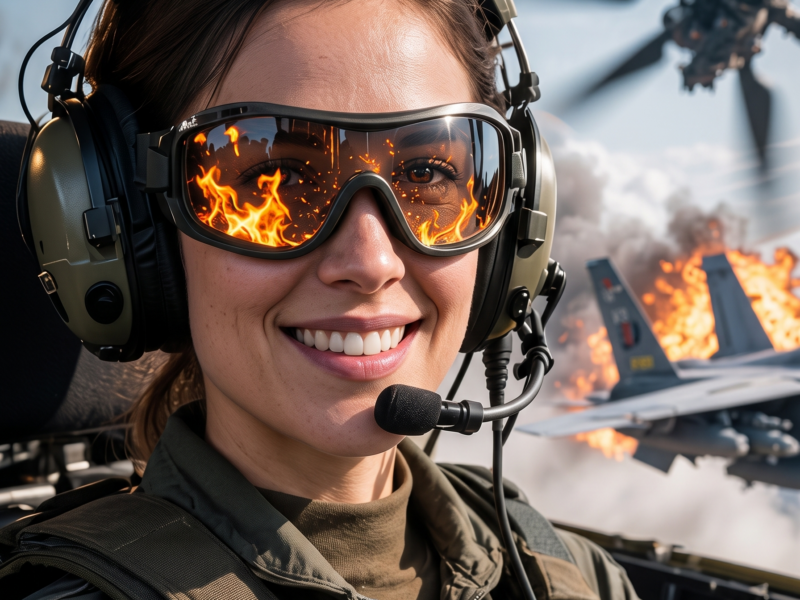
The first fighter jet screamed across the sky above Fort Campbell as I sat alone in my Apache, and when the second missile locked onto me, the commander ordered me to eject
The red primary warning strobe inside the cockpit of my AH-64E Apache pulsed like an open artery, throwing violent crimson flashes across the multifunction displays, the canopy glass, and the sweat stinging my eyes. The warble of the missile-approach warning system was not a polite beep; it was a shriek that rattled the fillings in my teeth.
“Missile launch! Sector six! Break, break, break!”
The panicked voice crackled through my helmet comms from Fort Campbell’s tactical air operations center, hundreds of miles away. Back in that air-conditioned bunker, commanders were staring at satellite feeds and telemetry lines showing what looked like madness: an army attack helicopter operating far outside its designated low-level training corridor, playing tag with two supersonic shadows over the jagged limestone gorges and dense oak ridges that hemmed in the Cumberland perimeter.
I didn’t answer. My hands moved by muscle memory honed over nine hundred combat flight hours in eastern Syria and the Helmand dust. I kicked the left anti-torque pedal hard, dumped collective, and hauled back on the cyclic stick. The four composite rotor blades overhead groaned in structural protest as the nose snapped ninety degrees.
Through the clear curved canopy above my left shoulder, the missile arrived.
It was an AIM-9X Sidewinder, traveling at nearly Mach 3. It didn’t look like a weapon from a textbook; it looked like a pencil of blinding white magnesium fire tearing a wound through the low-hanging overcast. It passed so close above my rotor mast that the supersonic shockwave slammed through the Apache’s titanium armor tub like a sledgehammer swung against the hull. The vortex ripped at my flight surfaces, sending the bird into an uncontrolled snap-roll toward the rock wall.
Down below, the limestone face of the gorge rose up to kill me.
“Captain Morgan! Eject!” The voice belonged to Colonel Miller, my battalion commander. His baritone was cracked with raw panic. “Claire, pull the pins and get out of that airframe right now! That’s an unlawful engagement! We are trying to establish line-of-sight command with NORAD—”
I let out a harsh, breathless laugh that caught in the back of my dry throat.
“Eject into what, Colonel? An open pit?” I pulled pitch, pulling seven Gs through my harness, the strain compressing my spine until my vertebrae clicked. “And leave the black box to whatever ghost unit you just let into your airspace?”
“Claire, listen to me—”
“Save it, sir.”
Three hours ago, this flight had been billed as an unclassified terrain-masking exercise—a routine navigational check of low-altitude electronic dead zones along the perimeter ridges. But three hours ago, my tactical data recorder had snagged a stray microwave burst bouncing off an abandoned limestone quarry. It wasn’t an army transmission. It wasn’t civilian FAA traffic. It was an antiquated, triple-encrypted military tactical data burst running on a hopping frequency discontinued before I was commissioned.
A frequency my father had taught me to read on a breadboard radio when I was ten years old.
The specific alphanumeric handshake of the 75th Special Reconnaissance Group. My older brother Daniel’s unit.
Twelve years ago, the Department of the Army had sent two officers in service dress uniforms to our front porch in Kentucky. They carried a brass flag case, a posthumous Silver Star, and a boilerplate casualty report explaining how Captain Daniel Morgan had been lost in an “unrecoverable ordnance detonation” at a secret weapons testing facility in the interior scrubland. There was no casket. There were no remains. There were only redacted manifests and a quiet pension deposited into my father’s bank account until the day he drank himself into cardiac arrest.
I had spent my entire adult life wearing the same uniform, chasing the same horizon, telling myself that Daniel was vaporized dust scattered across some forgotten test range.
Until that burst.
The coordinates packed inside that encrypted chirp didn’t point to an overseas black site. They pointed here: Sector 4-Echo, an overgrown, abandoned Cold War landing strip carved into the limestone bluffs twenty miles north of the base line, officially marked on every aeronautical chart as a toxic superfund cleanup site.
“How many on my tail?” I muttered, wiping a line of salty sweat from above my brow with the back of my flight glove while keeping my boots feather-light on the pedals.
“Two fighters,” Miller’s voice responded, sounding thin, distant, and utterly defeated. “Air National Guard markings, but their transponders are spoofed. They aren’t responding on guard frequencies. They aren’t ours, Claire. Get out of there.”
“That’s not happening,” I said.
The radar warning receiver flared again. The second jet had looped around over the cloud deck, using the high ceiling to dive down on my six. A helicopter in open air against a modern fighter is a clay pigeon; the only defense is to hug the dirt so close the ground radar loses you in the clutter of trees, mud, and boulders.
I shoved the nose forward. The Apache plummeted like a stone down into the slit of the gorge.
Limestone cliffs fifty feet tall blurred on either side of my canopy. Branches from wild cedar trees scraped along the bottom of the Hellfire launcher rails on my stub wings. The river at the floor of the gorge—swollen with gray spring runoff—whipped into frothing spray beneath my downwash.
Behind me, the second missile detonated against the cliff face where I had been hovering three seconds prior.
The blast wave punched the tail boom sideways. The sky above the ravine turned a sickening, boiling orange as hundreds of tons of shale and pulverized stone tumbled down into the river. Dust and acrid cordite smoke sucked into my engine intakes, causing the twin turbines to surge with a metallic cough before their digital governors stabilized the fuel flow.
I kept the collective buried, racing through the winding chasm at one hundred and forty knots, my wheels barely eight feet above the churning water.
Then, out of the haze ahead, the canyon widened into a natural limestone bowl.
Circling low over the tree line, wings rocking with deliberate, chilling grace, was the second fighter. It wasn’t an Air National Guard F-16. Through the cockpit glass, I could see the distinct silhouette of an unmarked, twin-engine strike craft, completely matte gray, without a single roundel, number, or insignia painted on its composite skin.
It passed across my twelve o’clock, slower than it had any right to fly, flaps extended to maintain lift just above stall speed.
A click sounded in my headset. It wasn’t the secure military net. It was the open emergency guard channel.
“Turn around, Claire.”
The voice was smooth, quiet, and carried a rhythmic cadence that froze the blood in my veins. It wasn’t the voice of an anonymous contract mercenary. It was a voice that used to sit on the other side of a kitchen table, telling me how to lead a target with a deer rifle.
“Who are you?” My voice was barely a whisper against the hum of the cockpit fans.
There was a five-second pause. The jet leveled off, its twin burner cans glowing faintly in the dim drizzle.
“Someone who remembers your brother,” the pilot answered. “If you cross that ridgeline, the people down there won’t let you leave. Pull up, turn south, and tell Miller your navigational system lost lock. It’s the only way you walk away from today.”
“Daniel is down there,” I said, my teeth clenched so hard my jaw ached.
“Claire, don’t do this.”
“Watch me.”
I didn’t turn south. I pulled back on the cyclic, dragged the Apache up over the rim of the gorge, and punched through the veil of burning brush and drifting smoke.
Below me, cleared out of the thick oak forest, lay the forgotten runway.
The cracked asphalt was covered in weeds and moss, but in the center, a three-hundred-foot section had been swept clean. Nestled into the earthen berm at the far end was an entrance to a subterranean bunker, its reinforced blast doors retracted into the rock face.
Parked directly outside that gaping concrete mouth was an old M939 six-wheel-drive military transport truck, its olive-drab paint oxidized to a chalky green. And stenciled across the steel tailgate in faded yellow lettering was an operational unit marking that had been officially disbanded in 2014:
75-SRG / DET-4.
My brother’s unit.
I flared the Apache hard, dropping the landing gear onto the fractured concrete twenty yards from the bunker mouth. The tires hit the ground with a screech, the shock absorbers bottoming out as I cut the fuel switches. The twin turbines whined down, their blades spinning into a slow, clicking glide.
I popped the canopy latch. The wet smell of damp earth, burning jet propellant, and cold limestone rushed into my nose.
I drew my standard-issue Beretta M9, rack-slid a round into the chamber, and slid down the side of the armor plate into the mud.
“Daniel!” I screamed into the rain.
The shadows inside the bunker shifted.
A solitary figure stepped out from behind the heavy hydraulic blast door. He didn’t wear a uniform; he wore grease-stained canvas work pants and an unzipped olive field jacket with the patches ripped off. He was gaunt. The sharp edges of his collarbones showed against his hollowed neck. His dark hair, once cut to regulation high-and-tight, hung past his ears, streaked with broad strokes of ash-gray.
He stopped ten paces away. His hands were empty, hanging loosely at his sides.
I looked into his eyes—the same pale gray eyes that looked back at me from my own mirror every morning.
My grip weakened. The Beretta slipped from my fingers, splashing into a puddle of brackish water at my boots.
“Daniel?” My voice broke, sounding like the frightened twelve-year-old girl who had watched an empty casket lowered into Kentucky clay.
Daniel looked down at my sidearm in the mud, then slowly raised his gaze to meet mine. There was no relief in his face. No joy. Only a hollow, bottomless exhaustion.
“You weren’t supposed to find me, Claire,” he whispered.
Before I could take a step, the silence of the clearing was shattered.
From the dark mouth of the bunker behind him, two dozen men in sterile black tactical gear surged forward, their carbines coming up to high-ready, the red dots of their laser sights painting my chest, my forehead, and the fuselage of the idling helicopter.
And from deep within the bowels of the mountain behind them, an industrial air raid siren began to wail.
The siren was an old mechanical Federal Sign & Signal beast, its iron throat revving up until the sound vibrated through the mud beneath my boots and rattled the teeth in my jaw. The men pointing rifles at my chest didn’t look like soldiers. They moved like soldiers—their footwork was balanced, their muzzle discipline absolute, their fingers indexed along the receivers of customized short-barrel carbines—but they wore no tags, no flags, no names. Their kit was matte black, devoid of light reflection, stripped of every piece of nylon that might identify an agency, a branch, or a country.
“Drop your vest!” the man closest to Daniel barked. His voice was muffled behind a charcoal-gray balaclava, but the tone left no room for debate. “Hands on the back of your head! Interlace your fingers! Now!”
I didn’t move. My gaze stayed locked on my brother.
Twelve years of grief—twelve years of visiting an empty plot at Cave Hill Cemetery, of holding my mother while she cried on Veteran’s Day, of saluting brass officers who offered rehearsed condolences—condensed into a white-hot spike behind my temples.
“You let us bury an empty box, Daniel,” I said. My voice was low, cutting right beneath the rise and fall of the air raid siren. “Dad died thinking you burned to death in an ordnance dump.”
Daniel flinched. It was subtle—just a twitch of the muscle along his jawline—but on a man who had survived six years in the Special Forces reconnaissance detachments, it was an admission of guilt as loud as a gunshot.
“Stand down, Vance,” Daniel said quietly, raising a single hand toward the man in the balaclava.
“Captain Morgan, she’s an active-duty officer with an active telemetry feed,” the man named Vance countered, not lowering his weapon an inch. “Her command knows she left the training box. They saw the intercept. Protocol 4-Zero requires immediate containment of any breach.”
“Her bird’s data link was fried the second she cleared the gorge,” Daniel said, his voice dropping into that familiar, quiet authority I hadn’t heard since childhood. “That modified bird in the sky didn’t drop Sidewinders to kill her, Vance. Cole was riding her six to blind the satellite tracking on her transponder. If he wanted her dead, she wouldn’t have made the treeline.”
The pilot in the unmarked jet. Cole.
The name hit my memory like a splash of ice water. Captain Marcus Cole. Daniel’s former wingman and ground-liaison coordinator during their tours in the Kunar Valley. Marcus Cole had supposedly died in the same “accidental ordnance explosion” that took my brother. His photo hung in the memorial foyer at the brigade headquarters.
“Who are you people?” I demanded, stepping forward.
Rifles clicked around me. Muzzle apertures centered on my sternum.
“Claire, don’t move,” Daniel warned, stepping directly into the path between Vance’s rifle and my chest. He looked at me, his eyes sunken, shadowed by dark violet circles that spoke of years without decent sleep. “If you take another step, they will put you down, and there won’t be a damn thing I can do to stop it. Keep your hands where they can see them. Walk inside.”
“I’m not going into that hole with you,” I said.
“You don’t have a choice,” Daniel said. He turned and pointed toward the southern horizon, above the lip of the limestone quarry.
Through the light gray drizzle, two heavy twin-rotor CH-47 Chinooks were descending out of the low cloud deck, flanked by a pair of blacked-out light observation helicopters running completely silent. They were five minutes out, approaching fast and low along the river contour.
“That’s not Fort Campbell search-and-rescue,” Daniel said grimly. “That is the clean-up detail. And unlike us, Claire, they don’t have family ties. If they find you standing beside this airframe, you won’t even get an empty box in Kentucky. You’ll simply cease to exist.”
I looked at the guns leveled at me, then at the gray silhouettes of the incoming transports. The logic of survival took over, cold and mechanical. I slowly raised my hands, interlaced my fingers behind my Kevlar helmet, and walked forward.
The air inside the bunker was twenty degrees colder than the spring rain outside. It carried a heavy, synthetic reek—a mixture of ozone, stale hydraulic fluid, industrial coolant, and old damp concrete. We passed through an eight-foot-thick steel airlock door, its locking lugs greased with thick amber compound, and stepped into an immense subterranean hallway that stretched deep into the limestone bedrock.
The walls were ribbed with heavy conduits carrying electrical cables as thick as my forearm. Overhead, flickering fluorescent tubes hummed in the damp draft.
“Clear the ramp,” Vance ordered his men as the massive outer door ground shut with a terrifying, air-cushioned hiss of pneumatic seals. “Get the perimeter cameras on the secondary loop. Feed the Campbell towers the standard static recording from the 2018 survey. If they see those birds land, I want them to think they’re looking at empty weeds.”
“Understood, sir.” The men dispersed down side corridors with silent, practiced efficiency.
Daniel led me past reinforced security gates, down three flights of rusted industrial iron stairs, and into what looked like an operational tactical operations center from forty years ago, retrofitted with modern server racks and glowing widescreen terminals. Maps of North America covered the cork boards on the walls, marked not with military installations, but with domestic power distribution grids, rail corridors, and fiber-optic trunk lines.
In the center of the room sat a scarred steel desk covered in plastic cups of cold black coffee, paper technical manuals, and an old field radio with its casing cracked.
Daniel sat down heavily on the edge of the desk, rubbing his face with calloused, oil-stained hands. He looked up at me, his eyes tracing the aviator wings pinned to my flight suit, the tactical patches on my shoulders, the rank insignia on my collar.
“Captain,” he said, the ghost of a proud smile touching the corner of his cracked lips before it died. “Dad always said you were the best stick in the state. I didn’t think you’d actually sign the papers.”
“I signed the papers because I wanted to find the people who killed you,” I said, my voice shaking with rage. I ripped off my flight gloves and threw them onto the desk. They hit a stack of documents with a wet slap. “I spent twelve years climbing into cockpits, taking deployments nobody wanted, digging through redacted records after midnight, trying to find an answer. And you’ve been living in an abandoned hole thirty miles from home?”
“Not living, Claire,” he said softly. “Hiding.”
“From who?”
“From the people who sign your flight orders,” a new voice said from the shadows of the stairwell.
I spun around.
The man who had flown the unmarked fighter stood at the base of the stairs, unzipping a high-altitude pressure suit. He was taller than Daniel, with a scar running through his left eyebrow and gray hair cropped close to a skull that looked like it had been carved from granite. Marcus Cole. A dead man walking into the light.
“You should have pulled pitch and headed south, little Morgan,” Cole said, tossing his flight helmet onto a server cabinet. “We spent three weeks setting up the electronic blind spot in that gorge so we could run a single transmission to an extraction contact in Ottawa. You blew our acoustic signature wide open.”
“You shot at me!” I yelled, stepping toward him. “You put two Sidewinders into my baffle!”
“I put two Sidewinders into the rock behind you to create an infrared smoke screen so the overhead satellites couldn’t track your tail down to the tarmac,” Cole fired back, his dark eyes narrowing. “If I wanted to take an Apache out of the air, Captain, you wouldn’t have heard the radar lock. You’d have been a grease spot on the limestone before you could touch the cyclic.”
“Shut up, Marcus,” Daniel ordered, standing up.
“She doesn’t belong here, Dan,” Cole said, stepping closer, his voice dropping into a harsh rasp. “Those birds landing up top right now belong to the Ironwood Directorate. If they breach that outer seal, they aren’t going to arrest her. They’re going to put her in a containment cell, pump her full of midazolam, and wait until her liver fails. She knows the frequency now.”
“What frequency?” I demanded, looking between the two men. “What was that data burst I caught?”
Daniel walked over to one of the large monitors on the far wall. He tapped a key, and a high-resolution satellite map appeared on the screen. It didn’t show a foreign war theater. It showed the continental United States, crisscrossed with dozens of pulsing crimson vectors centered on civilian infrastructure nodes: automated hydroelectric dams, municipal water treatment facilities, automated air traffic control centers, and high-voltage sub-stations.
“Twelve years ago, the 75th Recon was tasked with evaluating an automated continuity-of-government project called Project ARES,” Daniel said. His voice was steady, but there was a horror lurking beneath every syllable. “It was designed during the early drone wars. An autonomous, algorithmic defense network capable of taking command of domestic infrastructure, logistics, and localized military assets in the event of a catastrophic decapitation strike against Washington.”
“That sounds like standard contingency planning,” I said.
“It wasn’t a contingency,” Daniel replied grimly. “It was an acquisition. A private consortium of defense logistics contractors and senior members of the Joint Logistics Command realized that if they owned the system that controlled the infrastructure, they owned the country without ever firing a public shot. They didn’t have to stage a coup. They just had to trigger false-flag automated failures, declare economic emergencies, and let the algorithm divert federal supply chains through their proprietary networks.”
I shook my head, my mind rejecting the sheer scale of the betrayal. “That’s insane. That’s paranoid fiction, Daniel. You’re talking about high treason at the cabinet level.”
“We found the proof in 2014,” Daniel said. He pulled open a battered metal drawer and lifted out a heavy, olive-drab optical drive casing sealed with lead security wire. “We intercepted the primary deployment manifests. When we tried to deliver the drive to the Inspector General, our transport was hit by our own air support over the Kentucky border. Seven of my team died in that fire. Marcus and I only survived because we were riding the tail gate and got thrown into the river before the fuel tanks blew.”
“Why didn’t you go to the FBI?” I asked, my throat tight. “Why didn’t you go to the press?”
“Because the man who authorized the strike on our unit is now the four-star general commanding the Army Materiel Command,” Daniel said, his voice dropping to a whisper. “And the man who handles his operational security on the ground is the commander of your own aviation brigade.”
I stepped back, the breath rushing out of my chest as if I had taken another high-G turn.
“Colonel Miller,” I whispered.
Before Daniel could answer, the red emergency lighting in the bunker flickered twice and died, plunging the command center into total, suffocating darkness.
Then, through forty feet of solid limestone, came the dull, terrifying thud of a shaped thermite breaching charge detonating against the outer blast door.
The darkness lasted for three seconds before the emergency battery arrays kicked in, bathing the command bunker in the sickly, jaundiced glow of yellow halogen strips. The hum of the cooling fans died, replaced by an eerie, heavy silence broken only by the rhythmic metallic ticking of cooling electronic racks.
Overhead, dust rained down from the rock ceiling, dusting our shoulders and hair with fine white limestone powder.
“Primary seal is gone,” Vance’s voice crackled through a battery-operated tactical handset on the desk. “They used liquid thermite on the hinge assemblies. They have three breach teams on the upper ramp. They’re deploying CS gas and suppressive automatic fire. We can’t hold the airlock.”
“Fall back to Sector Three, Vance!” Daniel shouted into the receiver. “Blow the service shaft! Don’t let them secure the elevator lines!”
“Understood, Captain. See you on the other side.”
A muffled burst of suppressed rifle fire echoed down the concrete conduit, followed immediately by the concussive, hollow boom of an industrial satchel charge detonating in the vertical maintenance tube. The floor shook violently under my boots. The iron stairs leading to the upper deck twisted with a screech of tearing rivets, and a cloud of bitter, gray-black smoke belched into the hallway, smelling of burning insulation and sulfur.
Cole was already moving. He crossed the room in two strides, slammed the heavy metal drawer shut, and slung the lead-sealed optical drive into an old canvas field pack. He snatched a pair of short-barrel carbines from a wall rack, tossed one to Daniel, and turned to me.
“Can you still shoot a rifle, Captain, or do you need a digital flight computer to pull the trigger for you?”
I grabbed the carbine out of the air by its handguard, racked the bolt back half an inch to verify a round was seated in the chamber, and let the steel slap home. “I took top marksman in my flight class, Cole. Point me at whatever needs a hole in it.”
“Keep that fire in your belly,” Cole muttered, his face grim. “Because the people coming down that hall aren’t taking prisoners. They brought body bags and lye.”
“Where does this lead?” I asked, following Daniel as he kicked open a narrow, rusted steel access hatch hidden behind a row of disconnected server racks.
“This facility was built in 1961 as a hardened backup switching station for the strategic bomber alert network,” Daniel explained, ducking his head to clear the low ceiling of the unlined rock tunnel behind the hatch. Water dripped continuously from the raw ceiling, splashing into an open drainage trench that ran down the center of the passage. “The military abandoned the surface in the seventies, but the lower levels connect to an old limestone drainage system that cuts four miles south toward the Cumberland River. We call it the Sump.”
We moved in single file, our boots sloshing through six inches of freezing, stagnant groundwater. Daniel had the point, his rifle held high, scanning the darkness with a weapon-mounted red lens light that cut through the drifting mist. I took the middle, my weapon pressed tight against my shoulder pocket, while Cole took our rear, walking backward every few paces to watch our back-trail.
Behind us, through the tunnel’s tight acoustic throat, we could hear the methodical, terrifying sounds of the clean-up team clearing the upper rooms: the sharp thump-thump of controlled double-taps, the crash of kicked-down metal doors, and the rhythmic, amplified voice of a squad leader issuing concise directional commands.
“Room three clear.”
“Servers breached. Commencing incendiary sweep.”
“Target assets not located. They went down the service tube. Deploy the hounds.”
My stomach dropped. “Hounds?”
“Autonomous ground drones,” Cole hissed from behind me. “Tracked chassis, forward-looking infrared, and a thirty-millimeter grenade launcher mounted on a gimbal. They don’t need oxygen, they don’t care about the dark, and they don’t lose a scent.”
“Move faster,” Daniel urged, picking up the pace to a splashing jog.
The rough rock walls of the tunnel soon gave way to an immense underground cavern. The beam of Daniel’s light died in the vast blackness above us. The sound of running water grew from a trickle to a steady, hollow roar. We were standing on a narrow concrete catwalk that skirted the edge of a subterranean reservoir—a massive, black pool of subterranean water that had collected in the hollowed-out limestone belly of the mountain.
Decaying iron pump machinery, covered in thick coats of orange rust, stood like skeletal giants along the walkway.
Suddenly, a high-pitched, mechanical whine cut through the roar of the water.
From the tunnel mouth sixty yards behind us, a pair of brilliant green optical sensors appeared in the dark. They flickered with cold, artificial life, swiveling on a motorized neck. Beneath the lights was the low, squat silhouette of a tracked vehicle no larger than a timber wolf, moving with silent, terrifying speed over the jagged shale.
“Contact rear!” Cole yelled, dropping to one knee on the rusted grating of the catwalk.
His carbine barked three times, the muzzle flashes lighting up the cavern in strobing blue-white spikes. The rounds sparked harmlessly against the sloped titanium armor plate of the drone’s forward glacis.
The machine didn’t pause. Its motorized turret whined as its sensor suite locked onto the heat signature of Cole’s muzzle blast.
“Jump!” Daniel roared, grabbing the nylon drag handle on the back of my survival vest.
He hauled me sideways just as the drone’s launcher fired with a sharp, pneumatic chuff.
A high-explosive fragmentation grenade detonated against the concrete pylon supporting the catwalk beneath our feet. The explosion was deafening in the enclosed cavern. The shockwave lifted me off the deck, blowing the breath from my lungs and tossing me over the low railing into the void.
Cold water hit me like a solid wall.
The shock was total, instantaneous, and paralyzing. The subterranean reservoir was barely above freezing. The weight of my survival vest, my flight boots, and the tactical belt pulled me down into the ink-black depths. For three terrifying seconds, I lost all sense of up and down. My lungs burned. My helmet was gone, ripped away by the impact.
I fought the water, kicking frantically with my heavy boots, clawing toward the faint, flickering light filtering down from above.
My head broke the surface. I gasped for air, choking on the oily film floating on the water’s skin.
Ten yards away, the shattered wreckage of the catwalk was burning, diesel fuel from an old generator line floating on the pool and casting long, leaping shadows across the rock ceiling.
“Claire!”
Daniel was swimming toward me with powerful, one-armed strokes, holding his rifle above the water with his left hand. His face was streaked with black soot, and a deep gash along his temple was bleeding sluggishly into his eyebrow.
“I’m here!” I choked out, treading water. “Where’s Cole?”
“Across the channel!” Daniel yelled over the roar of the burning fuel. “He made the western bank! We have to get to the drainage weir before that machine reloads its secondary magazine!”
Above us, on the surviving section of the ledge, the drone was repositioning. Its green sensors scanned the churning, burning water, calculating thermal differentials. Its weapon mount swung downward, the motorized feed chute rattling as a fresh round was racked into the chamber.
I pulled myself onto a submerged limestone shelf, the rough stone ripping through the knees of my flight suit. My rifle was gone, lost to the bottom of the reservoir, but my hands found a heavy, rusted iron valve handle protruding from an ancient drain pipe embedded in the rock wall.
“Daniel, the drain!” I shouted, pointing at the massive, iron-grated culvert five feet above the water line. “It’s an overflow siphon!”
“It leads under the gorge wall to the river basin!” Daniel said, hauling himself up beside me, his chest heaving with violent, ragged breaths. “If we open it, the suction will pull us through the siphon pipe! If the grate at the other end is locked, we drown in the pipe, Claire!”
“If we stay here, that drone turns us into hamburger meat!” I screamed back.
The green sensors of the drone locked onto our position. The targeting laser painted a bright crimson dot directly between my shoulder blades.
“Do it!” Daniel roared.
Together, we grabbed the iron valve wheel. The ancient, rusted gears shrieked in mechanical agony as we threw the full weight of our bodies against the spokes. For a heartbeat, nothing happened. Then, with a concussive groan of shearing metal, the rusted chain snapped, and the massive counterweighted sluice gate slid upward into its housing.
A wall of black water rushed into the gaping maw of the pipe.
The suction was immediate, monstrous, and unstoppable. It pulled my feet out from under me, dragging me into the freezing vortex like a dry leaf caught in a storm drain.
Behind us, the drone’s grenade exploded on the ledge we had occupied a split-second before, showering the swirling pool with shrapnel and white-hot fire.
Then the darkness closed over my head, and the mountain swallowed us whole.
The journey through the overflow pipe was a violent, suffocating blur of roaring black water, scraping rock, and the absolute absence of light. I held my breath until my lungs felt as though they would rupture through my ribs. Twice, my shoulders slammed into the jagged iron seams of the conduit, spinning me end-over-end through the freezing torrent.
Just when the edges of my vision began to gray out into unconsciousness, the pipe ended.
I was vomited out into the open air, falling ten feet through the freezing night rain before crashing into the swollen, muddy shallows of the Cumberland River basin. I hit the gravel bottom, rolled through the reeds, and dragged myself onto a muddy bank, vomiting river water and gasping for air that tasted sweet and pure compared to the tomb we had just escaped.
A few yards downriver, Daniel hauled himself out of the current, collapsing onto his stomach in the mud. He lay there for a long moment, his shoulders heaving with violent tremors, coughing up dark water.
I crawled to him through the mud, grabbing his arm. “Daniel… Daniel, get up.”
He rolled onto his back, staring up into the driving rain. His lips were blue, his skin the color of wet parchment, but he managed a faint, bloody cough that sounded almost like a laugh.
“You always did… have a terrible sense of direction, little sister,” he rasped, clenching his trembling fists against his chest to stop the shaking.
Behind us, a rustling in the dense cane brake made me freeze.
I scrambled for a weapon that wasn’t there, ready to fight with bare hands and river stones, when the tall, imposing figure of Marcus Cole parted the reeds. He was soaked to the bone, missing his jacket, but he was carrying his carbine, two dry magazines wrapped in plastic, and the canvas pack containing the optical drive.
“You two make enough noise to wake every ranger in the state,” Cole whispered, stepping into the mud and hauling Daniel to his feet with one massive arm. “We have twenty minutes before their perimeter search grid expands to this drainage outlet. Can you walk, Dan?”
“I can walk,” Daniel said, gritting his teeth as he put his weight on his left leg. He looked at me. “Can you, Claire?”
“I flew nine hundred combat hours with a fractured tailbone,” I said, wiping river mud from my eyes. “I’m not dying in a swamp.”
“Good,” Cole said. “Because the extraction point isn’t south. It’s north. Back inside the base perimeter.”
I stared at him, dumbfounded. “You want to walk back into Fort Campbell? Miller controls the entire brigade! Every gate has facial recognition scanners, military police patrols, and biometric checkpoints!”
“Miller controls the operational commands,” Cole said, a cold, predatory smile cutting across his scarred face. “He doesn’t control the ghost network. Come on.”
We moved through the dense river bottoms under the cover of the torrential rain, avoiding the access roads where military search vehicles were already sweeping the tree lines with high-intensity infrared searchlights. Cole knew every deer trail, every dry creek bed, and every drainage ditch that bypassed the electronic perimeter fences. He moved through the terrain not like an aviator, but like a long-range reconnaissance scout who had spent years learning how to become invisible in his own backyard.
An hour later, we arrived at the western boundary of the airfield’s decommissioned ordnance storage depot—a sprawling field of grass-covered concrete bunkers, known to the soldiers on base as “The Boneyard.”
It was surrounded by a single rusted chain-link fence topped with barbed wire, marked with faded signs warning of unexploded training munitions. Nobody patrolled it because the military logistics database had marked the area as abandoned twenty years ago.
Cole pulled back a loose section of wire, and we slipped through into the shadow of Bunker 14.
Daniel reached behind an old electrical breaker box mounted to the concrete wall, pulled out a heavy brass key, and unlocked an unpainted steel door set into the earthen berm. We stepped inside, and Cole immediately pulled the heavy door shut, dropping a solid oak timber across the interior brackets.
The interior was not an abandoned bunker.
It was an operational communications redoubt. A single workbench was lit by a small green banker’s lamp. On the table sat a military-grade satellite uplink terminal, three laptops running Linux shells with cascading lines of encrypted code, a stack of military-grade field rations, and a row of clean, dry uniforms neatly hung on wire hangers.
Against the wall stood an old wooden gun cabinet containing six clean, unissued M4A1 carbines, cases of ammunition, and a field surgical kit.
“Welcome to the cemetery,” Cole said, throwing his soaked pack onto the workbench. He tossed two dry wool blankets to Daniel and me. “Dry off. Drink the water in the blue canteens. It’s clean.”
I wrapped the rough wool around my trembling shoulders, the heat slowly returning to my fingers. I looked around the room, taking in the tactical displays, the maps, the intercepted radio traffic scrolling silently across one of the monitors.
“You’ve been operating out of this base the entire time,” I said, the realization hitting me with staggering force. “Right under Miller’s nose.”
“The safest place to hide from a hunter is in his own tool shed,” Daniel said, collapsing into an old swivel chair beside the radio terminal. He pulled the lead-sealed optical drive from Cole’s pack, his fingers tracing the engraved government serial numbers on its casing. “Miller thinks we were killed twelve years ago. He thinks the only threat to his network is the sporadic electronic interference we’ve been feeding into his automated systems from off-base. He never imagined we were tapping his primary trunk lines from inside his own ammunition depot.”
“What is on that drive, Daniel?” I asked, stepping up to the desk. “Really. Not the high-level summary. What does it actually do?”
Daniel looked up at me, his face illuminated by the green glow of the terminal screen.
“It contains the cryptographic source keys to Project ARES,” he said. “The software isn’t just sitting in a government server waiting to be activated, Claire. It was integrated into the automated flight control systems of every frontline military aircraft delivered since 2018.”
A cold weight dropped into my chest, heavier than the freezing water of the reservoir.
“The Apaches,” I whispered.
“The Apaches. The F-35s. The digital cockpits of the Navy’s carrier fleet,” Daniel nodded, his voice flat with horror. “The moment the system receives a specific master trigger broadcast from the Department of Defense logistics server, the fly-by-wire flight control computers decouple from the pilot’s inputs. The airframes become autonomous drones controlled by the ARES logistics algorithm. The pilots become passengers in their own cockpits. Miller and his consortium aren’t planning an invasion. They’re planning an unpreventable demonstration of total control. An orchestrated incident where twenty combat aircraft refuse to respond to manual override, demonstrating that ‘human pilot error’ is the greatest threat to national security, justifying the total handover of tactical aviation to an autonomous network they own.”
“And Miller is hosting the regional demonstration tomorrow morning,” Cole added, tapping the monitor showing the flight schedule for Fort Campbell’s annual aviation review. “Twenty-four aircraft. High-ranking civilian observers from the Senate Armed Services Committee. The press. The entire Joint Staff.”
“They’re going to trigger it during the review,” I breathed, my hand flying to my mouth.
“They’re going to stage an automated diversion,” Daniel said. “A near-collision over the spectator stands, followed by an immediate ‘algorithmic recovery’ orchestrated by ARES to show the world that the machine is safer than the human. It will secure twenty billion dollars in private defense appropriations and cement their ownership of the military’s digital spine.”
“Unless we stop it,” Cole said.
“How?” I looked at the two exhausted, battered men. “The master transmitter is inside the primary air operations tower. It’s surrounded by two companies of military police and Miller’s private security detachment. We can’t walk up the stairs and ask him to turn it off.”
Daniel looked at me, a strange, burning intensity rising in his gray eyes.
“We don’t have to walk up the stairs, Claire,” he said softly.
I looked at him, then out the narrow ventilation slit of the bunker toward the flight line, where the dark silhouettes of dozens of attack helicopters sat parked in long, precise rows along the tarmac under the pouring rain.
“No,” I said, shaking my head. “No, Daniel. The flight line is completely locked down. Every bird is on armed guard alert.”
“Every bird except one,” Cole said, stepping up beside my brother. He pulled a maintenance clipboard from the wall, flipping the yellow carbon forms until he reached a red-stamped transit manifest. “Airframe Three-Zero-Niner. An older AH-64D airframe brought in for mechanical hydraulic testing. It has an older flight computer. Analog secondary linkages. It doesn’t run the ARES sub-routine because its processors are too slow to execute the code.”
“Three-Zero-Niner has its avionics bay open in Hangar Seven,” I said, the pilot in me calculating fuel loads, maintenance states, and engine hours without my permission. “It doesn’t have an operational gun tape, and the navigation suite is gutted.”
“It has two Pratt & Whitney turbines that work,” Daniel said, leaning forward, resting his hands on my shoulders. “It has an operational master bus that can interface with this optical drive. And it has the best stick in Kentucky sitting in front of me.”
I looked down at the olive-drab drive, then at my brother’s scarred face.
Twelve years ago, I had lost my brother to a lie. Today, I had found him in a tomb. And tomorrow morning, we were either going to break the sky wide open, or we were going to die together in the cockpit of an old machine.
“Get your gear,” I told them. “We have an aircraft to steal.”
The pre-dawn light over Fort Campbell broke not with the clean gold of sunrise, but with the bruised, purple-gray hue of a lingering storm. A heavy mist clung to the asphalt of Runway Two-Two, swirling around the wheels of the immaculate AH-64E Apaches lined up like predatory birds outside the main operations hangar.
Grandstands had been erected along the flight line, draped in red, white, and blue bunting. Three dozen civilian sedans bearing congressional plates were parked behind the VIP enclosure, their occupants sipping coffee under heated canvas awnings, waiting for the 0800 demonstration of “Next-Generation Automated Fleet Integration.”
Inside Hangar Seven, three hundred yards down the taxiway, the world was dark, smelled of grease, and was deathly quiet.
I sat in the front seat of Airframe 309, my fingers running over the older, mechanical toggle switches that had been replaced by smooth touchscreens in the modern fleet. There was comfort in the tactile resistance of those switches; they required intent, strength, and human hands to move.
Behind me, in the elevated gunner’s station, Daniel was hunched over the opened side of the master avionics terminal. He had spliced four heavy copper jumper cables directly from the optical drive into the primary navigation bus, wrapping the connections in electrical tape. His hands were bleeding from sharp aluminum edges inside the bay, but his focus was absolute.
“Bus is live,” Daniel’s voice came through my internal helmet comms. “The decryption script is loaded into the scratchpad memory. The second we spool the turbines, the drive will broadcast a hard override signal across the local tactical network. It will strip the ARES firmware back to the factory baseline on every aircraft on the line.”
“And Miller?” I asked, looking through the cockpit perspex toward the glass control tower looming four stories above the tarmac.
“Miller’s system will show a catastrophic data corruption,” Daniel replied. “He’ll have five seconds to realize what happened before the master feed redirects the unredacted files—the murder of the recon unit, the offshore accounts, the sabotage manifests—directly to the secure terminals at the Department of Justice and the Pentagon command center.”
“Assuming we live through the next five minutes,” Cole’s voice cut in from the ground.
He was standing beside the main landing gear, dressed in a borrowed mechanic’s jumpsuit, a heavy steel toolbox in his hands. Inside that toolbox wasn’t an array of wrenches; it was a pair of M4 carbines and four fragmentation grenades.
“Tower just cleared the VIP demonstration flight to start engines,” Cole warned, looking at an encrypted handheld scanner. “Six modern birds are spooling up on the apron. Miller is inside the tower glass with two members of the Senate Armed Services Committee. If you’re going to spin those blades, Claire, do it now.”
“Clear the ramp, Cole,” I said.
My hand dropped to the auxiliary power unit switch. I flipped the red guard cover up and shoved the toggle forward.
A high-pitched, piercing whine split the quiet of Hangar Seven as the APU spooled up, venting hot exhaust through the louvered doors on the right engine nacelle. The analog needles on my center console flickered to life, swinging across their dials in green-lit arcs.
“Number one engine starter, engage,” I commanded, pulling the left power lever back to the ground-idle detent.
The starter pneumatic valve opened with a heavy hiss. Overhead, the four massive composite blades began to rotate, slicing through the damp hangar air with a slow, rhythmic whuff… whuff… whuff… that rapidly accelerated into a deafening, mechanical roar.
Outside, the ground crew on the flight line turned their heads, alarmed. An unscheduled engine start in an auxiliary maintenance hangar was a direct violation of demonstration protocol.
Two armed security guards in high-visibility vests broke into a sprint toward our hangar doors.
“They’re coming!” Cole shouted over the engine noise, jumping onto the right avionics sponson and hauling himself into the crew compartment behind Daniel. “Pull pitch, Claire! Move!”
“Engine two, fly!” I slammed both power levers fully forward to the operational gate.
The twin turbines roared to full military power, the engine vibration shaking the airframe until my teeth buzzed. I hauled back on the collective lever with my left hand, kicking the right anti-torque pedal to counter the massive rotational torque.
The Apache didn’t roll out of the hangar.
It lifted straight off the concrete floor, hovering at six feet within the enclosed steel structure. The downwash from the rotors blew toolboxes, oil drums, and maintenance stands across the bay, smashing them through the plate-glass windows of the hangar office.
I pushed the cyclic stick forward.
The Apache dipped its nose and surged through the open hangar doors, bursting out onto the wet tarmac into the gray morning light.
The two security guards dove face-first into the grass as our four-blade rotor swept fifteen feet above their heads, the downwash throwing their gear across the taxiway.
“Warning! Warning! Unidentified airframe on active taxiway!” the tower controller’s voice shrieked over the open tower frequency. “Airframe Three-Zero-Niner, shut down your engines immediately! You are in violation of lethal force protocols!”
Through the rain-streaked canopy, I looked up at the fourth floor of the control tower. Standing behind the panoramic glass, a pair of high-powered binoculars pressed to his eyes, was Colonel Miller. Beside him stood a silver-haired senator and three civilian dignitaries.
Even from two hundred yards away, I saw the exact moment Miller recognized the registration number painted on our tail boom.
I saw the binoculars drop from his hands. I saw the absolute, gut-wrenching terror wash the color from his face.
“Daniel, broadcast!” I screamed into the mic.
“Transmitting now!” Daniel roared back.
Inside my cockpit, the old analog avionics bus shrieked with high-frequency interference. On the center console, the green lights of the auxiliary transponder flared into blinding white-blue intensity as forty gigabytes of encrypted evidence erupted across the military microwave link.
Down on the main apron, the six modern AH-64E Apaches that had been spooling their engines suddenly experienced a cascading digital seizure.
Their electronic multifunction displays went black. Their automated flight control linkages tripped their mechanical circuit breakers with a series of loud, metallic pops that could be heard over the engine noise. The sophisticated autonomous sub-routines of Project ARES were stripped away, burned out by the cryptographic kill-switch Daniel had waited twelve years to deliver.
The aircraft didn’t crash; they simply reverted to dumb, dead metal, their turbines winding down into an ignominious, sputtering halt on the concrete.
“Transmission confirmed!” Daniel yelled, slamming his fist against the titanium armor bulkhead behind my seat. “One hundred percent packet delivery! Pentagon server hub has received the files! The Senate oversight committee has the unredacted logs! It’s out, Claire! It’s all out!”
High up in the tower, the heavy plate-glass window was suddenly shattered from within.
Colonel Miller didn’t run. He didn’t pick up a microphone to issue orders. He stood alone behind the broken glass, looking down at our hovering helicopter. He reached into his service dress coat, pulled his service pistol from its holster, and looked at the airframe hovering fifty feet from his face.
He didn’t aim at us.
He knew what was on that drive. He knew the names, the dates, the bank accounts, and the seven dead men from the 75th Recon whose ghosts had just walked through the front door of the Department of Defense.
He slowly turned the weapon away from the glass, stepped back into the shadows of the command room, and vanished from view. A single, sharp crack sounded from the interior of the tower, muffled by the roar of our turbines.
Silence settled over the airfield, broken only by the wail of distant base sirens and the steady, unbroken beat of our rotor blades.
I held the old Apache in a rock-steady hover thirty feet above the center of the runway, our nose pointed directly at the VIP grandstands where hundreds of spectators, officers, and civilian leaders stood in paralyzed, open-mouthed shock.
The rain began to lighten, breaking into a soft, golden mist as the morning sun finally burned through the overcast clouds over Kentucky.
Behind me, Daniel slumped back into his seat, his hands shaking as he let go of the jumper cables. A long, shuddering breath escaped his chest—a breath twelve years in the making.
“It’s over,” he whispered through the comms. “It’s finally over.”
“Not yet,” I said softly, my hands steady and sure on the flight controls as I initiated a slow, graceful descent toward the tarmac. “We still have to tell Mom we’re coming home for dinner.”
The landing gear settled into the wet asphalt with a gentle, perfect compression.
I pulled the fuel levers back to the cutoff stops. The turbines sighed down, their pitch descending through the octaves until the great blades slowed, tilted, and came to a stop beneath the open, endless sky.
The end









