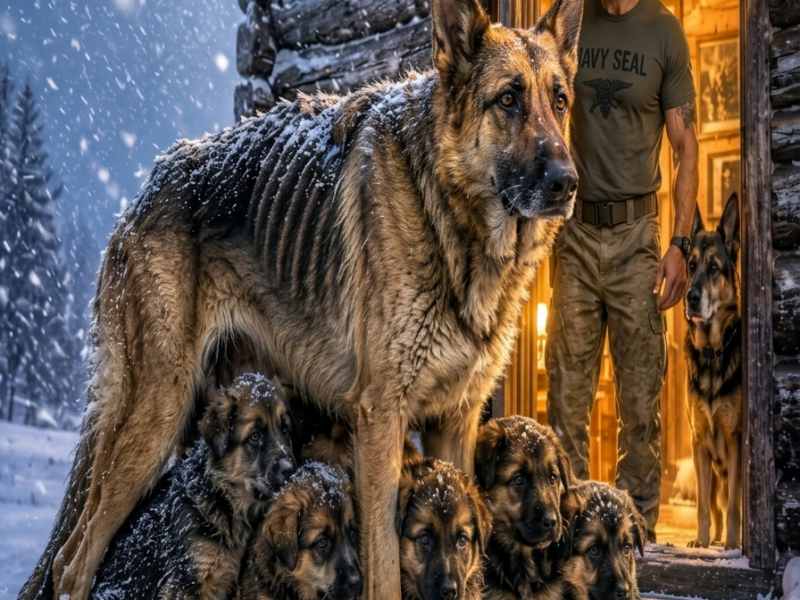
The fifth puppy was left trembling on my porch in the rain, and when I opened the door, the mother K9 stared at me like I had betrayed her
The rain did not fall; it drove hard against the wooden planks of my porch, a relentless assault that mirrored the steady drumbeat of my own rising anxiety. The fifth puppy was left trembling on the top step, a tiny, shivering mass of dark fur practically swallowed by the storm. When I opened the heavy oak door, the wind howled through the gap, but my attention was instantly anchored to the yard. The mother K9 stood at the edge of the tree line, illuminated only by the faint, flickering glow of the porch light. She stared at me. It was not a look of pleading, nor was it the typical submission of a stray seeking shelter. She stared at me like I had betrayed her.
This had been going on for days. She had been bringing me her offspring for three consecutive nights, and despite my training, despite everything I thought I knew about tracking and observation, I still did not know where she lived or how she was moving so silently.
I was a former United States Navy SEAL. I had spent over a decade in the most hostile environments on the planet. I knew how to read fear in an animal’s eyes, just as I knew how to read desperation in a man’s. But there was something entirely different about the gaze of this dog. She was not begging for my help. She was leading me. She was assessing me.
The sequence of events played in my mind like a mission debrief. The first night, the storm had been just as violent. I had stepped out to secure a loose shutter when she materialized from the darkness. She dropped a tiny black-and-white puppy directly beside my tactical boots. She did not whine. She simply waited until I crouched down, cautiously extending a hand, and then she vanished back into the pitch-black woods without making a single sound. I brought the puppy inside, dried it with a thick wool towel, and fed it a mixture of warm milk from a dropper.
The next morning, the gray light revealed the second offering. I found another puppy, this one a solid, dusty brown, curled tightly against the metal of my garage door, shivering violently. I brought it inside to join its sibling. By the third night, when a third puppy appeared in a hollowed-out planter box near the steps, I stopped wondering if this was a bizarre coincidence.
“Where are you getting these babies?” I had whispered into the freezing rain that third night, looking directly into the mother’s amber eyes. She only watched me from a distance, her posture rigid, her ears swiveled forward. I had called a local rescue center, left voicemails, even tried to lure her inside with raw meat. Every time I stepped forward, she backed away, maintaining an exact distance between us, always staying just out of reach.
Then came the fourth night. The fourth puppy.
I had opened the door before she even reached the porch, anticipating her arrival. She set the small creature down on the welcome mat. I knelt, reaching for the shivering animal. As my fingers brushed against the puppy’s neck, I felt something hard. A collar. Strays did not have collars. I brought the puppy into the light of the hallway and froze. My lungs suddenly felt completely empty, as if the air pressure in the room had vanished.
It was a small, faded red collar. Hanging from it was a scratched, tarnished brass tag. I turned it over with trembling fingers. The name engraved on the metal was deeply worn but undeniable.
“Ranger.”
That name hit me harder than a physical blow. The world tilted on its axis. My service dog, my partner in the darkest corners of the earth, had been named Ranger. He was a Belgian Malinois who had died six years earlier, giving his life to drag me by my tactical vest out of a burning, overturned transport vehicle in a combat zone overseas. I had survived because he had not. The guilt and the grief were scars I carried every single day.
I had stared at the puppy with the red collar, my heart hammering against my ribs, while the mother K9 stood just outside the open doorway, silent and strangely calm. She did not retreat that time. She watched me break down, watched the tears I had not shed in six years fall onto the puppy’s fur.
Now, on the fifth night, she brought the fifth puppy. The rain was freezing, slicing through the air like glass. I scooped up the trembling newborn, tucking it inside my thick jacket against the warmth of my chest.
This time, she stayed.
She did not retreat to the edge of the light. She stood her ground on the muddy grass, water streaming down her dark muzzle. She looked toward the dense, impenetrable woods behind my property, then turned her head back to me. She did it twice. A deliberate, calculated motion.
I knew exactly what she wanted.
I stepped back inside just long enough to place the fifth puppy in the heated whelping box I had built in the living room alongside the others. I grabbed my heavy-duty waterproof flashlight, slipped my sidearm into my shoulder holster—an old habit that refused to die—and pulled on my boots.
I stepped back out into the storm and locked my eyes on the mother K9.
“Okay,” I said quietly, the word barely carrying over the roar of the rain. “Show me.”
She turned and ran.
I followed her into the dark. The trees swallowed the ambient light from my house almost instantly, plunging us into a chaotic void of shadows and driving rain. The beam of my flashlight cut a narrow, bouncing path through the dense underbrush, illuminating the thrashing branches and the silver streaks of water falling from the canopy.
The mother K9 moved with incredible purpose. She did not check to see if I was following; she expected me to keep up. I was forced to push my physical limits, relying on years of military conditioning to navigate the treacherous, uneven terrain without breaking an ankle. We pushed deeper into a section of the woods I had never explored, crossing a swollen, fast-moving creek. The icy water surged over the tops of my boots, numbing my feet instantly, but the dog leaped across the rocks with practiced grace.
We descended a steep, muddy slope, the ground giving way beneath my heels. I slid the last ten feet, catching myself on the rough bark of an ancient oak tree. When I swept the flashlight forward, the beam caught the dull reflection of wet, rotted wood.
She had stopped beside an abandoned hunting shed.
The structure was half-buried beneath fallen pine branches and years of decaying leaves. The roof was sagging, covered in thick green moss, and the wooden door hung precariously on a single rusted hinge. The mother K9 sat beside the entrance, staring at me, the rain plastering her fur to her ribs. She was panting softly, her mission accomplished.
I approached the shed with absolute caution. My hand instinctively hovered over the grip of my sidearm. I nudged the door with the toe of my boot. It groaned in protest before swinging inward, scraping against the dirt floor. I stepped inside, sweeping the flashlight beam across the interior.
The smell hit me first. It was not the scent of death or decay, but a heavy, damp odor of wet wool, old dust, and rusted iron.
In the corner, I found a makeshift bed constructed from heavy moving blankets. They were torn and heavily soiled, clearly where the puppies had been born and kept. Nearby sat three empty, rusted cans of premium dog food, the labels entirely washed away by time and moisture. A heavy leather dog leash, snapped cleanly in half, lay coiled near the door.
But it was what covered the center of the floor that made my blood run cold.
Scattered across the damp earth were dozens of photographs. They were slightly curled at the edges from the humidity, but miraculously preserved. I dropped to my knees, shining the light directly onto them.
Every single photograph showed the same woman. She was young, smiling, with dark hair tied back in a messy braid. In every picture, she was holding a dark-furred K9 as a young puppy. The dog had a distinct white patch over its left eye—the exact same marking as the mother dog sitting outside the shed.
My hands began to shake as I picked up the photographs one by one. The woman’s face tugged violently at a memory buried deep within my subconscious. It was a face I had seen in dreams I could never fully remember upon waking.
I reached for the last picture, separated from the others, resting near a rusted tin box. The photograph was slightly larger, the colors slightly more faded. The woman was standing in a sunlit field, the K9 at her feet, and she had her arm wrapped tightly around the shoulders of a little boy.
My breath caught in my throat. The sound of the storm outside vanished, replaced by a deafening ringing in my ears.
I knew that little boy’s face.
It was mine.
I stared at the image, tracing the features of the child with my thumb. The photograph was taken at least twenty-three years earlier, decades before I joined the Navy, decades before I even understood what loss meant. But how could this be here? My mother had died in a car accident when I was four years old. I had grown up in the foster system. I had no memories of her, no photographs, no heirlooms. I had certainly never owned a dog as a child.
My mind raced, trying to force the puzzle pieces together, but the edges were all wrong. The dog in the picture with my mother was identical to the dog outside. The red collar belonging to my dead service partner. The empty food cans. The timeline was impossible.
“How…” I whispered to the empty shed, my voice cracking.
Before I could form another thought, the mother K9 outside let out a low, vibrating growl. It was not a warning directed at me. It was a threat directed at the woods.
I spun around, dropping the photograph and drawing my weapon in a single, fluid motion. I killed the flashlight, plunging the shed into absolute darkness, and pressed my back against the rotted wall beside the door frame. I held my breath, listening.
Over the sound of the rain, I heard the distinct, deliberate crunch of a heavy boot stepping onto a dry branch.
I peered around the edge of the door frame, letting my eyes adjust to the ambient gray of the storm. A man was standing at the edge of the trees, about twenty yards away. He was tall, broad-shouldered, wearing a heavy waxed canvas coat that absorbed the rain. He made no sudden movements. He just stood there, looking directly at the shed.
“You finally found her,” the man said. His voice was deep, gravelly, and completely calm, cutting through the noise of the weather with eerie clarity.
My hand tightened around the grip of my pistol. I kept it aimed center mass. “Step into the light. Keep your hands where I can see them. Who the hell are you?”
The man did not raise his hands, but he stepped forward slowly, stopping just a few feet from the mother dog. She did not attack him; her growl subsided into a low rumble. He smiled, and in the dim light, the expression looked incredibly sad.
“Someone who promised your mother I’d never tell you what happened,” he replied.
Then he looked toward the shed, his eyes seeming to pierce right through the darkness to where I stood. “And those aren’t the first puppies she’s brought here.”
The man’s words hung in the freezing air, heavy and suffocating. My mind struggled to process the sheer impossibility of what he was saying, but my training demanded absolute focus on the immediate threat. My weapon remained steady, locked on his chest.
“Explain yourself,” I demanded, stepping slowly out of the shed. The rain immediately began to soak through my jacket, but I barely felt the cold. “You have exactly ten seconds before I put you on the ground. Who are you, and how do you know about my mother?”
The stranger sighed, a heavy exhalation that plumed in the cold air. He reached slowly into his coat. “Easy, son. I’m just reaching for an envelope. Nothing sharp, nothing loaded.”
“Two fingers. Pull it out slow,” I commanded.
He did as instructed, producing a small, waterproof plastic pouch. He tossed it underhanded. It landed in the mud halfway between us.
“My name is Elias,” the man said, shoving his hands into his coat pockets. “I was your mother’s handler. And before you ask, no, I don’t mean in a biological sense. I mean in a professional capacity. Your mother didn’t die in a car accident. She was killed because of what she bred, and because of what she knew.”
I stared at him, the rain washing the mud from the plastic pouch at my feet. “You’re out of your mind. My mother was a high school teacher.”
“Your mother was a geneticist contracted by the Department of Defense,” Elias corrected, his tone unwavering. “She specialized in behavioral epigenetics in canines. She was developing a lineage of military working dogs that didn’t just learn commands—they inherited memories. Instincts. Protective protocols passed down through blood.” He gestured down to the mother dog, who was now sitting calmly at his side. “This is Echo. She is the fourth generation of your mother’s prime subject. Ranger—your Ranger, the one who died in the fire—he was from the third.”
My chest tightened so painfully I thought my ribs might crack. “Ranger was a standard military issue Malinois. I picked him from the kennel myself.”
“You were guided to him,” Elias said softly. “Just as he was guided to you. It was designed that way. Your mother’s dying wish was that her work would protect you, even if she couldn’t. Ranger died pulling you from that fire because that is what he was bred to do. To protect you at all costs.”
I shook my head, refusing to let the impossible logic take root in my brain. “This is insane. Why am I here? Why is this dog bringing me puppies?”
“Pick up the pouch,” Elias said.
Keeping my gun trained on him with one hand, I crouched and retrieved the plastic envelope. I backed away, tearing the seal open with my teeth. Inside was a single, laminated photograph.
I aimed the flashlight at it. It was a surveillance photo, taken from a high vantage point, showing the front of my house. The time stamp in the bottom corner was recent. Written on the back of the photo in thick black marker was my full name. And beneath that, a date.
Tomorrow’s date.
I felt the cold spread through my chest, freezing the blood in my veins. “What is this?”
“Echo hasn’t just been bringing you puppies to be a good mother,” Elias said, his voice dropping to a grim, urgent register. “She’s been evacuating them. She knows they are coming. The people who ordered the hit on your mother twenty-three years ago. The same people who set the fire that killed Ranger overseas. They never stopped hunting the bloodline. They realized Ranger wasn’t the last of the line. They tracked Echo here. And by extension, they tracked you.”
The mother dog whined, pacing back and forth nervously, looking up at the ridge behind us.
“They want the dogs, and they want the data your mother hid,” Elias continued. “Tomorrow’s date on that photo? That wasn’t a warning left for you. It was an extraction schedule I intercepted from their communications. Tomorrow is when they plan to raid your property.”
“If tomorrow is the date,” I said, my tactical mind rapidly shifting gears, assessing angles, sightlines, and defensive positions, “then why is the dog acting like this right now?”
Elias looked up at the black sky, the rain continuing to pour down in sheets. A flash of lightning illuminated his scarred, weathered face. Thunder rolled through the valley a second later, shaking the ground beneath our boots.
“Because in our line of work,” Elias said grimly, pulling a suppressed submachine gun from beneath his long coat, “nobody ever attacks on schedule. They’re already here.”
Above us, on the ridge line, a beam of harsh white light cut through the trees, sweeping across the canopy. Then another. And another. There were at least a half-dozen men moving through the woods, sweeping the perimeter of my property.
“We need to move,” I said, the shock of the revelations instantly replaced by the cold, calculating adrenaline of a SEAL in a combat zone. “Now.”
Elias nodded. He looked at Echo. “Bring them home, girl.”
The dog didn’t need to be told twice. She bolted up the muddy slope toward my house, moving faster than I thought possible. Elias and I followed, sprinting through the storm, the beams of the enemy flashlights slicing through the dark woods behind us. The hunt had begun, and the ghosts of my past were the ones pulling the trigger.
The sprint back to the house was a blur of tearing branches, slick mud, and burning lungs. My mind operated in two distinct, parallel tracks: one furiously processing the shattering truth about my mother, my childhood, and the dog that had saved my life; the other, cold and mechanical, calculating the tactical defense of my property.
We burst through the tree line and onto the manicured lawn of my backyard. The house stood dark against the storm. I had installed heavy deadbolts and reinforced doors, but against a coordinated mercenary strike, drywall and glass were merely suggestions.
“Through the back!” I yelled over the thunder, waving Elias toward the mudroom entrance. Echo was already waiting at the door, her fur matted, her eyes wide with frantic energy.
I unlocked the door, shoved them inside, and slammed it shut, instantly throwing the deadbolt. I moved methodically through the house, killing every light, unplugging lamps, and plunging the interior into total darkness.
“How many?” I asked Elias, moving toward my hidden gun safe in the hallway floor.
“Six on the ridge, maybe a four-man breach team approaching from the front road,” Elias replied, shaking the water from his coat and checking the magazine of his weapon. “They’re highly trained. Private sector. They won’t make noise until they have to.”
I spun the dial on the safe, pulled the heavy steel door open, and retrieved my customized AR-15, three spare magazines, and a tactical rig. I tossed a spare sidearm to Elias. “Take the upstairs landing. It covers the front door and the west windows. I’ll take the kitchen—it gives me a sightline to the back porch and the tree line. If they breach, we create a crossfire.”
“What about the dogs?” Elias asked.
I looked toward the living room. In the dim glow of the lightning flashing outside, I could see Echo standing over the whelping box. The five puppies were huddled together, completely silent. It was unnatural. Puppies that age should have been whimpering from the cold and the noise. But they were absolutely still. They knew.
“Basement,” I said. “There’s a root cellar reinforced with cinder block. It’s the safest place in the house.”
I didn’t need to move them. Echo carefully picked up the closest puppy by the scruff of its neck and trotted toward the basement door. I opened it for her, and she vanished down the stairs. She would make the trips herself. She was bred for this.
I moved into the kitchen, keeping low, the AR-15 pressed tightly against my shoulder. I peered through the edge of the blinds. The rain was coming down so hard it distorted the view of the yard, creating a shifting, shadowy landscape.
For ten agonizing minutes, there was nothing but the sound of the storm. The wind battered the side of the house, rattling the window frames. Every creak of the floorboards above me, where Elias was positioned, felt like an explosion in the silence of my own head.
Then, the motion sensor light on the corner of the garage shattered.
It wasn’t a loud pop, just the subtle tink of a suppressed round hitting glass, followed immediately by total darkness in that sector.
“They’re advancing,” I whispered into the darkness, knowing Elias couldn’t hear me, but needing to say it aloud.
Shadows detached themselves from the tree line. They moved with terrifying precision, utilizing the blind spots in the house’s architecture, keeping low, their weapons raised. I counted four men moving toward the back porch.
I took a breath, letting the oxygen flood my system, slowing my heart rate. I flipped the selector switch on my rifle off safe.
The back door handle clicked. Once. Twice. Someone was picking the lock.
I didn’t wait for them to succeed. I aimed chest-high through the heavy oak of the door and squeezed the trigger. Three rounds punched right through the wood in a tight grouping. A heavy thud sounded on the porch, accompanied by a muffled groan.
Instantly, the glass of the kitchen window shattered inward as suppressed return fire chewed through the drywall above my head. I dropped to the floor, crawling backward as the kitchen island absorbed the brunt of the assault. Wood splintered and plates shattered in the darkness.
“Front door!” Elias shouted from upstairs, followed by the deafening roar of his weapon. The flashes illuminated the staircase in strobe-like bursts of yellow light.
They were hitting us from both sides simultaneously.
I rolled out from behind the island, acquiring a target through the broken window, and fired two quick shots. A dark figure stumbled and fell into the azalea bushes. But another immediately took his place, tossing a small, heavy cylinder through the broken glass. It bounced across the linoleum floor.
Flashbang.
I squeezed my eyes shut and covered my ears, opening my mouth to equalize the pressure. The explosion was blinding, shaking the floorboards and filling the kitchen with acrid white smoke. My ears rang violently, disorienting me.
Through the smoke, the back door was kicked open. A massive figure stepped into the kitchen, an assault rifle raised. I was still on the floor, momentarily blinded, struggling to bring my weapon up in time.
Before the intruder could pull the trigger, a dark blur launched out of the smoke from the hallway.
Echo.
She didn’t bark. She didn’t growl. She hit the man directly in the chest with the force of a freight train, her jaws clamping down viciously on his forearm. The man screamed, his weapon discharging wildly into the ceiling as he crashed backward into the doorframe.
Echo was relentless, tearing and thrashing, a manifestation of engineered fury. She was protecting her bloodline. She was protecting me.
I recovered my footing, raised my rifle, and neutralized the threat as the man tried to reach for a secondary weapon. Echo released him immediately, retreating back into the shadows to guard the basement door.
“Elias!” I yelled, pushing through the smoke toward the living room. “Status!”
There was no answer.
I moved to the bottom of the stairs, my weapon raised. “Elias!”
A heavy boot stepped into view at the top of the landing. It wasn’t Elias. It was a man wearing advanced tactical gear, a night-vision mount pushed up on his helmet. In one hand, he held his weapon. In the other, he was dragging Elias by the collar of his coat. Elias was bleeding heavily from a wound in his shoulder, his eyes glazed.
The man at the top of the stairs looked down at me, a cruel, satisfied smile visible beneath his balaclava.
“Drop the rifle,” the man commanded, his voice modulated by a radio headset. “Or your mother’s guardian angel dies right here. And then I go down into that basement and exterminate the rest of the experiment.”
The standoff felt like it stretched into eternity. The storm outside raged on, but inside the house, the air was dead and thick with the smell of cordite and copper. I kept my rifle aimed dead center at the tactical helmet of the man holding Elias. My finger rested lightly on the trigger, the slack already taken up. One millimeter of pressure, and his skull would shatter.
But he had his weapon pressed directly beneath Elias’s jaw. It was a zero-sum game, and the math was against me.
“I said drop it,” the man repeated, his voice devoid of emotion.
“You shoot him, you die a millisecond later,” I replied, my voice steady, betraying none of the chaos churning in my chest.
“I’m willing to make that trade,” the man said. “My objective isn’t survival. It’s the erasure of the asset.”
I calculated the distance. Fourteen stairs. Approximately twenty feet. Too far for a physical disarm. Too close to risk a ricochet.
From the darkness of the hallway beneath the stairs, I heard a sound. It wasn’t a growl. It was a soft, almost imperceptible click of claws on hardwood. Echo. She had crept out from the basement door and was positioned directly below the staircase, completely invisible in the shadows.
I needed to buy three seconds.
“Why?” I asked, raising my voice just enough to command his attention. “You killed my mother twenty-three years ago. You killed my dog in a warzone six years ago. What makes this bloodline so dangerous to you that you’re willing to die on a stranger’s staircase?”
The man chuckled, a dry, rasping sound. “You think she just bred loyal dogs? Your mother cracked a genetic sequence that terrified the people who sign my paychecks. These animals don’t just remember training. They remember faces. They remember enemies. The original dog, the one your mother held in those photos? It recognized the operative who killed her. It hunted him down three years later, across international borders, and tore his throat out. The trait is passed down. They are biological heat-seeking missiles with a generational memory. As long as they exist, the people who ordered the strike on your mother are not safe.”
He shifted his weight, preparing to execute Elias. “That’s enough history for one night.”
“Echo,” I whispered. “Strike.”
It was a command I hadn’t used in six years. A command I had only ever given to Ranger.
The mother dog didn’t run up the stairs. She launched herself through the decorative wooden balusters on the side of the staircase, a vertical leap of pure, explosive power. She shattered the wood, bypassing the vertical distance entirely, and slammed directly into the side of the mercenary.
The impact was devastating. The man was thrown off balance, his shot going wide, burying itself into the ceiling plaster. Elias immediately dropped his dead weight, rolling down the top three steps to clear the line of fire.
The mercenary tried to throw Echo off, swinging his weapon like a club, but her jaws were locked onto his shoulder gear. She was a furious, thrashing weight, dragging him toward the edge of the landing.
I sprinted up the stairs, taking them three at a time. The man finally managed to draw a combat knife, raising it to plunge into Echo’s neck.
I didn’t hesitate. I drove the stock of my rifle into the side of his helmet with every ounce of strength I possessed. The sickening crack of impact echoed through the hallway. The man collapsed instantly, sprawling unconscious across the top of the stairs.
Echo let go, panting heavily, and immediately positioned herself between the downed man and Elias, her teeth bared.
I quickly kicked the man’s weapons away and secured his hands with heavy zip-ties from my tactical rig. I knelt beside Elias, examining his shoulder. The bullet had passed clean through the fleshy part of his deltoid. He would live, but he was losing blood quickly.
“I’ve got you,” I said, ripping a field dressing from my vest and applying heavy pressure to the wound.
Elias winced, gritting his teeth, but managed a faint smile. “She’s… exactly like the first one,” he gasped, looking at Echo. “Your mother… she would have been so proud.”
“Save your strength,” I told him.
The rest of the night was a blur of tactical cleanup. The assault force had broken. With their leader captured and several of their men down, the remaining operatives retreated into the woods, abandoning the mission. I didn’t pursue them. My priority was the house, Elias, and the dogs.
By the time the first gray light of dawn broke through the storm clouds, the police and emergency medical teams had arrived. Elias had made a single phone call before passing out, speaking in coded numbers to a shadowy contact. When the authorities showed up, they weren’t local police; they were federal agents driving unmarked black SUVs. They processed the scene with alarming efficiency, sweeping away the bodies, the captured leader, and the evidence of the firefight.
A man in a sharp suit approached me on the front porch as the paramedics loaded Elias into an ambulance.
“Elias will recover,” the suited man said, not offering his name. “He’ll be relocated. So will the people who ordered this attack. We have the leverage we need now. They won’t bother you again.”
“And the dogs?” I asked, my voice hard.
The man looked at Echo, who was sitting obediently by my side. “They are your property. Your mother’s legacy. Keep them safe.” He turned and walked away, disappearing into the morning mist.
I stood on the porch, watching the taillights of the ambulance fade down the driveway. The rain had finally stopped. The air smelled of wet pine and ozone, fresh and clean.
I looked down at Echo. She looked up at me, her amber eyes soft, the tension of the past five nights entirely gone. She nudged my hand with her wet nose.
We walked back inside, navigating the debris of the kitchen, and made our way down to the basement. I opened the door to the root cellar.
The five puppies were clumsily tumbling over each other on the thick blankets. They squeaked and yipped as Echo stepped into the enclosure, instantly swarming her to nurse.
I knelt beside the box, gently reaching out. I picked up the fourth puppy, the one with the red collar. He blinked up at me, his tiny tail wagging furiously against my palm. I ran my thumb over the tarnished brass tag. Ranger.
They weren’t just dogs. They were a promise. A bridge across time, built by a mother who knew she wouldn’t be there to protect her son, but who ensured he would never have to walk through the darkness alone.
I looked at the five puppies, then at Echo, who rested her chin proudly on her paws.
“Welcome home,” I whispered.
The end.









