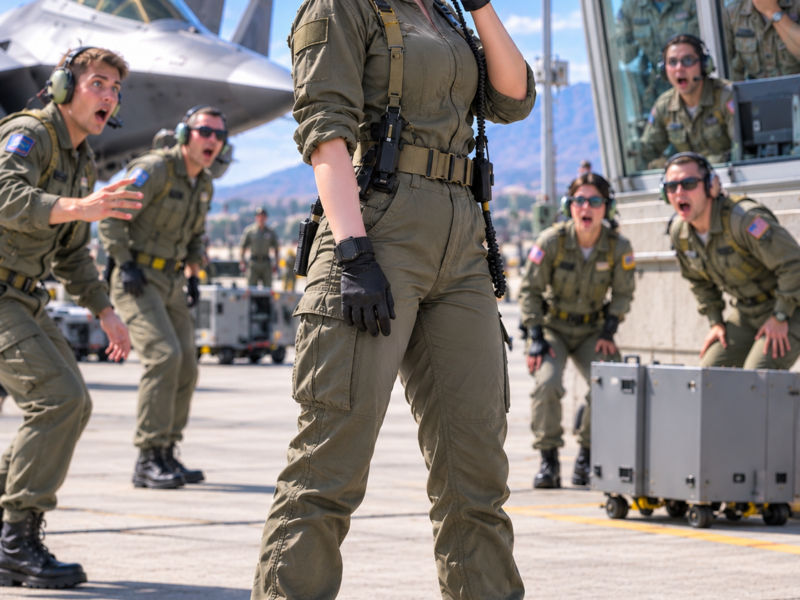
“The F-22 was seconds from being grounded at an airbase in Nevada when a young woman in a grease-stained flight suit stepped away from the maintenance crew
The voice on the restricted channel repeated my name.
“Emily, if that’s really you, tell me one thing. Who gave you permission to come back?”
I tightened my grip on the radio.
For six years, I had imagined hearing that voice again. In some dreams, I was angry. In others, I couldn’t speak.
Now, standing in a Nevada hangar with a colonel staring at me, I managed only three words.
“Major, it’s me.”
A burst of static followed.
Then the voice said, “God help us. What have they done?”
Colonel Hayes stepped toward me.
“Hand me that radio. Now.”
I didn’t move.
“Sir, I need you to listen. Captain Brooks is experiencing the same control anomaly we encountered during Operation Nightglass.”
The name meant nothing to the technicians.
But it meant something to the man on the radio.
“Emily, listen carefully,” he said. “Do not let them reset the flight-control system.”
Hayes snatched the handset from my hand.
“Identify yourself!”
The answer came through clearly.
“Major Thomas Reed. Former commander, classified flight evaluation detachment.”
Hayes’s expression changed.
I’d seen him angry, impatient, and dismissive.
I’d never seen him uncertain.
“Major Reed,” he said, “this is Colonel Richard Hayes. You’re transmitting on a restricted channel without authorization.”
“Then authorize it.”
“You’re not in my chain of command.”
“Neither is the problem you’re about to create.”
The colonel looked toward the aircraft.
“Explain yourself.”
Reed didn’t answer immediately.
Instead, he asked, “Is Emily Carter standing next to you?”
Hayes looked at me.
“Yes.”
“Then stop treating her like a maintenance technician and start listening to her.”
Nobody said a word.
The aircraft remained stationary near the runway.
Captain Brooks was still inside, trying to maintain control of systems that were becoming increasingly unpredictable.
I stepped forward.
“Sir, we need to establish communication with Captain Brooks through the backup channel. He needs to keep the aircraft on the ground and avoid any unnecessary system changes.”
Hayes stared at me.
“How do you know that?”
I swallowed.
“Because I watched another pilot make the wrong decision six years ago.”
That was when the past finally caught up with me.
Six years earlier, I hadn’t been Emily Carter, the quiet girl who checked equipment and changed hydraulic filters.
I’d been Lieutenant Emily Carter, an experimental flight-test officer assigned to a small evaluation program at Edwards Air Force Base.
I’d spent years learning to fly aircraft most pilots would never be permitted to touch.
I had been selected for the program because I understood something the other candidates didn’t.
I understood how a pilot could lose control without realizing the aircraft was no longer responding to him.
Major Thomas Reed had been my instructor, commander, and eventually the closest thing I’d had to family in the military.
He taught me to trust instruments, but never blindly.
“An aircraft can lie to you,” he’d once said. “The trick is knowing when it’s doing it.”
Operation Nightglass was supposed to be a routine evaluation of a new flight-control architecture.
The program involved a series of controlled tests, each designed to identify weaknesses before the system could be considered for wider operational use.
During the final test, Lieutenant Michael Lawson’s aircraft experienced a catastrophic control anomaly.
I was flying the support aircraft.
I heard his voice change.
At first, he sounded annoyed.
Then confused.
Then frightened.
He reported that the aircraft was making corrections he hadn’t commanded.
The ground team insisted the telemetry showed normal behavior.
But I could see something they couldn’t.
His aircraft was fighting him.
I tried to guide him through the emergency procedures.
The communications system failed.
The next few minutes were the longest of my life.
Michael’s aircraft went down before emergency support could reach him.
He didn’t survive.
The investigation blamed pilot error and an unauthorized deviation from the approved flight envelope.
I knew that conclusion was wrong.
I had heard the control anomalies myself.
I had watched the telemetry.
And I had submitted a report documenting every irregularity.
Three days later, my report disappeared.
The official version of events was revised.
I was questioned for hours.
Eventually, I was informed that my actions during the mission were under review.
I had been accused of transmitting unauthorized instructions and interfering with the test.
Major Reed defended me.
But the investigation had already moved beyond the people who had witnessed the incident.
I was given a choice: accept a medical separation and sign a confidentiality agreement, or face a lengthy disciplinary investigation that could destroy my career.
My father’s health had deteriorated that year.
My mother had died when I was young, and I was the only family he had.
I signed.
I left the program.
I changed assignments.
And eventually, I ended up at Redstone, where nobody knew what I had once done.
Except one person.
Major Reed.
Back in the hangar, Hayes was still holding the radio.
“You’re telling me this incident is connected to a six-year-old experimental program?”
“I’m telling you the same pattern is happening again,” I replied.
Miller looked between us.
“Ma’am, are you saying the aircraft was deliberately compromised?”
“I don’t know yet.”
I turned toward the diagnostic monitor.
“But I know the warning isn’t random.”
Hayes looked toward the tower.
“Get me Captain Brooks.”
The tower responded almost immediately.
“Colonel, Two-One is reporting another control fluctuation. The pilot is requesting instructions.”
I moved closer to the radio.
“Captain Brooks, this is Carter. Can you hear me?”
Static.
Then his voice.
“Yeah, Carter. I’m here.”
“Captain, I need you to tell me exactly what the aircraft is doing.”
“My inputs are delayed. Sometimes the aircraft responds before I make the correction. It feels like something is anticipating my movements.”
I exchanged a glance with Miller.
That was almost exactly what Michael Lawson had said six years earlier.
“Are you seeing any changes in the flight-control status?”
“Yes. There’s a warning that keeps appearing and disappearing.”
“What does it say?”
“Adaptive response synchronization.”
My stomach tightened.
That phrase wasn’t supposed to exist in the current maintenance documentation.
I looked at Miller.
“Pull up the system event log. Don’t reset anything.”
He nodded and hurried to the workstation.
Hayes stepped between us.
“Why?”
“Because a reset could erase the sequence we’re trying to understand.”
“That’s an extraordinary claim.”
“Then don’t take my word for it. Look at the data.”
Miller opened the event history.
Within seconds, his expression changed.
“Colonel…”
“What?”
“This aircraft received a software configuration update last night.”
Hayes frowned.
“That was an approved update.”
“Yes, sir. But the configuration doesn’t match the version listed in the maintenance record.”
“How different?”
Miller leaned closer.
“There’s an additional control module.”
I felt the room grow smaller.
“What module?”
He read the identifier.
I recognized it immediately.
NIGHTGLASS-7.
For six years, I had tried to forget that designation.
I looked at the colonel.
“Sir, somebody brought the old program back.”
Hayes didn’t answer.
Then Major Reed spoke through the radio.
“Emily, I need you to understand something. Nightglass wasn’t canceled because it failed.”
I stared at the handset.
“Then why was it canceled?”
“Because someone decided the failure was useful.”
Before I could ask what he meant, the tower interrupted.
“Colonel Hayes, we have an incoming aircraft approaching the restricted airspace.”
Hayes looked toward the control-room display.
“Identify it.”
“Unknown at this time. No standard flight plan. It’s transmitting a military identification code, but the registry isn’t matching.”
Reed’s voice returned.
“Emily, get away from that aircraft.”
“Why?”
“Because if Nightglass-7 is active, the system may be communicating with something outside the aircraft.”
I stared at the monitor.
A new line appeared beneath the event log.
REMOTE LINK ESTABLISHED.
Then another.
REMOTE COMMAND RECEIVED.
Miller whispered, “That’s impossible.”
I leaned closer.
“Who has access to this network?”
He shook his head.
“Nobody outside the authorized flight-test environment.”
The radio crackled.
Captain Brooks spoke again.
“Carter, something just changed.”
“What?”
“My flight-control display is showing a new command.”
“What does it say?”
There was a pause.
Then he read the words aloud.
“Manual override requested.”
Hayes grabbed the radio.
“Captain, reject the command.”
“Sir, I don’t have an option to reject it.”
I looked at the screen.
A countdown had begun.
Thirty seconds.
Twenty-nine.
Twenty-eight.
I remembered the same sequence from Operation Nightglass.
It had been the final stage of the test that killed Michael.
“Colonel, evacuate the immediate area and clear the runway.”
Hayes looked at me.
“You’re not authorized to issue orders.”
“Then give them yourself!”
For the first time that morning, he didn’t argue.
He turned toward the operations crew.
“Clear the runway. Get emergency response in position. Nobody approaches the aircraft until we know what’s happening.”
I grabbed the backup radio.
“Captain Brooks, listen to me. Do not accept any external control command.”
“Understood.”
“Keep your hands off the system configuration controls.”
“Copy.”
The countdown reached twelve seconds.
Then something unexpected happened.
The remote command disappeared.
The aircraft’s warning indicators went dark.
For several seconds, the hangar was silent.
Captain Brooks exhaled.
“Whatever that was, it’s gone.”
Hayes looked at the display.
“Did we just lose the fault?”
“No, sir,” Miller said.
He pointed to a new line.
“Someone terminated the connection.”
Reed’s voice came through.
“Emily, that’s not good.”
I stared at the monitor.
“Why?”
“Because whoever sent that command knows you recognized it.”
The unknown aircraft appeared on the tower’s radar.
It was circling beyond the perimeter.
Then it turned away.
No flight plan.
No explanation.
Just gone.
Hayes ordered a full security lockdown.
Within twenty minutes, the hangar had been sealed, the aircraft secured, and every technician involved in the incident questioned.
I was taken to a small briefing room.
Colonel Hayes sat across from me.
He had removed his flight cap and placed it beside a folder.
For the first time since I’d arrived at Redstone, he looked directly at me.
“Who are you, Carter?”
I folded my hands.
“You’ve had my personnel file for eleven months, sir.”
“I’ve read it.”
“Then you know who I am.”
“No. I know what your file says. I want to know why a former flight-test officer with a classified operational history is working on my ground crew.”
I looked at the table.
“Because I wanted a quiet life.”
“That’s not an answer.”
“It’s the only one I have.”
He opened the folder.
Inside were copies of my old flight records.
My qualifications.
My evaluation reports.
And the official investigation into Michael Lawson’s death.
Hayes turned one page.
“Your report says you identified an anomaly before the crash.”
“Yes, sir.”
“It also says you failed to follow the approved communications procedure.”
“I was trying to keep another pilot alive.”
He studied me for a long moment.
“Why didn’t you fight the investigation?”
I thought about my father sitting in a hospital room, waiting for me to come home.
I thought about the letters I’d received from the investigation board.
And I thought about Major Reed standing outside my office after the final hearing, telling me he was sorry.
“Because I was twenty years old, sir. And I was afraid.”
Hayes closed the folder.
Before he could respond, the door opened.
A security officer entered.
“Colonel, Major Reed has arrived.”
Hayes stood.
“He’s here?”
“Yes, sir. He insists on speaking with Lieutenant Carter.”
I hadn’t heard anyone call me lieutenant in years.
I stood slowly.
“Where is he?”
The officer hesitated.
“Outside, ma’am.”
I walked into the corridor.
Major Thomas Reed was waiting near the security desk.
He looked older than I remembered.
His hair had gone almost entirely gray, and he leaned slightly on his left leg.
But his eyes were the same.
For a moment, neither of us spoke.
Then he said, “You cut your hair.”
I almost laughed.
“Six years will do that.”
He looked at me as if he wanted to say something else.
Instead, he reached out and handed me a small envelope.
“Your father asked me to give you this if the program ever came back.”
My fingers stopped moving.
“My father?”
Reed nodded.
“He contacted me shortly before he died.”
I stared at the envelope.
My father had passed away eighteen months earlier.
I’d known he had been worried about my military career, but he’d never mentioned contacting Reed.
“What’s inside?”
“I don’t know. He asked me not to open it.”
I turned the envelope over.
My name was written across the front in my father’s familiar handwriting.
Emily.
Nothing else.
I opened it carefully.
Inside was a photograph.
It showed my father standing beside a younger Thomas Reed outside a hangar.
Both men were smiling.
On the back, my father had written a date.
It was three months before Operation Nightglass.
Beneath the date were six words.
They knew before Michael ever took off.
I looked up.
“Major, what does this mean?”
Reed’s expression hardened.
“Your father was an electrical engineer. He worked as a civilian contractor on the early Nightglass architecture.”
I read the words again.
“He never told me.”
“He wanted to protect you.”
“From what?”
Reed glanced toward the briefing room.
“From the people who were funding the program.”
I felt a familiar pressure building behind my ribs.
“Who were they?”
Before he could answer, Hayes joined us.
“Major, I need you to explain why you’re carrying classified material onto my base.”
Reed looked at him.
“Because I have spent six years waiting for someone to ask the right questions.”
He reached into his jacket and removed a second folder.
“This is the original Nightglass investigation. Not the version that was distributed to the review board.”
Hayes took it.
He opened the first page.
His face changed as he read.
“What is this?”
“The original telemetry.”
“Where did you get it?”
“From someone who was supposed to destroy it.”
I looked at Reed.
“Why didn’t you give it to the investigators?”
“I tried.”
“And?”
“They told me the records didn’t exist.”
He turned to me.
“Emily, your father found something in the system before the first test. He discovered that the adaptive control architecture could accept remote commands without the pilot’s knowledge.”
I remembered the phrase from the monitor.
Remote command received.
“Was that why Michael died?”
“Not exactly.”
Reed took a breath.
“Michael’s aircraft was given a remote correction during a high-stress maneuver. The system interpreted it as an authorized instruction. He tried to compensate, but every correction triggered another response.”
I looked away.
For years, I had replayed those final transmissions in my head.
Now I understood why Michael had sounded so confused.
“He couldn’t control the aircraft.”
“No.”
“Someone was controlling it.”
Reed nodded.
“Someone was testing the system in a live environment.”
The hallway seemed suddenly too quiet.
Hayes closed the folder.
“You’re accusing someone of deliberately causing a fatal aircraft accident.”
“I’m telling you what the telemetry shows.”
“Who authorized the command?”
Reed hesitated.
Then he said, “The original authorization came from a senior program administrator. The identity was concealed behind a contractor access account.”
“Name?”
“Daniel Voss.”
Hayes’s expression tightened.
I recognized the name from the file.
Daniel Voss had been the civilian director overseeing the Nightglass contract.
I’d met him twice.
He had always been polite.
He’d once congratulated me after a successful evaluation flight.
At Michael’s memorial, he’d stood beside the family and told them how sorry he was.
I remembered his hand on Michael’s mother’s shoulder.
The thought made me feel sick.
“Where is he now?” I asked.
Reed looked at Hayes.
“He’s the deputy director of the Advanced Systems Integration Office.”
Hayes slowly closed the folder.
“That office oversees several current flight-control modernization contracts.”
“Exactly,” Reed said.
A security officer hurried down the corridor.
“Colonel, we have a problem.”
Hayes turned.
“What now?”
“Someone accessed the maintenance server remotely.”
“From where?”
“We’re tracing it.”
The officer glanced at me.
“There’s another issue. The access request was submitted using Lieutenant Carter’s old credentials.”
I felt the blood drain from my face.
“That’s impossible.”
Hayes looked at me.
“Your credentials were active?”
“They were supposed to be deactivated six years ago.”
Reed’s jaw tightened.
“Someone is trying to frame her.”
The officer continued.
“The system also shows that the access request originated from inside the base.”
Hayes reached for the folder.
“Lock down every terminal. Nobody leaves this facility without authorization.”
But the damage had already been done.
My old credentials had been used to access the same system that had nearly put Captain Brooks in danger.
And someone had made sure the request appeared to come from me.
For the next two hours, investigators interviewed everyone who had been near Hangar Three.
I gave them every detail I could remember.
The warning codes.
The configuration update.
The remote command.
The unidentified aircraft.
The old credentials.
I also told them about my father’s photograph.
They took copies of everything.
At first, Hayes seemed determined to keep the investigation contained within Redstone.
But when the digital forensics team found an encrypted file attached to the remote access request, his attitude changed.
The file was named E.CARTER_FINAL.
It contained a scanned copy of my original Nightglass report.
And at the bottom was a signature.
Mine.
Except I had never signed that version.
I recognized the document immediately.
It was a report I’d submitted six years earlier, before the investigation began.
Someone had altered the final paragraph.
The original stated that the aircraft’s control system had accepted an unauthorized remote command.
The altered version said I had personally initiated a test override without permission.
That was the accusation that had ended my career.
Only now I understood that the report hadn’t simply been changed after the accident.
Someone had prepared the false version before the investigation was even completed.
Hayes stood beside the screen.
“Can you prove this is a forgery?”
I pointed to the bottom corner.
“My original report has a digital verification code. The code on this copy is different.”
The analyst checked.
A few minutes later, he confirmed it.
“She’s right.”
Hayes rubbed his forehead.
“Who had access to the original?”
Reed answered quietly.
“Voss. The program security office. And the investigation team.”
Nobody spoke.
Then the analyst discovered something else.
The file had been accessed from a secure terminal in the administration building.
The login belonged to a senior civilian official visiting Redstone that morning.
Daniel Voss.
Hayes immediately ordered security to locate him.
But Voss was already gone.
His vehicle had left the base twenty-seven minutes earlier.
For a moment, I thought we’d lost our only chance.
Then the security officer returned.
“Colonel, we’ve located his vehicle.”
“Where?”
“At the visitor parking area outside the old communications facility.”
Reed looked at me.
“That’s where the original Nightglass network was housed.”
We went there with a security team.
The building had been closed for years.
Dust covered the windows, and the entrance was secured with an electronic lock.
The security officer tried the access panel.
A red light appeared.
“Restricted access.”
Hayes looked at Reed.
“Can you open it?”
Reed shook his head.
“Not with my credentials.”
I stepped closer.
There was a small maintenance panel beside the door.
I recognized the model.
It was the same one we’d used during the original test program.
I removed the cover and examined the wiring.
“Someone has bypassed the external lock.”
Hayes glanced at me.
“Can you get us inside?”
“Maybe.”
I found a manual release behind the panel.
The door clicked.
We entered.
The air smelled of dust, old wiring, and cold metal.
A row of inactive computer terminals lined the far wall.
At the center of the room, one monitor was still on.
A man stood in front of it.
Daniel Voss.
He turned when he heard us.
For a second, he looked surprised.
Then he smiled.
“Colonel Hayes. I was wondering when you’d arrive.”
Hayes raised his voice.
“Step away from the terminal.”
Voss glanced at me.
“Lieutenant Carter. It’s been a long time.”
I wanted to ask how he could look at me so calmly.
Instead, I said, “Why did you use my credentials?”
He tilted his head.
“Because they were available.”
“You almost killed Captain Brooks.”
“I didn’t touch his aircraft.”
“Then who sent the remote command?”
Voss sighed.
“You’re still asking the wrong questions.”
Reed stepped forward.
“Michael Lawson died because of your system.”
Voss’s smile disappeared.
“Michael Lawson died because the evaluation team failed to understand the limitations of the architecture.”
“He was given a command he never authorized.”
“The system was designed to respond to external inputs.”
“Not without pilot confirmation.”
Voss looked at me.
“That was your recommendation, wasn’t it?”
I felt my hands curl into fists.
“Yes.”
“And you were wrong.”
“No. You ignored it.”
For the first time, his expression changed.
He looked at the monitor.
A series of data streams moved across the screen.
Hayes noticed.
“What are you doing?”
“Preserving a valuable program.”
“You’re under investigation.”
Voss laughed softly.
“You think a colonel and a retired test officer can stop a program that has already been approved at the highest levels?”
Reed stepped closer.
“Who authorized the current configuration?”
Voss said nothing.
I looked at the screen.
The system showed another remote connection.
A second aircraft had been selected.
Its identifier appeared at the top.
FALCON-02.
My stomach tightened.
“Colonel, get the security team to shut down the terminal.”
Voss moved toward the keyboard.
Hayes grabbed his arm.
“Step away!”
The two men struggled.
A security officer rushed forward and pulled Voss away from the console.
But the command had already been sent.
The screen changed.
REMOTE LINK ESTABLISHED.
I recognized the sequence.
It was the same control architecture.
Only this time, the target wasn’t Captain Brooks’s aircraft.
It was an aircraft already airborne.
I grabbed the radio.
“Tower, this is Carter. Do you have an aircraft designated Falcon-02 in the air?”
The response came almost immediately.
“Affirmative. Falcon-02 is conducting a scheduled evaluation flight.”
“Who is the pilot?”
There was a pause.
Then the tower answered.
“Captain Sarah Mitchell.”
I knew Sarah.
She had been one of the few people at Redstone who treated me like a person rather than a pair of hands.
She’d shared coffee with me during night shifts.
She’d once told me that if she could choose anyone to inspect her aircraft, it would be me.
Now she was flying directly into the same nightmare that had taken Michael.
I pressed the transmission button.
“Tower, this is Falcon Actual. I need immediate contact with Falcon-02.”
Hayes looked at me.
“Can you reach her?”
“I can try.”
The radio crackled.
“Falcon-02, this is ground control. Respond.”
Static.
Then Sarah’s voice.
“Ground control, Falcon-02. Go ahead.”
I leaned toward the radio.
“Sarah, it’s Emily. I need you to listen carefully.”
A pause.
“Carter? What’s going on?”
“Your aircraft may have received an unauthorized remote command. Do you have any unusual control indications?”
Her answer came quickly.
“Yes. I’ve got a control response warning. It appeared about thirty seconds ago.”
I closed my eyes briefly.
The same sequence.
The same warning.
“Sarah, do not accept any external command. Follow your approved emergency procedures and coordinate with the tower.”
“Understood.”
Voss, restrained by security, laughed.
“You can’t stop it.”
I turned toward him.
“Why are you doing this?”
He looked almost bored.
“Because the people who funded this system don’t want another six years of delays.”
“You’re putting pilots at risk.”
“Pilots accept risk.”
“Not like this.”
He looked at me.
“Your father understood that.”
The room went still.
I stepped closer.
“Don’t talk about my father.”
“Your father knew the architecture was flawed. He also knew it could be corrected.”
“Then why did you bury his report?”
Voss’s expression hardened.
“Because he refused to understand the larger objective.”
Reed looked at him.
“What objective?”
Voss didn’t answer.
But his eyes moved toward the screen.
I followed his gaze.
A new file had appeared.
NIGHTGLASS_DEPLOYMENT_AUTHORIZATION.
It contained a list of aircraft, test sites, and scheduled activation dates.
The system wasn’t an isolated experiment.
It was being prepared for wider deployment.
My father had spent the last months of his life trying to warn someone.
And now I was looking at the evidence he’d never managed to deliver.
The radio interrupted.
“Falcon-02 to tower. I have lost normal control response.”
I grabbed the handset.
“Sarah, can you maintain stable flight?”
“Affirmative, but I’m getting conflicting inputs.”
The tower began coordinating emergency support.
I looked at the terminal.
There was a diagnostic channel showing the remote command sequence.
It was moving faster than I could read.
“Can you see where the command is coming from?” Hayes asked.
I studied the data.
“Not yet.”
Voss spoke from behind us.
“You won’t find it.”
Reed ignored him.
“Emily, what do you need?”
I pointed to the secondary console.
“The original system logs. Not the current display. I need the archived command history.”
The analyst began working.
A moment later, the old records appeared.
I compared the current command sequence with the one from Michael’s accident.
There was a difference.
The original Nightglass command had come from a single remote terminal.
This one was being routed through several different accounts.
I recognized one of the identifiers.
It belonged to the original test administrator.
Another belonged to the contractor who had maintained the system.
A third was listed under an account that should have been permanently closed.
My father’s.
I stared at the screen.
“That’s impossible.”
Reed came closer.
“What?”
“Someone is using my father’s credentials.”
He looked at the data.
Then his face changed.
“Emily, your father never had remote command authority.”
“Exactly.”
I checked the timestamps.
The account had been activated the night before.
Someone had created a new access key using his old credentials.
But there was something else.
A small encrypted attachment sat beneath the command history.
I opened it.
A message appeared.
If you are reading this, the system has been activated again.
I recognized the writing style immediately.
My father.
The message continued.
Do not trust the official system logs. The original control architecture contains a hidden authorization layer. The only way to disable it is to remove the external command source and restore the pilot-confirmation protocol.
I read it twice.
Then I looked at the next line.
The authorization key is stored in the original engineering archive.
My father had left instructions.
Not for the military.
For me.
I looked at Reed.
“Where is the original engineering archive?”
He hesitated.
“Your father kept a copy at his old laboratory.”
“Where?”
“An engineering facility outside Dayton.”
I stared at him.
“Why didn’t you tell me?”
“Because I didn’t know he had left a message.”
The radio crackled again.
Sarah’s voice was weaker now.
“Falcon-02… control response deteriorating.”
I looked at the screen.
The remote connection was still active.
The authorization key could help us disable the system, but we didn’t have it.
Then I noticed a small line beneath the message.
ARCHIVE ACCESS TOKEN: EC-01.
My initials.
My first flight-test designation.
I tried the token on the old terminal.
Access denied.
I tried again with the original date of the Nightglass evaluation.
Access denied.
Then I remembered something my father had told me years earlier.
He used to say that the best passwords were the things people forgot they had ever shared.
When I was a child, he had given me a nickname.
Little Falcon.
I typed it.
The terminal paused.
Then the screen changed.
ARCHIVE AUTHORIZATION ACCEPTED.
Reed looked at me.
“How did you know?”
“My father used to call me that.”
A new folder opened.
Inside was a complete copy of the original engineering documentation.
And one final file.
A recording.
I opened it.
My father’s voice filled the room.
“Emily, if you’re hearing this, then the Nightglass system has been activated again. I’m sorry I didn’t tell you everything when I had the chance.”
I stood completely still.
He sounded tired.
Older than I remembered.
“I found evidence that the system was being modified to accept remote commands without pilot confirmation. I reported it. The report was rejected. I tried to take the evidence to the oversight office, but I was warned to stop.”
He paused.
“I know what happened to Michael. I know what they said about you. And I know you signed the separation agreement because you thought it was the only way to protect your family.”
My eyes burned.
“I never blamed you, sweetheart.”
I pressed my lips together.
“I should have told you the truth before I died. The people behind this program wanted the system deployed before anyone could fully understand what it could do. I couldn’t stop them alone.”
The recording ended.
For several seconds, nobody spoke.
Then Hayes asked, “Can we use this to shut it down?”
I looked at the engineering documentation.
“Yes.”
“How?”
“The system has two layers. The current software controls the aircraft response. The hidden authorization layer allows remote commands. We need to revoke the external authorization and restore the pilot-confirmation protocol.”
“Can you do that from here?”
I examined the connection.
“Not safely. The current command is being routed through the original network. If we cut power now, the aircraft could lose the control references it needs.”
Reed nodded.
“So we have to isolate the remote connection without disrupting the aircraft.”
“Exactly.”
The analyst pulled up the network diagram.
There was a central command node inside the facility.
If we isolated it, the remote commands would stop.
But the aircraft would need to transition back to its onboard control mode.
I studied the sequence.
Then I saw the problem.
The transition had to be authorized from the aircraft itself.
Sarah would have to confirm the change.
I picked up the radio.
“Falcon-02, this is Emily Carter.”
“Go ahead.”
“Sarah, I need you to listen carefully. We’re going to isolate an unauthorized external connection. Your aircraft will display a confirmation request. Do not accept anything that appears without a verified instruction from the tower.”
“Understood.”
I looked at Hayes.
“Sir, I need the tower to coordinate this with her. No conflicting instructions.”
He nodded.
He turned toward the communications officer.
“Establish a direct line. Only verified instructions go to Falcon-02.”
Then he looked back at me.
“You’re in charge of the technical explanation. I’ll handle the authorization.”
For the first time, he wasn’t calling me ground crew.
The analyst prepared the isolation sequence.
I checked every identifier against my father’s archive.
One mistake could make the situation worse.
Voss watched us from beside the security officers.
“You have no idea what you’re doing.”
I didn’t look at him.
“Then you should have explained the system properly six years ago.”
The final connection was identified.
I gave Hayes the confirmation.
He authorized the operation.
The analyst initiated the isolation.
The terminal displayed a warning.
EXTERNAL AUTHORIZATION WILL BE REVOKED.
I watched the status indicator.
Ten seconds.
Then the system asked for final confirmation.
“Wait,” I said.
Everyone turned.
There was a second connection hidden beneath the first.
It wasn’t coming from the original Nightglass network.
It was coming from an independent command server.
Someone had built a backup.
Voss smiled.
“Now you understand.”
I looked at the screen.
The backup server was using a separate authorization chain.
My father’s archive contained the primary key, but not the secondary one.
We had one option.
The original system could be forced into a protected local mode, but doing so would temporarily disable its adaptive functions.
That would give Sarah manual control, provided the aircraft’s onboard systems remained stable.
I explained the risk to Hayes.
He looked toward the radio.
“Can the pilot handle it?”
I thought of Sarah.
She was experienced.
But no pilot should have to make that decision under these conditions.
I keyed the radio.
“Sarah, I’m going to ask you something difficult. Do you trust your aircraft’s basic control response?”
She hesitated.
“I trust the parts I can feel.”
That was enough.
I turned to the analyst.
“Prepare the local-mode transition.”
Hayes authorized it.
I watched the terminal.
The command sequence began.
At the same time, the tower guided Sarah through the approved emergency procedures.
The screen flashed.
LOCAL MODE REQUESTED.
Then:
PILOT CONFIRMATION REQUIRED.
I held my breath.
Sarah responded.
“Confirmation received.”
The remote connection dropped.
The warning indicators began clearing.
For a moment, the system showed no data at all.
Then the aircraft’s status returned.
CONTROL MODE: LOCAL.
The radio came alive.
“Tower, Falcon-02. I have normal control response.”
A technician near the console let out a breath.
Someone else quietly said, “Thank God.”
I leaned against the workstation.
My knees felt weak.
Sarah continued.
“Ground control, I’m stable. Request permission to return.”
The tower cleared her to return under emergency procedures.
I watched the tracking display until her aircraft was safely on the ground.
Only then did I allow myself to sit.
Hayes looked at me.
“Captain Mitchell is safe.”
I nodded.
“Good.”
He stood quietly for a moment.
Then he said something I never expected.
“I’m sorry, Lieutenant.”
I looked up.
“For what, sir?”
“For eleven months of not asking who you were.”
I didn’t know what to say.
He continued.
“I judged you by your position, not your ability. I should have known better.”
I looked toward the hangar.
“Most people do.”
He accepted that without defending himself.
Daniel Voss was taken into federal custody before the end of the day.
The investigation expanded beyond Redstone.
The original Nightglass records were secured, and the deployment authorization was suspended pending a full review.
Several officials were placed on administrative leave.
Others resigned before investigators could reach them.
The evidence from my father’s archive helped establish that the remote-control capability had been concealed from the original oversight board.
The falsified report was traced to an account connected to Voss’s office.
Michael Lawson’s death was officially reopened.
For the first time in six years, his family received the original telemetry and a complete explanation of what had happened.
I attended the hearing.
His mother recognized me immediately.
She approached slowly, holding a photograph of Michael in his flight suit.
“I remember you,” she said.
I struggled to meet her eyes.
“I should have come sooner.”
She shook her head.
“You were a child yourself.”
“I was supposed to protect him.”
She held the photograph closer.
“Did you try?”
“Yes.”
“Then don’t spend the rest of your life punishing yourself for something you didn’t do.”
I looked down.
She reached for my hand.
“Michael trusted you. I know that much.”
I had no answer.
She gave my hand a gentle squeeze.
For six years, I had carried the sound of his final transmission like something I owed him.
That afternoon, I finally understood that remembering him didn’t require destroying myself.
Three months later, I received an official offer.
The Air Force wanted me to return to flight-test operations as a technical evaluation officer.
The position would involve reviewing advanced control systems, investigating anomalies, and ensuring that pilots were never asked to trust technology that hadn’t earned their trust.
I read the offer twice.
Then I called Major Reed.
“Do you think I should take it?”
He laughed.
“I think you already know.”
“I spent six years trying to leave that world behind.”
“Then don’t go back for the world. Go back for the people inside it.”
I looked at my father’s photograph on the desk.
For the first time, the decision didn’t feel like a choice between fear and duty.
It felt like a chance to finish something he’d started.
I accepted.
On my first day back, I walked into Hangar Three wearing a clean flight suit with my name and new insignia.
Miller spotted me.
“Well, look who’s back.”
I smiled.
“Try not to break anything while I’m here.”
He laughed.
Captain Brooks was standing beside an aircraft, reviewing a maintenance report.
He looked up.
“Lieutenant Carter.”
“Captain.”
He extended his hand.
“I owe you one.”
“You don’t owe me anything.”
“I think I owe you at least a decent cup of coffee.”
“That sounds reasonable.”
Colonel Hayes approached a few minutes later.
He handed me a folder.
Inside was the official assignment for the new flight-control safety evaluation team.
At the top was a line that made me stop.
FALCON ACTUAL — TECHNICAL LEAD.
I looked at him.
“Sir, you know that call sign?”
He nodded.
“Major Reed told me what it meant.”
I ran my fingers over the folder.
“Then you know it isn’t just a name.”
“I do now.”
That afternoon, I walked outside as an F-22 taxied toward the runway.
The Nevada sun was bright, and the desert wind carried the familiar smell of jet fuel across the flight line.
I stood beside the hangar and watched the aircraft turn toward the runway.
The radio crackled.
“Tower to Falcon Actual. Radio check.”
I lifted the handset.
“Falcon Actual copies.”
A brief pause.
Then the tower responded.
“Good to have you back, Lieutenant.”
I looked toward the runway.
For years, I’d believed that leaving the cockpit meant losing the part of myself that mattered.
I had been wrong.
Sometimes the person who saves a pilot isn’t the one sitting in the aircraft.
Sometimes she’s standing on the ground, covered in grease, holding a radio, and waiting for someone to finally listen.
And when the tower asked for Falcon Actual that afternoon, I answered without hesitation.
Not because I needed anyone to know who I used to be.
But because I finally knew who I was.
THE END.









