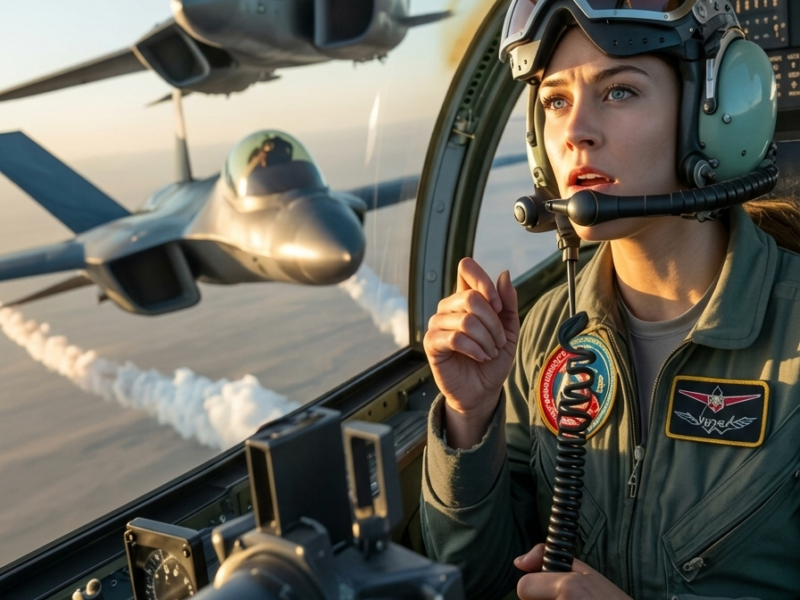
The F-22 pilots laughed when I walked into the Nevada briefing room wearing a bomber patch, but their smiles vanished when the commander read my call sign, “Viper,”
The desert heat radiated off the tarmac at Nellis Air Force Base in shimmering, liquid waves, but inside the main briefing room of Building 200, the air conditioning was cold enough to freeze sweat. I stood near the back wall, hands loosely clasped behind my back, wearing a clean, olive-drab flight suit adorned with a simple B-2 Spirit patch on the left shoulder.
Around the central oak briefing table sat twenty F-22 Raptor pilots from the elite 433rd Weapons Squadron. They were the apex predators of the sky—young, immaculate, and dripping with the natural swagger that comes from flying fifty-million-dollar stealth airframes at twice the speed of sound. They leaned back in their leather chairs, helmets resting on the floor beside them, holding paper cups of black coffee.
When I had walked in ten minutes prior, the low hum of conversation had sputtered out into amused chuckles.
A tall, broad-shouldered captain near the head of the table named Miller—call sign “Apex”—eyed the subtle wing emblem on my left breast and smirked. He nudged the pilot next to him with his elbow.
“Bomber pilots don’t usually brief us,” Apex said, his voice carrying clearly across the silent room. “Did you lose your way to the heavy-loader hangar, ma’am? Strategic Air Command is three buildings down.”
A few muffled laughs rippled down the row of fighter pilots. I ignored him, keeping my eyes fixed straight ahead on the blank projector screen. I didn’t blink. I didn’t react. When you have spent eight years living under the heavy weight of an absolute lie, petty cockpit vanity doesn’t even register.
The heavy steel door at the front of the room swung open, slamming against the drywall with a sharp thud.
General Raymond Vance walked in. The room instantly straightened, twenty pairs of boots snapping together as the pilots sat up rigid in their seats. Vance didn’t tell them to sit. He marched straight to the podium, his face drawn into a hard line of weathered gray stone, and tossed a thick, manila folder wrapped in red security tape onto the podium table.
“At ease,” Vance growled, his voice sounding like two grinding millstones. He adjusted his glasses and looked slowly around the room, letting the silence stretch until it was heavy enough to crush a man. “We’re changing the exercise for Red Flag today.”
Nobody spoke. Changing a multi-squadron tactical brief twenty minutes before engine startup was unheard of.
Vance slowly turned his gaze toward the back of the room, locking his piercing blue eyes onto mine.
“Viper will lead the air package,” Vance announced flatly.
A few pilots exchanged confused, almost insulting glances. Apex frowned, leaning forward with his elbows on his knees. “General, with all due respect, we have a complex low-observable sweep planned for the southern range. A B-2 pilot can’t manage the intercept vectors for six F-22 flight elements.”
“I didn’t ask for your tactical opinion, Captain Miller,” Vance snapped. “And she isn’t flying a bomber today.”
Apex blinked. “Viper?” he repeated, the name rolling awkwardly off his tongue as if he were trying to place a piece of obscure military trivia. “Who is Viper?”
I felt my chest tighten instantly. A sudden, cold pressure squeezed around my lungs, making it hard to draw air. I hadn’t heard that call sign spoken aloud in eight long years—not since the black, nameless night over the Baltic Sea when three airframes went into the water and only one came back out.
Vance slowly tapped his knuckle against the red tape on the folder. “That’s her call sign.”
The room became strangely, violently quiet. The casual chuckles vanished entirely.
An older F-22 pilot seated near the sunlit window—Major Harris, a fifteen-year veteran with a scarred chin—slowly stood up from his chair. His coffee cup remained balanced precariously in his hand, trembling slightly.
“Say it again, General,” Harris whispered, his voice stripped of all military protocol.
“Viper,” Vance said smoothly.
Harris’s face drained of color until his skin matched the pale plaster of the wall behind him. He stared at me across the twenty feet of air separating us, his eyes wide, looking at me like I was a ghost that had crawled out of a mass grave.
“I thought you were dead,” Harris breathed. “We all saw the telemetry. You went into the ocean at Mach 2.5.”
“I survived,” I said quietly, my voice flat, empty of emotion.
Harris swallowed hard, slowly sinking back into his chair without taking his eyes off my face. The rest of the room stared between Harris and me, realizing instantly that the woman in the bomber patch wasn’t an intruder—she was a legend they had been taught to study in classified tactical debriefs.
The pre-flight briefing ended without another joke.
Thirty minutes later, the blinding Nevada sun hit my face as I stepped out onto the concrete flight line. Standing in the central alert shelter wasn’t a heavy bomber, but a pitch-black, wing-modified variant of the F-15EX Eagle—a heavy interceptor retrofitted with experimental avionics and raw, unthrottled engine power.
As I strapped into the cramped cockpit, connecting my oxygen mask and checking the flight control surfaces, the thunder of six F-22 engines shook the canopy glass. The stealth fighters taxied out behind me, lining up in tight formation like black diamond points on the heat-blurred runway.
“Control, this is Viper Lead,” I said into my mask, the radio click sounding clear and crisp in my helmet. “Flight of seven, ready for takeoff.”
“Viper Lead, Edwards Tower. You are cleared for departure. Godspeed.”
I shoved the twin throttles forward into full afterburner. Twenty-nine thousand pounds of thrust slammed me back into the ejection seat as the jet roared down the concrete and tore into the empty blue sky, climbing vertically toward forty thousand feet.
For twenty minutes, the simulated exercise went exactly as planned. We crossed into the Nevada Test and Training Range, flying low beneath the simulated radar grid. The F-22s hovered on my flanks like lethal phantoms, invisible to the world.
Then, at 09:14 AM, my tactical display flared crimson.
A swarm of twelve fast-moving radar blips materialized out of nowhere on our rear quarter—simulated enemy Su-35s executing a textbook pincer maneuver from behind a mountain ridge. They had bypassed our forward airborne warning aircraft entirely.
“Viper! Tactical radar shows multiple hostiles closing on our tail!” Apex’s frantic voice crackled through the comms. “They’ve got us locked! We need to break formation now and engage!”
I stared at the glowing green vectors on my multi-function display. My brain calculated the closure rate, the radar cross-sections, and the mountain terrain below in a fraction of a second.
“Hold formation,” I ordered softly.
“What?!” Apex yelled over the radio. “We’re exposed! They have weapon-quality tracks on us right now!”
“I know,” I replied.
“Viper, make the call! Turn or break!” The voice on the radio became sharper, panicked. “They’re going to paint us in five seconds!”
Looking out my canopy at the vast expanse of the desert, I felt a ghost of a shadow touch the back of my mind. I smiled despite myself—a cold, dangerous smile hiding behind my oxygen mask.
“Trust me,” I whispered.
I pulled back on the stick and slammed the throttles, turning my heavy fighter directly toward the threat instead of diving away. I flew straight into the mouth of the enemy formation, exposing my radar signature completely.
The enemy flight took the bait instantly, locking all their weapons onto my lone, loud signal and diving to intercept me.
“Now,” I grunted into the mic.
The six F-22s behind me didn’t follow me into the turn; they used my massive radar distraction to drop their radar cross-sections to zero, drifting silently into the enemy’s blind spots. Seconds later, the six stealth fighters reappeared on the tactical network directly behind the pursuing enemy aircraft.
“Fox Three, Fox Three,” Apex gasped over the radio.
In less than ten seconds, all twelve simulated enemy fighters were painted with locked kill-signals. The entire enemy squadron was annihilated before they even realized they were being hunted.
“Clean sweep,” the controller’s voice came over the radio, sounding completely stunned. “Exercise over. Red Force eliminated.”
When we landed back at Nellis twenty minutes later, nobody celebrated. There were no high-fives on the tarmac, no laughing over the tactical victory.
I unstrapped my helmet, climbed down the boarding ladder, and set my boots on the hot concrete. Major Harris and Captain Miller were already waiting at the base of the gantry. Miller looked at me, his helmet tucked under his arm, his previous arrogance replaced by a strange, unsettled respect mixed with suspicion.
“Why didn’t you tell us who you were?” Miller asked quietly. “You maneuvered that heavy bird like you knew their automated radar algorithms before they even booted up.”
I paused on the lower rung of the ladder, looking down at him.
“Because the last time people knew who I was,” I said, my voice dropping like a stone, “someone died.”
Miller froze, his mouth opening slightly, but no words came out.
“That’s enough, Captain,” General Vance’s deep voice cut through the heavy heat. He walked up the flight line, holding the same red-taped folder from the briefing room. His face looked older, etched with severe strain.
“General,” I said, stepping off the ladder. “The exercise is complete.”
“This isn’t over, Viper,” Vance said quietly. He handed the folder directly to me. “This arrived by courier from the Pentagon ten minutes after you took off.”
I broke the red wax seal and pulled out a faded, glossy black-and-white photograph. It had been taken eight years ago inside a hardened shelter at an undisclosed base in Northern Europe.
Standing in front of a sleek, experimental stealth airframe were six elite test pilots wearing unmarked black flight suits. I recognized every single face—my old teammates, my brothers, my friends. Five of them were dead, buried in empty graves across the world.
Except one.
The man standing directly in the center of the photo had his face violently blacked out with a thick, permanent marker.
I turned the photograph over. On the back, written in fresh, neat, dark red ink, was a single sentence that made the blood in my veins freeze to solid ice:
Viper didn’t die that night.
My hands began to tremble. I looked up at Vance, my chest heaving beneath my flight suit. “Who is he? Who blacked this out?”
Vance stared past me, his eyes locked onto the empty, sun-baked runways stretching toward the Nevada mountains. “We don’t know.”
Before I could ask another question, the radio unit resting on my chest harness suddenly crackled to life with a blast of heavy, static feedback. It wasn’t connected to the base frequency, nor was it tuned to any standard military band.
Through the speaker, a low, wet, raspy voice whispered three words directly into my ear:
“Hello, Viper. Remember me?”
In that exact split second, every F-22 pilot standing on the tarmac around me froze. Their faces turned to absolute stone. As if operating on a single, shared, terrifying instinct, all six tactical pilots reached down and unholstered their sidearms.
The sharp metallic clicks of six Beretta 9mm slides chambering rounds echoed across the concrete flight line.
I didn’t move. My hand remained frozen over the static-laced radio unit on my chest. Major Harris had his pistol raised, the barrel aimed not at the sky, but directly at the space between my eyes. Captain Miller stood slightly to his left, his weapon pointed at the ground, his knuckles white as he scanned the perimeter fence half a mile away.
“Drop the radio, Viper,” Harris commanded, his voice tight and dripping with cold adrenaline. “Slowly.”
“Harris, what the hell are you doing?!” General Vance roared, taking an authoritative step between Harris’s gun and my chest. “Put those weapons down! That is an order!”
“She’s compromised, General!” Harris shouted back, his hand unshaken. “That frequency is on a closed, hard-encrypted frequency used exclusively by the Joint Chiefs’ black-budget flight operations! Nobody gets on that net unless they are inside the perimeter server room or holding a Level 5 authentication key!”
“Look at the pilots, General!” Miller added, his eyes wild. “The radio call didn’t just come through her harness! It came through our internal helmet radios on the tarmac!”
I slowly unclipped the small radio unit from my flight vest and let it dangle from its black wire. The static on the speaker had died down, replaced by the faint, rhythmic sound of breathing—slow, calm, and unnaturally deep.
“Harris,” I said softly, staring directly into the bore of his gun. “If I wanted you dead, I wouldn’t have pulled those Su-35s off your tail twenty minutes ago. Put the gun away.”
“Who was that on the radio?” Harris demanded. “Who is the sixth man in that photo?!”
“Eight years ago,” I began, my voice steady despite the adrenaline surging through my body, “Operation Black Sky was launched over the Baltic Sea. Six of us flew out of a classified facility in Norway. Our mission was to intercept and capture a prototype airborne electronic warfare platform that had been stolen from a research bunker in Poland.”
“I read the official report,” Vance interrupted, looking between us. “The mission failed. Atmospheric icing caused multiple engine flameouts. Three jets crashed into the sea. Two crashed on the coast. You were the only survivor.”
“The report was a lie written by the Defense Intelligence Agency to hide what really happened,” I snapped, taking a slow step toward Harris until the barrel of his pistol was inches from my forehead. “There was no atmospheric icing. The sky was completely clear. We were betrayed from inside the flight package.”
Harris blinked, a flicker of doubt crossing his face. “Betrayed?”
“The sixth man,” I said, pointing down at the blacked-out face in the photograph still held in my left hand. “His call sign was ‘Ghost.’ He wasn’t an Air Force pilot. He was an officer placed in our unit by an international private defense conglomerate called Apex. Halfway over the target zone, Ghost didn’t execute the intercept. He jammed our flight control computers remotely, killed our engines, and forced five aircraft into supersonic dives.”
“Why?” Miller asked, his gun lowering an inch. “Why kill his own flight element?”
“Because he wasn’t trying to destroy the prototype,” I replied, the memories flooding back into my mind with horrific, vivid clarity. “He was delivering it to them. I managed to override my flight controls manually by severing the automated fly-by-wire hydraulic lines, but my jet broke apart when I hit the water. I spent four days in a freezing liferaft before a Navy submarine picked me up. When I woke up in a hospital in Bethesda, the Pentagon told me my entire team was dead, the operation never existed, and my name had been erased from the military register.”
The radio unit dangling from my chest crackled again.
“Very impressive memory, Sarah,” the raspy voice spoke through the speaker again. The voice was smooth, completely unbothered by the fact that seven armed military officers were listening. “Except you left out one minor detail.”
Harris’s eyes widened. “He’s listening to us right now!”
“Where are you?!” Vance barked into his shoulder mic, trying to signal the base security tower. “Base Command, this is Vance! Trace this signal! Lock down all external communications!”
“Don’t bother, Raymond,” Ghost’s voice chuckled through the radio—a dry, hacking sound like dead leaves scraping across concrete. “I’m not in your server room. I’m not even on your base. But I am currently sitting in the primary flight control seat of the automated orbital strike platform you built at Groom Lake three years ago.”
General Vance went dead white. “That project was canceled!”
“Projects like that are never canceled, General,” Ghost replied smoothly. “They are simply renamed and handed over to people who know how to use them. Sarah… or should I say, Viper… look up.”
Every officer on the tarmac instinctively turned their head toward the crystal-blue Nevada sky.
At first, there was nothing—only the harsh glare of the midday sun and a few high-altitude cirrus clouds. But then, a tiny, brilliant point of light materialized in the upper atmosphere. It looked like a falling star in broad daylight, rapidly expanding as it plummeted toward the desert floor at hypersonic speed.
“Impact in twenty seconds,” Ghost said calmly over the radio. “Target: Hardened Hangar 4, Nellis Air Force Base.”
“Incoming! Get down!” Miller screamed.
“It’s not an explosive!” I yelled, grabbing Vance by his tactical vest and throwing him behind the heavy steel wheel structure of my F-15. “It’s a kinetic strike rod!”
A second later, a solid tungsten rod six feet long and four inches thick, moving at Mach 12, struck the roof of Hardened Hangar 4 three hundred yards away.
There was no fiery explosion, no bright fireball. The sheer kinetic energy of the impact created a localized shockwave that felt like a major earthquake. The concrete tarmac buckled beneath our feet like a carpet being whipped. A deafening sonic boom tore through the airfield, shattering every single glass window across the entire base in a fraction of a second. A massive cloud of pulverized concrete and white dust erupted into the sky where the hangar had stood moments before.
The blast wave threw Harris and Miller onto their backs, their pistols skittering across the fractured asphalt. Sirens began to blare in screaming, chaotic unison across the entire base as emergency vehicles scrambled from their bays.
I pulled myself up, leaning against the warm tires of the F-15, my ears ringing violently from the atmospheric shockwave.
Through the radio, Ghost’s voice returned, perfectly clear, completely unaffected by the chaos he had just unleashed.
“That was a fifty-pound tungsten projectile dropped from ninety miles up,” Ghost said softly. “The next one weighs two tons. And it is currently positioned directly over the city of Las Vegas.”
I grabbed the radio microphone with a trembling hand, pressing it against my lips. “What do you want, Ghost?”
“I want the same thing I wanted eight years ago in the Baltic, Sarah,” Ghost replied, his tone suddenly dropping into a dark, terrifying intensity. “I want you to fly. There is a modified, uncrewed prototype sitting in the underground vault beneath Hangar 12. You have ten minutes to get inside, link your flight suit to the neural interface, and take off.”
“And if I refuse?” I growled.
“If you refuse,” Ghost said, “I drop the two-ton rod on the Strip. You have nine minutes and fifty seconds, Viper. Don’t keep me waiting.”
The radio went completely dead.
The cloud of white concrete dust was still settling over the ruined remains of Hangar 4 as General Vance, Major Harris, and I sprinted across the cracked tarmac toward the perimeter of Hangar 12.
Around us, Nellis was in absolute chaos. Fire trucks were racing toward the impact site, military police vehicles were flashing red and blue lights, and armed security teams were fanning out across the perimeter, expecting a ground assault that was never coming.
“He’s bluffing about the orbital platform!” Harris yelled over the sound of screaming sirens, wiping blood from a small cut on his forehead where flying glass had caught him. “The military doesn’t have an operational kinetic weapon array in low Earth orbit!”
“He isn’t bluffing,” Vance said grimly, pulling a heavy magnetic keycard from his inner tunic pocket as we reached the heavy steel blast doors of Hangar 12. “Project Thor was officially mothballed five years ago after the international space treaties were signed. But the hardware was built. Three tungsten-launching satellites were placed into polar orbit under the guise of weather monitoring systems.”
“And Apex took control of them,” I said, stepping inside as the heavy blast doors slid open with a deep hydraulic groan.
Inside, Hangar 12 looked empty—a vast, dark expanse of steel beams and concrete. But Vance walked straight to the rear wall, pressed his palm against a biometric scanner hidden behind an electrical junction box, and entered a twelve-digit security code.
With a heavy metallic shudder, a massive section of the concrete floor began to sink downward, revealing a steep, sloped elevator ramp descending into a brightly lit underground vault.
We descended into the cool, fluorescent light of the vault. Sitting on a raised hydraulic platform in the center of the subterranean room was an aircraft that made my breath catch in my throat.
It wasn’t an F-22, nor was it an F-35. It was an experimental, delta-winged stealth aircraft coated in a matte-black, light-absorbing ceramic skin. It had no canopy glass, no cockpit windows, and no visible air intakes. It looked like a razor-sharp shadow resting on steel struts.
“The X-44 MANTA,” Vance said, his voice echoing in the concrete vault. “Multi-Axis No-Tail Aircraft. It was designed to fly without physical flight control surfaces—no rudders, no elevators. It uses pure thrust vectoring and automated boundary-layer airflow control. But a human pilot can’t react fast enough to keep it stable at high speeds.”
“That’s why it requires a direct neural link,” I murmured, stepping up to the side of the sleek black fuselage.
A panel on the side of the airframe slid back automatically, revealing an open cockpit fitted with a molded carbon-fiber couch and a heavy black helmet lined with thousands of silver, hair-thin fiber-optic pins.
“Sarah, listen to me,” Harris said, grabbing my arm, his face rigid with concern. “Neural flight interface testing was banned in 2018. Over eighty percent of the test pilots who connected to that system suffered severe neurological trauma or permanent memory loss within twenty minutes of full synchronization. You can’t put that helmet on.”
I looked at Harris, then down at the photograph still clutched in my left hand. I looked at the blacked-out face of the man who had murdered my team eight years ago and was now holding millions of innocent lives hostage from space.
“If I don’t get into this seat, Harris,” I said softly, “Las Vegas becomes a crater in seven minutes.”
I pulled my arm free from his grip, stepped onto the mounting platform, and lowered myself into the dark carbon-fiber couch of the X-44.
“Vance,” I called out, adjusting the straps of the five-point safety harness across my chest. “How do I weaponize this bird? It has no visible cannon ports or missile bays.”
“It carries a high-energy directional pulse laser powered by a compact solid-state reactor,” Vance said, stepping up to the console table beside the elevator. “It has an effective atmospheric range of fifty miles. But to punch through the orbital shielding of Ghost’s satellite, you’ll have to take this aircraft to the absolute edge of space—at least one hundred and twenty thousand feet.”
“That’s above the operational ceiling of any jet engine,” Harris warned. “You’ll be flying on pure rocket boost. If your neural link drops for half a second while you’re up there, the airframe will tumble, break apart, and incinerate in the upper atmosphere.”
“Then I guess I better not lose focus,” I said.
I picked up the heavy black helmet. The silver fiber-optic pins caught the cool fluorescent light of the vault, shimmering like tiny needles.
“Sarah,” Vance said, his old voice cracking slightly. “Eight years ago… I was the one who signed the order to classify the Baltic incident. I was told your whole unit had been corrupted by Apex. I didn’t know Ghost was the traitor. I am sorry.”
I looked at the old general, giving him a small, tight nod. “Keep the sky open for me, General.”
I pulled the helmet down over my head.
For three seconds, there was absolute, suffocating darkness.
Then, a sudden, blinding spike of cold electricity shot through the base of my skull, radiating down my spine like liquid lightning. I gasped, my fingers curling tightly into the leather arms of the couch as my brain fought against the foreign signal forcing its way into my central nervous system.
NEURAL LINK INITIATED, a synthetic, calm female voice resonated directly inside my auditory cortex. CALIBRATING SYNAPSE FREQUENCY… 30%… 70%… 100%. WELCOME BACK, VIPER.
The physical walls of the subterranean vault vanished.
I was no longer sitting in a cockpit. I was the X-44. I felt the ice-cold temperature of the hydraulic fluid flowing through the titanium veins of the wings. I felt the immense potential energy stored inside the solid-state rocket boosters. I felt the electromagnetic pulse of every radar station within three hundred miles humming against my skin.
The underground hydraulic lift slammed upward, elevating the X-44 onto the main runway of Nellis Air Force Base.
The afternoon sun hit my synthetic sensors with blinding clarity. Across the radio network, Ghost’s voice returned—laughing, mocking, cold.
“Two minutes remaining, Sarah,” Ghost sneered. “I see you’ve climbed into the casket. Let’s see if you remember how to fly.”
I didn’t waste time with words.
THROTTLE FULL, I commanded with a single thought.
The twin scramjet engines at the rear of the X-44 detonated with a sound that cracked the sky in two. The black stealth jet shot down the runway like a bolt of dark lightning, reaching two hundred knots in less than four hundred feet.
I pulled the nose up—not with a physical stick, but by simply desiring to touch the sky.
The X-44 tore through the atmosphere at a eighty-five-degree angle, accelerating past Mach 1, Mach 2, Mach 3, climbing into the deep, dark blue of the upper atmosphere toward the void of space.
The sky didn’t fade to blue; it died into absolute black.
At ninety thousand feet, the thick blue blanket of the Earth’s atmosphere collapsed beneath me, revealing the blinding, curvature of the planet below and the cold, terrifying infinity of the cosmos above. The air was so thin that conventional control surfaces were entirely useless. The X-44 was flying on small, precise bursts of reaction-control thrusters along its wingtips.
Inside my mind, the neural link was a roaring river of data. Altitude, air speed, engine temperature, orbital inclination vectors—billions of numbers streamed through my subconscious mind every second. My head felt as if it were caught in a vice, a dull, thumping ache pulsing behind my eyes as my brain burned through oxygen to process the massive information stream.
ALTITUDE: 115,000 FEET, the internal system voice reported. ATMOSPHERIC DENSITY: 1%. ROCKET BOOSTERS EXHAUSTED IN 45 SECONDS.
“I see you, Viper,” Ghost’s voice crackled through my mind. It was no longer coming through a physical radio speaker; the neural interface was capturing the encrypted satellite transmission and converting it directly into audio signals in my brain. “Look above you. The pinnacle of human engineering.”
Floating forty miles above me, suspended in the black vacuum of low Earth orbit, was a massive, cylindrical satellite made of polished titanium and solar arrays. Suspended beneath its main chassis was a heavy, revolving magazine loaded with twelve solid tungsten kinetic rods—the Thor Strike Platform.
A bright green target reticle illuminated the underside of the satellite on my visual field.
TARGET LOCKED, my internal system announced. LASER CHARGE AT 80%. NEED 10 SECONDS FOR FULL COHERENCE.
“You’re too late, Sarah,” Ghost whispered into my mind. “The target data for Las Vegas has already been locked into the primary ignition computer. The rod drops in fifteen seconds.”
“Why, Ghost?” I demanded through the neural comms, fighting to keep the X-44 stable as the upper-atmosphere turbulence tried to roll the fragile airframe onto its back. “Why slaughter innocent people? What does Apex gain from this?”
“Power isn’t about money, Sarah,” Ghost laughed—a sound that was rapidly becoming unhinged, insane. “It’s about demonstrating that boundaries, governments, and armies are illusions. When this rod hits, every nation on Earth will realize that their air forces, their stealth fighters, and their radar networks are completely obsolete. Apex will dictate global security for the next century!”
LASER CHARGE: 90%, the system warned. WARNING: ORBITAL TARGET HAS DEPLOYED ACTIVE DEFENSIVE COUNTERMEASURES.
A series of bright, blinding flares erupted from the sides of the satellite. Simultaneously, a high-frequency jamming signal flooded my neural link, sending a wave of agonizing, white-hot pain shooting straight through my temporal lobes.
“Gah!” I screamed aloud inside my helmet.
My physical hands clamped onto my thighs as my vision flickered violently. The crisp, three-hundred-and-sixty-degree view of space shattered into static-filled noise. The X-44’s left thruster misfired, sending the jet into a dangerous, high-speed spin at Mach 5.
“You can’t hit what you can’t see, Viper!” Ghost mocked me, his voice echoing from every direction inside my skull. “Your neural link is degrading! You’re suffering synaptic overload! Pull back and die, or stay and burn!”
I felt warm liquid trickling out of my left nostril—blood, running down my upper lip inside the dark helmet. My heart rate jumped to one hundred and ninety beats per minute. The system warning lights flashed violently crimson inside my head.
CRITICAL NEURAL DAMAGE IMMINENT. DISCONNECT IMMEDIATELY.
I looked down at the dark curve of the Earth below. I saw the faint, glittering grid of lights that was the city of Las Vegas, completely unaware of the kinetic hammer hovering ninety miles above their heads. I saw the faces of my four dead teammates from the Baltic Sea—the men Ghost had murdered in cold blood eight years ago.
No, I thought, forcing my mind to stand firm against the searing pain. Not today.
I didn’t try to clear the jamming signal. I didn’t try to use the automated computer tracking system.
I completely disconnected my target acquisition lock from the computer processor. I bypassed the automated guidance array and routed the laser’s firing circuit directly into my own optic nerve.
I used my own eyes as the crosshairs.
“Sarah! What are you doing?!” Vance’s faint voice screamed through the secondary ground link from Nellis. “You’re routing reactor power through your visual cortex! It will blind you!”
“I don’t need my eyes to fly after this, General,” I whispered.
I locked my physical gaze onto the central command node of the satellite floating in the black void ahead. The agonizing pain in my head escalated to an unbearable roar, but I didn’t flinch. I held the X-44 rock-steady in the vacuum, aligning the nose of the jet with the precise mechanical heart of the weapon.
LASER CHARGE: 100%.
“Goodbye, Ghost,” I said.
FIRE.
A brilliant, continuous beam of concentrated blue coherent light erupted from the nose cone of the X-44, cutting through the thin vacuum of space like a lance of divine fire.
The high-energy laser beam struck the central command core of the Thor satellite with absolute, terrifying precision.
In the vacuum of space, there was no sound—only a silent, magnificent spectacle of destruction. The heavy titanium skin of the satellite vaporized instantly under the multi-megawatt thermal output. The internal energy cells ruptured, triggering a chain-reaction explosion that sheared off the solar arrays and melted the tungsten rod launcher into a useless, molten blob of white-hot slag.
Through the neural link, Ghost’s voice let out a horrific, garbled scream of pure agony as the command signal was violently severed, echoing inside my skull before abruptly cutting off into absolute, dead silence.
The massive orbital strike platform disintegrated into a cloud of glowing, harmless space debris, tumbling uselessly into the upper atmosphere to burn up like shooting stars.
TARGET DESTROYED, the synthetic system voice reported faintly. NEURAL SYSTEM CRITICAL. REENTRY VECTOR REQUIRED IMMEDIATELY.
My strength was completely gone. The laser pulse had burned out the primary sensory feed of the helmet. The brilliant stars, the black void of space, and the blue Earth below vanished from my mind, replaced by pitch-black darkness. I couldn’t feel my hands. I couldn’t feel my legs.
The X-44, deprived of its neural pilot, began to tumble backward into the dense layers of the upper atmosphere, its belly catching the friction of the air as heat began to build along the ceramic leading edges of the wings.
“Viper! Viper, do you read me?!” Vance’s voice was frantic, sounding miles away through the crackling ground comms. “Your reentry angle is too steep! You’re going to burn up! Pull the nose up!”
I sat in the dark cockpit, blood slowly dripping onto my flight suit, my breath shallow and ragged. I couldn’t move my arms to grab the emergency mechanical stick. My brain was too weak to send the commands through the neural wire.
So this is how it ends, I thought quietly. Not in the freezing Baltic… but in the fiery sky over Nevada.
Suddenly, a warm, steady touch seemed to brush against the back of my subconscious mind.
It wasn’t a computer prompt. It wasn’t an alarm.
Pull the stick, Viper, a voice whispered softly in my mind—not Ghost’s voice, but the voices of my old team. The men from Operation Black Sky. You brought us home. Now bring yourself home.
A sudden, final surge of adrenaline shot through my heart.
I didn’t try to command the complex flight computers. I simply reached deep into my remaining strength, grabbed the physical mechanical override stick between my knees with both hands, and pulled back with everything I had left.
Outside, the X-44’s emergency mechanical trim tabs deployed into the roaring plasma wind. The stealth jet bit into the atmosphere, its nose slowly lifting out of the fatal dive, leveling off into a long, smooth glide vector six miles above the Nevada desert.
The heat dissipated. The roaring plasma died down.
Ten minutes later, the dark, battered shape of the X-44 glided silently through the warm afternoon sky over Nellis Air Force Base, touchdown gear dropping with a heavy hydraulic clack as it lined up with Runway 21.
The tires squealed against the hot asphalt, smoke rising from the rubber as the black jet rolled to a complete, peaceful halt right in front of the emergency fire crews and waiting military vehicles.
The heavy armored canopy unlatched and swung open automatically.
Warm desert air rushed into the cramped cockpit, smelling of hot asphalt and jet fuel. I slowly lifted my hands, unlatched the heavy black helmet, and pulled it off my head.
The bright Nevada sunlight hit my eyes. I blinked against the glare, wiping the dried blood from my nose with the sleeve of my flight suit.
General Vance, Major Harris, and Captain Miller were running toward the aircraft, surrounded by armed security personnel and medical teams. They threw a light access ladder against the fuselage, and Harris scrambled up to the cockpit edge, his face pale with worry.
“Sarah!” Harris gasped, reaching down to unbuckle my five-point harness. “Can you hear me? Can you see me?”
I looked up at him, squinting into the sun. I gave him a small, weak, tired smile.
“I see you, Major,” I said, my voice rough and hoarse.
Vance reached the top of the ladder, looking down into the cockpit at the fried neural interface cables dangling from the helmet bay. He looked out toward the sky where the orbital threat had been destroyed, then back down at me with profound, unspoken reverence.
“It’s over, Sarah,” Vance said softly. “Ghost is gone. The platform is destroyed. Apex’s network in North America is completely blind.”
I allowed Harris and Miller to gently lift me out of the carbon-fiber couch and lower me onto the warm concrete of the flight line. I stood on my own two feet, leaning slightly against the cold titanium wing of the X-44.
Captain Miller stepped forward, holding his leather helmet under his arm. He looked at me for a long moment, then slowly brought his hand up to his brow, executing a crisp, perfect military salute.
“It was an honor flying wing with you, Viper,” Miller said, his voice entirely free of arrogance.
I returned the salute slowly, looking around at the base, the sun, and the vast, empty blue sky stretching out toward the horizon.
For eight years, I had been a ghost—a dead pilot running from a nameless war in the dark. But as I stood on the hot tarmac of Nellis, surrounded by the roar of jet engines and the smell of fuel, I knew the ghosts were finally gone.
I wasn’t running anymore. Viper was home.
The end.









