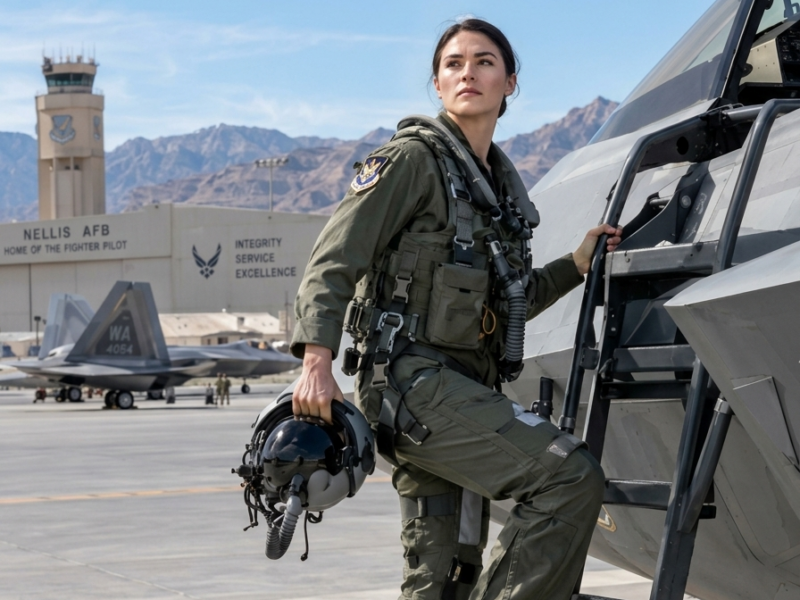
The F-22 pilots laughed when I identified myself over the radio above Nevada, until the lead pilot suddenly went silent after hearing my callsign
The desert below was a void of absolute, oppressive pitch, a sea of cracked clay and ancient dust stretching for hundreds of miles under the moonless Nevada sky. At forty thousand feet, the air was bitter cold, thin, and deadly. Inside the cramped, unpressurized cockpit of my unregistered, custom-built experimental jet, the only light came from the dim emerald glow of the primary flight display and the faint amber flickering of a jury-rigged threat receiver.
My pulse was a steady, rhythmic thud against my ribs. I had spent thirteen long, invisible years waiting for this exact altitude, this exact vector, and this precise frequency.
Then, the airwaves crackled.
“Unknown contact, transponder squawking 0000, you are entering restricted airspace within Military Operating Area Delta. Identify yourself immediately or face interception,” a sharp, highly trained voice barked over the guarded UHF channel.
I didn’t flinch. I reached out with a gloved finger and pressed the transmit switch mounted on my throttle.
“Nevada Control, this is experimental craft designated Raven One. Requesting clearance through Sector Four.”
A brief pause hung on the line. Then came a sharp, dismissive burst of laughter over the tactical frequency. It was the arrogant, casual chuckle of top-tier fighter pilots who knew they owned the sky.
“Raven One?” a second, younger voice mocked over the open air. “Check your history books, buddy. Raven was a ghost program from the nineties. Identify your real tail number or we’ll put a Sidewinder up your tailpipe.”
I didn’t answer right away. I pulled back slightly on the stick, pitching the nose up five degrees, letting my custom-modified turbine engines ingest the thin air, pushing my airspeed past Mach 1.2 without a sonic boom—a trick of stealth design I had perfected over a decade of hidden manual labor in a buried hangar.
Suddenly, two dark, razor-sharp silhouettes tore through the upper canopy above me, banking hard to loop into a classic twin-ship pincer intercept. F-22 Raptors. The undisputed apex predators of modern aviation. They locked onto my flanks, their twin engines glowing like twin coals in the dark.
“Say again, unknown aircraft,” the lead pilot commanded. But his tone had shifted. The casual humor was gone, replaced by a strange, sharp tension.
I kept my hands steady on the controls. The flight stick felt warm beneath my leather glove.
“Raven One,” I repeated, my voice flat, devoid of fear.
The radio went dead. Absolute silence filled my helmet, save for the faint hiss of static and the low hum of my oxygen system.
Then a voice whispered over the secure frequency, stripped of all military protocol. “That’s impossible.”
I knew that voice. Even through the digital compression of a secure encryption algorithm, I would know it anywhere. It was Captain Daniel Hayes.
We had flown together before, back when my name still appeared on squadron mission boards, back when I wore a patch depicting a black raven clutching a lightning bolt, back when people still knew what I had done for this country.
Before the accident.
Before the cover-up.
Before they officially declared me dead.
“Raven One, identify yourself,” Daniel’s voice came again, tighter this time, strained with an emotion he was desperately trying to suppress.
“I already did, Dan,” I said softly.
I heard the quick, ragged inhalation of breath through his oxygen mask over the open mic. “You died. July 14th. The crash in the Groom Range. I saw the wreckage. I helped clean up the scrap.”
The words hit harder than the sudden altitude warning flashing red across my primary instrument panel.
“I survived,” I replied quietly.
Below us, the Nevada desert stretched into seamless darkness. Above me, the two F-22s shifted their formation, dropping their noses slightly, matching my speed to the knot. They weren’t escorting me out of the airspace. They were watching me, sizing up an impossibility cruising at their wingtips.
Daniel spoke again, his tone sharp with rising panic. “Who gave you that callsign? That’s classified top-secret level five. Who authorized you to use that radio?”
“My father,” I said.
Silence descended once more over the radio waves.
My father had been Colonel Richard Vance, commander of the elite Black-Ops Flight Test Squadron that had vanished into thin air thirteen years earlier. Everyone in the Pentagon believed our four-ship element of advanced prototypes had suffered a catastrophic mid-air collision during a high-altitude, night-time electronic warfare test over the bomb ranges. They told the public it was a tragic accident. They gave my mother a folded flag and an empty casket.
But it hadn’t been an accident. We hadn’t been testing jammer pods. We had been ordered to intercept something that was never supposed to exist—an unflagged, hyper-advanced air vehicle operating out of an unmapped subterranean facility deep inside the Tonopah basin. And when my father and I discovered what that platform was carrying, and who was actually funding it from deep inside our own government, someone high up in the chain of command pressed a button.
I still remembered the final transmission crackling over my father’s dying radio as his aircraft disintegrated beside mine.
“Erase Raven from the system.”
Then came the flash of an onboard proximity charge. Then the deafening explosion. Then thirteen years of darkness.
I survived. My father didn’t.
For thirteen years, I lived under a dead man’s shadow, building my own aircraft piece by stolen piece in an abandoned copper mine, while the men responsible for his murder climbed higher through the ranks of the Defense Department.
Until tonight.
Daniel suddenly shouted over the radio, shattering my thoughts. “Raven, break left! Break left now!”
I snapped my eyes to the amber threat receiver. Three unidentified radar tracks had just materialized out of thin air directly behind us at Mach 2.5. They had no transponders, no infrared signatures, and they were closing the gap with terrifying acceleration. They weren’t American. And they weren’t supposed to be anywhere near restricted airspace.
I slammed the throttle forward, feeling the raw surge of thrust shove me deep into my ejection seat. The two F-22s dropped their outer tanks and fell in beside me, matching my evasive dive. For the first time in thirteen long years, Raven wasn’t flying alone.
We tore through the midnight sky together, three black shadows cutting across the desert floor.
Then, one of the unknown contacts patched directly into my private, military-grade encrypted frequency—a channel that only five people in the world were supposed to possess.
A cold, synthesized voice filtered through my headphones.
“Raven, we know you’re alive.”
My blood turned to ice in my veins. Daniel heard the intrusion over his cross-link monitor.
“Who are they, Ethan?” Daniel demanded, his voice cracking with panic. “Who is on this channel?!”
I stared at the blinking crimson signal on my tactical console. “I don’t know.”
A second transmission cut through the static, dropping like a blade.
“You should have stayed dead, Vance.”
The sky seemed to freeze around us. The hum of my engines faded beneath the sudden, overwhelming dread creeping into my chest.
Daniel’s voice came through, trembling. “Raven… what did you uncover back then?”
I looked down at the custom navigation display. Suddenly, a set of classified targeting coordinates flashed onto my screen in bright neon white—the exact same flight vector and target designation from thirteen years ago, broadcasting live from an unknown ground station below.
A sickening realization washed over me, making my hands tremble against the cold titanium stick.
Someone hadn’t just discovered my presence tonight. Someone had reactivated the ghost mission.
And this time, they were waiting for me to finish it.
“Break formation! Evasive maneuvers!” I screamed over the tactical link, pulling hard on the stick to send my jet into a vertical climb.
The air outside shrieked against the metal airframe as the three bogies split their attack vector. They weren’t flying conventional aircraft; their radar returns fluctuated wildly, shifting size and position as if bending light and radio waves around their fuselages.
A streak of blinding purple light tore through the void between my jet and Daniel’s F-22. It wasn’t a missile. It was a high-energy directed beam, superheating the thin air and leaving a trail of ionized ozone that smelled faintly through my air scrubbers.
“What the hell was that?!” Daniel’s wingman, callsign Apex, yelled over the open channel. “That’s not kinetic ordnance! Radar lock lost! I can’t acquire them!”
“Don’t rely on your radar!” I barked, watching my own threat board go haywire as broadband jammer pulses bombarded our sensors. “Use your thermal imaging! Track the heat from their thrust vectors! They can hide their radar cross-section, but they can’t hide the heat displacement!”
Below us, the desert ground was rushing away as we climbed through fifty thousand feet. The mysterious contacts swarmed us like phantom hornets. One of them banked impossibly—a ninety-degree turn at supersonic speed that would have crushed a human pilot into a pulp—and slotted directly onto Apex’s tail.
“Apex, break right! He’s on your six!” Daniel yelled, pitching his Raptor around to bring his M61 Vulcan cannon to bear.
“I can’t clear him! Controls are sluggish! My avionics are frying!” Apex screamed.
Before Daniel could align his reticle, the trailing bogie fired another pulses of focused energy. The beam struck the starboard wing of Apex’s F-22. Instantly, the titanium composite structure boiled away, igniting the jet fuel within the wing tank. A blinding fireball illuminated the dark canopy, expanding for a split second before collapsing into a long, trailing line of burning debris falling toward the desert floor.
“Apex! Eject! Eject!” Daniel roared.
A tiny white canopy popped from the flaming wreckage, followed a second later by the blossoming arc of a survival parachute.
“He’s out! Apex is in the chute!” Daniel panted, his voice heavy with rage and shock. He slammed his throttle into full afterburner, the twin Pratt & Whitney engines roaring as his Raptor carved through the sky. “Raven, who are these bastards?! What kind of tech are they flying?!”
“Project Erebus,” I answered through gritted teeth, my eyes scanning the tactical situation display as I executed a high-G barrel roll to avoid a incoming thermal tracking lock. “The same project my father tried to shut down. It was an off-the-books joint venture between rogue elements in the Defense Intelligence Agency and private defense contractors. They were reverse-engineering experimental propulsion systems—systems that don’t belong to any civilian or military fleet on Earth.”
“And your father?” Daniel asked, his voice tight as he banked left to cover my tail.
“He realized what they were doing,” I said. “They weren’t just building advanced fighters. They were building a black-budget military platform capable of bypassing every global defense network in existence. A weapon system that answered to no president, no parliament, and no chain of command. When my father threatened to go directly to the Senate Oversight Committee, they marked our entire squadron for liquidation.”
“And my commander… General Vance?” Daniel asked softly.
The question hung heavy between us. General Arthur Vance—my father’s younger brother, my uncle, and the man currently sitting at the top of the Joint Chiefs of Staff.
“Arthur was the one who signed the execution order,” I revealed, the bitter truth tasting like ashes in my mouth. “He traded his brother’s life and mine for a four-star rank and a seat on the executive board of the syndicate running Erebus.”
The radio fell dead for three full seconds. Daniel was digesting the betrayal of the man he had served under for a decade.
Suddenly, my warning receiver screamed a continuous, high-pitched tone. HARD LOCK. MISSILE LAUNCH.
The third bogie had looped around the upper atmosphere and was diving straight down on my position, dropping out of the sunless sky like a falling anvil. It launched two low-observable kinetic interceptors. They weren’t guided by heat or radar; they were riding an optical laser beam aimed directly at my cockpit.
“I can’t shake them!” I gritted my teeth, pulling twelve Gs as my flight suit inflated violently around my legs and torso, forcing blood back into my brain to prevent me from passing out. The world flickered at the edges of my vision, narrowing into a tight, gray tunnel.
“Hold steady, Raven!” Daniel’s voice sliced through the haze.
The dark shadow of his F-22 swept beneath my belly, putting his own aircraft directly in the path of the incoming missiles. He dumped a massive cluster of flare and magnesium decoys while pulling a hard cobra maneuver, forcing his fighter to act as a massive heat shield for my craft.
The first kinetic missile slammed into Daniel’s expendable flare pod, exploding in a cascade of white-hot embers. The second missile grazed his lower ventral fin, ripping off the ventral rudder and sending his F-22 into a violent, sickening yaw.
“Daniel!” I yelled.
“I’m… I’m still in control!” he grunted, fighting the heavy mechanical vibration tearing through his stick. “Fuel pressure is dropping… but my systems are alive! Raven, look down! The coordinates!”
I looked down at the primary display. The flashing coordinates were no longer just a static point on the map. They had begun transmitting an automated landing beacon—a encrypted radio pulse designed to guide a returning aircraft down into a hidden subterranean recovery bay.
The location was deep inside the Groom Lake salt flats, hidden beneath a dry lakebed that had been officially marked as a toxic ordnance disposal site for fifty years.
“They aren’t just hunting us, Dan,” I realized, staring at the telemetry data cascading down my screen. “The automated system… it thinks I’m my father. The encryption key I used to log into this frequency triggered an automated recall sequence. The facility is opening up.”
“Then we end this tonight,” Daniel said, his damaged Raptor regaining level flight alongside my wing. “I don’t have enough fuel to make it back to Nellis, and my hydraulic system is leaking fast. If I’m going down, I’m going down giving you air cover.”
“Daniel, you don’t have to die for this,” I pleaded.
“I took an oath to protect this country from enemies foreign and domestic, Ethan,” Daniel replied, his voice calm and steady for the first time since he heard my voice over the radio. “I didn’t realize the worst enemies were the ones wearing stars on their shoulders. Go down there. Expose them. Finish what your father started.”
Behind us, the two surviving bogies pulled into a trailing attack formation, preparing for their final, lethal run.
I looked at the mountain ridge looming ahead in the moonlight. “Follow my lead. We’re taking this fight straight into the ground.”
I pushed the nose of my experimental jet down, aiming directly for the barren expanse of the dry lakebed. The altimeter spun backward in a terrifying blur: twenty thousand feet, ten thousand feet, five thousand feet. The desert floor rushed up to meet us like a wall of solid stone.
At two thousand feet, a section of the cracked earth cracked open.
Huge, reinforced steel blast doors, painted with weathered camouflage to blend seamlessly with the desert scrub, slid apart. Deep within the trench, a line of dimly lit amber landing lights flickered to life, revealing an inclined subterranean runway leading deep into the bedrock of the mountain range.
“There it is,” I breathed, lining up my approach vector. “The nest.”
“I’ve got your back! Clear for entry!” Daniel called out.
His damaged F-22 rolled inverted, positioning itself directly over the opening of the silo. As the two pursuing Erebus fighters swooped down to destroy me, Daniel unleashed his remaining internal weapons bay stores—four AIM-120 missiles fired at point-blank range without radar lock, straight into the flight path of the pursuers.
The resulting mid-air explosions created a wall of fire and flying metal in the night air. One of the pursuing craft was clipped by debris, its left anti-gravity foil snapping off before it cartwheeled violently into the desert floor, exploding into a towering plume of orange flame.
The second bogie overshot the target, banking sharply into the night sky to reset its attack vector.
“I’m out of ordnance! Hydraulics failing!” Daniel’s radio transmission cut through with heavy static. “Raven… get inside! I’m making an emergency belly landing on the salt flat!”
“Land safe, Dan. I’ll see you on the other side,” I said.
I dropped my landing gear, pulled my throttle back to flight idle, and dropped my jet through the yawning maw of the subterranean blast doors.
The transition from the cool desert air to the interior of the installation was instantaneous and jarring. The air inside smelled of jet fuel, ozone, and stagnant earth. The inclined runway stretched downward for half a mile at a steep ten-degree angle, guided by magnetic deceleration strips built directly into the concrete floor.
My aircraft’s tires slammed onto the concrete with a deafening screech of rubber. The automated magnetic arrestor cables snagged my tailhook, jerking me forward against my shoulder straps as the jet ground to a sudden, violent halt inside a massive underground hangarbay.
The blast doors overhead hissed shut with the heavy, definitive thud of hydraulic locks engaging. The sky was gone. The desert was gone. I was inside the heart of the shadow state.
I sat in the quiet cockpit for a long moment, listening to the hot engine metal creak and ping as it cooled. The silence inside the cavernous hangar was deafening.
I reached down, unbuckled my harness, and manually popped the glass canopy. The cool, artificial air of the facility washed over me. I drew my sidearm—a sidearm that had belonged to my father—and stepped out onto the boarding ladder, my tactical boots echoing loudly off the polished floor.
The hangar was massive, spanning the length of three football fields. Rows of sleek, wingless aircraft—identical to the ones that had attacked us above—sat lined up in stasis bays, suspended by heavy magnetic clamps. Technicians in unmarked hazmat suits stood frozen beside computer consoles, staring at me in utter disbelief.
They hadn’t expected a living ghost to walk out of that jet.
High above the hangar floor, on an elevated glass observation deck overlooking the entire floor, a bank of soft fluorescent lights switched on.
A single figure stepped to the glass railing. He was an elderly man, impeccably dressed in a tailored military dress uniform adorned with four silver stars on each shoulder strap. His hair was snow-white, his posture rigid and uncompromising.
General Arthur Vance.
He looked down at me through the reinforced glass, his expression a cold mask of disappointment rather than shock.
“I told them you were dead, Ethan,” Arthur’s voice echoed through the hangar’s public address system, calm and detached. “I spent thirteen years convincing the board that the Vance bloodline was no longer a threat to this operation.”
I pointed my pistol up toward the glass booth, my arm steady, my voice laced with steel. “You murdered your own brother, Arthur. You murdered my father.”
Arthur let out a soft, tired sigh. “Your father was a brilliant aviator, Ethan, but a terrible visionary. He saw the world in black and white—patriotism versus treason, right versus wrong. He couldn’t comprehend the scale of what we discovered here.”
“You built an illegal army under the feet of the American people!” I shouted, my voice bouncing off the concrete walls. “You used black-budget funds to build a weapon system that operates outside the Constitution!”
“The Constitution was written for men with muskets, Ethan!” Arthur snapped, his calm demeanor cracking to reveal the fanatic beneath. “We are facing threats that exist beyond the horizon of public knowledge! Do you think the Russian military or the Chinese State care about congressional oversight? We built Erebus to ensure that when the next war comes, we control the sky, the land, and the vacuum above it!”
“By executing your own pilots?!” I demanded.
“By doing what was necessary to preserve absolute secrecy!” Arthur countered, leaning over the railing. “And now, you walk into my facility carrying the final piece of the puzzle. The master decryption key stored on your aircraft’s flight recorder. The key your father stole before he crashed.”
I glanced back at my jet. The flight computer was currently uploading its internal memory bank directly into the facility’s master mainframe via the automated umbilical cable connected to the floor.
“I didn’t bring the key to give it to you, Arthur,” I said quietly, a cold smile touching my lips. “I brought it to deliver a payload.”
Arthur froze, his eyes darting to the terminal screen beside him on the observation deck.
Across the giant monitors lining the walls of the underground facility, lines of red code began cascading down like a digital waterfall. The green operational indicators on the suspended Erebus fighters turned to a flashing, warning amber, followed by a chorus of piercing electronic alarms.
WARNING: SYSTEM PURGE INITIATED. CORE DATA OVERWRITE IN PROGRESS.
“What did you do?!” Arthur roared over the microphone, his voice lose all its military composure. “What did you upload?!”
“My father knew you would try to recover his data eventually,” I called up to him, my voice steady and clear above the rising din of emergency sirens. “He didn’t just record the flight logs that night, Uncle Arthur. He spent his final minutes before the crash writing a self-replicating logic bomb into the core firmware of the Erebus operating system.”
The technicians on the hangar floor panicked, abandoning their workstations and sprinting toward the emergency blast exits as sparks began showering down from the overhead power conduits.
“Stop the upload! Sever the hardlines!” Arthur screamed to his remaining security personnel, but it was already too late.
The virus my father had authored thirteen years ago wasn’t just erasing the files; it was overloading the experimental liquid-state power cores inside every single Erebus aircraft in the hangar. The magnetic clamps holding the wingless fighters failed one by one, dropping the multi-million-dollar prototypes to the concrete floor with deafening metallic crashes.
Thick, acrid smoke began pouring from the engine bays of the suspended craft as their power cells underwent thermal runaway.
“You’ve destroyed everything!” Arthur shouted, rushing down the metallic spiral staircase leading from the observation deck to the hangar floor. Heavy armed guards in black tactical gear surged out from the side corridors, their automatic rifles raised, locking onto my position.
“Drop your weapon! On the ground now!” the lead guard bellowed.
I didn’t drop my gun. I stepped back toward the tail of my experimental jet, using the reinforced titanium landing gear as cover.
“Arthur!” I shouted as the General stepped onto the floor, surrounded by his personal security detail. “It’s over! The data is already being broadcast via the high-altitude satellite relay my jet linked with before I landed! In five minutes, every major news outlet and congressional committee in the country will have the full schematics of Erebus and the financial records linking you to the syndicate!”
Arthur’s face turned pale, the cold arrogance completely stripped away to reveal a desperate, cornered animal.
“Kill him,” Arthur whispered to his guards. “Kill him and clear the drives manually!”
Before the guards could pull their triggers, a sudden, violent shudder shook the entire underground complex.
The heavy blast doors at the top of the entry ramp shattered inward with a thunderous explosion. Dust, concrete fragments, and twisted metal rained down into the upper level of the hangar.
A massive tactical breach vehicle—an armored military transport bearing the insignia of the United States Air Force Special Tactics Squadron—came crashing down the inclined runway, its heavy tires burning rubber as it slid sideways to form a barricade across the hangar entrance.
Armed operators in standard-issue desert camouflage poured out from the back of the transport, their weapons raised, red laser sights painting the walls and the black-clad Erebus guards.
Behind them stepped Captain Daniel Hayes, his flight suit torn and stained with grease, holding a tactical radio in one hand and a service rifle in the other.
“Federal troops! Drop your weapons and step away from the aircraft!” Daniel’s voice boomed through a tactical megaphone. “General Arthur Vance, by order of the Commander of Air Combat Command, you are under arrest for high treason, murder, and the misappropriation of classified defense assets!”
The black-clad guards looked between Arthur, the approaching Special Forces team, and the flaming, disintegrating prototypes behind them. Realizing the battle was lost, one by one, they dropped their rifles to the concrete floor and raised their hands.
Arthur stood alone in the center of the chaotic hangar, surrounded by the ruin of his shadow empire.
The silence that fell over the underground facility was heavy, broken only by the rhythmic pulsing of emergency lights and the hiss of fire suppression systems extinguishing the burning prototype engines.
General Arthur Vance didn’t fight as the Special Forces operators stepped forward and forced his hands behind his back, snapping heavy steel flex-cuffs around his wrists. He didn’t look at the soldiers, nor did he look at the flashing red monitors declaring the total destruction of the Erebus database.
He only looked at me.
“You think you’ve saved something, Ethan,” Arthur said, his voice a low, raspy whisper as they led him past my position. “You think bringing this into the light makes the world safer. You’re naive. Just like your father.”
I looked my uncle dead in the eye, stepping out from behind my aircraft. “My father died an honest man, Arthur. You’re going to die in a federal supermax facility as a traitor.”
Arthur let out a dry, chilling laugh that faded down the long concrete corridor as he was marched away into the shadows.
Daniel walked up to me, slinging his rifle over his shoulder. He looked at my face, then at the custom-built jet that had brought me back from the grave.
“Nice landing,” Daniel said, a faint, exhausted smile appearing on his face. “Though you completely ruined my F-22’s paint job out there.”
“I owe you a beer, Dan,” I replied, feeling the immense weight of thirteen years of hiding finally lifting from my chest. “Or maybe a new fighter jet.”
“I think the Air Force can handle the tab for the jet,” Daniel said, looking around the cavernous hangar as federal agents and military investigators began flooding into the facility to secure the evidence. “It’s over, Ethan. The Pentagon just issued an emergency freeze on all accounts linked to the Erebus board. Your father’s name… your name… it’s being cleared right now on the national wire.”
I looked down at my hands. For thirteen years, I had lived as a ghost, a nameless mechanic working in the dirt, consumed by the single-minded obsession of exposing the men who had stolen my life. Now that the ghost was gone, I had to figure out who was left standing in its place.
“What are you going to do now?” Daniel asked softly.
I walked over to my aircraft, reaching into the cockpit to retrieve a small, worn leather flight logbook that had belonged to my father. I tucked it into my jacket pocket, close to my heart.
“I spent thirteen years hiding from the sky,” I said, looking up through the open blast doors at the top of the ramp, where the first pale pink rays of the Nevada dawn were beginning to streak across the horizon. “I think it’s time I finally went home.”
Two days later, the sun rose bright and warm over the runway at Edwards Air Force Base.
A full military honors ceremony was taking place on the tarmac. Flags flew at half-mast against the deep blue sky. Rows of active-duty aviators stood in crisp dress uniforms, standing at rigid attention as a four-ship formation of F-22 Raptors roared overhead in a flawless precision flyby.
As the formation reached the center of the airfield, the lead aircraft pulled sharply into a vertical climb, soaring straight up toward the heavens, leaving the other three to fly onward—the traditional ‘Missing Man’ formation.
I stood at the edge of the tarmac, wearing a clean civilian suit, watching the lone jet disappear into the infinite blue above. Beside me stood Daniel, his arm held in a sling from his injuries during the crash landing, saluting the sky.
The name Colonel Richard Vance was no longer erased. It was etched into the black granite memorial wall at the Air Force Academy, restored with full honors, alongside the names of the men who had fought to protect the truth.
And as for Raven One?
The file was closed. The prototype aircraft was quietly transferred to a classified museum vault, never to fly again. The ghost program was dead, buried under the desert sands where it belonged.
I turned away from the runway, taking a deep breath of the crisp morning air. For the first time in thirteen years, the sky above me was quiet, clear, and peaceful.
I wasn’t a dead man flying anymore. I was finally alive.
The end.









