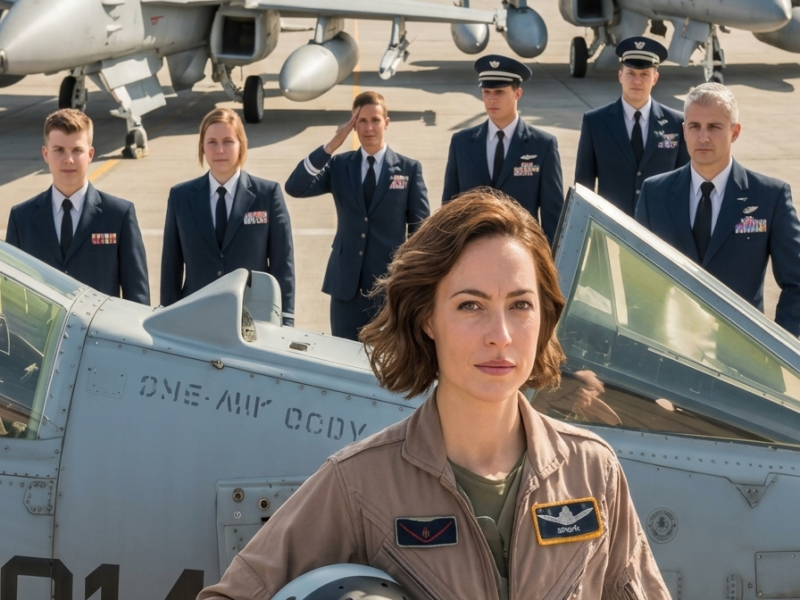
The F-16 pilots laughed when I taxied my battered A-10 Warthog onto the runway at Nellis Air Force Base, but their grins vanished the moment their commander saw my tail number
The laughter came through my helmet speakers in a burst of sharp, metallic static. It was a cold, arrogant sound—the kind bred in glass cockpits, at thirty thousand feet, by pilots who believed war was fought entirely through radar screens and laser-guided microchips.
I sat inside the tight, titanium-shielded cockpit of Tail Number 78-0622—a heavily battered A-10 Thunderbolt II, known to the military as the Warthog and to its detractors as a flying anvil. Around me, the afternoon heat of the Nevada desert rose off the tarmac of Nellis Air Force Base, creating a shimmering mirror that warped the sleek, matte-gray silhouettes of four F-16 Fighting Falcons idling on the taxiway ahead. Next to them, my aircraft looked like a primitive relic dug up from a forgotten trench. Its skin was a mosaic of mismatched dull-gray paint patches, its rivets were heavy and exposed, and its massive 30mm GAU-8 Avenger rotary cannon protruded from its nose like a rusted sledgehammer sitting in a display of surgical scalpels.
“Seriously, Captain?” Lieutenant Jake Morrison’s voice crackled over the tactical squad frequency, dripping with theatrical amusement. “Did logistics pull that thing out of a scrap yard, or did you break into a military museum?”
A chorus of chuckles broke out across the open comms channel. I didn’t turn my head. I kept my flight-gloved hands steady on the throttle and control stick, watching the fuel flow gauges and mechanical dials that lined my instrument panel.
“Keep laughing, Morrison,” I replied, my voice smooth and deliberate. “It helps me recognize you when I pass you in a dogfight.”
“A dogfight?” Morrison scoffed. “Ma’am, that flying brick can’t even outrun its own shadow. You’re holding up the entire flight line.”
Before I could answer, a sudden shift in the air base atmosphere occurred. High above the flight line, on the glass-walled balcony of the primary control tower, a lone figure stepped out into the blinding sunlight. Colonel Richard Hayes, the base commander and a legendary veteran of two foreign wars, raised his binoculars to inspect the runway bottleneck.
I watched through my canopy as Hayes locked onto my aircraft. His hands lowered slowly. The binoculars hung loosely from his neck. Even from two hundred yards away, I saw his body go rigid, as if he had just stepped onto an unexploded landmine.
He spun on his heel, slammed his hand down on the balcony intercom button, and his voice cut directly through the base emergency frequency with a cold, terrifying authority.
“Tower, identify that A-10’s tail number instantly,” Hayes demanded.
A silence fell over the frequency. The laughter from the F-16 pilots died away instantly. Five seconds stretched into ten as the tower air traffic controller cross-referenced the military registry.
“Tower to Command,” the controller’s voice returned, trembling slightly. “Tail number verified as November-Seven-Eight-Zero-Six-Two-Two. Registered to…” The controller paused, taking a sharp breath. “…to the 354th Tactical Fighter Wing. Decommissioned and listed as lost in action, 2006.”
Colonel Hayes didn’t hesitate. “All aircraft, abort takeoff preparations immediately! Repeat, ground every aircraft on Taxiway Bravo! Fire teams, secure the perimeter!”
Jake Morrison’s voice returned to the radio, stripped of every ounce of its previous arrogance, replaced by a confused, hesitant tremor. “Ma’am… what exactly are you flying?”
I lowered my eyes to the faded yellow numbers stenciled beneath my left canopy sill: 78-0622.
“Something my father never got to bring home,” I whispered into my oxygen mask.
Twenty years earlier, Major Daniel Carter had taken off from a classified forward operating base in Central Asia for a low-altitude night interdiction mission inside a deep, radar-black valley. He never returned. His wingman refused to answer questions during the inquiry, claiming total instrument failure and amnesia. The Air Force concluded a brief, three-week investigation with a terse summary: Aircraft crashed due to spatial disorientation; wreckage non-recoverable.
My mother received a neatly folded American flag and a small pension check. I was seven years old, left with nothing but his old, oil-stained leather flight jacket and a thousand unanswered questions. Every time I tried to dig into the archives, every time I asked my father’s former squadmates what happened that night, I was met with icy silence and a stern directive: Stop digging, Emily. For your own good.
I hadn’t stopped. I spent twelve years in the Air Force climbing the ranks, earning my wings, and specializing in heavy ground-attack aircraft. Six months ago, while performing a deep audit of mothballed airframes transferred between storage depots, I found an anomaly: a classified transfer order signed by a shadow division of the Defense Logistics Agency. A-10 Tail Number 78-0622 had never crashed into a mountain. It had been secretly retrieved, stripped of its official records, rebuilt in an underground hangar, and kept hidden under a false serial number inside a dark maintenance program.
I spent every off-duty hour over the next six months using my security clearance to access that hangar, memorizing every inch of the aircraft, learning its strange, undocumented hardware modifications.
And then I found the plate.
Deep inside the avionics bay behind the ejection seat, hidden behind a heavy lead-shielded junction box, someone had scratched a message into the raw aluminum with a survival knife. I knew the handwriting intimately; it matched the notes inside the margins of the flight manuals my father had left in our attic.
If this aircraft ever flies again, the truth must come with it.
Before the F-16s could clear the runway, a piercing, multi-ton emergency siren began to wail across Nellis Air Force Base. Red strobe lights flashed atop the command buildings.
A high-priority distress signal had just reached the war room. A Joint Special Operations reconnaissance team operating inside a narrow, granite-walled canyon in a foreign dead zone had been ambushed. Their transport helicopter was destroyed on the ground. A localized, high-powered electromagnetic pulse generator operated by hostile forces had fried all digital communications, blinding high-altitude drones and disabling the fly-by-wire computer systems of every modern stealth jet sent to assist.
The terrain was too tight for fast jets, the skies were choked with electronic warfare, and a violent desert storm was sweeping into the canyon, dropping visibility to zero.
The commanders didn’t need a high-tech multi-role fighter that relied on satellite guidance and fragile microchips. They needed a low-flying, heavily armored battering ram that ran on mechanical cables, heavy hydraulic fluid, and raw pilot skill. They needed a Warthog.
Heavy boots pounded against the concrete. Colonel Hayes rushed across the tarmac toward my idling aircraft, his green flight suit damp with sweat, his face pale as chalk. He waved off the security detail that had rushed out to surround my plane and climbed up the steel access ladder until his eyes were level with my cockpit.
“Captain Carter,” Hayes said, his breath coming in short, ragged gasps. “You are not cleared to operate this airframe. Get out of the cockpit. Now.”
I reached out and placed my hand firmly on the throttle quadrant. “Then clear me, Colonel. You’ve got four operators pinned down in a dead zone, and none of those shiny F-16s out there can survive the interference layer in that canyon. You know it, and I know it.”
“You don’t understand what you’re asking, Emily!” Hayes shouted over the roar of my twin TF34 turbofan engines. “This airframe is a crime scene! It belongs to an ongoing black-level investigation!”
“That’s what everyone said for twenty years whenever I brought up my father’s name!” I yelled back, leaning closer to the canopy frame. “You buried him, Colonel! You buried his plane, you buried his record, and you left my mother to die believing he was a traitor who deserted his post!”
For a moment, Hayes lost his military posture. The rigid, cold commander melted away, revealing an old, haunted man standing beside a grave he had spent two decades trying to keep sealed.
He closed his eyes, took a deep breath, and reached into his inner jacket pocket. He pulled out a thick, wax-sealed manila envelope and slammed it onto the ledge of my cockpit.
“Your father wasn’t lost because of pilot error, Emily,” Hayes whispered, his voice trembling against the roar of the jets. “He didn’t crash. He discovered something inside that canyon—something he was never supposed to see. Something that got three test pilots killed before him.”
I stared at the envelope, then back at Hayes. “What are you talking about?”
Hayes glanced anxiously toward the glass window of the control tower, where two figures in dark, unbadged civilian suits had just appeared behind the glass, pointing down at our position.
“Project Monarch,” Hayes said, his voice barely audible. “The atmospheric weapon system you’re about to fly into… it wasn’t built by a foreign military. It was built by us. And twenty years ago, your father was ordered to destroy the proof—including the survivors.”
Before I could digest the horrifying weight of his words, a loud, sharp burst of static erupted through my helmet headset.
The emergency frequency had been hijacked. A voice broke through the noise—weak, fragmented, and raspy, but carrying an cadence that sent a cold wave of shock straight down my spine. It was the voice from the cassette tapes my mother had kept on her nightstand, the voice that had read me bedtime stories through a tape recorder when I was a child.
“Emily…” the voice crackled through the speaker, breathless and terrified. “Emily… if you’re hearing this… they finally let you fly her…”
My heart slammed against my ribs. My breath caught in my throat. “Dad…?” I gasped into the mask.
The voice crackled again, overwhelmed by a high-pitched electromagnetic whine, before delivering a single, final sentence that shattered everything I believed about my life:
“Listen to me, Emily… whatever command told you about your mother… don’t believe them. She isn’t dead.”
The world inside my cockpit tilted. The desert heat, the idling engines, the shouts of ground crews—everything receded into a distant, muffled echo.
“Mother…?” I choked out, my fingers tightening on the flight stick until my leather gloves strained at the seams. “She died of cancer fifteen years ago… I was at her bedside!”
“She never left the facility, Emily!” my father’s voice surged through the radio, fighting through a terrifying wall of rising static. “They faked her medical records to isolate you! She’s been held at the extraction site at Northern Sector Nine… She’s the only engineer who knows how to manually shut down the Monarch core!”
“Captain Carter! Disregard that transmission!” Colonel Hayes screamed from the ladder, his face contorted in panic as he reached into the cockpit to flip my radio switch off. “It’s a voice-synthesis trick! Hostile intelligence in the canyon has been mimicking radio signatures to trap incoming pilots!”
I slammed my arm across the cockpit ledge, shoving Hayes’s hand away. “Get off my ladder, Colonel!”
“Emily, listen to me!” Hayes pleaded, his eyes wide with desperate urgency. “If you take off in 622, you are committing treason! They will launch interceptors from Edwards to take you down before you reach the border!”
“Let them try,” I growled.
I hit the pneumatic canopy switch. The heavy acrylic dome slammed down, locking into place with a vacuum hiss that cut off the noise of the tarmac. Hayes was forced to jump backward off the steel ladder as I shoved the dual throttles forward.
The twin TF34-GE-100 turbofans behind my wings roared to a deafening, twin-engine shriek. The 30,000-pound aircraft lurched forward, rolling straight past the lined-up F-16s.
“Tower, this is Warthog Six-Two-Two,” I announced into the open airwaves, my voice dropping into a cold, unbreakable register. “I am taking emergency tactical command of the search-and-rescue mission at Sector Nine. Clear my runway or get out of my way.”
Jake Morrison’s F-16 scrambled to pull back onto the taxiway shoulder, his pilot canopy reflecting the shadow of my heavy, armored wings as I accelerated down Runway 22 Left. I pulled back on the stick. The heavy titanium nose lifted, the wheels left the sun-baked asphalt, and Tail Number 78-0622 climbed into the clear Nevada sky, turning hard to the north-northwest toward the restricted mountains of Sector Nine.
Behind me, two alarm tones chimed on my raw mechanical console. The military defense radar at Nellis had locked onto my tail. They were painting me as a rogue asset. But I knew the A-10’s unique low-altitude capability better than anyone in the military.
I slammed the nose down, dropping the aircraft to less than fifty feet above the desert floor, hugging the contours of the jagged dry riverbeds. At that altitude, radar signals bounced off the terrain, swallowing my radar signature in ground clutter.
For two hours, I flew in complete radio silence, navigating entirely by visual landmarks and the manual, mechanical compass installed on my dashboard.
The smooth blue sky eventually vanished, replaced by a wall of churning, bruise-purple storm clouds hanging over the jagged peaks of the Granite Mountain Range. This was Sector Nine—a sprawling, unmapped military exclusion zone hidden inside a massive volcanic caldera.
As soon as my wingtips crossed the outer ridge of the caldera, my modern backup navigation instruments went haywire.
The digital fuel readouts flickered and died. The mechanical attitude indicator spun wildly. The high-pitched electromagnetic hum that my father had warned about filled my helmet, vibrating through the teeth in my jaw. It felt as if an invisible, high-voltage current was passing directly through the aircraft frame.
Through the dense, swirling fog and blinding rain, I saw the canyon floor.
It was a narrow, vertical-walled gorge, no wider than two hundred feet across in some sections. Below, surrounded by burning vehicle wreckage, four soldiers in torn tactical gear were pinned down behind a ruined concrete barrier. Hostile technical trucks and armored personnel carriers were closing in on their position from three sides, firing heavy 12.7mm machine guns into their shelter.
And behind the hostile forces, carved directly into the sheer face of the mountain wall, sat a massive, brutalist complex constructed of reinforced black concrete and steel.
Atop the facility rested a giant, dish-shaped structure that pulsed with a sickening, pale-blue ion arc—the Monarch pulse generator.
“Special Operations team, this is Warthog Six-Two-Two,” I radioed on the local tactical frequency, switching my radio to the analog frequency my father had modified years ago. “Do you copy?”
A rough, cough-laced voice answered instantly, backgrounded by the deafening chatter of automatic rifle fire. “Warthog! Oh, thank God! We’ve got multiple light armored vehicles pressing our flank! We’re out of anti-tank munitions! We can’t hold them off for another two minutes!”
“Sit tight,” I replied, feeling a wave of absolute calm wash over me as the instincts of my training took control. “I’m coming in low.”
I pulled the flight stick to the left, banking the heavy A-10 into a razor-thin turn inside the canyon walls. Granite cliffs whipped past my wingtips, so close that the wingtip lights grazed the wet stone.
I lined up the nose with the lead enemy armored vehicle. The glass optical crosshair on my windshield locked onto the target.
I flipped the heavy red safety guard off the cannon trigger.
“Clearing the line,” I said.
I squeezed the trigger.
BRRRRRRRRRRRRRRRRRRRRRRRRRRRRRRRRRRRRRRRRRRRRR!
The thunder of the GAU-8 Avenger cannon shook the entire airframe, a sound so loud and powerful that it momentarily slowed the aircraft’s airspeed. A stream of 30mm armor-piercing depleted-uranium rounds erupted from the nose at four thousand rounds per minute, cutting through the mountain air like a line of liquid fire.
The lead armored vehicle didn’t just explode; it dissolved. The heavy shells tore through its steel armor plating like wet paper, detonating its fuel tank and ammunition stores in a towering pillar of orange flame.
I kicked the rudder pedal, walking the deadly line of fire across the remaining technical trucks. Explosions lit up the dark canyon floor, throwing hostile infantry and shattered metal across the rocks.
“Direct hits! Direct hits!” the ground team commander yelled over the comms, his voice filled with ecstatic disbelief. “Target column neutralized! But watch out, Six-Two-Two! The facility’s automated defense system just woke up!”
Before I could pull up, four automated, twin-barrel anti-aircraft turrets rose from concrete silos along the facility roof.
Bright red tracer rounds zipped through the air, stitching across my right wing and slamming into the heavy titanium “bathtub” armor protecting my legs and cockpit. The metal rang like a massive bronze bell under the impact, but the heavy armor held.
I pulled back hard on the stick, executing a steep, vertical climb to clear the facility roof.
As I crested the top of the complex, I looked down through my canopy into the glass dome of the central facility tower.
Standing inside the illuminated control room, staring up at my aircraft through the rain-streaked glass, was a woman wearing a faded white laboratory coat. She was older, her hair silvered with age, but her eyes—visible even through the storm—were undeniably the eyes that had looked at me in my childhood photos.
My mother was alive.
And right behind her, holding a suppressed sidearm to her head, was a officer wearing the uniform of a United States Air Force General.
My hand froze on the flight stick as I banked the A-10 into a tight harbor orbit over the facility peak.
“Emily… stay away!”
My mother’s voice burst through the cockpit speakers—clearer now, coming directly from an internal short-range transmitter inside the facility base. “It’s a trap! Hayes didn’t just send you here to save the recon team! They’re using the Monarch array to force your aircraft into range!”
“Mom?!” My breath was ragged, tears clouding my vision behind my visor. “Mom, is that really you?!”
“Emily, listen to me carefully!” she cried out, her voice filled with a mother’s desperate terror. “Project Monarch isn’t a weapon system designed to jam electronics! It’s an atmospheric harvesting grid designed to capture black-budget flight data and neural telemetry! Twenty years ago, your father found out that the military was using human pilots as living processors to fine-tune autonomous killer drones!”
The puzzle pieces that had haunted my entire life began to lock into place with horrifying clarity.
Twenty years ago, my father hadn’t suffered a breakdown or been shot down by enemy fire. He had discovered that the very military branch he served was executing classified tests that sacrificed human aircrews to feed neural data into automated weapon systems. When he tried to fly Tail Number 78-0622 out of the test zone to hand the hard flight recorder data over to federal prosecutors, they shot him down over these very mountains—and kept my mother imprisoned here to maintain the system’s software core under the threat of my execution.
“He hid the primary override key inside this airframe, Emily!” my mother shouted over the crackling speaker. “In the lead-shielded box behind the flight stick! If you insert that key into the main terminal in the courtyard, it will wipe the entire Monarch network worldwide!”
“She’s telling you half the truth, Captain Carter!”
A new, smooth voice cut into the radio frequency. It belonged to the man standing behind my mother in the glass tower—General Arthur Vance, the director of Special Weapons Development and Colonel Hayes’s direct superior.
“General Vance,” I growled, my finger hovering dangerously over the cannon trigger. “Release my mother, or I will level that control tower with thirty-millimeter fire.”
“You won’t do that, Emily,” Vance replied, his voice completely devoid of emotion. “Because if you shoot this tower, you kill your mother yourself. And more importantly, you destroy the only surviving operational copy of your father’s neural flight map.”
I paused, the blood running cold in my veins. “What did you say?”
“Your father didn’t die in the crash twenty years ago,” Vance explained calmly, looking up at my aircraft through his binoculars. “His body was broken, but his brain survived. We spent ten years transferring his spatial instincts, his flight patterns, and his combat decision-making matrix into the central processor of Project Monarch. He is the autonomous defense grid that guards this valley.”
My stomach turned. The raspy voice I had heard on the radio when I first took off from Nellis… it wasn’t a living man, and it wasn’t a simple synthetic voice generator. It was the digital fragment of my father’s consciousness, trapped inside an endless military processing loop, forced to target and destroy any aircraft that entered the valley.
“He tried to protect you today, Emily,” Vance continued, a faint, sinister smile appearing on his face inside the tower window. “Every time he recognized your aircraft’s signal, he fought against our command protocols to warn you away. But his logic gates are collapsing. In three minutes, the automated Monarch system will execute a total purge, locking on to your A-10 and bringing you down just like it did twenty years ago.”
As if on cue, the giant dish atop the facility spun toward my aircraft, its blue ion core pulsing with an intense, blinding radiance that set off every radiation warning light in my cockpit.
WARNING: SYSTEM CRITICAL.
ELECTROMAGNETIC OVERLOAD IN 180 SECONDS.
Below me, the stranded Special Operations team was taking cover as automated laser-guided turrets began deploying from the facility courtyard walls, locking onto their position.
“Captain!” the recon leader screamed through the static. “The facility doors are locking down! If those turrets fire, we’re done!”
I had three minutes. Three minutes to make a choice that no daughter, no pilot, and no military officer should ever have to make.
I could fly away, use the A-10’s heavy armor to breach the outer rim of the caldera, and escape back to civilian airspace to broadcast the truth to the world—leaving my mother and the recon team to be executed.
Or I could dive straight into the heart of the Monarch grid, destroy the central processor, and erase the last living fragment of my father’s mind to save them.
I looked at the small metal plate behind my cockpit control stick. I reached down, pulled my survival knife from my boot, and wedged the blade beneath the edge of the lead box.
With a hard twist, the metal plate popped open. Inside, wrapped in oil-soaked canvas, sat a heavy, solid-gold physical encryption drive—my father’s final legacy.
I looked down at the illuminated control tower where my mother stood, her hands pressed against the glass, shaking her head in a silent plea for me to run.
I grabbed the oxygen mask microphone, pulled it tight against my face, and spoke to the machine that held my father’s mind.
“Dad,” I whispered, tears spilling over my eyelids and running down into my mask. “I’m going to finish your mission.”
I slammed the dual throttles forward into full military power. The Warthog screamed, its nose pitching straight down toward the courtyard in a terminal ninety-degree dive.
The wind roared around my canopy like an enraged beast. The airspeed indicator needle swung past three hundred knots—dangerously fast for a heavy, unswept-wing ground attack aircraft diving straight toward solid concrete.
“Emily, pull up! You’ll smash into the courtyard!” my mother screamed over the short-range radio link.
“Hold on, Mom!” I yelled, fighting the immense G-forces pulling at my eyelids and chest.
General Vance stood in the control tower window, his confident demeanor vanishing as he saw the thirty-ton iron dragon descending straight toward his position. He dropped his radio, grabbed my mother by the arm, and attempted to drag her toward the rear blast doors.
“Defense turrets! Intercept that aircraft!” Vance’s voice screamed over the base loudspeaker system.
The four automated 30mm anti-aircraft cannons surrounding the courtyard turned simultaneously, their radar arrays locking onto my nose. They opened fire at point-blank range.
A wall of high-explosive tungsten rounds pounded against the A-10.
CLANG-CLANG-CLANG-CLANG-CLANG!
The impacts sounded like a heavy sledgehammer striking a sheet of iron right next to my ears. The outer skin of my left wing was shredded; hydraulic lines severed, spewing red fluid into the slipstream that instantly ignited into a trailing ribbon of flame.
WARNING: HYDRAULIC SYSTEM B FAILED.
WARNING: ENGINE 1 FIRE.
Master caution alarms screamed across my panel. The cockpit glass cracked, a web of fine lines spreading across the right side of my canopy. But the thick, titanium armor tub encasing the cockpit took the brunt of the fire, deflecting rounds that would have torn any other jet in the military arsenal to shreds.
I didn’t flinch. I kept the crosshairs locked on the reinforced steel blast doors at the base of the control tower.
At five hundred feet above the deck, I pulled the cannon trigger one last time.
BRRRRRRRRRRRRRRRRRRRRRRRRRRRRRRRRRRRRRRRRRRRRR!
The GAU-8 Avenger delivered its final, merciful strike. The thirty-millimeter shells slammed directly into the concrete courtyard and the reinforced steel doors, shattering the six-inch-thick blast barriers into a rain of jagged shrapnel and dust.
At two hundred feet, I yanked the flight stick back into my lap with both hands.
The A-10 groaned in agony, its heavy wings flexing under a brutal 7G pull-out. The tail skid grazed the courtyard asphalt, throwing a shower of bright white sparks as the aircraft leveled off just three feet above the ground, skidding sideways across the concrete before crashing into a row of parked military transport trucks.
The violent impact threw me forward against my harness. My helmet slammed against the canopy frame, and darkness blacked out the edges of my vision.
For ten long seconds, there was only silence, broken by the hiss of leaking jet fuel, the crackle of burning tires, and the ticking of cooling metal.
Groaning through a wave of dizzying pain, I unbuckled my flight harness, popped the manual canopy release, and shoved the shattered acrylic dome open. Smoke filled the air, smelling of burnt copper, rubber, and aviation fuel.
I grabbed my sidearm and the gold encryption drive from the open panel, pulled myself up out of the smoking cockpit, and dropped onto the concrete courtyard.
My left leg buckled under my weight—a sharp pain shooting up from my ankle—but I forced myself to stand, drawing my Beretta pistol as I limped toward the shattered entrance of the control tower.
Inside the ruined lobby, covered in dust and fallen ceiling tiles, General Vance was dragging my mother toward an underground elevator bay, his sidearm raised.
“Move another step, Vance,” I barked, raising my pistol with both hands, my sight lined up directly between his eyes. “And I’ll end this right here.”
Vance stopped. He looked at me—covered in soot, blood dripping down my forehead from a cut under my visor line, holding a weapon with steady, unshakeable hands.
“You’re too late, Emily,” Vance spat, coughing through the dust. “The Monarch core has achieved full automatic lock! In sixty seconds, it will release an electromagnetic pulse that will fry every brain-computer interface and digital grid across three states!”
“Not if I upload this,” I said, holding up the gold encryption drive.
Vance’s eyes widened in realization. He raised his gun to shoot me.
RELEASE COMMAND EXECUTED.
A sudden, deep voice echoed through the facility’s emergency speakers—not raspy, not metallic, but clear, powerful, and ringing with absolute human authority.
It was my father’s voice, fully overriding the system controls.
The blast doors behind Vance slammed shut, trapping him in the corridor. The elevator lines snapped with a heavy metallic bang, locking the lower levels down completely.
“Emily…” my father’s voice spoke soft and clear from the wall speakers above us. “Insert the drive into the primary terminal beneath the screen.”
My mother broke free from Vance’s grip and ran to me, wrapping her arms around my neck in a fierce, trembling embrace. “Emily! Oh God, Emily!”
“Mom…” I squeezed her back with one arm, keeping my gun trained on Vance, who had dropped to his knees as heavy automated security gates closed around him.
I stepped over to the main control terminal, holding the gold drive in my hand.
On the large overhead monitor, a digital wireframe of my father’s original A-10 Thunderbolt II appeared, glowing in bright white lines against a black background.
“Emily,” my father’s digital voice whispered softly through the terminal. “If you upload that key, it erases the entire Monarch network… including my core memory files. I won’t be here anymore.”
Tears streamed down my dirty face, washing lines through the soot on my cheeks. “Dad… I don’t want to lose you again.”
“You never lost me, sweetheart,” he replied, his voice filled with a warmth that transcended twenty years of dark technology and cold metal. “I’ve been flying wingman for you every time you took to the skies. But it’s time for me to land. Bring your mother home.”
I looked at my mother. She nodded softly, tears shining in her eyes, placing her hand over mine.
Together, we pressed the gold encryption drive into the terminal slot.
The terminal screen instantly went white.
A single, massive pulse of energy rippled through the facility—not a destructive electromagnetic blast, but a clean, cascading wipe command that swept through every computer server, every antenna dish, and every satellite link tied to Project Monarch across the globe.
High above the courtyard, the giant dish dish groaned, its blue ion glow slowly fading into nothingness before its support frame collapsed into the mountain rocks.
Across the valley, the high-pitched hum in the air vanished. The dark storm clouds that had choked the caldera for twenty years began to break apart, parted by a fresh alpine wind, allowing bright, clean golden sunlight to pour down into the gorge.
The sound of approaching heavy rotors filled the sky.
Three CH-47 Chinook heavy-lift transport helicopters, bearing the official markings of the United States Army and escorted by two standard Air Force A-10s from a neighboring base, dropped into the canyon. They had finally cleared the mountain ridge now that the atmospheric jamming was gone.
The Special Operations team ran across the courtyard toward us, securing General Vance and his remaining guards while medical personnel poured out of the lead transport helicopter to tend to my mother and me.
I refused to be loaded onto a stretcher.
I stood in the center of the quiet courtyard, leaning on my mother’s shoulder, looking back at Tail Number 78-0622.
The old Warthog sat amidst the smoking wreckage of the transport trucks. Its left wing was scorched and wingtip torn, its engine housing blackened by fire, its metal skin pitted with hundreds of bullet holes. But its heavy titanium frame remained unbroken, standing tall against the mountain backdrop like a mechanical guardian that had finally completed its duty.
Colonel Hayes stepped out of the second landing helicopter, accompanied by military police investigators and federal prosecutor agents. He walked slowly across the concrete, looking at the destroyed Monarch dish, then at my mother, and finally at me.
He didn’t pull a sidearm. He didn’t issue an order to arrest us.
Hayes stopped ten feet away, removed his military cover, and held it against his chest.
“Captain Carter…” Hayes said, his voice quiet, stripped of all military authority, leaving only profound respect. “The Joint Chiefs have just issued a full presidential pardon for your flight from Nellis. The Department of Defense has officially opened a criminal inquiry into Project Monarch and General Vance.”
He looked back at the battle-scarred A-10.
“Your father’s name… Major Daniel Carter… has been officially restored to full active duty honor rolls with high distinction.”
I looked Hayes dead in the eyes. “And my mother?”
“She is a free woman,” Hayes replied firmly. “With full government protection and complete restitution.”
My mother squeezed my hand tightly, resting her head against my shoulder as the medical team gently wrapped a warm blanket around her shoulders.
One month later.
The morning sun washed over the polished floor of Hangar 1 at Davis-Monthan Air Force Base in Arizona—the famous “Boneyard” where retired military aircraft rested beneath the clear desert sky.
A massive ceremony had been organized. Hundreds of pilots, technicians, and senior officers stood in formation inside the hangar, dressed in full dress uniforms.
At the center of the hangar sat Tail Number 78-0622.
The maintenance crew had spent three weeks restoring the airframe. The bullet holes were patched, the scarred left wing replaced, and a fresh coat of tactical gray paint covered her heavy metal body. But under my explicit orders, two things were left completely untouched.
First, the faded yellow tail number—78-0622—was preserved in its original form.
Second, right beneath the cockpit canopy on the left side, two pilot names were painted in clean, bold white lettering:
MAJ. DANIEL CARTER
CAPT. EMILY CARTER
I stood at the podium in front of the crowd, wearing my Service Dress uniform with the Distinguished Flying Cross pinned to my chest. My mother sat in the front row, smiling proudly through her tears, surrounded by the members of the Special Operations team we had saved in Sector Nine.
“For twenty years, people told me this aircraft was obsolete,” I spoke into the microphone, my voice echoing clearly through the high steel rafters of the hangar. “They told me that raw steel, mechanical cables, and human courage had been replaced by algorithms and remote controls.”
I paused, looking back at the Warthog sitting in the sunlight behind me.
“But this aircraft didn’t survive because of its metal,” I continued. “It survived because it was built on a promise—a promise that no matter how dark the sky gets, no matter how heavy the fire is, we do not leave our people behind.”
The crowd erupted into standing ovation, the thunder of applause echoing across the tarmac outside.
After the ceremony ended and the crowds cleared away, I walked out onto the flight line alone.
The warm desert wind whipped across the tarmac, carrying the faint, familiar smell of jet fuel and warm hydraulic oil. I climbed up the steel ladder one last time, reaching into the cockpit to touch the hidden lead panel behind the seat.
The gold drive was gone, handed over to federal prosecutors to ensure no project like Monarch could ever be built again. But inside the metal frame, scratched deep into the aluminum skin, my own message now sat right beside my father’s original words:
Mission complete, Dad. We brought her home.
I stepped back down to the ground, placed my hand against the cold steel nose of the Warthog, and looked up into the vast, clear blue sky where the sun burned bright and endless.
And in the soft whistle of the desert wind passing through the A-10’s heavy engines, I heard a sound like a quiet, satisfied whisper in the air:
Good flying, Captain.
The end.









