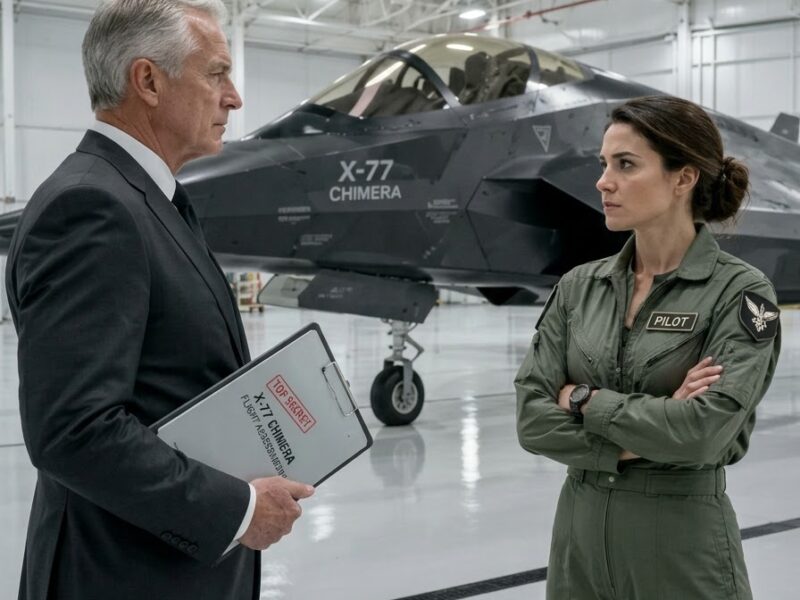
The experimental jet bucked violently above Edwards Air Force Base while three decorated pilots failed to control it
The alarm tore through the damp desert air at 06:17, its high-pitched siren bouncing off the corrugated steel walls of Hangar 4 at Edwards Air Force Base. I was standing near the flight line, grease on my flight jacket, a cold cup of black coffee in my hand, watching the eastern horizon burn a violent shade of crimson.
The experimental X-79 Valkyrie surged down Runway 04 Right. Its twin scramjets let out a deafening, metallic scream that rattled my teeth. But three hundred feet into its climb, the aircraft bucked.
It wasn’t a standard atmospheric bump. The aircraft didn’t roll or pitch naturally; its titanium frame shuddered in a rapid, unnatural micro-oscillation, its long, razor-thin wings vibrating like plucked piano wire. Smoke—pale grey and smelling of burnt silicon—began curling from the port ventral bay.
Inside the glass-walled control room overlooking the tarmac, chaos erupted. Through the open communication bay doors, I could hear the desperate chatter over the radio monitors.
“Pull it up!” an engineer barked. “Control authority dropping to forty percent!”
“She’s losing stability on the pitch axis! The flight computer is fighting the pilot!”
My stomach plummeted, a cold knot tightening in my gut. My eyes remained glued to the trembling jet as it dipped sharply toward the dry lake bed.
That wasn’t an engine failure. It wasn’t a mechanical bird strike or an unexpected thermal updraft. It was the exact same dynamic instability I had reported three months ago—the subtle, deadly control-loop anomaly that had led to my flight status being revoked, my security clearance frozen, and my reputation dragged through the mud.
Nobody had listened then. Now, everyone stood frozen, watching eighty million dollars of classified engineering plummet toward the desert floor.
Commander Hayes burst onto the tarmac, his uniform pristine, his eyes wide with rising panic. A convoy of fire trucks and staff cars screeched to a halt behind him.
“Get another pilot in there!” Hayes roared, waving a gloved hand toward the secondary taxiway where the recovery team was already assembling. “We have a three-minute window before the test sequence locks out!”
Major Thomas, a decorated combat veteran with over four thousand flight hours, sprinted up the ladder of a secondary test unit parked in the holding bay. He strapped into the simulator console connected directly to the X-79’s remote-override suite. Within forty seconds of attempting to stabilize the aircraft’s automated sequence, the jet lurched ninety degrees to the left, its wingtip barely clearing the radar tower.
Thomas hit the manual override, blowing the cockpit canopy and ejecting into the sand, his parachute opening just two hundred feet above the desert floor.
A second test pilot, Lieutenant Commander Vance, took the secondary console. He tried to force the flight computer into manual bypass. He lasted less than forty-five seconds before the aircraft’s internal flight manager overrode his inputs, sending the nose plunging into a violent dive that threatened to tear the airframe apart.
The aircraft remained airborne only through its raw, automated momentum, but its internal thermal sensors were redlining. Its systems were deteriorating at a catastrophic rate.
Hayes turned away from the runway, his face pale, his eyes darting across the tarmac until they locked onto me. I stood ten yards away, motionless, my eyes fixed on the struggling aircraft.
“Captain Morgan,” Hayes barked, his voice sharp and laced with authority. “Stay where you are.”
I walked past the fire trucks, stopping three feet from him. “Your pilots can’t control it, Commander. They’re fighting the computer. You can’t beat that system with force.”
His jaw tightened, a vein pulsing near his temple. “That’s an order, Morgan.”
I turned my head, looking through the heavy glass of the telemetry bay at the jet’s instrument feeds, which were flashing red on every master warning panel like a dying heartbeat.
“Then you’re going to lose the aircraft,” I said, my voice flat. “And whoever is inside the telemetry queue when it hits the sand.”
Hayes stepped into my personal space, his shadow blocking the morning sun. “You were fired from this program because you couldn’t follow instructions, Captain. Don’t make me have Security escort you off this base in handcuffs.”
The words cut deeper than I wanted to admit, opening a raw wound that had barely begun to heal.
Three months ago, during the preliminary high-speed taxi and flight tests, I had identified a lethal lag in the fly-by-wire flight-control software. During high-speed, high-G turns, the computer was over-correcting for micro-stalls, creating a feedback loop that would eventually drive the plane into the ground.
I took the data to the board. They called it paranoia.
When I refused to sign off on the flight readiness certificate, they called it incompetence.
When I took my findings directly to the Chief of Staff, they called it insubordination.
I had signed my dismissal papers without defending myself further. I didn’t have a choice. Dr. Julian Vance, the chief software engineer who had privately corroborated my math and promised to testify alongside me, had vanished from his base housing forty-eight hours before my court-martial hearing. His house was found empty, his hard drives wiped, his car abandoned at an off-base diner. The military officially classified him as a deserter.
I knew better. Julian hadn’t run.
A mechanic came sprinting out of Hangar 4, his headset slipping off his ear, his face slick with cold sweat.
“Commander! The jet’s automatic recovery system just suffered a total logic crash! Emergency flight controls are unresponsive! She’s coming down hard on Taxiway Bravo!”
The tarmac fell dead silent. The scream of the jet’s dying engines echoed off the mountains in the distance.
I didn’t ask for permission. I didn’t look at Hayes. I turned on my heel and walked straight toward the secondary flight-line aircraft—the twin-seat X-79 chase prototype resting in Bay 2, hooked directly into the master flight-line grid.
Hayes lunged forward, grabbing my upper arm. “What do you think you’re doing, Morgan?”
I looked down at his hand, then up into his eyes, my gaze cold and devoid of fear.
“Saving your people. And finishing what I started.”
He stared at me, his mouth open, the weight of the impending disaster crashing down on his shoulders. Slowly, his fingers loosened. He let go.
The cockpit of the chase unit smelled of hot copper, scorched insulation, and high-octane aviation fuel.
I dropped into the Kevlar-reinforced seat, pulled the five-point harness across my chest, and slammed the buckles home with practiced precision. My fingers flew across the control boards, throwing switches I had memorized over three years of intensive development. Primary power, avionics, telemetry sync, thrust vectoring—the switches clicked like a series of small, lethal gunshots in the quiet canopy.
The jet beneath me shuddered as its APU (Auxiliary Power Unit) roared to life, the dual turbines whining up to high idle.
“Captain Morgan, you have zero clearance for engine start,” Hayes’ voice crackled over the secure helmet comms. His tone was caught somewhere between military command and absolute desperation.
“I know,” I said, pulling the glass canopy down and sealing it shut.
“If you lift off that deck, you are committing a federal offense. Get out of that aircraft!”
I ignored him, wrapping my gloved hand around the throttle assembly and pushing it smooth and hard into the forward detent.
The chase jet surged out of Bay 2, its tires screaming against the concrete as it banked violently onto Runway 04 Right. The acceleration shoved me back into the seat cushions, the G-meter climbing instantly. I didn’t wait for optimal takeoff speed; I pulled back on the stick, lifting the nose into the sky while the landing gear was still retracting.
Two miles ahead, the rogue X-79 prototype was tumbling through a bank of low clouds, its automated thrusters firing in random, violent bursts.
For the first five seconds of closed-loop intercept, everything felt normal. Then, as I locked my chase unit’s control suite onto the prototype’s secondary receiver, my own control stick began to buck against my grip.
The nose of my aircraft drifted six degrees off axis without my input. The fly-by-wire system was trying to force my plane into the exact same destructive feedback loop.
I didn’t fight the stick. I knew better than to match force with an automated control loop operating at three gigahertz. Instead, I let the stick move, anticipating the computer’s erroneous correction, and neutralized the input using the manual rudder trim and differential throttle.
I didn’t fly against the computer; I tricked it into thinking it had already achieved stability.
Slowly, agonizingly, the wild oscillations in both aircraft began to dampen.
In the control room below, the radio chatter exploded into breathless disbelief.
“Telemetry is settling! Pitch axis deviation down to twelve percent!”
“She’s… she’s stabilizing the line! How the hell is she doing that without the primary flight code?”
I kept my eyes fixed on the HUD (Heads-Up Display), matching the prototype’s altitude foot for foot at fourteen thousand feet. “Hayes, I have structural control of the asset,” I said, breathing heavily into my oxygen mask as I held the stick in a precise, offset angle. “I’m guiding her into a wide, low-G bank over the salt flats. Clear the primary runway.”
“Copy, Captain,” Hayes replied, his voice subdued, robbed of all its earlier hostility. “Runway 04 is clear. You are cleared for emergency recovery approach.”
I guided the rogue jet through a series of broad, sweeping turns, carefully keeping its airframe outside the critical high-speed angle of attack that triggered the software fault. It was like walking a tightrope over a pit of fire, balancing eighty tons of metal on the edge of a feather.
Then, as I brought up the deep-level diagnostic telemetry window on my secondary screen to force the prototype’s landing gear down, my blood ran cold.
Beneath the standard operational parameters, hidden behind four layers of encrypted military firewall code, a tiny red line of text was scrolling across the bottom of the diagnostic terminal.
[UNAUTHORIZED COMMAND INJECTED AT 06:14:02]
[SOURCE: INTERNAL NODE 09 – BASE AUXILIARY SERVER]
[OVERRIDE PARITY: ACTIVE]
My heart pounded against my ribs like a sledgehammer.
This wasn’t a software bug. It wasn’t an unfortunate mathematical error in the flight-control algorithms created by an overworked engineering team.
Someone had deliberately written a malicious line of code into the flight-control logic. Someone had intentionally altered the software to trigger an unrecoverable dive the moment the aircraft reached a specific altitude and speed threshold.
My mind raced through the implications. Three months ago, when I reported the instability, I thought I was pointing out a design flaw. But I hadn’t been exposing a mistake.
I had been accidentally blowing the whistle on a sabotage operation.
And Julian Vance hadn’t disappeared because he was afraid of a failed test program. He had disappeared because he found out who wrote the code.
“Captain Morgan, you are on final approach,” Hayes’ voice broke through my headset, bringing me back to the reality of the cockpit. “Bring her down.”
“Roger,” I whispered, my eyes burning as I stared at the diagnostic screen. “Bringing asset home.”
The landing was hard and dirty.
The rogue prototype hit the asphalt of Runway 04 with a cloud of burnt rubber, its emergency brake parachutes deploying with a loud crack that echoed across the dry lake bed. My chase jet touched down fifty yards behind it, rolling to a stop near the edge of the taxiway just as a dozen emergency vehicles surrounded both aircraft, their red and blue lights flashing against the morning sky.
I popped the canopy, unbuckled my harness, and stepped down the boarding ladder. My legs were shaking from the adrenaline, my flight suit soaked with cold sweat.
Commander Hayes was waiting at the base of the ladder. He stood alone, away from his aides and the fire crews. His face had lost every trace of its usual ruddy color. He looked old, tired, and deeply shaken.
He stared at me as I removed my flight helmet, holding it under my arm.
“You brought it back,” Hayes said, his voice barely louder than the hum of the cooling turbines nearby. “I didn’t think anyone could fly through that lockout.”
“The aircraft didn’t fail, Commander,” I said, stepping closer so the surrounding mechanics couldn’t hear us. “The software did exactly what it was programmed to do.”
Hayes froze, his eyes narrowing. “What are you talking about?”
“Who else knew about that flaw?” I demanded, my voice dropping to a dangerous whisper. “Who had root access to the auxiliary server three months ago when I filed my first safety report?”
“That code was audited by three independent defense contractors, Morgan,” Hayes replied defensively, though a flicker of fear crossed his eyes. “It was declared clean.”
“Then your auditors are either blind or they’re working for the person who tried to destroy that aircraft today,” I said, pointing a finger back toward the control room overlook. “Everyone who signed my dismissal papers… everyone who sat on that board… they knew I was right. Or they wanted that plane to crash.”
Hayes swallowed hard, his throat clicking in the morning silence. He opened his mouth to respond, but the sharp, piercing ring of his encrypted satellite phone cut him off.
He pulled the device from his belt, looked at the caller ID, and pressed it to his ear.
“Hayes,” he said curtly.
I watched his face as he listened. I saw the exact moment his composure completely disintegrated. His shoulders dropped, his eyes widened in sheer disbelief, and his hand began to tremble so violently he almost dropped the phone.
“Say that again,” Hayes whispered into the receiver.
He listened for three more seconds, then slowly lowered the phone from his ear, staring at the concrete floor beneath his feet as if the earth were opening up to swallow him whole.
“What happened?” I asked, my instincts taking over as I stepped toward him. “Hayes, what is it?”
Hayes raised his head slowly, his eyes locked onto mine with an expression of pure dread.
“Dr. Julian Vance,” Hayes whispered, his voice cracking. “The chief software engineer who disappeared three months ago…”
My breath caught in my chest. My heart skipped a beat. “What about him? Did they find his body?”
“No,” Hayes said, his voice shaking. “He’s alive. An unscheduled transport just cleared the main security gate at the south entrance. He surrendered himself to base guards two minutes ago.”
Before I could digest the news, the heavy steel doors of Hangar 4 behind us creaked open.
Footsteps echoed off the concrete—slow, deliberate, echoing in the quiet morning air.
Hayes glanced toward the hangar doors, his face drained of all color. “He’s standing behind you.”
I turned around slowly, my heart hammering against my ribs.
Standing in the shadow of the massive hangar doorway was a man who looked like a ghost of the person I had worked with for two years.
Dr. Julian Vance had lost at least thirty pounds. His civilian suit was wrinkled and stained with desert dust, his posture hunched, his skin pale and sunken around dark, hollow eyes. But his gaze was sharp, terrified, and focused entirely on me.
“Julian,” I breathed, taking a step toward him. “You’re alive.”
He didn’t run to greet me. He didn’t smile. He stayed in the shadow of the hangar door, his hands tucked deep into his coat pockets, his eyes frantically scanning the tarmac, the radar towers, and the windows of the command building behind us.
“You shouldn’t have flown that plane today, Evelyn,” Julian whispered, his voice raspy, as if he hadn’t used his vocal cords in weeks. “You were supposed to stay away. I tried to delay the test sequence from the outside, but they accelerated the timeline.”
“Who is ‘they’, Julian?” Hayes demanded, stepping up beside me, his hands on his belt. “You disappeared three months ago! You abandoned a classified military initiative! Do you have any idea the criminal charges you’re facing?”
Julian let out a bitter, lifeless laugh, looking at Hayes with utter contempt.
“Charges, Commander? You think I care about your court-martial?” Julian took a step forward into the light, pointing a thin, trembling finger at Hayes. “I ran because if I stayed another twenty-four hours on this base, I would have ended up in a pine box at the bottom of Lake Mead.”
“Who threatened you?” I asked, stepping between Julian and Hayes, putting my hand up to keep Hayes from advancing. “Julian, tell me what happened. I found the code injection in the flight manager today. Someone altered the control loop.”
“It wasn’t just a code injection, Evelyn,” Julian said, his eyes filled with a deep, consuming dread. “The X-79 program was never meant to produce a functional operational aircraft. It was a billion-dollar funnel.”
The air seemed to freeze around us.
“A funnel?” Hayes repeated, stunned. “What are you talking about?”
“Project Valkyrie was designed from day one to fail during its operational demonstration phase,” Julian explained rapidly, his words spilling out like a confession. “A high-profile, catastrophic failure over foreign territory or remote airspace. The entire avionics package, the neural-flight architecture, the propulsion schematics… they weren’t lost in development errors. They were being sold to an international defense syndicate based out of Geneva.”
My mind spun as I connected the pieces. “The software crash today… it wasn’t just a sabotage attempt to cover up a mistake.”
“It was the delivery mechanism,” Julian said, nodding grimly. “The moment the aircraft entered a high-altitude loss-of-control event, its secondary communications array was programmed to dump the entire core design database to an offshore orbital satellite receiver, under the guise of an ’emergency telemetry backup.’ Once the data transferred, the plane was coded to force an unrecoverable dive into the salt flats, destroying the physical evidence.”
“My God,” Hayes breathed, taking a step back as the realization hit him. “The whole flight program…”
“Was an elaborate corporate heist,” Julian finished. “Three months ago, when Evelyn found the control loop anomaly, she accidentally found the backdoor route used for the data extraction. I tried to patch it secretly, but they found out. They intercepted me at my house, forced me into an unmarked van, and kept me in a black-site holding facility in Nevada for nine weeks.”
“How did you escape?” I asked.
“I didn’t escape,” Julian said, his voice dropping into a terrifyingly calm register. “They let me go forty-five minutes ago.”
I felt a sudden, icy wave of panic wash over my spine. “Why? Why would they let you go now?”
Julian looked directly into my eyes, his face pale as death.
“Because they don’t need the automated crash routine anymore,” Julian whispered. “They realized you were on base. They knew you were the only pilot capable of recovering the plane. And now that you’ve landed it… now that you’ve brought the complete, fully operational data core back onto this tarmac…”
Julian swallowed hard, looking over my shoulder toward the perimeter gates of Edwards Air Force Base, where three black, un-marked armored SUVs were breaking formation, crashing straight through the security gates, their heavy steel bumpers smashing the wooden barriers to splinters.
“They’re coming for you,” Julian said.
“Security breach at South Gate!” the base-wide speakers suddenly screamed, their mechanical alarms drowning out the wind. “All personnel, assume Condition Red! Repeat, Condition Red!”
The three black SUVs tore across the tarmac, their heavy diesel engines roaring as they sped directly toward Hangar 4. Through the tinted glass of the lead vehicle, I could see armed men in tactical gear, holding short-barreled automatic weapons.
“Hayes!” I yelled, turning toward the commander. “Get your security team out here now!”
Hayes was already barking into his radio, but the channel was filled with loud, high-pitched static.
“Comms are jammed!” Hayes swore, dropping the radio in frustration. “Local cell towers and military frequencies are completely dark!”
“They aren’t here to steal the data anymore,” I realized, the horror dawning on me in an instant. “They’re here to erase everyone who knows the truth.”
“Inside the hangar! Move!” Hayes shouted, drawing his sidearm from his holster.
Julian, Hayes, and I scrambled into the shadows of Hangar 4 as the first SUV screeched to a halt outside the bay doors. Automatic gunfire erupted, bullets ricocheting off the steel frame of the building with deafening metallic cracks.
“We can’t hold this building,” I said, crouching behind a heavy hydraulic generator unit. “They have heavy gear and local signal suppression. Within two minutes, they’ll flank us.”
“Then what do we do?” Julian panicked, pressing his hands over his ears as another burst of gunfire shattered the glass windows of the telemetry office above us.
I looked through the open rear bay doors of the hangar, out onto the secondary runway where the twin-seat chase jet I had just landed was still idling, its engines hot, its fuel tanks seventy percent full.
“We take the chase unit,” I said.
Hayes stared at me like I had lost my mind. “That’s a two-seat prototype, Morgan! There are three of us!”
“Then you stay and buy us time with the base defense force,” I said coldly, looking Hayes dead in the eye. “Or you climb into the secondary cargo compartment behind the avionics bay and hold on for dear life.”
Hayes looked at his empty radio, looked at the armed mercenaries advancing across the tarmac, and made his decision in half a second. “I’m climbing in.”
“Julian, get into the rear flight seat!” I ordered, grabbing a spare flight helmet from a rack near the wall and shoving it into his hands. “Put this on and don’t touch any blue switches on the side panels!”
We sprinted out the rear exit of Hangar 4, keeping low as bullets kicked up chunks of concrete around our feet.
Julian scrambled up the ladder into the back seat of the chase jet, his hands trembling violently as he fumbled with the harness. Hayes wedged himself into the narrow avionics access bay behind the cockpit bulkhead, pulling the heavy steel hatch shut from the inside.
I leapt into the pilot’s seat, slammed the canopy down, and engaged the emergency taxi thrust before my harness was even fully buckled.
The jet shot forward as a group of mercenaries rounded the corner of the hangar, raising their weapons. Bullets pinged harmlessly off the reinforced titanium belly of the aircraft as I slammed the throttles into full afterburner.
The twin engines roared, dumping raw fuel into the exhaust streams. Two brilliant tongues of blue flame erupted from the tailpipes, scorching the tarmac as the aircraft leapt down Runway 04 Right.
“Evelyn! They have SAM vehicles near the south perimeter!” Julian screamed through the internal comms, pointing toward a heavy truck mounting a surface-to-air missile pod near the main fence.
“Let them try,” I gritted out through my teeth.
I pulled back hard on the stick. The chase jet didn’t just take off; it rocketed vertically into the sky at an eighty-degree angle, its thrust-vectoring nozzles carving a path through the morning air.
Below us, two surface-to-air missiles launched from the truck, trailing white plumes of smoke as they homed in on our heat signature.
“Missiles locked!” Julian shrieked.
I waited—one second… two seconds… feeling the exact moment the radar-homing heads locked onto our tail.
Then, I cut the left engine completely, threw the right engine into full reverse-thrust vectoring, and kicked the left rudder pedal to the floor.
The aircraft executed a flat, radical drift in mid-air—a maneuver mathematically impossible for standard flight systems, a maneuver only made possible by bypassing the very software control loops that had been designed to keep pilots obedient.
The two missiles shot past our belly, exploding harmlessly in the empty air three hundred feet below us.
“Target clear!” I roared over the intercom as I brought the left engine back online, leveling the aircraft off at thirty-five thousand feet into the clear, blinding light of the morning sun.
Below us, the desert of Edwards Air Force Base shrank into a small, distant grid of brown sand and concrete strips. Sirens were finally blaring across the base as military police units flooded the flight line, surrounding the mercenaries’ vehicles from every side. The ambush was over. The strike team was trapped.
Inside the cockpit, the master diagnostic display cleared. The unauthorized command string vanished, replaced by a secure, direct link to the Department of Defense’s primary command network at the Pentagon.
[SECURE DATA ENCLAVE ESTABLISHED]
[TRANSMITTING COMPLETE AUDIT TRAIL TO DOD INSPECTOR GENERAL…]
[TRANSFER COMPLETE: 100%]
Julian let out a long, ragged breath in the seat behind me, collapsing back into his headrest. “It’s over… the entire network file just uploaded to the highest authority in the military structure. They can’t delete it now.”
From the avionics bay behind my seat, a muffled thud echoed as Hayes knocked against the metal partition. “Captain Morgan!” his voice came through the comms, breathless and awestruck. “Are we… are we alive?”
I adjusted my flight helmet, looking out over the vast, endless horizon where the blue sky met the black edge of space. The air was smooth, silent, and completely under my control.
“We’re alive, Commander,” I said quietly, a slow, real smile touching my lips for the first time in three months. “And this time, nobody is taking my wings away.”
The end.









