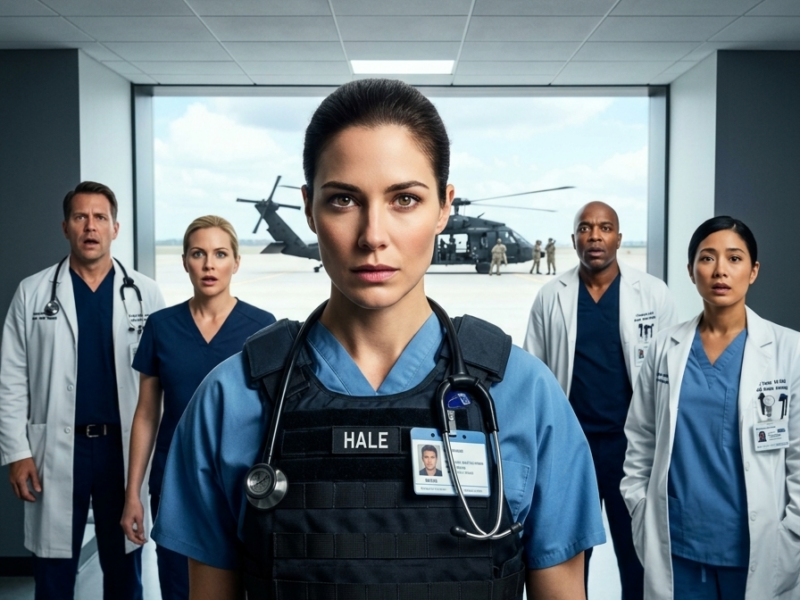
The ER staff laughed when the new nurse froze during her first chaotic shift, but their smiles vanished when a Navy helicopter thundered over the hospital
The fluorescent lights of Harborview Medical Center flickered overhead, buzzing with a sharp, hummed vibration that seemed to synchronize with the pounding behind my temples. It was 0200 hours on a Tuesday, and Trauma Bay 2 was bathed in the harsh, sterile smell of bleach, dried iron, and industrial floor wax.
I stood in front of the pyxis medication dispenser, my fingers hovering over the glass touchscreen. My breath was shallow, caught somewhere in the tight center of my throat.
“Come on, Sarah, it’s not an algebra problem. Just punch in the code,” Nurse Brenda called out from the central desk, her tone dripping with lazy condescension. She didn’t look up from her clipboard, but the two traveling nurses sitting next to her snickered quietly.
“The drawer is jammed again,” I said softly, keeping my voice flat, devoid of emotion.
“It’s not jammed, honey, you’re just pulling the latch before the solenoid clicks,” Brenda replied, turning her head to give me a theatrical, exaggerated sigh. “Nine days on the floor and you’re still fighting the furniture. Maybe nursing isn’t for everyone. Some people are just built for desk jobs.”
I didn’t answer. I pretended not to hear the quiet chuckles that followed her remark. I stared down at my hands—my short, clean fingernails, the faint, pale crescent-shaped scar running along the inside of my right thumb, the skin scrubbed raw from cheap hospital soap.
They thought I was useless. They thought I was a frightened, thirty-year-old novice who had somehow managed to stumble her way through a community college nursing program and land an entry-level residency at one of Seattle’s busiest level-one trauma centers. To them, I was Sarah Morgan: the girl who jumped whenever a tray dropped, the girl who kept her head down, the girl who spoke in a whisper and never made direct eye contact for more than three seconds.
They didn’t know that my silence wasn’t fear. It was discipline.
Suddenly, the heavy, pneumatic double doors leading from the ambulance bay blew open with a violent blast of cold, wet Pacific Northwest air.
“Trauma incoming! Unannounced!” a paramedic yelled, his boots skidding across the slick tile floor as he pushed a high-velocity stretcher into the bay.
The calm inside the unit disintegrated instantly. Doctors sprang from their seats; monitors began to chime in erratic, high-pitched sequences. Four paramedics were crammed around the stretcher, two of them actively applying manual pressure to the patient’s torso with blood-soaked abdominal pads.
“What do we have?” Dr. Vance, the attending trauma surgeon on duty, shouted as he snapped on a pair of latex gloves.
“Male, approximately thirty-five years old, severe blunt-force and penetrating trauma to the left chest and flank!” the lead paramedic shouted over the din. “Systolic was eighty on scene, down to sixty-two now! Tachycardic at one-forty! He’s slipping fast!”
I stepped back against the stainless-steel supply cabinet, making myself small, letting the senior nurses push past me. Brenda took the lead, grabbing an IV pole, while Dr. Vance leaned over the patient’s face, shining a penlight into his pupils.
“Get him onto the bay gurney on three!” Vance ordered. “One, two, three—shift!”
As they transferred the man’s weight, his jacket slipped open, revealing a dark green tactical undershirt soaked in dark, venous blood. Beneath the blood, pinned to his chest, was a tarnished metal insignia—a trident crossed with an anchor and a flintlock pistol.
My chest tightened. My pulse spiked, hitting a steady, familiar combat rhythm.
“What’s his name?” I asked. The question slipped out before I could censor myself, my voice cutting through the noise with an odd, unexpected authority that made Brenda glance back at me in surprise.
“Lieutenant Mason Reed,” the paramedic snapped, unhooking the suction line. “Navy. Found him in a wreckage off the pier.”
Lieutenant Mason Reed.
The name hit my brain like a physical shockwave. The room seemed to warp, the sound of the blaring monitors dimming into a distant, underwater roar. I knew that name. I had carried that name in the dark for eight long years, buried under layers of classified red tape, forged identities, and deliberate, painful oblivion.
Before I could process the sudden, suffocating wave of memory, the ceiling above us began to rattle.
It started as a low, sub-audible tremor—a vibration that rattled the glass medicine vials inside the cabinets and caused the IV bags to swing violently on their chrome stands. Within five seconds, the tremor escalated into a deafening, rhythmic thrum. Thump-thump-thump-thump.
“What the hell is that?” Dr. Vance muttered, looking up at the tiled ceiling. “Is there construction on the roof?”
“That’s not construction,” I whispered, though no one heard me over the growing tempest.
Outside the thick glass windows of the trauma bay, the night sky turned white. A massive Sikorsky MH-60M Black Hawk helicopter, stripped of civilian markings and painted in matte stealth black, hovered less than fifty feet above the hospital’s concrete parking lot. Its massive rotor wash battered the building, tearing saplings out of the landscaping and sending plastic trash bins tumbling across the pavement.
The emergency radio console at the charge nurse’s desk burst into life with a high-pitched, screeching squelch of encrypted military radio static.
“Harborview Trauma Command, this is Navy Rescue Command flight Vanguard-Zero-One. Do you read? Over.”
Brenda froze, her hands hovering over Mason Reed’s neck. Dr. Vance stared at the radio as if it had turned into a snake.
“This is Harborview,” Vance said, walking over and slapping the push-to-talk button. “You are in restricted civilian airspace! You need to clear the pad immediately!”
“Negative, Harborview,” the radio barked back, the voice cold, razor-sharp, and entirely unyielding. “We are conducting an emergency tactical extraction and quarantine. Identify your staff immediately. We need Nurse Sarah Morgan.”
A dead, heavy silence descended upon Trauma Bay 2. The radio static hummed through the speaker, high and brittle.
Brenda let out a short, nervous laugh, turning her head to look at me. “Why the hell would the Navy be asking for her?”
The radio crackled again, louder this time, overriding the hospital’s internal communications loop. “Repeat: We require Nurse Sarah Morgan in Bay Two immediately. Acknowledge.”
Every single pair of eyes in the room—doctors, orderlies, paramedics, and the nurses who had laughed at me five minutes ago—turned to lock onto me.
I took a slow, deliberate breath. The timid posture I had maintained for nine days melted away. My shoulders pulled back; my chin came up.
“I’m Sarah,” I said smoothly.
The radio responded instantly, the speaker dropping the formal protocol for a fraction of a second. “Thank God. Hold your position, Operative.”
Dr. Vance stared at me, his eyes wide, his penlight still burning in his hand. “Sarah… what the hell is this? Who are you?”
Before I could answer, the double doors of the ambulance bay were physically thrown off their tracks. Two men in dark blue tactical dress uniforms, accompanied by three heavily armed operators carrying short-barreled assault rifles, marched into the trauma room.
The senior officer, a man with steel-gray hair and three stars gleaming on his collar, walked straight past Dr. Vance, straight past Brenda, and stopped exactly two feet in front of me. In his hand, he carried a reinforced, heavy black metal case stamped with an orange classification seal.
“Are you the individual who received Lieutenant Reed?” the officer demanded.
“I am,” I replied, my voice devoid of any hesitation.
He didn’t ask for my ID. He didn’t ask for verification. He simply placed the black metal case on the crash cart next to me and popped the heavy dual latches. The seal broke with a sharp hiss of pressurized air.
Inside lay a single, physical photograph, laminated in thick plastic.
My blood turned to liquid ice.
The photograph showed a seven-person elite surgical forward-deployment team standing in the dust of an unmarked airstrip in Al-Anbar province. We were wearing unflagged desert camouflage, tactical vests, and carrying sidearms. Standing in the center of the group, holding a field scalpel in one hand and a rifle in the other, was a younger, harder version of me.
I hadn’t seen that photograph in eight years. It was supposed to have been incinerated in the fire that erased Development Group Alpha.
The officer stepped closer, lowering his voice so only I could hear. “You weren’t hired at Harborview because of your nursing degree, Ms. Morgan. Your application was routed through our regional division three months ago.”
I stared into his slate-gray eyes. “Then why was I put here?”
The officer turned his head slowly, looking past me to the bloody gurney where Lieutenant Mason Reed lay dying. “Because three days ago, before he went dark behind enemy lines, Lieutenant Reed gave us one instruction. He said if he came back broken, you were the only person alive with the clearance to fix him.”
A faint, wet gasp came from the stretcher.
Mason Reed’s hand moved. His bloodied fingers twitched, grasping weakly at the edge of the sheet. His eyelids fluttered, opening just enough to expose two striking, pale green eyes.
He didn’t look at Dr. Vance. He didn’t look at the admiral. He locked his sight onto me.
“Sarah…” he rasped, his lungs rattling with fluid.
I stepped past the admiral, dropping to one knee beside the gurney. I reached out, my fingers wrapping around his cold, blood-stained hand, finding the exact pressure point to steady his pulse. “I’m here, Mason. Stop talking. You’ve got a collapsed lung.”
He pulled me closer, his strength surging in a desperate, final effort, and whispered four words directly into my ear.
“They… found… you… Phoenix.”
The air left my chest.
Behind me, the senior Navy officer reached over, grabbed the heavy stainless-steel handle of Trauma Bay 2’s double doors, pulled them completely shut, and threw the manual deadbolt.
Click.
The room was locked.
I turned around slowly. Dr. Vance was backing away toward the corner; Brenda was trembling, her hands pressed against her mouth; the orderlies were frozen in total shock.
They had spent nine days laughing at the quiet, clumsy girl who couldn’t open a medication drawer. They had no idea that the woman standing in front of them had been the chief trauma surgeon for the most secretive black-ops unit in the United States military—a ghost who had spent eight years waiting for the past to finally catch up to her.
“Clear the room,” the admiral ordered, his voice echoing off the tiled walls with absolute, unquestioned authority.
“Now wait just a damn minute!” Dr. Vance yelled, his face flushed red with a mixture of fear and professional outrage. “This is a civilian medical facility! That man on the table is in critical condition! He has a hemothorax, his pressure is dropping, and I am the attending physician in this emergency department!”
The admiral didn’t even look at Vance. He simply made a subtle gesture with his left hand. Two of the armed operators stepped forward, grabbed Vance by the upper arms with iron grips, and moved him firmly toward the back observation room.
“Hey! Let go of me!” Vance shouted, struggling uselessly against two hundred and thirty pounds of tactical muscle.
“You nurses, out,” the third operator commanded, opening the door to the side utility closet and forcing Brenda and the two travel nurses inside.
“Sarah!” Brenda shrieked, her eyes wide with terror as she looked at me through the narrowing gap of the closet door. “Sarah, tell them! Tell them who you are!”
I didn’t look at her. “Keep quiet, Brenda. Do what they say and you won’t get hurt.”
The closet door slammed shut, leaving only the admiral, the tactical operators, Mason Reed, and me in the primary trauma bay. The roaring rotor wash of the Black Hawk outside continued to beat against the building, a constant, thunderous reminder that the world outside this room had ceased to operate under civilian rules.
I turned back to the black metal case on the crash cart. My hands, which had appeared so hesitant while operating the pyxis machine ten minutes ago, moved with rapid, lethal precision. I grabbed a pair of surgical shears, cut Mason’s tactical shirt straight down the center line, and tossed the bloody fabric to the floor.
“Needle thoracostomy, now,” I said, looking up at the admiral. “He has a tension pneumothorax. If I don’t vent his chest cavity in thirty seconds, his heart is going to stall.”
The admiral nodded. One of the operators immediately unclipped a specialized, olive-drab medical kit from his belt and laid it open beside me. It wasn’t standard civilian hospital gear; it contained military-grade, field-surgical instruments—titanium trocars, rapid-seal chest valves, and synthetic blood expanders.
They hadn’t just brought Mason here to be treated. They had brought the entire operating theater with them.
I picked up a 14-gauge relief needle, located his second intercostal space at the midclavicular line with my thumb, and drove the needle firmly through his skin into his chest wall.
A sharp, violent hiss of trapped air and dark blood rushed out of the catheter. Mason’s chest heaved upward; his monitor beeped erratically, then began to settle into a steady, rhythmic rhythm. His blood pressure reading spiked from sixty to ninety-four.
“Good,” I muttered, wiping a streak of sweat from my forehead with the back of my wrist. “He’s stabilized for the next ten minutes. Now talk to me, Admiral. Why is Lieutenant Reed covered in blood, and why did he bring my call sign back to life?”
The admiral stepped up to the edge of the gurney, looking down at Mason’s pale face. “My name is Admiral Thomas Vance—no relation to your civilian doctor back there. I head the Naval Special Warfare Intelligence Command.”
“I know who you are, Thomas,” I said coldly, adjusting the chest seal on Mason’s torso. “You were the one who signed the execution order on Operation Shadowfall eight years ago in Mosul.”
Thomas’s eyes flickered with a tiny sliver of genuine surprise, but his composure held. “Shadowfall was compromised by a high-level mole inside the Pentagon, Phoenix. We had to burn the entire network to protect the operational grid. We thought your entire team was killed in the artillery strike.”
“We weren’t killed by an artillery strike,” I said, my voice dropping into a register so dark and lethal that the two armed guards at the door tightened their grip on their rifles. “We were betrayed. Someone leaked our coordinates to a private military contractor operating out of Dubai. They ambushed us at the extraction point. Mason and I were the only ones who made it out of the kill zone.”
“I know,” Thomas said softly. “And for eight years, we believed you were dead. Until three days ago.”
“What happened three days ago?”
Thomas reached into his coat pocket and pulled out a encrypted tactical tablet. He swiped the screen twice and held it out to me. On the display was a satellite thermal feed showing a burning compound tucked into the jagged, snow-covered mountains of the Oregon border.
“A rogue offshoot of that same private military group—calling themselves the Aegis Collective—has been operating an unauthorized dark site less than two hundred miles from this hospital,” Thomas explained. “They weren’t just running black-market weapons. They were harvesting intelligence from compromised military personnel. Lieutenant Reed spent the last six months infiltrating their command structure.”
I looked down at Mason. His breathing was smoother now, but his skin was still grey, his body fighting the effects of severe hemorrhagic shock. “He went in alone?”
“He went in to find the list,” Thomas said.
My heart did a sharp, painful flip. “What list?”
“The list of surviving operatives from the Shadowfall protocol,” Thomas replied, looking directly into my eyes. “The Aegis Collective didn’t just ambush your unit eight years ago, Phoenix. They’ve been hunting down the survivors one by one, erasing them to make sure the truth about the Pentagon leak never sees the light of day. Mason found out they had located an operative living in Seattle under the name Sarah Morgan.”
I froze. The scalpel in my hand felt heavy, cold, terrifyingly real.
“He didn’t come to Harborview to get treated,” I whispered, the horrifying truth dawning on me. “He came here to warn me.”
“No,” Thomas said, his voice dropping into a solemn, grim tone. “He didn’t come to warn you. He came here because the strike team that attacked his compound followed him.”
At that exact second, the overhead lights in Trauma Bay 2 didn’t just flicker—they died completely.
The low hum of the hospital’s central power grid cut out, replaced by the sudden, terrifying silence of a total blackout. The heavy Black Hawk helicopter outside let out a sharp, mechanical whine as its searchlights were suddenly extinguished by a localized electromagnetic pulse.
In the sudden, absolute darkness of the trauma room, the operational comms on the guards’ vests exploded into frantic, static-laced shouting.
“Alpha One! We have lost power across the entire facility! Perimeter breaches on floors one through three! Hostiles inside the building! I repeat, hostiles inside the building!”
The red emergency backup lights kicked on three seconds later, bathing Trauma Bay 2 in an eerie, blood-colored glow.
“Defensive positions!” Admiral Thomas ordered, drawing a suppressed sig-sauer pistol from beneath his uniform jacket with a practiced, fluid motion.
The two SEAL operators instantly posted up on either side of the locked double doors, their rifle scopes glowing faintly green in the low light. Down the long corridor outside, the sound of civilian panic was rising—screams of disoriented patients, orderlies shouting for backup generators, and the sharp, distinct sound of heavy combat boots crunching over shattered glass.
“They cut the main feed and dropped a directional EMP,” I said, dropping my field scalpel into the tray and reaching down to Mason’s tactical rig on the floor. I pulled out a Glock 19 sidearm, checked the magazine with a quick, muscle-memory press-check, and racked the slide.
The metal felt right in my hands. The eight years I had spent holding thermometers, chart pads, and IV lines vanished like smoke in the wind.
“You still know how to use that, Operative?” Admiral Thomas asked, glancing at me as I took up a position behind the stainless-steel crash cart.
“I spent four years as the chief sniper for DevGru before I took my medical commission, Thomas,” I replied, my eyes fixed on the frosted glass panels of the entrance doors. “I don’t forget.”
From inside the locked observation room, Dr. Vance began hammering wildly on the glass window. “Let us out! What’s happening out there? Is that gunfire?”
“Shut him up,” I barked without looking back.
One of the operators turned and smashed the butt of his rifle against the observation glass, cracking it into a spiderweb pattern. “Stay down and keep your mouth shut if you want to live!” he roared. Vance backed away into the shadows, terrified into total silence.
Thump. Thump. Thump.
The sound came from the ceiling—directly above the trauma bay’s air ducting system.
“Thermal imaging!” the operator on the right shouted. “They’re on the roof! Repelling down the ventilation shaft!”
Before the words had even fully cleared his throat, the drywall panels of the drop ceiling exploded downward in a cloud of white dust and twisted metal gridwork. Two black-clad tactical breach operatives dropped through the opening, firing unsuppressed automatic submachine guns as they hit the linoleum floor.
The sound inside the enclosed, concrete-walled room was deafening.
Tat-tat-tat-tat-tat!
Dust, glass, and plastic medicine bottles shattered into thousands of flying projectiles. One of Thomas’s SEAL operators took two heavy rounds to his tactical chest plate, staggering back against the wall, but he didn’t go down. He raised his rifle and returned fire, punching three 5.56 rounds through the first attacker’s helmet.
I didn’t wait for orders. I rolled out from behind the crash cart, staying low beneath the sweeping arc of fire. The second attacker was turning his weapon toward Mason’s gurney.
I raised my Glock, acquired his sight picture through the red emergency haze, and pulled the trigger twice.
Bang! Bang!
The rounds hit him precisely in the unprotected soft tissue beneath his armpit, punching through his side and collapsing his lungs. He crumpled to the floor with a heavy, wet metallic thud, his weapon skidding across the blood-soaked tile to come to a stop at my feet.
“Clear!” I shouted, dropping back to one knee, my weapon scanning the dark hole in the ceiling.
“More coming down the main corridor!” the remaining SEAL yelled, pointing through the cracked glass doors.
Through the frosted panels, I could see five, six, maybe seven armed silhouettes advancing down the hallway, firing methodically through the doors of other treatment rooms. They weren’t here to take prisoners. They were conducting a systematic sweep of the entire floor, clearing every room until they found the former black-ops surgeon who carried the keys to their destruction.
“They’re using heavy body armor!” Thomas said, slamming a fresh magazine into his sidearm. “We can’t hold this room with light sidearms! We need to move the patient!”
“Move him where?” I demanded, gesturing to the heavy monitors and oxygen lines tethered to Mason’s chest. “He’s on an active chest drain and manual fluid resuscitation! If we move him into a hot hallway without a sealed transport unit, he’ll bleed out in under two minutes!”
“Then we make our stand here,” Thomas said, his jaw tightening into iron.
“No,” a weak, gravelly voice rasped from the gurney behind us.
We both turned. Mason Reed had pulled himself up onto one elbow, his teeth bared in an agonizing grimace as he held his leaking chest tube against his ribs. His green eyes were burning with a desperate, wild intensity.
“The sub-basement…” Mason gasped, blood trickling from the corner of his mouth. “The old morgue elevator behind Bay Two… it connects directly to the lower parking garage… where the heavy extraction team is waiting…”
I looked at the back wall of Trauma Bay 2. Behind a wall of steel supply cabinets was an old, manual freight elevator used in the 1970s to transport biohazard waste to the basement—a feature that didn’t appear on modern hospital floor plans.
“He’s right,” I said, turning to Thomas. “I’ve been here nine days. I know where that shaft leads. But the door is welded shut with an industrial deadbolt.”
“Then we blow it,” Thomas said, looking at his surviving SEAL operator. “Charge the hinges.”
“What about the doctors and nurses?” the operator asked, pointing toward the locked closet and observation room.
I looked back at the cracked glass of the observation window. Dr. Vance was cowering behind a desk; Brenda was staring at me through the closet slats, tears streaming down her terrified, bleach-stained face.
I walked over to the closet door, grabbed the handle, and threw it open.
Brenda gasped, falling backward onto a pile of clean linens. “Sarah… please…”
“Listen to me very carefully, Brenda,” I said, my voice cold, absolute, and utterly devoid of fear. “You are going to stay on the floor of this closet. You are not going to make a sound. When the shooting stops, you are going to count to three hundred, then you are going to take the emergency stairs down to the street. Do you understand me?”
Brenda nodded frantically, her hands clasped together as if praying to a ghost. “Yes… yes, Sarah… I’m sorry… I’m so sorry…”
“Don’t be sorry,” I said, stepping back and pulling the door shut. “Just survive.”
I turned back to Mason’s gurney. I unhooked the wall-mounted suction, attached a portable field pump, grabbed two extra bags of O-negative blood from the transport cooler, and hung them over my shoulder.
“Charge set!” the SEAL operator called out, pressing a strip of military plastic explosive along the iron frame of the hidden freight elevator door. “Three seconds! Cover!”
I threw my body over Mason’s gurney, shielding his exposed chest with my torso as the SEAL hit the detonator.
BOOM!
The explosion didn’t just break the lock—it sheared the steel doors completely off their tracks, sending them crashing down into the dark, empty elevator shaft with a horrific, echoing metallic screech that reverberated through the foundation of the hospital.
A thick cloud of acrid cordite smoke and pulverised concrete dust filled the room.
“Move! Move!” Thomas barked, grabbing the front handles of Mason’s heavy gurney while I took the rear.
Together, we pushed the gurney through the shattered opening, forcing it into the narrow, dark freight elevator carriage. The SEAL operator stepped in behind us, pulling the heavy, wire-reinforced security gate shut just as the primary entrance doors to Trauma Bay 2 were blown inward by a barrage of heavy shotgun rounds.
Through the gaps in the elevator gate, I saw the lead attacker burst into the room. He was wearing an unmarked, dark grey tactical uniform with a full-face ballistic mask. He swept the blood-stained room with his rifle, his eyes locking onto the elevator gate just as Thomas pulled the manual emergency drop lever.
Clang-clang-clang-clang!
The old counterweight system groaned in mechanical agony as the elevator plummeted down the dark shaft, dropping us into the pitch-black bowels of the hospital. The sounds of gunfire above us grew faint, replaced by the rushing wind of the open shaft and the heavy, ragged breathing of four people trapped in a metal cage.
“You okay, Mason?” I asked, dropping to my knees beside him in the darkness, feeling his carotid pulse with two fingers. It was fast, but strong.
“I’ve… been better, Operative,” Mason rasped, a faint, painful smirk pulling at the corner of his lips. “You… still have lousy bedside manner.”
“Shut up or I’ll use a larger needle next time,” I muttered, though a tiny, involuntary breath of relief escaped my lips.
The elevator hit the sub-basement level with a jarring thud that rattled our teeth. Thomas slammed the manual gate open, stepping out into a damp, ill-lit concrete corridor lined with rusted steam pipes and ancient medical storage crates.
“Which way to the garage?” Thomas demanded, scanning the gloom with his weapon raised.
“Left, through the old boiler room,” I replied, grabbing the rear of the gurney and pushing it forward into the dark corridor. “It exits directly into the subterranean ambulance park beneath the south wing.”
As we moved through the dim, flickering amber light of the basement, the SEAL operator walked point, his weapon low, his eyes moving continuously. The air down here was thick with the smell of wet earth, diesel fuel, and old dust. It felt like the tunnels beneath Mosul. It felt like home.
“Thomas,” I said as we pushed the heavy gurney through a set of rusted double doors. “You haven’t told me the whole story.”
“What story?” Thomas asked without turning his head.
“Why Mason really came for me,” I said, stopping the gurney in the center of the boiler room. “You said he wanted to warn me about the Aegis Collective. But Mason didn’t just bring a warning. He brought a decryption key in his tactical rig. I saw the flash drive pinned inside his vest.”
Thomas stopped walking. The SEAL operator kept moving toward the exit, taking up a tactical guard position at the far door, but Thomas turned around slowly to face me in the dim light.
“You always were too smart for your own good, Phoenix,” Thomas said quietly.
“The intelligence list isn’t just on an offsite server, is it?” I asked, my voice dropping into a dangerous, razor-thin register. “It’s in him. He carried the primary drive out of that compound.”
“Yes,” Thomas admitted. “The drive contains the names of every high-ranking government official who took money from Aegis over the last decade. It’s enough to burn down half the defense infrastructure in Washington.”
“Which means whoever controls Mason controls the entire board,” I realized, stepping between Thomas and the gurney. “Including you.”
Thomas’s eyes narrowed slightly. “Are you implying something, Operative?”
“I’m implying that eight years ago, when Development Group Alpha was burned, you were the only officer with the clearance codes to alter our GPS beacons,” I said, raising my Glock until the sights were aligned precisely with the center of Thomas’s chest. “You didn’t come here tonight to save us, Thomas. You came here to make sure Mason didn’t hand that drive to anyone else.”
A heavy, suffocating silence fell over the boiler room. The distant rumble of the storm outside beat against the concrete foundation like a dying heart.
Thomas looked down at the barrel of my weapon, then looked up into my eyes. A cold, chilling smile slowly formed on his face—a smile devoid of any warmth, any military honor, or any humanity.
“You really were the best surgeon I ever trained, Sarah,” Thomas said softly, his voice dropping the formal, patriotic tone he had used upstairs. “It’s a damn shame you didn’t stay in that quiet little civilian hospital.”
Before I could pull the trigger, a sharp, metallic click sounded from behind me.
I didn’t have to turn around to know what it was. The SEAL operator—the man who had stood beside us, defended the room, and taken bullets for the team—had just raised his rifle and pointed it directly at the back of my head.
“Drop the weapon, Phoenix,” the operator said, his voice flat, emotionless, and entirely devoid of mercy. “Or the lieutenant dies right now.”
I didn’t drop the gun.
My arms remained perfectly steady, the sights of my Glock locked onto the bridge of Admiral Thomas’s nose. In the dim, amber glow of the boiler room, the three of us formed a tight, lethal triangle of death—a standoff where a single twitch of a finger would end three lives in less than a second.
“You sold us out,” I said softly, my voice devoid of anger, replaced by an absolute, icy clarity. “Eight years ago. It wasn’t a Pentagon leak. It was you.”
“It was business, Sarah,” Thomas said calmly, adjusting his cuffs with his left hand while keeping his right hand steady on his own sidearm. “The cold war was over. The black-ops budget was shrinking. Aegis offered me twenty million dollars for the coordinates of a unit that officially didn’t exist anyway. Your lives were already forfeit the moment you stepped onto that helicopter in Mosul.”
“And Mason?” I asked, glancing sideways at the pale, silent man on the gurney.
“Mason was a loose end who refused to die,” Thomas replied. “He spent eight years hunting for the truth, slowly piecing together the financial paper trail that led straight back to my office. When he broke into the Oregon dark site three days ago, he didn’t just steal the drive—he flagged my personal account. He forced my hand.”
“So you staged this entire rescue operation,” I said, assembling the pieces of his grand design in my mind. “You brought a full tactical squad to a civilian hospital, cut the power, let the Aegis mercenaries breach the floor, and planned to execute both of us in the basement. You would report to Washington that Lieutenant Reed and Nurse Sarah Morgan were killed by terrorists before your team could extract them.”
“It’s a clean narrative,” Thomas agreed, taking a small, deliberate step forward. “The tragic death of a war hero and a brave civilian nurse. A memorial service at Arlington. Full honors. Now… drop the gun, Sarah. Don’t make this messy.”
“I don’t make messes, Thomas,” I whispered. “I clean them up.”
I didn’t shoot Thomas.
Instead, I dropped my shoulder, spun on my left heel, and slammed my body weight directly into the side of Mason’s gurney. The heavy, stainless-steel frame swung violently around, its heavy rubber wheels catching the SEAL operator across his shins and throwing him off balance.
Bang!
The operator’s rifle went off as he fell, sending a burst of 5.56 rounds screaming into the concrete ceiling, shattering a steam pipe directly above us. High-pressure, scalding white steam roared out of the ruptured pipe, filling the narrow boiler room with a blinding, impenetrable curtain of heat and white mist.
Thomas roared in frustration, firing three blind shots through the steam screen. Bang! Bang! Bang! The heavy rounds struck the steel boiler behind me, sending bright orange sparks flying into the haze.
I moved through the steam like a phantom. I didn’t need eyes; I had spent nine days memorizing the physical layout of this basement. I dropped low beneath the rising heat, swept my hand across the concrete floor, grabbed the fallen SEAL operator’s tactical knife from his belt, and drove it straight through his hand as he tried to raise his rifle.
He let out a choked scream, dropping the weapon. I grabbed the barrel of his carbine, whipped it around, and slammed the heavy buttstock directly into his jaw, knocking him unconscious instantly.
“Sarah!” Thomas’s voice echoed through the roaring steam, wild, desperate, and cracking with rage. “You can’t leave this building! I have teams covering every exit!”
I didn’t answer. I emerged from the white cloud directly behind him, silent as a ghost.
Thomas felt the cold, steel barrel of my Glock press firmly against the soft skin directly beneath his left ear.
He froze. His sidearm hovered in mid-air, trembling slightly for the first time all night.
“You forgot one thing, Thomas,” I whispered into his ear, my breath warm against his neck.
“What…” he rasped, his eyes darting frantically toward the door.
“You taught me how to perform surgery,” I said softly. “Which means I know exactly where every major artery runs in the human body. I know how much pressure it takes to sever a carotid. And I know how long a man has to live when his heart stops pumping blood to his brain.”
Thomas swallowed hard, his arrogance evaporating into pure, unadulterated terror. “Sarah… wait… we can talk about this… I have access to thirty million dollars… offshore accounts…”
“I don’t want your money, Thomas,” I said. “I want my life back.”
I pulled the trigger.
The heavy 9mm round didn’t go through his head. I shifted the angle at the last microsecond, firing the shot directly through his shoulder joint, shattering his collarbone and severing the main motor nerve in his right arm.
Thomas screamed, dropping his sidearm as he collapsed to his knees, his right arm dangling uselessly at his side as blood soaked his crisp navy uniform.
Before he could recover, I kicked his weapon across the floor, pulled out a pair of heavy tactical zip-ties from his own vest, and bound his left wrist securely to the iron frame of the steam pipe.
“You’re going to sit here in the dark,” I said, looking down at the man who had ordered my death eight years ago. “And when the Federal Marshals arrive in ten minutes, you’re going to tell them everything.”
I walked back through the clearing steam, took the handles of Mason’s gurney, and pushed it through the double doors into the subterranean ambulance park.
The storm outside had finally broken. The heavy rain had turned into a soft, Pacific Northwest drizzle, and the grey light of dawn was beginning to illuminate the wet pavement of the parking lot.
A sleek, unmarked dark grey civilian van sat parked in the loading dock, its engine idling quietly. The driver’s side door opened, and a woman in plain clothes stepped out, holding a tactical medical kit and a secure satellite phone.
“Phoenix,” she said, nodding respectfully as she walked over to help me lift Mason’s gurney into the back of the van. “The primary server in Washington has just received the drive. The warrants for Thomas’s network are being executed right now.”
I looked down at Mason. His eyes were open again, his skin color slowly returning as the IV fluids did their work. He reached up, grasping my fingers firmly.
“We did it, Sarah,” he whispered, a tired, genuine smile spreading across his face. “It’s over.”
I looked back at the grand, towering brick building of Harborview Medical Center. Up on the fourth floor, behind the glass of Trauma Bay 2, Brenda and Dr. Vance were probably still sitting in the dark, trying to figure out what had happened to the quiet, timid new nurse who couldn’t open a medication drawer.
I reached up, unclipped my plastic hospital ID badge—Sarah Morgan, RN—and tossed it into the drain by the curb.
I climbed into the back of the van beside Mason, pulled the heavy sliding door shut, and looked at the driver.
“Where to now, Operative?” she asked, putting the van into gear.
I looked out the dark tinted window at the rising sun, feeling the weight of eight long years finally lift from my chest.
“Somewhere quiet,” I said smoothly. “I’m off the clock.”
The end.









