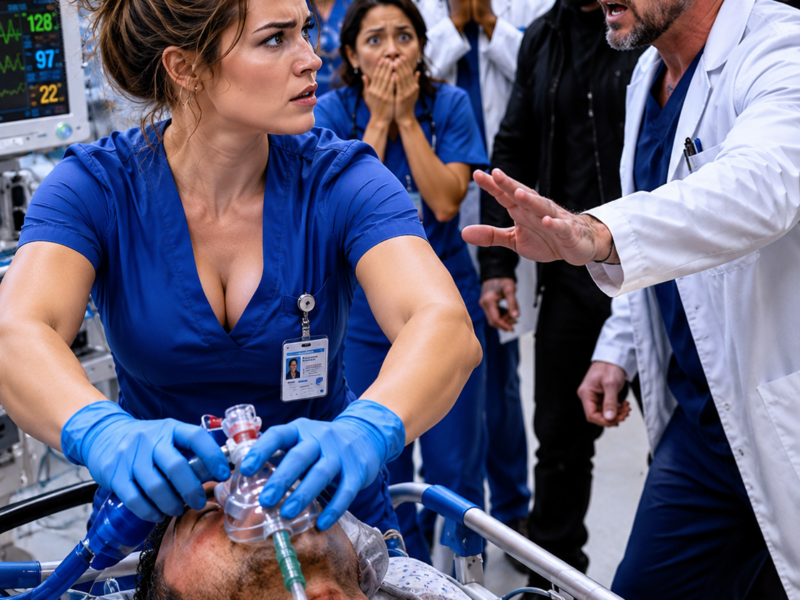
“The ER director ordered me to stay behind the nurses’ station while blood-covered patients flooded through the ambulance doors
“Because this little girl may need the same kind of rescue that saved your entire unit.”
Colonel Michael Reeves didn’t wait for anyone to respond.
He moved toward Emma’s stretcher, looked at the monitor, and spoke with the calm authority of someone who had spent decades working in places where panic could cost lives.
“Get pediatric critical care here immediately. We need the attending physician at the bedside.”
Dr. Lawson stepped forward.
“Colonel, this is my emergency department. I don’t appreciate someone walking in and taking over.”
Reeves didn’t raise his voice.
“Then act like the director of an emergency department and make sure this child receives the attention she needs.”
Lawson’s face reddened.
I didn’t look at either man.
Emma was my priority.
Her small hand rested beside the pink strap of her backpack. A cartoon rabbit was printed across the front, and one of its ears had been torn.
I gently moved the backpack away from the equipment.
“Emma, sweetheart, can you hear me?”
There was no response.
The pediatric physician arrived, followed by a respiratory therapist.
I reported the changes I had observed, the timeline, and what the paramedic had told us.
The physician took over the medical assessment.
“Let’s reassess her airway and breathing. I want a focused examination immediately.”
I stayed beside the team, preparing the equipment they requested.
The monitor continued to sound.
The little girl’s oxygen level was dangerously low.
The physician examined her chest and quickly recognized that something more serious than a simple impact injury was happening.
“Possible major thoracic injury,” he said. “We need immediate imaging when she’s stable enough, and we need to prepare for emergency intervention.”
Colonel Reeves looked at me.
“Tell them what you noticed.”
“Her breathing became progressively more shallow. Her left side wasn’t expanding normally, and she stopped responding to verbal stimulation.”
The pediatric physician nodded.
“Good observation.”
The team continued the assessment and identified a life-threatening chest complication.
The appropriate emergency treatment was initiated.
Within minutes, Emma’s condition began to improve.
Her oxygen levels rose.
Her breathing became more effective.
The physician looked at the monitor, then at the team.
“She’s responding. Keep monitoring her closely.”
I let out a breath I hadn’t realized I was holding.
The paramedic standing near the doorway lowered his head.
“Thank God.”
I looked at Emma’s backpack.
The torn rabbit ear was resting against the stretcher rail.
For some reason, that small detail hurt more than the alarms.
She was someone’s little girl.
Someone had probably packed that bag for school that morning, never imagining she would spend the night in an emergency department surrounded by strangers.
I gently adjusted the blanket over her legs.
Then I heard Lawson behind me.
“Hannah. My office. Now.”
Colonel Reeves turned.
“She’s still part of the team caring for this child.”
“She’s under my supervision.”
“Then supervise her properly.”
Lawson stared at him.
But Reeves had already turned away.
The mass-casualty incident continued for almost four hours.
By midnight, Mercy General had received nineteen patients from the highway collision.
Three required emergency surgery.
Several had fractures and head injuries.
One elderly passenger had suffered a cardiac arrest during transport but was stabilized by the resuscitation team.
The hospital was stretched beyond capacity.
I worked wherever I was needed.
I helped prepare patients for transfer, coordinated supplies, assisted with monitoring, and supported the nurses who were beginning to show signs of exhaustion.
Nobody called me lazy.
Nobody complained that I was moving too quickly.
And nobody asked me why I seemed to know exactly what equipment was needed before anyone requested it.
Around 1:30 a.m., Melissa approached me near the supply room.
She handed me a bottle of water.
“Drink.”
I looked at it.
“Thank you.”
She leaned against the counter.
“I’ve worked here seven years. I’ve never seen anything like tonight.”
“Me neither.”
She studied my face.
“That wasn’t your first mass-casualty incident, was it?”
I took a sip of water.
“No.”
She waited.
I knew she wanted to ask more.
But before she could, the pediatric physician came around the corner.
“Emma is stable. We’re transferring her to the pediatric intensive care unit.”
I nodded.
“That’s good.”
He smiled.
“Her mother has arrived. She’s been asking about the nurse who stayed with her.”
I looked down at my hands.
“Tell her the pediatric team took good care of Emma.”
He smiled again.
“I’ll tell her.”
Then he added, “But I think she wants to thank you.”
Emma’s mother was sitting beside the ICU bed when I entered.
Her name was Laura Bennett.
She looked exhausted, with damp hair and a hospital visitor badge clipped crookedly to her sweater.
The moment she saw me, she stood.
“You’re Hannah?”
I nodded.
She crossed the room and took both my hands.
“They told me you were the one who noticed she was getting worse.”
I felt uncomfortable.
“There were several people helping her.”
“But you noticed.”
Her voice broke.
“I was on the other side of the bus. They told me Emma had been taken in another ambulance. I thought…”
She couldn’t finish.
I squeezed her hands gently.
“She’s here. She’s getting treatment.”
Laura looked at her daughter.
Emma was sleeping beneath a white blanket, with a small monitor attached to her finger.
“She had that backpack with her because today was her first day at a new school,” Laura whispered.
I glanced at the pink bag.
“She likes rabbits?”
Laura managed a small smile.
“She loves them. She wanted to show her new teacher.”
I nodded.
For a moment, neither of us spoke.
Then Laura asked, “Do you have children?”
I looked at Emma.
“No.”
She noticed the change in my expression.
“I’m sorry. I didn’t mean to pry.”
“It’s okay.”
I turned toward the door.
Laura called after me.
“Whatever happened tonight, I hope you know that you mattered to us.”
I stopped.
Those words were simple.
But I carried them with me down the hallway.
At 3:15 a.m., Colonel Reeves found me sitting in the staff break room.
He placed a cup of coffee on the table.
“You still take it black?”
I looked up.
“Some things don’t change.”
He sat opposite me.
For a while, we listened to the ventilation system humming overhead.
Then he asked, “How long have you been working here?”
“Nineteen days.”
He raised his eyebrows.
“And they’ve already managed to make you miserable?”
I smiled faintly.
“Dr. Lawson thinks I’m inexperienced.”
“Are you?”
“Not exactly.”
“That’s an understatement.”
I looked at the coffee.
“Please don’t tell people about my military background.”
He leaned back.
“Why?”
“Because I came here to start over.”
“Starting over doesn’t mean pretending the person you were never existed.”
I looked at him.
“You don’t understand.”
“Then explain it.”
I hesitated.
There were things I had never told anyone at Mercy General.
There were things I hadn’t even told my mother.
And there was one memory I had spent three years trying to bury.
“Do you remember Daniel?” I asked.
Reeves’s expression softened.
“Your brother?”
I nodded.
“He was twenty-four when he died.”
“I remember.”
“He was stationed at the same base during my last deployment. We weren’t supposed to be assigned to the same convoy, but we were short on personnel that morning.”
My voice became quieter.
“His vehicle was hit during a training operation. The first report said it was a mechanical failure. I was part of the medical team that reached him.”
Reeves looked down.
“I remember that day, Hannah.”
“I was the one who treated him.”
He didn’t interrupt.
“I did everything I had been trained to do. I followed the protocol. I called for evacuation. I kept trying until there was nothing left to do.”
I swallowed.
“But I couldn’t save him.”
Reeves was quiet for a long time.
Finally, he said, “You know what I remember?”
I shook my head.
“I remember you staying with the other wounded soldiers after Daniel was evacuated. You had blood on your uniform, your wrist was injured, and you hadn’t slept in almost thirty hours.”
He leaned forward.
“You kept asking whether the others were going to make it.”
I looked away.
“You didn’t even ask whether you needed medical attention.”
I pressed my lips together.
Reeves continued.
“After Daniel died, you blamed yourself. I know that. But his death was not caused by your failure.”
I stared at the coffee.
“I should have seen something sooner.”
“You were a medic, not a miracle worker.”
The room seemed smaller.
I hadn’t realized how badly I needed someone to say those words until he finally did.
But I still wasn’t ready to believe them.
At 7:00 a.m., the hospital’s emergency department finally began returning to normal operations.
I was preparing to leave when Melissa approached me.
“Lawson wants to see you.”
I closed my locker.
“Of course he does.”
She hesitated.
“Be careful.”
I gave her a small smile.
“I’ve been careful for nineteen days.”
She looked uncomfortable.
“That’s not what I meant.”
I understood.
Lawson had already told several staff members that I had disregarded his instructions during the incident.
He had also complained that Colonel Reeves had undermined his authority.
I walked to his office.
He was standing behind his desk, looking at a computer screen.
“Sit down, Hannah.”
I sat.
He closed the door.
“What happened last night was unacceptable.”
I waited.
“You disregarded a direct instruction in front of the entire department.”
“Emma was deteriorating.”
“That’s not the point.”
“It was the point to me.”
He looked up sharply.
“You seem to have developed a very high opinion of yourself.”
I kept my voice calm.
“I was reporting changes in a patient’s condition.”
“You acted outside your role.”
“I assessed her within my nursing responsibilities and escalated her condition to the physician.”
“You challenged me.”
I looked at him.
“Would you rather I hadn’t?”
His jaw tightened.
“You’re not qualified to make decisions about department priorities.”
“I wasn’t deciding department priorities. I was trying to make sure a critically ill child wasn’t overlooked.”
He leaned forward.
“Colonel Reeves has clearly filled your head with some ridiculous idea that you’re special.”
I said nothing.
He opened a folder.
“Until further notice, you’re removed from the emergency department schedule. Human resources will contact you about a formal performance review.”
I stared at the folder.
“Are you suspending me?”
“I’m protecting the department.”
I slowly stood.
“Then I hope the department can explain why a child was left deteriorating while I was being ordered to walk away.”
His expression hardened.
“Watch your tone.”
I looked at him for several seconds.
Then I left.
I had barely reached the parking garage when my phone rang.
It was an unfamiliar number.
“Hello?”
“Is this Hannah Miller?”
“Yes.”
“This is Patricia Cole from the hospital’s nursing administration. Could you come to the conference room on the third floor? We need to discuss last night’s incident.”
I glanced toward the hospital entrance.
“I’ve just been told I’m being removed from the schedule.”
There was a pause.
“Yes. We’re aware of that. Please come upstairs before you leave.”
I returned to the building.
In the conference room, I found Patricia, the hospital’s chief nursing officer, a human resources representative, and Colonel Reeves.
Dr. Lawson was sitting at the far end of the table.
He looked irritated.
Patricia gestured toward a chair.
“Thank you for coming, Hannah.”
I sat.
“We’ve reviewed the preliminary documentation from the mass-casualty event,” she continued.
“Before we discuss the concerns raised by Dr. Lawson, we’d like to understand your actions.”
I described what I had observed.
I explained Emma’s changing condition, the paramedic’s report, and the sequence of events leading to the pediatric team’s arrival.
I didn’t exaggerate.
I didn’t leave anything out.
When I finished, Patricia turned to Lawson.
“Did you receive Hannah’s initial report about the child?”
He shifted in his chair.
“Yes.”
“And what did you do?”
“I instructed her to prepare the secondary treatment room.”
“Did you personally assess Emma at that point?”
“I was managing several other critical patients.”
“Did you arrange for another physician to assess her immediately?”
He didn’t answer.
The human resources representative opened a document.
“We’ve also received a statement from Colonel Reeves.”
Lawson scoffed.
“He’s retired. He wasn’t responsible for the department.”
Reeves looked at him.
“That is correct. But I was present, and I observed the sequence of events.”
He placed a folder on the table.
“I also reviewed the preliminary clinical timeline.”
Patricia opened it.
Reeves pointed to the recorded observations.
“Emma’s condition deteriorated over several minutes. Hannah identified the change and repeatedly escalated her concern.”
He paused.
“The patient received timely attention after the pediatric team was called. Her response to treatment supports the importance of the early assessment.”
Lawson folded his arms.
“Are you suggesting I deliberately ignored a child?”
“No,” Reeves replied. “I’m suggesting that you made a poor decision under pressure and then tried to blame the nurse who raised the concern.”
Nobody spoke.
Patricia looked at Lawson.
“Is there any reason you believe Hannah’s actions were inappropriate?”
He glanced at me.
“She has a history of overstepping.”
I frowned.
“What history?”
He opened another folder.
“Her previous performance concerns.”
Patricia looked at the paperwork.
“These are from the last two weeks?”
“Yes.”
I stared at him.
He had documented me for taking too long to check medication labels.
For asking questions during handoffs.
For requesting clarification when instructions were incomplete.
And for leaving the department floor to assist a patient whose call bell had gone unanswered.
Every entry described my actions as unnecessary delays or poor judgment.
I felt something inside me settle.
Not anger.
Something colder.
“May I see the dates?” I asked.
Patricia passed me the folder.
I read through the reports.
Then I noticed something.
One complaint claimed I had delayed a medication administration by eleven minutes on a night when the medication had not yet arrived from the pharmacy.
Another said I had abandoned my station when I had been assigned to assist a patient transfer.
I looked up.
“These reports aren’t accurate.”
Lawson gave a small shrug.
“That’s your opinion.”
I placed the folder on the table.
“Then I would like the hospital to review the electronic records and staffing assignments.”
Patricia nodded.
“We will.”
I looked toward the chief nursing officer.
“I also want to make sure the review includes the fact that I have repeatedly been discouraged from escalating patient concerns.”
The room became quiet.
Patricia folded her hands.
“That’s a serious allegation.”
“I know.”
I took a breath.
“But I can provide dates, witnesses, and documentation.”
Colonel Reeves watched me.
For the first time, I didn’t look away.
The investigation took three weeks.
During that time, I was placed on paid administrative leave.
It was the longest three weeks of my adult life.
I kept checking my phone, expecting another message from the hospital.
I visited my mother.
I cleaned the apartment.
I went grocery shopping and spent twenty minutes choosing between two kinds of cereal.
Ordinary things.
The kind of things I had wanted when I left the Army.
But every night, I thought about Emma.
I wondered whether she was recovering.
I wondered whether she remembered the emergency room.
And I wondered whether I had finally found a place where my past could exist without controlling my future.
Then one afternoon, Laura Bennett called.
“Hi, Hannah. I hope I’m not bothering you.”
“Not at all. How’s Emma?”
“She’s home.”
I stood up from the couch.
“Really?”
“Yes. She’s tired, and she has follow-up appointments, but she’s doing much better.”
I smiled.
“That’s wonderful.”
Laura hesitated.
“She keeps asking about you.”
I laughed softly.
“Tell her I’m glad she’s feeling better.”
“I will.”
There was a pause.
Then Laura said, “We’re having a small family dinner this weekend. Emma wants to invite you.”
I looked toward the window.
For a moment, I didn’t know what to say.
“That’s very kind.”
“She says she wants to show you something.”
I smiled.
“I’d love to come.”
The following Saturday, I arrived at Laura’s house carrying a small stuffed rabbit.
Emma opened the door.
She was wearing purple pajamas and had a bandage covering a small healing bruise near her collarbone.
“You’re Hannah!”
I crouched down.
“Hello, Emma.”
She held up a drawing.
It showed a hospital bed, a pink backpack, and a woman with brown hair standing beside it.
Above the woman, Emma had written:
MY BRAVE NURSE.
I felt my throat tighten.
“That’s beautiful.”
Emma pointed at the drawing.
“That’s you.”
“I can tell.”
“Mom says you helped the doctors.”
I smiled.
“Your doctors did a wonderful job.”
Emma looked at me with complete seriousness.
“But you noticed me first.”
I didn’t have an answer.
She reached for the stuffed rabbit.
“Is this for me?”
“Yes.”
She hugged it.
Then she whispered, “I’m going to name him Daniel.”
The name struck me so unexpectedly that I had to look away.
“That’s a nice name,” I managed.
Laura noticed my expression.
Later, while Emma was showing her father the rabbit, Laura approached me in the kitchen.
“She picked that name because she heard you talking about your brother when we visited the hospital.”
I nodded slowly.
“Daniel was my brother.”
“I’m sorry.”
I looked at the drawing Emma had left on the counter.
“Thank you.”
Laura rested a hand on my arm.
“She doesn’t know what happened to him. She just liked the way you said his name.”
I swallowed.
For three years, hearing my brother’s name had felt like touching an injury.
That afternoon, for the first time, it felt like remembering someone I loved.
The hospital called on Monday.
Patricia asked me to come in for a meeting.
When I arrived, she was waiting with two members of the review committee.
She looked serious but not unfriendly.
“We’ve completed the initial review of your employment concerns and the mass-casualty response.”
I sat.
“The review found that several performance reports submitted by Dr. Lawson were inaccurate or unsupported by the electronic records.”
She paused.
“We also found that your escalation attempts during the incident were appropriate and consistent with your nursing responsibilities.”
I felt my shoulders relax.
Patricia continued.
“Dr. Lawson has been removed from his emergency department leadership position while the hospital completes its formal disciplinary review.”
I nodded.
“Understood.”
“His actions are also being referred to the medical executive committee for further review.”
I looked down at my hands.
I had expected to feel triumphant.
Instead, I felt tired.
Patricia seemed to understand.
“I also want to apologize.”
I looked up.
“The hospital should have recognized the pattern of complaints sooner. We relied too heavily on a supervisor’s assessment without independently verifying the circumstances.”
She folded her hands.
“That shouldn’t have happened.”
I nodded.
“Thank you for saying that.”
She then offered me a choice.
I could return to the emergency department under a different supervisor, or I could transfer to the hospital’s trauma response and emergency preparedness team.
The second role would include training staff, helping coordinate mass-casualty readiness, and supporting clinical education.
I didn’t answer immediately.
“What about patient care?”
“You would still be involved in clinical response. But you would also help prepare teams for incidents like the one we experienced.”
I thought about the highway collision.
The crowded trauma bays.
The frightened child with the pink backpack.
And the moment I had realized that the skills I had tried to bury were still part of me.
“I’d like to take the second position,” I said.
Patricia smiled.
“I think that’s a good fit.”
A month later, Colonel Reeves invited me to a small military veterans’ gathering at a community center outside Denver.
I almost declined.
I hadn’t attended one since leaving the Army.
But something made me go.
The room was filled with familiar faces and unfamiliar ones.
Some wore old unit shirts.
Others carried photographs of people who had never made it home.
Colonel Reeves introduced me to a few former colleagues.
Then he brought me to a man standing near the refreshments table.
“Hannah, there’s someone I’d like you to meet.”
The man turned.
He was in his late thirties, with dark hair and a slight limp.
For a second, I didn’t recognize him.
Then I saw the scar near his eyebrow.
“Marcus?”
His expression broke into a smile.
“Well, look who it is.”
I hadn’t seen Marcus Reed in four years.
He had been one of the soldiers evacuated during the incident at Kandahar.
He was alive.
He was standing in front of me.
And he was smiling.
We shook hands.
Then he pulled me into a hug.
“I heard you were back in Colorado.”
“I didn’t know you were here.”
“Moved back last year.”
We talked for nearly an hour.
He told me about his recovery, his new job, and the daughter he had welcomed into the world.
Then he became quiet.
“Do you still think about Daniel?”
I looked down.
“Every day.”
Marcus nodded.
“So do I.”
He took a breath.
“There’s something I’ve wanted to tell you.”
I waited.
“Daniel saved my life that morning.”
I looked at him.
“What?”
“He pulled me away from the vehicle just before the second explosion. If he hadn’t done that, I wouldn’t have made it.”
I felt my eyes sting.
“I knew he helped you.”
Marcus shook his head.
“No. You don’t understand. I was trapped. He could have gotten out, but he came back for me.”
I covered my mouth.
“Why didn’t anyone tell me?”
“Because you were treating the other wounded soldiers when they evacuated him. And afterward, nobody knew how to tell you.”
He looked directly at me.
“Daniel didn’t die because you failed to save him, Hannah. He died after making sure someone else had a chance to live.”
I turned away.
The room became blurry.
I had spent three years replaying that morning, searching for the moment when I should have done something differently.
I had built an entire life around a mistake that had never been mine.
Marcus gently touched my shoulder.
“He talked about you all the time.”
I looked back at him.
“He did?”
“He said you were the stubborn one. The person who would argue with a wall if you thought somebody needed help.”
A laugh escaped me through my tears.
“That sounds like him.”
Marcus smiled.
“It does.”
The following Monday, I began my new role at Mercy General.
My first assignment was to help organize a mass-casualty training exercise.
I stood in the main emergency department while staff members prepared simulated patients, equipment stations, and emergency communication procedures.
Melissa approached me.
“Ready to terrify everyone?”
I laughed.
“Only a little.”
She looked at the training materials.
“You know, I never understood why you kept so much to yourself.”
I adjusted a stack of forms.
“Sometimes it’s easier to start fresh when nobody knows your history.”
She nodded.
“Well, I’m glad we know you now.”
I looked around the emergency department.
The same hallway.
The same nurses’ station.
The same doors through which Emma had arrived that terrible night.
But I felt different.
Not because everyone suddenly respected me.
Not because a colonel had recognized my military background.
And not because Dr. Lawson was no longer in charge.
I felt different because I had finally stopped treating my past like something shameful.
During the exercise, a young nurse named Olivia approached me.
She was nervous and kept checking her notes.
“Can I ask you something?”
“Of course.”
“What do you do when you’re afraid you’ll make the wrong decision?”
I considered the question.
“First, you remember that you don’t have to know everything. You have to recognize what you’re seeing, communicate clearly, and ask for help when you need it.”
She nodded.
“And if somebody tells you to stop asking questions?”
I smiled gently.
“Then you make sure your concerns are documented and escalated through the appropriate channels. A patient’s safety is more important than protecting someone’s pride.”
Olivia looked down at her notes.
Then she looked up.
“Thank you.”
I watched her return to the exercise.
For a moment, I remembered myself at nineteen days into my new job.
The nurse who checked every label twice.
The woman who tried to make herself smaller because she was afraid of being judged.
I wished I could tell that version of myself that she didn’t need to erase her history to deserve a fresh start.
Six months later, Emma came back to Mercy General for a follow-up appointment.
I happened to be walking past the pediatric unit when I heard a familiar voice.
“Hannah!”
I turned.
Emma was standing beside her mother, holding a stuffed rabbit with one floppy ear.
“Hello, sweetheart.”
She ran toward me.
Laura smiled.
“She’s been looking forward to seeing you.”
Emma held up the rabbit.
“This is Daniel.”
I crouched down.
“He’s gotten bigger.”
“He comes everywhere with me.”
I looked at the rabbit’s worn fur.
“That’s a good friend to have.”
Emma nodded.
Then she reached into her backpack and pulled out another drawing.
This one showed a large hospital with several nurses standing outside.
One of them had brown hair.
Beside her was a little girl holding a pink backpack.
At the top, Emma had written:
PEOPLE WHO HELP PEOPLE.
I held the drawing carefully.
“Can I keep this?”
She nodded.
“It’s for you.”
I thanked her and watched as she returned to her mother.
After they left, I stood in the hallway for a few moments.
The hospital was busy.
A monitor sounded somewhere down the corridor.
A nurse called for assistance.
Someone laughed near the nurses’ station.
Life continued, as it always did.
I looked at the drawing in my hands.
For years, I had believed that being strong meant carrying everything alone.
I had thought leaving the Army meant leaving behind the person who knew how to respond when everything fell apart.
But that person had never disappeared.
She had simply been waiting for me to stop being ashamed of her.
I slipped Emma’s drawing into my office folder, beside the photograph of Daniel.
Then I returned to the emergency department.
Not as the new nurse nobody trusted.
Not as the combat medic who couldn’t save her brother.
But as Hannah Miller, a nurse who had finally learned that she could honor the past without living inside it.
And when the next ambulance came through those doors, I was ready to listen.
The End.









