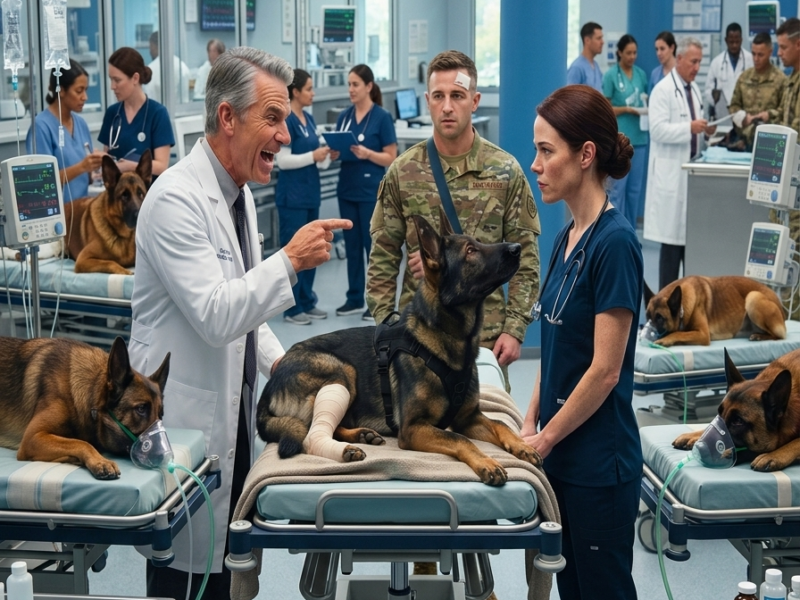
The ER director laughed when he ordered me to treat six critically injured military K9s alone in the trauma bay, telling the entire staff I would be lucky to save even one
The ER director laughed when he ordered me to treat six critically injured military K9s alone in the trauma bay, telling the entire staff I would be lucky to save even one, but when the dogs suddenly began responding to a signal only I recognized, his cruel little joke exposed a secret that could destroy his career.
The six German Shepherds arrived at Harbor Point Medical Center just after midnight, carried through the emergency entrance on bloodstained stretchers. Their handlers followed close behind, exhausted and desperate, their uniforms torn from a roadside explosion during a training operation in the nearby coastal hills.
I counted six dogs, six sets of labored breaths, and six pairs of eyes searching for someone who could make the pain stop.
Dr. Richard Hale, the emergency department director, stood beside the nurses’ station with a paper coffee cup in his hand, his posture relaxed, his eyes glinting with patronizing amusement.
“Since you’re so good with animals, Nurse Carter, why don’t you handle them?”
A few staff members laughed nervously, glancing between Hale and the chaotic scene unfolding in the trauma bay. He knew I was the newest nurse on the night shift, and he had spent weeks reminding everyone that my previous military service didn’t make me special. He assumed I was a broken veteran hiding from real responsibility.
I ignored him and examined the first dog.
One had a deep wound along his flank that seeped blood onto the white sheet; another struggled to breathe, his tongue pale and cyanotic; a third had blood running from a torn ear onto his tactical vest. The remaining three showed severe signs of shock—shallow respirations, weak thready pulses, and trembling limbs.
“We need veterinary support and additional hands immediately,” I said, keeping my voice firm despite the adrenaline surging through my veins.
Hale glanced at his watch, taking a deliberate sip of his coffee. “The regional veterinary trauma unit is forty minutes out. You have one hour before the military transport team takes them elsewhere. Do what you can, Carter. Or don’t.”
Then he walked away, his polished shoes clicking against the linoleum.
For a moment, the room seemed impossibly large, and I felt the weight of six lives pressing against my chest. I had served as a military combat medic in a special operations joint task force before a roadside improvised explosive device ended my deployment, leaving me with physical scars on my shoulder and mental wounds I never discussed with civilian colleagues. I knew what happened when people mistook silence for weakness.
“All right, boys,” I whispered, moving rapidly between the stretchers. “We’re going to get through this together.”
I immediately stepped into my old combat medic role. I assigned one nurse to bypass standard administrative delays and call the emergency veterinary consult line again, and another to gather chest tubes, warming blankets, lactated Ringer’s IV bags, and compression bandages while I coordinated immediate stabilization and monitored each dog’s condition.
Every second mattered. One dog—a massive male with a heavily scarred muzzle—began to deteriorate rapidly, his blood pressure dropping as his breathing turned into ragged gasps. I dropped beside him, placing my hands firmly on his chest, speaking softly while my team worked to support his airway.
“Stay with me, buddy. Stay right here.”
His handler, a young sergeant with soot covering his cheeks, knelt nearby, tears gathering in his dust-caked eyes. “His name is Duke,” he whispered, his voice cracking. “He pulled two of my men out of the burning vehicle before the secondary charges went off.”
I pressed my lips together and kept working, applying direct pressure to Duke’s abdominal bleed while managing his fluid resuscitation line.
Minutes blurred into urgent instructions, clipped responses, and the relentless rhythm of heart monitors. Then, amid the noise and flashing displays, something unexpected happened.
The six dogs, despite their severe trauma and disorientation, began responding whenever I gave a specific, short verbal command accompanied by a unique double-tap rhythm on their sternums.
“Eyes on me.” Tap-tap.
At the sound of those words and the cadence of the tap, Duke lifted his heavy head, his dilated pupils focusing directly on my face. Another dog across the bay stopped thrashing against his restraints, settling long enough for us to safely insert a large-bore IV line into his foreleg. Even the younger Shepherd with the torn ear stopped whining, his ears pricking forward in total attentiveness.
The handlers exchanged stunned, disbelieving looks across the trauma bay.
“Where did you learn that command structure?” the senior handler, a staff sergeant named Miller, asked in a low voice. “That’s not standard military Working Dog protocol.”
I froze for half a second, my hands resting on Duke’s ribcage.
That command hadn’t come from a manual. It had belonged to my old unit’s classified K9 tactical integration team, where my closest friend and team leader, Sergeant Michael Reeves, had spent years developing a specialized bio-feedback command system to calm hyper-aroused or wounded working dogs in chaotic combat environments. Michael had been reported killed during the same catastrophic ambush that ended my military career two years ago. I had never told a soul at Harbor Point about him or the classified nature of our deployment.
By the forty-minute mark, the civilian veterinary emergency team arrived, taking over long-term surgical prep. Thanks to our rapid triage, all six dogs were fully stabilized, their bleeding controlled, their pain managed, and their vitals leveling out.
Dr. Hale returned to the trauma bay expecting a disaster—expecting to find me overwhelmed and humiliated. Instead, he found six living dogs surrounded by an organized, exhausted staff, each animal receiving expert care.
Hale’s smug smile disappeared instantly. “What exactly did you do here?” he demanded, looking at the neatly labeled IV lines and monitoring sheets.
“I called for help, followed emergency stabilization protocol, and kept them alive long enough to receive the specialized care they needed,” I said, stepping back from Duke’s stretcher and wiping blood from my gloved hands.
Staff Sergeant Miller stepped forward, his eyes locked on Hale, then turning back to me. “Sir, this nurse didn’t just stabilize them. She knew the exact tactical communication commands our unit used overseas. Commands that were never written down in official doctrine.”
Hale’s face changed completely when he heard Miller mention our unit’s numerical designation—Task Force 88. His ruddy skin drained of color, turning a chalky, sickly gray. He looked at me as if he had suddenly recognized a phantom stepping out of an old, buried photograph.
Then Duke, still lying beneath the thermal warming blanket, lifted his head and began emitting a deep, gut-wrenching whine directed straight at Dr. Hale. The other five dogs followed suit, their ears pinning back, their bodies tensing into cold, hostile alertness.
Hale took a involuntary step backward, dropping his paper coffee cup onto the floor.
I had seen that specific behavioral reaction before—working dogs reacting to a handler’s stress or an recognized enemy—but never from six military dogs simultaneously toward a civilian doctor in an American hospital.
Staff Sergeant Miller reached slowly into his inner tactical vest pocket and pulled out a thick, wax-sealed military envelope.
“Your name is on this, Nurse Carter,” Miller said quietly, handing the envelope to me with trembling fingers. “Sergeant Michael Reeves made us promise to deliver it to you personally if we ever encountered a medic who used his touch-signal.”
I stared at the dark blue ink writing my full name on the paper—handwriting I had spent two long, painful years grieving.
Before my thumb could break the wax seal, Dr. Hale stepped forward, his voice dropping into a frantic, harsh whisper that made Miller turn toward him in utter disbelief.
“You can’t give her that,” Hale stammered, his eyes darting frantically to the security cameras in the hallway. “She was never supposed to find out what happened on that mission. She was supposed to be discharged and forgotten.”
And suddenly, saving six dogs felt like the smallest, simplest part of the night.
The heavy silence that fell over the trauma bay was thicker than the fog hanging outside the hospital windows.
Sergeant Miller shifted his stance, placing his hand near his belt, his eyes narrowing as he assessed Dr. Hale. “What did you just say, Doctor?”
Hale swallowed hard, pulling his shoulders back in a desperate attempt to reclaim his authority as department head. “I said that Nurse Carter’s past military service is irrelevant to her duties at Harbor Point. This is a civilian medical facility. Whatever classified military business you think you have with her does not belong in my emergency room.”
“My name is on this letter,” I said, stepping between Hale and Miller. “And Michael Reeves was my team leader.”
“Michael Reeves died in a classified ordnance accident in Sector Four, Carter!” Hale snapped, his voice tight and unnaturally sharp. “You were medically discharged with severe head trauma and memory loss! You have no standing to question military documentation!”
“I never said Michael died in Sector Four,” I replied softly, my heart hammering against my ribs. “I never mentioned the sector to anyone at this hospital. How do you know where my unit was deployed, Dr. Hale?”
Hale froze. The color didn’t just leave his face this time; his entire frame seemed to shrink under the harsh fluorescent lights of the trauma bay.
Miller took one step closer to Hale, his boots making a heavy, deliberate sound against the floor. “Task Force 88’s deployment coordinates were classified at the highest level of Special Operations Command. The only civilians who had access to our location manifests were the regional medical directors managing the black-budget casualty transit network.”
Miller turned to me, his jaw clenched tight. “Reeves didn’t die in an accident, Nurse Carter. Two years ago, our unit was ambushed because someone sold our evacuation route coordinates to a private military contractor operating out of Germany. Michael knew there was a leak at the medical command level. Before he vanished during the extraction attempt, he handed this envelope to our unit’s senior handler and told us to hold it until we found the medic who knew his touch-command.”
My fingers trembled as I broke the thick red wax seal on the envelope.
Inside were three folded sheets of official military letterhead, stamped with the emblem of the Defense Intelligence Agency, along with a high-capacity encrypted memory drive.
I unfolded the first page. It was a casualty transfer manifest dated July 14th, two years ago—the exact night of the ambush that had destroyed my life. Listed at the top of the manifest were seven names. Six were marked as CRITICAL / EVACUATED TO REGIONAL FACILITY.
The seventh name was mine: SPECIALIST ELENA CARTER — DECEASED.
I stared at the word printed in bold black letters next to my name. DECEASED.
Below my name was a signature authorizing the falsification of my medical record, transferring my unconscious body out of the military hospital system into a private civilian rehabilitation facility under a false identity, stripping me of my service benefits, my security clearance, and my memories of the mission’s true objective.
The signature at the bottom of the form belonged to Dr. Richard Hale—who, two years ago, had served as a Colonel in the United States Army Medical Materiel Development Activity.
“You…” I whispered, looking up from the paper, my eyes filled with tears of rage. “You signed my death certificate while I was still breathing in an ICU bed.”
“Elena, listen to me,” Hale said, his tone shifting rapidly from hostile authority to frantic negotiation. He took a step toward me, his hands raised in a placating gesture. “You don’t understand the scale of what was happening! The program… Project Cerberus… it wasn’t just a combat trial! The neural-link technology Reeves was testing on those dogs was worth hundreds of millions to private defense firms! If your unit had returned with the full data drives, the entire contract would have been canceled!”
“So you sold out my team?” Miller roared, taking a step toward Hale with his fists clenched. “You let eight men get ambushed on a ridge in the mountains so you could steal the research?”
“I didn’t order the attack!” Hale pleaded, backing away until his spine hit the supply cabinet. “I was just paid to clean up the paperwork! To ensure that any survivor who could connect the medical data to the contractor was classified as dead or permanently incapacitated! When you showed up at Harbor Point three months ago seeking a civilian nursing job, I thought it was a coincidence! I kept you under my supervision to make sure your memories never returned!”
Duke let out a sharp, guttural bark from his stretcher, his dark eyes locked onto Hale. The other five dogs echoed his bark, their voices ringing through the concrete walls of the trauma bay like a chorus of judgment.
I slipped the encrypted memory drive into my pocket, holding the signed manifest tightly in my hand.
“Where is Michael?” I demanded, staring straight into Hale’s eyes. “The manifest says six men were evacuated, but only four handlers came in tonight. The file says Michael wasn’t killed in the blast.”
Hale shook his head frantically. “I don’t know! I swear to God, I don’t know where Reeves is! He escaped the field hospital before my team could transfer him! He’s been living as a ghost for two years!”
“He’s not a ghost,” Miller said quietly, looking down at his phone as a encrypted text message chimed on his screen. “He just arrived at the front gate.”
The glass sliding doors of the Harbor Point Emergency Department groaned open as a heavy coastal gust swept into the lobby, bringing with it the smell of salt water and rain.
A man stepped through the entrance, wrapped in a long, dark canvas coat, a low tactical cap pulled down over his brow. He walked with a pronounced limp, leaning slightly on a heavy wooden cane, but his shoulders were broad, his posture rigid, and his gaze cutting through the room with absolute focus.
When he reached the threshold of the trauma bay, he stopped.
He pulled off his cap, revealing a face lined with jagged surgical scars along his jaw and temple—scars from the same blast that had shattered my life two years ago.
“Elena,” he said softly.
His voice hit me like a physical wave. The two years of grief, the silent nights spent wondering why I had survived while my team perished, the gaps in my memory that had tormented me—all of it seemed to freeze in time.
“Michael…” I breathed, taking a slow step forward.
The six German Shepherds, despite their bandages and IV lines, let out a low, collective whining sound—not of hostility, but of absolute, instant recognition. Duke turned his head toward the entrance, his tail giving two weak, rhythmic thuds against the metal frame of his stretcher.
Michael dropped his cane, stepping forward and catching me as I threw my arms around his neck. He held me tightly, his chin resting against my shoulder, his rough coat smelling of rain and engine oil.
“I thought you were dead,” I sobbed into his jacket. “They told me everyone on the ridge died.”
“They wanted us to believe we were alone,” Michael whispered, drawing back to look at my face, his thumb gently wiping a tear from my cheek. “Hale and his handlers spent two years wiping our records, hiding the casualty reports, and selling off the combat neural-data we gathered in the field. But I knew you were alive, Elena. I spent eighteen months tracking the paper trail of the false death certificates until it led straight to this hospital.”
Dr. Hale backed slowly toward the rear exit door of the trauma bay, his hand surreptitiously reaching for his security badge to swipe through the restricted access lock.
“Going somewhere, Colonel?” Miller asked, stepping into his path and blocking the exit frame with his broad frame.
Hale spun around, his face slick with sweat. “This is a private medical facility! You have no authority to detain me here! I am calling hospital security!”
“Hospital security won’t help you, Richard,” Michael said, turning his cold, scarred face toward the director. He reached inside his canvas coat and pulled out a satellite communications pad, tossing it onto the stainless steel supply table beside Hale’s discarded coffee cup.
On the screen was a live, high-definition video feed of federal agents from the Department of Defense Inspector General’s office, alongside armed Military Police officers, entering the hospital’s main administrative offices upstairs.
“Project Cerberus is officially unsealed,” Michael announced, his voice steady and icy. “Thirty minutes ago, the encrypted data drive Elena holds was broadcast directly to the Joint Chiefs of Staff and the Senate Armed Services Committee. The private defense contractor in Munich was raided an hour ago by Interpol.”
Hale sank down against the wall, his knees giving out as he slid to the floor, his head tucked between his hands, uttering incoherent pleas.
Michael walked over to Duke’s stretcher, dropping onto one knee beside the massive Shepherd. He pressed his hand against the dog’s chest, executing the exact same double-tap rhythm I had used forty minutes earlier.
Tap-tap.
“Good boy, Duke,” Michael whispered, his eyes shining with emotion. “You brought her back to us. You did your job.”
Duke pressed his scarred muzzle into Michael’s palm, letting out a long, contented sigh that seemed to signal the end of a very long, very dark deployment.
I looked around the trauma bay—at the six living, breathing dogs who had survived against all odds, at the handlers standing proud in their torn uniforms, at Michael standing beside me, and finally at Hale, whose reign of terror and deceit had come to a definitive end.
“What happens now?” I asked, looking at Michael.
“Now, Elena,” Michael said, taking my hand in his, “we tell the truth. To the military court, to the public, and to ourselves. And then… we take our team home.”
The stark, oak-paneled courtroom inside the United States District Court in Norfolk was filled to capacity.
Dozens of high-ranking military officers, federal prosecutors, medical ethics representatives, and national journalists sat in tense silence beneath the bright brass chandeliers. Behind the defense table sat Dr. Richard Hale, clad in an orange detention jumpsuit, flanked by three defense attorneys who looked increasingly grim as the proceedings unfolded.
I sat at the witness stand in my pristine Navy service dress uniform—restored to my full rank as Lieutenant Elena Carter following the complete expungement of my fraudulent civilian discharge records.
“Lieutenant Carter,” the lead federal prosecutor, a sharp-eyed woman named Defense Attorney Vance, said, stepping toward the podium. “Can you state for the record what occurred in the trauma bay of Harbor Point Medical Center on the night of October 11th?”
I looked straight ahead at the panel of federal judges and military magistrates.
“On that night, Dr. Richard Hale ordered me to attend to six critically injured military working dogs without adequate veterinary staff or medical supplies,” I testified, my voice clear and unwavering. “He explicitly stated that he expected the animals to die within the hour. He intended to use their deaths as a cover to dispose of the remaining biological evidence linked to Project Cerberus.”
“And how were you able to stabilize six complex trauma patients simultaneously?” Vance asked.
“Because Sergeant Michael Reeves and I had developed a specialized, non-verbal bio-feedback integration system during our service with Task Force 88,” I explained, gesturing to the technical documents displayed on the courtroom screens. “The dogs recognized the tactile touch-commands and vocal cadences. They trusted the protocol, which allowed my team to perform emergency chest tube placements, arterial clamping, and fluid resuscitation without chemical sedation, keeping them alive until secondary veterinary teams arrived.”
A quiet murmur ran through the gallery.
Prosecutor Vance turned toward the defense table. “Dr. Hale claimed in his initial deposition that he was unaware of your identity or your military history. Is that correct?”
“That is false,” I replied, pulling a heavy blue folder from my briefcase. “Documentary evidence recovered from Dr. Hale’s private server confirms that he personally falsified my military death certificate while I was comatose in a field hospital in Germany. He altered my medical records, stripped my security clearances, and arranged for my placement at Harbor Point Medical Center to monitor me and ensure my combat memories remained suppressed.”
At the defense table, Hale dropped his head into his hands as his lead attorney leaned over to whisper frantically into his ear.
“And what was the financial motive behind these actions, Lieutenant?” Vance asked.
“Dr. Hale and his associates at the private military firm spent three years trying to monetize the neural-link communication protocols developed by Task Force 88,” I stated, my eyes fixing on Hale. “They intended to sell the technology as an autonomous control system for uncrewed combat platforms. When Sergeant Reeves refused to hand over the master encryption keys, Hale leaked our tactical evacuation route to hostile forces on the ridge, resulting in the ambush.”
The presiding judge, a stern-faced Admiral, slammed his wooden gavel down onto the bench. “The court has reviewed the complete digital archive submitted by Lieutenant Carter and Captain Reeves. The evidence of treason, medical malpractice, forgery, and conspiracy is absolute.”
The Admiral turned his cold, uncompromising gaze toward Richard Hale.
“Richard Hale, by order of this military tribunal and the United States Federal Court, you are remanded to federal custody without bail pending final sentencing. This court recommends maximum confinement under national security statutes.”
As military marshals stepped forward to lock heavy steel handcuffs around Hale’s wrists and drag him from the courtroom, the gallery stood up in unison.
I looked toward the back row of the courtroom.
Sitting proudly in the gallery were Staff Sergeant Miller and the three other handlers from Task Force 88, dressed in their crisp dress uniforms. Sitting at their feet, wearing official military service vests decorated with commendation ribbons, were the six German Shepherds—including Duke, his flank fully healed, his dark eyes bright and intelligent as he watched me from across the room.
Beside them stood Michael, holding his cane, a proud, quiet smile gracing his scarred face. He raised his hand in a sharp, crisp salute.
I stood tall on the witness stand and returned the salute, feeling the cold weight of the past two years finally lift from my shoulders.
Six months later, the morning sun broke over the green rolling hills of the new K9 Tactical Rehabilitation and Medical Center in the coastal mountains of Virginia.
The facility—built using the recovered funds from the seized black-budget accounts of Project Cerberus—was designed specifically to provide advanced medical care, trauma recovery, and specialized training for injured military working dogs and their handlers.
I stood on the wide wooden porch of the main clinic building, holding a steaming mug of coffee, watching the morning mist rise off the training fields below.
Down on the grass, six German Shepherds were running through a agility course, their powerful bodies moving with strength, freedom, and grace. Their handlers walked beside them, calling out commands, their voices filled with laughter and mutual trust.
A heavy footstep sounded on the wooden porch behind me.
Michael walked out, setting his cane against the railing as he leaned beside me, looking out over the misty valley. He wore a navy fleece jacket with the new facility’s emblem embroidered over his chest: a silver shepherd’s head surrounded by a gold compass star.
“Morning, Director,” Michael said, a teasing smile playing on his lips.
“Don’t call me Director,” I chuckled, resting my elbow on the wooden railing. “I’m still a nurse at heart.”
“You’re the Chief Medical Officer of the finest K9 rehabilitation center in the country, Elena,” Michael corrected gently, reaching out to wrap his warm hand around mine. “The Department of Defense just approved twenty more rehabilitation grants for wounded working dogs across the eastern seaboard. They want our touch-command protocol incorporated into standard handler training nationwide.”
“It’s what you and your team spent years fighting for,” I said softly, looking at him. “The truth finally won.”
“We won,” Michael corrected, looking down at the field. “Because a nurse in a civilian trauma bay refused to let six dogs die on a cold floor.”
A low, familiar bark echoed from the bottom of the porch steps.
Duke—now officially retired from military service and adopted as our permanent facility mascot—trotted up the wooden stairs, his tail wagging smoothly, his head held high. He walked directly up to us, nudging my knee with his large, warm snout before settling comfortably on the porch floor between Michael and me.
I dropped down onto one knee beside Duke, stroking his thick, soft fur, feeling his calm, steady heartbeat beneath my palm.
Tap-tap.
Duke let out a soft, contented sigh, leaning his heavy head against my leg, his eyes closing peacefully in the warm morning sunlight.
Michael knelt down beside us, putting his arm around my shoulders, looking out over the valley as the sun cleared the mountain peaks, bathing the entire facility in golden light.
The shadows of the past, the secret missions, the stolen memories, and the dark halls of Harbor Point were gone, replaced by the clear, open air of a new day.
“Eyes on me, buddy,” I whispered softly to Duke.
Duke opened one dark, intelligent eye, gave a slow, rhythmic wag of his tail, and looked up at the open sky. We were finally home.
The end,









