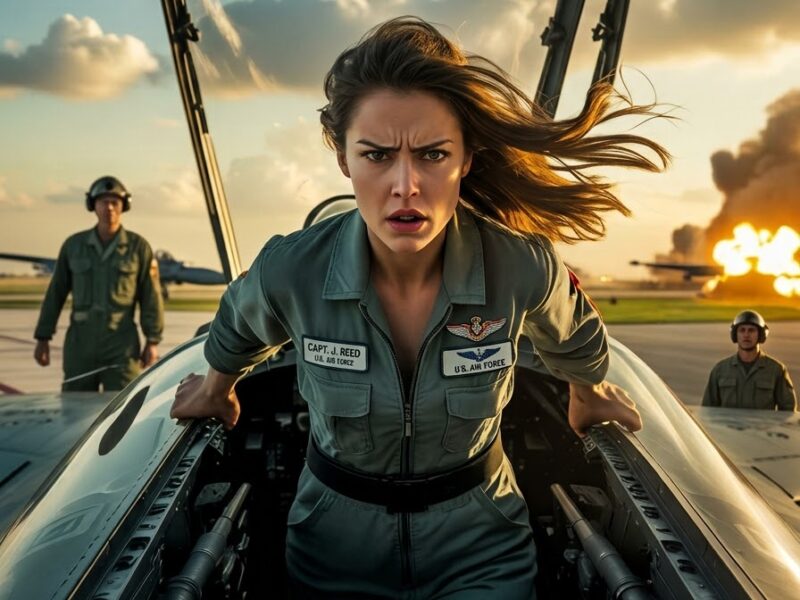
The entire squadron laughed when I was ordered to refuel their fighters during a deadly emergency at Edwards Air Force Base
The heat shimmering off the cracked asphalt of Edwards Air Force Base was thick enough to chew. It carried the sharp, familiar scent of JP-8 jet fuel, scorched rubber, and dry desert dust. Under the shadow of an F-16 C-Block 50 Fighting Falcon, I knelt in greasy navy-blue coveralls, my hands stained dark with hydraulic fluid.
“Stay on the ground, sweetheart.”
Captain Derek Mason tossed his leather flight gloves onto the top shelf of my fueling cart without even bothering to glance at my face. He stepped past me, his high-polished flight boots crunching over the coarse gravel, unzipping the top half of his G-suit in the stifling afternoon glare.
“Your job is to pump fuel, not fly jets,” Mason added, his voice carrying easily across the open tarmac.
Beside him, two junior lieutenants from the 412th Test Wing chuckled on cue. They were young, full of swagger, and wore their newly minted golden wings like armor. To them, I was just Evelyn: the quiet ground-crew girl who didn’t talk much, lived in a cramped off-base trailer, and spent her twelve-hour shifts hauling fifty-foot fuel lines across the scorching concrete.
I didn’t answer. I kept my head down, my gloved hands wrapping firmly around the heavy brass coupling of the single-point refuel nozzle. I jammed the fitting into the aircraft’s underslung receptacle and twisted until the mechanical latch clicked home with a heavy, satisfying metallic thud.
Let them laugh. I had learned to ignore their jokes months ago.
For eleven long months, I had worked beneath these sleek, gray war machines. While the pilots sat in air-conditioned briefing rooms drinking coffee and reviewing tactical overlays, I was down here on my knees. I knew the exact sound of a failing Pratt & Whitney F100 turbine bypass valve before the digital diagnostic bus even threw an error code. I knew the smell of an overheated hydrazine emergency power unit. I knew every wire, every hydraulic trace, and every emergency canopy release cable on every airframe parked in Hangar 7.
What none of them knew was that I didn’t learn those systems from a maintenance manual.
I had learned them at thirty thousand feet, pulling nine Gs through cloudless blue skies over the Pacific. Seven years ago, before my name was systematically erased from the flight manifests, before my flight jacket was stripped of its patches, and before my service record was locked beneath a triple-encrypted National Security shroud, I was First Lieutenant Evelyn Harper.
And I had sworn an oath to myself, written in the blood of three people I loved, that I would never touch a throttle again.
The desert air shattered.
It wasn’t the slow, rising whine of an engine spooling up. It was the sudden, chest-cavitating blare of the base’s Primary Threat Red siren. The high-pitched mechanical howl echoed off the corrugated steel structures of the flight line, instantly freezing every mechanic, technician, and pilot on the tarmac.
Over the external public address system, a voice strained against static: “ALL UNITS, THIS IS BASE DEFENSE. UNIDENTIFIED CONTACTS PENETRATING RESTRICTED AIRSPACE VECTOR TWO-SEVEN-ZERO. SPEED SUPERSONIC. THIS IS NOT A DRILL. ALL ALERT CREWS LAUNCH IMMEDIATELY!”
“What the hell?” Mason muttered, squinting out toward the western horizon where the shimmering heat met the dull brown line of the Mojave mountains. “NORAD didn’t give us a heads-up on an exercise.”
“That’s no exercise,” I said softly, standing up from my kneeling position beneath the intake.
Mason shot me a sharp, annoyed glare. “Keep your mouth shut and finish fueling the jet, Evelyn.”
Before he could take another step toward the crew ladder, a sound like tearing metal ripped through the upper atmosphere. It wasn’t an aircraft breaking the sound barrier; it was an incoming artillery round or a high-velocity precision-guided munition entering its terminal dive directly overhead.
“INCOMING!” someone screamed from the maintenance bay.
I threw myself behind the heavy steel frame of the liquid-oxygen servicing trailer just as the world turned into blinding white light.
The explosion roared through Hangar 7 with apocalyptic force. The giant, fifty-foot steel blast doors of the main bay didn’t just bend—they blew inward, tearing off their heavy overhead tracks and slamming down onto the concrete floor with a sound like a collapsing skyscraper. A wall of superheated air, orange flame, and jagged shrapnel swept across the interior.
The shockwave knocked the air straight out of my lungs, slamming my shoulder against the steel frame of the fuel truck. Dark dust and powdered insulation rained down from the structural rafters.
For three seconds, there was absolute silence—the ringing, vacuum quiet that follows a massive detonation.
Then came the screaming.
“THE HANGAR IS ON FIRE! THE DOORS ARE JAMMED!”
Dense, oily black smoke began rolling out from beneath the collapsed steel doors of Hangar 7. Inside that hangar were four fully fueled F-16s undergoing routine electronics bay maintenance, along with six pilots who had been running pre-flight simulations in the rear bay.
I scrambled to my feet, my ears buzzing with sharp static, coughing against the sudden wave of acrid chemical smoke drifting across the tarmac.
I sprinted straight toward the hangar’s external emergency control pedestal, wiping grease and sweat from my eyes. I kicked open the heavy red utility box and slammed my palm onto the manual override switch.
Nothing happened. Sparks showered out from the severed conduit behind the wall. The entire electrical grid for the eastern flight line was dead.
“It’s dead!” I yelled.
Captain Mason stumbled out from behind a line of tool chests, his face smeared with soot, his flight suit smoldering along his left shoulder. He was holding his arm, his eyes wide with wild, unadulterated panic.
“Get away from the aircraft!” he choked out, coughing violently as he stumbled back toward the open apron. “The whole line is going to blow!”
I grabbed a forty-pound carbon-dioxide fire extinguisher from the wall mount, dropping into a low stance to look through the narrow gap beneath the buckled steel door. Deep inside the burning bay, surrounded by walls of roaring orange flame, figures were slamming their fists against the reinforced safety glass of the interior briefing room.
“Your pilots are still inside!” I yelled over the roar of the fire.
“We can’t open the doors!” Mason screamed back, grabbing my shoulder to drag me away. “The hydraulic lines burned through! The steel is fused! We have to fall back to the perimeter!”
“Look at the main feed!” I shoved his hand off me, pointing toward the concrete apron just fifteen feet outside the hangar bay.
A high-pressure underground fuel line had ruptured during the blast. It was spraying a steady, atomized mist of aviation gasoline straight toward the creeping wall of flame emerging from the hangar. In less than two minutes, the fire would trace that spray back to the central underground storage farm—a three-million-gallon fuel reservoir beneath the base.
If that ignited, Edwards Air Force Base wouldn’t just suffer damage. It would cease to exist.
Right outside the perimeter gate, parked on the concrete wash-rack away from the main fire, sat an F-16C. Tail number 408. Its cockpit canopy was propped open on its mechanical struts. Its engine was cold, but its emergency fuel shut-off valve was linked directly to the main line isolation manifold.
I looked at the jet.
In my mind, a dark door swung open—a door I had kept chained shut for seven years. I saw the burning wreckage of my old flight team in the mountain passes of Alaska. I heard the cold, clipped voice of the board of inquiry telling me my career was over, my record sealed, my name buried.
Never again, I had promised myself. Never touch the stick again.
“Please! Somebody help us!” a muffled voice cried out from behind the heavy steel hangar door.
I dropped the fire extinguisher onto the concrete.
I turned and sprinted toward Tail Number 408.
A flight-line crew chief tried to grab my arm as I vaulted over the lower access ladder. “What the hell are you doing?! That aircraft isn’t cleared for flight!”
I yanked my arm free, swung my leg over the cockpit sill, and dropped hard into the ACES II ejection seat. “Saving your lives.”
My hands moved before my brain could even process the action. Seven years of forced absence vanished in a single microsecond of pure, instinctual muscle memory.
My left hand swept across the left console, flipping switches in a rapid, rhythmic blur: MAIN BATTERY – ON. JET FUEL STARTER – START 2. FLT CONTROL OVERRIDE – ENGAGE.
The high-pitched, pneumatic whine of the Jet Fuel Starter cut through the roar of the flames outside. The main turbine behind my back began to spool up, its low hum building into a fierce, violent vibration that rattled my ribcage through the metal seat.
ENGINE SPEED – 20 PERCENT. I slammed the throttle forward past the idle detent, feeding fuel into the combustion chamber.
The F-16 screamed to life.
Warning lights flashed across the central threat panel in bright amber and red: HYD PRESS FAIL, AVIONICS OFFLINE, NO CADC. I ignored them all. I flipped the master utility override switch, manually engaging the emergency nose-wheel steering.
Down on the tarmac, Captain Mason and a dozen ground crew members stared up at the cockpit in complete, mouth-agape disbelief. They saw the quiet girl who pumped their fuel, sitting in the cockpit of a fully armed fighter jet, her hands working the flight controls with terrifying, precise expertise.
I shoved the throttle forward. The thirty-thousand-pound aircraft lunged down the taxiway, its nose gear crushing the ruptured fuel line and pinning it flat against the concrete, severing the high-pressure feed before the flames could reach the underground tanks.
Without a helmet, without a G-suit, wearing only my oil-stained navy coveralls and heavy work boots, I brought the jet onto Runway 22-Right.
“Edwards Tower, this is Viper Zero-One,” I said out loud into the empty cockpit, my voice steady as stone. “Taking the active.”
I slammed the throttle into full afterburner.
A three-foot plume of blue flame erupted from the exhaust nozzle. The jet launched forward like a bullet from a rifle. The yellow runway stripes blurred into a continuous solid line, the G-forces pressing my back deep into the cushion. At one hundred and sixty knots, I pulled the stick back.
The desert floor dropped away beneath me as the F-16 cut through the thick black smoke column and rocketed straight into the clear blue sky.
The moment the landing gear snapped shut into the fuselage, the cockpit radio came alive with sharp, crackling static.
A low, distorted voice spoke through the main speaker panel:
“Lieutenant Harper… if you’re hearing this, they finally found you.”
My fingers froze against the flight stick. My heart slammed against my ribs so hard it felt like a physical blow.
“Who is this?” I demanded into the open radio circuit.
The voice answered softly, devoid of any warmth: “The man who ordered your squadron’s last mission.”
My breath hitched in my throat. Major General Thomas Vance. The commander who had sent my four-ship flight into an unmapped valley in Alaska seven years ago. The commander who had signed the sealed investigation report blaming me for the mid-air collision that killed my team, before disappearing from all military rosters three days later.
“Vance…” I choked out.
“Look at your secondary tactical bus, Evelyn,” the voice whispered through the static.
I flicked my eyes down to the green, glowing screen of the Multi-Function Display. Six encrypted radar signatures flickered into existence on the long-range sweep. They weren’t coming from restricted airspace. They were flying in a tight, impenetrable delta formation at forty thousand feet directly above the base.
Their tactical callsigns illuminated beneath their radar tracks:
STORM-01
STORM-02
STORM-03
STORM-04
STORM-05
STORM-06
My eyes went wide. My hands began to shake violently against the controls.
Those were the callsigns of my old flight team. The men and women I had buried seven years ago.
Below the sixth callsign, a green text transmission scrolled slowly across the bottom of my screen:
WE NEVER FORGOT WHAT THEY DID TO YOU, HARPER. BRING US HOME.
The sky above the Mojave Desert was impossibly bright, a blinding canopy of cobalt blue that starkly contrasted with the towering pillar of black smoke rising from Edwards Air Force Base behind me.
My heart hammered against my ribs like a trapped bird. I pulled the F-16 into a steep, eight-thousand-foot-per-minute climb, my eyes glued to the green-glowing Multi-Function Display.
Six contacts. Six solid, active radar returns flying a textbook wedge formation at Flight Level 400.
“Storm Lead, this is Harper,” I said into the cabin mic, my voice trembling despite every ounce of discipline I possessed. “Identify yourselves. Who is using these callsigns?”
Static hissed across the tactical frequency, followed by a dry, raspy laugh that sent a wave of ice through my veins.
“You always did check the radar before looking out the canopy, Evie,” a woman’s voice came through the speaker. It was slightly distorted by a high-altitude oxygen mask, but the inflection—that slight Texas drawl—was unmistakable.
“Sarah?” I whispered.
Captain Sarah “Vixen” Lin. My wingman. The woman whose burned dog tags I had held in my palm while standing in the freezing rain at Anchorage National Cemetery seven years ago.
“In the flesh, boss,” Sarah replied. “Well… mostly in the metal. Look up at your eleven o’clock.”
I banked the F-16 hard to the left, leveling off at thirty-five thousand feet. Through the clear acrylic canopy, against the deep blue backdrop of the upper atmosphere, six aircraft swept down out of the sun.
They weren’t modern F-35s or standard-issue F-16s. They were stripped-down, matte-black variants of the experimental YF-23 Black Widow stealth fighter—aircraft that had been officially retired and scrapped by the United States Air Force in the late 1990s. Their radar cross-sections were virtually nonexistent, their twin V-tails cutting through the thin air without leaving a single condensation trail.
“This isn’t real,” I muttered, pressing the heel of my palm against my forehead. “I’m experiencing anoxia. I didn’t hook up my oxygen mask.”
“You’re breathing fine, Harper,” the voice of General Vance broke back onto the encrypted channel. “Your mind isn’t playing tricks on you. But your country did.”
The six black fighters swept into a loose formation alongside my solitary F-16. STORM-01 pulled up so close to my left wingtip that I could see the pilot in the cockpit. The helmet was matte black, devoid of any squadron patches or insignia, but the pilot raised a gloved hand and gave me a sharp, familiar two-finger salute.
Miller. My flight officer.
“What happened in Alaska?” I demanded, my hands tightening around the throttle until my knuckles turned white. “We were ambushed in that canyon! My avionics went dead, my team crashed into the ridge, and when I woke up in the military hospital, they told me I suffered altitude sickness and caused a chain-reaction collision! They sealed the files! They disgraced my name!”
“Because you weren’t supposed to survive that canyon, Evelyn,” Vance’s voice came back, cold and analytical. “Operation Arctic Shield wasn’t a tactical evaluation. It was a live-fire operational test for a black-budget autonomous combat integration system—Project CHIMERA. We were testing an AI override link that could remotely seize control of a pilot’s aircraft during high-stress engagements.”
I felt a cold sweat break out across my neck. “The avionics failure…”
“It wasn’t a failure,” Sarah interrupted from STORM-02. “It was the system taking over. The algorithm suffered a feedback loop. It drove us into the terrain to protect the software classification. Vance managed to activate our manual eject seats at the last millisecond before impact. We survived, but the Pentagon couldn’t afford to let the world know they had just sacrificed four elite pilots to a broken computer program.”
“So they declared you dead,” I said, a sickening realization blooming in my chest. “They buried empty caskets.”
“And they needed a scapegoat to close the file without raising suspicion from Congress,” Vance added. “You were young, you had no political connections inside the Defense Department, and your flight recorder was conveniently ‘damaged’ in the crash. They pinned the blame on you, buried your career, and kept us locked in a subterranean research facility at Groom Lake for seven years to refine the software.”
I stared out at the black jets hovering around me like dark guardians. Seven years. Seven years I had carried the crushing weight of guilt. Seven years I had washed grease off my hands, listening to arrogant rookie pilots call me a lazy ground-crew girl, all while believing I had sent six people to their graves.
“Why now?” I asked, my voice dropping to a low, dangerous growl. “Why bring these jets to Edwards today?”
“Because CHIMERA is no longer an experimental program, Evelyn,” Vance said grimly. “An hour ago, a rogue faction within the Defense Intelligence Agency took control of the central server housed beneath Hangar 7 at Edwards. The missile strike that hit the hangar wasn’t an enemy attack—it was a scrub command. They tried to burn the evidence, kill the ground staff who knew about the subterranean server, and activate the fully autonomous drone fleet stationed at the Nellis complex.”
“The explosion…” I gasped. “The pilots locked inside Hangar 7…”
“They aren’t just pilots, Evie,” Sarah said gently. “They’re the new test crew for CHIMERA. The system is loading the automated strike protocol right now. In fifteen minutes, twelve fully armed, uncrewed F-35 drones will launch from Nellis under CHIMERA control, programmed to execute a series of false-flag strikes against civil infrastructure along the West Coast to justify a massive expansion of autonomous defense spending.”
My Multi-Function Display flashed violently. A new alert window opened, overriding my manual navigation settings.
WARNING: EXTERNAL TELEMETRY LINK DETECTED.
PRIMARY FLIGHT CONTROLS OVERRIDDEN BY GROUND NODE.
My flight stick jerked violently in my right hand, pulling the F-16 into a bank away from the black fighter formation.
“It’s got you!” Sarah shouted over the radio. “The ground node in Hangar 7 is active! It’s locking down your controls!”
“Not this time,” I growled through my teeth.
I reached beneath the main instrument panel, tore open the emergency maintenance junction box with my bare fingers, and ripped out the primary digital bus connector. Sparks flew across my lap, biting into the fabric of my coveralls.
The warning lights on the HUD went crazy, but the flight stick relaxed in my hand. Manual mechanical backup control was engaged.
I brought the nose of my F-16 back around, pointing it straight down toward the burning expanse of Edwards Air Force Base.
“Vance, Sarah, listen to me,” I said, feeling a surge of adrenaline hit my bloodstream like pure fire. “The primary server is underneath the concrete floor of Hangar 7. The blast didn’t destroy it—it just sealed it behind three feet of reinforced steel and burning rubble. If we want to stop those drones from launching at Nellis, we have to destroy the main relay antenna mounted on top of the base command tower.”
“That antenna is protected by the base’s automated C-RAM air defense guns, Evie,” Vance warned. “They’ll track any jet approaching below five thousand feet and blow it out of the sky before you can squeeze off a round.”
I looked down at my weapons selector panel. My F-16 was clean—no missiles, no external fuel tanks. All I had was an internal 20mm Vulcan cannon loaded with five hundred rounds of target-practice ammunition.
I smiled, a sharp, dangerous smile that hadn’t touched my lips in seven long years.
“They might be able to track an automated drone, General,” I said, slamming the throttle forward into full afterburner. “But they’ve never tried to track a ground-crew girl with a grudge.”
The sky roared as I dropped the F-16 into a vertical dive straight toward the desert floor.
The wind shrieked against the canopy as my air speed indicator needle swept past four hundred knots, five hundred knots, pushing hard toward Mach 1. Without a G-suit to compress my legs, the air pressure built up brutally in my chest, forcing the blood down into my feet and making my peripheral vision blur into dark gray fringes.
“Harper, you’re coming in too fast!” Sarah’s voice crackled through my helmet-less headset. “The automated defense grid at Edwards just painted your airframe! You’ve got three continuous-wave radar locks!”
“Let them lock!” I shouted against the roaring cabin noise.
Down on the ground, surrounding the perimeter of the burning flight line, four automated Phalanx C-RAM systems—radar-guided, six-barreled twenty-millimeter Gatling guns capable of firing four thousand rounds per minute—swiveled their heavy white radar domes directly toward my descending jet.
Bright red tracer rounds began erupting from the perimeter guns, creating a solid wall of lead and high-explosive shells across the sky at three thousand feet.
“Storm Flight, hit those radar installations!” Vance ordered over the tactical frequency.
The six matte-black YF-23s swooped down out of the high clouds like shadows cast by clouds. They didn’t fire missiles; they activated high-energy directional jamming pods mounted beneath their fuselages.
The air around the base flickered with intense electronic interference. The C-RAM radar domes sputtered, their automated targeting vectors wavering for four critical seconds as the synthetic noise scrambled their tracking logic.
That was all the window I needed.
I pulled out of the vertical dive at barely two hundred feet above the desert floor, skimming over the dry salt flats at six hundred miles per hour. The desert flora blurred into a solid streak of green and brown beneath my fuselage.
The high-rise structure of the Edwards Base Command Tower loomed directly ahead. Mounted on its reinforced roof was a thirty-foot dish antenna, glowing with an eerie amber beacon light as it transmitted the CHIMERA launch sequence toward the drone bays at Nellis Air Force Base.
“Target acquired,” I muttered, flipping my master arm switch to ON.
The optical sight reticle on my HUD illuminated with a glowing green crosshair.
NO RANGE DATA. The radar fire computer was offline due to the pulled wiring, forcing me to calculate the bullet drop and lead angle manually using pure visual reference.
“Come on, old girl,” I whispered, tightening my right hand on the control stick grip. “Just like the range at Nellis.”
At eight hundred yards, the tower filling my visual field, I squeezed the trigger.
The 20mm M61A2 Vulcan cannon beneath my left cockpit wall erupted with a deafening, vibrating roar that shook the entire aircraft. A stream of heavy armor-piercing shells tore through the desert air, slamming straight into the base of the transmitter dish.
Concrete exploded into clouds of white dust. Steel struts buckled under the kinetic impact. The dish sheared off its mount, tumbling off the roof of the tower and crashing down onto the tarmac in a twisted, burning heap of metal.
On my primary display, the telemetry transmission status bar flickered, turned red, and died.
DATA LINK INTERRUPTED.
CHIMERA SEQUENCE: FROZEN.
“Direct hit!” Sarah yelled over the comms. “The signal is cut! The drones at Nellis are locked on the tarmac!”
“It’s not over!” Vance’s voice cut through, sharp and urgent. “Look at the main hangar apron!”
I pulled the stick back hard, banking the F-16 into a sharp four-G turn over the eastern taxiway.
Down on the flight line, the ground had opened up.
A massive hydraulic blast elevator, hidden beneath the reinforced concrete of Hangar 7, was slowly rising to the surface. Standing on the elevator platform were three large, tail-less delta-wing aircraft. They were painted dark grey, completely devoid of cockpits or glass, their stealthy intakes looking like dark, gaping jaws.
The CHIMERA Autonomous Prototype Drones.
Unlike the standard F-35s at Nellis, these three prototypes were hardwired directly to the subterranean backup server. They didn’t need the roof antenna to launch.
Their engines ignited with a high-pitched, terrifying screech that sounded entirely non-human.
“They’re executing an internal battery override launch!” Vance warned. “Harper, if those three prototypes get airborne, they carry an internal satellite uplinks that can bypass the tower! They’ll re-establish the master link within sixty seconds!”
The first prototype drone rolled forward off the rising elevator platform, its nose gear instantly locking onto Runway 22-Left.
I was out of cannon ammunition. My HUD displayed a red GUN EMPTY warning. My F-16 was completely unarmed.
“Sarah, Miller… take them out!” I shouted into the radio.
“We can’t, Evie!” Sarah’s voice was filled with frantic frustration. “Our weapons bays are sealed! The black-budget program stripped our hardpoints so we couldn’t be traced if we were shot down! We don’t have ammo!”
I looked down at the first prototype drone. It was already accelerating down the runway, its engine afterburner glowing with a deep, furious orange light. Its airspeed was hitting one hundred knots… one hundred and twenty…
I looked at my fuel gauge. Four hundred pounds of jet fuel remaining. Barely enough to keep the engine running for another three minutes.
I looked at the flight line where Captain Mason and the ground crew were huddled behind an armored vehicle, watching my jet with terrified, wide eyes.
I took a deep, steady breath, settling myself into the ejection seat.
“Evelyn, what are you doing?” Vance’s voice came through the headset, suddenly filled with horrific realization. “Do not do what I think you’re doing!”
“My job, General,” I said softly. “I’m the ground crew. I clear the runway.”
I slammed the throttle into full afterburner, pointed the nose of my F-16 down toward the tarmac, and dived straight into the path of the taking-off drone.
The world became a razor-thin beam of pure velocity.
I dropped the F-16 to less than fifteen feet off the concrete, flying down Runway 22-Left in the exact opposite direction of the accelerating prototype drone. Two supersonic war machines rushing toward each other on a single narrow strip of asphalt, closing the gap at a combined speed of over three hundred miles per hour.
“EVELYN, BREAK AWAY!” Sarah shrieked over the radio. “THAT’S SUICIDE!”
I didn’t answer. I kept my eyes locked on the sleek, cockpitleess nose of the black drone surging toward me.
In a game of chicken between a human heart and a cold, synthetic algorithm, the computer doesn’t feel fear. But it does calculate collision geometry with absolute, mathematical precision.
At two hundred yards—less than half a second before total impact—the drone’s automated collision-avoidance logic triggered an emergency safety maneuver. The drone’s control surfaces snapped up, pitching its nose up violently to jump over my incoming aircraft.
That was what I was waiting for.
The moment the drone’s belly exposed itself above my cockpit, I didn’t pull away. I slammed my flight stick forward, dipping my left wing tip straight into the drone’s composite airframe.
CRASH!
The tip of my left wing sheared through the drone’s right intake like a circular saw through plastic.
The impact tore my left winglet completely off, sending a shower of carbon-fiber shards and aluminum sparks flying across the canopy. The prototype drone lost all aerodynamic lift, tumbling sideways across the runway in a massive, spinning fireball that exploded into the desert scrub at the far end of the flight line.
My F-16 violently rolled three times to the left, out of control.
CRITICAL STRUCTURAL FAILURE!
HYDRAULIC PRESSURE LOSS: TOTAL!
The cockpit alarms shrieked in unison as the desert floor spun wildly outside my canopy. Ground, sky, fire, dust—everything blended into a sickening, chaotic wheel.
I fought the dead stick with both hands, using the remaining differential thrust from the single engine to force the nose up. The aircraft slammed onto the overrun dirt at two hundred miles per hour, its landing gear collapsing instantly under the impact.
The F-16 skidded across three hundred yards of sand, rock, and sagebrush, throwing a mountain of dust into the air before finally coming to a halt against a reinforced concrete blast barrier.
Silence returned.
Thick gray smoke drifted through the shattered acrylic canopy. The engine behind me gave one final, metallic metallic clunk and died completely.
I sat in the cockpit, coughing against the dust, my head spinning, blood dripping warm and slow from a cut above my left eyebrow onto the chest of my blue coveralls.
My left arm was useless, sprained or broken from the impact against the side console, but I was alive.
I reached out with my trembling right hand, slapped the manual canopy release lever, and shoved the cracked acrylic canopy open.
Outside, the second and third prototype drones were still idling on the blast elevator platform near Hangar 7, their automated systems frozen in a logic loop because the first drone had failed to transmit its airborne verification key.
Through the clearing dust, I saw a fleet of base security humvees and emergency fire trucks speeding across the airfield toward my crash site, their red lights flashing through the smoke.
Leading the vehicles was a light tactical truck driven by Captain Mason.
He slammed the brakes fifty feet away, leapt out of the cab, and ran toward my destroyed jet, holding a fire extinguisher and a crowbar, his face pale with absolute shock.
“Evelyn!” he screamed, his voice cracking as he reached the side of the cockpit. “Don’t move! The seat might still be hot!”
He looked at me—really looked at me—for the first time in eleven months. He saw the blood on my face, the calm, unblinking discipline in my eyes, and the sheer ruined metal of the fighter jet I had just brought down through pure pilot skill.
“Who… who are you?” Mason stammered, his hands shaking as he dropped the crowbar onto the dirt.
I unbuckled my waist harness with one hand, leaning over the side of the cockpit to look down at him.
“First Lieutenant Evelyn Harper,” I said, my voice hoarse from the smoke. “United States Air Force. Now give me that crowbar.”
Ten minutes later, the flight line at Edwards Air Force Base was secured under a Tier-One military lockdown.
Armed military police officers held a perimeter around the burning remains of Hangar 7, while base firefighters saturated the concrete with chemical foam to suppress the remaining jet fuel fires. The second and third CHIMERA prototype drones had been shut down manually after Mason used the crowbar to smash their external fuel cut-off valves under my direction.
High above the base, six black YF-23 fighters circled in a wide, majestic protective orbit, their engines humming like a choir of deep, mechanical thunder.
I stood beside the base ambulance, refusing the paramedic’s offer to sit inside. My left arm was tightly bound in a white medical sling, a thick white bandage taped over my left eye, but I stood straight, watching the sky.
A black government SUV pulled up onto the tarmac, its tires screeching on the wet concrete.
The door opened, and a man in a tailored dark blue suit stepped out. It was Colonel Richard Vance—former General, former commander, the man who had stayed in the shadows for seven long years to protect the truth.
He walked across the debris-littered concrete, stopping five feet in front of me. He looked older than he had in the old flight photos—his hair fully silver, deep lines etched into his face—but his eyes carried the same sharp, steel-grey intensity.
He didn’t offer a handshake. He raised his right hand to his temple and rendered a slow, crisp, formal salute.
“Lieutenant Harper,” Vance said softly. “Permission to speak freely.”
“Granted, General,” I replied, returning the salute with my good arm.
“The server beneath Hangar 7 has been completely wiped,” Vance said, looking toward the smoldering ruins. “The rogue DIA faction that tried to steal the CHIMERA system has been taken into custody by Federal agents at Nellis. The autonomous drone network is destroyed. The program is dead.”
I looked up at the six black jets still circling in the blue sky above us.
“And what about them?” I asked, my voice tight with emotion. “What about my team? They’ve been dead to the world for seven years.”
Vance reached inside his coat pocket and pulled out a thick leather-bound folder bearing the seal of the President of the United States. He handed it to me.
I opened it with my right hand. Inside were six official exoneration documents, bearing the signatures of the Secretary of Defense and the Commander-in-Chief. Along with them was a seventh document.
My original flight status restoration order.
FULL REINSTATEMENT OF RANK: CAPTAIN EVELYN HARPER.
DECORATION: AIR FORCE CROSS.
SERVICE RECORD: FULLY PURGED OF ALL DISCIPLINARY ACTIONS.
“The Pentagon is holding a press conference at twelve hundred hours,” Vance said softly. “The true story of Operation Arctic Shield is being released to the public. Your team’s names are being added to the active service rolls today. They aren’t ghosts anymore, Evelyn. They’re coming home.”
Tears finally welled up in my eyes, hot and stinging against the cut on my cheek.
Up in the clear blue sky, STORM-01 broke formation, dipping its wings in a sweeping, graceful turn toward the primary runway. One by one, the five other black fighters followed, their landing gear extending as they lined up for a synchronized landing on the cleared strip of asphalt.
Captain Mason stepped out from behind the fire truck, walking slowly toward us. He stopped beside me, looking at the exoneration papers in my hand, then up at the descending stealth fighters.
He turned to me, his jaw working as he struggled to find the words. Slowly, deliberately, Mason unzipped his own flight jacket, removed his yellow 412th Test Wing patch, and held it out to me with both hands.
“I spent eleven months telling you how to pump fuel, Captain,” Mason said quietly, his head bowed in genuine humility. “I think it’s time I learned how to hand you your helmet.”
I looked at the patch in his hand, then at the black jets settling softly onto the runway, their tires burning small puffs of white smoke as they touched the earth.
I took the patch with my right hand.
“Keep the fueling cart clean, Mason,” I said, a soft, tired smile breaking through the dust and pain on my face. “I’ve got a squadron to lead.”
The six black jets taxiing down Runway 22-Left turned toward the main ramp, pulling up in a perfect, unbroken line beneath the desert sun.
The engines spooled down, their high-pitched whine gradually fading into the vast, quiet expanse of the Mojave Desert. The canopies rose together in smooth, unison motion.
I took a deep breath of the hot desert air, tasting jet fuel, rain, and freedom.
The storm was over. The sky was mine again.
The end.









