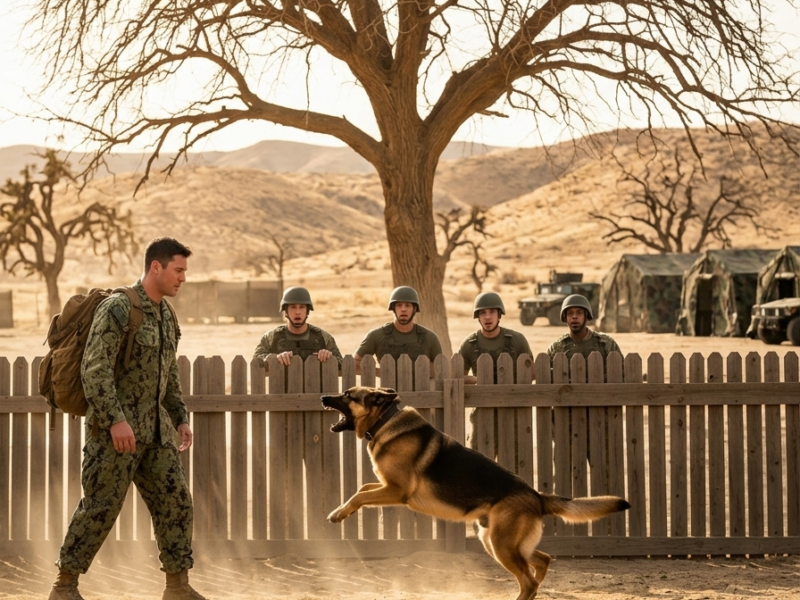
The entire police kennel watched as three experienced handlers failed to control the snarling German Shepherd, but when I stepped through the gate and whispered a name nobody had spoken in years
The concrete floor of the county police kennel was cold enough to seep through the soles of my boots, but the tension in the room was far colder.
Three handlers—seasoned men with thick leather sleeves and heavy batons—stood forming a wide semicircle around the rear enclosure. Inside, the heavy German Shepherd slammed his body against the iron chain-link gate with terrifying force. The metal rattled in its frame, a metallic screech echoing against the high ceilings. The dog’s muzzle was stained with foam and dark sweat, his teeth bared in a relentless, desperate snarl.
“Keep your distance!” the senior handler, Sergeant Miller, shouted over the roar of barking. He was holding a catch-pole, his hands trembling slightly despite his bulk. “He took a chunk out of Henderson’s forearm this morning. The dog’s gone bad, mister. Unstable. Brain damage from a local hit-and-run, or just a bad strain.”
“He’s not unstable,” I said softly, my hands remaining tucked inside the pockets of my faded Navy sweatshirt. “He’s terrified.”
“I don’t care if he’s scared or possessed,” Miller snapped, gesturing toward a man standing near the observation window holding a loaded tranquilizer rifle. “If he doesn’t calm down in five minutes, Chief Vance gave the order. We put him down for public safety. He’s an anonymous surrender, no owner on record, no service history.”
“He has a service history,” I murmured.
I stared past the wire mesh. The Shepherd wasn’t lunging to attack; he was driving them back. His weight was shifted onto his hindquarters, his tail tucked low, his eyes darting frantically toward the heavy steel fire door at the back of the facility. Every time a handler took a step forward, the dog didn’t push into their space—he placed himself directly between them and a low wooden bench bolted to the concrete wall.
He wasn’t fighting for dominance. He was guarding a position.
“Open the gate,” I said.
Miller turned, staring at me like I had lost my mind. “Did you not hear what I just said? That animal is dangerous. You walk in there without armor, he’ll tear your jugular out before I can drop him.”
I pulled a folded leather wallet from my inner pocket, flipped it open, and pressed my old Navy Special Warfare ID card against his chest. “Ten years in the Teams, Sergeant. Three deployments with multi-purpose canines in the Helmand and Korengal. I know a rogue dog from an operator carrying trauma. Give me sixty seconds.”
Miller looked from the bronze Trident on the card up to my face. He saw the flat, unblinking calm that only comes from men who have spent years living in dark places. After a agonizing silence, he gestured to his men. “Stand by with the pole. If he lunges, drop the door.”
He inserted the brass key into the padlock, turned it, and swung the heavy chain-link gate open six inches.
I stepped inside.
The growl that tore from the dog’s chest was a low, sub-audible vibration that rattled through the soles of my boots. He lowered his head, his ears pinned flat against his skull, black lips curling back over yellow canines.
I didn’t look him in the eyes. In the language of predators, direct eye contact is an invitation to war. Instead, I sank slowly to my knees on the damp concrete, resting my palms flat on my thighs, letting my shoulders slump into an open, defenceless posture.
“Easy, buddy,” I whispered, my voice thick with a sudden, suffocating knot in my throat. “Nobody’s going to make you go back into the dark.”
The dog froze. The snarling stopped mid-breath.
For the first time in an hour, the kennel fell into absolute silence. The only sound was the hum of the overhead fluorescent lights and the distant patter of rain against the high windows.
I took a slow breath, closed my eyes, and hummed three low, falling notes—a specific pitch used by the elite instructors at the naval strike warfare center in Indiana to settle high-drive working dogs during high-stress HALO drops.
The dog’s ears twitched. His head tilted slightly to the left.
Then, slowly, his chest gave a long, shuddering heave. The vicious alpha mask melted away in a single second, revealing a exhausted, broken animal trembling so violently his claws scraped like small needles against the stone floor. He didn’t walk; he crawled on his stomach, dragging his heavy frame across the five feet that separated us.
When he reached my knees, he didn’t snap. He buried his wet, scarred snout directly into the cup of my right palm and let out a small, high-pitched whine that sounded like a child weeping in the dark.
“I know,” I whispered, my thumb tracing the ridge above his muzzle. “I know, boy.”
Behind his left ear, partially hidden beneath thick black and tan fur, lay a jagged, crescent-shaped white scar—the unmistakable mark left by a hot piece of shrapnel during an ambush in the upper Sangin Valley three years ago.
During that mission, a military working dog named Ranger had dragged my unconscious body out of a burning, collapsed compound after an IED wiped out half our element. When the extraction chopper finally landed through the smoke, Commander Hayes had dragged me aboard. Ranger had been left behind in the chaotic withdrawal. Hayes told me the dog had died in the second blast.
I pulled back his thick leather collar. Stamped on the back of a tarnished steel plate hidden beneath the lining were eight faint numbers: US-NAV-SPEC-8842.
It was Ranger’s official service serial number.
My heart slammed against my ribs like a trapped bird. “Where did this dog come from?” I rasped, turning my head toward Miller.
Miller looked pale. “I told you… an anonymous transfer. A private transport van dropped him off at midnight with a city impound form.”
“What company?” I demanded, standing up. Ranger immediately shifted, placing his body firmly against my left leg, his brown eyes locking onto the room’s doorways.
“A… a security firm,” Miller stammered, stepping back as Ranger let out a warning huff. “Vanguard Tactical Solutions. They said he was a retired guard dog that went vicious.”
Before I could reply, Ranger suddenly broke position. He spun toward the back wall of the kennel, whining frantically. He threw his front paws against a loose sheet of rusted corrugated tin that covered an old drain pipe, scratching at it until his nails bled.
I knelt beside him, jammed my fingers behind the metal lip, and ripped the panel away from the cinderblock wall.
Behind it, wrapped tightly in clear waterproof tape, was a small black plastic pouch.
I cut the tape with my pocket knife. Inside was a high-resolution photograph and a single sheet of paper.
The photo was taken six years ago on the tarmac at Bagram. It showed me standing shoulder-to-shoulder with Captain Thomas Hayes—my former commanding officer, the man who had written the official casualty reports, signed my medical discharge, and now served as the Assistant Chief of Police for this very department.
On the back of the photo, written in permanent marker, were seven words: HE KNOWS WHAT HAPPENED TO YOUR TEAM.
My hands grew numb. I unfolded the note inside.
Your dog survived the blast, Walker. But the men who brought him home were never supposed to talk. Hayes sold the recovery contract to Vanguard. Look inside the collar.
Before I could turn to Miller, the heavy steel exit door at the far end of the hallway slammed shut. I looked through the glass window—Miller was running down the corridor, his radio pressed to his mouth, screaming for armed backup.
Then, in my pocket, my phone vibrated once.
I pulled it out. An unknown number had sent a single image: a live, real-time photo of my small frame house on the outskirts of town. Sunlight hit the front porch. Red laser dots rested squarely on the front window.
Beneath the image was a message: Walk away, or your dog dies next.
I looked down at Ranger. He leaned his heavy head against my knee, his eyes steady, waiting for his handler’s command.
Three years ago, I thought I had buried my brothers, my mission, and my peace. Now I realized they hadn’t just lied to me—they had turned my dog into a prisoner to cover up a war crime.
“Come on, boy,” I whispered, unlocking the rear emergency exit. “We’re going to finish the mission.”
The rain outside had turned into a torrent by the time we reached my old Ford pickup parked three streets away from the station.
Ranger leaped smoothly into the passenger seat, his eyes never leaving the side mirrors. His military training hadn’t faded; despite three years of neglect, the muscle memory of an elite assault canine was fully intact. He scanned every passing vehicle, his body tense, waiting for a threat.
I sat in the driver’s seat, the engine idling rough, my mind racing through the fragments of a conspiracy that was rapidly unspooling in front of me.
Captain Thomas Hayes hadn’t just been my CO in Afghanistan; he was the man who delivered the folded flags to the families of Sergeant Miller and Specialist Reyes—the two men killed in the compound explosion. If Hayes was connected to Vanguard Tactical Solutions, it meant the entire “insurgent ambush” in Sangin had been staged.
Vanguard wasn’t just a security contractor. They were a multi-billion-dollar defense conglomerate that specialized in deep-black logistics, battlefield asset recovery, and weaponized security. If they were holding Ranger, it was because the dog carried something they couldn’t risk leaving in the wild.
I reached down and unbuckled Ranger’s collar. Using my pocket knife, I carefully pried open the heavy double-stitched leather strap where the steel ID plate was riveted.
A micro-sized brass cylinder, no larger than a 9mm casing, fell into my palm. It was an encrypted military flash drive, sealed with wax to prevent moisture damage.
“You held onto this for three years, didn’t you, buddy?” I murmured, stroking Ranger’s neck.
The dog let out a low huff, resting his chin on the dashboard.
I plugged the drive into my hardened military-grade laptop sitting on the bench seat. The screen flickered to life, demanding a 16-digit decryption key.
I paused. What key would a Navy handler use in the middle of a warzone?
I typed in the callsign of our strike element: GHOST-ACT-0612.
The drive clicked, and a single directory appeared: OPERATION SILENT ARCHER – INCIDENT REPORT.
I opened the top file. It contained raw thermal footage from a high-altitude drone taken on the night of our final deployment.
My breath caught in my throat.
The video didn’t show an insurgent rocket attack. It showed a unmarked Vanguard Tactical helicopter hovering over our compound twenty minutes before the explosion. Figures in advanced tactical gear—not Taliban fighters—descended onto the roof. They loaded four heavy aluminum crates from our secure storage bunker into the chopper.
Then, a man in a US Navy uniform stepped into the frame, took off his helmet, and looked directly up toward the drone camera to confirm the payload.
It was Captain Thomas Hayes.
Seconds later, Hayes stepped back, threw a thermite grenade into the compound’s main weapons cache, and sprinted toward the perimeter. The screen washed out in a blinding white flash as the compound detonated, burying my team alive.
The video paused. Ranger hadn’t been lost in an ambush. He had been locked inside the lower storage bay during the robbery, survived the blast through sheer luck, and dragged me out of the rubble before Hayes’s private recovery team could sweep the site.
Hayes couldn’t kill the dog on site because the drone feed was auto-archiving to a secure server—a server linked directly to Ranger’s tactical harness telemetry.
“They didn’t abandon you,” I rasped, my knuckles turning white against the steering wheel as tears burned my eyes. “They hid you because you were the evidence.”
Suddenly, the side mirror of my truck shattered in a shower of silver glass.
CRACK!
The sharp, high-velocity crack of a suppressed rifle bullet echoed through the rainy alleyway.
Ranger instantly ducked low into the footwell, letting out a sharp bark. I threw the truck into reverse, stomping on the gas pedal. The tires spun on the wet asphalt, screaming as the truck surged backward just as a second round punched a neat hole through the windshield right where my head had been a second earlier.
Through the rain-streaked mirror, I saw two dark Chevy Suburbans swerving into the entrance of the alleyway, blocking our escape route. Four men in black tactical uniforms stepped out, raising short-barreled rifles equipped with suppressors.
Vanguard had arrived.
I slammed the brakes, threw the transmission into drive, and whipped the wheel hard to the left, crashing through the wooden fence of an abandoned lumber yard.
“Hold on, boy!” I yelled.
The truck smashed through stack after stack of rotten pine boards, rain and debris blinding us as the engine roared. Behind us, the suppressed rifles kept up a steady, rhythmic cadence—thump-thump-thump—bullets tearing through the tailgate and side panels.
We were outgunned, trapped in a dead-end commercial district, and the local police department was being run by the very man who wanted us buried.
I grabbed my tactical bag from behind the seat, pulled Ranger’s harness over his shoulders, and looked into his steady eyes.
“We go dark now,” I said.
The abandoned textile mill on the riverfront was a cavernous tomb of rusted iron, broken brick, and shattered glass. Rain poured through the collapsed skylights three stories above, creating a deafening drumroll that drowned out our footfalls.
I crouched behind a massive iron loom, holding my breath, my SIG Sauer P226 held in a two-handed low-ready position. Beside me, Ranger was pressed flat against the damp floor, his nose twitching as he caught the scents swirling through the drafty structure.
Outside, the strobing red and blue lights of half a dozen police cruisers painted the rain-soaked brick walls. Hayes had pulled out all the stops. He had used the department’s emergency broadcast system to label me an armed and dangerous fugitive who had assaulted officers and stolen a dangerous police animal.
The police weren’t just looking for a dog—they were under orders to shoot on sight.
“Two coming through the north loading dock,” I whispered, barely breath against Ranger’s ear. “Three sweeping the catwalks.”
Ranger gave a single, almost imperceptible press of his paw against my boot. He understood.
Through the gloom above us, the narrow beams of weapon-mounted flashlights cut through the rising fog. Heavy combat boots echoed on the iron grating of the upper walkways.
“Walker!” a voice boomed through a tactical megaphoned speaker from outside. It was Hayes. His voice was smooth, commanding, carrying the total authority of a decorated military veteran and senior law enforcement officer. “Give it up, Logan! You’re suffering from severe PTSD! You’ve had a psychotic break! Let us get you the help you need before somebody gets killed!”
I felt a cold, bitter smile touch my lips. “Psychotic break,” I muttered. The classic cover story for every whistleblower they wanted to erase.
“I know you have the dog, Logan!” Hayes continued, his voice drawing closer to the main entrance. “That animal is diseased! He’s a liability! Leave him and step out with your hands up!”
Beside me, Ranger’s lips curled back slightly, but he didn’t make a sound. He knew discipline.
I pulled my phone from my pocket. It had two percent battery remaining. I didn’t call the police. I didn’t call the news. In a town where the police chief controls the narrative, local media is useless.
Instead, I opened a secure, satellite-routed application that had been dormant on my phone since my discharge—a direct line to the Office of the Inspector General of the Department of Defense.
I attached the encrypted video file from the micro-drive and typed a brief message: OPERATION SILENT ARCHER. ASSET RECOVERED. COMMAND CORRUPTION IDENTIFIED. LOCATION: OAKRIDGE TEXTILE MILL.
I hit send.
The signal bar flickered. Sending… 45%… 60%…
CRACK!
A flashbang grenade burst through the upper skylight, detonating forty feet above us with a blinding white flash and a deafening shockwave that rattled my teeth.
Ranger didn’t panic. The moment the light flared, he lunged forward—not toward the light, but into the shadow of the main support pillar.
A Vanguard contractor dropped down from a tactical rope directly behind us, his rifle raised.
Before the man could orient his weapon, Ranger was in the air. Sixty pounds of muscular, highly trained canine hit the contractor in the chest like a furry cannonball. The man hit the concrete floor hard, his rifle flying into the darkness. Ranger clamped his jaws onto the tactical vest’s shoulder strap, dragging the man away from his weapon with ferocious strength.
“Don’t move!” I barked, stepping out of the shadows and leveling my SIG Sauer at the contractor’s head.
The contractor—a scar-faced man with a tactical headset—froze, his hands raised, gasping for air under Ranger’s heavy paws.
“Who ordered the hit?” I demanded.
“Hayes…” the contractor gasped, his eyes wide with fear as Ranger let out a low rumble from deep in his chest. “Hayes… and Vanguard… the drive… they need the drive…”
“The drive is already at the Pentagon,” I said coldly.
Sending… 100%. Sent.
My phone went black as the battery died completely.
Above us, the iron catwalks groaned as heavy boots rushed toward our position. “They’re on the ground floor! Move! Move!”
“Up!” I ordered Ranger.
We sprinted through the shadows toward the rear exit leading toward the river. But as we burst through the double doors into the pouring rain, a wall of blinding light pinned us against the brick wall.
Three armored vehicles were parked in a semicircle, their high-intensity searchlights washing over us.
Standing in front of the center vehicle, flanked by six heavily armed tactical officers, was Captain Thomas Hayes.
He looked immaculate in his dress uniform, his trench coat dry beneath a large umbrella held by an assistant. He looked at me with a mixture of pity and cold, calculated hatred.
“End of the line, Logan,” Hayes said, drawing his nickel-plated service sidearm. “You should have stayed in the mountains.”
The glare of the searchlights was blinding, casting long, stark shadows against the wet brick wall behind us. The rain poured down in sheets, washing off the mud and blood that covered my face and Ranger’s coat.
Ranger stood pressed against my left hip, his ears back, his chest rising and falling in deep, measured breaths. He didn’t bark. He was waiting for the single word that would send him into the gunfire.
“Put the dog down, Logan,” Hayes said, taking three slow steps forward, his sidearm leveled directly at my chest. “You’re surrounded. There are no cameras here. There are no reporters. Just my officers doing their duty against an unstable veteran.”
“You sold out Reyes and Miller for twenty million dollars in lithium mining permits,” I said, my voice cutting through the roar of the river behind us. I didn’t raise my gun. I kept it pointed at the ground, letting the tactical officers behind him hear every word. “You let a private military company blow up our compound while my team was sleeping inside.”
A slight shift occurred among the tactical officers behind Hayes. Two of them—younger county deputies I recognized from the station—looked at each other, their rifle barrels lowering half an inch.
“He’s delusional!” Hayes barked, his voice sharpening with anger. “He’s quoting classified operational ghost stories! Officers, prepare to engage!”
“Ask him about Vanguard Tactical Solutions!” I shouted, taking a step forward. Ranger moved with me, a living extension of my will. “Ask him why a private contractor dropped this dog off at the county kennel at midnight with an order to put him down! Ask him why a military working dog missing from Afghanistan for three years turned up in his jurisdiction!”
“Shut up!” Hayes roared, his face flushing crimson as he tightened his grip on his pistol.
“Check the collar!” I yelled at the deputies. “Search his official vehicle! The payoff records are in his secure trunk! He didn’t just betray us—he’s using your department to clean up his blood money!”
“That’s enough!” Hayes yelled, raising his pistol to target my head. “Fire!”
Nobody fired.
The heavy, suffocating silence of the night was broken only by the sound of rain hitting the pavement.
Hayes glanced back, his eyes wild with fury. “I gave you an order! Shoot him!”
“Sir…” one of the young deputies said, his hands trembling as he stared at Ranger’s tactical harness and the scarred Navy serial number clearly visible beneath the searchlights. “That… that’s an official military tag. That dog’s a veteran.”
“I don’t care if he’s the President’s dog!” Hayes screamed, losing his composure completely. “Shoot them both now!”
Before any officer could make a decision, a deafening chop-chop-chop filled the air from above.
The darkness above the river exploded into blinding light as two dark grey MH-60 Black Hawk helicopters dropped out of the low cloud cover, their massive searchlights pinning Hayes’s vehicles from above. The force of their rotor wash ripped the umbrella from the assistant’s hands and sent trash and water swirling through the air like a hurricane.
“ALL UNITS, STAND DOWN!” a voice thundered from a bullhorn on the lead helicopter. “THIS IS THE UNITED STATES DEPARTMENT OF DEFENSE INSPECTOR GENERAL’S OFFICE! LOWER YOUR WEAPONS IMMEDIATELY!”
Ropes dropped from the sides of both Black Hawks before they even touched the ground.
A dozen men in full combat gear—wearing the distinctive desert camouflage of the Navy Special Warfare Development Group—slid down the ropes with blinding speed, hitting the pavement and establishing a lethal perimeter around Hayes’s tactical squad in less than ten seconds.
“WEAPONS ON THE GROUND! NOW!” the team leader shouted, his rifle trained squarely on Hayes’s chest.
The county deputies didn’t hesitate. They dropped their rifles onto the wet asphalt, raising their hands in the air.
Hayes stood frozen in the middle of the alleyway, his nickel-plated sidearm still held in his hand, his eyes wide with absolute, disbelieving terror as he looked at the black Trident insignias on the operators’ vests.
A tall man in a dark suit stepped out from behind the lead operator, holding a secure satellite terminal. He walked straight past the trembling police chief and stopped three feet in front of me.
“Chief Special Warfare Operator Walker,” the man said, offering his hand. “I’m Special Agent Vance, DOD Inspector General. Your file just hit my desk ten minutes ago.”
I looked at him, then lowered my SIG Sauer and engaged the safety. “You took your time, Agent.”
Vance looked down at Ranger, who was now sitting calmly beside my leg, his tail giving a single, slow thump against the wet concrete.
“We had to make sure the evidence was verified,” Vance said quietly. He turned his head toward Hayes. “And it was.”
The sun rose three days later over the rolling green hills of the Naval Special Warfare Annex in Virginia. The morning air was crisp and clear, smelling of fresh salt breeze from the bay and damp earth.
I sat on a wooden bench overlooking the parade grounds, dressed in my clean dress whites—the medals on my chest catching the golden morning light. The Navy Cross rested atop the stack, newly awarded following the official review of Operation Silent Archer.
Beside me, lying on a plush orthopedic fleece blanket, was Ranger.
His coat had been brushed, his wounds treated by top military veterinarians. Around his neck was a brand-new leather collar fitted with a gold-plated plate bearing his full name and title: MASTER CHIEF CANINE RANGER – RETIRED WITH HONORS.
The trial of Thomas Hayes and eleven senior executives from Vanguard Tactical Solutions had already begun in a federal courthouse in Washington D.C. The drone footage, combined with the encrypted financial ledgers stored on the micro-drive Ranger had carried for three years, left no room for defense. They were facing multiple counts of high treason, grand theft, and pre-meditated murder.
The truth had finally come out. The families of Sergeant Miller and Specialist Reyes had been brought to Washington to receive the true story of their sons’ bravery—a story that had been stolen from them by a corrupt commander.
Footsteps echoed on the concrete walkway behind us.
I turned to see a young SEAL officer approaching, holding a polished mahogany box under his arm. He stopped three feet away, snapped a crisp, flawless salute, and held it until I stood and returned it.
“Chief Walker,” the officer said respectfully. “The Commander of Naval Special Warfare asked me to deliver this to you personally before the ceremony.”
He opened the mahogany box. Inside rested a solid brass replica of the SEAL Trident, engraved with two names: LOGAN WALKER & RANGER.
“The Department has officially updated your service record,” the young officer said, his eyes filled with genuine reverence. “You and Ranger have been granted full medical retirement, lifetime service benefits, and open access to any naval facility in the country. Your watch is finished, Chief.”
“Thank you, Lieutenant,” I said softly.
He saluted once more, nodded respectfully to Ranger, and walked back down the path toward the headquarters building.
I sat back down on the wooden bench, resting my hand on Ranger’s head. The dog leaned his heavy body into my leg, letting out a long, peaceful sigh as he watched a flock of gulls fly over the blue waters of the bay.
The night terrors, the silence, the crushing weight of guilt that had followed me for three long years—none of it had completely vanished. But the unbearable shadow was gone. We weren’t hiding anymore. We weren’t running.
We had brought our brothers home, exposed the darkness, and earned our peace.
I looked down into Ranger’s clear, steady brown eyes.
“Ready to go home, boy?” I asked softly.
Ranger stood up, gave a deep, energetic bark that echoed across the quiet grounds, and bumped his nose against my palm.
Together, side by side, handler and dog walked down the sunlit path toward the gate, stepping out of the shadow of the past and into the bright, open sky of the future.
The end.









