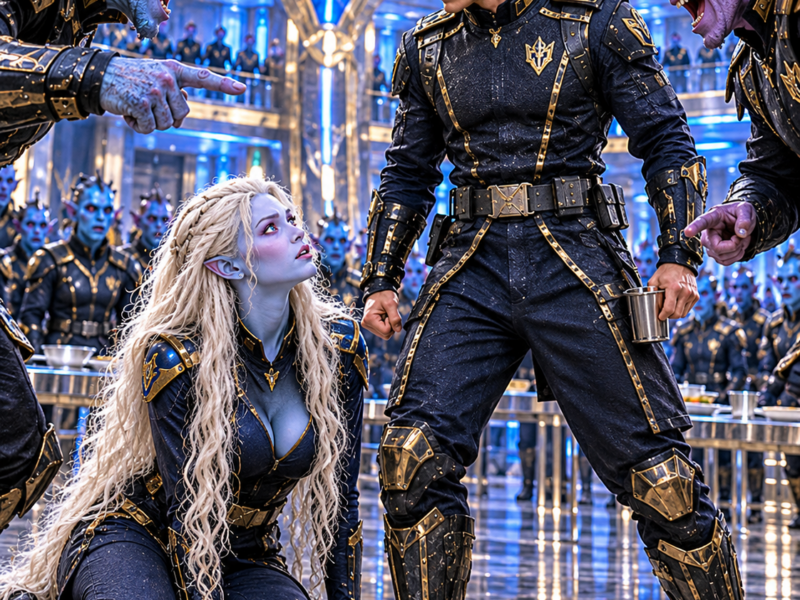
The entire mess hall went silent when the plate shattered at Narina’s feet
A continuation of Gareth and Narina’s story
Gareth took the beer from Walt, turned it slowly in his hand, and frowned.
“What happened to this?”
Walt looked offended. “I held it exactly where you told me to.”
“You drank half of it.”
“I was keeping it cold.”
“You kept it cold inside your stomach?”
Walt shrugged. “It’s an advanced human technique. You wouldn’t understand.”
Narina laughed.
It was a small laugh at first, almost as if she wasn’t sure she was allowed to make that sound. Then she laughed again, louder this time.
Gareth looked at her and smiled.
“Welcome aboard the Long Haul,” he said. “First rule of working with humans: never trust Walt with your beer.”
“Second rule,” Walt added, “never let Gareth near the engine controls before he’s had coffee.”
“That’s not a rule. That’s basic survival.”
For the first time in a very long time, Narina felt that she was standing somewhere she might belong.
But the journey ahead would not be as simple as walking through the docking gates.
And Gareth was about to discover that freeing someone from a debt collar was only the beginning.
Chapter One: A Place Without a Collar
Harbor 9 had a thousand stories, but most of them were never told.
It was a trading station built around an old mining platform, located far from the major shipping lanes. Ships came and went every day, carrying minerals, machinery, food, and passengers from dozens of worlds.
Some people came to make fortunes.
Others came because they had nowhere else to go.
Narina belonged to the second group.
She had arrived on Harbor 9 three standard years earlier aboard a transport vessel from Lani Prime. Her family had sent her away after a mining accident destroyed their home settlement. They had hoped she would find work and send money back.
Instead, she had been placed under a labor contract that grew more expensive every month.
The station charged her for accommodation, meals, uniforms, equipment, and even the electricity used in the maintenance corridors she cleaned.
Every time she earned enough to reduce her debt, another fee appeared.
The glowing collar around her neck had become part of her life.
She had stopped imagining what it would feel like without it.
Until Gareth.
Now she stood outside Docking Bay Twelve, holding a small cloth bag containing everything she owned.
A worn jacket.
Two personal photographs.
A handful of tools.
And a little silver pendant shaped like a crescent moon.
Gareth approached carrying a toolbox.
“That’s everything?”
Narina nodded.
“You sure?”
She looked down at the bag.
“Yes.”
Gareth glanced toward the station’s administrative building.
“Then let’s get you registered.”
Narina hesitated.
“Registered?”
“Crew registration. You’re not a prisoner, and you’re not working off a debt anymore. If you’re coming aboard my ship, I want your name on the crew list.”
She looked at him carefully.
“Will I still have to work?”
“Of course.”
“Will I have to pay for my room?”
Gareth shook his head.
“No.”
“Food?”
“No.”
“Tools?”
“Provided by the ship.”
She frowned.
“Then what do you want from me?”
Gareth considered the question.
“An honest day’s work. And if you see something broken, tell me before it explodes.”
Walt appeared behind him.
“Especially if it’s the coffee machine. That thing has been threatening my life for six months.”
Narina smiled.
Gareth opened the docking hatch.
“Come on, engineer. Let’s get you home.”
She stepped across the threshold.
For the first time since arriving at Harbor 9, nobody was telling her where she belonged.
She was choosing it herself.
Chapter Two: The Long Haul
The Long Haul was not an impressive ship.
It had once been a commercial transport vessel, built for carrying industrial equipment between remote colonies. Its hull was old, its paint was faded, and one of its engines made a noise that Gareth insisted was normal.
Walt called it a mechanical death rattle.
Gareth called it personality.
The ship had three decks.
The lower deck held the cargo compartments and engineering bay. The middle deck contained the crew quarters, mess hall, and control room. The upper deck housed the bridge and communications equipment.
There were only six bunks, although the ship officially carried a crew of four.
Gareth showed Narina the smallest cabin.
“This one’s yours.”
She stepped inside.
It was barely large enough for a bed, a storage cabinet, and a narrow desk. The walls were scratched, and the overhead light flickered.
But there was a door.
A real door with a lock she could control from the inside.
Narina touched the control panel.
“Can I lock it?”
“Of course.”
“Even when I’m sleeping?”
Gareth looked puzzled.
“That’s generally when people lock their doors.”
She nodded slowly.
He didn’t understand why the question mattered.
Perhaps one day he would.
For now, he left her alone to unpack.
An hour later, Narina found him in the engineering bay.
He was lying on his back beneath a coolant manifold, trying to reach a pipe with a wrench.
“Gareth?”
“Unless you’re here to tell me the engine is fixed, give me a minute.”
“I looked at the pressure readings.”
“Good.”
“They’re wrong.”
Gareth stopped moving.
“What?”
“The secondary coolant pump is compensating for a blockage in the return line. The system is increasing pressure because the temperature sensor is reading too low.”
He slid out from beneath the manifold.
“That’s not possible. I replaced that sensor last month.”
Narina pointed toward the diagnostic panel.
“You replaced the main sensor. This one is connected to the auxiliary line.”
Gareth stared at the readings.
Then he looked at her.
“How did you notice that?”
“The sound.”
“The sound?”
“The pump changes pitch when the pressure rises. It has been doing it since we left the station.”
Gareth sat up.
“You heard that from the mess hall?”
Narina nodded.
Walt, who had been passing through with a mug of coffee, stopped.
“Hold on. Are you telling me she diagnosed the engine by listening to it?”
“Yes,” Gareth said.
Walt looked at the engine.
Then at Narina.
Then at Gareth.
“I’ve been telling you that noise was dangerous for six months.”
Gareth stood up.
“You told me it sounded like a dying animal.”
“Exactly.”
Narina crouched beside the panel and began adjusting the diagnostic settings.
“May I?”
Gareth stepped aside.
“It’s your engine.”
She looked up.
“Our engine?”
Gareth smiled.
“That’s what I said.”
She returned to the controls.
Twenty minutes later, the coolant pressure stabilized.
The engine settled into a smooth, even hum.
Walt took a sip of coffee.
“Well, I’ll be damned.”
Gareth folded his arms.
“Not bad for someone who was supposed to be eating off the floor today.”
Narina looked at him.
“Was I really supposed to?”
“No.”
“Why?”
Gareth considered the question.
“Because being hungry doesn’t make anyone less deserving of respect.”
She looked down at her hands.
Then she returned to the engine.
But she remembered those words.
Chapter Three: The Message from Harbor 9
Three days after leaving Harbor 9, the Long Haul received a priority transmission.
Gareth was in the control room when the message appeared.
The sender identification belonged to Harbor 9 Station Administration.
He opened it.
A familiar face appeared on the screen.
It was Craig.
The huge Bruvach trader looked uncomfortable. His gray skin had lost its usual confident expression, and one of his thick arms was wrapped in a medical support brace.
“Gareth of Earth,” he said.
Gareth leaned back in his chair.
“Craig.”
“I am contacting you regarding the incident in the station mess hall.”
“Which part?”
Craig’s mouth tightened.
“All of it.”
Walt appeared in the doorway.
“Oh, this should be good.”
Craig ignored him.
“The station council has opened an investigation into my treatment of contracted workers. Several witnesses have submitted statements. The administration has also reviewed the financial records connected to Narina’s labor contract.”
Gareth nodded.
“Good.”
Craig looked down briefly.
“They discovered that several charges were improperly added to her account.”
“Several?”
“Many.”
“How many?”
Craig hesitated.
“Enough that the station has ordered a review of all contracts managed by my trading company.”
Gareth’s expression hardened.
“That’s not just Narina’s contract, is it?”
“No.”
“How many workers?”
“Twenty-seven.”
The room went quiet.
Walt lowered his coffee.
“Twenty-seven people?”
Craig nodded.
“Their contracts are being examined. The station has temporarily suspended the debt collection authority of my company.”
Gareth rubbed his forehead.
“Why are you telling me?”
Craig looked directly into the camera.
“Because I was wrong. Not only about Narina. About the way I treated everyone who worked under me.”
He paused.
“I believed that strength gave me the right to command. I believed that fear was the same thing as respect.”
Gareth said nothing.
Craig continued.
“When the cargo door failed, I could have walked away. I could have let the human die and saved myself. But you kept telling me to hold on.”
“You did hold on.”
“I did because you told me I could.”
Gareth leaned forward.
“You held on because you chose to. Don’t give me credit for your decision.”
Craig stared at him for a long moment.
Then he nodded.
“I understand.”
The transmission ended.
Walt looked at Gareth.
“Do you believe him?”
“I believe he’s embarrassed.”
“That’s not the same thing.”
“No,” Gareth agreed. “It isn’t.”
Narina had been standing quietly at the entrance.
She stepped forward.
“Will the other workers be free?”
Gareth looked at her.
“That’s what we’re going to find out.”
Chapter Four: Twenty-Seven Names
The following morning, Narina asked to use the ship’s communications terminal.
She had been thinking about the twenty-seven workers.
She knew some of them.
There was a young Torvian named Pell who worked in the loading bay. He had a damaged leg and often struggled to carry heavy containers.
There was an older Lani woman named Sera who cleaned the passenger quarters.
And there was a small family from the Veyran colonies who had arrived only six months earlier.
They had all worn debt collars.
They had all been afraid of Craig.
Narina wanted to know what would happen to them.
Gareth gave her access to the terminal.
She composed a message.
It was simple.
My name is Narina. I worked on Harbor 9 for three years under a debt contract. I am now free. I want you to know that the contract can end. You do not have to believe anyone who tells you that you are worthless because you owe money.
She paused.
Then she added another sentence.
If you need help, I will listen.
She sent the message to the station’s public worker network.
Within an hour, the replies began arriving.
Some were short.
Some were frightened.
Some contained only questions.
Is it true?
Can they really remove the collars?
What if my contract owner refuses?
One message stood out.
It came from Sera.
Narina, I thought you were gone forever. I heard about what happened in the mess hall. Are you safe?
Narina read the message twice.
Then she typed.
Yes. I am safe. I have a room. I have work. And nobody can lock the door from the outside.
She sent it.
A few seconds later, another message arrived.
I am happy for you. I hope one day I can say the same.
Narina stared at the screen.
She wanted to help.
But she didn’t know how.
Gareth entered the communications room carrying two mugs.
He saw her expression.
“What happened?”
She showed him the message.
Gareth read it carefully.
Then he placed one mug beside her.
“Looks like your work isn’t finished.”
Narina looked up.
“What can I do?”
Gareth pulled up the station’s public records.
“First, we find out whether those contracts are legal. Then we find someone who can challenge them.”
“Who?”
“Someone with more patience than me.”
Walt appeared behind them.
“That’s a very low bar.”
Gareth pointed at him.
“Exactly.”
Chapter Five: The Law of Harbor 9
Harbor 9 had a law code, although many workers rarely saw it.
The station was governed by a council representing its major commercial groups. Its rules were designed to keep trade flowing and prevent disputes from turning violent.
Debt contracts were legal.
Debt collars were legal.
But there were limits.
A worker could not be held indefinitely for a debt that had been artificially increased. Employers were required to provide accurate financial records, safe working conditions, and access to independent arbitration.
Craig’s company had violated nearly every one of those rules.
Gareth hired an independent legal advocate named Vessa, a tall, blue-skinned Kethari who specialized in labor disputes.
She reviewed the documents aboard the Long Haul.
After three hours, she removed her reading lenses.
“This is worse than I expected.”
Narina sat across from her.
“How many?”
“Twenty-seven confirmed contracts. Possibly more.”
“Can they be released?”
Vessa nodded.
“If the council accepts the evidence, the collars can be deactivated and the debts voided.”
“Then why haven’t they done it?”
“Because the company controls the records. And because the workers are afraid to testify.”
Narina understood.
She had been afraid too.
Vessa looked at her.
“You will need to speak publicly.”
Narina’s hands tightened around her mug.
“About what happened?”
“Yes. About the contract. The charges. The treatment. Everything.”
Narina looked toward Gareth.
He didn’t tell her what to do.
He simply waited.
Finally, she nodded.
“I will speak.”
Vessa began preparing the case.
For the next two days, Narina helped identify workers and compare their payment records. She remembered names, dates, work schedules, and even small details about the station’s maintenance system.
Her knowledge was invaluable.
The station had recorded many charges as equipment damage, even when the workers had never used the equipment.
Some had been charged for meals they had not eaten.
Others had been charged for medical treatment that had never been provided.
Narina recognized the pattern.
It wasn’t a mistake.
It was a system.
And it had trapped people for years.
Chapter Six: The Hearing
The hearing took place in Harbor 9’s central assembly chamber.
It was a large circular room with a raised platform at the center. Representatives from the station’s major trading companies sat around the outer ring.
Narina stood before them.
She wore a simple dark jacket Gareth had helped her choose. Her silver hair was neatly tied behind her head.
There was no collar around her neck.
Still, she felt as if she could feel its weight.
Vessa stood beside her.
Across the chamber sat Craig.
His medical brace had been removed, but his expression remained serious.
The council chair activated the recording system.
“Narina of Lani Prime, you may begin.”
Narina looked around the room.
Some faces were curious.
Some were bored.
A few looked openly hostile.
She took a breath.
“My name is Narina. For three years, I worked on Harbor 9 under a debt contract.”
Her voice trembled slightly.
She continued anyway.
“I cleaned the engine decks, repaired ventilation systems, and maintained the service corridors. I worked long hours because I believed I owed money to the station.”
She looked toward Craig.
“I was told that my debt would decrease every month. But every month, new charges appeared. I was told I had damaged equipment. I was charged for food I did not eat. I was charged for rooms I was not allowed to use.”
One of the company representatives interrupted.
“Do you have evidence of these allegations?”
Vessa raised a data tablet.
“We have the original payment records, maintenance logs, and station invoices.”
The representative looked uncomfortable.
Narina continued.
“I was not the only one.”
She named the twenty-seven workers.
One by one.
She described their jobs, their living conditions, and the charges attached to their accounts.
Then she spoke about the mess hall.
“Craig pushed my tray onto the floor. He told me to eat from the deck. I tried to explain that I had not dropped it.”
Her voice became quieter.
“Everyone watched. Nobody helped.”
She paused.
“Then a human stood up.”
The room turned toward Gareth, who was sitting near the back with Walt.
Narina looked at him.
“He did not ask whether I had money. He did not ask whether I was important. He simply helped me stand.”
She looked back at the council.
“I am not asking you to punish someone because he was cruel to me. I am asking you to stop a system that allows cruelty to become profitable.”
The chamber fell silent.
For a moment, nobody moved.
Then the council chair turned toward Craig.
“Do you wish to respond?”
Craig stood.
His massive frame seemed even larger beneath the chamber lights.
“I do.”
He looked at Narina.
“I treated you as if your debt made you less than me. I was wrong.”
He turned toward the council.
“I will not dispute the financial records. My company created charges that were not justified. I authorized the system, and I benefited from it.”
A murmur spread through the chamber.
Craig continued.
“I will cooperate with the investigation. I will provide the names of every manager involved. I will also transfer the remaining assets of my trading company into a fund for the affected workers.”
One council member leaned forward.
“You understand that this may destroy your business?”
Craig nodded.
“Yes.”
“Why would you agree to that?”
Craig looked toward Gareth.
“Because I learned something in the mess hall.”
He paused.
“Being strong does not mean you get to decide who deserves dignity.”
The hearing continued for another four hours.
By the end, the council had reached its decision.
All twenty-seven contracts were suspended immediately.
The workers’ collars were ordered deactivated.
The financial records would be independently audited, and any illegal charges would be refunded.
Craig’s company would remain under investigation.
For the first time, the people who had been trapped by those contracts had a way out.
Chapter Seven: The First Free Day
The Long Haul returned to Harbor 9 two weeks later.
Narina stood beside Gareth at the docking window.
She watched the station grow larger.
“Are you nervous?” he asked.
“A little.”
“Good. Means you’re paying attention.”
She glanced at him.
“You’re not nervous?”
“I’m always nervous.”
“You don’t look nervous.”
“That’s because I’m very good at looking like I know what I’m doing.”
Walt walked past carrying a box.
“He isn’t.”
Gareth ignored him.
When the ship docked, Narina stepped onto the station.
She went directly to the workers’ residential wing.
Sera was waiting outside the common room.
The older Lani woman had silver hair like Narina’s, though hers was streaked with white.
For a moment, neither spoke.
Then Sera reached out.
Narina took her hand.
“I heard,” Sera whispered.
Narina nodded.
“It’s over.”
Sera touched the side of her neck where her own collar had once rested.
“Mine too.”
They embraced.
Around them, other workers began emerging from their rooms.
Pell was there, leaning on a walking support.
The Veyran family stood together near the doorway.
A young maintenance worker approached Narina with tears in his eyes.
“Is it really true?”
“Yes,” she said.
“We can leave?”
“Yes.”
“Where will we go?”
Narina looked toward Gareth.
He was speaking with the station administrator.
Then she looked back at the worker.
“Wherever you choose.”
Some people cried.
Others laughed.
A few simply stood still, unable to believe that their lives had changed.
Narina spent the next several hours helping them complete their release documents.
She showed them how to check their financial records and how to request copies of their employment histories.
She also helped Sera pack.
The older woman had been planning to return to Lani Prime for years.
Now she could.
“Will you come with me?” Sera asked.
Narina shook her head gently.
“I have a job.”
“A job?”
“On a ship.”
Sera smiled.
“You always wanted to work with engines.”
Narina nodded.
“I didn’t think anyone would let me.”
Sera touched her cheek.
“Then don’t forget the people who gave you the chance.”
Narina looked toward Gareth.
“I won’t.”
Chapter Eight: The Trouble with Freedom
The next few months were busy.
The Long Haul traveled between small colonies, carrying replacement parts, medical equipment, and industrial supplies.
Narina became an essential member of the crew.
She learned the ship’s systems quickly and began improving them.
She replaced several outdated diagnostic panels, repaired the auxiliary power network, and redesigned the coolant distribution system.
The ship ran better than it had in years.
Gareth complained that she was making him look bad.
Narina reminded him that he had hired her.
Walt complained that the improved engine made the ship quieter, which meant he could no longer tell when something was about to break.
Gareth told him that was the point.
But Narina’s new life was not without challenges.
Sometimes she woke in the middle of the night, convinced that someone was standing outside her cabin.
Sometimes she hid food in her storage cabinet, even though the ship’s pantry was always full.
And sometimes, when Gareth asked her to take a break, she kept working because she was afraid that stopping would make her seem useless.
One evening, Gareth found her in the engineering bay long after her shift had ended.
She was replacing a filter that didn’t need replacing.
“Everything all right?”
Narina looked up.
“Yes.”
“Then why are you working?”
She hesitated.
“I want to be useful.”
“You are useful.”
“I know.”
“Then why are you still working?”
She looked at the filter.
“If I stop, I worry that you will think I am not worth keeping.”
Gareth was quiet.
Then he pulled a chair over and sat beside her.
“Narina, listen to me.”
She looked at him.
“You don’t have to earn your place on this ship every hour of every day.”
“But I have a contract.”
“No. You have a job. There’s a difference.”
He leaned back.
“A contract says someone owns a piece of your time. A job says you agree to work because you want to. If tomorrow you decide you want to leave, you can leave.”
She stared at him.
“You would let me?”
“Of course.”
“Even after everything?”
“Especially after everything.”
She lowered her eyes.
Gareth continued.
“I hired you because you’re a good engineer. I kept you because you’re a good person. But you don’t owe me your life.”
Narina swallowed.
“I don’t know how to live like that.”
“Then we’ll figure it out.”
He stood and offered her his hand.
“Come on. The engine will still be there tomorrow.”
She took his hand.
And for the first time, she left a repair unfinished without feeling guilty.
Chapter Nine: The Distress Signal
Six months after Narina joined the Long Haul, the ship received a distress signal from a small mining station near the outer edge of the Kethari trade region.
The transmission was weak.
The station identified itself as Vesta-4.
Its message repeated every forty seconds.
“Emergency. Reactor containment failure. Life support unstable. Requesting immediate assistance.”
Gareth examined the navigation display.
“How far?”
“Four hours at our current speed,” Narina answered.
“Any other ships nearby?”
“None responding.”
Walt appeared at the bridge entrance.
“Could be a trap.”
Gareth nodded.
“Could be.”
The signal repeated.
“Reactor containment failure. Life support unstable.”
Narina looked at the station’s technical data.
“The reactor is an older fusion model. If the containment field collapses, the station could lose power completely.”
“How many people?” Gareth asked.
“According to the registry, thirty-one.”
Walt sighed.
“I knew we were going to have a quiet week.”
Gareth looked at him.
“Get the rescue equipment ready.”
Walt nodded.
Narina returned to the engineering station.
“I want to examine the reactor diagrams before we arrive.”
“Do it.”
The Long Haul changed course.
When they reached Vesta-4, the station was dark except for a few emergency lights.
Its outer hull showed signs of impact damage.
Gareth attempted communication.
No response.
He tried again.
A weak voice finally came through.
“This is Vesta-4. Who is calling?”
“Long Haul. We received your distress signal. We’re here to help.”
There was a pause.
Then the voice answered.
“Please hurry.”
Gareth docked the ship manually.
Narina and Walt prepared emergency suits.
They crossed into the station carrying medical kits and portable power equipment.
Inside, the corridors were cold.
Several lights flickered overhead.
A small group of miners waited near the emergency shelter.
One of them approached Gareth.
“Are you the rescue team?”
“That’s us.”
“There’s a problem.”
“What kind?”
The miner looked toward the reactor chamber.
“The main containment field is failing. We tried to restart the auxiliary system, but the control panel is locked.”
Narina stepped forward.
“Who locked it?”
“The station supervisor. He said nobody was allowed near the reactor.”
“Where is he?”
The miner looked away.
“Dead.”
They followed him through the corridor.
When they reached the reactor chamber, Narina studied the control system.
She recognized the model.
It was older than the one aboard the Long Haul, but the design was similar.
“The auxiliary control is here,” she said.
Gareth looked at the panel.
“Can you open it?”
“Maybe.”
She connected her diagnostic tool.
The display filled with warnings.
Then she noticed something unusual.
The reactor wasn’t failing because of a containment defect.
Someone had manually disabled the auxiliary coolant system.
“Gareth.”
“What?”
“This wasn’t an accident.”
He looked at the screen.
“Are you sure?”
Narina pointed to the shutdown log.
“Someone entered the control sequence manually. They knew what they were doing.”
Walt looked toward the miners.
“Who had access?”
Nobody answered.
Gareth turned to the group.
“Is there something you’re not telling us?”
The miners exchanged nervous glances.
Finally, one of them spoke.
“The supervisor was selling reactor components. He had been removing safety equipment for months.”
Gareth stared at him.
“And nobody reported it?”
“We tried. He controlled the communications system.”
Narina looked back at the reactor.
The containment field was weakening.
“We can argue about that later,” she said. “Right now, we need to restart the coolant system.”
She began working.
The panel rejected her first command.
Then the second.
A warning flashed across the screen.
MANUAL OVERRIDE REQUIRED.
Gareth looked at her.
“What does that mean?”
“The coolant control is physically locked inside the reactor access chamber.”
“Can you reach it?”
She studied the diagram.
“Yes.”
Gareth shook his head.
“No.”
She looked at him.
“I can fit through the access tunnel.”
“That’s not what I asked.”
“Gareth, there are thirty-one people on this station.”
“And you’re one of them.”
Narina took a breath.
“I know the risk.”
He looked at the reactor readings.
The containment field was dropping rapidly.
He knew she was right.
There was no other way.
He handed her an emergency light.
“Stay on the comm channel. If anything changes, you come back immediately.”
She nodded.
Then she entered the narrow access tunnel.
Chapter Ten: The Small Engineer
The tunnel was barely wide enough for Narina’s shoulders.
She moved carefully, keeping one hand against the wall and the other on the emergency light.
The temperature increased as she approached the coolant chamber.
Her communicator crackled.
“Status?” Gareth asked.
“I’m halfway through.”
“Any problems?”
“It’s hot.”
“That’s not encouraging.”
She almost smiled.
“I’m fine.”
She reached the control assembly.
The manual lever was stuck.
A warning label indicated that the mechanism had not been serviced in several years.
Narina examined the locking pins.
One had broken.
Another was bent.
She pulled a small tool from her belt and began working.
The reactor alarm grew louder.
“Gareth?”
“I’m here.”
“The locking mechanism is damaged. I can move the lever, but I need someone to hold the auxiliary line open from the control panel.”
Gareth moved to the main console.
“Tell me what to do.”
She gave him the sequence.
He entered it.
The display changed.
AUXILIARY LINE READY.
“Now,” Narina said.
Gareth activated the control.
The mechanism resisted.
“Again!”
He repeated the command.
Nothing.
Narina braced her feet against the wall and pulled the lever with both hands.
It moved a fraction.
Then stopped.
She gritted her teeth.
“Come on.”
The reactor alarm changed pitch.
Walt looked at the readings.
“Gareth, we have less than two minutes.”
Gareth leaned toward the communicator.
“Narina, get out. We’ll find another way.”
“No.”
“That’s an order.”
“You’re not my owner.”
The words came out before she could stop them.
Silence filled the communication channel.
Then Gareth answered.
“No. I’m not.”
He took a breath.
“And I’m asking you as your friend. Please come back.”
Narina looked at the lever.
She thought about the collar.
The mess hall.
The people who had looked away.
Then she thought about the thirty-one miners waiting in the shelter.
“I can do this.”
She planted both feet against the wall.
Pulled.
The lever moved another inch.
Then the broken locking pin snapped.
The mechanism released.
Narina was thrown backward against the tunnel wall.
But the auxiliary coolant line opened.
On the main console, the reactor readings began to stabilize.
Gareth watched the numbers.
“Containment field rising.”
Walt looked over his shoulder.
“It’s working.”
Gareth closed his eyes briefly.
Then he spoke into the communicator.
“Narina, talk to me.”
A faint voice answered.
“I think I broke something.”
“Yourself or the reactor?”
“The reactor is fine.”
Gareth laughed with relief.
“Then we’ll consider that a successful repair.”
He helped her out of the tunnel.
She was covered in dust, with a small cut across her forehead.
But she was smiling.
The miners began cheering when they heard the reactor was stable.
One of them approached her.
“You saved us.”
Narina looked uncomfortable.
“I just fixed the coolant system.”
The miner shook his head.
“You came into a dangerous place when nobody else could.”
She looked toward Gareth.
He gave her a small nod.
Narina turned back to the miner.
“Then next time, don’t let someone remove your safety equipment.”
The miner lowered his head.
“We won’t.”
Chapter Eleven: A Different Kind of Strength
The rescue operation lasted another six hours.
Gareth and Walt helped evacuate the injured miners, while Narina worked with the station’s remaining engineers to restore life support.
By the time they returned to the Long Haul, everyone aboard Vesta-4 was safe.
The station’s authorities promised to investigate the stolen reactor components.
Gareth filed a full report.
Narina slept for fourteen hours.
When she woke, she found a small package outside her cabin.
Inside was a metal badge.
It had been made from a piece of the station’s old reactor casing.
The front was engraved with a simple symbol: a silver crescent surrounded by eight small stars.
There was a note.
To Narina, who entered the dark when others were afraid. Thank you for bringing us home.
She turned the badge over.
On the back, someone had engraved three words.
YOU BELONG HERE.
She sat on the edge of her bed and held it for a long time.
Then she walked to the bridge.
Gareth was checking the navigation system.
She placed the badge on the console.
“What’s this?”
“From Vesta-4.”
He examined it.
“That’s nice.”
“They said I saved them.”
“You did.”
“I don’t think I did anything special.”
Gareth looked at her.
“That’s usually what people say after doing something special.”
She smiled.
Then she asked a question she had been carrying for months.
“Gareth, why did you help me?”
He leaned back.
“Because you needed help.”
“That’s all?”
“That’s enough.”
She looked toward the stars outside the bridge window.
“On Lani Prime, we were taught that the strongest people were the ones who could take care of themselves.”
Gareth nodded.
“That’s useful sometimes.”
“But I think I was wrong.”
He waited.
Narina touched the badge.
“Maybe the strongest people are the ones who help someone else stand.”
Gareth smiled.
“That’s a pretty good way to look at it.”
Walt entered carrying two mugs.
“I have a better definition.”
Gareth groaned.
“Here we go.”
“Strength is being able to drink this coffee without crying.”
Narina took a sip.
Her face twisted.
“That’s terrible.”
Walt looked offended.
“It’s an acquired taste.”
Gareth shook his head.
“It’s an acquired medical condition.”
For the next several minutes, the three of them laughed.
And the Long Haul continued through the stars.
Chapter Twelve: The Return to Harbor 9
Nearly a year after Narina had first boarded the Long Haul, Gareth received an invitation from Harbor 9.
The station council was holding a public ceremony to recognize the workers whose contracts had been illegally manipulated.
They wanted Narina to attend.
She read the message several times.
Then she put it aside.
Gareth noticed.
“You don’t have to go.”
“I know.”
“Do you want to?”
She looked at the screen.
“I don’t know.”
Walt leaned against the doorway.
“You could always go, tell them what you think, and leave before the speeches become unbearable.”
Gareth looked at him.
“That’s your advice?”
“It’s excellent advice.”
Narina smiled faintly.
“I think I want to go.”
The Long Haul returned to Harbor 9 three days later.
The station looked exactly the same.
The same docking lights.
The same metal corridors.
The same crowded public areas.
But something had changed.
Workers walked through the station without collars.
Some wore new uniforms.
Others carried toolkits and personal belongings.
The common dining hall had been renovated.
A large sign above the entrance read:
ALL WORKERS ARE ENTITLED TO DIGNITY AND SAFE CONDITIONS.
Narina stopped in front of it.
Gareth stood beside her.
“Not bad.”
She nodded.
“No.”
Inside, Sera was waiting.
She embraced Narina warmly.
“You came back.”
“I said I would.”
Sera smiled.
“You look different.”
“Do I?”
“Yes. You stand taller.”
Narina laughed.
“Maybe the ship’s gravity is stronger.”
“No,” Sera said. “I think it’s something else.”
The ceremony began shortly afterward.
Representatives from the station council spoke about the investigation and the changes being made.
They announced a new independent worker protection office.
They also announced that all debt contracts would be subject to external review.
Then the council chair invited Narina to the stage.
She walked forward.
The room was full.
Many of the people who had once avoided looking at her were now watching closely.
The chair handed her a small certificate.
“Narina of Lani Prime. In recognition of your courage and your contribution to the reform of labor protections on Harbor 9.”
The audience applauded.
Narina looked at the certificate.
Then she looked toward the workers sitting in the front rows.
“I accept this,” she said, “but I don’t want anyone to think that freedom came because one person was brave.”
She paused.
“It came because people finally started telling the truth. It came because workers spoke to one another. It came because people who had been silent decided they could no longer look away.”
She looked toward Gareth.
“And it came because one person decided that helping someone stand was more important than keeping his seat.”
The audience turned.
Gareth shifted uncomfortably.
Walt whispered, “That’s you.”
“I know.”
“Try not to look so proud.”
“I’m not.”
“You’re smiling.”
“Shut up.”
The applause grew louder.
Narina stepped away from the microphone.
But before she left the stage, she turned back.
“There is one more thing I want to say.”
The room quieted.
“When I first arrived on Harbor 9, I believed the collar around my neck told the truth about me. I believed that because I owed money, I was worth less than other people.”
She touched the place where the collar had once rested.
“It was never true.”
She looked around the room.
“Not for me. Not for Sera. Not for Pell. Not for anyone.”
Then she stepped down.
Chapter Thirteen: Craig’s Apology
After the ceremony, Narina found Craig waiting near the station’s observation windows.
He was no longer wearing the expensive armor he once favored.
His clothing was simple, and his company insignia was gone.
He looked older.
“Narina,” he said.
She stopped.
“Craig.”
“I was hoping you would speak with me.”
She glanced toward Gareth.
He nodded and moved a few steps away, giving them space.
Craig looked uncomfortable.
“I wanted to apologize again.”
“You already did.”
“I know. But I don’t believe one apology is enough.”
Narina considered him.
“What do you want from me?”
“Nothing.”
“Then why are you here?”
Craig looked through the window at the station’s docking bays.
“My company is gone. The investigation found more wrongdoing than I expected. Several managers have been removed, and the remaining assets are being used to compensate the workers.”
Narina said nothing.
“I have spent most of my life believing that power was something you held in your hands. Money. Ships. People who feared you.”
He looked down at his enormous hands.
“When I held that cargo anchor, I thought I was proving I was stronger than you and the human.”
He paused.
“But when the door failed, I discovered that strength was something else.”
Narina remembered the wind.
The screaming metal.
Gareth’s voice telling Craig to breathe.
“You helped hold the door,” she said.
Craig nodded.
“I did.”
“That mattered.”
He looked surprised.
Narina continued.
“But it doesn’t erase what happened before.”
“I know.”
“You hurt people.”
“Yes.”
“You made them afraid.”
“Yes.”
“And they will remember.”
Craig lowered his head.
“I know that too.”
Narina studied him.
“Then don’t ask them to forget. Make sure nobody else has to go through what we did.”
Craig nodded slowly.
“That is what I intend to do.”
For a moment, neither spoke.
Then Narina extended her hand.
Craig stared at it.
He seemed unsure what to do.
Finally, he reached out and shook it carefully.
It was a small gesture.
It did not make them friends.
It did not erase the past.
But it was a beginning.
Chapter Fourteen: The Last Rule
The Long Haul departed Harbor 9 the following morning.
Narina stood at the engineering station as the ship moved away from the docking bay.
She watched the station become smaller.
For a long time, she said nothing.
Gareth entered carrying a small package.
“Something for you.”
She turned.
“What is it?”
“Open it.”
Inside was a new tool kit.
It was compact, well-made, and designed specifically for Lani hands.
There was a small engraving on the handle.
CHIEF ENGINEER — LONG HAUL.
Narina looked up.
“Chief engineer?”
Gareth shrugged.
“You’ve been doing the job for months.”
“But you never said.”
“I thought the title might make you work harder.”
She laughed.
“That’s not how promotions work.”
“It’s how they work on my ship.”
Walt appeared behind him.
“Congratulations. I look forward to having someone else to blame when the engines stop working.”
Narina turned the tool kit over in her hands.
“Thank you.”
Gareth nodded.
Then he added, “There’s one more thing.”
She looked up.
“What’s the last rule of the Long Haul?”
Narina thought for a moment.
“Never trust Walt with your beer?”
“That’s the first rule.”
“Never repair the engine before coffee?”
“Second.”
She smiled.
“I don’t know.”
Gareth leaned against the doorway.
“The last rule is simple.”
He looked at her.
“On this ship, nobody has to earn the right to be treated like a person.”
Narina was quiet.
Then she nodded.
“I like that rule.”
“Good. Don’t let Walt change it.”
Walt raised both hands.
“I have never changed a rule in my life.”
Gareth and Narina looked at him.
He sighed.
“Fine. I changed the coffee rule once.”
The three of them laughed.
Outside, the stars stretched across the darkness.
The Long Haul continued toward its next destination, carrying spare parts, supplies, and a crew that had become something more than a collection of people sharing a ship.
And Narina, once a frightened worker with a glowing collar around her neck, stood at the engineering station with her own tools, her own cabin, and a future she had chosen.
She no longer had to look down when someone larger entered the room.
She no longer had to apologize for taking up space.
And she no longer believed that her worth could be measured by the debt someone else claimed she owed.
She had learned that freedom was not simply the absence of a collar.
It was the ability to make choices.
To work because she wanted to.
To rest without fear.
To help others without being forced.
And to know that if she ever needed a hand, someone might offer one without asking what it would cost.
Gareth had not defeated Craig by being bigger.
He had not freed Narina by buying her.
He had simply refused to accept that cruelty was normal.
And when the moment came, he had held on long enough for someone smaller to make a difference.
That was the strange thing about humans, the other species would eventually learn.
They were not always the strongest.
They were not always the fastest.
They were not even particularly good at knowing when to stop working.
But sometimes, when someone was being pushed down, a human would stand up.
Sometimes they would offer a hand.
Sometimes they would put their own body between a bully and a victim.
And sometimes, all it took to change an entire station was one tired mechanic, one stolen beer, and five simple words:
“Hold my beer. I’ve got this.”
THE END









