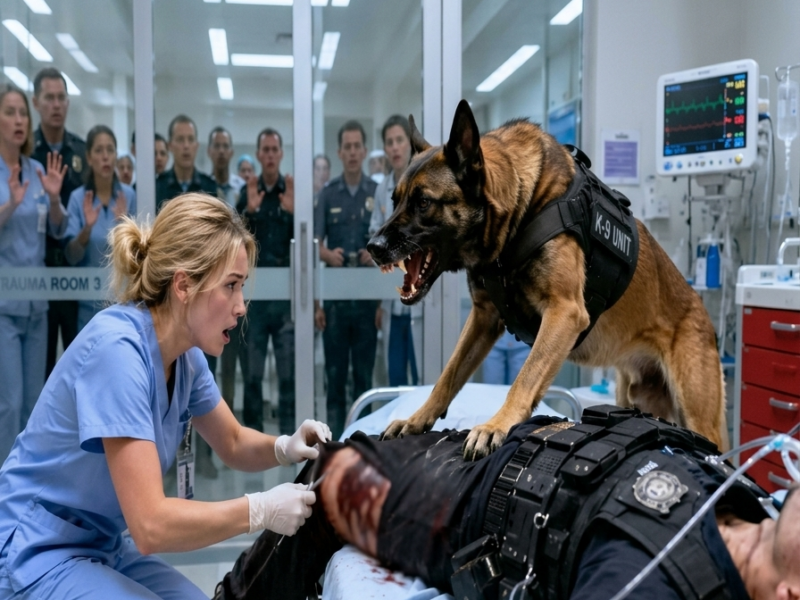
The entire hospital watched in horror as a massive service K9 lunged at me in the emergency room hallway, while the head surgeon coldly ordered everyone to stand back and let the new nurse handle the consequences
The polished linoleum floor of the emergency department at Riverside Medical Center in Denver reflected the harsh fluorescent lighting like ice. It was a Tuesday evening, the kind of quiet shift where the silence felt unnaturally heavy, as though the building itself was holding its breath before an inevitable storm.
For the past two weeks, I had moved through these halls like a ghost. To the rest of the staff, I was just Emily Carter: twenty-eight years old, excessively quiet, and inexplicably detached. I never joined the nurses in the break room when they complained about their twelve-hour shifts or gossiped about the attending physicians. I never bragged about my trauma certifications, nor did I explain why the sharp scent of antiseptic mixed with metallic blood sent my heart racing into overdrive. When someone mentioned military deployments or overseas casualties during small-talk conversations, I simply turned around and walked away. They assumed I was cold, incompetent, or simply too fragile for the intense environment of emergency medicine.
I preferred it that way. Invisibility was a armor I had meticulously crafted after returning home three years ago.
“Carter! Grab the gurney from bay four!” Dr. Hayes’s sharp voice echoed down the corridor, cutting through the low hum of heart monitors.
Dr. Richard Hayes was the chief surgical resident on duty—a man whose arrogance was matched only by his absolute intolerance for anything he perceived as weakness. He looked down on me from the day I arrived, treating my silence as a sign of incompetence. I nodded without a word, pulling the stainless-steel gurney into the central hallway just as the automatic doors of the ambulance bay slid open with a heavy hiss.
What stepped through those doors was not a standard patient admission.
Two armed security guards walked in first, followed closely by Sergeant Miller, a burly man in military fatigues whose face was slick with cold sweat. Between them was a military transport crate, and inside it was a massive German Shepherd.
The moment the crate was rolled past the sliding doors, the dog exploded into an uncontrollable fury. A sound erupted from his throat—a deep, guttural roar of absolute panic and rage that echoed off the hard tiles of the ER. The metal mesh of the carrier shook violently as the animal threw his full body weight against the frame.
“Hold him! Keep him steady!” Sergeant Miller barked, his voice laced with genuine fear. “The tranquilizer isn’t holding! He’s fighting it!”
“What is that thing doing in a civilian trauma unit?” Dr. Hayes demanded, taking a quick step backward and pulling a young medical intern behind his broad shoulders. “We handle human beings here, Sergeant, not wild animals!”
“He’s a decorated K9!” Miller shouted back over the deafening snarls. “He’s been refusing food for six days, showing severe signs of neurological distress and extreme aggression. We were transferring him to the veterinary facility at Fort Carson when he started suffocating! He needs an airway evaluation right now!”
Before Miller could finish his sentence, the latch on the transport crate gave way under the dog’s violent lunges.
The heavy metal door snapped open with a sharp crack.
Panic ripped through the emergency hallway. Nurse Martinez screamed, losing her footing and stumbling violently into a stainless-steel medication cart, sending vials of saline and syringe packages crashing to the floor. The two security officers instinctively reached for their sidearms, but the chaos was too dense, the risk of a ricochet off the tiled walls too high.
“Everybody back!” the security chief yelled, his voice cracking with fear.
The massive German Shepherd burst out of the cage, his silver-and-black fur standing on end, his jaw snapped shut with a force that sounded like a breaking branch. His leash trailed behind him, snapping against the floor like a whip. He was a war machine unlocked, capable of tearing a person’s throat out in seconds.
Dr. Hayes pressed his back firmly against the wall, his eyes darting around until they landed squarely on me. I was standing near the wall, completely still, unable to move—not out of terror, but because my mind had suddenly been violently yanked back across time and space to a dusty, sun-baked compound in the Middle East.
Hayes saw my paralysis and mistook it for cowardice. A cruel smirk flickered across his face before he masked it with authority. “You wanted to prove you’re useful, didn’t you, Carter?” he sneered loudly, ensuring everyone in the corridor heard him. “Go calm him down. Or do you only know how to stand around and waste space?”
“Dr. Hayes, no!” Nurse Martinez gasped from the floor. “Call animal control!”
“I’m a nurse, Dr. Hayes,” I said, my voice barely above a whisper, though my eyes remained locked on the animal. “I’m not a K9 handler.”
“Then I suggest you start acting like someone who belongs in emergency medicine,” Hayes snapped, backing further into the safety of an open doorway. “Handle the situation or hand in your badge by morning.”
The hallway fell into an oppressive silence, broken only by the heavy, ragged breathing of the dog and the scrape of his heavy claws against the polished floor.
Sergeant Miller tried to step forward to grab the trailing leash, but the dog spun around, baring his teeth with a vicious snarl that forced the sergeant to retreat. The animal was cornered, terrified, and dangerous.
Yet, as I stared at the creature, the terror in my own chest transformed into something entirely different. A cold shock ran down my spine.
I noticed what nobody else in that hallway saw.
The dog wasn’t attacking out of wild malice. His posture was defensive, desperate. His amber eyes weren’t locked on the throat of the nearest human; they were darting frantically toward the red neon light of the emergency exit. And every time the metal collar shifted against his neck, a sound escaped his chest—not a roar of aggression, but a broken, high-pitched, almost human whine of grief.
I knew that sound. I had heard it in my nightmares every night for three years.
My hands began to shake violently. My lungs burned as if I were inhaling smoke and desert dust.
Three years ago, I had served as a frontline combat medic attached to a special operations task force overseas. I wasn’t just Emily Carter the civilian nurse; I was Specialist Carter. And during those grueling months in the dust, I worked closely alongside a dual-purpose military working dog named Shadow and his handler—Corporal Daniel Reed.
Daniel had been everything I wasn’t: brave, steadfast, and fiercely loyal. Shadow was his shadow in every sense of the word, a tactical marvel who saved our squad from three separate ambushes. But on our final mission, an unexpected explosive device detonated inside an abandoned compound. I remembered the blinding flash, the deafening roar, and the crushing weight of debris. I remembered Daniel throwing his body over mine, shoving me behind a thick concrete barrier milliseconds before the world turned to fire.
When I woke up in a military hospital three days later, they told me the truth. Daniel didn’t make it. Neither did Shadow. They told me their bodies were buried under tons of rubble, destroyed beyond recovery. I was given a medal, an honorable discharge, and a lifetime of overwhelming guilt.
Now, standing in a brightly lit hospital in Denver, looking at the dog in front of me, the scars on his left shoulder caught the light—three distinct jagged lines from a shrapnel tear I had stitched myself with black nylon thread in a dirt bunker.
“Emily, don’t move!” Sergeant Miller yelled. “He’ll tear you apart!”
I ignored him. I ignored Dr. Hayes. I ignored the gasps of the medical staff watching from behind glass doors.
Slowly, carefully, I lowered myself down onto one knee. I kept my hands visible, resting lightly on my thighs. I didn’t reach for him. I didn’t make sudden movements.
“Don’t you dare approach that animal!” Hayes barked from his doorway. “If you get bitten, the hospital takes no liability!”
The dog turned his massive head toward me, his teeth still bared, his body coiled like a steel spring ready to strike. A low rumble vibrated through his chest.
I looked straight into his amber eyes, swallowing the lump of tears in my throat, and whispered three simple words—the exact phrase Daniel used to command quiet focus in the dark.
“Easy, Shadow. Find me.”
The reaction was instantaneous, violent in its sudden silence.
The growl died in the dog’s throat as if cut by a knife. His ears, pinned back in aggression, suddenly twitched and stood straight up. His nostrils flared wildly as he caught my scent—the faint lingering trail of lavender soap mixed with the unique chemical signature of my skin that he used to track through the desert dust.
The dangerous, wild beast vanished in a single microsecond.
Shadow let out a sharp, ear-piercing bark—not of anger, but of pure, unadulterated disbelief. He pulled free from the handler’s trailing leash with such sudden force that Miller nearly fell.
“Watch out!” someone screamed.
Shadow charged straight at me. But he didn’t launch his teeth at my neck.
He reached me and slammed his enormous seventy-pound body straight into my chest, forcing me backward against the cold floor. But before anyone could move to pull him off, the dog buried his massive head directly into the crook of my neck. He collapsed across my knees, trembling so violently that his entire body shook from nose to tail. He let out a series of soft, broken whimpers—a sound of profound, overwhelming relief, like a lost soul who had finally found home after years in the dark.
I wrapped both arms around his neck, burying my face into his thick silver fur. The scent of ozone and dirt hit me, and the dam inside me broke. Tears blurred my vision, spilling hot and fast down my cheeks into his coat.
“You remember me…” I whispered, my voice choking on a sob. “I thought you were gone… I thought you both were gone…”
Shadow licked my face frantically, pressing his forehead against mine, refusing to move an inch away from me.
The emergency room hallway was dead quiet. Dr. Hayes stood froze in his doorway, his mouth slightly open, completely speechless. Nurse Martinez was staring at us with wide, disbelieving eyes. The security guards slowly lowered their hands from their holsters.
Sergeant Miller stepped forward slowly, his boots clicking heavily against the tile. His face was pale, his eyes wide as he looked at the dog currently curled like a lapdog in my lap.
“Ma’am…” Miller said, his voice trembling slightly. “That’s… that’s impossible.”
I looked up at him, wiping my eyes with the back of my sleeve, keeping one arm tightly secured around Shadow’s trembling frame. “What is impossible, Sergeant?”
Miller swallowed hard, his throat moving nervously. “That dog’s name isn’t Rex. That’s the alias we used on his medical transfer papers to prevent media leak. His real military tag is Shadow. But… Specialist Carter, Shadow’s military records state he died three years ago in Al-Anbar alongside Corporal Daniel Reed. He was classified as killed in action.”
My stomach tightened into a hard, cold knot. “Then why is he here? Why is he alive?”
Miller took a breath, glancing nervously toward the glass sliding doors of the emergency entrance before leaning down toward me. “Because yesterday morning, at 0400 hours, an unidentified man with extensive facial scarring checked himself into a classified military medical clinic outside Colorado Springs. He refused to give a name to the guard at the gate. He only said one sentence.”
My breath hitched. “What sentence?”
“He said: ‘Find the medic who saved my life in the valley.'” Miller stared down at me, his eyes dark with unspoken terror. “He gave us your full name, Specialist Emily Carter. And then he walked out into the mountains before the guard could lock the gate.”
I couldn’t breathe. The air in my lungs felt like frozen lead.
“Who was he?” I managed to ask, my heart hammering wildly against my ribs. “Was it Daniel?”
Before Sergeant Miller could answer, the silent air was pierced by the sharp, rhythmic vibration of my phone inside my pocket.
I reached down with a trembling hand and pulled out the screen. It was an unknown, encrypted number. A single text message illuminated the dark glass:
Emily, if Shadow has found you, then they know I’m alive. Don’t trust the general. Don’t trust anyone wearing my unit’s insignia. And whatever you do, don’t let them open the second file.
My fingers went completely numb. The phone almost slipped from my grasp.
Directly beneath the text was a photo attachment. I tapped the screen with a shaking thumb.
The image expanded. It was a recent photograph taken in a dimly lit room. Standing in the center was Corporal Daniel Reed—older, thinner, his left cheek bearing a thick, jagged burn scar, but indisputably alive.
But it wasn’t Daniel that made the blood run completely cold in my veins.
Standing directly behind Daniel, captured in the reflection of a dark window, was a man wearing a military dress uniform—a man whose face was etched into my memories, a man I had personally pronounced dead, whose body I had zipped into a black body bag three years ago in the desert sand.
The light on my phone screen faded to black, leaving my reflection staring back at me against the dark glass. The silence in the hallway felt entirely different now—it was no longer the awkward shock of hospital staff witnessing an animal calm down; it was the suffocating weight of a conspiracy pulling its threads around my neck.
“Specialist Carter?” Sergeant Miller’s voice snapped me out of my trance. He was looking at my pale face, his brows furrowed in concern. “What is it? What’s on the phone?”
“Nothing,” I lied instantly, sliding the phone deep into the pocket of my scrub pants. My heart was pounding so hard I could hear it ringing in my ears. “Just a automated system notification.”
Shadow shifted his head on my lap, letting out a low whine. He knew I was lying. Dogs trained for combat don’t just read human body language; they sense the spike in adrenaline, the sharp change in sweat chemistry. He pressed his snout harder against my wrist, as if trying to ground me.
Dr. Hayes stepped out from behind the doorframe, his initial embarrassment rapidly turning into cold authority to regain control over the room. He adjusted his white lab coat and cleared his throat loudly.
“Well,” Hayes said, his tone dripping with forced professionalism. “Now that the animal is clearly non-threatening, let’s clear this hallway immediately. Nurse Carter, get that beast out of my emergency department. We have actual patients coming in, and this isn’t a shelter.”
I didn’t answer Hayes. I didn’t even look at him. I stood up slowly, and Shadow rose with me, sticking so close to my left leg that his silver coat brushed against my scrubs. He didn’t growl at Hayes, but his eyes followed the doctor’s every movement with dark, calculating focus.
“Sergeant Miller,” I said quietly, turning toward the military officer. “Where are you taking him?”
“He was supposed to go to the Fort Carson veterinary quarantine,” Miller replied, his voice low so the surrounding nurses couldn’t hear. “But after what happened this morning… after the man appeared at the clinic… I don’t think Fort Carson is safe for him. Or for you.”
“What do you mean?”
Miller stepped closer, grabbing the lead that Shadow was no longer fighting. “The order to transport Shadow didn’t come through standard military logistics channels. It came directly from the office of General Vance at the Pentagon. The transfer was classified as ‘Level Four Asset Containment.’ Do you know what that means, Emily?”
My throat tightened. “Level Four means extermination. They were going to put him down.”
“Yes,” Miller whispered. “They said he was incurably rabid and violent. But look at him. He’s not rabid. He was looking for someone.”
Don’t trust the general. Daniel’s text message flashed in my mind like a neon warning sign. General Richard Vance was the commanding officer who had overseen our entire deployment in Al-Anbar. He was the one who personally signed the casualty reports, who presented the folded American flag to Daniel’s family, and who had written the official debriefing file that declared our entire unit wiped out by an unexpected insurgent artillery strike.
“Miller,” I said, my voice dropping to a harsh whisper. “Who was the man behind Daniel in that clinic? Did the guards get a face scan?”
Miller hesitated, his eyes darting toward Dr. Hayes, who was currently barking orders at two nurses near the reception desk. “There were no face scans. The clinic’s security cameras went completely dark five minutes before the man walked up to the gate. The power was cut from an outside relay. Whoever brought Daniel there knows military protocols better than we do.”
“I need to leave,” I said suddenly.
“You can’t just leave your shift, Carter!” Dr. Hayes’s voice cut through the air. He had walked back over, holding a clipboard like a weapon. “You have three patients in the observation unit and two admissions coming from trauma bay one. If you walk out that door, I will personally see to it that your nursing license is revoked for abandonment of care!”
I turned around and looked Dr. Hayes dead in the eye. For two weeks, I had allowed him to talk down to me, to call me useless, to treat me like a timid ghost. But the woman standing in front of him now wasn’t the quiet civilian nurse he thought he knew. The medic who had stitched arterial bleeds under heavy mortar fire in a sandstorm had returned.
“Revoke it,” I said flatly.
Hayes blinked, taken aback by the sudden, freezing intensity in my voice. “What?”
“Revoke my license, Dr. Hayes. File the paperwork. Do whatever makes you feel powerful,” I said, my voice dangerously calm. “Because right now, if you step between me and that door, you’re going to find out why I survived the desert and your career didn’t leave this hallway.”
Hayes opened his mouth to shout, but the sheer coldness in my eyes stopped him cold. He took an involuntary step backward.
I turned back to Miller. “Where is the second file?”
Miller’s face went completely ghost white. “How… how do you know about the second file?”
“Daniel mentioned it,” I said, leaning in. “He said whatever I do, don’t let them open the second file. What is it, Miller?”
Miller took a deep breath, looking around the crowded hallway before pulling a small, heavy silver flash drive from his inner jacket pocket. It was a military-grade, encrypted hardware drive, wrapped in a red biometric seal.
“This came with Shadow’s transfer papers,” Miller whispered, his voice barely audible above the hum of the ER. “It’s the classified after-action report from the Al-Anbar explosion. It was supposed to be delivered directly to General Vance’s aide at Fort Carson tonight. The digital seal requires two biometric keys to open: one from the commanding officer, and one from the surviving medic on scene.”
He looked at me with a terrifyingly clear realization. “They didn’t just bring Shadow here to put him down, Emily. They brought him here to find you. They needed your fingerprint to unlock this drive.”
Before I could answer, the emergency room’s double doors swung open with a loud bang.
Four men stepped into the hallway. They weren’t wearing standard medical uniforms or local police gear. They wore dark tactical suits with no name tags, no unit patches, and sidearms strapped discreetly under their jackets. The man leading them was tall, with silver hair cut in a precise military buzz, his cold gray eyes scanning the hallway until they locked directly onto me and the dog.
It was Colonel Marcus Brody—General Vance’s right-hand man.
“Specialist Carter,” Brody’s voice boomed across the ER, smooth, authoritative, and utterly devoid of warmth. “Stand away from the canine and hand over the military property in your possession immediately.”
Shadow immediately moved in front of me, his spine stiffening, a dark, dangerous growl rumbling deep in his chest.
“Colonel Brody,” Sergeant Miller stepped forward, trying to maintain protocol. “Sir, I am in the middle of executing the medical transfer order—”
“The transfer order has been updated, Sergeant,” Brody interrupted coldly, pulling a rolled parchment document from his coat. “Under Special Directive 88, this facility is now under military quarantine. All personnel are to remain in place. Specialist Carter is to be taken into federal custody for questioning regarding a breach of national security.”
Nurse Martinez gasped. Dr. Hayes quickly retreated behind the central nurses’ station, his face pale.
“On what grounds?” I demanded, keeping my hand pressed firmly against Shadow’s neck, feeling the intense vibration of his anger.
“On the grounds that Corporal Daniel Reed is a fugitive wanted for high treason,” Brody said, his eyes narrowing as he took a step toward us. “And you, Specialist, are suspected of assisting him in hiding classified intelligence.”
“He’s not a fugitive!” I snapped, my voice echoing off the walls. “He saved my life! He died in that compound!”
“He didn’t die,” Brody said with a chilling smile. “And neither did the project he stole from us. Give me the drive, Emily. Or we will take it, and the dog will not leave this hallway alive.”
As Brody spoke, the two tactical guards behind him reached into their jackets, their hands settling on the grips of their weapons.
Shadow knew what that motion meant. He had been trained to recognize the draw of a firearm. The dog didn’t wait for my command. With a deafening roar, Shadow launched himself forward, his heavy body hurtling straight toward Colonel Brody.
“Shadow, no!” I screamed, but the chaotic cascade of events had already broken loose.
Shadow didn’t bite to kill; he executed a precise, tactical takedown. His heavy forepaws slammed directly into Colonel Brody’s chest, knocking the silver-haired officer backward onto the polished floor with a sickening thud. Brody’s head bounced off the linoleum, his tactical paper flying into the air.
“Shoot it!” one of the armed guards yelled, unholstering his 9mm pistol.
“Hold your fire! This is an active hospital room!” Sergeant Miller screamed, diving toward the guard and grabbing his wrist just as a shot echoed through the hallway.
BANG!
The gunshot shattered a glass display case near the reception desk, sending shards of glass raining down onto the floor like a sudden hail storm. Screams erupted instantly from the nurses and patients. Dr. Hayes threw himself flat onto the floor, covering his head with both arms, wailing in terror.
“Out the back! Move!” Miller roared at me, using his full body weight to pin the armed guard against the wall.
I didn’t hesitate. I grabbed the silver flash drive from Miller’s hand, shoved it into my pocket, and whistled a sharp, two-tone signal—the old rally call Daniel had taught me.
Shadow instantly released Brody, spun around on his back paws, and galloped right beside me as I sprinted down the narrow hallway toward the rear exit of the hospital.
Behind us, shouts and heavy footsteps echoed down the corridor. “Stop them! Don’t let her reach the vehicle!” Brody’s furious voice screamed.
We burst through the double doors leading to the service alleyway behind the hospital. The cold Denver night air hit my face like an icy towel, shocking my lungs. Snow had begun to fall, light white flakes swirling in the dark air, dusting the asphalt with a thin, slippery layer.
My old Honda Civic was parked near the loading dock, thirty yards away.
“Shadow, up!” I yelled, unlocking the doors with the remote fob in my hand.
The German Shepherd launched himself through the back door, landing heavily on the rear seat. I dove into the driver’s seat, slammed the door shut, and jammed the key into the ignition. The engine turned over with a rough splutter before roaring to life.
Just as I slammed the transmission into reverse, the service doors exploded open. Brody and two of his tactical men burst into the alley, weapons raised.
CRACK! CRACK!
Two bullets punched cleanly through the driver-side side mirror and shattered the rear windshield, raining tempered glass over Shadow, who ducked down low on the seat, barking fiercely.
I stomped my foot on the accelerator. The tires shrieked against the wet asphalt, spinning for a terrifying second before catching traction. The car launched backward, swerving violently out of the alleyway onto the main street just as a black SUV pulled up to block the exit. I swung the steering wheel hard to the left, mounting the curb, tearing through a row of plastic snow markers, and hitting the main avenue at fifty miles per hour.
In the rearview mirror, red and blue lights didn’t flash—these weren’t cops. Two unmarked black SUVs pulled out of the hospital driveway, their headlights cutting through the falling snow, pursuing us with terrifying speed.
My heart was hammering against my ribs like a trapped bird. My hands were slick with sweat on the steering wheel.
“Hold on, boy,” I gasped, looking back at Shadow.
The dog climbed up onto the middle console, resting his large snout on my shoulder, his heavy breathing warm against my cold neck. He wasn’t shaking anymore. The panic that had consumed him in the hospital crate was entirely gone. He was back in his element—back in a operational environment with a handler he trusted.
I needed to get off the main roads. Brody’s men had satellite tracking, cell tower monitoring, and likely access to Denver’s traffic camera system. If I stayed on the highway, they would box me in within ten minutes.
I yanked the wheel right, diving down a dark, unlit side street leading into the industrial warehouse district near the South Platte River. The old brick buildings rose up around us like dark monoliths, casting long, twisted shadows over the snow-covered streets.
I cut my headlights, navigating purely by the faint glow of the streetlamps and the moon reflecting off the snow.
I pulled the Civic into an abandoned auto-repair yard, driving deep between two rusty shipping containers, and cut the engine. The immediate silence was deafening, broken only by the rhythmic tick of the hot exhaust pipe cooling down in the freezing air.
Shadow sat bolt upright, his ears swiveling toward the street.
A few seconds later, the low, deep hum of two high-performance V8 engines drifted down the street. The bright beams of light from the two black SUVs cut through the darkness outside the alleyway, moving slowly, searching every doorway, every alley.
I held my breath, pressing my back flat against the vinyl seat, one hand resting on Shadow’s head. “Quiet, Shadow… easy…”
The dog remained dead silent, not making a single sound, his eyes fixed on the gap between the shipping containers.
The headlights swung past our hiding spot, sweeping over the rusted metal sides of the containers, missing the nose of my car by less than three feet. The sound of the engines slowly faded away into the distance as the SUVs moved deeper into the industrial park.
I let out a long, ragged exhale, my forehead resting against the steering wheel.
We were safe for now. But we were fugitives. In less than an hour, my name, my license plate, and my face would be broadcast across every law enforcement database in the state. Brody wouldn’t report this as a military dispute; he would report me as an armed and dangerous suspect who abducted a military war dog.
I reached into my pocket and pulled out my phone and the encrypted flash drive.
The phone screen was lit up with sixteen missed calls—twelve from the hospital, three from unknown numbers, and one new text message from the same encrypted sender.
I opened the message.
They lost you at the river. Good. Get to the old water treatment facility on 44th Avenue. Don’t use the roads. Walk through the train yards. Bring Shadow. It’s time you see what they did to us.
I stared at the screen, my fingers trembling. What they did to us.
I looked at the silver flash drive in my hand. Miller had said it required two biometric inputs: one from a commanding officer, and one from the surviving medic on scene. My thumb hovered over the biometric reader built into the side of the drive.
“If I open this,” I whispered to Shadow, “there’s no going back.”
Shadow rested his heavy paw on my knee, looking at me with those steady, amber eyes. He didn’t need to speak. He had made his choice three years ago in the desert, and he was making it again tonight.
I pressed my right thumb onto the small glass scanner on the drive.
A faint green laser light swept across my skin. A tiny LED light on the drive flickered from red to yellow, accompanied by a soft electronic chime.
BIOMETRIC KEY 1 ACCEPTED: SPECIALIST EMILY CARTER.
AWAITING BIOMETRIC KEY 2: COMMANDING OFFICER / SUBJECT ZERO.
My breath caught in my throat. Subject Zero? That wasn’t a standard military designation. That was a laboratory classification.
I jammed the drive into my pocket, grabbed my heavy winter coat from the backseat, and pulled my medical kit out from under the passenger seat. I slipped the strap over my shoulder and looked at Shadow.
“Alright, Shadow,” I whispered, opening the car door gently into the quiet snow. “Let’s go find Daniel.”
The walk through the abandoned train yards was a trek through a frozen graveyard of rusted iron and quiet snow. The cold air burned my lungs with every breath, but Shadow moved beside me with silent, effortless grace, his paws leaving delicate prints in the fresh powder before the falling snow covered them up.
For forty-five minutes, we navigated the labyrinth of abandoned boxcars and overgrown railway tracks until the massive, decaying silhouette of the old 44th Avenue Water Treatment Plant rose up out of the gloom like a sunken fortress.
The main facility had been decommissioned in the late nineties, its high chain-link fences rusted and covered in dead ivy. A single rusty door at the base of the main concrete building hung slightly open, creaking softly in the freezing wind.
Shadow stopped ten feet from the entrance, his body tense, his head low. He didn’t growl, but his tail gave a single, slow thump against his leg.
“Is he in there, boy?” I whispered.
Shadow stepped forward, pushing the heavy iron door open with his snout.
Inside, the air was warmer, smelling heavily of damp concrete, rust, and oil. The only illumination came from a single battery-powered lantern resting on top of a overturned oil drum in the center of a massive concrete chamber.
“Emily.”
The voice came from the shadows behind the old filtration tanks. It was low, raspy, worn down by pain and years of silence, but I recognized it instantly. It was the voice that had comforted me while I stitched wounds in dust-covered tents.
A figure stepped slowly into the soft yellow light of the lantern.
I gasped, my hand flying to my mouth.
It was Daniel. But he was barely recognizable.
The handsome, bright-eyed young corporal I had known was gone. His face was thin, gaunt, his left cheek covered in a deep, silvery lattice of burn scars that pulled at the edge of his mouth. He wore a dark, faded civilian jacket over old tactical pants, and his left arm moved with a stiff, unnatural rigidity, his hand covered by a heavy leather glove.
Shadow didn’t hesitate. He trotted across the concrete floor, pressing his head firmly against Daniel’s hip. Daniel lowered his gloved hand, his fingers burying deep into the dog’s fur, his eyes closing for a brief second as a shudder passed through his shoulders.
“You brought him,” Daniel said, his voice cracking slightly. “I wasn’t sure if Miller would get him to you in time.”
“Daniel…” I stepped forward, tears welling in my eyes, taking in the sight of him. “How… how are you alive? We buried you! The military sent casualty reports! They said the compound collapsed on you!”
“The compound did collapse,” Daniel said, looking down at his gloved hand. “But we didn’t die from the explosion, Emily. We were taken before the dust even settled.”
My blood ran cold. “Taken? By who?”
“By General Vance’s private security unit,” Daniel said, his eyes filled with a dark, hollow fury. “The explosion wasn’t an insurgent mortar strike. It was a controlled detonation set off by Colonel Brody. They needed a reason to declare our entire unit dead so we could be erased from military rosters.”
“Why?” I stammered, shaking my head in disbelief. “Why would Vance do that to his own soldiers?”
Daniel reached into his jacket, pulling out a thick, faded yellow folder stamped with a black military classification mark, and tossed it onto the oil drum beside the lantern.
“Because of Project Cerberus,” Daniel said flatly. “Vance wasn’t running a combat operation in Al-Anbar. He was running an unauthorized, black-budget medical field trial. They were testing experimental biological neural-enhancers designed to eliminate fear, heighten combat reflexes, and force rapid tissue recovery in frontline soldiers and working animals.”
I stared at him, horror mounting in my chest. “Biological enhancers? Daniel… what are you talking about?”
Daniel pulled off his leather glove.
I stepped back with a sharp gasp.
His left hand wasn’t human anymore. The skin was crisscrossed with dark, raised purple veins that hummed with a subtle, unnerving tremor. Beneath the skin, thin, metallic filaments were woven directly into his tendons and muscle tissue—a terrifying fusion of advanced bio-tech and rough surgical intervention.
“They injected our unit while we were in the medical tents after the third skirmish,” Daniel explained, his voice flat, devoid of emotion. “They told us it was an advanced antibiotic against regional infections. But it wasn’t. It was a synthetic neural-stabilizer. Shadow was given the canine variant.”
He looked down at the dog, who whined softly and licked Daniel’s scarred wrist.
“The experiment failed on most of the squad,” Daniel continued, his voice darkening. “Eight men died within forty-eight hours from severe organ failure. Their bodies couldn’t take the biological strain. That’s why Vance blew up the compound—to cover up the bodies of eight dead American soldiers killed by his own illegal science.”
“But you survived,” I whispered, my mind spinning into chaos.
“Me and Shadow,” Daniel nodded grimly. “We were the only two whose genetic markers didn’t trigger immediate fatal rejection. They kept us in an underground facility in Iraq for two years, running tests, measuring our recovery rates, trying to figure out why we didn’t die. They turned us into lab rats, Emily.”
“How did you escape?”
“Three months ago, during a transport transfer to a facility in Nevada, Shadow fought back,” Daniel said, a faint, sad smile touching his scarred lips. “He bit through his handler’s restraint, killed two guards, and opened my cell door from the outside. We’ve been running ever since.”
“And the photo?” I asked, pulling out my phone. “The photo you sent me… there was a man behind you in a dress uniform. I recognized him, Daniel. It was Lieutenant Miller—Sergeant Miller’s older brother, who was declared dead four years ago!”
Daniel’s expression turned dead serious. “That wasn’t Lieutenant Miller, Emily. That was Subject Zero. The first man Vance ever tested this on. And he isn’t a victim like me. He’s Vance’s enforcer.”
Before I could ask another question, Shadow suddenly let out a low, menacing growl, his teeth bared, his eyes locked on the shadowy catwalks hanging high above the concrete floor.
A heavy, slow applause echoed down from the darkness above us.
“Brilliant, Corporal,” a smooth, cultured voice rang out through the vast chamber. “Truly brilliant. I always knew you were the most intelligent asset from the Anbar batch.”
A tall man stepped out from the catwalk shadows into the faint light above.
It was General Richard Vance, dressed in a immaculate dark trench coat over his dress uniform. Standing directly beside him was the man from the photograph—Subject Zero—his eyes unblinking, his posture stiff and unnaturally motionless, like a statue carved from cold stone.
And behind them stepped Colonel Brody, holding an automatic assault rifle aimed straight at my chest.
“General Vance,” Daniel said quietly, stepping in front of me and Shadow, his scarred hand dropping toward his waist.
“Don’t move, Corporal,” Vance said calmly, descending the metal spiral staircase with slow, measured steps. The heels of his polished boots clicked against the iron treads like a ticking clock. “You’ve caused me a tremendous amount of administrative trouble over the past seventy-two hours. Running across state lines, breaking into military clinics… and pulling poor Specialist Carter back into a war she thought she had left behind.”
“You killed eight of our men, Vance!” I yelled, my voice ringing out with fierce anger that surpassed my fear. “You experimented on your own soldiers and buried them in the desert like trash!”
Vance stopped at the bottom of the stairs, ten feet away from us, his hands resting comfortably in his coat pockets. He looked at me with a cold, detached amusement, as if he were looking at an angry child.
“Progress requires sacrifice, Specialist Carter,” Vance said smoothly. “History doesn’t remember the names of the soldiers who died in medical tents; it remembers the men who won the wars. What we created in Corporal Reed and Subject Zero is the future of human warfare. A soldier who feels no pain, requires no sleep, and heals from fatal trauma in hours.”
He turned his cold eyes toward me. “But you… you were an unexpected variable. When Brody searched the Anbar site, he realized that you had managed to download the raw research logs onto an encrypted drive before the compound was destroyed. You thought it was a medical casualty log, didn’t you?”
“I didn’t know what it was,” I said, my hand tightening around the silver drive in my pocket. “I only knew people were dying and you were hiding the truth.”
“That drive contains the complete genetic sequence of the Cerberus compound,” Vance said, his voice dropping to a low, dangerous whisper. “It is worth hundreds of millions of dollars to our defense contractors. But it requires two biometric signatures to unlock: the medic who created the initial encryption, and the subject who survived the injection.”
He looked at Daniel, then at me.
“You both are standing in the same room. You’ve brought me everything I need to finalize the project.” Vance smiled cruelly. “Colonel Brody, take the drive. Eliminate the dog and the girl. Keep Reed alive; we need his blood for the next batch.”
“Yes, Sir,” Brody said, stepping forward, leveling his rifle at my forehead.
Beside Vance, Subject Zero moved with inhuman speed. In a fraction of a second, he vanished from the light, sprinting across the concrete floor with a speed that defied human biology.
“Shadow! INTERCEPT!” Daniel roared.
Shadow didn’t hesitate. The massive German Shepherd launched himself into the air, intercepting Subject Zero mid-stride. The two bodies crashed together with astounding force, sliding across the wet concrete floor in a fury of snarls and brutal physical strikes.
At the same instant, Daniel lunged forward, throwing his full body weight into Colonel Brody.
BANG! BANG!
Rifle shots shattered the silence, rounds ricocheting off the concrete walls, sparking violently in the dark. Daniel slammed Brody into the metal filtration tank, disarming the officer with a brutal strike from his bio-mechanically enhanced hand.
General Vance backed away toward the exit, pulling a small silver pistol from his belt. “Insolent fools!” he spat, aiming straight at Daniel’s back.
I acted on pure survival instinct.
I grabbed the heavy battery-powered lantern from the oil drum and swung it with all the strength left in my body, hurling it straight at Vance’s head.
The heavy glass lantern struck Vance squarely in the face. The bulb shattered, plunging the entire chamber into pitch-black darkness, save for the blue electric arcs snapping wildly from a severed power cable near the ceiling.
Screams, gunshots, and the terrifying snarls of two apex predators clashed in the dark.
“Emily! The drive! Connect it to the main server box on the wall!” Daniel’s voice echoed through the dark. “There’s a satellite transmitter! Broadcast the files to the Department of Justice!”
I hit the floor on my knees, crawling through the cold snow and rust toward the wall where a glowing green LED light marked the facility’s legacy communications terminal.
Behind me, I heard a heavy thud as Daniel threw Brody over his shoulder, slamming him into the concrete. But Subject Zero was moving again, his dark silhouette leaping across the darkness straight toward me.
Shadow hit him from the side again, his jaws locking firmly around Subject Zero’s forearm. The augmented soldier yelled out in pain—human pain—as Shadow’s sheer willpower overcame the bio-enhanced brute force.
I reached the terminal panel. With hands slick with dirt and blood, I jammed the silver flash drive into the open port.
The terminal screen flickered to life, bathing my face in bright green light.
BIOMETRIC KEY 1: ACCEPTED.
INPUT BIOMETRIC KEY 2 NOW.
“Daniel! I need your hand!” I screamed.
Daniel broke away from Brody, sprinting toward the terminal. He slammed his scarred left palm onto the scanner glass beside my thumb.
A bright, crimson laser light scanned both our hands simultaneously.
The screen flashed violently:
BIOMETRIC MATCH CONFIRMED.
SUBJECT ZERO / CORPORAL DANIEL REED IDENTIFIED.
DECRYPTING PROJECT CERBERUS FILE 2…
UPLOADING TO FEDERAL PROSECUTION NETWORK & GLOBAL MEDIA OUTLETS…
0%… 45%… 89%… UPLOAD COMPLETE.
A loud, piercing electronic alarm began to blare throughout the facility—an automated federal breach alert, broadcasting the encrypted files directly to every major intelligence agency and news network in North America.
General Vance staggered back against the open doorway, his face covered in blood from the shattered lantern, staring at the green screen in absolute, helpless horror. His career, his secret empire, his freedom—everything he had built on the bones of dead soldiers was evaporating in real-time across millions of digital screens.
“No…” Vance whimpered, dropping his pistol to the floor. “No… what have you done?”
In the distance, the faint, rising wail of dozens of federal law enforcement sirens echoed through the cold Denver night, rapidly approaching the water treatment plant. Sergeant Miller had come through—he had brought the FBI.
Subject Zero stopped fighting. The realization of the broadcast broke the neural conditioning in his brain; he collapsed onto his knees, his hands dropping to his sides as Shadow stood over him, breathing heavily but holding his ground.
Colonel Brody lay unconscious near the filtration tank.
Daniel sank down against the wall beside the terminal, resting his back against the cool metal. His face was pale, his heavy breathing ragged as the intense adrenaline rush finally began to fade from his system.
Shadow walked over slowly, his paws clicking softly against the concrete, and rested his large, silver head directly onto Daniel’s lap. Daniel stroked the dog’s head with his scarred, gloved hand, letting out a long, shuddering breath.
I sat down on the floor right beside them, pulling my knees up to my chest, letting the cool air fill my lungs. For the first time in three long, painful years, the crushing weight on my chest began to lift.
I looked at Daniel, then down at the faithful K9 who had brought us all back from the dead.
“Is it over?” I whispered, as the flashing red and blue lights of the arriving federal vehicles began to illuminate the frosted windows of the warehouse.
Daniel looked over at me, a genuine, soft smile breaking through the silver scars on his face.
“No,” Daniel said softly, wrapping his arm around Shadow’s neck. “It’s not over. But for the first time, Emily… we’re finally going home.”
The end.









